UPDATE: Artists: Be The Change, Submit Comments! Deadline EXTENDED to August 10th

As The Trichordist noted in the July 16th post, the White House Intellectual Property Enforcement Coordinator Victoria Espinel has issued a call to the public to file comments with her office about the US intellectual property laws.  If you care about artist rights, this is a good time to tell Victoria Espinel what you think.  You can comment on anything, but she is probably looking for specific comments about how good a job you think the US government is doing in enforcing our IP laws and protecting artist rights and any ideas you have about how the government could be doing more.

You should be aware that opponents of artist rights will seize upon this kind of public comment period to flood Ms. Espinel’s office with copyleft and radical anti-artist commentary.  You can bet that they will do it and they will do it from all over the world.  This is so that they can point to the quantity of their comments and try to wrap themselves in some kind of mandate in dealing with the IPEC.  Or more likely, trying to remove that job from the Federal government altogether–I’m sure that is their true goal as Ms. Espinel has done more to protect artist rights by enforcing the laws than anyone in the last 20 years.  And we can’t have that.

Ms. Espinel’s job is to coordinate the resources of the federal law enforcement establishment on enforcing the laws of the United States against those who would steal our intellectual property at all levels–from your song to the avionics for spacecraft.  This is a very hard job that has been allocated very few direct resources and we are lucky to have her.

When Ms. Espinel first announced the comment period it was to end on July 25 (today).  The deadline has now been extended to August 10.

You don’t need to write a letter unless you really want to.  There is a webform for your comments available at this direct link for your comments:  http://www.regulations.gov/#!submitComment;D=OMB-2012-0004-0002

Don’t be shy.  Ms. Espinel wants to know what you think.

Here are quotes from the Federal Register notice:

The Federal Government is starting the process of developing a new Joint Strategic Plan on Intellectual Property Enforcement. By committing to common goals, the U.S. Government will more effectively and efficiently combat intellectual property infringement. In this request for comments, the U.S. Government, through the Office of the U.S. Intellectual Property Enforcement Coordinator (“IPEC”), invites public input and participation in shaping the Administration’s intellectual property enforcement strategy.

The Office of the U.S. Intellectual Property Enforcement Coordinator was established within the Executive Office of the President pursuant to the Prioritizing Resources and Organization for Intellectual Property Act of 2008, Public Law 110-403 (Oct. 13, 2008) (the “PRO IP Act”). Pursuant to the PRO IP Act, IPEC is charged with developing the Administration’s Joint Strategic Plan on Intellectual Property Enforcement for submission to Congress every three years. In carrying out this mandate, IPEC chairs an interagency intellectual property enforcement advisory committee comprised of Federal departmental and agency heads whose respective departments and agencies are involved in intellectual property enforcement.

A Brief History of Artists’ Control of Their Product by Jonathan Segel

by Jonathan Segel
(re-posted by permission, copyright in the author)

I would like to start out by saying that I am writing in a completely subjective voice—this is opinion!— with annotation from other similar voices. This isn’t an academic paper, but I will try to cite others ideas – hoping that I can remember where they came from!

I’m writing here about the current situation that musicians find themselves in with respect to economic and the ability to sustain any sort of career as a musician. There are, of course, numerous ways in which people who are musicians can make money or have a career doing such. The ones that interest me are the type that are based in the creative process of composing or performing one’s own music, including making recordings thereof. I am not so interested presently in discussing the economics of performing other people’s compositions (as classical musicians do, as jazz “standards” players do for, for instance, hotel lounges, nor as cover or wedding bands do), but I would like to touch on this briefly later. I am mostly interested in how a composer or writer can make a living, and in this variety of musician I do include all live improvisers and performers of their own music.

It seems that historically, composers have had about a 200 year stretch of time in which they were able to control their own economy, based on a salable item that was a representation of the music. Of course, one cannot sell the music itself, it exists in real time: “when you hear music, after it’s over, it’s gone in the air, you can never capture it again” as Eric Dolphy said. Prior to around 1800, professional composers in general relied on either a royal or church patronage to pay them for composing. It is unlikely that prior to, say, 1400, composers were kept alive by the royalty to write music—with the exception of perhaps court jesters or griots as part of a royal entourage. However, with the age of reason and the restructuring of many governments, opportunities opened up for the composers to be in control of the licensing of their works themselves. While Mozart wanted freedom from his employer (the Archbishop Colleredo) to be able to receive performance fees, when he was finally “fired” in 1781, though his fame continued to spread, he only made money when he himself was performing, despite writing some of his greatest pieces in this time (and most musically intense, apparently difficult for audience and players), so he went back to a part time gig from a royal employer, Joseph II in 1786. Despite this, he never made enough money to get out of debt, even with rich admirers pledging yearly amounts. It is thought that he made *some* money from the sales of sheet music that he had written for Joseph II, but nobody knows the exact deal. He died, in debt, in 1791.

A landmark in this history is available to us in the form of a receipt from Ludwig Van Beethoven in 1805, where he is promising several piano pieces to be written for a London based publisher for an advance of 5 pounds. I say this is a landmark, as this is the first instance I have heard of where a composer is directly selling representations of their compositions (in the form of sheet music) and doing so in advance of their having been written!

To run through this quickly, the 19th century managed to upgrade composers’  abilities to market a product themselves (or with the aid of agents and management, that is to say, not necessarily with the aid of royal patronage) by means of selling scores of their works for people to play at home or in concerts, or by performing or conducting their own pieces. A side effect of this in the art music world meant that large scale pieces were simpler and more crowd-pleasing, while the pieces performed in small salons were the ones that were more adventurous in terms of developing the musical language.

The 19th century also gave us industrialism and thus a population moving toward urbanization. By the late 1880s people had developed an analog means for reproducing actual sound waves, it didn’t take long for this to become commercialized. The commercialization of recording music produced vast changes in the musical horizons of most people in the western world, and had major effects on the music itself. By the start of the 20th century there were three major differences: 1) composers and performers could sell their recordings (to record companies, of course, if not directly to listeners), 2) people in general could have music anywhere they had the device to play back a recording, and 3) the technology of recording limited the length and dynamic range of the music being recorded.

The music that became popular initially was loud and short, in general. Prior to World War I, many brass band pieces were produced on recorded media, and many of these were military style, which had two lasting cultural effects: 1) some sort of militarism and patriotism was common in urban environments enabling the US to easily conscript people for war when the US joined the World War fray, and 2) John Philip Sousa himself demanded payment for being the composer of the pieces on the recordings, and being so important a patriot he actually petitioned congress to enact laws regarding “royalty payments” to composers for recorded media.

Here begins the great story of recorded media. It goes through many changes over the course of the century, wax cylinders, 78rpm shellac records, 33 and 45rpm vinyl records, tape, multitrack tape, cassette tape, digital tape, compact discs, and finally the digital information freed from the physical media and stored and passed back and forth between peoples’ hard drives.

So. Let’s talk then about the value exchange. What is the value that is being translated into a monetary currency here, when composers sell music? Since a person can’t actually “own” music itself, I understand that the value is in the hearing of it. Music, indeed art in general, has an intrinsic value that gives an audience some form of pleasure or meaning when it is being heard or viewed. The performer of music can sometimes charge people money to hear them play. The composer of music had more limited options, unless they themselves performed it, until the rise of physical media, which gave them a physical object that could serve as the currency for the value exchange (albeit additionally laden with the ideas of mechanical and artistic royalties to enable this.) I would like to point out as well that with the development of the recording arts themselves, a huge compositional aspect to recorded music came to exist within the recording itself, perhaps more akin to sculpting sound. The final product, the “sculpture” would then be the final mastered version of the piece.

So here is where our current problem arises. When the recorded piece of music is made, the information is now able to be digitized and copied with no degradation from the source media (from a compact disc—a vinyl record can be copied when played, but as it is played it plays an analog representation of the piece, and a copy is degraded by another generation.) Of course, when a digitized file is made, it can be copied into other digital file formats that may degrade the original (e.g. MP3 or AAC+ file formats, which purposefully lose some of the information.) Regardless, the inherent value of a piece of music is in the listening, and that value does not disappear.

Adherents of what we now call “Media Piracy” claim that “Copying is not theft. Stealing a thing leaves one less left. Copying it makes one thing more”. What is happening here seems to be a willful ignorance that the inherent value is still there, not being paid for in the distribution of additional copies. These same individuals would certainly make the claim that they are copying the music in order to listen to it, (though there have been studies that suggest that the hard drives of the biggest illegal downloaders are full of unviewed or unheard media!) but are refusing to admit the relevance of the social contract that says that that inherent value is what is used in the exchange rate with monetary currency. I see this as a hypocrisy: either music has no value at all, (in which case why copy it to begin with?), or it has value and the copiers are refusing to admit that it does, simply because it is a copy. There is no way that a piece of art can have value and exact copies of it cannot. There is no way that anything can both have a value and not have a value at the same time (in our physical universe.)

I also see this as the main problem with the Creative Commons licensing formula. The strictest license allows anybody to “download your works and share them with others as long as they credit you, but they can’t change them in any way or use them commercially.” The idea here is that there would be no economic exploitation. This, however, ignores the fact that the value is there so any copying whatsoever is in fact economic exploitation.

I think that this sort of breaking of the social contract of value exchange is becoming more and more common. However, we don’t have people breaking the social contract of paper currency’s value as often, simply because there are extremely restrictive laws regarding counterfeiting.

Similarly, paper currency (and coinage to a large extent) is really only worth the cost of the paper and part of our societal systems allow it to represent value by means of a social contract. Listening to a copy of a piece of music would be like taking somebody’s currency and then claiming that it is only paper and therefore valueless, …and then spending it!

A willing disbelief of any inherent value of anything can lead to the acceptance of the idea that a copy of a piece of art has no value (even when the same person is utilizing the cultural value of this copy.) The morality that allows this hypocrisy is one that sees such conflicts as anachronistic. Jennifer Egan’s latest novel, “A Visit from the Goon Squad” has some very funny chapters set in the near future involving children who have grown up in the current media environment who refer to this sort of moral dilemma as a form of “Atavistic Purism” (though, the use of atavism in social sciences should refer to an actual previous state and there is no morally pure previous state of society. Perhaps it should be “Atavistic Puritanism”.)

Indeed, more and more younger people becoming adults (in the legal sense) are seemingly oblivious to any morality involving copying others’ intellectual property. See, for example, this New York Times article on plagiarism. Many believe that things available on the web are fair game and “authorless”. One German teenage apparently even plagiarized most of her novel and when caught, said: “There’s no such thing as originality anyway, just authenticity.”

Additionally, many people in the “sharing culture” believe that artists and musicians are either overpaid to begin with or are somehow untrustworthy enough to pay for what they do, or that the creative class’ output has little value to being with—all the while benefiting from this same output. See this Salon article. Or, they somehow believe that supporting intellectual property rights is somehow opposing free speech! As if supporting workers rights were somehow different.

It’s easy to see this same mindset in much of the popular music of today—a lot of it is made out of other music. I recently watched a video interview with a famous DJ, (Theo Parrish ) who claimed that he favored “artistry over convenience” in his milieu, denigrating the use of computers in favor of playing vinyl records on turntables, even going so far as to compare the “artistry” of finding old records and playing them as a DJ versus using a computer playlist to painting with oil paint and brushes versus using photoshop. I was incredibly taken aback by the narrowness of this focus, where he was willfully ignoring the basic fact of this essentially bourgeois use of the labor of others by making music from other peoples’ recordings of music! In essence a selector DJ is the very paradigm of capitalist use of the labor of others, where one is paid for their taste, the choices they have made of in others’ music being their talent. But this view of intellectual property or ownership of music is clearly not even part of the mindset of such an individual.

I would even go so far as to say: perhaps it is no longer OK to use samples of other peoples’ music to make music that you claim is your own, or represents you. This is an unpopular viewpoint, I know, and one that has been fermenting in me for a long time. I admit freely that when “sampling” started in Hip Hop in the 1980s, and was then used as parts in so many other musical genres, even so far as plunderphonics, I believed in the idea that when a sample of one music is taken from its initial context and used in an entirely different context, it bore an almost surrealist element of juxtaposition, which made, to my mind, interesting forms of semiotics, unintended meaning made by the juxtaposition of contexts.

Unfortunately, this has developed into a culture of music making where the idea of juxtaposition is no longer in use, where the context of the sample is the same context of the music it is used within. It is not only no longer interesting, it has nothing to say. When Apple made Garageband, an application that by their very advertising tagline needs “no musical talent” to make “music”, I think it basically ended the game. Yes, those loops are lacking any rights other than the one Apple sold you with the software, equivalently McDonalds is selling food with no nutritional value.

The Pirate Parties that are infiltrating government in Europe are additionally opposed to copyright, basing their argument on some economic model of “blockbuster” entertainment releases (e.g., “The Avengers” opened with a $200 million weekend, therefore after a year, it should be free,) completely ignoring the facts that 1) most artists are dependent on the “long tail”, that is to say that the project either will never recoup its investment or may make it back if sold over a great length of time, and 2) somehow it is alright for people in other professions to save money to provide for their children but when that savings is in the form of intellectual property it is somehow unreasonable.

If an author writes a book and it sells well, what argument can you possibly make that she isn’t doing it to provide for her children or grandchildren, that it should be free after the first five years in print?

The entire Pirate Party basically comes off as a bunch of self-centered teenage boys in their views on what they want and why and their severe lack of human empathy.

This is not a pretty picture of the future. If you combine these ideas with the veneration of popular idols who do nothing, (“What does a Kardashian do?” “Kardashes…?” ) we become a society that is easily manipulated by media and thus easily controlled. In western culture, even into the 1970s, people were interested in intelligent and artistic people in society. As education in America began to suffer in the Reagan era, and continued a 30 year slide toward a population of people who are convinced by the pyramid scheme of Republicanism, we have found ourselves in a society that produces more vacuous media than any other, at the expense of the minds of the audience, enabling the current generation controlling the thrust of pop culture to be willfully ignorant of any political or cultural history that came before them.

Many people think that the music industry also started its artistic decline in the 1980s even as it began an economic upswing into the 1990s. I have heard anecdotes that say that the reason was of course the wholesale introduction of organized crime who saw the 13 million copy sales of “Frampton Comes Alive” and made some quick calculations. Of course, we’ve been fed crap for years, but in the past decade, or decade and a half, a huge percentage of media made is either directly using older media (i.e. sampling, so-called, though entire pieces are lifted piece by piece) or referring older media or authors, not merely as quotation but as if a particular album or artist was a genre unto itself that newer artists could be part of. (I’ve said it before and I’ll say it again: I’m tired of indie-pop bands who just discovered “Pet Sounds” and think that they can be part of it as if it were a genre.) The idea of venerating a DJ based on their expression of “who they are” is as intensely bourgeois as veneration of a king because of their choice of composer for their court dances.

Some people have written that this is simply a market demanded “supply versus demand” situation, where music is now devalued and seen as overpriced. I somehow don’t doubt that it is devalued in the minds of the consumer (why pay when we can get something for free?) but I don’t believe this changes any inherent value. I think the perceived value is lowered due to ubiquity, that is to say, music is everywhere and with the advent of personal listening devices has become almost obligatory background information. This leads to a new problem of perception of music, let alone the value of music: most people are constantly “hearing” music. How many are listening? The iPod has changed our culture, there are even sociology courses in these changes that make us “alone, together”, and we all know the “why, when I was a kid…” stories of listening to LPs and looking at the album cover in a dedicated session, something that compares to dedicated classical music audiences (those that aren’t sleeping) listening quietly and intently to the music in a small auditorium or salon. I offer this comparison to bring me back to the idea of the development of the western musical language over the course of the 18th, 19th and early 20th centuries. “Listening” allowed a forward momentum. “Hearing” seems to have allowed a stagnancy in development. (Though in this article the author believes that people are indeed listening, and that this is an modern urban attempt to control personal space in crowded environments. I would tend to think that the intention is listening, I certainly use headphones for critical listening myself, but I still bet that for most people it’s just background music for their current endeavors.)

So, it’s 2012. We now have a culture that has been distrustful of intellectuals since before eggheads won the war with their atom bombs and cryptography, a culture gradually educated less and less, taught to worship “cool” by a media culture that sells it to us, taught to idolize the rich by the rich themselves, a culture where media necrophilia is the norm (why remake movies that were good to begin with, anyway?), where new and creative art is made less and less, where an artist cannot survive economically due to these factors combined with the lack of control of the currency exchange of their art.

Combine this with our current economic and political situation, the wars based on control of energy production and fueled by religious positions (don’t even get me started on this!) Where can this end up if not a culture that falls, as did Rome?

Ok, that’s sort of a bummer.So where can we go? Can we rebuild some sort of society that values art and music? It’s unknown. Can we ever make a way for artists and musicians to gain some sort of value for their work? This could be possible, but it will be difficult. For one thing, there is no such thing as “sustenance level capitalism”, only growth-oriented capitalism.

The pundits who claim that the internet “leveled the playing field” for musicians got just that: a level field. A whole lot of mediocrity (yay, we won the DIY revolution!) Unfortunately, the modern fan-based patronage hasn’t panned out the same way the old Royalty-based patronage did, it’s still a situation where the rich (corporations, usually) pay and everybody else listens for free—to those who get the production paid for by advertising!

For most artists it’s a case where they pay for their own production costs themselves and then a few people buy the music and everyone else listens for free. There are of course a few lottery winners in the fan-based patronage, touted as examples by tech writers in various blogs of course, but there are as many of these as actual lottery winners—and certainly those are the ones to garnish the media attention, why wouldn’t they be?

We can try to educate people, not only in the realities of being a musician/composer/artist/dancer/whatever, but also in general. I do believe that more education in general is necessary for the world at large. It can only help. I’ve been a teacher of music for several years, and while of course I am teaching musicians, I always do try to include, for example, social relevance into music history and mathematical relevance into music theory as a way to get people to think. I can see that it works, to some extent, to get students thinking around the present idea instead of trying to memorize.

Economically and technologically, I’ve heard a few decent ideas. The best of which so far seems to me to be Paul McGuiness’ article in GQ where he points out that the ISPs are the ones making the money here, and how it should not be difficult, in fact is possible, to know exactly which bits have been downloaded by whom when. It’s pretty easy. Oh no, you say, I don’t want anybody spying on me! Well, tough, it’s already happening.

If you’re on the internet, your privacy is compromised. In fact, as Jaron Lanier points out repeatedly in his excellent book “You Are Not a Gadget”, the anonymization of one’s presence on the internet has only worked out for the worst, bringing out the troll in everybody. If we all had to be ourselves publicly, we might have to back up our various statements in real life, idiotic or not.

It occurred to me recently while trying to find a decent mobile phone plan (I recently moved to Sweden) that the real winners in the entire streaming radio/cloud based collection services are your phone companies as much or more than the ISPs. Apple, Google and Amazon are all chomping at the bit to get everybody’s music collection’s uploaded, and Spotify, Pandora, MOG, etc, are all deep into mobile app development. (note: I worked for Pandora for 3 years, until April 2012, so it’s iffy what I can actually talk about w/r/t the company in a legal sense. Leave it at: we had a bad breakup.)

Recently, for example, Verizon removed the unlimited data plans, to the glee of the wall street pundits. The more you stream, the more money they will make. I know how much Pandora pays in royalties, and I know somewhat how little Spotify does (very confusing, when they have made individual deals with major labels) but as all the spreadsheets show, that means zillions of plays per before a composer earns U.S. minimum wage! As Paul McGuiness noted, it’s certainly an easy matter of digital bookkeeping to know what’s being played. Why not have the phone companies chip in with their immense data charges? I mean, they even charge people for sending SMS texts… that must cost them absolutely nothing. I’m betting the data usage is near a 1000% markup.

Other possibilities have included the more idealistic ideas presented in forums, such as caps on value for music, wherein once that cap is paid it become freely accessible (this in response to my musings that potentially value can be calculated by the number of listens to a song: if you bought a CD and listened once, would the tracks then inherently be more valuable than if listened multiple times, as each listen spreads out the cost of the CD…?) Or ultimately the idea that there will be no more professional artists or musicians and the art forms will lapse to the era of folk music or folk art.

Personally, I like recording music, manufacturing music in the studio. As long as I have a job that can keep me alive (which I do not at the moment…) I will continue to do so, regardless of the ability to “sell” the music. As a solo artist, I’ve basically been priced out of performing with a band: I can’t afford to pay other musicians nor even rehearsal time if the band isn’t popular enough to earn more than $400 for a gig, and that just doesn’t happen.

So I’ll see you on my front porch in a few years?

CopyLike.Org – We Do This For The Love

Check out this Organization:
http://copylike.org/
https://www.facebook.com/copylike

We do this for the Love,
But unfortunately the supermarket
doesn’t accept love, they want money.

You might have heard that music is very cheap to make these
days and computers make everything easy, and you don’t even
have to be able to sing.

That’s partly true. Big businesses have made a lot of money
selling cheap crappy junk to you. But that’s not our fault,
we’re real artists, we make real art.

Art takes time, its not easy at all. If you don’t believe us
try writing a song or directing a movie.

We all need to eat and keep warm. If we want to charge
anyone for our work, why should we feel any shame?

Defend Copyright.
It’s All We Have Left.
COPYLIKE.ORG

Artists Deserve to be Compensated For Their Work by Mark Isham

By Mark Isham for ibuymymusic.org
(Copyright in the Author, Posted with Permission)

Music is something that used to have a manageable business model, but with new technology appearing everyday, manageable isn’t even close. When Shawn Fanning decided to take a crack at technology and created Napster in 1999, the largest file sharing program in the world, he revolutionized the way in which music reaches its audience, changing the entire meaning behind the word “consumer.”

Illegal exploitation of the artists work is now a learned behavior. Artists’ popularity is now based on ticket sales, tweets and Facebook Likes, but not on music sales. Michael Jackson, the King of Pop, and Katy Perry, arguably the new Queen of Pop, both tied five number one singles off of one album by the Billboard Hot 100 Charts, Bad (1987) and Teenage Dream (2010). Yet, compare the sales of these two albums; that is a whole different kettle of songs.

Although music consumption is at the highest it has ever been, the majority of it is being consumed illegally. Steve Jobs had the right idea with the invention of iTunes, making music more accessible than ever. But even with success such as his, illegal distribution is the market owner. Digital music consumption has hit a plateau, only increasing by 13% in 2009. The reason why these sales are so low is that with just a click of a button, type in “Telephone” by Lady Gaga (the most illegally distributed song of 2010) and you will be lead directly to the first site in which you can get that song for free, thanks to Google. So Google profits from the illegal exploitation of the artists’ work, but not the artist themselves. This is the real problem: companies and corporations profiting by illegally distributing the artists work.

Employment numbers from the Bureau of Labor Statistics show a drop of 45.3 percent between August 2002 and August of 2011 “musical groups and artists”.  Music piracy hurts both the music producers and the music consumers. I’m not the only one affected by this; most, if not all, professional artists have taken a slump in recorded music sales due to the illegal distribution and leaks.

Michael Jackson’s Bad has sold over an estimated 30-45 million copies worldwide. Katy Perry’s Teenage Dream, combining digital and physical sales, has sold 5.5 million total album copies worldwide, a mere fraction of Jackson’s total sales. However, she has tied him with being the only artist to have five number one singles on the Billboard Hot 100 Chart from one album. Her total sales should represent her lasting power on the charts, but they don’t, proving further that the majority of listeners are gaining access to music illegally. Ask any teenager how they access their music — most will tell you they download it illegally.

I Buy My Music (www.ibuymymusic.org) is a new campaign I’ve launched with the hopes of making the realization that obtaining music illegally is taking away more than just money, it’s taking away art — an expression of feeling and power. I Buy My Music is a way of bringing awareness to the quality of life music brings to everyone — taking pride in buying art and supporting our artists and fellow man by reveling in his or her expression.

An artist is only an artist because of the music they produce — it’s their existence. Each song is an individual masterpiece, and the illegal exploitation of the artists work violates this human respect of art. We all love music and should be able to enjoy it. I would like us all to recognize that the artist can only continue to create music from our show of support by purchasing their music, rather than stealing it from them. With the continuation of illegal downloading, artists will be incapable of producing more high quality music that is representative of dedicated, committed and highly trained professionals. I admire and respect musicians, wanting them to continue with the creation of great music, and I encourage all of us to do the same before it’s too late.

Mark Isham, John Morton, Paul Williams

The Trichordist Random Reader News & Links Sun Jun 10

Grab the Coffee!

This past weeks posts on The Trichordist;
* How Copyright Encourages Creativity In Hollywood
* Artists Know They Enemy, Who’s Ripping You Off and How…
* Google Tells Ari Emanuel To Change His Business
* Artist Exploitation Calculator – Internet Edition
* Musicians, What to do when you find your Lyrics on Pirate Lyric Sites
* CopyLike.Org – Evil Corporations, We Don’t Like Them

We discovered two Artists Rights groups this week definitely worthy of support:
http://copylike.org/
http://musikschaffende.ch/
and in English via Google Translate; http://bit.ly/Mx21tg

Electronic Musicians grapple with having their work being Illegally Exploited, Synthtopia reports:
http://www.synthtopia.com/content/2012/06/05/how-should-electronic-musicians-deal-with-file-sharing/

Billy Corgan and Noel Gallagher are quoted in this fantastic piece by the UK’s Guardian about the illegal exploitation of artists work on line and how the next generation of upcoming developing artists are negatively effects, well done;
http://www.guardian.co.uk/music/musicblog/2012/jun/08/behind-music-piracy-pop?CMP=twt_gu

Writer David Newhoff wrote a compelling piece this week for Copyright Alliance addressing the frequent “Copyleft” argument that copyright and free speech can not co-exist;
http://blog.copyrightalliance.org/2012/06/guest-post-is-copyright-a-threat-to-free-speech-by-david-newhoff/

Spotify was the subject of hot debate this week as both Digital Music News and Hypebot picked up and republished the current “Steaming Price Index” from The Trichordist;
http://digitalmusicnews.com/permalink/2012/120604youtube#5ArY3BUTQBtv273GLJ0Ddg
http://www.hypebot.com/hypebot/2012/06/an-indie-labels-shares-what-spotify-streaming-music-services-pay-them.html

Speaking of Spotify more and more artists are realizing the model is unsustainable, artists Hyland and Lewis discuss;
http://christianmusiczine.com/hyland-lewis-spotify/

We found this enlightening and ironic.  A Pirate Party Australia Spokesperson  is opposed to Spotify, guess they don’t like the competition. What does it say about a commercial legal service when the pirate party doesn’t like it for cutting in on their business?
http://olbrychtpalmer.net/2012/02/22/streaming-is-not-an-alternative-to-piracy/

Editor’s note:  Mr Olbrycht-palmer wrote us a very polite note begging to differ on our characterization above. He notes he was speaking for himself not in his official capacity as Press Officer for  PPAU.  We stand corrected! And it is duly noted.   He has written a thoughtful rebuttal to our piece here: http://olbrychtpalmer.net/2012/06/14/trichordist-strawmen/

Not surprising, the same people ripping off artists are also trying to rip off their governments. Once a thief, always a thief, good luck with that, Torrent Freak reports;
http://torrentfreak.com/bittorrent-admin-jailed-for-tax-evasion-on-site-donations-120605/

This one is so over the top it should be eligible for a Nyan Cat Award as presented by The Magic Beaver. TechDirt goes down the rabbit hole thinking about the likelihood of copyright infringement post-Singularity, pure comedy at it’s best;
http://www.techdirt.com/articles/20120523/04341919034/how-copyright-would-make-singularity-infringement-if-it-ever-arrived.shtml

[ THE 101 ] [NEW BOSS / OLD BOSS ] [ SPOTIFY ] [GROOVESHARK ] [ LARRY LESSIG ]
[ JOHN PERRY BARLOW ] [ HUMAN RIGHTS OF ARTISTS ] [ INFRINGEMENT IS THEFT ]
[ THE SKY IS RISING : MAGIC BEAVER EDITION ] [SF GATE BLUNDERS PIRACY FACTS ]
[ WHY ARENT MORE MUSICIANS WORKING ] [ ARTISTS FOR AN ETHICAL INTERNET ]

Artist Exploitation Calculator – Internet Edition

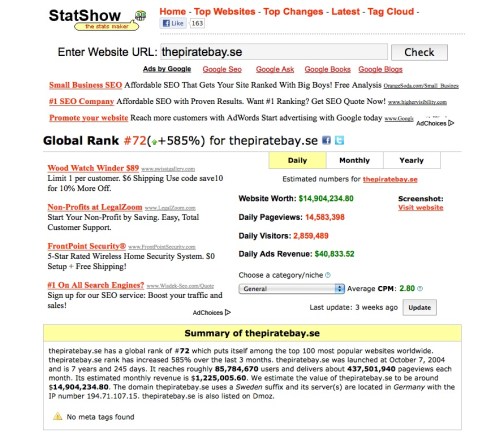
If there is any doubt left in anyone’s mind about the Exploitation Economy ripping off artists, this fantastic website shows the estimated revenue generated for commercial businesses on the backs of artists and creators without paying the artists a single penny.

Stat Show:
http://www.statshow.com/

The Pirate Bay – $14 Million Dollars Annually Estimated
http://www.statshow.com/thepiratebay.se

4 Shared – $11 Million Dollars Annually Estimated
http://www.statshow.com/4shared.com

Iso Hunt – $4 Million Dollars Annually Estimated
http://www.statshow.com/isohunt.com

And that’s just the tip of the iceberg, we also recommend reading:

Artists, Know They Enemy:
https://thetrichordist.wordpress.com/2012/06/05/artists-know-thy-enemy/

Ethical Fan – Wall Off Shame:
http://ethicalfan.com/2012/04/wall-of-shame-april-2012/

[ WHY ARENT MORE MUSICIANS WORKING ] [ ARTISTS FOR AN ETHICAL INTERNET ]
[ THE SKY IS RISING : MAGIC BEAVER EDITION ] [SF GATE BLUNDERS PIRACY FACTS ]
[ THE 101 ] [NEW BOSS / OLD BOSS ] [ SPOTIFY ] [GROOVESHARK ] [ LARRY LESSIG ]
[ JOHN PERRY BARLOW ] [ HUMAN RIGHTS OF ARTISTS ] [ INFRINGEMENT IS THEFT ]

Artists, Know Thy Enemy – Who’s Ripping You Off and How…

Musicians have been getting the short end of the stick for a long time. There are no shortage of stories about the wrong doings of managers, booking agents, etc and of course record labels.

But today we find ourselves in a battle with an enemy few of us understand. If we were to believe the writings and ramblings of the tech blogosphere, than they would have us believe that our enemy is our fans. This is simply not true.

The enemy are the for profit businesses making money from our recordings and songwriting illegally. Let’s be clear about this, our battle is with businesses ripping us off by illegally exploiting our work for profit. This is not about our fans. It is about commercial companies in the businesses of profiting from our work, paying us nothing and then telling us to blame our fans. That is the ultimate in cowardice and dishonesty.

Who are these companies? You know some of them, the ones that have been prosecuted and are no longer operating, Napster, Limewire, Grokster and Kazaa to name a few. Some have been convicted of operating illegally and are running from the law, switching servers to jurisdictions outside the reach of justice, such as The Pirate Bay. And, there are other still others who have yet to go to trial like Megaupload who alone made a billion for it’s owner Kim Dotcom who paid artists nothing, nadda, zero, zilch, zippo…

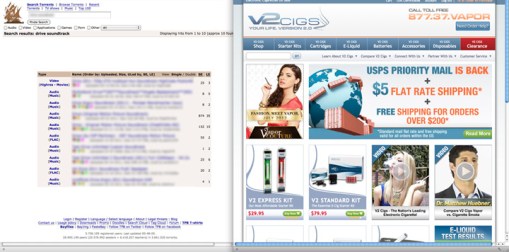
Our friends over at Ethical Fan recently published a Wall of Shame showing not only the sites who are profiting, but also who is paying for the advertising. This is no different than your music being used in a TV Commercial by AT&T, Time Warner, Verizon, State Farm Insurance, etc. Virtually all of these Artist Exploitation sites such as The Pirate Bay, Demonoid, Iso Hunt and others are operating for profit. Again, this is not about fans sharing, this is about illegally operating businesses making millions (and more likely Billions collectively) of dollars a year from the exploitation of artists work and not sharing any of the revenue with artists.

To the uninitiated, it might seem odd that what seems like a simple question of right or wrong is even being debated, but these sites that exploit artists are supported and promoted by faux civil liberty groups opposed to protecting creators rights — and internet giants are happy to throw their support behind them. Together, they have crafted a narrative of creator rights as quaint and outdated, offering artists a brave new online world where they can throw off the shackles of labels (or publishers, or studios, etc.) and give away their work to find fame and fortune. However, after a decade of half baked ideas, faulty business models, and outright lies, we know this is simply untrue. If the internet is working for musicians, why aren’t more musicians working professionally?

We may not always be fans of record labels, but at least the labels negotiate contracts, pay advances, market and promote artists, and are contractually accountable for wrong doing. However, the Artist Exploitation sites who are operating illegally and completely above the law are making 100% of the money from work created by musicians and artists. We would love to see the day when these sites license music legally, governed by fairly negotiated contracts.

Being able to collect 100% of the money from exploiting the work of artists is no doubt profitable when these companies don’t have to share any of that money with the artists themselves. This is expressly why copyright exists, specifically to protect artists and musicians from corporate interests who would illegally exploit the artist for profit. This is why record labels, publishing companies as well as the producers of films and television must negotiate with artists for the use of their work. And the artist has the free agency to decline. The artist has no such enforceable rights online today in the Exploitation Economy.

In other words, artists, creators and musicians have become road kill on the information super highway.

Opponents of the enforcement of Artists Rights online often cite what a powerful tool the internet is for distributing music cheaply. We are encouraged by many new and promising services to musicians that are being developed. But is absolutely false to assert that an artist’s work must be exploited illegally for the artists to enjoy the benefits of the internet.

Nothing is stopping any artist from sharing or giving away their work online through legitimate sites such as Soundcloud and Bandcamp.  Artists have the full right and capability to distribute their work freely, and by choice without having to be exploited illegally to the benefit and profit of an exploitative  company or corporation.

This is not about being for, or against technology or the internet, this is about being opposed to illegally operating businesses on the internet exploiting artists for commercial gain. It’s really just that simple. 

Those attacking Artists Rights also want you to believe that if you want to be paid you must be against technology and for censorship. Nothing could be more wrong. The internet is a amazing tool and most musicians we know are also early adopters of new technology (especially of the musical variety!). More so, it was artists and record labels who have historically fought against censorship and for freedom of expression. No where was this been more evident than in the 90’s battles against the PMRC in regards to record labeling with “Explicit Lyrics” stickers. Many artists have been on the front line of the battle for freedom of expression such as ICE-T, Jane’s Addiction and many others.

Let’s be clear, there is a difference between protecting the right to the freedom of expression, and profiting from the illegal exploitation of that expression itself.

In other words, artists and musicians are champions of freedom of expression and new technology. The only question that we ask is, is the use of the technology legal and does it respect artists rights as expressed in copyright. Copyright serves as the foundation that enables an artist the free agency to make the choices for themselves that are meaningful to them. Without the enforcement of copyright artists are bullied into forced collectivism by the new gate keepers who control the access to distribution revenues of music exploited illegally.

An economy built on the illegal exploitation of artists, is very simply an Exploitation Economy.

Any wrong doing of illegally operating businesses ripping off artists and illegally exploiting their work should be held accountable, even if they are on the internet.

The Human Rights of Artists

By Chris Castle

Given the plight of Chinese poet Zhu Yufu today is a good day to think about the human rights of artists. The human rights of artists is a different concept from intellectual property rights, such as copyright. Intellectual property rights are created by national laws, and the human rights of artists are recognized as the fundamental rights of all persons by all of the central human rights documents to which hundreds of countries have agreed.

These rights resonate in a number of international and national documents, but a good international agreement to consider first is the International Covenant on Economic, Social and Cultural Rights that was ratified by the United Nations General Assembly on December 16, 1966. It is important to remember that human rights are fundamental, inalienable and universal entitlements belonging to individuals, individual artists in our case. As a legal matter, human rights can be distinguished from intellectual property rights as intellectual property rights are arguably subordinate to human rights and actually implement at the national level the human rights recognized as transcending international and national intellectual property laws.

The Covenant recognizes everyone’s right—as a human right–to the protection and the benefits from the protection of the moral and material interests derived from any scientific, literary or artistic production of which he or she is the author. This human right itself derives from the inherent dignity and worth of all persons. The Covenant recognizes these rights of artists (in article 15, paragraph 1 (c):“The right of everyone to benefit from the protection of the moral and material interests resulting from any scientific, literary or artistic production of which he or she is the author.”

These human rights are transcendent and timeless expressions of fundamental entitlements of humanity that safeguards the personal link between authors and their creations as well as their basic material interests. These rights are personal to the authors and artists concerned and are arguably of broader scope than the rights that can be enforced under particular national intellectual property regimes.

The human rights of authors are recognized in a multitude of international agreements, including article 27, paragraph 2, of the Universal Declaration of Human Rights: (“Everyone has the right to the protection of the moral and material interests resulting from any scientific, literary or artistic production of which he is the author”); article 13, paragraph 2, of the American Declaration of the Rights and Duties of Man of 1948 (“Every person has the right…to the protection of his moral and material interests as regards his inventions or any literary, scientific or artistic works of which he is the author”); ; article 14, paragraph 1 (c), of the Additional Protocol to the American Convention on Human Rights in the Area of Economic, Social and Cultural Rights of 1988 (the Protocol of San Salvador) (“The States Parties to this Protocol recognize the right of everyone…[t]o benefit from the protection of moral and material interests deriving from any scientific, literary or artistic production of which he is the author”); and article 1 of Protocol No. 1 to the Convention for the Protection of Human Rights and Fundamental Freedoms of 1952 (the European Convention on Human Rights) (“Every natural or legal person is entitled to the peaceful enjoyment of his possessions. No one shall be deprived of his possessions except in the public interest and subject to the conditions provided for by law and by the general principles of international law”).

These precedents clearly enunciate the goals of the international community. The Covenant is closely linked with the right to own property (recognized in article 17 of the Universal Declaration of Human Rights) and workers’ rights to adequate remuneration. The “material interests” protected by the Covenant are protected under the right to an adequate standard of living.

These moral rights include the right of authors to be recognized as creators of their works and to object to any modification of their works that would be “prejudicial to their honor and reputation.” The protected interests of artists include the right to just remuneration for their labor as well as the moral right to the “intrinsically personal and durable link” between creators and their creations that survives even after the passing of the work into the public domain. This rule will no doubt come as a shock to those wishing to sell consumer electronics devices to the “remix culture” bent on perpetuating regurgitative “art.”

And what bothers me the most about the massive, worldwide infringement of artist human rights is not just that major multinational corporations like Google are knee-deep in perpetuating this exploitation economy. It is that the governments of the world have—until last year—done very little or nothing to stop it. And in that regard, these governments have failed to protect the human rights of artists.

If there seems to be a coordinated effort in many countries to oppose the rights of creators, that’s because there is—a complex effort very well described in the book Winning the Web, written by the former head of the Open Rights Group and sponsored by the Open Society Institute (www.soros.org). (The Open Rights Group (or “ORG”) is essentially the UK version of the Electronic Frontier Foundation and is a voice in the opposition to artist rights protection under the UK Digital Economy Act.)

But these coordinated attacks on artists’ rights also extend to some unlikely places—such as the United Nations Human Rights Council. This is not surprising because there has been a sustained effort to define away an artist’s ability to protect these transcendent rights (“it’s not really theft”)–the success of the anti-copyright crowd in destroying artists is in part dependent on getting over this issue. If the ORG, EFF and Google can define away an artist’s right to protect their rights through ridicule (such as Lessig’s obliging piece “The Starving Artist Canard“) , or by making them small as Lessig said on a Pirate Party UK video, “we” should not “break the Internet” to protect a “tiny industry” such as the hated “Hollywood”, then it will be easier for Google to roll over artists. Then it is easier to define an artist’s human rights out of existence altogether. And doesn’t that just sound like a human rights violation? Their reach is deep–I find it very strange that the Special Rapporteur for the UN Human Rights Commission fails to address the human rights of artists even once. The Special Rapporteur’s conclusions would impose grave burdens on artists, yet bends over backwards to protect the rights of corporate intermediaries online–and specifically mentions Google.

Of course it is not enough that the States of the General Assembly merely recognize these rights of artists in a number of international agreements—the States also have undertaken the affirmative obligation to protect these rights of authors. Those protections include adequate legislation and regulations, as well as making effective administrative, judicial or other appropriate remedies available to authors within each jurisdiction. Access to such remedies must be affordable, or as I have said in the past—violations of moral rights cannot be remedied only if the rich seek to enforce their rights.

Anyone who takes seriously the international human rights of artists will find “Big Tech’s” dismissive use of “moral panic” to be deeply offensive to professional creators. It is Orwellian to describe as a “moral panic” an allegation of immorality being associated with massive illegal downloading that deprives creators of their ability to pursue work which they freely chose and remuneration for that work enabling them to achieve an adequate standard of living.

Google’s Patry has, in fact, travelled the world speaking to NGOs and universities trying to make his case that using the language of morality to describe massive online theft is somehow insidious and that it should stop immediately. Or, as his employer Google might say, “Don’t be moral.” This “don’t be moral” admonition obscures much more than mere lusting for commercial gain on the part of Google and the Pirate Bay. The protection of artist rights—many of the rights of the professional creative class—are entitled to protection as human rights.

The human rights of artists have nothing to do with intellectual property laws that apply to corporations, or “Big Music”, or the even bigger “Big Tech”, it has nothing to do with superstars. A national artist in the smallest country has equal protection with the global superstar under the U.N. human rights treaties.

This is a complex topic that is well worth studying further.

###

[ THE 101 ] [NEW BOSS / OLD BOSS ] [ SPOTIFY ] [GROOVESHARK ] [ LARRY LESSIG ]
[ JOHN PERRY BARLOW ] [ HUMAN RIGHTS OF ARTISTS ] [ INFRINGEMENT IS THEFT ]
[ THE SKY IS RISING : MAGIC BEAVER EDITION ] [SF GATE BLUNDERS PIRACY FACTS ]
[ WHY ARENT MORE MUSICIANS WORKING ] [ ARTISTS FOR AN ETHICAL INTERNET ]

Roll Call : Musicians For An Ethical Internet

The conversation is now clearly about the unethical practices of corporations and companies profiting from the illegal exploitation of artists work without consent or compensation. As the 13 year war against Artists Rights has waged on, more and more artists are recognizing this fundamental truth, and speaking up.

Many artists are expressing the need for an Ethical Internet that should preserve all the rights and freedoms enjoyed in the physical world. Anyone who proposes that one set of rights (privacy, labor & fair compensation) must be sacrificed to protect another set of rights (freedom of speech), should be seriously questioned. Internet and tech companies need to innovate beyond the old model of illegally exploiting artists work as the basis for their unimaginative models and work to create new fair and ethical businesses.

Bono, Elton John, Eminem, Prince and others don’t need anything that Piracy is said to offer such as promotion, which is laughable at best. The Pirate Bay has made, and continues to make MILLIONS OF DOLLARS annually from artists via advertising (from Google) while providing no compensation to the artists what-so-ever. This is truly immoral and unethical, as well as being unacceptable as a legitimate business.

We hope that more artists will continue to speak up in favor of artists rights online in the pursuit of an ethical internet. What follows is a list of previous artists comments, compiled and attributed to their respective sources on the subject.

BONO
“…somebody should fight for fellow artists, because this is madness. Music has become tap water, a utility, where for me it’s a sacred thing, so I’m a little offended. The Internet has emasculated rather than liberated artists…”

LL COOL J
“My first question is this: Do people in the entertainment industry have the same rights as other Americans to fair pay for fair work?”

PATRICK CARNEY  / THE BLACK KEYS
“The guy [Sean Parker] has $2.5 billion he made from figuring out ways to steal royalties from artists, and that’s the bottom line.”

ELTON JOHN
“I am of the view that the unchecked proliferation of illegal downloading (even on a “non-commercial” basis) will have a seriously detrimental effect on musicians, and particularly young musicians and those composers who are not performing artists.”

EMINEM
“I think that shit is fucking bullshit. Whoever put my shit on the Internet, I want to meet that motherf***er and beat the shit out of him, because I picture this scrawny little dickhead going ‘I got Eminem’s new CD! I got Eminem’s new CD! I’m going to put it on the Internet.’ I think that anybody who tries to make excuses for that shit is a fucking bitch.”

JOHN MCCREA / CAKE
“The idea of making a living from selling musical recordings is sort of a quaint idea and is no longer really feasible… But I do think that if music is going to be free, then sandwiches should also be free. There should be some consistency and we should learn to cooperate better.”

ZACK HEMSEY
“…piracy is primarily motivated by greed – it’s a business, and apparently a very good one. There’s nothing wrong with someone making money, but if they are making money by commandeering and exploiting my work, and not even sharing any of those earnings with me to boot, then it shouldn’t be controversial to suggest their actions are less than admirable.”

DON HENLEY
“Theft of American products and ideas is no longer the hobby of teenagers with laptops; it’s big business, as the Office of the U.S. Trade Representative warns in a recent report on the world’s most notorious illicit markets. And they’re not just stealing movies and music; they are stealing America’s jobs and  future.”

PRINCE
“Nobody’s making money now except phone companies, Apple and Google…It’s like the gold rush out there. Or a carjacking. There’s no boundaries.”

DAVID LOWERY
“I feel that what we artists were promised has not really panned out.  Yes in many ways we have more freedom.  Artistically this is certainly true.  But the music business never transformed into the vibrant marketplace where small stakeholders could compete with multinational conglomerates on an even playing field.”

TRENT REZNOR
“Just because technology exists where you can duplicate something, that doesn’t give you the right to do it. There’s nothing wrong with giving some tracks away or bits of stuff that’s fine. But it’s not everybody’s right. Once I record something, it’s not public domain to give it away freely. And that’s not trying to be the outdated musician who is trying to ‘stop technology. I love technology.”

DAVID DRAIMAN / DISTURBED
“Make no mistake, however, that the culture that has been bred over the course of the last 10+ years of simply thinking that all music should be available for free is wrong, and immoral; plain and simple.This mentality has created an environment where it is more and more difficult for artists, particularly up-and-coming ones, to survive and sustain themselves. We, as artists, love and appreciate our fans more than you know. We know that we could not exist without you, but we don’t steal from you, not in any way, not ever. Wrong is wrong, no matter what color you paint it, or how you try to spin it.”

THE GRATEFUL DEAD
“No commercial gain may be sought by websites offering digital files of our music, whether through advertising, exploiting databases compiled from their traffic, or any other means.”

LOGAN LYNN
“What pisses me off is having over 91 percent of my personal intellectual property stolen, often before it even has the chance to be finished and released to the world. As a professional musician, a lot of time, hard work, and money goes into making a record. As an independent musician, that money comes directly out of my own pocket. ”

RANDY BACHMAN
“Digital online piracy is making it nearly impossible for Canada’s emerging artists to make it”

LUPE FIASCO
“People are trapped in the culture where music needs to be free and you don’t need to pay for it… who are you to have the right to tell me that I shouldn’t demand payment or feel a certain way for seeing people put my music out there like that? If I chose to do that, that’s one thing. But I didn’t choose to do that. That music was stolen.”

LILY ALLEN
“The world over, people are stealing music in its millions in the form of illegal file-sharing. It’s easy to do, and has become accepted by many, but we need people to know that it is destroying people’s livelihoods and suffocating emerging new British artists.”

TAIO CRUZ
“I could have been dropped from my record deal because so much was spent and so much of my album was leaked and not paid for. But luckily my label had great belief in me. File-sharing has had a very, very negative effect on my career, as it has on many others.”

In closing, perhaps this quote from Hemingway is also appropriate as food for thought:
“The individual, the great artist when he comes, uses everything that has been discovered or known about his art up to that point, being able to accept or reject in a time so short it seems that the knowledge was born with him, rather than that he takes instantly what it takes the ordinary man a lifetime to know, and then the great artist goes beyond what has been done or known and makes something of his own.” – Death in the Afternoon

###

[ THE 101 ] [NEW BOSS / OLD BOSS ] [ SPOTIFY ] [GROOVESHARK ] [ LARRY LESSIG ]
[ JOHN PERRY BARLOW ] [ HUMAN RIGHTS OF ARTISTS ] [ INFRINGEMENT IS THEFT ]
[ THE SKY IS RISING : MAGIC BEAVER EDITION ] [SF GATE BLUNDERS PIRACY FACTS ]
[ WHY ARENT MORE MUSICIANS WORKING ] [ ARTISTS FOR AN ETHICAL INTERNET ]