
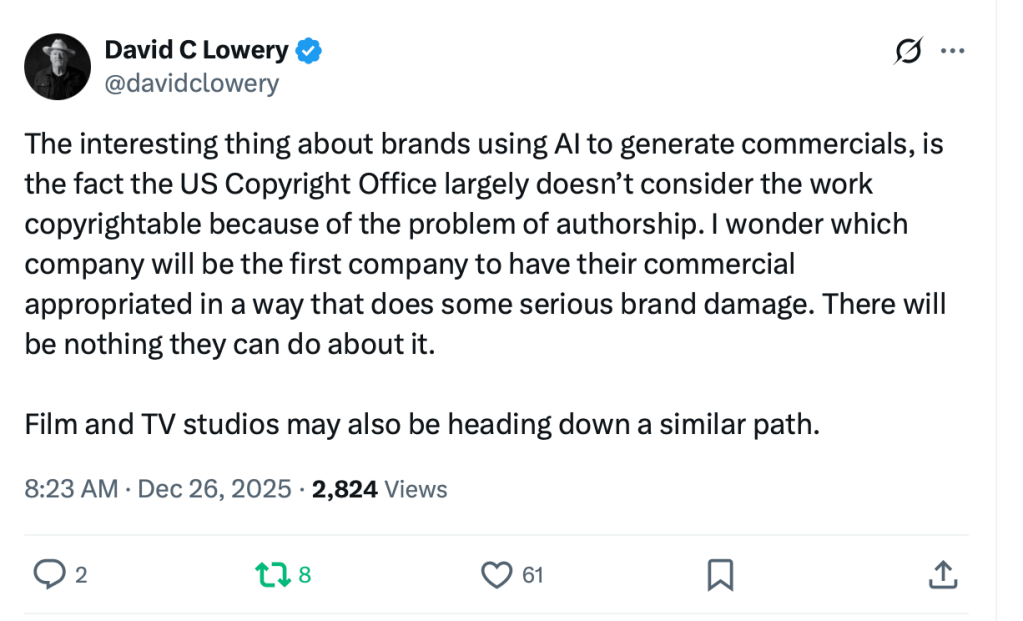
David is pointing to a quiet but serious problem hiding behind the rush to use generative AI in advertising, film, and television: copyright law protects authorship, not outputs. AI muddies or even erases authorship altogether in some cases
Under current U.S. Copyright Office guidance, works generated primarily by AI are often not registrable in the Copyright Office because they lack a human author exercising creative control. That means a brand that relies on AI to generate a commercial may not actually own exclusive rights in the finished work. If someone copies, remixes, or repurposes that ad, even in a way that damages the brand, the company may have little or no legal recourse under copyright law.
The Copyright Office guidance says:
In the Office’s view, it is well-established that copyright can protect only material that is the product of human creativity. Most fundamentally, the term “author,” which is used in both the Constitution and the Copyright Act, excludes non-humans. The Office’s registration policies and regulations reflect statutory and judicial guidance on this issue….If a work’s traditional elements of authorship were produced by a machine, the work lacks human authorship and the Office will not register it For example, when an AI technology receives solely a prompt from a human and produces complex written, visual, or musical works in response, the “traditional elements of authorship” are determined and executed by the technology—not the human user
David has not identified a theoretical risk. Copyright is the backbone of brand control in media. It’s what allows companies to stop misuse, dilution, parody-turned-weapon, or hostile appropriation. In the US, a copyright registration is required to protect those rights. Remove that protection, and brands are left relying on weaker tools like trademark or unfair competition law, which are narrower, slower, and often ill-suited to digital remix culture.
David’s warning extends beyond ads. Film and TV studios experimenting with AI-generated scripts, scenes, music, or visuals may be undermining their own ability to control, license, or defend those works. In trying to save money upfront, they may be giving up the legal leverage that protects their brand, reputation, and long-term value.
 The Trichordist
You must be logged in to post a comment.