Sir Lucian Grainge Just Drew the Brightest Line Yet on AI

by Chris Castle

Universal Music Group’s CEO Sir Lucian Grainge has put the industry on notice in an internal memo to Universal employees: UMG will not license any AI model that uses an artist’s voice—or generates new songs incorporating an artist’s existing songs—without that artist’s consent. This isn’t just a slogan; it’s a licensing policy, an advocacy position, and a deal-making leverage all rolled into one. After the Sora 2 disaster, I have to believe that OpenAI is at the top of the list.

Here’s the memo:

Dear Colleagues,

I am writing today to update you on the progress that we are making on our efforts to take advantage of the developing commercial opportunities presented by Gen AI technology for the benefit of all our artists and songwriters.

I want to address three specific topics:

Responsible Gen AI company and product agreements; How our artists can participate; and What we are doing to encourage responsible AI public policies.

UMG is playing a pioneering role in fostering AI’s enormous potential. While our progress is significant, the speed at which this technology is developing makes it important that you are all continually updated on our efforts and well-versed on the strategy and approach.

The foundation of what we’re doing is the belief that together, we can foster a healthy commercial AI ecosystem in which artists, songwriters, music companies and technology companies can all flourish together.

NEW AGREEMENTS

To explore the varied opportunities and determine the best approaches, we have been working with AI developers to put their ideas to the test. In fact, we were the first company to enter into AI-related agreements with companies ranging from major platforms such as YouTube, TikTok and Meta to emerging entrepreneurs such as BandLab, Soundlabs, and more. Both creatively and commercially our portfolio of AI partnerships continues to expand.

Very recently, Universal Music Japan announced an agreement with KDDI, a leading Japanese telecommunications company, to develop new music experiences for fans and artists using Gen AI. And we are very actively engaged with nearly a dozen different companies on significant new products and service plans that hold promise for a dramatic expansion of the AI music landscape. Further, we’re seeing other related advancements. While just scratching the surface of AI’s enormous potential, Spotify’s recent integration with ChatGPT offers a pathway to move fluidly from query and discovery to enjoyment of music—and all within a monetized ecosystem.

HOW OUR ARTISTS CAN PARTICIPATE

Based on what we’ve done with our AI partners to date, and the new discussions that are underway, we can unequivocally say that AI has the potential to deliver creative tools that will enable us to connect our artists with their fans in new ways—and with advanced capability on a scale we’ve never encountered.

Further, I believe that Agentic AI, which dynamically employs complex reasoning and adaptation, has the potential to revolutionize how fans interact with and discover music.

I know that we will successfully navigate as well as seize these opportunities and that these new products could constitute a significant source of new future revenue for artists and songwriters.

We will be actively engaged in discussing all of these developments with the entire creative community.

While some of the biggest opportunities will require further exploration, we are excited by the compelling AI models we’re seeing emerge.

We will only consider advancing AI products based on models that are trained responsibly. That is why we have entered into agreements with AI developers such as ProRata and KLAY, among others, and are in discussions with numerous additional like-minded companies whose products provide accurate attribution and tools which empower and compensate artists—products that both protect music and enhance its monetization.

And to be clear—and this is very important—we will NOT license any model that uses an artist’s voice or generates new songs which incorporate an artist’s existing songs without their consent.

New AI products will be joined by many other similar ones that will soon be coming to market, and we have established teams throughout UMG that will be working with artists and their representatives to bring these opportunities directly to them.

RESPONSIBLE PUBLIC POLICIES COVERING AI

We remain acutely aware of the fact that large and powerful AI companies are pressuring governments around the world to legitimize the training of AI technology on copyrighted material without owner consent or compensation, among other proposals.

To be clear: all these misguided proposals amount to nothing more than the unauthorized (and, we believe, illegal) exploitation of the rights and property of creative artists.

In addition, we are acting in the marketplace to see our partners embrace responsible and ethical AI policies and we’re proud of the progress being made there. For example, having accurately predicted the rapid rise of AI “slop” on streaming platforms, in 2023 we introduced Artist-Centric principles to combat what is essentially platform pollution. Since then, many of our platform partners have made significant progress in putting in place measures to address the diversion of royalties, infringement and fraud—all to the benefit of the entire music ecosystem.

We commend our partners for taking action to address this urgent issue, consistent with our Artist-Centric approach. Further, we recently announced an agreement with SoundPatrol, a new company led by Stanford scientists that employs patented technology to protect artists’ work from unauthorized use in AI music generators.

We are confident that by displaying our willingness as a community to embrace those commercial AI models which value and enhance human artistry, we are demonstrating that market-based solutions promoting innovation are the answer.

LEADING THE WAY FORWARD

So, as we work to assure safeguards for artists, we will help lead the way forward, which is why we are exploring and finding innovative ways to use this revolutionary technology to create new commercial opportunities for artists and songwriters while simultaneously aiding and protecting human creativity.

I’m very excited about the products we’re seeing and what the future holds. I will update you all further on our progress.

Lucian

Mr. Grainge’s position reframes the conversation from “Can we scrape?” to How do we get consent and compensate? That shift matters because AI that clones voices or reconstitutes catalog works is not a neutral utility—it’s a market participant competing with human creators and the rights they rely on.

If everything is “transformative” then nothing is protected—and that guts not just copyright, but artists’ name–image–likeness (NIL), right of publicity and in some jurisdictions, moral rights. A scrape-first, justify-later posture erases ownership, antagonizes creators living and dead, and makes catalogs unpriceable. Why would Universal—or any other rightsholder—partner with a company that treats works and identity as free training fuel? What’s great about Lucian’s statement is he’s putting a flag in the ground: the industry leader will not do business with bad actors, regardless of the consequences.

What This Means in Practice

  1. Consent as the gate. Voice clones and “new songs” derived from existing songs require affirmative artist approval—full stop.
  2. Provenance as the standard. AI firms that want first-party deals must prove lawful ingestion, audited datasets, and enforceable guardrails against impersonation.
  3. Aligned incentives. Where consent exists, there’s room for discovery tools, creator utilities, and new revenue streams; where it doesn’t, there’s no deal.

Watermarks and “AI-generated” labels don’t cure false endorsement, right-of-publicity violations, or market substitution. Platforms that design, market, or profit from celebrity emulation without consent aren’t innovating—they’re externalizing legal and ethical risk onto artists.

Moral Rights: Why This Resonates Globally

Universal’s consent-first stance will resonate in moral-rights jurisdictions where authors and performers hold inalienable rights of attribution and integrity (e.g., France’s droit moral, Germany’s Urheberpersönlichkeitsrecht). AI voice clones and “sound-alike” outputs can misattribute authorship, distort a creator’s artistic identity, or subject their work to derogatory treatment—classic moral-rights harms. Because many countries recognize post-mortem moral rights and performers’ neighboring rights, the “no consent, no license” rule is not just good governance—it’s internationally compatible rights stewardship.

Industry Leadership vs. the “Opt-Out” Mirage

It is absolutely critical that the industry leader actively opposes the absurd “opt-out” gambit and other sleights of hand Big Technocrats are pushing to drive a Mack truck through so-called text-and-data-mining loopholes. Their playbook is simple: legitimize mass training on copyrighted works first, then dare creators to find buried settings or after-the-fact exclusions. That flips property rights on their head and is essentially a retroactive safe harbor,

As Mr. Grainge notes, large AI companies are pressuring governments to bless training on copyrighted material without owner consent or compensation. Those proposals amount to the unauthorized—and unlawful—exploitation of artists’ rights and property. By refusing to play along, Universal isn’t just protecting its catalog; it’s defending the baseline principle that creative labor isn’t scrapable.

Consent or Nothing

Let’s be honest: if AI labs were serious about licensing, we wouldn’t have come one narrow miss away from a U.S. state law AI moratorium triggered by their own overreach. That wasn’t just a safe harbor for copyright infringement, that was a safe harbor for everything from privacy, to consumer protection, to child exploitation, to everything. That’s why it died 99-1 in the Senate, but it was a close run thing,,

And realize, that’s exactly what they want when they are left to their own devices, so to speak. The “opt-out” mirage, the scraping euphemisms, and the rush to codify TDM loopholes all point the same direction—avoid consent and avoid compensation. Universal’s position is the necessary counterweight: consent-first, provenance-audited, revenue-sharing with artists and songwriters (and I would add nonfeatured artists and vocalists) or no deal. Anything less invites regulatory whiplash, a race-to-the-bottom for human creativity, and a permanent breach of trust with artists and their estates.

Reading between the lines, Mr. Grainge has identified AI as both a compelling opportunity and an existential crisis. Let’s see if the others come with him and stare down the bad guys.

And YouTube is monetizing Sora videos

[This post first appeared on Artist Rights Watch]

@CadeMetz @ceciliakang @sheeraf @stuartathompson @nicogrant: How Tech Giants Cut Corners to Harvest Data for A.I.


[This is a must-read, deeply researched, long form article about how Big Tech–mostly OpenAI, Google and Microsoft–are abrogating consumers trust and their promises to creators in a mad, greedy, frothing rush to some unknown payoff with AI. The Dot Bomb boom is dwarfed by the AI gold rush, but this article is a road map to just how bad it really is and how debased these people really are. Thanks to the destruction of the newsroom, only a handful of news outlets can deliver work of this quality, but thankfully the New York Times is still standing. How long is another story.]

OpenAI, Google and Meta ignored corporate policies, altered their own rules and discussed skirting copyright law as they sought online information to train their newest artificial intelligence systems….

OpenAI researchers created a speech recognition tool called Whisper. It could transcribe the audio from YouTube videos, yielding new conversational text that would make an A.I. system smarter.

Some OpenAI employees discussed how such a move might go against YouTube’s rules, three people with knowledge of the conversations said. YouTube, which is owned by Google, prohibits use of its videos for applications that are “independent” of the video platform.

Ultimately, an OpenAI team transcribed more than one million hours of YouTube videos, the people said….

Like OpenAI, Google transcribed YouTube videos to harvest text for its A.I. models, five people with knowledge of the company’s practices said. That potentially violated the copyrights to the videos, which belong to their creators.

Last year, Google also broadened its terms of service. One motivation for the change, according to members of the company’s privacy team and an internal message viewed by The Times, was to allow Google to be able to tap publicly available Google Docs, restaurant reviews on Google Maps and other online material for more of its A.I. products.

The companies’ actions illustrate how online information — news stories, fictional works, message board posts, Wikipedia articles, computer programs, photos, podcasts and movie clips — has increasingly become the lifeblood of the booming A.I. industry. 

Read the post on New York Times.

Google, Advertising, Money and Piracy. A History of Wrongdoing Exposed.

Readers of this blog will know that we’ve been gaining attention and awareness on brand sponsored piracy. We’ve noted how 50 Major Brands are Supporting Music Piracy. When that information is paired with The LA Times and The New York Times reports from the USC Annenberg Innovation Lab’s Transparency Report on Advertising Networks financing piracy we see a very clear picture emerging.

It is very clear that online piracy is a mass scale, for profit, enterprise level commercial business. There is a lot of money changing hands. Google is said to make approximately $30 Billion a year, with 97% of the money coming from advertising revenue. All of Google’s other products combined only account for less than 3% of it’s annual earnings.

So we can see that there are a lot of people making a lot money from the unauthorized, illegal infringement of artists and creators work. This is no longer about individual “sharing.” This is about businesses exploiting artists for profit, and not paying the artists a penny. We do not know of one cent being paid to artists from sites like The Pirate Bay, 4Shared and Filestube just to name a few of the major offenders.

So where does Google fit into this? Why do so many artists rights advocates focus so intently on Google? Simply because public documents have exposed Google as having knowledge of wrong doing and doing nothing about it – until they got busted, red handed, twice.

In 2011 Google paid $500,000,000 (that’s half a billion dollars) in a non-prosecution settlement agreement to avoid criminal prosecution. Yes, Google paid half a billion dollars to avoid criminal prosecution and the documents in the case revealed that knowledge of wrongdoing went all the way to the top, to none other than Larry Page himself. The story caught the attention of many mainstream media outlets including CNN.

The Wall Street Journal Reported:

“Larry Page knew what was going on,” Peter Neronha, the Rhode Island U.S. Attorney who led the probe, said in an interview. “We know it from the investigation. We simply know it from the documents we reviewed, witnesses that we interviewed, that Larry Page knew what was going on” . . .

Harvard Law Associate Professor Ben Edelman continues;

These admissions and the associated documents confirm what I had long suspected: Not only does Google often ignore its stated “policies”, but in fact Google staff affirmatively assist supposed “rule-breakers” when Google finds it profitable to do so…

In June I observed that Google’s bad ads span myriad categories beyond pharmaceuticals — charging for services that are actually free, promising free service when there’s actually a charge, promoting copyright infringement, promoting spyware/adware, bogus mortgage modification offers, work-at-home scams, investment rip-offs, identify theft, and more.

Note that Edelman reports the problem is much larger than just the illegal advertising of drugs.  It appears to even extend into such black markets as human trafficking. This issue was even met with a Change.Org petition as well as being reported on here and here.

So if Google has been caught lying about their knowledge of wrong doing in the past, and violating their actual practices versus policies, than what else do they know and what else are they doing? How many other of their own policies do they not follow, or worse, aid others in circumventing them? All reasonable questions to ask given the publicly available information.

The profiting from illegal behavior was also reported by Ars Technica ,

When the sting began in 2009, Google had in place policies designed to block illicit pharmaceutical advertising. Whitaker’s orders were initially rejected under those policies. But Whitaker says Google sales reps helped him tweak his sites to skirt the rules.

“It was very obvious to Google that my website was not a licensed pharmacy,” Whitaker told the Journal. “Understanding this, Google provided me with a very generous credit line and allowed me to set my target advertising directly to American consumers.”

All of this brings us back to where we are now regarding Google’s non-denial regarding financing commercial scale infringement sites. There is a history of this behavior with Google that dates back further. In May of 2011 The Copyright Alliance noted the following regarding the 2007 case of EasyDownloadCenter.com and TheDownloadPlace.com.

Indeed there is even publicly documented history of Google knowingly and purposefully working with pirate websites to increase traffic to such websites and profits to Google from the Sponsored Links/Adwords programs. In conjunction with the settlement of a copyright infringement lawsuit brought by the major Hollywood studios against Luke Sample, Brandon Drury and their companies for operation of subscription based websites devoted to helping consumers find and download pirated copyrighted works, Sample’s Affidavit was filed by one of the defendants testifying to the fact that Google worked directly with the illegal website to drive traffic to it and increase Google’s revenues from its participation in the sponsored links program.

This is the part below really gives us pause, reported not just by The Copyright Alliance, but also many tech publications and outlets such as DailyTech.

In fact, Google’s ad teams even made suggestions designed to optimize conversion rates by using keywords targeted to pirated content – such as suggesting downloading films still in theatrical release, that obviously were not available yet in any authorized format for home viewing.

According to PCWorld this added up to some decent money…

EasyDownloadCenter.com and TheDownloadPlace.com generated US$1.1 million in revenue between 2003 and 2005, and Google received $809,000 for advertising, the Journal reported.

So the question today is what does Google actually know about how it’s advertising practices are financing the destruction of the creative community by supporting these unauthorized, illegally operating, commercial infringers? How much has really changed?

Keep in mind that although Google pays it’s “partners” a revenue share on YouTube for claimed content, the company makes no such offer to artists and creators on the advertising that it still appears to be serving to pirate sites. This is further demonstrated by the lack of ability for the company to make a definitive statement that Google does not serve any ads, to any pirate sites (or at least the 43,000 listed in the companies own transparency report).

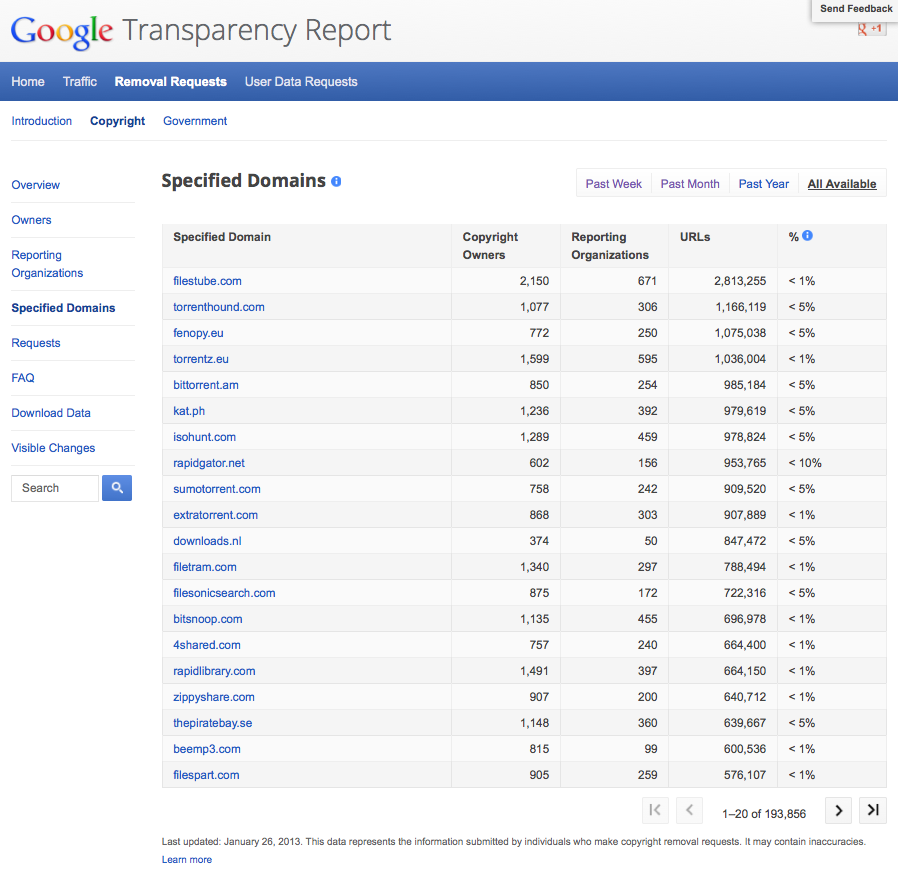
Also central to this conversation is that the way consumers access the unauthorized, illegal and infringing sites which usually starts with a Google search itself. In fact according to Google’s own public transparency report there are over 13 million infringing links being removed from Google’s search engine monthly by rights holders. Those 13 million infringing links represent over 43,000 infringing sites.

Wouldn’t the rational and logical solution be to create a joint review board the represents the interests of all stakeholders that can negotiate penalties or the removal of bad actors?

GoogleTransparencyReport

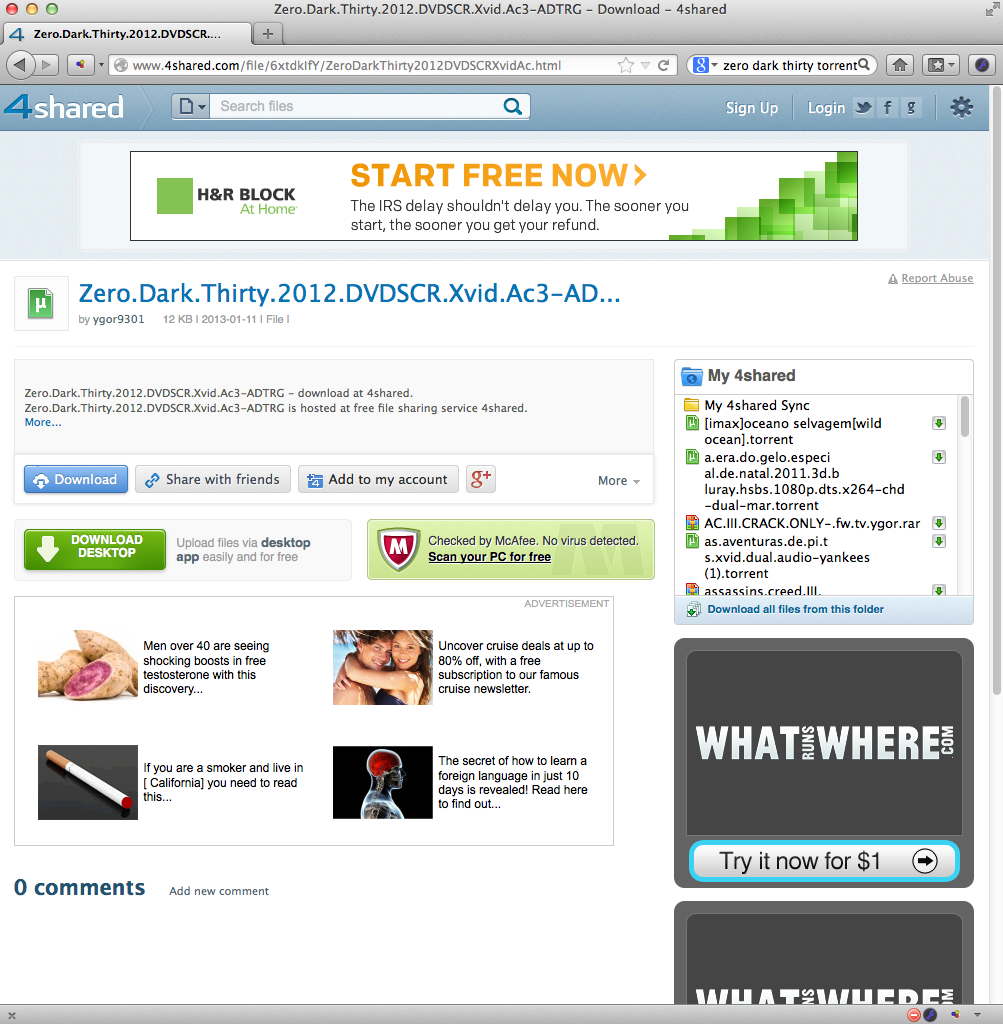
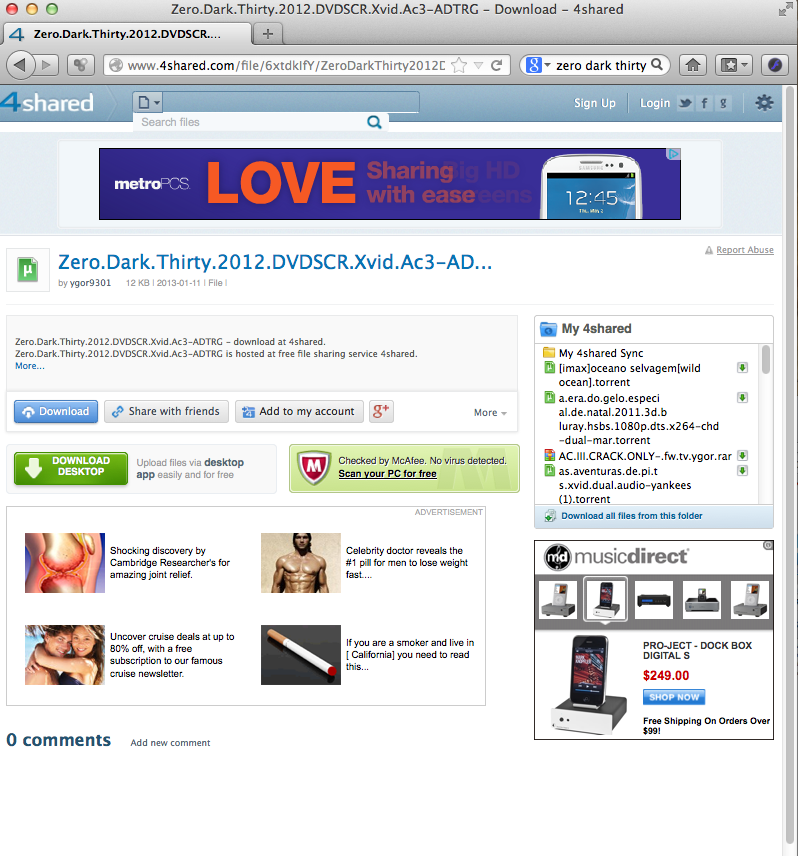
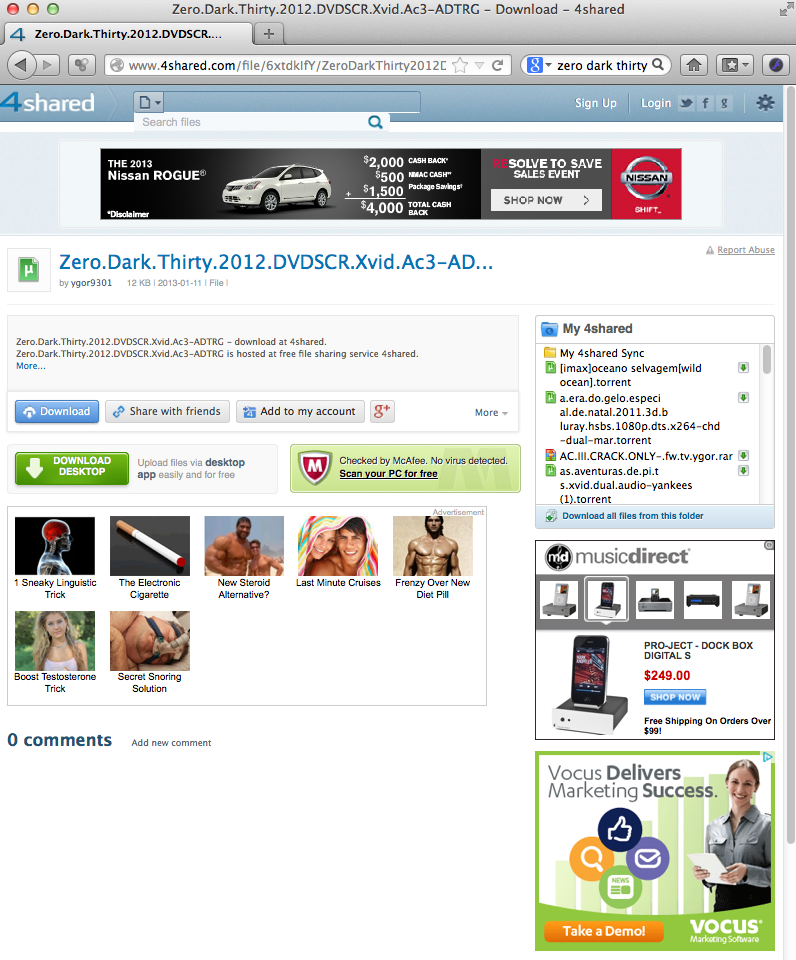
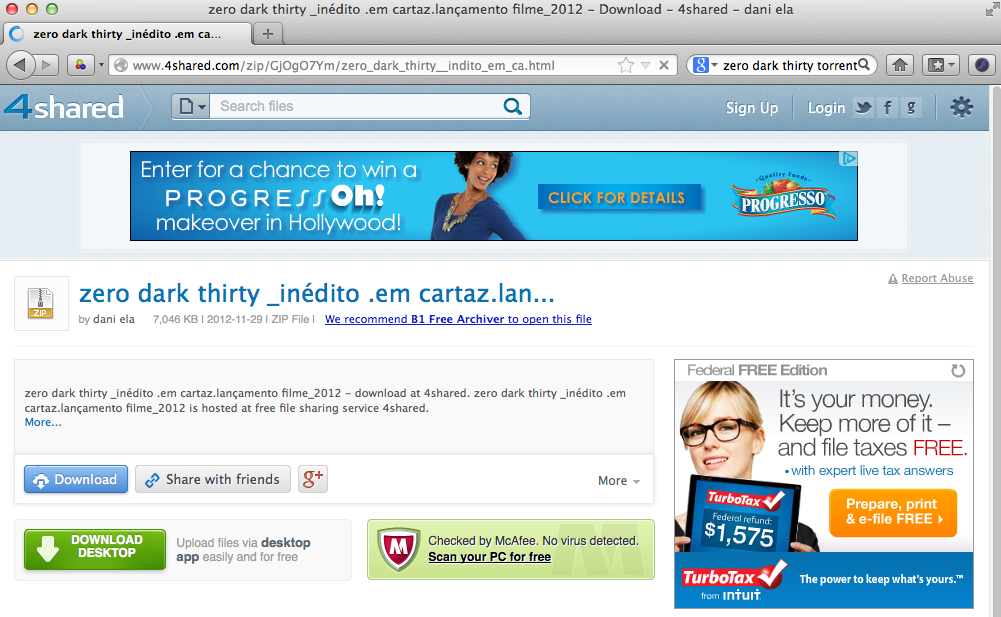
Zero Dark Thirty, Best Picture Academy Award Nominee, Exploited by AT&T, Verizon, MetroPCS, Nissan, H&R Block, British Airways, Progresso, and more…

We spend most of our time here focused on artists rights as it applies to music and musicians. But we wanted to see if the film industry was having the same challenges as music. We believe in the rights of all creators to consent and compensation for their work (ethical internet principles numbers two and four, respectively).

With the upcoming Academy Awards we wondered if it would be possible to find pirated versions of Zero Dark Thirty. It is  the most talked about film of the year which is nominated for five Academy Awards including Best Picture. But it could easily be any of the other nominated films, in any of the categories as well. We just picked Zero Dark Thirty. It’s also been widely reported that most of the nominated films have already been pirated and are online.

We were also curious what major brands might be supporting that piracy, and if any of those same brands might have advertising that appears on the broadcast of  The Academy Awards show itself. We would hope the Academy Of Motion Picture Arts and Sciences would be able to educate the various brands, advertising agencies and online ad networks about the damage they are doing to the creative community.

What makes this even more frustrating in the case of Zero Dark Thirty is that the film is not even out of theaters yet. At least with music, it is usually (usually…) commercially available before it is pirated.

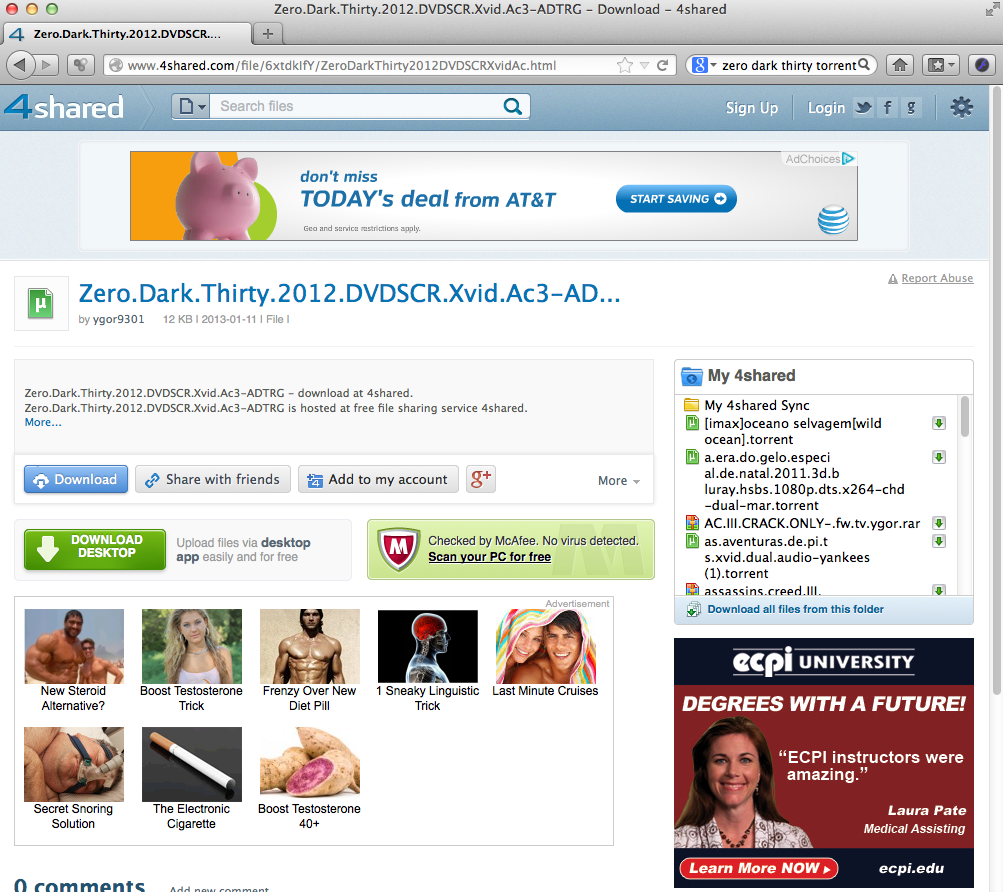
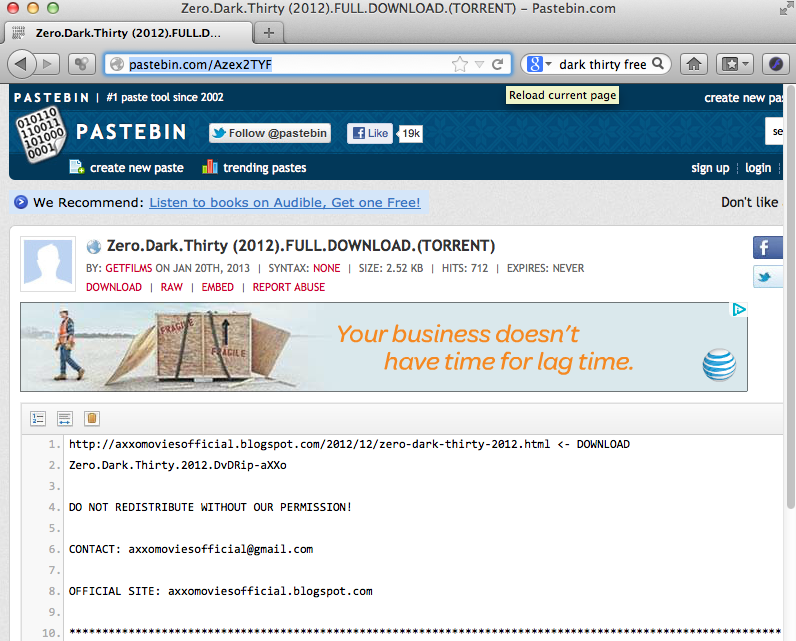
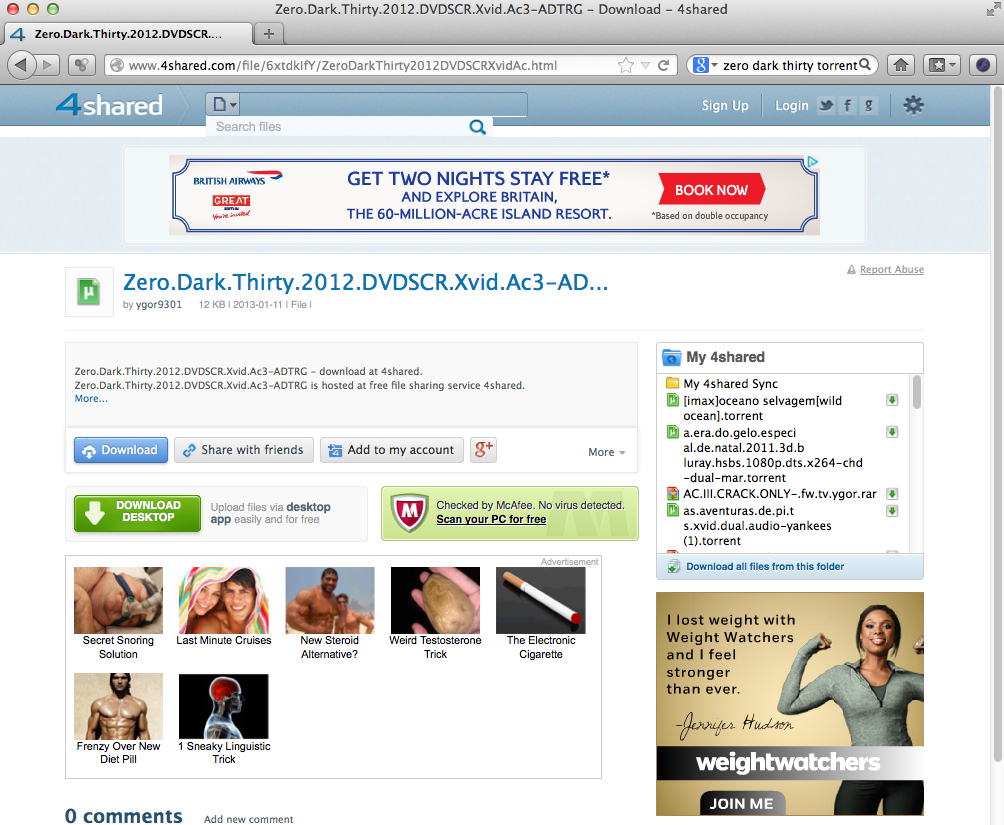
Here’s what we found within a few minutes, on just two sites…

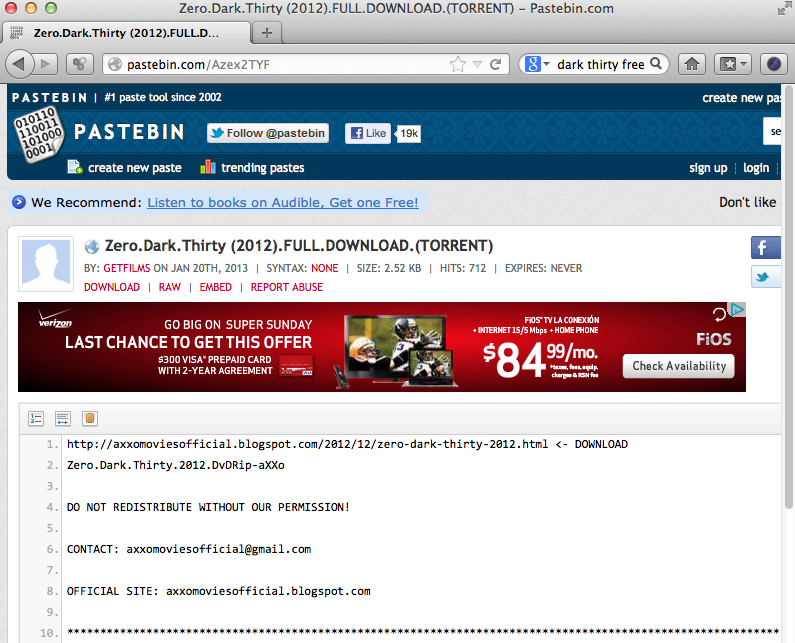
* AT&T on 4Shared
* AT&T on Pastebin
* British Airways on 4Shared
* H&R Block on 4Shared
* MetroPCS on 4Shared
* Nissan on 4Shared
* Progresso on 4Shared
* Turbo Tax on 4Shared
* Verizon on Pastebin

ZDT_ATTT

ZDT_Pastebin

ZDT_BAZDT_H&RBlockZDT_metroPCSZDT_NIssanZDT_ProgressoTTZDT_Verizon

That’s just a couple sites to download the movie for free. What’s more common amongst film piracy are the faux subscription services that charge annual membership fee’s to stream all of their pirated movies (so much for information wants to be free, but movie want to be paid for…).

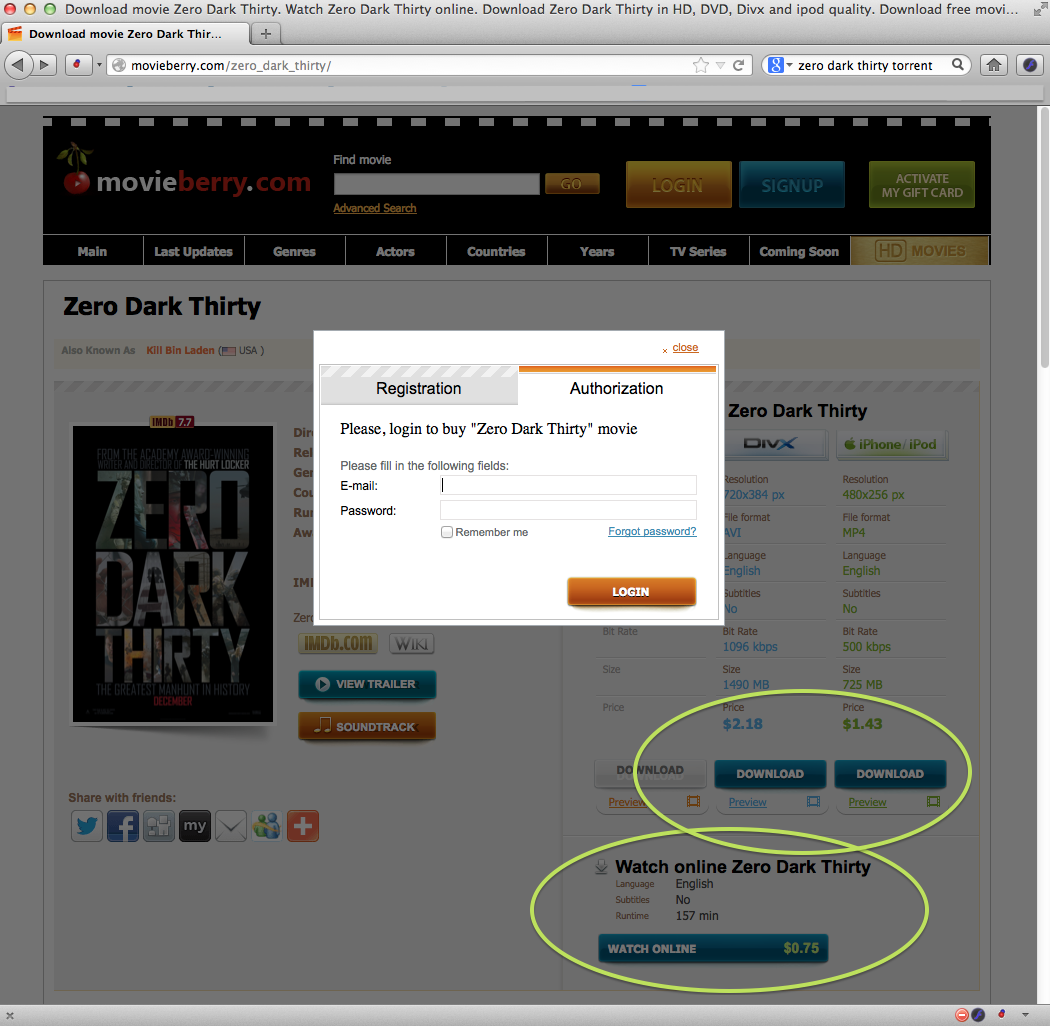
Here’s just one example where you can pay on a transactional basis of $.75 to stream the film or between $1.43 or $2.18 to download the film of varying quality.

ZDT_movieberry

So much for “Free Culture.” As it turns out there’s probably very little online piracy happening without money changing hands somewhere in the value chain. The money may be in advertising, or it may be in transactional or subscription fees, but one thing is for sure, people are getting paid and not paying the creators.

In the case of the above, and as we also asked did MegaVideo Charge for Streaming Movies the problem here is to address those processing payments such as American Express, Visa, Master Card and the various other banks such as Citi Bank and Wells Fargo (whom have also been seen advertising on pirate sites). At least PayPal is taking responsibility and denying service to pirate sites. That thanks largely to the good work being done by StopFileLockers.

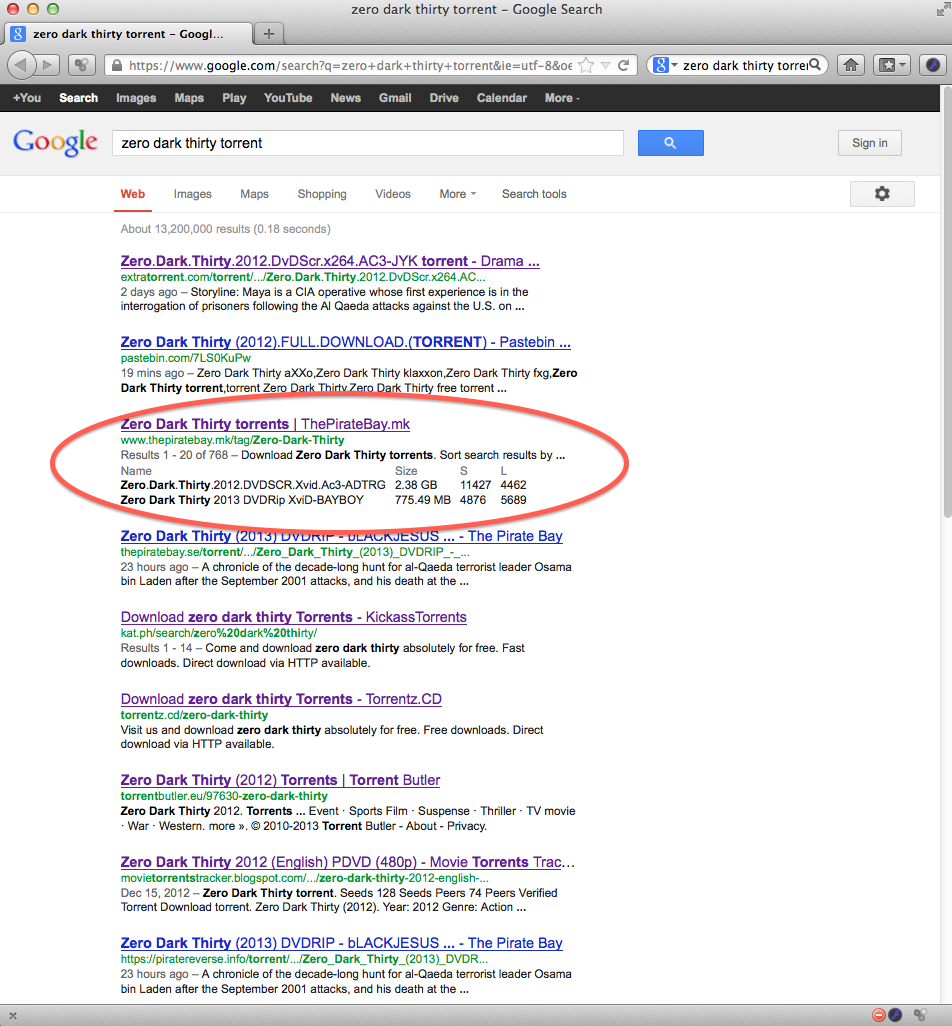
We found a couple of things of interest as well regarding Google’s search. Despite there being (we’re guessing conservatively) literally thousands of DMCA notices to remove the film from search, The Pirate Bay still ranks #3 on the first page of search results! Surely Google as well as everyone else in the world knows the site was found guilty and it’s founders sent to jail. Yet Google has not delisted the site from search in it’s entirety which would be the right thing to do, knowing that the judgement against The Pirate Bay was upheld even by the Supreme Court of Sweden.

ZDT_GoogleSearch

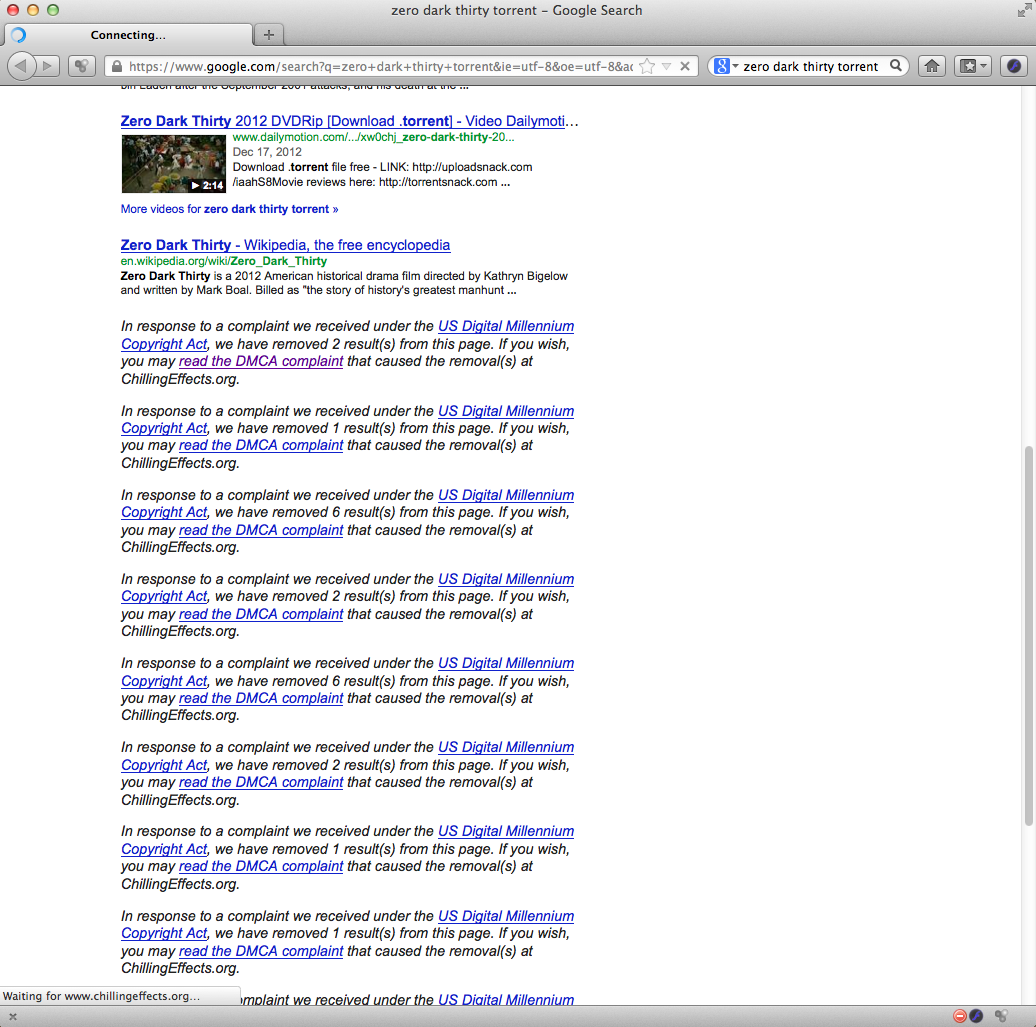
Of course a quick scroll down the page and the delisted link removal notices start to appear as follows:

In response to a complaint we received under the US Digital Millennium Copyright Act, we have removed 1 result(s) from this page. If you wish, you may read the DMCA complaint that caused the removal(s) at ChillingEffects.org.

ZDT_DMCA_GoogleCjill

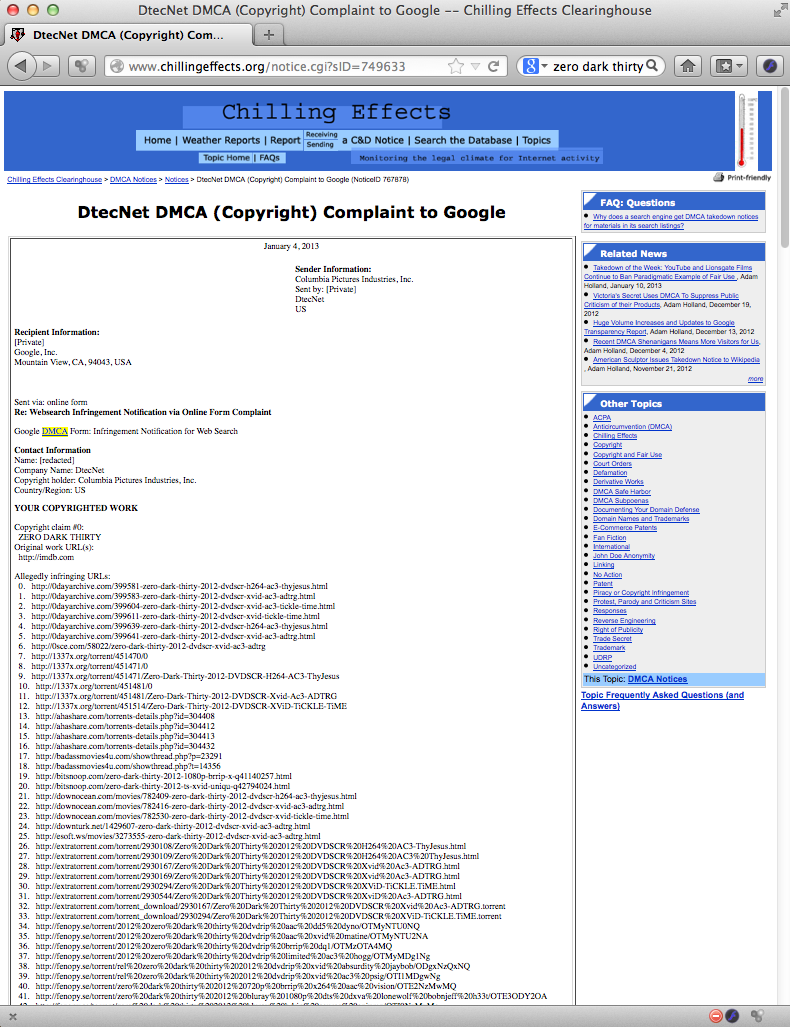
Now why exactly is there a need, once a link has been delisted to post a notice to a site that then shows that very same link that had been lawfully delisted from Google search by the DMCA? In the screen shot below are shown just the first forty delisted links, but on that one notice alone there are over three hundred delisted links to pirated copies of Zero Dark Thirty in one way or another.

ZDT_CEpg1

Make no mistake about it, every one of those previously delisted links is still active on the servers where it originated and it can simply be copied and pasted back into any web browser.

Further more, these links have been delisted due to the fact that most if not all of these infringing sites are not based in the United States and do not conform to United States law and therefore do not comply with the DMCA itself.

Is this all just a cat and mouse game for Google to profit from piracy? Draw your own conclusions.

Why are Internet Freedom Fighters always fighting against the Internet Freedom of Artists?

We’re always a little amazed when site like Hypebot takes up the fight for internet freedom, as long as that freedom does not include artists rights. Recently the site has confused the difference between a $20 settlement for illegal downloadingversus a $9,250 per song judgement for copyright infringement.

It seems to us, that getting off the hook for $20 per song is a pretty good deal. Should a person downloading also be found to be uploading and distributing (you know, infringing copyright) than they might want to think twice before pushing back too hard or they could end up like Joel Tenenbaum and Jammie Thomas. Both of whom were found guilty of copyright infringement by a Jury of their peers and awarded damages upheld by the courts.

It’s troubling when sites that state they are trying to help musicians are actually making arguments to support the people who exploit artists and rip them off, but not the artists themselves.