
When did Noah build the Ark? Before the rain.
The Artist Rights Institute has prepared comments responding to the Copyright Office’s inquiry into music streaming fraud, arguing that the industry’s approach to fraud prevention starts too late. The public inquiry is made at the request of U.S. Representative Scott Fitzgerald, a thoughtful Member who is concerned with government policies applicable to songwriters.
The problem isn’t simply fraudulent streams. It’s the ease with which AI-generated recordings, unauthorized copies, and hijacked artist identities enter streaming services through digital distributors without adequate verification. As usual, it comes back to an extraordinary failure of unaccountable management royalty with blood money stock options at both streaming platforms and the distributors we are forced to use.
ARI proposes a straightforward approach: Know the customer. Know the content. Follow the money.
Distributors should verify uploaders, ownership claims, and ultimate royalty recipients before recordings enter the system. Streaming services should not rely on algorithms and arbitrary royalty thresholds to compensate for failures at the distribution gateway. Flat fee distributors have no incentive to properly vet users. That structure may fit a Racketeer Influenced and Corrupt Organization (RICO) investigation.
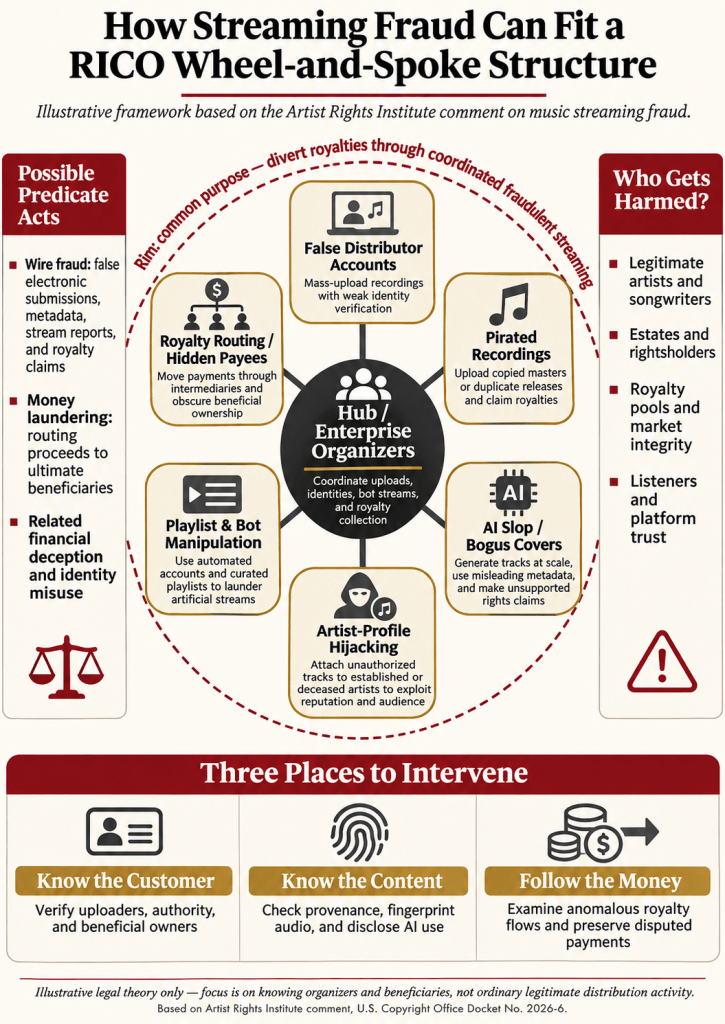
The comment also challenges the economics of fraud. Revenue-share royalty pools allow fraudulent streams to dilute legitimate royalties without necessarily increasing streaming services’ costs. A meaningful per-stream mechanical royalty would help align financial incentives with fraud prevention.
ARI also calls for greater transparency, AI provenance information, appropriate royalty eligibility standards, and stronger accountability throughout the distribution chain.
The solution isn’t another algorithm to detect fraud after the fact. It’s enforcing the rules before fraudulent recordings enter the marketplace.
If you want to comment on the issue, the comment period is open until November 23, and you’ll find more information here.







You must be logged in to post a comment.