The AI “License” That Isn’t: A Musician’s Checklist for Spotting a Covenant Not to Sue Censorship Trap in Disguise

If you saw the adverb “forever” in a contract, would it give you pause?  It would me—I would wonder who allowed that to slip through.  As text-to-audio generative AI models desperately try to normalize their shoot-ready-aim ingestion of likely stolen works to support their next round of financing (or in some cases perhaps a VC exit by IPO), it’s likely that we will see some efforts at “licensing” reminiscent of the Napster era. “Licenses” that actually paper over the main act—stop the lawsuit before they start. What will that look like and what should we look for buried in the not so fine print?

Generative AI companies are coming to the negotiating table with “music licensing agreements” (and probably other artists’ too). That sounds encouraging — it suggests they want to do the right thing and pay for the content they use. Trust me, they don’t. What they want is to get away with it.

Not every document titled “license” actually functions like one. Some of these deals are better described as litigation insurance dressed up in licensing language, and if you sign one without reading the small print, you may be giving away far more than you realize. Because as Tom Waits taught us in the classic Step Right Up, the large print giveth and the small print taketh away.

Here’s a practical checklist of red flags to watch for if you want to look past the hype:

☐ Check Whether the “License” Actually Includes a Perpetual “Covenant Not to Sue”

A quick definitional note: a covenant not to sue is a contractual promise in which you agree in advance never to bring a legal claim against the other party — regardless of what happens, regardless of whether you even know you have a claim, and often regardless of whether the conduct at issue would otherwise be something you could sue for or get a court to stop (like with an injunction). Unlike a license, which grants permission and can expire, a covenant not to sue can be a permanent waiver of your right to seek a remedy. It’s the difference between handing someone a key to your house and signing a contract promising you’ll never call the police no matter what they do inside.

A real license gives someone permission to use your work under defined conditions, and when the term ends, so does the permission. Watch out for agreements that include a separate clause in which you irrevocably promise — both during and after the term — never to bring any claim against the company or even its users. If the covenant not only covers copyright, publicity rights, moral rights, defamation, and lawsuits over issues that may not exist yet, you are not licensing your work. You are surrendering your right to enforce your rights, permanently. Or you know, “forever.” Make sure you understand the difference before you sign.

☐ Beware a “Non-Exclusive” License That Binds Your Co-Writers

Remember the 100% licensing debacle back in 2016? Tenants-in-common co-ownership of a copyright means any co-owner can grant a non-exclusive license without the others’ consent — but that principle can be weaponized. If an agreement requires you to represent and warrant that no third-party consent is needed, and that you will not encourage your fellow songwriters to take any position inconsistent with the deal (again with the censorship), you may be dragging your co-writers into an arrangement they never agreed to. Worse, if the covenant not to sue extends to all contributors, your co-writers’ enforcement rights could be compromised by a deal they had no say in. Before you sign, make sure the AI platform isn’t leveraging TIC principles to bind people who aren’t at the table. Here’s why this matters in practice: under TIC co-ownership, a non-exclusive license granted by one co-owner is generally binding on all co-owners, even without their consent. That means if you grant a non-exclusive license — or, more critically, a covenant not to sue — covering the full composition, your co-writer may be unable to bring an infringement claim against the same company for the same use, because the company can point to your grant as a complete defense. The co-writer’s right to sue isn’t technically extinguished, but it’s rendered practically worthless. The result is that one publisher’s signature can neutralize enforcement rights across an entire song’s ownership chain. Ask your lawyer.

☐ Look for a Sweeping Pre-Signing Release

Some agreements bury a broad release of all claims arising before the effective date — known and unknown, suspected and unsuspected. That’s not a license, it’s a preemptive settlement masquerading as a license.  Worse, they may ask you to preemptively waive protections like California Civil Code Section 1542, which exists specifically to protect people in this exact situation. The statute prevents people from accidentally releasing claims they don’t yet know about. If an AI company has been training on your catalog without permission for years, a release like this could function like a contractual safe harbor and eliminate any leverage you had to seek compensation for that unauthorized use, or better yet an injunction. You know, kind of like the Music Modernization Act.  Ask yourself: why does a forward-looking license need a backward-looking release? Aside from wanting a pony.
☐ Make Sure “Training Rights” Aren’t Irrevocable in Practice

A license to include your works in a training corpus sounds civilized, but look closely at the removal mechanics (and take a class in “machine unlearning“). If the company is only required to retrain its model a limited number of times per year — say, twice — then even if you pull your catalog, your works may remain embedded in the AI model for months or even “forever”. There are no guarantees that “retraining” will actually remove your works from the model and, in fact, the literature suggests it won’t. And if the covenant not to sue survives the term for anything created while the deal was active (or before the deal was active), the training that already happened is effectively locked in. You may be inadvertently granting a right for yourself and maybe your co-writers that you can never meaningfully take back.

☐ Don’t Pre-Approve a Statutory Streaming License They May Not Be Entitled To

Some AI music platforms aspire to become full on-demand streaming services — and their agreements may include language contemplating exactly that expansion, with provisions stating the company will simply obtain a blanket mechanical license from the Mechanical Licensing Collective under 17 U.S.C. § 115(d). But whether a generative AI platform that creates synthetic music qualifies for the statutory compulsory license designed for traditional on-demand streaming is a genuinely open legal question. If you agree to terms that treat this expansion as a foregone conclusion — or worse, if your covenant not to sue or conditional authorization greenlights streaming functionality by default — you may be conceding the argument before it’s ever litigated. Don’t let an agreement’s assumptions about statutory eligibility become your assumptions. That question should be tested, not waived.

There’s a deeper problem here, too. The Section 115 compulsory license has always contained an anti-piracy prerequisite: you cannot obtain a compulsory license to use a musical composition if the sound recording you’re working from was not lawfully fixed or authorized by the sound recording’s copyright owner. If an AI platform trained its model on sound recordings it ingested without authorization (as is currently being litigated), its entire statutory license theory may be built on a foundation of infringement. The compulsory license was never designed to launder unauthorized use of sound recordings into lawful use of the compositions they embody. By agreeing to terms that treat the platform’s eligibility as settled, you may be implicitly conceding that the platform’s use of those sound recordings was authorized — a concession likely worth far more than anyone is probably paying for it and that can get you sideways with the sound recording owners.

☐ Scrutinize “Guardrail Failure” Safe Harbors

Technical safeguards — input filters, output filters, vocal classifiers — are only as good as the consequences for failure. Be wary of provisions that excuse the AI company from breach liability when its guardrails fail, so long as the failures are characterized as “inadvertent” and “de minimis” which are in the eye of the beholder and just buying a lawsuit.  If the agreement treats guardrail failures as non-breaches by default, you’ve effectively agreed that the company can produce unauthorized outputs of your works without meaningful accountability, as long as it promises to try to fix the problem after the fact with no stick if it fails.

☐ Watch Who Owns the AI Model — and Learned “Insights”

Ownership clauses in AI agreements often go further than you’d expect. The company may claim ownership not just of the AI model, but of all “insights” it learns which can be damn near anything. That “learning” is including those developed using your content. That language could be read to mean that everything the AI extracts, learns, or derives from your catalog belongs to the platform. Make sure you are not inadvertently ceding ownership of the creative intelligence embedded in your works.

☐ Don’t Let a Third Party’s Binding Calculation Determine Your Payment

I am no fan of market share revenue share deals, particularly when the revenue pool is a fixed number. Some revenue pool deals delegate the calculation of your market share — and therefore your payment — to a third party, and then declare that calculation to be binding on you, even if you had nothing to do with calculating either your market share (under the “license” not in general) or your share of the revenue or minimum guarantee. If you have no right to challenge the methodology or the math, or to audit that third party, you could be found to have agreed to be paid whatever someone else decides you’re owed, with no recourse if they get it wrong.

☐ Trace the Revenue Through Every Deduction Before Celebrating the Rate

A headline royalty rate means nothing if it’s applied to a revenue base that has already been carved down by layers of deductions including off the top fees, advertising costs, technical fees, inference compute costs, app-store commissions, performance royalties, and more. Each deduction may sound reasonable in isolation, but stacked together, they can reduce the revenue pool to a fraction of what you’d expect. Always model your actual payout, not just the stated percentage.

☐ Beware Conditional Authorizations That Expand the Deal Without Your Active Consent

Some agreements include provisions for future features such as API access, enterprise customer pricing, new product versions, downloads, or interactive streaming that automatically activate once a majority of other rightsholders sign on. If the trigger is what other labels or publishers do rather than what you approve, you may find that the scope of the license has expanded well beyond what you agreed to, without any additional negotiation or compensation.  And remember what they say about if everyone else was running off a cliff.

☐ Censorship Clauses: Don’t Agree to Never Contradict the Deal

Representation and warranty sections sometimes include a covenant that you will not take, or encourage your artists or songwriters to take, any position at any time (whether during or after the term and whether or not truthful) that is inconsistent with the hoorah narrative about AI or the applicable license. Read that carefully. It could be interpreted to prevent you — or your writers — from ever publicly criticizing the deal, advocating for stronger protections, or supporting legislation that conflicts with the agreement’s framework, even years after it expires even if the AI platform is in breach.  Aside from censoring your freedom of speech, this has nothing, and I mean nothing, to do with a license.

☐ Understand What Walled Garden Actually Means for Your Writers

A service that restricts AI-generated content to a “walled garden” with no downloads sounds contained. But if users can generate unlimited content using your works, share tracks or links to tracks across social media, and the company retains the right to expand into other product lines (including non-AI product lines like an on-demand streaming service) all within the same agreement, any “walled garden” may be pretty ephemeral.

☐ Confirm That Your Minimum Guarantee Is Actually Guaranteed

A minimum guarantee that is “fully recoupable” against future royalties is not a floor — it’s an advance. If the service underperforms, you keep the advance, but if it succeeds, the guarantee is just an interest-free loan. Make sure you understand whether the guarantee represents real minimum compensation or simply front-loaded royalties you would have earned anyway. Also, plan for both failure and success—if you’re a publisher or label, how on earth are you going to be able to account to your songwriters or artists while you’re recouping any minimum guarantee or afterwards?

☐ Demand Flow-Down Protections in the Platform’s Terms of Service

An AI platform’s Terms of Service are where your contractual protections actually meet the end user — and if the ToS doesn’t carry your rights forward, your rights may exist only on paper, if at all. Before you sign, confirm that the agreement requires the platform’s user-facing ToS to include, at a minimum:

  • An ownership disclaimer — users must acknowledge they acquire no copyright or ownership interest in AI outputs that embody your works.
  • A reverse-engineering prohibition — users must be prohibited from extracting, reconstructing, or isolating your works from the model’s outputs.
  • A downstream training restriction — users must be barred from using AI-generated outputs containing your works to train their own AI models.
  • User indemnification that flows to you — if a user misuses your works, you shouldn’t have to rely solely on the platform to make you whole.
  • A meaningful commercial-use definition and enforcement mechanism — if the deal says “personal, non-commercial use only,” the ToS needs to define what that means and impose real consequences for violations, not just account revocation. Remember, “non-commercial” has been used for text and data mining exceptions in various countries that are huge and unintended exceptions to copyright.
  • An anti-circumvention clause — users should be explicitly prohibited from attempting to bypass input/output filters and guardrails, not just prevented by technology that may fail.
  • Publisher review and approval rights over ToS language — if the agreement references ToS protections as part of your deal, you should have the right to review and approve the actual language implementing them.

If the platform isn’t required to flow these protections down to users, then the guardrails in your agreement are a ceiling, not a floor.

☐ Ask Whether Any Other Rightsholders Are Getting Equity — and Whether You Are, Too

If the agreement includes an MFN clause promising you’ll receive the “most favorable economic terms” offered to any other licensor, ask the obvious follow-up: are large rightsholders receiving equity stakes in the AI platform as part of their deals like the majors and Merlin did with Spotify? We’ve seen this movie before. When streaming platforms launched, labels negotiated equity positions that dramatically increased the total value of their agreements — value that was never shared with publishers or songwriters. If an AI company is offering stock, warrants, or other equity consideration to labels while offering publishers only cash royalties and a minimum guarantee, then the MFN clause is cosmetic. The “most favorable economic terms” aren’t favorable at all if they exclude the most valuable component of the deal. Before you accept the premise that you’re being treated equally, ask what the royalty rate would look like if nobody were getting equity. That’s the number that tells you whether the cash terms are fair on their own — or whether they’re subsidized by equity you’ll never see.

Now What: When an AI company presents you with a “licensing agreement,” read it like a litigator, not a dealmaker. (When presented with a contract, dealmakers look at the money, litigators look at the remedies.). The title of the document matters far less than what’s inside it. If the agreement includes a perpetual covenant not to sue, a retroactive release of claims, and an ownership clause that captures everything the AI learns from your work, what you’re being offered isn’t a license — it’s capitulation with a royalty attached.

Know what you’re signing. Read it yourself, don’t buy the hoorah.
This Isn’t Just Copyright—It’s Trade Discrimination Against American Creators

Readers of this blog know we’ve spent years supporting the American Music Fairness Act and its predecessor legislation, as well as the tireless efforts of the MusicFIRST Coalition and Blake Morgan’s #IRespectMusic campaign to modernize U.S. law. The argument has always been simple: the United States is virtually alone among developed nations in refusing to pay recording artists when their music is played on AM/FM radio. We’ve long argued that this is unfair to American performers.

Now it may become something even worse.

On July 8, an unusually broad coalition representing virtually every corner of the American music industry—including performers, musicians, independent labels, collecting societies, unions, songwriters’ organizations, managers, and the Recording Academy—sent a letter to U.S. Trade Representative Jamieson Greer warning that the European Commission has indicated it may consider legislation that could use this gap in U.S. law as the basis for reducing or denying royalties to American performers and record companies in Europe.

According to the coalition, nearly $300 million in annual royalties could be at risk if Europe abandons the longstanding principle of national treatment in favor of what proponents call “material reciprocity,” the latest mercantilist dodge.  The coalition urged the Administration to oppose any such proposal as a trade matter.  They identified passage of the American Music Fairness Act as the most direct way to eliminate the rationale behind Europe’s proposed policy shift.

That makes this story about far more than royalties for broadcasts (“neighboring rights”). It is about whether a longstanding defect in U.S. copyright law is beginning to produce real economic consequences for American creators overseas—and why organizations that rarely agree have united to ask the United States government to respond and protect American creators.

What Is National Treatment?

For generations, national treatment has been one of the foundational principles of international copyright and neighboring rights. Simply put, when another country uses an American recording, American performers generally receive the same treatment that country gives its own creators. That principle has helped ensure that American musicians, background singers, session players, independent artists, and record companies receive compensation when their recordings are broadcast or publicly performed overseas.

The policy now being discussed in Europe would move away from that principle in favor of what proponents call material reciprocity. The phrase sounds technical—even fair. It is anything but straightforward.

“Material reciprocity” sounds like a neutral rule requiring countries to treat one another equally. It is more accurately an optional exception to national treatment derived from the reservation provisions of the WIPO Performances and Phonograms Treaty. The treaty permits a country to limit protection to the extent another country has limited its own remuneration right; it does not require that result.

In practice, the proposed European approach would allow royalties generated by the use of American recordings in Europe to be withheld from the American performers whose recordings generated them, based on a defect in U.S. law over which those creators have little control and have done their best to rid themselves.

In other words, Europe would not be saying American recordings have no value. Make no mistake, those recordings would still be broadcast. Broadcasters would still pay royalties. The question—as usual—would simply become who gets the money? Spoiler alert—it’s not the artist who earned the money.

Why This Is Happening

The immediate backdrop is the 2020 decision of the Court of Justice of the European Union in RAAP, which held that American performers are entitled to equitable remuneration under existing European law. Following that decision, most EU member states amended their laws to comply.

Not everyone welcomed that result.

IMPALA, which represents independent record companies across Europe, has been among the organizations urging the European Commission to restore “material reciprocity” after RAAP. Its position is straightforward: European performers and labels should not be required to share European neighboring-rights royalties with American performers when the United States provides no comparable terrestrial radio right to Europeans—even if the U.S. performers earned those royalties in Europe.  Get it?

There is a certain irony here.

For years, supporters of the American Music Fairness Act argued that Congress should fix the terrestrial radio loophole because it unfairly denied American performers compensation at home. Now that same loophole is being cited overseas as justification for reducing compensation paid to American performers abroad.

Whether one agrees with IMPALA or not, the dispute illustrates that copyright policy increasingly operates as trade policy.

A Remarkably Broad Coalition

One of the most significant aspects of the coalition’s July 8 letter to the USTR is who signed up to it.  The coalition includes organizations representing performers, musicians, recording artists, independent labels, managers, unions, composers, songwriters, and collecting societies. These organizations represent different constituencies, pursue different priorities, and advocate competing legislative agendas.

Yet on this issue they have found common ground.  Their message is straightforward: American creators should continue receiving the same treatment in Europe that European countries provide their own creators.

That breadth of commitment is significant.

In an era when the music industry is often divided over artificial intelligence, streaming economics, licensing reform, Copyright Royalty Board proceedings, and virtually every other major policy debate, this level of agreement is unusual.

That alone should command policymakers’ attention.

This Is About More Than $300 Million

The dollar figure understandably grabs headlines.  But the larger issue is fundamental fairness.

American recordings account for a substantial share of music played on European radio—royalty generating plays on European radio. The royalties generated by those performances are not theoretical. They represent meaningful income for performers whose recordings continue to create value around the world, often years or decades after they were made.

Once governments begin replacing national treatment with reciprocity tests, the stability of international rights system begins to erode. Other countries may decide to revisit their own neighboring-rights systems, creating a patchwork of nationality-based rules that ultimately harms creators everywhere.

For many American performers—particularly independent artists, session musicians, and legacy performers—these foreign neighboring-rights royalties are not windfalls. They are earned compensation for recordings that continue to succeed internationally.

More Than Copyright: A Trade Issue

The coalition is not asking merely for a change in IP policy. It is asking the United States Trade Representative to treat this as a matter of international trade affecting American creators and one of America’s most successful cultural exports.

That is a significant development.

The music industry has long viewed copyright disputes primarily through the lens of intellectual property. This coalition letter recognizes that international copyright rules increasingly function as trade rules as well. Decisions made in Brussels can directly affect the income of American creators and the competitiveness of American cultural exports.  As the coalition letter states:

National treatment has long been a cornerstone of the global copyright system, ensuring American creators—including recording artists, musicians, and performers—are treated no less favorably than domestic rightsholders abroad. The Commission’s proposed shift to reciprocity would condition these protections on U.S. law, replacing a clear, rules-based system with one that is fragmented, uncertain and would directly disadvantage U.S. creators in foreign markets….Left unchecked, this approach will erode nondiscrimination principles, invite retaliatory measures, and weaken transatlantic cooperation on intellectual property.

The central trade question is not difficult to understand: should a foreign government be permitted to collect royalties generated by the exploitation of American recordings while denying those royalties to the American performers and producers whose work generated them?  Again from the letter:

USTR has already taken an important step by placing the European Union on the Special 301 Watch List. We encourage the Administration to build on this action by fully leveraging available trade tools—including sustained bilateral engagement, coordinated multilateral pressure, and, if necessary, targeted enforcement measures—to prevent the adoption of material reciprocity and ensure compliance with national treatment obligations.

Calling that result “material reciprocity” does not make it any less discriminatory in practice.

Why This Is Significant

International copyright rarely receives widespread public attention until the consequences become irreversible.  

The debate over artificial intelligence has reminded us how quickly longstanding norms can come under pressure. Whether the issue is AI training, streaming economics, or neighboring rights, the underlying question remains remarkably consistent:

Will creators continue to receive fair compensation when others profit from their work?

When the Industry Speaks With One Voice

The music industry rarely agrees on anything. Artists and record labels disagree. Major labels and independent labels disagree. Managers, unions, publishers, collecting societies, and digital services often find themselves on opposite sides of legislative and regulatory debates. That is precisely why this coalition is important..

Organizations representing performers, musicians, managers, independent labels, unions, composers, and collecting societies, have all concluded that this issue deserves the immediate attention of the United States government. Whether the European Commission ultimately moves forward with legislation remains to be seen. But the coalition deserves credit for bringing the issue to the attention of the U.S. Trade Representative before any formal legislative proposal has been introduced.

If nothing else, the letter serves as an early warning that international copyright policy and international trade policy are becoming increasingly intertwined—and that decisions made in Brussels can have significant consequences for American creators.

For now, the most important takeaway is simple: pay attention. The music industry rarely speaks with one voice. When it does, policymakers should listen.

This is a story worth watching, and we’ll continue to follow it as it develops.

Europe at the Crossroads: Will the Law Strengthen Authors’ Rights or Surrender the “Crown Jewels” of Human Creativity? @Helienne Lindvall’s ECSA Keynote

[An important keynote from Helienne Lindvall, President of the European Composer and Songwriter Alliance, on why creators’ consent, transparency, and fair remuneration must remain central in the AI era. The keynote was presented as part of the European Composer & Songwriter Alliance (ECSA) conference on “Authors’ Rights and Music Streaming in the Age of AI”, which focused on generative AI and the future of music creators’ rights in Europe

Good afternoon to every one of you, whether you’re here in this room or joining us online. It is a pleasure to welcome you all here today and I want to thank MEDAA, la Maison européenne des Autrices et des Auteurs, for hosting today’s ECSA conference on “Authors’ Rights and Music Streaming in the Age of AI”. ]

I am Helienne Lindvall, songwriter and the President of ECSA, the European Composer and Songwriter Alliance. ECSA represents 57 professional music authors’ associations and more than 30,000 composers across 29 European countries. I am honoured to be here today with fellow composers, songwriters, policymakers, and representatives from Europe’s cultural and creative sectors.

I am particularly grateful to welcome Henna Virkkunen, the Executive Vice-President for Technological Sovereignty, Security, and Democracy at the European Commission. Ms. Virkkunen – thank you again for joining us. We are all looking forward to hearing your opening remarks in just a moment.

I also want to thank three Members of the European Parliament for their participation: Emma Rafowicz, co-rapporteur on the Agora EU programme, Axel Voss, rapporteur on the recent report on copyright and generative AI, and Hélder Sousa Silva, who will draft the forthcoming report on the Cultural and creative sectors in the age of AI.

We would also like to express our deepest gratitude to all the speakers who will contribute their time and expertise today. And remember that this conference would not be possible without the support of the Creative Europe programme.

So, Authors’ Rights and Music Streaming in the Age of AI? Let me first take a step back to 2016. Ten years ago, the European Commission President, Jean-Claude Juncker, called artists and creators “Europe’s crown jewels”. He said their works should be protected and they should be paid fairly.

Three years later, the EU adopted the Directive on Copyright in the Digital Single Market. We applauded it, for enshrining appropriate and proportionate remuneration, for increasing transparency in contracts, and for strengthening author’s rights on content-sharing platforms. Seven years on, where do we stand?

Well, the truth is that the principle of appropriate and proportionate remuneration is still too often circumvented in practice, in particular through buyout practices, but also when it comes to other online exploitation, such as streaming.

And then came generative AI. Adopted at a time when generative AI was barely existing, the Directive does not mention AI anywhere.

But it does include text and data mining exceptions, designed to help universities and researchers, discover new trends and gaining new knowledge. Supposedly with minimal harm to authors and other rightholders.

The reality? When not simply ignoring EU rules, global AI companies have exploited those exceptions far beyond their intended purpose. They’ve scraped and used all our works without consent, without transparency, and without remuneration. The harm to music authors isn’t minimal—it’s maximal. AI-generated content now imitates and substitutes us.

Some say “You could have opted out.” But here’s the truth: AI companies scraped everything – looting the entire history of musical works – before we had a fair chance to opt out and even know how to opt out.

To quote Baroness Beeban Kidron, the director of Bridget Jones The Edge of Reason: “Should shopkeepers have to opt out of shoplifters? Should victims of violence have to opt out of attacks? Should those who use the internet for banking have to opt out of fraud? I struggle to think of another situation where someone protected by law must proactively wrap it around themselves on an individual basis.”

And for a songwriter like me—working with co-writers, different CMOs, publishers, and labels—opting out is practically impossible. And even if it was possible, we would be naive to believe it would be respected. How would we even know if it were, when there is no transparency?

The AI Act’s implementation hasn’t helped. Its transparency rules are weak. Trade secrets protect massive theft. Imagine a fast-food manufacturer who had stolen all the ingredients that went into their products, refusing to reveal what the ingredients are or where they came from, calling it a “trade secret”. Then demanding it should be up to the farmers to prove it was their produce that was stolen. That’s what we’re dealing with.

Coca Cola may have a secret recipe, but it still has to display what went into each bottle, and pay its suppliers. It shouldn’t be up to creators to prove AI companies used our works. They should be required to get our consent and to be transparent. Or we should presume — correctly — that they already scraped the entire web.

Yes, a few licensing deals have been signed in the past year — between a couple of major labels and AI companies, usually after litigation, and mostly in the US. But we know next to nothing about the details of those deals – or whether composers and songwriters will benefit in any way, despite it being our works that have been stolen and exploited.

Licensing shouldn’t only be available to those with the muscle to sue. In Europe, where we claim to cherish our artists and cultural diversity, survival of the fittest cannot be the answer. AI companies have ingested ALL the music available online. It makes no sense that only the most powerful get a license and get paid, when they only supplied a fraction of the ingredients. And let me be clear: we are not against AI. It can be a helpful tool in our workflow as creators. We are simply against unlicensed AI.

Generative AI companies must act ethically. They must work with us—not profit from our work without consent and at our expense. That’s the only way to rebuild trust between creators and AI companies. Currently, the AI landscape is like the Wild West, and AI startups that want to act ethically cannot compete when there is a shop next door selling stolen goods.

Let’s be honest, the current framework is misinterpreted and applied far beyond its original purpose. It has created a high level of uncertainty that only benefits global generative AI companies to the detriment of creators. We cannot wait for courts to decide policy. We cannot rely on opaque deals between big corporations where the money rarely trickles down to creators.

This isn’t the time for sticking plasters [or Band Aids] on a wooden leg. It’s time for policymakers to be bold. The good news: not only the Pope but also many EU Member States and the European Parliament are showing the way. The recent Voss report on Copyright and Generative AI recognizes that AI systems rely massively on protected works—exploited without authorization or compensation. It recommends:

• Full transparency for AI training, including a rebuttable presumption of use for any AI service operating in the EU; and

• A new legislative initiative to clarify licensing rules and establish a functioning market.

We fully support this. We need a framework that:

1. Enables fair remuneration for creators

2. Ensures EU copyright law applies to all services operating in the EU.

3. Addresses the substitution and dilution of human creation by AI output

4. Ensures collective management can deliver appropriate and proportionate remuneration to all creators—big and small

The Parliament has also insisted that digital platforms must act against AI fraud and manipulation. And it is not the first time – the European Parliament’s report on music streaming, adopted in 2024, already did so, with many other recommendations to improve the identification of creators on music streaming platforms and ensure more transparency in algorithms and recommendation systems, as well as when it comes to AI generated music.

For composers and songwriters, streaming fraud through AI is a critical issue. In April, Deezer reported that 75,000 fully AI-generated tracks are uploaded daily to the platform – that’s 44% of all uploads. In March, a man in the US pleaded guilty to defrauding streaming platforms with AI-generated tracks, generating millions in royalties. Fraudsters impersonate real artists, upload fake songs to their profiles, and steal their royalties. This isn’t just an economic issue. It’s ethical – it’s a massive violation of moral rights and personal data.

And it threatens citizens’ trust in the authenticity of digital content. That’s one of the many reasons why we welcome MEPs Rafowicz and Kuhnke’s draft report on AgoraEU, which rightly prioritizes human creativity over AI-generated works.

We also warmly welcome this proposal for a dedicated music strand that can address the concrete challenges and structural imbalances impacting the sector, such as increasing market concentration, artistic freedom, fair remuneration and the growing dominance of digital service providers.

Today, 26 organisations from across the European music sector published a statement to support this draft report and encourage all MEPs to give the music sector the support it deserves.

Now, let me conclude: Our plea today is simple: The promise made to Europe’s crown jewels in 2016 remains unfulfilled: The exceptions designed to help researchers and generate information now fuel billion-dollar companies that exploit us. The transparency we were promised is hidden behind trade secrets. The licensing market that should exist is reserved for those who can afford the most expensive lawyers in the US. This must change.

We call on European policymakers to act with courage. With the European Parliament, we call for an additional legal framework, one that can finally uphold the key principles of transparency, consent and remuneration and encourage a well-functioning licensing market. This is not about adding more regulation This is to rebalance a framework that is fundamentally flawed, far from its intended purpose and Europe’s most fundamental values.

Europe must decide: will it stand with its creators, or stand by while our works are taken without consent? Let us become once again Europe’s crown jewels.

Please. Let’s make this true. Thank you.

Say No to Suno

Late last year, thieves disguised as construction workers broke into the Louvre during broad daylight, grabbed more than $100 million worth of crown jewels, and roared off on their motorbikes into the busy streets of Paris. While some of those thieves were later arrested, the jewelry they stole has yet to be recovered, and many fear those historic works of artistry have already been recut, reset, and resold.

Closer to home, but no less nefarious, is the brazen rip-off of artists enabled by irresponsible AI, whose profiteers are recutting, remixing, and reselling original works of artistry as something new.  The hijacking of the world’s entire treasure-trove of music floods platforms with AI slop and dilutes the royalty pools of legitimate artists from whose music this slop is derived. 

Meanwhile, those who are promoting this new business model are operating in broad daylight, too – minus the yellow safety vests.  That is AI music company Suno, the brazen “smash and grab” platform whose “Make it Music” ad campaign suggests that the most personal and meaningful forms of music can now be fabricated by their unauthorized AI platform machinery trained on human artists’ work. 

How significant is this activity?  Publicly revealed data says Suno is used to generate 7 million tracks a day, a massive quantity that suggests a dominant market share of AI tracks.  According to recent reports, Deezer “deems 85% of streams of fully AI-generated tracks [on its service] to be fraudulent,” and that such tracks include outputs from major generative models.  As JP Morgan’s analysts said, Deezer’s data “should be indicative of the broader market.”  Suno has yet to demonstrate persuasively that its platform does not, in practice, serve as a scalable input into streaming-fraud schemes — raising a serious concern that Suno has, in effect, become a fraud-fodder factory on an industrial scale.

In a February 2 LinkedIn post, Paul Sinclair, Suno’s Chief Music Officer, claims that his company’s platform is about “empowerment” that enables “billions of fans to create and play with music.”  He argues that closed systems are “walled gardens” that deny people access to the full joy of music.

Ironically, Sinclair’s choice of analogy undermines his own argument.  Ask yourself: just why are most gardens surrounded by fences or walls?  To keep out rabbits, deer, raccoons and wild pigs seeking a free lunch.  We cultivate, nurture and protect our gardens precisely because that makes them much more productive over the long run.

While Sinclair may be loath to admit it, AI is fundamentally different from past disruptive innovations in the music industry.  The phonograph, cassettes, CDs, MP3s, downloads, streaming – all these technologies were about the reproduction and distribution of creative work.  By contrast, irresponsible AI like Suno appropriates and plunders such creative work while undermining the commercial ecosystem for artists.

Think back to the days of Napster.  What brought the music industry back from the ruinous abyss of unfettered digital piracy?  It was the very “closed systems” that Sinclair derides as exclusionary.  At least streaming platforms maintain access controls and content management systems that enable creator compensation, even if the economic outcomes for many creators remain inadequate.  Should we be against Apple Music, Spotify, Deezer, YouTube Music, and Amazon Music?  What about Netflix, Disney+ and HBO, too, while we’re at it?

At its core, Sinclair’s argument is just a tired remix of the old trope that “information wants to be free.”  What that really means is: “We want your music for free.”

Artists need to understand Suno’s game.  They are not putting technology in the service of artists; they are putting artists in the service of their technology.  Every time artists’ creations are used by the platform, those creations have just unwittingly been contributed to the creation of endless derivatives of artists’ own work, not to mention AI slop, with limited or no remuneration back to the human creators.  Suno built its business on our backs, scraping the world’s cultural output without permission, then competing against the very works exploited.

It’s also important to keep in mind that using Suno to generate audio output calls into question the copyrightability of whatever Suno creates.  Most countries around the world including the US Copyright Office have been clear that generative AI outputs are largely ineligible for a copyright – meaning the economic value of the Suno creation lies solely with Suno, not with the artist using it.  The only ones gaining empowerment from Suno are Suno themselves.

Many in our community are embracing responsible AI as a tool for creation, and as a means for fans to explore and interact with our artistry.  That’s wonderful.  But it’s not the same as creating an environment where AI-generated works sourced from our music are mass distributed to dilute our royalties or, worse yet, reward those actively seeking to commit fraud.  Artists need to know the difference – all AI platforms are not the same, and Suno, which is being sued for copyright infringement, is not a platform artists should trust.

Responsible AI-generated music must evolve within a framework that respects and remunerates artists, enhances human creativity rather than supplants it, and empowers fans to engage with the music they love.  At the same time, AI services must preclude mass distribution of slop and prevent fraudsters from destroying the very ecosystem that has been built to reward and sustain artists and audiences alike.

All of us, including billions of music fans, share an urgent, deep and abiding interest in protecting and rewarding human genius, even as AI continues to change our industry and the world in unimaginable ways.  So in 2026, even as the Louvre continues to revamp its own approach to security, we in the arts must rise to confront those who would “smash-and-grab” our creativity for their own benefit.

Together, while embracing innovation, we must work to establish more effective safeguards – both legal and technological – that better promote and protect all creative artists, our intellectual property, and the spark of human genius.

Say no to Suno. Say yes to the beauty and bounty of the gardens that feed us all.

Signed: 

Ron Gubitz, Executive Director, Music Artist Coalition

Helienne Lindvall, Songwriter and President, European Composer and Songwriter Alliance

David C. Lowery, Artist and Editor The Trichordist

Tift Merritt artist, Practitioner in Residence, Duke University and Artist Rights Alliance Board Member

Blake Morgan, artist, producer, and President of ECR Music Group.

Abby North, President, North Music Group

Chris Castle, Artist Rights Institute

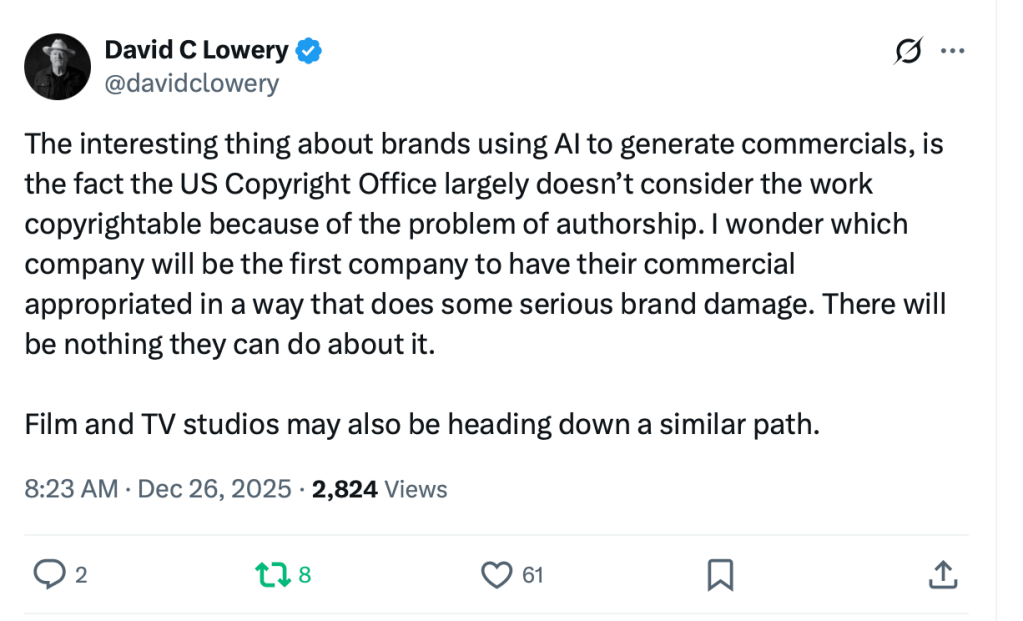
What Don Draper Knew That AI Forgot: Authorship, Ownership, and Advertising

David is pointing to a quiet but serious problem hiding behind the rush to use generative AI in advertising, film, and television: copyright law protects authorship, not outputs. AI muddies or even erases authorship altogether in some cases

Under current U.S. Copyright Office guidance, works generated primarily by AI are often not registrable in the Copyright Office because they lack a human author exercising creative control. That means a brand that relies on AI to generate a commercial may not actually own exclusive rights in the finished work. If someone copies, remixes, or repurposes that ad, even in a way that damages the brand, the company may have little or no legal recourse under copyright law.

The Copyright Office guidance says:

In the Office’s view, it is well-established that copyright can protect only material that is the product of human creativity. Most fundamentally, the term “author,” which is used in both the Constitution and the Copyright Act, excludes non-humans. The Office’s registration policies and regulations reflect statutory and judicial guidance on this issue….If a work’s traditional elements of authorship were produced by a machine, the work lacks human authorship and the Office will not register it For example, when an AI technology receives solely a prompt from a human and produces complex written, visual, or musical works in response, the “traditional elements of authorship” are determined and executed by the technology—not the human user

David has not identified a theoretical risk. Copyright is the backbone of brand control in media. It’s what allows companies to stop misuse, dilution, parody-turned-weapon, or hostile appropriation. In the US, a copyright registration is required to protect those rights. Remove that protection, and brands are left relying on weaker tools like trademark or unfair competition law, which are narrower, slower, and often ill-suited to digital remix culture.

David’s warning extends beyond ads. Film and TV studios experimenting with AI-generated scripts, scenes, music, or visuals may be undermining their own ability to control, license, or defend those works. In trying to save money upfront, they may be giving up the legal leverage that protects their brand, reputation, and long-term value.

Sir Lucian Grainge Just Drew the Brightest Line Yet on AI

by Chris Castle

Universal Music Group’s CEO Sir Lucian Grainge has put the industry on notice in an internal memo to Universal employees: UMG will not license any AI model that uses an artist’s voice—or generates new songs incorporating an artist’s existing songs—without that artist’s consent. This isn’t just a slogan; it’s a licensing policy, an advocacy position, and a deal-making leverage all rolled into one. After the Sora 2 disaster, I have to believe that OpenAI is at the top of the list.

Here’s the memo:

Dear Colleagues,

I am writing today to update you on the progress that we are making on our efforts to take advantage of the developing commercial opportunities presented by Gen AI technology for the benefit of all our artists and songwriters.

I want to address three specific topics:

Responsible Gen AI company and product agreements; How our artists can participate; and What we are doing to encourage responsible AI public policies.

UMG is playing a pioneering role in fostering AI’s enormous potential. While our progress is significant, the speed at which this technology is developing makes it important that you are all continually updated on our efforts and well-versed on the strategy and approach.

The foundation of what we’re doing is the belief that together, we can foster a healthy commercial AI ecosystem in which artists, songwriters, music companies and technology companies can all flourish together.

NEW AGREEMENTS

To explore the varied opportunities and determine the best approaches, we have been working with AI developers to put their ideas to the test. In fact, we were the first company to enter into AI-related agreements with companies ranging from major platforms such as YouTube, TikTok and Meta to emerging entrepreneurs such as BandLab, Soundlabs, and more. Both creatively and commercially our portfolio of AI partnerships continues to expand.

Very recently, Universal Music Japan announced an agreement with KDDI, a leading Japanese telecommunications company, to develop new music experiences for fans and artists using Gen AI. And we are very actively engaged with nearly a dozen different companies on significant new products and service plans that hold promise for a dramatic expansion of the AI music landscape. Further, we’re seeing other related advancements. While just scratching the surface of AI’s enormous potential, Spotify’s recent integration with ChatGPT offers a pathway to move fluidly from query and discovery to enjoyment of music—and all within a monetized ecosystem.

HOW OUR ARTISTS CAN PARTICIPATE

Based on what we’ve done with our AI partners to date, and the new discussions that are underway, we can unequivocally say that AI has the potential to deliver creative tools that will enable us to connect our artists with their fans in new ways—and with advanced capability on a scale we’ve never encountered.

Further, I believe that Agentic AI, which dynamically employs complex reasoning and adaptation, has the potential to revolutionize how fans interact with and discover music.

I know that we will successfully navigate as well as seize these opportunities and that these new products could constitute a significant source of new future revenue for artists and songwriters.

We will be actively engaged in discussing all of these developments with the entire creative community.

While some of the biggest opportunities will require further exploration, we are excited by the compelling AI models we’re seeing emerge.

We will only consider advancing AI products based on models that are trained responsibly. That is why we have entered into agreements with AI developers such as ProRata and KLAY, among others, and are in discussions with numerous additional like-minded companies whose products provide accurate attribution and tools which empower and compensate artists—products that both protect music and enhance its monetization.

And to be clear—and this is very important—we will NOT license any model that uses an artist’s voice or generates new songs which incorporate an artist’s existing songs without their consent.

New AI products will be joined by many other similar ones that will soon be coming to market, and we have established teams throughout UMG that will be working with artists and their representatives to bring these opportunities directly to them.

RESPONSIBLE PUBLIC POLICIES COVERING AI

We remain acutely aware of the fact that large and powerful AI companies are pressuring governments around the world to legitimize the training of AI technology on copyrighted material without owner consent or compensation, among other proposals.

To be clear: all these misguided proposals amount to nothing more than the unauthorized (and, we believe, illegal) exploitation of the rights and property of creative artists.

In addition, we are acting in the marketplace to see our partners embrace responsible and ethical AI policies and we’re proud of the progress being made there. For example, having accurately predicted the rapid rise of AI “slop” on streaming platforms, in 2023 we introduced Artist-Centric principles to combat what is essentially platform pollution. Since then, many of our platform partners have made significant progress in putting in place measures to address the diversion of royalties, infringement and fraud—all to the benefit of the entire music ecosystem.

We commend our partners for taking action to address this urgent issue, consistent with our Artist-Centric approach. Further, we recently announced an agreement with SoundPatrol, a new company led by Stanford scientists that employs patented technology to protect artists’ work from unauthorized use in AI music generators.

We are confident that by displaying our willingness as a community to embrace those commercial AI models which value and enhance human artistry, we are demonstrating that market-based solutions promoting innovation are the answer.

LEADING THE WAY FORWARD

So, as we work to assure safeguards for artists, we will help lead the way forward, which is why we are exploring and finding innovative ways to use this revolutionary technology to create new commercial opportunities for artists and songwriters while simultaneously aiding and protecting human creativity.

I’m very excited about the products we’re seeing and what the future holds. I will update you all further on our progress.

Lucian

Mr. Grainge’s position reframes the conversation from “Can we scrape?” to How do we get consent and compensate? That shift matters because AI that clones voices or reconstitutes catalog works is not a neutral utility—it’s a market participant competing with human creators and the rights they rely on.

If everything is “transformative” then nothing is protected—and that guts not just copyright, but artists’ name–image–likeness (NIL), right of publicity and in some jurisdictions, moral rights. A scrape-first, justify-later posture erases ownership, antagonizes creators living and dead, and makes catalogs unpriceable. Why would Universal—or any other rightsholder—partner with a company that treats works and identity as free training fuel? What’s great about Lucian’s statement is he’s putting a flag in the ground: the industry leader will not do business with bad actors, regardless of the consequences.

What This Means in Practice

  1. Consent as the gate. Voice clones and “new songs” derived from existing songs require affirmative artist approval—full stop.
  2. Provenance as the standard. AI firms that want first-party deals must prove lawful ingestion, audited datasets, and enforceable guardrails against impersonation.
  3. Aligned incentives. Where consent exists, there’s room for discovery tools, creator utilities, and new revenue streams; where it doesn’t, there’s no deal.

Watermarks and “AI-generated” labels don’t cure false endorsement, right-of-publicity violations, or market substitution. Platforms that design, market, or profit from celebrity emulation without consent aren’t innovating—they’re externalizing legal and ethical risk onto artists.

Moral Rights: Why This Resonates Globally

Universal’s consent-first stance will resonate in moral-rights jurisdictions where authors and performers hold inalienable rights of attribution and integrity (e.g., France’s droit moral, Germany’s Urheberpersönlichkeitsrecht). AI voice clones and “sound-alike” outputs can misattribute authorship, distort a creator’s artistic identity, or subject their work to derogatory treatment—classic moral-rights harms. Because many countries recognize post-mortem moral rights and performers’ neighboring rights, the “no consent, no license” rule is not just good governance—it’s internationally compatible rights stewardship.

Industry Leadership vs. the “Opt-Out” Mirage

It is absolutely critical that the industry leader actively opposes the absurd “opt-out” gambit and other sleights of hand Big Technocrats are pushing to drive a Mack truck through so-called text-and-data-mining loopholes. Their playbook is simple: legitimize mass training on copyrighted works first, then dare creators to find buried settings or after-the-fact exclusions. That flips property rights on their head and is essentially a retroactive safe harbor,

As Mr. Grainge notes, large AI companies are pressuring governments to bless training on copyrighted material without owner consent or compensation. Those proposals amount to the unauthorized—and unlawful—exploitation of artists’ rights and property. By refusing to play along, Universal isn’t just protecting its catalog; it’s defending the baseline principle that creative labor isn’t scrapable.

Consent or Nothing

Let’s be honest: if AI labs were serious about licensing, we wouldn’t have come one narrow miss away from a U.S. state law AI moratorium triggered by their own overreach. That wasn’t just a safe harbor for copyright infringement, that was a safe harbor for everything from privacy, to consumer protection, to child exploitation, to everything. That’s why it died 99-1 in the Senate, but it was a close run thing,,

And realize, that’s exactly what they want when they are left to their own devices, so to speak. The “opt-out” mirage, the scraping euphemisms, and the rush to codify TDM loopholes all point the same direction—avoid consent and avoid compensation. Universal’s position is the necessary counterweight: consent-first, provenance-audited, revenue-sharing with artists and songwriters (and I would add nonfeatured artists and vocalists) or no deal. Anything less invites regulatory whiplash, a race-to-the-bottom for human creativity, and a permanent breach of trust with artists and their estates.

Reading between the lines, Mr. Grainge has identified AI as both a compelling opportunity and an existential crisis. Let’s see if the others come with him and stare down the bad guys.

And YouTube is monetizing Sora videos

[This post first appeared on Artist Rights Watch]

Hey Budweiser, You Give Beer a Bad Name

In a world where zero royalties becomes a brag, and one second of music is one second too far.

Let me set the stage: Cannes Lions is the annual eurotrash…to coin a phrase…circular self-congratulatory hype fest at which the biggest brands and ad agencies in the world if not the Solar System spend unreal amounts of money telling each other how wonderful they are. Kind of like HITS Magazine goes to Cannes but with a real budget. And of course the world’s biggest ad platform–guess who–has a major presence there among the bling and yachts of the elites tied up in Yachtville by the Sea. And of course they give each other prizes, and long-time readers know how much we love a good prize, Nyan Cat wise.

Enter the King of Swill, the mind-numbingly stupid Budweiser marketing department. Or as they say in Cannes, Le roi de la bibine.

Credit where it’s due: British Bud-hater and our friend Chris Cooke at CMU flagged this jaw-dropper from Cannes Lions, where Budweiser took home the Grand Prix for its “One‑Second Ad” campaign—a series of ultra-short TikTok clips that featured the one second of hooks from iconic songs. The gimmick? Tease the audience just long enough to trigger nostalgia, then let the internet do the rest. The beer is offensive enough to any right-thinking Englishman, but the theft? Ooh la la.

Cannes Clown

Budweiser’s award-winning brag? “Zero ads were skipped. $0 spent on music right$.” Yes, that’s correct–“right$”.

That quote should hang in a museum of creative disinformation.

There’s an old copyright myth known as the “7‑second rule”—the idea that using a short snippet of a song (usually under 7 seconds) doesn’t require a license. It’s pure urban legend. No court has ever upheld such a rule, but it sticks around because music users desperately want it to be true. Budweiser didn’t just flirt with the myth—it took the myth on a date to Short Attention Span Theater, built an ad campaign around it, and walked away with the biggest prize in advertising to the cheers of Googlers everywhere.

When Theft from artists Becomes a Business Model–again

But maybe this kind of stunt shouldn’t come as a surprise. When the richest corporations in commercial history are openly scraping, mimicking, and monetizing millions of copyrighted works to train AI models—without permission and without payment—and so far getting away with it, it sends a signal. A signal that says: “This isn’t theft, it’s innovation.” Yeah, that’s the ticket. Give them a prize.

So of course Budweiser’s corporate brethren start thinking: “Me too.

As Austin songwriter Guy Forsyth wrote in Long Long Time“Americans are freedom-loving people, and nothing says freedom like getting away with it.” That lyric, in this context, resonates like a manifesto for scumbags.

The Immorality of Virality

For artists and the musicians and vocalists who created the value that Budweiser is extracting, the campaign’s success is a masterclass in bad precedent. It’s one thing to misunderstand copyright; it’s another to market that misunderstanding as a feature. When global brands publicly celebrate not paying for music–in Cannes, of all places—the very tone-deaf foundation of their ad’s emotional resonance sends a corrosive signal to the entire creative economy. And, frankly, to fans.

Oops!… I Did It Again, bragged Budweiser, proudly skipping royalties like it’s Free Fallin’, hoping no one notices they’re just Smooth Criminals playing Cheap Thrills with other people’s work. It’s not Without Me—it’s without paying anyone—because apparently Money for Nothing is still the vibe, and The Sound of Silence is what they expect from artists they’ve ghosted.

Because make no mistake: even one second of a recording can be legally actionable particularly when the intentional infringing conspiracy gets a freaking award for doing it. That’s not just law—it’s basic respect, which is kind of the same thing. Which makes Budweiser’s campaign less of a legal grey area and more of a cultural red flag with a bunch of zeros. Meaning the ultimate jury award from a real jury, not a Cannes jury.

This is the immorality of virality: weaponizing cultural shorthand to score branding points, while erasing the very artists who make those moments recognizable. When the applause dies down in Yachtville, what’s left is a case study in how to win by stealing — not creating.

French court orders search firms to block pirate sites | BBC

A court in France has ordered Google, Microsoft and Yahoo to block 16 video-streaming sites from their search results.

The court said the sites broke French intellectual property laws and were “almost entirely dedicated” to streaming content without the owners’ permission.

Google, Microsoft and Yahoo must now take measures to ensure the blocked pages cannot be found in a list of search results.

ISPs, including Orange and Bouygues Telecom, will also have to prevent users from being able to access the sites.

READ THE FULL STORY AT THE BBC:
http://www.bbc.co.uk/news/technology-25185819