
What We Know—and Don’t Know—About Spotify and NMPA’s “Opt-In” Audiovisual Deal

When Spotify and the National Music Publishers’ Association (NMPA) announced an “opt-in” audiovisual licensing portal this month, the headlines made it sound like a breakthrough for independent songwriters. In reality, what we have is a bare-bones description of a direct-license program whose key financial and legal terms remain hidden from view.

Here’s what we do know. The portal (likely an HFA extravaganza) opened on November 11, 2025 and will accept opt-ins through December 19. Participation is limited to NMPA member publishers, and the license covers U.S. audiovisual uses—that is, music videos and other visual elements Spotify is beginning to integrate into its platform. It smacks of the side deal on pending and unmatched tied to frozen mechanicals that the CRB rejected in Phonorecords IV.

Indeed, one explanation for the gun decked opt-in period is in The Desk:

Spotify is preparing to launch music videos in the United States, expanding a feature that has been in beta in nearly 100 international markets since January, the company quietly confirmed this week.

The new feature, rolling out to Spotify subscribers in the next few weeks, will allow streaming audio fans to watch official music videos directly within the Spotify app, setting the streaming platform in more direct competition with YouTube.

The company calls it a way for indies to share in “higher royalties,” but no rates, formulas, or minimum guarantees have been disclosed so it’s hard to know “higher” compared to what? Yes, it’s true that if you evan made another 1¢ that would be “higher”—and in streaming-speak, 1¢ is big progress, but remember that it’s still a positive number to the right of the decimal place preceded by a zero.

The deal sits alongside Spotify’s major-publisher audiovisual agreements, which are widely believed to include large advances and broader protections—none of which apply here. There’s also an open question of whether the majors granted public performance rights as an end run around PROs, which I fully expect. There’s no MFN clause, no public schedule, and no audit details. I would be surprised if Spotify agreed to be audited by an independent publisher and even more surprised if the announced publishers with direct deals did not have an audit right. So there’s one way we can be pretty confident this is not anything like MFN terms aside from the scrupulous avoidance of mentioning the dirty word: MONEY.

But it would be a good guess that Spotify is interested in this arrangement because it fills out some of the most likely plaintiffs to protect them when they launch their product with unlicensed songs or user generated videos and no Content ID clone (which is kind of Schrödinger’s UGC—not expressly included in the deal but not expressly excluded either, and would be competitive with TikTok or Spotify nemesis YouTube).

But here’s what else we don’t know: how much these rights are worth, how royalties will be calculated, whether they include public performances to block PRO licensing of Spotify A/V (and which could trigger MFN problems with YouTube or other UGC services) and whether the December 19 date marks the end of onboarding—or the eve of a US product launch. And perhaps most importantly, how is it that NMPA is involved, the NMPA which has trashed Spotify far and wide over finally taking advantage of the bundling rates negotiated in the CRB (indeed in some version since 2009). Shocked, shocked that there’s bundling going on.

It’s one thing to talk about audiovisual covering “official” music videos and expressly stating that the same license will not be used to cover UGC no way, no how. Given Spotify’s repeated hints that full-length music videos are coming to the U.S. and the test marketing reported by The Desk and disclosed by Spotify itself, the absolute silence of the public statements about royalty rates and UGC, as well as the rush to get publishers to opt in before year-end all suggest that rollout is imminent. Until Spotify and the NMPA release the actual deal terms, though, we’re all flying blind—sheep being herded toward an agreement cliff we can’t fully see.

[A version of this post first appeared on MusicTechPolicy]

@ArtistRights Newsletter 8/18/25: From Jimmy Lai’s show trial in Hong Kong to the redesignation fight over the Mechanical Licensing Collective, this week’s stories spotlight artist rights, ticketing reform, AI scraping, and SoundExchange’s battle with SiriusXM.

Save the Date! September 18 Artist Rights Roundtable in Washington produced by Artist Rights Institute/American University Kogod Business & Entertainment Program. Details at this link!

Artist Rights

JIMMY LAI’S ORDEAL: A SHOW TRIAL THAT SHOULD SHAME THE WORLD (MusicTechPolicy/Chris Castle)

Redesignation of the Mechanical Licensing Collective

Ex Parte Review of the MLC by the Digital Licensee Coordinator

Ticketing

StubHub Updates IPO Filing Showing Growing Losses Despite Revenue Gain (MusicBusinessWorldwide/Mandy Dalugdug)

Lewis Capaldi Concert Becomes Latest Ground Zero for Ticket Scalpers (Digital Music News/Ashley King)

Who’s Really Fighting for Fans? Chris Castle’s Comment in the DOJ/FTC Ticketing Consultation (Artist Rights Watch)

Artificial Intelligence

MUSIC PUBLISHERS ALLEGE ANTHROPIC USED BITTORRENT TO PIRATE COPYRIGHTED LYRICS(MusicBusinessWorldwide/Daniel Tencer)

AI Weather Image Piracy Puts Storm Chasers, All Americans at Risk (Washington Times/Brandon Clemen)

TikTok After Xi’s Qiushi Article: Why China’s Security Laws Are the Whole Ballgame (MusicTechSolutions/Chris Castle)

Reddit Will Block the Internet Archive (to stop AI scraping) (The Verge/Jay Peters) 

SHILLING LIKE IT’S 1999: ARS, ANTHROPIC, AND THE INTERNET OF OTHER PEOPLE’S THINGS(MusicTechPolicy/Chris Castle)

SoundExchange v. SiriusXM

SOUNDEXCHANGE SLAMS JUDGE’S RULING IN SIRIUSXM CASE AS ‘ENTIRELY WRONG ON THE LAW’(MusicBusinessWorldwide/Mandy Dalugdug)

PINKERTONS REDUX: ANTI-LABOR NEW YORK COURT ATTEMPTS TO CUT OFF LITIGATION BY SOUNDEXCHANGE AGAINST SIRIUS/PANDORA (MusicTechPolicy/Chris Castle)

@wordsbykristin: Legal Fights, Transparency & Neutrality: DiMA’s CEO On Improvements Streamers Suggest for the MLC

Kristin Robinson makes another important contribution to the artist rights conversation with her interview of Graham Davies, the new head of the Digital Media Association. Graham comes to DiMA from a background in the artist rights movement at our friends the Ivors Academy in the UK. We have high hopes for Graham who brings his intellect to clean up a long, long line of mediocrity at the DiMA leadership who are from Washington and here to help.

Kristin’s interview highlights DiMA’s recent filings in The Reup–the redesignation of the MLC by the Copyright Office that we’ve highlighted on Trichordist. He also has some well thought out analysis on how the MLC is not HFA, however similar the two may seem in practice.

This is an important interview and you can find it on Billboard (subscription required).

Here’s an example of Graham’s insight:

Do you think a re-designation every five years is not enough on its own?

I think it’ll be interesting to see what the re-designation process brings forward from the Copyright Office. Maybe the Copyright Office leans in on governance and says, “We’ve heard enough, and we can come forward with ideas.” But the re-designation process is a different thing than a governance review, which would bring in a special team to actually dig into governance-related issues and bring forward recommendations and proposals that could then be implemented. It would be something more specific and something the MLC could just do. You wouldn’t need the Copyright Office to sponsor it, though they could if they wanted to.

Clowns to the Left of Me, Jokers To the Right: When Will the MLC Show Us the Money?

If you’ve received one of these emails from the MLC about having to recast their monthly statement inside of a single month, when you’re eying that $500,000,000 of supposedly unmatched money that’s sitting in the MLC, Inc.’s bank account (maybe?), or if you’re trying to figure out when they are launching the vastly overdue claiming portal, you’re probably wondering–who’s in the clown car today? Bozo or Pennywise?

But maybe they’re smarter than they look. Because all they have to do to distribute that $500,000,000 on a market share basis is keep you looking at the bright and shiny object while they run out the clock.

And if you’re waiting for the Copyright Office to save you because they have “oversight”, you’re going to be waiting for a long time. Here’s the reality–nobody is minding the store. There’s a difference between “oversight” and “overwatch.” In Washington, “oversight” means finding someone else to blame and from the very beginning it has been clear who the MLC intends to blame–you. Because you didn’t “play your part” or sufficiently “connect to collect”.

The Copyright Office has done a couple things while under the supervision of the current head lobbyist for Spotify. They’re good at studies, terrible at oversight, so let’s give credit where it’s due. But also realize that’s where it stops because they have about as much moxie as a starfish. (And if you think the NMPA is going to save you, take a look at the frozen mechanicals debacle and ask yourself if a rational person could really take that seriously.)

At the core of the MLC’s business model is the ability to match. Matching is kind of a “See Spot run” building block. If you can’t match, it’s very close to saying you can’t count. Because it depends on what the definition of “match” is.

So what is a match? Or as the Bard might say, how can I screw thee? Let me count the ways. The Copyright Office produced the Unclaimed Royalties Best Practices study partly on this very topic. Notice the difference between “best practices” and “rules.” “Best practices” is not the same as “rule”. If you violate a best practice, nothing happens to you, so therefore perfect for Washington. If you violate a rule, bad things happen to you. The connective tissue is enforcement. If you violate a rule at the Securities and Exchange Commission, you wear stripes. If you violate a rule at the Environmental Protection Agency, you will pay a fine, for sure. If you violate a rule at the MLC? There really aren’t any so it can’t happen. In other words, it’s just like the Harry Fox Agency.

But that’s what we have so let’s look at one passage in particular from the Best Practice Study because that’s the closest we have to a rule book.

The Office recommends that the MLC make all [matching] metrics publicly available, except to the extent it would cause confidential or business sensitive information to be improperly disclosed. [God forbid.] Specifically regarding match rates, the Office acknowledges the MLC’s point that “vendors can easily increase their claimed ‘match percentage’ by simply dropping the confidence level at which they call something a match.” For that reason, the Office recommends that the MLC provide appropriate context for its metrics, including information surrounding how it defines a match, relevant confidence levels, and how confidence levels are tuned. Additionally, so that they are clear and precise, and to avoid possible confusion, the Office recommends that all royalty figures be provided both with and without accrued interest. [How about a best practice of how they are practicing complying with best practices best?

The Office recommends that in addition to providing annual statistics in its annual report, the MLC also have a dedicated public webpage displaying all of these metrics in a clear, well-organized, user-friendly, and accessible manner. The webpage should be interactive and allow users to search, sort, and break down the data so it may be more easily reviewed and analyzed. The webpage should also have an export or download feature, including bulk exporting/downloading, to aid public consumption and dissemination. The Office recommends that the webpage be updated monthly after each batch of new reports of usage arrive and go through initial matching processes. All metrics should be retained and made available online indefinitely (though the MLC could distinguish between current and historic metrics in the future) so long-term trends can be assessed and to ensure the public and the Office have access to them in connection with the review of the MLC’s designation every five years. The MLC should also be very clear about how applicable metrics may change in response to DMP reporting adjustments and the reconciliation of any related royalty underpayments or overpayments permitted by the Office’s regulations. Relatedly, the Office also recommends that the MLC make publicly available relevant metrics about DMP reported usage that the MLC determines is not subject to blanket licenses (e.g., where it is subject to a voluntary license instead, public domain musical works, etc.), such that any related paid royalties have been credited or refunded back to the DMP.

What would also be nice is to tell you how much of your money they are holding and how you get it back. Maybe they could practice the best out of that.

There’s nothing particularly insightful about any of that, right? It’s the kind of thing that any songwriter giving the subject a moment or two of thought could have figured out at any point in the last 100 years. It’s also the kind of thing that you would have expected to have been built into the MLC’s system–which is essentially the HFA system–from the beginning.

It doesn’t matter what they say they aspire to do. Naturally they have to say they aspire to get it 100% correct–because otherwise that raises some interesting questions about intent, right?

Will they ever be called to account for their failures? Doubtful. The only business in the world where you can get the government to let you hold $500,000,000 of other people’s money and then keep it because paying it out was just too hard for you.

Do you think this mess is what Congress had in mind after they were fed a bunch of crap by the know-nothing lobbyists?

So let’s ask again–Bozo or Pennywise?

Will the @CommonsDCMS Committee Ask How Apple and Spotify Got Away With Hundreds of Millions in Black Box for So Many Years?

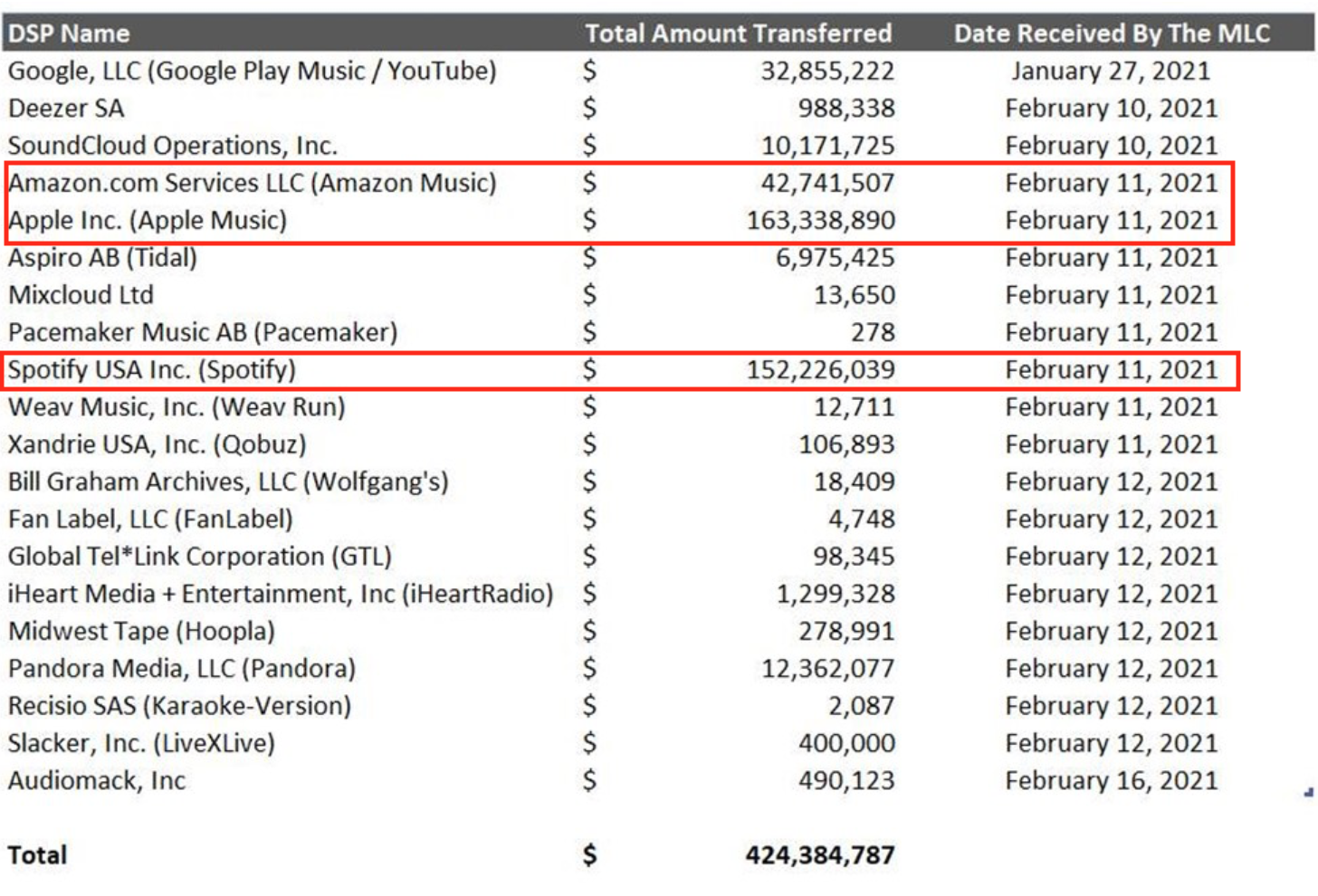
One of the questions that immediately comes to mind with the announcement of the MLC’s $424 million black box payment is how did they get away with owing so much money to so many people for so long? Tough question to get an answer to for the average songwriter, but good news: The UK Parliament’s inqiury into the economics of streaming is meeting on February 23 and will have before it senior representatives of Amazon, Apple and Spotify! Great timing! These three companies alone account for $350,000,000 in black box, or 82% of the total.

MLC Payments

So not only can the Committee inquire into how long the companies got away with it and the justification for holding onto so much of other people’s money for so long, but the Committee could also inquire as to whether there are any UK songwriters included in the respective companies black box payments for exploitations in the US during the worst pandemic in living memory.

Remember, these services are required by law to obtain a license to exploit all these songs. This was always the deal and they knew going into business what was expected of them. The law requires them to find the songwriter or not use the song. It doesn’t require them to not find the songwriter but use the song anyway.

The DLC Finally Confirms (Sort Of) How Much is in the MMA Black Box–Bigger than a breadbox

By Chris Castle

[This post first appeared on MusicTechPolicy]
We’ve all heard rumors about how much is in the “inception to date” black box at the digital music services. The main reason that nobody knows is another example of the dismal drafting of the Music Modernization Act.

Limitation on Liability

Wouldn’t you think that if the class actions against Spotify gave the insiders the leverage to negotiate the MMA giveaway that they could at least have gotten an immediate accounting from the services for how much of the songwriters’ money they’ve been holding all these years? But no, it’s sleepy time in Washington yet again. From the Land of Frozen Mechanicals they bring you more Brinksmanship 101. The retroactive black box payment is due to be made by the services to the MLC and its data vendor, HFA–remembering that HFA was also the data vendor for at least some of the services that created the black box in the first place.

limitation on liability 2

However, there is some activity at the Copyright Office now about how to get this money paid. It’s at the Copyright Office because while drafting the aircraft carrier revision to the Copyright Act (aka Title I of the Music Modernization Act), the hard parts were never drafted and were left to the Copyright Office to handle through regulations. Musicians–you’ve seen this before. This is the Washington version of “we’ll fix it in the mix.” So you do have feel sympathy for the Copyright Office in the situation when all the smart people leave them twisting in the breeze.

Not that I necessarily believe this number, but for the first time the services have given a bigger than a breadbox idea of how much is in the black box. The DLC’s lawyers filed an “ex parte” letter in which they made that revelation (along with the known universe: Artist Rights Alliance Ex Parte Letter (Nov. 17, 2020)Digital Licensee Coordinator Ex Parte Letter (Nov. 17, 2020)Mechanical Licensing Collective Ex Parte Letter (Nov. 17, 2020)Music Artists Coalition Ex Parte Letter (Nov. 17, 2020)Nashville Songwriters Association International Ex Parte Letter (Nov. 17, 2020)National Music Publishers’ Association Ex Parte Letter (Nov. 17, 2020)Recording Academy & Songwriters of North America Ex Parte Letter (Nov. 17, 2020)Songwriters Guild of America et al. Ex Parte Letter (Nov. 18, 2020).)

The DLC itself is at the mercy of its members in terms of revealing this number but they claim the following in the Digital Licensee Coordinator Ex Parte Letter (Nov. 17, 2020):

DLC also provided a rough estimate of accrued royalties that are available to be transferred to the MLC, based on a limited survey of a subset of DLC members at a particular point in time, and with the crucial caveat that the precise amounts are in flux as digital music providers continue to engage in robust matching efforts. Specifically, DLC estimated that several hundred million dollars were available to be transferred to the MLC as accrued royalties, even after accounting for the derecognition of accruals based on preexisting agreements containing releases to claims for accrued royalties.

DLC also explained that the accruals that were derecognized because copyright owners were paid and provided releases were a fraction of that amount—on the order of tens of millions of dollars.

So now we know at least that much. We know there are “several hundred million” dollars at issue in the black box and we generally know where the money is. We may know that DLC members hold the money. We also know that this money has not been identified, but we at least know enough to get the nose of the camel in the tent.