On August 22, 2025, the Artist Rights Institute, together with music publisher Abby North, filed joint comments with the U.S. Copyright Office as part of the agency’s ongoing five-year redesignation review of the Mechanical Licensing Collective (MLC). The comments memorialize an ex parte meeting with senior Copyright Office attorneys and stress that this redesignation process must not become a perfunctory exercise. Instead, it should serve as a meaningful opportunity to hold the MLC accountable for its statutory obligations.
The filing underscores that Congress deliberately gave the Copyright Office broad regulatory oversight because the MLC was established as an experiment under the Music Modernization Act. After five years, the evidence points to serious deficiencies: continuing metadata errors, lack of access to bulk matching tools for rightsholders, opaque governance decisions, and unresolved questions about audits and litigation. Most strikingly, the MLC’s unilateral investment of unmatched royalties in the securities markets—totaling more than $1.2 billion on the MLC’s latest tax return—raises concerns about statutory authority and fiduciary duties.
The joint comments argue that interest on unmatched royalties was intended by Congress as a penalty on licensees for failure to timely match and pay, not as a windfall for the MLC itself. By adopting an unauthorized investment policy, the MLC risks stepping outside its mandate, exposing its officers and directors to fiduciary liability.
To restore transparency and trust, the Institute and Ms. North propose clear regulatory reforms: conditional redesignation tied to performance benchmarks, publication of vendor match rates, real-time disclosure of governance actions, clarified metadata responsibilities, and monthly reporting of investment holdings. These reforms would align the U.S. system with international best practices and protect songwriters whose livelihoods depend on fair and accurate royalty distributions.
Save the Date! September 18 Artist Rights Roundtable in Washington produced by Artist Rights Institute/American University Kogod Business & Entertainment Program. Details at this link!
In a world where zero royalties becomes a brag, and one second of music is one second too far.
Let me set the stage: Cannes Lions is the annual eurotrash…to coin a phrase…circular self-congratulatory hype fest at which the biggest brands and ad agencies in the world if not the Solar System spend unreal amounts of money telling each other how wonderful they are. Kind of like HITS Magazine goes to Cannes but with a real budget. And of course the world’s biggest ad platform–guess who–has a major presence there among the bling and yachts of the elites tied up in Yachtville by the Sea. And of course they give each other prizes, and long-time readers know how much we love a good prize, Nyan Cat wise.
Enter the King of Swill, the mind-numbingly stupid Budweiser marketing department. Or as they say in Cannes, Le roi de la bibine.
Credit where it’s due: British Bud-hater and our friend Chris Cooke at CMU flagged this jaw-dropper from Cannes Lions, where Budweiser took home the Grand Prix for its “One‑Second Ad” campaign—a series of ultra-short TikTok clips that featured the one second of hooks from iconic songs. The gimmick? Tease the audience just long enough to trigger nostalgia, then let the internet do the rest. The beer is offensive enough to any right-thinking Englishman, but the theft? Ooh la la.
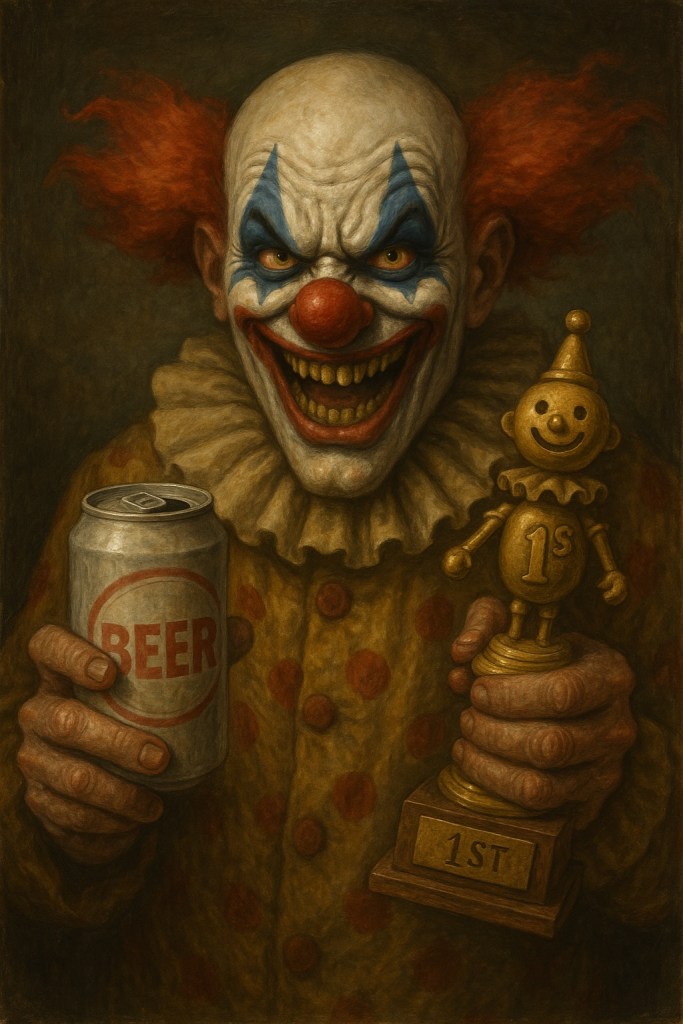
Cannes Clown
Budweiser’s award-winning brag? “Zero ads were skipped. $0 spent on music right$.” Yes, that’s correct–“right$”.
That quote should hang in a museum of creative disinformation.
There’s an old copyright myth known as the “7‑second rule”—the idea that using a short snippet of a song (usually under 7 seconds) doesn’t require a license. It’s pure urban legend. No court has ever upheld such a rule, but it sticks around because music users desperately want it to be true. Budweiser didn’t just flirt with the myth—it took the myth on a date to Short Attention Span Theater, built an ad campaign around it, and walked away with the biggest prize in advertising to the cheers of Googlers everywhere.
When Theft from artists Becomes a Business Model–again
But maybe this kind of stunt shouldn’t come as a surprise. When the richest corporations in commercial history are openly scraping, mimicking, and monetizing millions of copyrighted works to train AI models—without permission and without payment—and so far getting away with it, it sends a signal. A signal that says: “This isn’t theft, it’s innovation.” Yeah, that’s the ticket. Give them a prize.
So of course Budweiser’s corporate brethren start thinking: “Me too.”
As Austin songwriter Guy Forsyth wrote in Long Long Time, “Americans are freedom-loving people, and nothing says freedom like getting away with it.” That lyric, in this context, resonates like a manifesto for scumbags.
The Immorality of Virality
For artists and the musicians and vocalists who created the value that Budweiser is extracting, the campaign’s success is a masterclass in bad precedent. It’s one thing to misunderstand copyright; it’s another to market that misunderstanding as a feature. When global brands publicly celebrate not paying for music–in Cannes, of all places—the very tone-deaf foundation of their ad’s emotional resonance sends a corrosive signal to the entire creative economy. And, frankly, to fans.
Oops!… I Did It Again, bragged Budweiser, proudly skipping royalties like it’s Free Fallin’, hoping no one notices they’re just Smooth Criminals playing Cheap Thrills with other people’s work. It’s not Without Me—it’s without paying anyone—because apparently Money for Nothing is still the vibe, and The Sound of Silence is what they expect from artists they’ve ghosted.
Because make no mistake: even one second of a recording can be legally actionable particularly when the intentional infringing conspiracy gets a freaking award for doing it. That’s not just law—it’s basic respect, which is kind of the same thing. Which makes Budweiser’s campaign less of a legal grey area and more of a cultural red flag with a bunch of zeros. Meaning the ultimate jury award from a real jury, not a Cannes jury.
This is the immorality of virality: weaponizing cultural shorthand to score branding points, while erasing the very artists who make those moments recognizable. When the applause dies down in Yachtville, what’s left is a case study in how to win by stealing — not creating.
The latest twist in the long-running AM radio saga comes from a new alliance: cars and music. Automaker trade groups Alliance for Automotive Innovation, Consumer Technology Association, and Zero Emission Transportation Association are shoulder to shoulder with the musicFIRST Coalition and SoundExchange in urging Congress to link the “AM Radio in Every Vehicle Act” with the American Music Fairness Act (AMFA). If we’re going to mandate AM radios be placed in new cars then music played on those radios should pay the people who made that music. It’s unfair and fundamentally inconsistent to require one without the other, so broadcasters should pay artists.
What Is the American Music Fairness Act?
If you haven’t run across it yet, AMFA is bipartisan legislation sponsored by our champion Senator Marsha Blackburn in the Senate and our long-time ally Rep. Darrell Issa in the House of Representatives that would finally require AM/FM radio stations to pay performance royalties to recording artists and performers when their recordings are played over the air. Currently, the U.S. remains the only democracy that allows terrestrial radio to make billions from music without compensating performers.
Why Artists Get Left Out
As incredible as it may seem, under U.S. copyright law, terrestrial radio must pay songwriters and publishers—but not performers or sound recording rights holders. That means backup singers, session musicians, and producers receive zero compensation, even when their work drives–literally–billions in broadcast revenue. This is what allows the National Association of Broadcasters shillery to claim “we pay for music” and then try to pit artists against songwriters. That dog won’t hunt, but that never stops them from trying.
The musicFIRST Coalition, including SoundExchange and tons of artists and creators, has been front and center pushing Congress to close this loophole for years and we have been right there with them along with our friend Blake Morgan and his #IRespectMusic campaign.
“Mandating AM radio without addressing the performance royalty issue would perpetuate an inequity that denies hundreds of millions of dollars in compensation to countless recording artists every year. Congress should not pass a mandate for radio without ensuring appropriate royalties for artists… They deserve to have their hard work respected and valued with fair compensation — like they receive in every other industrialized country.” —SoundExchange CEO Michael Huppe
The Math on AMFA
U.S. radio plays over 240 million songs annually without compensating performers
The music industry could gain an estimated $200–300 million annually if Americans were paid for domestic and foreign broadcast plays
Aligns U.S. copyright with global norms—terrestrial radio already pays performers in virtually every other developed nation.
What is to be done
If Congress is going to mandate AM radio in every car, it can’t ignore the rights of the very artists who create the content. By demanding performance royalties through AMFA, we can preserve public safety benefits while ensuring creators are paid for their work. This is a rare chance for Congress to get it right—fairness and infrastructure can go hand-in-hand.
If you believe artists deserve fairness when their music plays on the radio, now is the time to act:

 The Trichordist
You must be logged in to post a comment.