
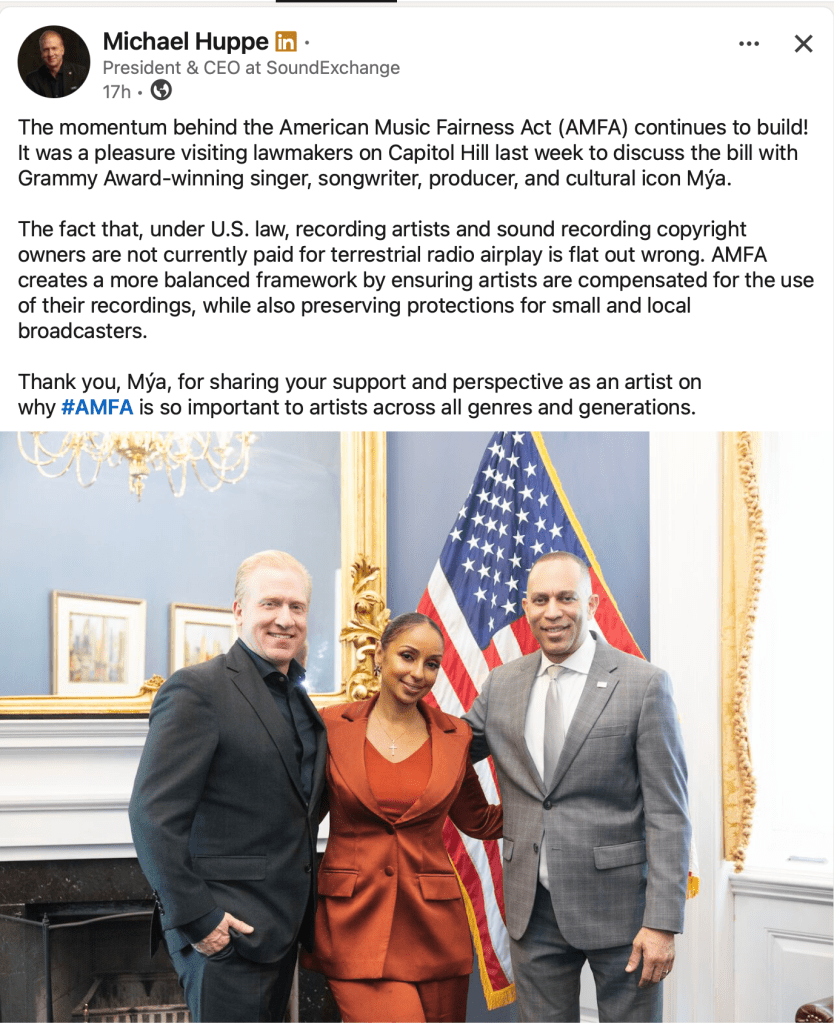
Readers of this blog know we’ve spent years supporting the American Music Fairness Act and its predecessor legislation, as well as the tireless efforts of the MusicFIRST Coalition and Blake Morgan’s #IRespectMusic campaign to modernize U.S. law. The argument has always been simple: the United States is virtually alone among developed nations in refusing to pay recording artists when their music is played on AM/FM radio. We’ve long argued that this is unfair to American performers.
Now it may become something even worse.
On July 8, an unusually broad coalition representing virtually every corner of the American music industry—including performers, musicians, independent labels, collecting societies, unions, songwriters’ organizations, managers, and the Recording Academy—sent a letter to U.S. Trade Representative Jamieson Greer warning that the European Commission has indicated it may consider legislation that could use this gap in U.S. law as the basis for reducing or denying royalties to American performers and record companies in Europe.
According to the coalition, nearly $300 million in annual royalties could be at risk if Europe abandons the longstanding principle of national treatment in favor of what proponents call “material reciprocity,” the latest mercantilist dodge. The coalition urged the Administration to oppose any such proposal as a trade matter. They identified passage of the American Music Fairness Act as the most direct way to eliminate the rationale behind Europe’s proposed policy shift.
That makes this story about far more than royalties for broadcasts (“neighboring rights”). It is about whether a longstanding defect in U.S. copyright law is beginning to produce real economic consequences for American creators overseas—and why organizations that rarely agree have united to ask the United States government to respond and protect American creators.
What Is National Treatment?
For generations, national treatment has been one of the foundational principles of international copyright and neighboring rights. Simply put, when another country uses an American recording, American performers generally receive the same treatment that country gives its own creators. That principle has helped ensure that American musicians, background singers, session players, independent artists, and record companies receive compensation when their recordings are broadcast or publicly performed overseas.
The policy now being discussed in Europe would move away from that principle in favor of what proponents call material reciprocity. The phrase sounds technical—even fair. It is anything but straightforward.
“Material reciprocity” sounds like a neutral rule requiring countries to treat one another equally. It is more accurately an optional exception to national treatment derived from the reservation provisions of the WIPO Performances and Phonograms Treaty. The treaty permits a country to limit protection to the extent another country has limited its own remuneration right; it does not require that result.
In practice, the proposed European approach would allow royalties generated by the use of American recordings in Europe to be withheld from the American performers whose recordings generated them, based on a defect in U.S. law over which those creators have little control and have done their best to rid themselves.
In other words, Europe would not be saying American recordings have no value. Make no mistake, those recordings would still be broadcast. Broadcasters would still pay royalties. The question—as usual—would simply become who gets the money? Spoiler alert—it’s not the artist who earned the money.
Why This Is Happening
The immediate backdrop is the 2020 decision of the Court of Justice of the European Union in RAAP, which held that American performers are entitled to equitable remuneration under existing European law. Following that decision, most EU member states amended their laws to comply.
Not everyone welcomed that result.
IMPALA, which represents independent record companies across Europe, has been among the organizations urging the European Commission to restore “material reciprocity” after RAAP. Its position is straightforward: European performers and labels should not be required to share European neighboring-rights royalties with American performers when the United States provides no comparable terrestrial radio right to Europeans—even if the U.S. performers earned those royalties in Europe. Get it?
There is a certain irony here.
For years, supporters of the American Music Fairness Act argued that Congress should fix the terrestrial radio loophole because it unfairly denied American performers compensation at home. Now that same loophole is being cited overseas as justification for reducing compensation paid to American performers abroad.
Whether one agrees with IMPALA or not, the dispute illustrates that copyright policy increasingly operates as trade policy.
A Remarkably Broad Coalition
One of the most significant aspects of the coalition’s July 8 letter to the USTR is who signed up to it. The coalition includes organizations representing performers, musicians, recording artists, independent labels, managers, unions, composers, songwriters, and collecting societies. These organizations represent different constituencies, pursue different priorities, and advocate competing legislative agendas.
Yet on this issue they have found common ground. Their message is straightforward: American creators should continue receiving the same treatment in Europe that European countries provide their own creators.
That breadth of commitment is significant.
In an era when the music industry is often divided over artificial intelligence, streaming economics, licensing reform, Copyright Royalty Board proceedings, and virtually every other major policy debate, this level of agreement is unusual.
That alone should command policymakers’ attention.
This Is About More Than $300 Million
The dollar figure understandably grabs headlines. But the larger issue is fundamental fairness.
American recordings account for a substantial share of music played on European radio—royalty generating plays on European radio. The royalties generated by those performances are not theoretical. They represent meaningful income for performers whose recordings continue to create value around the world, often years or decades after they were made.
Once governments begin replacing national treatment with reciprocity tests, the stability of international rights system begins to erode. Other countries may decide to revisit their own neighboring-rights systems, creating a patchwork of nationality-based rules that ultimately harms creators everywhere.
For many American performers—particularly independent artists, session musicians, and legacy performers—these foreign neighboring-rights royalties are not windfalls. They are earned compensation for recordings that continue to succeed internationally.
More Than Copyright: A Trade Issue
The coalition is not asking merely for a change in IP policy. It is asking the United States Trade Representative to treat this as a matter of international trade affecting American creators and one of America’s most successful cultural exports.
That is a significant development.
The music industry has long viewed copyright disputes primarily through the lens of intellectual property. This coalition letter recognizes that international copyright rules increasingly function as trade rules as well. Decisions made in Brussels can directly affect the income of American creators and the competitiveness of American cultural exports. As the coalition letter states:
National treatment has long been a cornerstone of the global copyright system, ensuring American creators—including recording artists, musicians, and performers—are treated no less favorably than domestic rightsholders abroad. The Commission’s proposed shift to reciprocity would condition these protections on U.S. law, replacing a clear, rules-based system with one that is fragmented, uncertain and would directly disadvantage U.S. creators in foreign markets….Left unchecked, this approach will erode nondiscrimination principles, invite retaliatory measures, and weaken transatlantic cooperation on intellectual property.
The central trade question is not difficult to understand: should a foreign government be permitted to collect royalties generated by the exploitation of American recordings while denying those royalties to the American performers and producers whose work generated them? Again from the letter:
USTR has already taken an important step by placing the European Union on the Special 301 Watch List. We encourage the Administration to build on this action by fully leveraging available trade tools—including sustained bilateral engagement, coordinated multilateral pressure, and, if necessary, targeted enforcement measures—to prevent the adoption of material reciprocity and ensure compliance with national treatment obligations.
Calling that result “material reciprocity” does not make it any less discriminatory in practice.
Why This Is Significant
International copyright rarely receives widespread public attention until the consequences become irreversible.
The debate over artificial intelligence has reminded us how quickly longstanding norms can come under pressure. Whether the issue is AI training, streaming economics, or neighboring rights, the underlying question remains remarkably consistent:
Will creators continue to receive fair compensation when others profit from their work?
When the Industry Speaks With One Voice
The music industry rarely agrees on anything. Artists and record labels disagree. Major labels and independent labels disagree. Managers, unions, publishers, collecting societies, and digital services often find themselves on opposite sides of legislative and regulatory debates. That is precisely why this coalition is important..
Organizations representing performers, musicians, managers, independent labels, unions, composers, and collecting societies, have all concluded that this issue deserves the immediate attention of the United States government. Whether the European Commission ultimately moves forward with legislation remains to be seen. But the coalition deserves credit for bringing the issue to the attention of the U.S. Trade Representative before any formal legislative proposal has been introduced.
If nothing else, the letter serves as an early warning that international copyright policy and international trade policy are becoming increasingly intertwined—and that decisions made in Brussels can have significant consequences for American creators.
For now, the most important takeaway is simple: pay attention. The music industry rarely speaks with one voice. When it does, policymakers should listen.
This is a story worth watching, and we’ll continue to follow it as it develops.


You must be logged in to post a comment.