If Pandora wants Terrestial Radio Royalty Rates, Act Like It – Problem Solved!

We have no problem with Pandora getting parity with terrestrial radio royalty rates, just disable all of the user interactivity and function exactly like Terrestrial Radio to get exactly the same rates. Isn’t this just obvious?

Simple. Done.

Fair.

In truth, Terrestrial Radio in just about every country outside the USA pays performance royalties to artists and rights holders. So yes, there also should be parity, and Terrestrial Radio in the USA should be paying artists performance royalties as well. The selective reasoning of those who seek to exploit artists seems to know no bounds in it’s lack of consistency or logic.

Stay tuned for more…

Tell Congress: Don’t Slash Music Creators’ Pay

http://musicfirst-coalition.rallycongress.com/7986/tell-congress-dont-slash-music-creators-pay/

Sign the @musiciansunion (AFM) Letter: Friends don’t let friends get IRFA’d!

If you’ve been following the growing opposition to IRFA, the Internet Radio Fairness Act (aka the “Pandora Shakedown Act”), you won’t be surprised to know that Pandora has now enlisted the Über National Association of Broadcasters to help them screw musicians.  (NASDAQ: P)

You’ll remember the NAB–they are the ones who led the dirty tricks campaign against the Performance Rights Act that would have really leveled the playing field by paying American musicians and singers for the same rights that every other country pays them for when records are played on the radio.

So it’s not surprising to see Pandora lining up the lobbying muscle and huge political donations of the dreaded NAB, one of the few trade associations that has a news outlet in every Congressional district.

Do we just have to take it and get bullied?  Not without fighting back.

Here’s a start, a few things you can do:

First–make sure you and your band are registered to vote.  Can I Vote? is a good place to start if you’re not.  If you’re going to be on the road on election day, be sure you find out about early voting or getting an absentee ballot.

You can look up your representative at Tweet Congress and tweet them to vote against IRFA.

You can follow us on Twitter and search for #opposeirfa, then you can decide if you want to retweet our tweets or RTs to Members of Congress, especially members of the House and Senate Judiciary Committees, or

You can use the letter to Congress interface that the American Federation of Musicians has put together for you.  The link will lead you to an interface to enter your zip code to find out who your representatives are, then it pulls up an editable suggested form letter.  You can either use that letter or write your own using the web page.

And remember–friends don’t let friends get IRFA’d!

Pandora, Please Stop discrimination against Musicians!

Below is a letter from Tim Westergren, Founder of Pandora (NASDAQ: P) urging consumers to help him discriminate against musicians by attempting to reduce his royalty obligations.
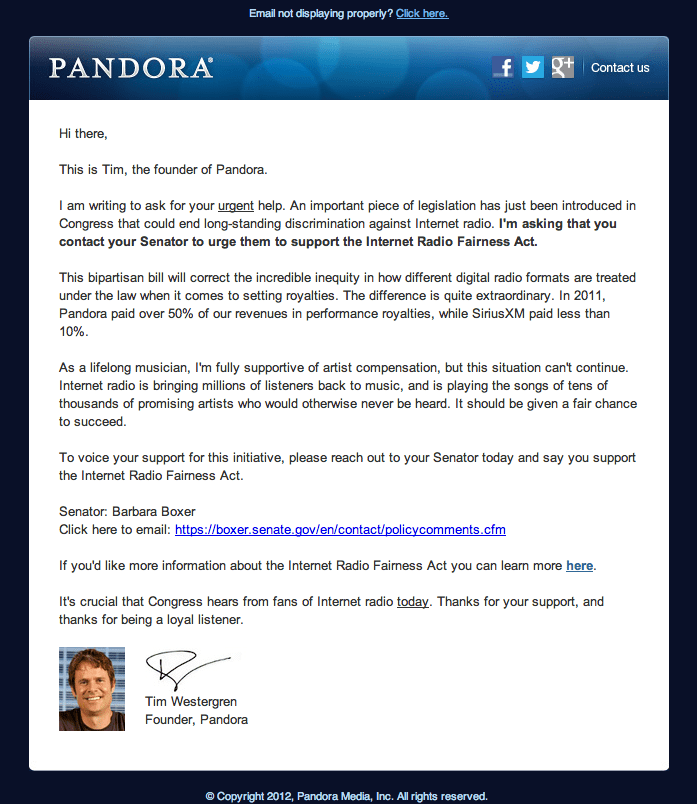
This letter is highly misleading. Pandora is not Radio!! Pandora is a near-on demand streaming service.  Having a subscription to Pandora is like virtually owning every album on earth. (This is complex and we try to talk it through on a high level later in this post.) Pandora should and does pay higher royalties than XM radio for that reason!  It is completely manipulative of Mr. Westergren to compare his royalties to radio royalties.  Shame on him.  Shame on him for trying to get his subscribers to manipulate our government into screwing musicians. I am sad to see that Pandora has come to this:

Just another Silicon Valley firm who can’t make their business model work asking for a bailout from the US government and Musicians.  -David Lowery

We all love Pandora, we love that it pays on time and is honest in its approach and it provides a great platform for independent music. In fact, we’ve seen some estimates that 30% of Pandora’s spins are independent music.

Here’s what the lawyer for the webcasters said about the statutory webcasting rates at the time of the last settlement (and he never mentions artists, by the way):

In sum, while far from a perfect deal that webcasters would have selected on their own, this deal does provide another option for webcasters with substantial advantages in many area to those that qualify for treatment under this deal. While no doubt the fight will continue over the standards that should be used to determine royalties in future proceedings, so that parties don’t need to enter into these after-the-fact settlements [which is not happening now because the 2009 deal is in place until 2015] when one party has a substantial bargaining advantage with a favorable decision already in hand, SoundExchange [including the artist unions] should be credited for agreeing to reach this deal when there was no compulsion that they do so. This deal presents certainty for many webcasters – eliminating further litigation and negotiation costs while setting rates at which a class of webcasters can go on with their operations.

But what’s happening now ain’t personal, it’s just business. Pandora apparently doesn’t like paying artists a fair royalty–at a rate that Pandora negotiated and was all happy with a few years ago–and now is lobbying in Washington to use their political influence to force artists to take lower rates. Pandora compares itself to Sirius:

Consider this: last year Pandora generated $274MM of gross revenue, and paid $136MM of performance royalties — approximately 50 percent of the total revenue. In the same year, SiriusXM, on revenues of $2.7B paid $205M in royalties, or 7.5 percent. Radio delivered over cable television pays 15 percent of revenue. Radio delivered over the FM/AM spectrum pays nothing to performers.

This is, unfortunately, slight of hand–SiriusXM is primarily a subscription service and Pandora is primarily an ad supported service. Apples and oranges aside from low artist royalties–we have issues with Sirius, too, but that’s another story. The fact that over the air radio pays nothing is not exactly something to be proud of as we will spin out a bit in this post. But here’s the point we think is important: If Pandora wants to compare apples to apples and feels it is unfairly penalized by the rate setting procedure, it ain’t exactly like they weren’t represented in the past or now.

If Pandora would like artist support for some changes that would help them be more profitable going forward without reducing rates to artists, then all they have to do is ask and if what they want really is fair, they’d probably get artist support. But we didn’t hear that ask and we don’t see that proposal. What we see is the typical Big Tech Washington cronyism that artists simply can’t compete with.

You’re going to hear a lot of talk about “fairness” and “stifling innovation” as Pandora spends big lobbying bucks to grease the skids for the Congress to set price controls in its favor. Just remember–Pandora gets those big lobbying bucks from a wildly successful initial public offering of the company’s stock. And the reason Pandora had a wildly successful IPO is because they make a great product that is 100% dependent on your music. No music, no Pandora.

This is why the musicians union president recently called out Pandora founder Tim Westergren about this end run around artists

Of course, this technological innovation moves much faster than the laws out of Washington, which still treat each radio platform a little differently. That means some radio platforms, like Pandora, compensate artists when they play their recordings, while regular over-the-air “terrestrial” radio stations don’t pay musicians a dime for playing those same recordings.

That’s not fair to musicians that depend on those performance royalties to put bread on the table. And it’s not fair to expect some radio companies to pay while others get a free pass.

It sounds like Pandora never picked up the phone to discuss their beef with either the musicians union or the singers union (now SAG-AFTRA). This was a major oopsie for Pandora founder and Chief Strategy Officer Tim Westergren, an ex-record producer .

Unlike American Federation of Musicians President Ray Hair, Westergren ain’t elected and he only represents Pandora–even though Time Magazine says Tim is one of the 100 most influential people in the world. So it seems that when you have that kind of influence, you don’t need to call a mere elected union president whose members supply your company with its only product, but whose members had their bargaining rights taken away by the compulsory webcasting license. No strikes–just the way they like it in the Valley.

This is important because Pandora now wants to reduce their already low rates royalty rates to even lower rates. This is just like when Sirius and their PR machine wanted you to focus on how bad things were for Sirius Radio a few years ago when Sirius got a 50% off deal on their royalties. Now Sirius and their lobbyists and lawyers want you to ignore that Sirius suddenly has an extra $1,000,000,000 in cash–that’s right, a BILLION IN CASH. When the bad times came, the artists gave Sirius a deal. Sirius has no intention of returning the favor in the good times. We applaud their success, but where is the love?

The joke is that things are so bad for Pandora, they just went public. So don’t expect any love from Pandora, either.

Because just like Sirius, Pandora doesn’t answer to the artists for their 100% dependence on music.

Pandora answers to Wall Street, which is to be expected for a public company.

So we say to Tim Westergren, we love you, man, but face facts–you are The Man 2.0. Don’t fool yourself into thinking that Time Magazine knows anything about the music business. It’s really OK, we get you, we’re used to dealing with The Old Boss and The New Boss.

You made your choice, so just be honest about who you are when you are moving the goal posts.

Pandora’s Backstory

You’ve probably heard how difficult it is for “innovators” to license music because the major labels ask for big up front payments. This can be confusing because different types of music services qualify for different types of licenses. Here’s where Pandora, Sirius and lots of other Internet radio and satellite music services get a real advantage over other types of competing digital music services. (Digital radio licensing is a complex area, so we’re going to give you the high points and stay out the weeds.)

Back in 1995, the U.S. Congress effectively took away the artist’s and record company’s right to negotiate private deals with Internet radio when Congress established the limited public performance right for sound recordings. Due to a quirk of US law, recording artists were never paid for radio play unlike songwriters. The US Congress partly changed that in 1995.

So quick—how many of you thought all these years that the artists got paid when a song was played on over the air radio? (Call it “broadcast radio” to distinguish it from Internet and satellite radio, call those “digital radio”.)

Well, you’d all be wrong. Except for digital radio. (The most important difference between a Spotify-type service and Pandora is that Spotify allows you to choose which tracks you want to listen to (“on demand” or “interactive” and less like broadcast radio) and Pandora and Sirius “choose” them for you–“non-interactive” and more like broadcast radio.  There’s also a bunch of other government mandated restrictions called the “sound recording performance compliment”–too much to go into here.  Although we would argue that Pandora’s music genome allows it to be “near-on demand” but that’s another story.)

The compulsory license for digital radio does not cover broadcast radio or on-demand services. So far, artists have not been able to move that needle to include broadcast, although we’ve tried. Hard. Going up against the broadcast radio lobby is like going up against Google—limitless lobbying budgets, tremendous political influence, control over a significant portion of the dissemination of news. There is, after all, a radio station in every Congressional district. And most of all, an unbridled willingness to crush anyone who gets in their way. Like artists, for example.

This is a good time to mention a key fact—almost every other country in the world requires broadcasters to pay artists for performances on both broadcast and digital radio. (“Almost” because North Korea and China don’t.) So it is American broadcasters who get out of paying the artists, including American artists. This is why the broadcasters (including digital radio like Pandora) don’t like the Internet radio rates.

Even so, the digital radio royalty and statutory license have actually worked, which is more than you can say for the DMCA. What that means is that no one can refuse to license for digital radio and the royalty rates are set by the government. More on that later.

These SoundExchange royalties are split 50/50 between the sound recording owners on one hand and the featured artists, session vocalists and session musicians on the other. And—if the royalties are paid through SoundExchange (the non-profit that collects and administers the compulsory license), the artist money is paid directly to the artists on a nonrecoupment basis, meaning that the artists keep 100% of their digital radio royalty regardless of whether they are recouped under their record deals, current or historical. (Remember, SoundExchange receives royalties at many different rates, takes out some administration fees and then splits the money 50/50.  This is too complicated to go into here, but take a look at the SoundExchange website for more information.)

Spotify, for example, had to license recordings and songs piecemeal because Spotify’s on-demand service doesn’t qualify for the digital radio royalty. That’s why it took so long for them to launch in the US. (Although Spotify launched a side-by-side statutory digital radio service at the end of 2011 as a companion to their on-demand service.)

Pandora has leveraged this government-mandated compulsory license to get its business going. Unlike Spotify, all Pandora had to do to get its content licensed was send a notice to the Copyright Office and to SoundExchange, get blanket licenses for the songs and they were in business. No piecemeal negotiations with anybody, no advances to anybody, just send the notice, build their technology and get going. Artists get paid, labels get paid, innovators can form companies without paying any advances.

Of course, Pandora lead the charge in 2009 against the digital radio royalty rates. But they paid up when they got the deal they wanted. Or the deal that they wanted long enough for the company to bring to market an initial public offering of its stock.

Now they want a different deal.

And as the Bard sayeth, therein lies the rub.

This Time, It’s About Money. Period.

Remember—Pandora has great technology, superior technology even. Pandora is a highly innovative and music driven company. We love Pandora. But because it is music driven it has one product—music.

Pandora last negotiated licensing rates for the music they profit from in 2009. That was a long and painful process. We heard sanctimony from Pandora’s Tim Westergren at every turn about how Pandora was going to go out of business if they couldn’t get cheap licensing rates on music.

A lot of people said privately that they’d like to know where it was written that Pandora was guaranteed the right to stay in business when musicians weren’t. But Pandora looked like a promising investment, so artists invested in the company the way artists usually invest—do the same work for less money. Pandora got a special deal on royalties and they stayed in business.

That 2009 deal comes to an end in 2015 and new rates are now being litigated.   (The current “pureplay” webcaster rate for nonsubscription services that we understand Pandora qualifies for is a formula, the greater of 25% of US gross revenues or a per-play rate of $0.00110 ($0.0020 for subscription/bundled services like Pandora), going to $0.00120 in 2013, $0.00130 in 2014 and $0.00140 in 2015.  (Subscription/bundled services are a little higher per play rates.) Maybe–things are so good that Pandora may be about to shift into the 25% of gross revenues part of the formula and that’s the beef?)

Now Pandora are back again with the same song—they want to pay even less. So what happened? They must be having a really hard time like last time, right? Scraping by?

No, actually what happened between 2009 and now was that the company “went public” in 2011 with a billion dollar-plus valuation, the dream of every Silicon Valley entrepreneur. The founders and their VCs cashed out. We’re happy for them and glad to see a stand-alone digital music service trading on the New York Stock Exchange.

Westergren is apparently not as rich as Daniel Ek (the 10th richest man in the music business), but surely he got a nice payday when Pandora went public (which we think he totally deserved for years and years of hard work, by the way). Pandora has a market cap roughly that of a major label. But now that it’s public, Pandora has to make its revenue numbers to keep Wall Street happy. So there’s a couple different ways they can do that.

One way is to throw all their resources at growing their revenues. That’s what most people will do.

The other way is to decrease their costs. Like their royalty costs, for example. It is simple math: Every dollar that Pandora pays in royalties is a dollar less for Wall Street. The fastest way for Pandora to increase its profits—and theoretically its stock price–is to pay lower royalties to artists.

And when you look around the Pandora board meeting, there’s a face at the table to oppose cutting every cost item–except one.

This will be familiar to artists—it’s the same fight that artists are having with Spotify. And just like Spotify, we don’t see Pandora coming to the artists and offering to pay a bonus to everyone who gave them a deal on royalties so that Pandora could be successful and go public.

For years we’ve heard from Westergren about how artists should aspire to be middle class, to make a good middle class living, don’t expect too much, be happy with what you have. Lowering expectations.

Meet the new boss.

Pandora’s Box

Now we know why. The other shoe is dropping now, and Pandora’s true agenda is becoming obvious. Rather than devote themselves to growing their revenues to satisfy Wall Street, instead they want to spend their resources on lobbying the government to force artists to accept lower rates knowing that the artists on whom they depend cannot compete with lobbying dollars of their own.

The Greek name “Pandora” translates into she who received gifts from all. And boy does that ever fit this company.

Here’s the deal—Pandora gets the gift of certainty in licensing, certainty in rates and low startup licensing costs. This gift allows them to devote their resources to innovating delivery and discovery of music which they have done masterfully.

What do they give back for this gift? We don’t get equity in their company, so when they went public, we got nothing while they joined the Valley elite. (Just like artists won’t get anything when Spotify goes public.)

And now Pandora wants even more gifts. And they want to use their public company political clout to force artists to accept less so Pandora’s shareholders can get more.

And yes, it is a zero sum game and yes it is that simple. Pandora keeps Wall Street happy while they get rich from our gifts and now they take their riches to lobby the Congress to pay them even more of our money.

So at the end of the day there is very likely going to be another Big Tech driven SOPA-style hissy fit over digital radio rates. And remember, it was Pandora that originated the hissy-fit technique that Google perfected with SOPA so expect that threat just any day now from one of the Most Influential People in the Known Universe.

But this time—don’t let them fool you into thinking that somehow they are doing this to protect the “middle class artist” or “innovation”.

Because they are not.

This time it’s just about money and we won’t get fooled again.

____________

Updated 9/22/12 to include clarification on “near on-demand”, SoundExchange splits, Pureplay rates and Oxenford quote.

Weekly News and Recap! Sunday Sep 2, 2012

Grab the Coffee!

Recent Posts:
* Principles for an Ethical and Sustainable Internet
* Neil Young Exploited by Ford, Cooper Mini, Target, State Farm, Adobe, Alaska Air, ATT…
* CNBC Tonight : Hollywood Robbery — Thursday, August 30th 9p | 12a ET
* Hey Tom Waits! Who’s That Bandido Ripping You Off Now? … Wendy’s, Yahoo, BMW…
* The Making of Le Noise: the new album from Neil Young (9-14-10)

The Illusion of More : Dissecting the Digital Utopia
– A fantastic new blog and audio podcast launched this week which explores the good, the bad and the ugly of Internet culture, “Now that we’re just about 20 years into the digital age, and the babies born to the sound of dial-up modems are young adults who’ve never known life without the Web, it seems like a good time to explore some of the best and the worst of what we’re making of this technology.” Check out The Illusion of More [here].

Copyhype’s Friday Endnotes 08/31/12
– In addition to the weekly recap here, we strongly recommend the weekly reading of Friday’s Endnotes from Terry Hart’s fantastic blog, Copyhype. Terry often delivers thoughtful and insightful analysis of recent copyright cases, legal developments and news stories that are important to artists and creators.

Artists Exploitation is a Mass Scale, Enterprise Level, Infringing Business
– We are pleased to see several other blogs picking up on this story and asking the same questions we have been. Who is responsible for the funding of illegal artists exploitation on sites dedicated to infringement? Adland picked up the ball this week on our Neil Young post and commented from the perspective from within the Advertising Industry. Several other blogs also have been picking up on the story including Bill Rosenblatt’s Copyright and Technology, Terry Hart’s Copyhype, and Bruce Warlia at Music Think Tank.

Apple V Samsung, $1 Billion Dollar Victory for Apple leaves Anti-IP/Freedhadists with panties all bunched up…
– This is a major win for all artists and creators of Intellectual Property. Even though this case is about patents and not copyrights it clearly illustrates (again) that when presented to a jury (Tenenbaum/Thomas), people understand right from wrong and that copying without permission, is in fact stealing someone else’s hard work for profit. It’s important to note, this jury is comprised of regular folks being presented the actual facts in a court of law. All of the free culture nonsense that reverberates through the echo chamber of tech blogosphere has little impact in the bright light of reality. We are encouraged by the common sense and fairness that this jury displayed, Ars Technica reports;

The jury “wanted to send a message to the industry at large that patent infringing is not the right thing to do, not just Samsung,” Hogan told the newspaper. “We felt like we were 100 percent fair, but we wanted something more than a slap on the wrist.”

Comscore released a white paper this week on the Economics of Online Advertising.
You can download the white paper [here]. Readers of this blog will note that we are somewhat skeptical of the economics of online advertising as they seem to be largely dependent upon “exploitation economics” to remain profitable. This could be the use of unpaid bloggers for corporate gain, or the use of unlicensed content to aggregate an audience large enough to monetize with advertising. One only need look at the post IPO performance of Facebook to see this in action. Given the above, we found this statement particularly interesting,

“Bottom line, despite all the ingenuity of market participants, the current market situation is untenable.”

Cult of Mac Writer John Bownlee on “Why I Stopped Pirating Music”
– It’s a bitter sweet essay not unlike the one written by NPR’s infamous intern Emily White. We’re encouraged by the notion that as people mature from their 20s into their 30 recognize the value (not the cost) of music in their lives. Not only do they recognize this value, but they recognize the value in actually paying the creators of that work for enriching their own lives. As Brownlee writes, “As a thirty-three year old man, I’m ashamed of the piracy of my twenties” which is encouraging. However it’s the second part of the sentence, the rationalization for a decade plus of denying artists their rightful compensation that still remains as the bitter part, “but I’d be lying if I didn’t admit that it gradually helped transform me from a person who didn’t care about music into a music lover, an individual with a true passion for sound, and a fervent believer in buying music.”  The takeaway may be that one in their twenties will not pay for music if they don’t have to, but we should be grateful to them if they should grow a conscience and awareness in their thirties? We hope that people like John will stop with the rationalizations, and just admit to themselves and others that the artists that provide enrichment of their lives are deserving of compensation for the consumption of their work and for their contributions to the listeners life.

Streaming and Sustainability, Maybe it Just Doesn’t Work?
– This isn’t just about Spotify as Pandora also faces challenges with scaling it’s business. Maybe the truth is that internet advertising dependent businesses for content just don’t work once one factors in the actual fixed costs to produce and license the content itself? It’s no mystery to us why the illegally operating infringing sites monetizing content seem to be the only ones making money. They’re not actually paying for the content they are monetizing against. This is not a failure of the content industries, it is a failure of the internet community to figure out how to build models that can actually pay for the content they are using to attract the audience they need in which to sell advertising. Not surprisingly, Pandora has hired K-Street lobbyists in an attempt to deny artists of royalties and to line their own pockets. This may also be why Spotify is betting on a subscription model and not advertising, as Digital Music News reports.

Pirates meltdown as they realize that Copyright Law is not going to be abolished anytime soon.
– It is endlessly fascinating to us that the entirety of the free culture movement is defined by the same talking points as a petulant two year old, “I want it, I want it, I want it.” The constant whining and crying is really troublesome as they could be actually working on cooperative and innovative solutions for all stakeholders. Although Rick Falkvinge at Torrent Freak fears having these conversations for the next forty years, we’re a little more optimistic that only those who like walking into walls instead of walking through doorways will insist on continuing the pointless discussion about the unprincipled practice of exploiting the labor of others. We suspect in forty years people will look back at this moment in time and realize the truth that the exploitative robber baron’s of internet industry got a nearly two decade free ride as education and the law reconciled core societal values that have been present for centuries. Copyright is an individual right.

FilesTube Facebook Page Hacked
– Fascinating as it is entertaining. This week the Facebook page of FilesTube was hacked and an endless streaming of taunting and humorous pictures were posted. Not sure why, or who would be motivated to do this but it does indicate that not all hackers are aligned with the free culture movement. Wouldn’t a true “Robin Hood” movement actually transfer wealth from corporations to artists and creators as opposed to the other way around? One again, Torrent Freak reports.

Another one bites the dust, FileSonic Offline.
– The BBC Reports that FileSonic is the latest cyberlocker to go offline, “It’s becoming more difficult for file-sharing sites to operate without getting into trouble both from the authorities and also lawsuits from copyright owners.” Add to this that IMAGiNE BitTorrent Piracy Group Members Have All Plead Guilty and Sweden Ordered Pirate Bay Founder’s Arrest, while Cambodia Mulls Options. It’s getting hard out there for a Pimp, maybe the pirates should just listen to Larry Lessig and “Get Over It”?

Google, YouTube, Porn, Infringement, Copyright Policy and Consequences.
– We pretty much adhere to the time tested idea that eventually, the truth will out. We’ve said for a long time that managing copyright online is a question of will and not capability. This stunning story on Buzzfeed from a Google/YouTube temp worker confirmed what we’ve always believed. If there are consequences for bad behavior (such as porn and other nasty stuff getting onto YouTube) then there are ways to figure out how to manage it. This simply illustrates the obvious, consequences lead responsibility. Or in other words, necessity if the mother of innovation,

“One of the most shocking parts of my job was working on porn issues. Child porn is the biggest thing for internet companies. By law you have to take it down in 24 hours upon notice and report it to federal authorities.”

The Illegal Exploitation of Creators Work is not limited to Musicians.
– Javier Bardem, the Academy Award Winning star of “No Country For Old Men” explains how piracy removes opportunities from actors and other creative artisans.

Be sure to check out the CNBC, Crime Inc. Broadcast of Hollywood Robbery
– Airing Sunday, September 2nd, 11:00 PM EST/PST.

Weekly News and Recap! Sunday Aug 26, 2012

Grab the Coffee!

Recent Posts:
* MegaUpload (MegaVideo) Smoking Gun? Did the site illegally charge for Streaming Movies?
* How to DMCA : Google Web Search, De-Listing Infringing Links
* Aimee Mann Exploited by Wells Fargo Bank, Nationwide Insurance and Others…
* Neko Case Exploited by Macy’s, Levi’s, Princess Cruises, Skype, Yahoo and Others…
* Talib Kweli Exploited by State Farm Insurance, Neiman Marcus, Ferguson/Kohler and Others…
* Death Cab For Cutie Exploited by Google, Target, AT&T, Ford, Urban Outfitters and Others…
* Jared Leto Exploited by Rapidshare, Volkswagon, Ford, LG, Adobe, Target and Others…
* A Commendable Response from Zedo
* SXSW Panels for Artists Rights – Show Your Support @ SXSW Panel Picker

The Sky is (not) Rising…
– The truth is unavoidable. In this post from Digital Music News we see again that not only are the sales of recorded music in decline, but along with it the number of professional musicians are also in decline. For all the spin put forth by the likes of former TuneCore CEO Jeff Price and the Future Of Music Coalition, the truth is the internet has failed to create a stronger professional working class of musicians. Anyone attempting to spin this anyone other way is not working for their own interests and not those of musicians. From the DMN post,

“according to stats supplied by the US Department of Labor, there are 41 percent fewer paid musicians since 1999.”

DMCA Takedown requests to Google up 100% in one month…
– Is anyone really surprised that given a new tool for delisting infringing links from Google Web Search that these numbers have increased. As Torrent Freak reports, “the scale of the issue had largely been hidden.”

A Shill by Any Other Name…
– Google released it’s Supplemental Disclosures, you can read here at scribd.com featuring all the usual suspects and your favorite cast of characters. Listed and described in the document are Public Knowledge, The Electronic Frontier Foundation, Floor 64 CEO Mike Masnick (also of Tech Dirt, but who questions why he was included by Google under the reference to the CCIA that he consults for) and others. The judge who ordered the disclosure rightfully understands that he who pays the piper names the tune. It’s funny how many of these same players appeared to have editorialized the SOPA debate to the benefit of Google’s business interests.

It’s the other guys fault, no really… Rapidshare plays pass the buck…
– Rapidshare pulls a page from the Google playbook in it’s filing to the Intellectual Property Enforcement Coordinator (IPEC) by passing the buck of responsibility for illegal file sharing onto the the search engines, advertisers, pirate sites and ad networks. While this open and honest admission is encouraging, Rapidshare unfortunately is still not taking responsibility for the overwhelming amount of infringing material it is hosting itself. So tell me more about how sophisticated these websites are and why more sophisticated legislation is not the solution? Does this sound familiar?

“Rather than enacting legislation that could stifle innovation in the cloud, the U.S. government should crack down on this critical part of the online piracy network.

The only way that content stored with RapidShare can be accessed by a third party is when a user makes his or her access credentials available to others by posting this information on websites. These very sophisticated websites, often featuring advertising, facilitate the mass indiscriminate distribution of copyrighted content on the Internet and should be the focus of US intellectual property enforcement efforts.”

USA TODAY details the true costs of “Free” Downloads
– We were very encouraged to see a well written report on the reality of illegally artist exploitation online by infringing and pirates sites By Ken Paulson in USA Today. The brief but lucid article details the historical origins of both free speech and copyright as complimentary, not competing principles. Ken writes,

“…this nation adopted two major, interlacing principles: Americans were free to write whatever they wanted and had every right to be compensated for their work. The First Amendment encouraged creativity, and the copyright clause guaranteed compensation.”

Musicians Stand to Lose Again in Battle over Radio Royalties
– It seems no matter where you look today musicians are under fire. Now internet streaming internet services like Pandora and others are hoping to make more money from musicians work, by paying them less royalties. Even major labels let artists collect 100% of their streaming royalties whether or not they’re recouped but Pandora wants to profit more by paying less.  For all the talk of how the internet is liberating and empowering musicians, it seems the in reality the truth is actually very much the opposite. This looks like a pattern–every few years Pandora will try to move the goal posts in their direction by exercising their lobbying muscle.  So much for a “middle class musician.”  Musicians need to be informed about these issues and be vocal in their support of legislative and union representation. We’re very disappointed by the strong position taken by Pandora to not fairly pay artists.  Read more in AFM President Ray Hair’s piece at The Hill.

Gearslutz pulls Spotify advertising after forum users complain
– The web forum Gearslutz caters to musical enthusiasts and hobbyists interested in studio gear. The highly successful site is probably the top meeting place online for this particular demographic of aspiring musicians. This week the site pulled it’s Spotify advertising banners after users on the forum complained that Spotify might well be the end of their professional aspirations. As the Spotify debate rages on, there still appear to be more questions than answers about the transparency of the companies practices and what it’s long term effects will be on the professional music community.

Google concerned over online Piracy?
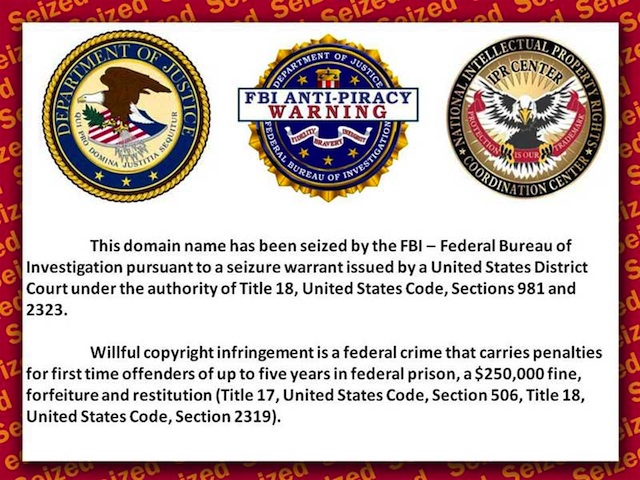
– We found this story on Ars Technica about the FBI (as opposed to U.S. Immigration and Customs Enforcement) seizing the domain names of sites that allegedly participate in Android app piracy. Sooner or later it appears Google will learn that a fair and honest internet is the best way to build a fair and honest businesses. Now if only this solution were available to remedy the sites infringing on musicians work like FilesTube, Rapidshare and others.

The Trichordist Random Reader News & Links Sun Apr 29

Grab the coffee!

Google stops charging for advertising, moves to t-shirts and merchandise model instead (just like bands should)…
http://themusicaldisconnect.blogspot.com/2012/01/google-announces-ads-free-just-buy-tee.html

Class war on creatives; Salon reports astounding labor stats of 45.3% drop in “Musical groups and artists” from Aug 2002 – Aug 2011…
http://www.salon.com/2012/04/22/no_sympathy_for_the_creative_class/singleton/

Spotify to introduce “Pandora” like internet radio. This allows Spotify access to all music, as no artists or labels can opt out and royalties are set as stat rate. Will be interesting to see if the Major Labels have direct licenses that redirect the artist share to the labels.
http://www.hypebot.com/hypebot/2012/04/spotify-readies-pandora-like-radio-service.html

This week was Grammy’s On The Hill, support artists rights, call your representative…
http://capwiz.com/grammy/callalert/index.tt?alertid=61243176

In case you were wondering, traditional terrestrial radio airplay is still the number one influence in music purchasing “60 percent of musically active consumers citing it as a top influence.” We love social media but don’t believe the hype…
http://www.hypebot.com/hypebot/2011/12/active-vs-passive-fans-why-radio-tv-still-rank-tops-for-music-discovery-best-of-hypebot.html
https://www.npd.com/wps/portal/npd/us/news/pressreleases/pr_111110

If you disagree with Sergey Brin it’s only because you aren’t smart enough to understand that he doesn’t want to ask your permission to exploit you or your work so that Google can make more money…
http://copyrightblog.co.uk/2012/04/20/a-sergey-update-we-misunderstood-him/

Can’t make this up, Pirate Politician Says Party ‘Rising as Fast as Nazis’…
http://www.spiegel.de/international/germany/0,1518,829166,00.html

Hacker collective Anonymous to create pirate streaming music search engine so that music “can be free.”
http://www.slashgear.com/anonymous-targets-music-industry-with-anontune-20223840/
However, there is some interesting skepticism online.
http://www.geek.com/articles/news/anonymous-launches-anontune-streaming-music-service-20120419/

Larry Lessig explains why Hollywood (ie, “the copyright industry”) needs to accept that there’s no point in protecting copyright. This is the origins of the “break the internet” rhetoric. Uploaded by the Pirate Party to YouTube on Aug 27, 2009…
http://www.youtube.com/watch?v=KEYbD-TFlxs