Meet The New Boss, Worse Than The Old Boss? Part 2

By David Lowery

(Part 2 of a 5 part series)

What follows is based on my notes and slides from my talk at SF Music Tech Summit.  I realize that I’m about to alienate some of my friends that work on the tech side of the music business.  These are good well intentioned people who genuinely want to help musicians succeed in the new digital paradigm. But if we are gonna come up with a system to compensate artists fairly in the new digital age we need an honest discussion of what is going on.  The tech side of the music business really needs to look at how their actions and policies negatively impact artists,  just as they have pointed out the negative effect record company actions have had on artists.

Too often the debate is about pirates vs the RIAA.  This is ridiculous because the artists, the 99 percent of the music business are left out of the debate.  I’m not advocating going back to the old record label model,  to an industry dominated by the big 3 multi-national  labels.  This is a bit of hyperbole intended to make us all think about this question:  Is the new digital distribution paradigm really better for the artist?

Meet the New Boss, Worse than the old boss- David Lowery.

Part 2.

slide 4

When Napster and P2P came along honestly I wasn’t pleased.   At best I was ambivalent.  I thought that we’d lose sales to large scale sharing but through more efficient distribution systems and disintermediation we artists would net more.   So like many other artists I embraced the new paradigm and waited for the flow of revenue to the artists to increase.  It never did. In fact everywhere I look the trend seemed to be negative.  Less money for touring. Less money for recording. Less money for promotion and publicity.  The old days of the evil record labels started to seem less bad.  It started to seem downright rosy.

So this talk I’m giving grew out of this bit of hyperbole:

Was the old record label system better?

I mean it didn’t seem like the artists were literally starving and living in their vans like now?  I mean even the independent bands seemed able to stay in a hotel every once in a while and being a “Freegan” was a lifestyle choice, not  a necessity.

Sadly I think the answer turns out to be yes.  Things are worse.  This was not really what I was expecting.  I’d be very happy to be proved wrong.  I mean it’s hard for me to sing the praises of the major labels. I’ve been in legal disputes with two of the three remaining major labels.   But sadly I think I’m right.   And the reason is quite unexpected.  It’s seems the Bad Old Major Record Labels “accidentally” shared  too much  revenue and capital through their system of advances.  Also the labels  “accidentally” assumed most of the risk.   This is contrasted with the new digital distribution system where some of the biggest players assume almost no risk and share zero capital.

I can see Russia from my house. No really I can. 

To be clear, when I’m talking about how things are now, I’m not talking about my band and my friend’s bands.  I’ve owned a studio complex for 18 years.  We’ve recorded everything from hobbyists to Lamb of God. High school punk rockers to octogenarian blues singers.  My wife is a concert promoter of some note.  She probably books over 300 artists a year.  We share an office and from where I write this, I feel like I have a comprehensive view of the music scene in the Southeastern US, if not the entire United States.  We live in a city that has one of the highest concentrations of musicians outside of Nashville and Austin.

I generally know what artists are grossing I also have a pretty good idea of what they are netting.   If a 4 piece band shows up at the 40 watt club with 2 crew members, beat up old van and they sell 200 tickets?  They are probably making about 150 bucks a day each.  If a band shows up at my wife’s Atlanta theatre with 2 buses, a truck 10 crew members and an 8 piece band?  Well I can tell you they need to sell it out or they (or the promoter) are losing money.  Likewise having detailed knowledge of different artists recording budgets and schedules through my studios tells me a lot about how much these artists are expecting to make from sales and touring.

Artists have seen their most important assets collectivized by file-sharing.  They no long control the distribution and exploitation of these assets. If this were happening to practically any other group of Americans there would be mass outrage and civil unrest.  Other than Ted Nugent and John Popper most musicians are not heavily armed. Hence the lack of armed standoffs.

Without the ability to effectively and fairly exploit their sound recordings the vast middle and lower class, the 99% of the music business has been impoverished.

* There have been a couple serious arguments that if artists received 0.3 – 0.9 cents a song each stream this would be a “sustainable” amount.  “All you can eat streaming” services would be able to charge a reasonable rate to the consumer and it would stabilize recorded music revenues or even lift them a little.  Also the Spotify question deserves it’s own post cause I’m not sure if artists getting too little money is necessarily Spotify’s fault.  

So this is the data I am looking at.  It’s all aggregate and most of it is hard data.  Those  who argue things are better for the artist now usually cite anecdotal cases as evidence, cook the books by excluding data or simply argue that there is no conclusive evidence file sharing  has had  any effect on recorded music revenues.  In other words it’s an unproven theory  like global warming, evolution and the roundness of the earth. It’s just a coincidence recorded music revenues dropped 64% since the advent of file sharing.

I think the recording studio data is really important.  This is an expense that is common to the independent artist and the label artist (label artists pay for recording out of “their” advance money). Further they can roll in revenue from live performance and other sources into the recording budgets.   So you get an expression of the artists entire revenue outlook when you look at the recording process.   The fact that artists are spending much less TIME recording can only mean they have less money or expect to make less money.  When hundreds of artists of all kinds  do this simultaneously it’s hard to argue that artists are making more money.

Improved technology is not the explanation.  Technology may have produced some productivity gains, but not in the time consuming tasks of getting sounds, composition and arrangement. Many people who haven’t worked in a studio don’t realize how long it takes just to position microphones and instruments in a room to capture the sounds right.  And every drumset, studio, microphone piano, guitar amp and player is a little different.  There are no shortcuts.

No matter how good the recording engineer, he/she can’t make the drummer figure out the right beat for the song,  what words the singer should sing  or the melody of the guitar solo.  No, the only explanation for why artists are spending much less time recording is the obvious one. Occam’s razor.  Every other explanation adds assumptions.

I’m With Stupid.

“But wait a minute, I keep reading stuff on the internet that says artists are doing much better now?  Why do so many people  think artists are doing better?”

Let me give you an amusing answer and a serious answer.

The internet is making us stupider.  You can make a strong mathematical argument to this effect.  The internet is an entertainment medium.  It propagates what is entertaining. The internet does a much better job of propagating the wacko-tin-foil-hat way-out-in- the-long-tail untruths than it does propagating the sober accepted scientific facts that live in the head of the curve.

Wacko-tin-foil-hat is  way more entertaining especially if it claims to be true. I’m not knocking it cause the entire Camper Van Beethoven oeuvre is based on these kinds of untruths.    It’s much more exciting  to believe that global warming is a hoax, Obama is a secret Muslim born in Kenya or the RIAA is throwing old ladies in jail for singing happy birthday to their grandchildren in  YouTube videos.

Here is a chart that a well intention but hopelessly un-informed friend shared on my facebook page.

If you look at the chart.  It is wildly non factual.  Yet it’s been shared over 5 thousand times.  How many hundreds of thousands of people have absorbed this as fact!

It includes percentages of revenue from record sales going to the agent. Agents only charge fees on live performance.

Former record label (?!)

The studio.  Usually paid a flat fee not a percentage of sales.

The manager slice is too large. 15%-20% of net on recorded music not gross as represented here.

But all you really need to know is that it appears this chart was created by a bass player.  There is only one bass player joke:

“What do bass players use for birth control?”

“Their personalities.”

The general consensus in the music business is that The Bass Player is the most aggrieved and dissatisfied member of any ensemble.  I have many good friends that are bass players and even they will admit there is some truth to this stereotype.

In actuality a much higher share of revenue goes to most artists under a typical record deal. In the 1990‘s typical deals were 15-25% of wholesale.  I’m told some superstars got as much  as 50%. Add another 70-95 cents for mandatory and statutory “mechanical royalties”. And your “typical’ artist was getting more than 25% of wholesale on physical CDs.

Further mechanical royalties  are paid regardless of whether a record is recouped or not.  So  “downloading a free album”  almost always takes 70-95 cents out of the artists pocket, EVEN IF THE ARTIST IS UNRECOUPED!

This negative view of record deals is the result of what I call “the whiner bias.”  You only hear about the “bad” record deals.  And believe me there were bad deals out there!  but most weren’t.  But what artist is gonna go out and say “Man my record label is paying me so much money it’s amazingly fair!!”

Also people often confuse artistic conflicts with monetary conflicts.  Record labels definitely sought to control artists creatively.  But as Morrissey notes

 “you could have said no, if you wanted to, you could have said no”

I remember being told to dress in powdered wigs and 18th century clothing for a video.  I said no.

Then there is the matter that most record deals end badly.  Record deals end when the artist is no longer selling enough albums to justify the deal.  The artist is then dropped which leads to a very public falling out.  In fact see my song about Virgin Records  “It Ain’t Gonna Suck Itself”.

The more serious reason that people think artists are doing much better post napster?  There has been a concerted effort by a certain part of the tech blogosphere to paint a rosy picture of the music industry.  They have two techniques:

Totally misleading fake studies.  Like the Computer and Communications Industry Association’s  “The Sky is Rising” Report. First off this was passed around as independent research when it was actually industry lobby generated propaganda.   Among the most outrageous obfuscations and bizarre metrics:  Including gaming revenue to help disguise recorded music revenue decline, Not mentioning the drop in live music revenues in North America, and creating the bizarre metric of “number of recorded music transactions” instead of using recorded music revenues.  Recorded music transactions are up because people buy individual tracks now instead of 1 album of 10 songs.  Get it?

There are 14 academic peer reviewed studies that paint quite a different picture. Yet you rarely see these quoted by the digerati.

Anecdotal Examples.   Things like Ok Go.  Yep that’s a success story. Louis CK  Yep success story.   But here’s the thing: the music business is like the casino business.  You can’t look at one or two players winnings and tell how the casino or  ALL the other players are doing.  And like a casino the house lets a few people win but overall the game is rigged.

The Future of Music Coalition or as I like to call them the Fooling our Musicians Coalition seems to be the new innovator in this field. Their recent “case studies” seem to be taking it to the next level.  They appear to have combined misleadingly titled studies with meaningless anecdotal information.

Example 1.

Are Musicians benefiting from Music Tech?

http://money.futureofmusic.org/are-musicians-benefiting-from-music-tech-sf-musictech-presentation/

Their conclusion is a resounding yes!

But dig into the paper and you find that by “benefiting” they mean things like “being able to keep in touch with fans through Twitter” and being able to use .Zip files.  While the .Zip file was a real game changer  for musicians, especially  banjo players, most people reading the headline and not reading the article would think they were addressing a much more important question:

“Despite the loss of revenue to file sharing has technology allowed the artists to make up the loss of revenue in other ways?.”

We all know that Twitter allows us to talk to our fans already.  This has been established. Why did FOMC need to do a study on this? Anytime I read something put out by the FOMC I find myself asking “what exactly was the point of that?”

Example 2.

http://money.futureofmusic.org/case-study-a/

Their  “case study” of the veteran 13 year indie rock musician composer showed this particular artist had increasing revenues 2008-2011 (why not 1999-2011 since the artist’s professional  career began in 1999?)  However the artists identity was not revealed and FOMC refused to release raw data.  Further they  refused to publish actual total dollars. Instead they only published relative percentages of revenues and expenses. When pressed on these matters on Digital Music News blog, The FOMC study director  refused citing  “privacy concerns”. Who’s privacy concerns?

And right here  is where my  tech industry friends will start to hate me.

I call bullshit.  I don’t think the FOMC wanted to release the raw data because as clever bloggers deduced it appears this 13 year veteran artist netted less than 34 thousand dollars in his/her best year! (they interpolated this from the percentage assigned to AF of M dues).
“Famous indie rocker only makes 34k a year !” was not a headline they wanted to see in relation to the study.

Why would self proclaimed artist advocates  publish such a study?

I don’t really know. But the FOMC is relentlessly praising technology and the technology industry.  Fawning might be more accurate.   In fact they spend way more time talking about technology issues than they do issues of interest to musicians.  Just look at their blog.   It’s as if there were an organization called “Friends of Mary Todd Lincoln” but all they did was talk about the theatre.

“Creators must be able to maximize value from their copyrights in a legitimate digital marketplace. We understand the very real problem of intellectual property infringement and its impact on the music ecosystem. We also share the convictions of those who depend on the internet in practically every aspect of their lives and careers that free expression and entrepreneurship are too important to be undermined by overly-broad policy.

“We look forward to working with our many friends in the music and arts communities, as well as those in the innovation sector to find ways to achieve stronger protections for artists while preserving the dynamics of innovation and expression that are the engines of the internet.”–Casey Rae Hunter Dept Director Future of Music Coalition. Statement on Intellectual Property Bills “Reset”. 

“Free expression” and “Innovation” are tech speak for being able to use artists songs, sound recordings, films, photos and books without having to license or share any revenue.

And step back for a second.  Look at the absurdity of this statement.  How the fuck are indie artists making 34k a year, how the fuck are  these artists slowing down and preventing Google and other billion dollar companies from innovating?

And why am I pointing this out instead of an organization that claims to represent artists in the digital world?

Maybe if  the “Innovation Sector” spent a little less time “innovating” novel legal arbitrages, trying to intimidate struggling indie film makers  by posting  her DMCA takedown  notices on the appropriately named www.chillingeffects.org  or wasting shareholder dollars building driverless cars they wouldn’t need the subsidy that the unlicensed use of our music is providing them. But I digress.

And referring to the  tech industry as  “The Innovation Sector”?  I mean is it possible to be more of a bootlicker?  This is why I’ve started calling FOMC  The Fooling our Musicians Coaliton.  Helping musicians does not seem to be at the top of their agenda.

>>>>>>>>>>>>>>>>>>>>>>>>>>>>>>>

Read Part 1

Read Part 3

Tomorrow part 3.
Meet The New Boss, Worse Than The Old Boss? Part 1.

By David Lowery

Part 1 of a 5 part post

(Copyright in the author, used by permission)

What follows is based on my notes and slides from my talk at SF Music Tech Summit.  I realize that I’m about to alienate some of my friends that work on the tech side of the music business.  These are good well intentioned people who genuinely want to help musicians succeed in the new digital paradigm. But if we are gonna come up with a system to compensate artists fairly in the new digital age we need an honest discussion of what is going on.  The tech side of the music business really needs to look at how their actions and policies negatively impact artists,  just as they have pointed out the negative effect record company actions have had on artists.

Too often the debate has been  pirates vs the RIAA.  This is ridiculous because the artists, the 99 percent of the music business are left out of the debate.  I’m not advocating going back to the old record label model,  to an industry dominated by the big three multi-national  labels.  This is a bit of hyperbole intended to make us all think about this question:  Is the new digital  model better for the artist?

Meet the New Boss, Worse than the old boss

Introduction

I was like all of you.  I believed in the promise of the Internet to liberate, empower and even enrich artists.  I still do but I’m less sure of it than I once was.  I come here because I want to start a dialogue.  I feel that what we artists were promised has not really panned out.  Yes in many ways we have more freedom.  Artistically this is certainly true.  But the music business never transformed into the vibrant marketplace where small stakeholders could compete with multinational conglomerates on an even playing field.

In the last few years it’s become apparent the music business, which was once dominated by six large and powerful music conglomerates, MTV, Clear Channel and a handful of other companies, is now dominated by a smaller set of larger even more powerful tech conglomerates.  And their hold on the business seems to be getting stronger.

On one hand it doesn’t bother me because the “new boss” doesn’t really tell me what kind of songs to write or who should mix my record. But on the other hand I’m a little disturbed at how dependent I am on these tech behemoths to pursue my craft.  In fact it is nigh impossible for me to pursue my craft without enriching Apple, Amazon, Facebook and Google.   Further the new boss through it’s surrogates like Electronic Frontier Foundation  seems to be waging a cynical PR campaign that equates the unauthorized use of other people’s property (artist’s songs) with freedom.   A sort of Cyber –Bolshevik campaign of mass collectivization for the good of the state…er .. I mean Internet.   I say cynical because when it comes to their intellectual property, software patents for instance, these same companies fight tooth and nail.

Meet the new boss, he wants to collectivize your songs!

The other problem? I’ve been expecting for years now to see aggregate revenue flowing to artist increase.  Disintermediation promised us this.  It hasn’t happened.   Everywhere I look artists seem to be working more for less money.  And every time I come across aggregate data that is positive it turns out to have a black cloud inside.  Example: Touring revenues up since 1999. Because more bands are touring, staying on the road longer and playing for fewer people.  Surely you all can see Malthusian trajectory?

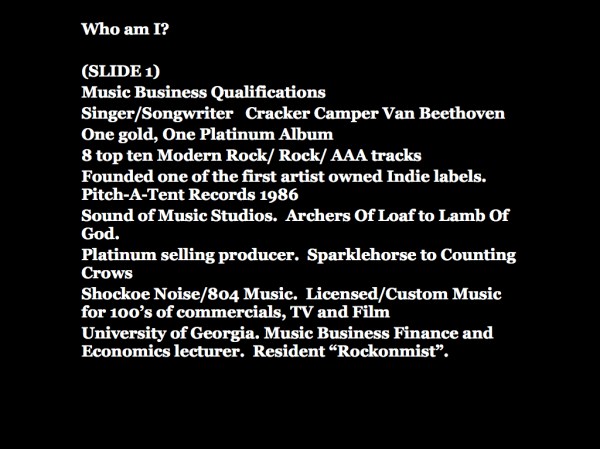
SLIDE 1

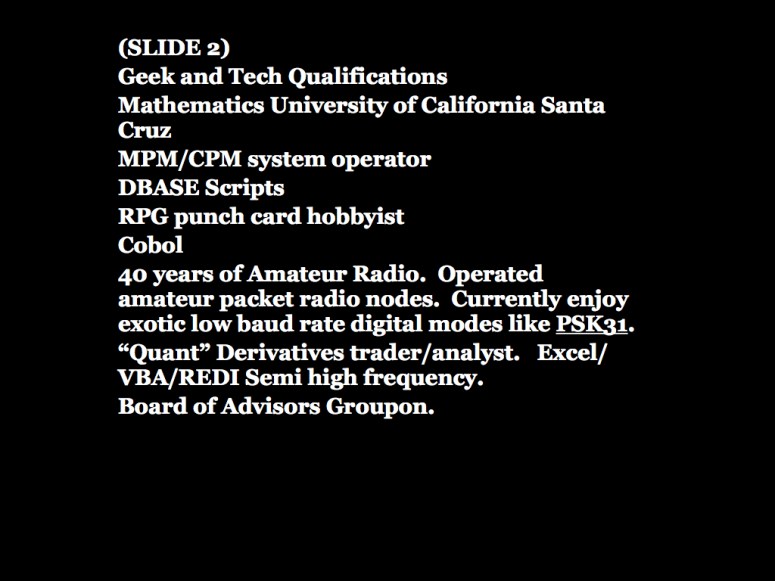
I realize that some of you may not know much about me or even who I am. I like to think that I am uniquely qualified as an artist, entrepreneur and geek.  I was trained as a mathematician. My first job after I graduated involved being the systems operator for an MPM OS system and I wrote a lot of DBASE IV scripts.  I had a fascination with the old RPG punch card programming language.  I am deeply involved in the digital amateur radio world.   You can sometimes find me operating PSK31 on 20 meters. I spent some time in Chicago near the CME. I worked as a “Quant” doing some semi high frequency trading.  While there I became involved with a company called www.thepoint.com which evolved into  www.groupon.com.

I can out geek most of you.

++++++++++++++++++++++++++++++++++++

My company is faster than your company.

Musicians are constantly derided by the Digerati.  It’s usually after someone like myself suggest that if other people are profiting from distributing an artist’s work (Kim Dotcom, Mediafire, Megavideo, Mp3tunes,) they should share some of their proceeds with the artists.  At this point the Digerati then proceed to call us “dinosaurs”, “know nothings” or worse.  Suddenly your Facebook page is filled with angry comments from their followers that seem to all be unsuccessful Canadian hip hop artists who proclaim:

“We are gonna turn you into Lars Ulrich  and bitch your band sucks anyway”.

(At the risk of getting the Canadian non-lethal equivalent of a  “cap in my ass” I have to say:  I am so scared!)

The most virulent of these folks are almost always unsuccessful musicians. It fascinates me.  I can only surmise that part of their anger seems tied to the hatred of the record companies that rejected them.  Successful even marginally successful musicians are often viewed as some kind of traitors.   A special kind of hatred is reserved for these apostates. The file sharing/ cyber locker industry has figured  this out and purposely stokes stokes them with a faux populism.    I would say it’s juvenile but it’s really more medieval.  That’s why I call them Freehadists. People like me are actually looking out for these young musician’s rights.  I am trying to keep the new boss from screwing them.  They dont’ realize they are doing the work of  The Man.  But I digress.

Despite the tech lobby’s portrayal of musician as luddites or doddering old hippie, musicians, especially independent musicians are often the early adopters of technology.  We are always a couple years ahead of the “straight” business world when it comes to technology.  As an example we perfected “social marketing” before it even had a name.  We were outsourcing and insourcing services for our highly flexible virtual companies  when Windows 3.0 was state of the art.

When it comes to the web, we not only understand the consumer side of the Internet we understand the producer/supplier side as well.  And like any producer or supplier we want to be compensated.  The reason the Digerati are so fixated on “what the consumer wants” is simply because most of them have only experienced the web as consumers.

“The consumer wants music to be free”  they shout as they pound their tiny fists on their Skovby tables.

The consumer also wants cars to be free.  And beer.  Especially beer.  But any market involves a buyer and a seller.  A consumer and a producer.  If GM can’t afford to give away their product for free it ain’t gonna happen.  No matter what the consumer wants. (See my note on “digeridiots”)

Often overlooked by Digerati, is the glaringly obvious fact that musicians and bands have long been a part of the new economy.  We’ve been a web-enabled business since 1992.  We’ve been a web-based business since Napster. Virtually every interaction that an artist and a fan have is web based.  Even live concerts are web-enabled.  The artist and the fan communicate about the upcoming concert through Twitter, Facebook events or traditional email.  Recording has long been web enabled.  We might all get together in the same spot to record basic tracks, but oftentimes overdubs and even mixing happens remotely, exchanging files and notes via the web.

So please forgive us if we roll our eyes at the Digerati who tell us we need to “embrace the web”, “work the new digital ecosystem” or come up with a “new model”.  It’s a little like your great aunt seeing you at thanksgiving dinner and telling you something like:

“You should make some T-shirts for your band and sell them on tour”.

You politely smile and try not to roll your eyes.

Actually that’s the number one “new model” that the Digerati suggest.  Sell T-shirts at your shows to make money! This despite the fact it’s not new.  Bands have been selling t-shirts at live shows since the early 1970s. Recording albums to sell a few t-shirts is a terrible way to make money.  Thanks for the advice but no thanks.  Plus t-shirts are just as bootlegable as music.

“Information wants to be free. Information also wants to be expensive”-Stewart Brand

Everyone knows there a second half to his quote? Right? Cause I usually only see the first sentence bandied about in technology circles.

Sound recordings are information.  Sound recordings are not cheap to make.  The technology is not the expensive part of making songs and sound recordings. It hasn’t been since the late 1980s.  Many in the tech community blindly assume that recording budgets have gone down because the technology is less expensive and provides greater productivity.  With absolutely no facts to back up their argument I often hear:

“Well artists are making less money but recording costs are lower, so the artists are doing okay”.

In other words technology has lowered your revenues in the form of unlicensed file-sharing on an industrial scale but that’s okay because Digidesign (the makers of Pro-Tools™)  has given back some cost savings.  As if Kim Dotcom and Digidesign share the same bank account.  These people believe in technology like it is a religion.  The lord Technology Industry taketh, and The Lord Technology Industry giveth back.

The data I have from recording studios says something different.  Recording budgets are lower because artists spend dramatically less time recording.  They just don’t have the money.

Recording budgets didn’t start shrinking until after the advent of file-sharing. 2002 ish. While most of the improvements in technology and gains in productivity occurred in the early 1990s.  By 1996 the home studio/pro studio production chain was firmly in place.  Pro studios used for “tracking” and “mixing.”  Home or project studios used for overdubs and editing.    If lower recording budgets were caused by improvements in technology they should have started shrinking 10 years earlier.

Sound recordings are very labor intensive.   If you want to make good ones you are relying on highly skilled labor.  The cost of sound recordings is largely dependent on labor costs.  Technological advances have little effect on recording cost.

This is the main problem with the technologists contention recordings should be free. They seem to think that the only people who work on recordings are the touring performers themselves.    Artists still have to pay for that highly skilled labor.

Is the  mix engineer gonna follow us around on tour hawking HIS T-shirts to the audience?

SLIDE 3

Nevertheless, I’m what you might call a “Freemiumnista”.  I was a Freemiumnista before there was an Internet.  I get that not all interactions between fans and artists should be monetized.  I get that you can give away something and make more money in the long run.  Virtually every live show we’ve ever played is available free on archive.org.  Even before the internet we’ve encouraged and organized tape trees and later CD burn trees for distributing our live shows   And we spend a lot of time trying to get people to buy our studio albums as well.

Unlike a lot of the Digerati I have walked the walk.  I still do.

I’ve embraced many of the things that those on the tech side of the music business want musicians to embrace.  But what many of you forget is that IT IS MY CHOICE whether I choose to give away my songs or sell them.  IT IS MY CHOICE how and where to distribute my songs.  IT IS MY CHOICE to decide which websites get to exploit my songs.   Like it or not, the right to control one’s intellectual property (like songs) is a constitutional right.  It is also part of every international human rights agreement. Technology company funded blogs that think there should be no song copyrights are actually advocating violating my constitutional and human rights!

Many in the digital music industry rightfully condemn the past exploitation of artists by record labels.  But at the same time they seem to be doing the same thing.  Trying to bully artists into giving up their rights so that companies like MegaUpload or YouTube can make money is  the same thing.

With exploitative record contracts The Old Boss tried  to take your songs a dozen at a time and pay you pennies.  The New Boss wants to take ALL of your songs,  past present and future and pay you nothing.

I’ll make technologists a deal, I’ll give up my song copyrights if you give up your software patents.  Software patents are even less unique than your typical song.   So this should be easy right?

Talk the Talk.  Walk the Walk.

http://www.huffingtonpost.com/2011/08/15/google-motorola-mobility_n_927670.html

http://www.huffingtonpost.com/2012/03/12/yahoo-sues-facebook-patent_n_1340032.html

<<<<<<<<<<<<<<<<<<<<<<<<<<<<<<<<<<<<

Read Part 2.

Read Part 3

Musicians POV: Occupy Artist Rights – Full Post

By Chris Whitten

(Copyright in the author, used by permission, all rights reserved)

I’m an independent, self-employed musician.  It’s a risky business. You’re only as good as your last record or gig. There are few long term contracts, no sick leave, no holiday entitlements and nothing in the way of protection against bullying in the workplace, sexual discrimination, or unfair dismissal. Yes, it’s largely a labour of love, with some degree of personal satisfaction, and if you’re one of the lucky ones, some financial reward.

To co-opt the slogan of the recent Occupy movement, we are the 99%.  The 99% of professional musicians who have more in common with ordinary workers than the rock stars portrayed by the media, frittering away their millions like 24-hour party people.

For the last couple of years I’ve been following the piracy debate, especially online. Contrary to what is often claimed, I feel the ‘free music’ movement has succeeded in shouting down the view from actual content creators. Much of the commentary is dominated by technology journalists, or tech industry watchers, but relatively little has been contributed by creative people working in the music industry. Many musicians, especially the young, up-and-coming ones, have stayed out of the debate, leaving music fans not much option but to accept one or two myths and misrepresentations as fact.

The political musician is a thing of the past, it seems. Maybe recent generations of artists are rebelling against their parents who went to Woodstock or Live Aid? What is sure is that musicians understand they need to be liked in order to survive. You build a fanbase, which in turn provides the all-important bums on seats needed to fund the next tour or album recording. So the last thing you want to do is alienate that fanbase. Heck, who wants to be the next Lars Ulrich? Still getting a public kicking eleven years after Metallica triumphed over Napster. As with many things in life, short term gain is popular while the long game is not. Young musicians who ask fans to pay for their music, sometimes even daring to critisise music pirates, are often derided around the blogs and internet music communities.

Let’s be clear about this: in the relationship between musician and music consumer, the musician has no power. Currently the consumer has all the power. Even if they could admit to themselves that non-payment is wrong, who’s going to readily give up all that free music, movies and television with virtually no chance of ever being caught?

The reader comments section of any blog discussing the issue of music piracy makes for depressing reading – at least for professional musicians. The often repeated threat of “price music fairly or we’ll just take it” is made by people who aren’t prepared to work for free themselves, and couldn’t make ends meet if their weekly paypacket fluctuated wildly dependent on how much their employer felt like paying them each week.

The modern mantra is ‘information is free’. Well we pay for our internet service, don’t we? And music isn’t really information, it’s the product of someone working hard to entertain us. In a capitalist system you don’t get to demand entertainment for free. Someone provides a service, and the consumer decides whether they are willing to buy it or not. After the death of capitalism, when we no longer have to pay for our electricity, we can talk about free music.

Another myth is that the music pirate is somehow righting a wrong visited on artists by the major record labels in past decades. Sadly, musicians survive at least in part by selling records. So what we have is an apparent double punishment. You’ve been ripped off by the labels, and now it’s the music fan’s turn to rip you off. Worse still, with the short careers of many artists, we’re supposedly righting some financial wrong done to The Saints by ripping off Wolfmother.

Music artists are grown up enough to look after themselves. As far back as the late 1970’s with the explosion of independent labels and DIY recording, artists have had plenty of acceptable avenues to distribute their work without relying on corporate labels. The reality which rather sinks this pirate ship is the amount of independent and self-released music that is pirated. Do music pirates download music they want to hear, whatever the source, or do they target major label artists only? I personally know people who have written and recorded their own music, paying for the whole thing themselves, only to find it uploaded against their wishes by someone they don’t know for everyone else to share freely.

I have no doubt there are a few idealists, anti-capitalists and ex-hippies who genuinely believe that by file-sharing they are bringing down the corporate music industry. However, the biggest casualties caught in the crossfire are average musicians. Even if they try to do the right thing by the public, eschewing the major label system, pricing their music fairly, giving some music away, they are pirated as readily as the commercial pop manufactured for mass consumption. When Radiohead offered their ‘pay whatever you want’ download of ‘In Rainbows’ there is evidence many still downloaded the album from popular pirate sites. The clear motive then for most is to obtain any music, any time, without having to pay for it.

So let’s briefly look at a few other, shall we say ‘misunderstandings’….

• The new economy for music is in live performance.

Actually, that was the old economy. You earned a little income from selling records, you might also make a bit from playing live, put it all together and most musicians could earn enough to keep playing. The pirate economy removes income from recordings. So in fact, there is no new way of making money, we’ve just taken one income source away.  In addition, the recording is a product in of itself. It isn’t a promotional tool. After Sgt Peppers was released, The Beatles didn’t tour, and yet we can all still enjoy the music today. I was too young to see Jimi Hendrix in concert, but I have always enjoyed listening to Electric Ladyland. In a country like Australia, you often can’t support artists via their shows without literally going the extra mile. If you live in Darwin, even Albury Wadonga, the only way to see most bands is to travel. International acts just don’t play outside the major Metropolitan centres. The easier way to support artist’s output is to buy the record. Records and shows are two equal products with equal creative value. Recordings capture a moment in time. In recordings from ‘Kind Of Blue’ (Miles Davis) to ‘Smells Like Teen Spirit’ (Nirvana) it’s a moment of magic you can’t replicate in live performance now some of the players are gone. In the end, does anyone suggest actors appear in movies to promote theatre?

• You should play music for love not money.

Yes, but instruments, music lessons and rehearsal spaces don’t come free. And if you want to attain some level of excellence you need to invest a lot of time and money in your music. Besides, why are there all these rules for musicians that don’t apply to anyone else? I’m sure Sam Stosur would play tennis just for grins, but we apparently have no problem with appearance fees and prize money. It’s obvious Tony Abbott would LOVE to be Prime Minister. When he finally achieves that goal should we take away the $260,000 a year he’s enjoyed as opposition leader, pay him nothing and recommend he “have fun”?

If you add the suggestion to play for the love of music, to the suggestion musicians play more shows, the cracks in these theories start to appear. Putting on a show doesn’t come cheap, there are rehearsals, travelling expenses, equipment costs. So are musicians to fund these costs through professional musicianship, or accept the dreaded day job? If like others in society your ambition is to rent or own a home, start a family and provide for your kids, you’ll likely need to get a regular job. The bank manager doesn’t understand “I work only for love”.

The average holiday entitlement in regular employment is four weeks per annum. That hardly meets the demands of modern touring. So the post piracy band would only tour for one month each year, and every band member would have to co-ordinate the same month off. Then work the remaining eleven months without a break. When do they find time to record the album, or shoot the video?

When I toured globally with Dire Straits in 1991, we spent six weeks in Australia alone. You can forget seeing most international acts grace these shores ever again if those acts have to balance the needs of regular employment with their careers in music.

Finally we come to a couple of ‘dog ate my homework’ type excuses.

• Not Every Illegal Download Is a Lost Sale.

Duh…. yeah! That’s right, but it’s amazing how regularly this is brought up in the debate as if it’s the killer argument, the Achilles heel of the professional musician. Never mind the high probability that many illegal downloads represent many lost sales. It’s really not believable to claim all pirated music is binned without being listened to, or if it is listened to and appreciated, the downloader goes on to pay for it. Clearly a reasonable amount of music is pirated because the pirate wants to enjoy the music but isn’t prepared to pay for it. Isn’t prepared to actually support the persons creating the music.

More than three years into a GFC, with Europe facing financial meltdown, 40% youth unemployment in Spain, rock music’s biggest market the USA looking down the barrel of a double dip recession, and most Aussie musicians driving in the slow lane of a three speed economy, you bet every single lost sale counts.

• I Can’t Afford Music

I can’t afford to eat at Aria. Life’s a beeeyach. Obtaining music isn’t a right, it’s one of life’s pleasures. And while we’re talking about life’s pleasures, a take away coffee costs $3 to $4, and lasts as long as it takes to drink. A song costs $2.99 from iTunes, and provides entertainment for years. With the popularity of fast broadband and large data plans, it’s quite obvious many of the same people who claim they can’t afford music, somehow can afford a computer, a Blackberry or iPhone and a $60 a month ADSL2 plan. I think what they mean to say is “I can’t afford music because my entertainment priorities lie elsewhere….. and music is available free”

Music piracy is a wholly negative culture. It takes out, but puts nothing back.                                  When I was a teenager we had a similar view of the mainstream music industry. It was tired, complacent and wasn’t making the records we wanted to hear. Towards the end of the 1970’s like-minded people started forming their own bands, they wrote their own music, promoted their own gigs, made their own records and started their own indie labels. It really did blow the establishment apart…. at least for a few years. Why is it that action for positive change has been replaced by simply robbing music from music makers? I can’t say I understand the excuse that pirates download music because most music is rubbish. Surely some young person somewhere is thinking they’d rather make some amazing new music of their own and make a name for themself, rather than spend all night trawling through torrent sites downloading gigs of garbage.

The final pirate promise is that music will always be there.

Well you can’t really argue with that, but what kind of music will it be? Just as talented school athletes play a variety of sports and eventually decide to concentrate on one, young creative often draw, write and play an instrument to a reasonably high level. Given a choice, teenagers will usually opt to pursue a career where they feel valued, have a decent chance of success, and be rewarded for their hard work. Things are pretty gloomy right now in the music scene, but if we could restore income from record sales, I think we could reward our best and brightest to make great music in the future. With the industry in the doldrums or worse than its current state, the most talented creative minds will choose other avenues to express themselves, avenues that give them some hope of a decent living, put a roof over their head, and a pat on the back from respected peers for a job well done.

That would be the music fan’s loss.

Downloading music for free is a short term gain. The long term damage it’s doing to the broader music community and the message that sends to the grass roots, where the musicians of tomorrow emerge from, should be understood by anyone who enjoys new and exciting music. We need creative risk taking and innovation in music, or else millions of teenagers would still be listening to Doris Day and dancing The Twist. The history of pop music shows us creative risk taking and innovation is carried out in the bedrooms of Manchester, England, the garages of Seattle, the back room of a pub in Melbourne, not in the spotlight glare of a season of X Factor. The mainstream is supported by television and advertising, mainstream artists are offered guest spots on CSI: Miami, or a signature fragrance as part of a cosmetic sponsorship. These aren’t avenues of income a young band from Wagga Wagga can enjoy. So we need to financially support the musicians at the margin, for they are the future of good music.

The final ironic twist is I believe free music is a brief abberration. Everyone but the pirates understand that quality content comes at a price. The internet giants are the new record companies. While music sales have been hammered by illegal downloading, web companies have seized the opportunity to throw desperate musicians a bone in the form of some small income from iTunes, Spotify and the forthcoming ‘cloud’. Most of these services are embryonic, but once they gain some popularity it’ll be in the tech industry’s interests to finally stamp out easily available free music, while encouraging people to access music through paid for services like Spotify and iCloud.

The only difference is that many tech companies have demonstrated they are more ruthless than any record label ever was. Unlike record labels, tech companies aren’t interested in music specifically, the nurturing and development of new artists. They are primarily interested in making money through hardware sales like iPads, or online services like Google and Facebook. They want to supply the most popular, most desirable content, at the lowest price as a way to attract and hold on to loyal customers. Mark Zuckerberg’s recent high profile relaunch of Facebook was centred around the (legal) sharing of music and movies.

It’s in the interest of music fans to financially support the next generation of musicians. The internet corporations demonstrably aren’t, and musicians being normal people, they’ll drift away from music as the daily grind of making innovative music with no reward and no encouragement takesits toll.

Less edgy innovation, but more mainstream commercial pop – that’s the road we are on and that’s bad for music fans.

Rather than online anarchy, a mass exploitation by the many of the few, we the 99% of music consumers need to directly support the 1% of adventurous, young music makers, or we can’t really complain when we end up paying. But we won’t just be paying for our entertainment. We will also be paying in terms of the talent that goes unheard and the groundbreaking music that wont be made. And the ultimate irony is that this time it’s a computer company – not a specialist music company – determining what music we get.

###

[ THE 101 ] [NEW BOSS / OLD BOSS ] [ SPOTIFY ] [GROOVESHARK ] [ LARRY LESSIG ]
[ JOHN PERRY BARLOW ] [ HUMAN RIGHTS OF ARTISTS ] [ INFRINGEMENT IS THEFT ]
[ THE SKY IS RISING : MAGIC BEAVER EDITION ] [SF GATE BLUNDERS PIRACY FACTS ]
[ WHY ARENT MORE MUSICIANS WORKING ] [ ARTISTS FOR AN ETHICAL INTERNET ]

Smells Like Pirate Desperation, The Promo Bay now Elitist Gatekeeper

The Pirate Bay wants to help artists (stop laughing). No, really, they do.  So this begs the question, if The Pirate Bay really wants to help artists why don’t they just pay them? You know the saying, “with friends like these, who needs enemies,” right?

The three month old story of  TBP offering promotion to indie bands made the rounds again this weekend as it launched. The headline reads 5,000+ indie bands sign up for Pirate Bay Promotion, but what’s not clear is how many will actually get that promotion?

This promotion was originally announced on Torrent Freak and TechDirt back in January without much fanfare. I guess there wasn’t much interest. So with just 5,000 bands signed up The Pirate Bay is desperately reseeding the story now and seeking headlines to attract more artists. But the whole thing is really laughable given that by the rules of the promotion, TPB are now the very thing they ridiculed, a gate keeper. Hypocrisy anyone?

“Of course, we can and will not release everything we recieve. We will pick something every now and then from the pool. If we like your submission, and the countries you chose are not already flooded by requests, you will recieve an email when it’s about to start.”

Of course right? Every now and then? Who are you guys, Rolling Stone? I’m curious to see the net effect of this other then exploiting artists yet again for TPB’s own self serving interests. So if they like your stuff and they think it’s worthy of promoting in some third world country, you might just have a chance of having TPB promote you. Uhm, thanks? Here’s an idea, instead of the Promo Bay, why not the Cash Bay? Hmmmm.

So what’s it worth even if they do pick you from the lottery? As of this writing the artist SOSO has gotten about 85,000 views on their YouTube Video with all the views appearing to come from Sweden (according to the publicly posted YouTube analytics and despite that we can see it in the USA). The band’s SoundCloud page is not faring as well with the most played song registering some 4,500 plays.

As much as we applaud any artist getting anything of value out of TPB, and we always respect the artists right to chose what is best for them, this PR stunt just reeks of desperation. I guess it’s not helping that more and more artists are becoming vocal about their rights, like Patrick Carney of the Black Keys and also this fantastic post by Zack Hemsey.

Let us not forget The Pirate Bay has made, and continues to make MILLIONS annually from artists via advertising while providing no compensation to the artists what-so-ever. Nothing, Zero, Zilch, Zippo, Nadda, not a penny.

###

[ THE 101 ] [NEW BOSS / OLD BOSS ] [ SPOTIFY ] [GROOVESHARK ] [ LARRY LESSIG ]
[ JOHN PERRY BARLOW ] [ HUMAN RIGHTS OF ARTISTS ] [ INFRINGEMENT IS THEFT ]
[ THE SKY IS RISING : MAGIC BEAVER EDITION ] [SF GATE BLUNDERS PIRACY FACTS ]
[ WHY ARENT MORE MUSICIANS WORKING ] [ ARTISTS FOR AN ETHICAL INTERNET ]

Fake Fridays: The Google Diaries: Fake Larry Does Seattle Human Trafficking Protests Against Google

Secret Diary of Fake Eric Schmidt, April 6, 2012

[Deleted]

Secret Diary of Fake Larry Page, April 6, 2012

Since Eric and Fred told me I can’t archive my Gmail anymore, I guess I have to write this diary.  I can’t believe these people are using a petition on Change.org against Google!  We gave these people so much money!  I mean, this is Larry’s thing, right?   How dare they use Change for petitions against us!  Maybe Chilling Effects can get involved?  What do we have it for? Note to self, ask Fred about Chilling Effect and Change.org.

Why do we get accused of all these bad things that nobody has ever told us to stop doing?  And how do we know these so-called “pimps” are doing anything illegal or even bad!  These are our users, we don’t sue our users just cuz some whacko actress says one of them is a so-called “pimp”!  That’s censorship! I mean how do I know that Googlers do anything bad if nobody tells me!!  Just because we sold one ad for one pharmacy one time, what does that even mean!  Eric said we were sorry!  We’re always sorry, why isn’t that enough?  We’re not censors!  We’re not responsible for anything, we just give users convenient ways to find things.

The flacks started talking to me today about trafficking, I mean that’s our business, right?  If we can’t do trafficking, then there’s no Google.  The record label music companies think we should be going after these so-called pimps who pay for these ad.  No, wait, not the music company label records, its someother censorship facists who want us to stop selling advertising.  Traffic, Google, interchangeable, right?  But they were talking about human trafficking, what does that even mean?  We sell traffic, nobody knows what the machines talk about, that’s between them.  How do they get human traffic out of machine traffic?  It’s all so confusing sometimes.

I have to call Mike and get him to go after whoever is saying these bad things, put their names on the list.  He had that great quote from Teddy Roosevelt, “the man in the arena whose face is marred by dust and sweat and blood, who strives valiantly”.  Boy, that’s me, that’s us.  They just don’t realize how much they need us to make everything scaleable and convenient.  Well, one day they won’t have Google to kick around anymore.

That’s what it is, these protesters just don’t understand how cool it is for things to be convenient!  When everything is convenient, then you don’t ever have to complain about anything.  Except…you know, when you forget the refill.

Convenient is cool.  Google is cool.  Google means convenience.  Google means no complaining.  We know what users are thinking before they do anyway so what are they complaining about?  And so what if our customers are these so-called pimps!  We’re not going to become sex cops for the government censors!  Don’t they appreciate all the cool products we give away for free?

The Musicians POV: Occupy Artist Rights, Part 3–The attack of the homework eating dogs

[Part 3 of a 3-part post “Occupy Artist Rights”]

By Chris Whitten

Finally we come to a couple of ‘dog ate my homework’ type excuses.

• Not Every Illegal Download Is a Lost Sale.

Duh…. yeah! That’s right, but it’s amazing how regularly this is brought up in the debate as if it’s the killer argument, the Achilles heel of the professional musician. Never mind the high probability that many illegal downloads represent many lost sales. It’s really not believable to claim all pirated music is binned without being listened to, or if it is listened to and appreciated, the downloader goes on to pay for it. Clearly a reasonable amount of music is pirated because the pirate wants to enjoy the music but isn’t prepared to pay for it. Isn’t prepared to actually support the persons creating the music.

More than three years into a GFC, with Europe facing financial meltdown, 40% youth unemployment in Spain, rock music’s biggest market the USA looking down the barrel of a double dip recession, and most Aussie musicians driving in the slow lane of a three speed economy, you bet every single lost sale counts.

• I Can’t Afford Music

I can’t afford to eat at Aria. Life’s a beeeyach. Obtaining music isn’t a right, it’s one of life’s pleasures. And while we’re talking about life’s pleasures, a take away coffee costs $3 to $4, and lasts as long as it takes to drink. A song costs $2.99 from iTunes, and provides entertainment for years. With the popularity of fast broadband and large data plans, it’s quite obvious many of the same people who claim they can’t afford music, somehow can afford a computer, a Blackberry or iPhone and a $60 a month ADSL2 plan. I think what they mean to say is “I can’t afford music because my entertainment priorities lie elsewhere….. and music is available free”

Music piracy is a wholly negative culture. It takes out, but puts nothing back.  When I was a teenager we had a similar view of the mainstream music industry. It was tired, complacent and wasn’t making the records we wanted to hear. Towards the end of the 1970’s like-minded people started forming their own bands, they wrote their own music, promoted their own gigs, made their own records and started their own indie labels. It really did blow the establishment apart…. at least for a few years. Why is it that action for positive change has been replaced by simply robbing music from music makers? I can’t say I understand the excuse that pirates download music because most music is rubbish. Surely some young person somewhere is thinking they’d rather make some amazing new music of their own and make a name for themself, rather than spend all night trawling through torrent sites downloading gigs of garbage.

The final pirate promise is that music will always be there.

Well you can’t really argue with that, but what kind of music will it be? Just as talented school athletes play a variety of sports and eventually decide to concentrate on one, young creative often draw, write and play an instrument to a reasonably high level. Given a choice, teenagers will usually opt to pursue a career where they feel valued, have a decent chance of success, and be rewarded for their hard work. Things are pretty gloomy right now in the music scene, but if we could restore income from record sales, I think we could reward our best and brightest to make great music in the future. With the industry in the doldrums or worse than its current state, the most talented creative minds will choose other avenues to express themselves, avenues that give them some hope of a decent living, put a roof over their head, and a pat on the back from respected peers for a job well done.

That would be the music fan’s loss.

Downloading music for free is a short term gain. The long term damage it’s doing to the broader music community and the message that sends to the grass roots, where the musicians of tomorrow emerge from, should be understood by anyone who enjoys new and exciting music. We need creative risk taking and innovation in music, or else millions of teenagers would still be listening to Doris Day and dancing The Twist. The history of pop music shows us creative risk taking and innovation is carried out in the bedrooms of Manchester, England, the garages of Seattle, the back room of a pub in Melbourne, not in the spotlight glare of a season of X Factor. The mainstream is supported by television and advertising, mainstream artists are offered guest spots on CSI: Miami, or a signature fragrance as part of a cosmetic sponsorship. These aren’t avenues of income a young band from Wagga Wagga can enjoy. So we need to financially support the musicians at the margin, for they are the future of good music.

The final ironic twist is I believe free music is a brief abberration. Everyone but the pirates understand that quality content comes at a price. The internet giants are the new record companies. While music sales have been hammered by illegal downloading, web companies have seized the opportunity to throw desperate musicians a bone in the form of some small income from iTunes, Spotify and the forthcoming ‘cloud’. Most of these services are embryonic, but once they gain some popularity it’ll be in the tech industry’s interests to finally stamp out easily available free music, while encouraging people to access music through paid for services like Spotify and iCloud.

The only difference is that many tech companies have demonstrated they are more ruthless than any record label ever was. Unlike record labels, tech companies aren’t interested in music specifically, the nurturing and development of new artists. They are primarily interested in making money through hardware sales like iPads, or online services like Google and Facebook. They want to supply the most popular, most desirable content, at the lowest price as a way to attract and hold on to loyal customers. Mark Zuckerberg’s recent high profile relaunch of Facebook was centred around the (legal) sharing of music and movies.

It’s in the interest of music fans to financially support the next generation of musicians. The internet corporations demonstrably aren’t, and musicians being normal people, they’ll drift away from music as the daily grind of making innovative music with no reward and no encouragement takesits toll.

Less edgy innovation, but more mainstream commercial pop – that’s the road we are on and that’s bad for music fans.

Rather than online anarchy, a mass exploitation by the many of the few, we the 99% of music consumers need to directly support the 1% of adventurous, young music makers, or we can’t really complain when we end up paying. But we won’t just be paying for our entertainment. We will also be paying in terms of the talent that goes unheard and the groundbreaking music that wont be made. And the ultimate irony is that this time it’s a computer company – not a specialist music company – determining what music we get.

_______________________

See Part 1: “The New Boss is Worse Than the Old Boss

See Part 2: “A Few Misunderstandings

See complete post: “Occupy Artist Rights (Complete)”

The Musican’s POV: Occupy Artist Rights, Part 2–a few misunderstandings

[Part 2 of a 3 part post–“Occupy Artist Rights”]

By Chris Whitten

So let’s briefly look at a few other, shall we say ‘misunderstandings’….

• The new economy for music is in live performance.

Actually, that was the old economy. You earned a little income from selling records, you might also make a bit from playing live, put it all together and most musicians could earn enough to keep playing. The pirate economy removes income from recordings. So in fact, there is no new way of making money, we’ve just taken one income source away.  In addition, the recording is a product in of itself. It isn’t a promotional tool. After Sgt Peppers was released, The Beatles didn’t tour, and yet we can all still enjoy the music today. I was too young to see Jimi Hendrix in concert, but I have always enjoyed listening to Electric Ladyland. In a country like Australia, you often can’t support artists via their shows without literally going the extra mile. If you live in Darwin, even Albury Wadonga, the only way to see most bands is to travel. International acts just don’t play outside the major Metropolitan centres. The easier way to support artist’s output is to buy the record. Records and shows are two equal products with equal creative value. Recordings capture a moment in time. In recordings from ‘Kind Of Blue’ (Miles Davis) to ‘Smells Like Teen Spirit’ (Nirvana) it’s a moment of magic you can’t replicate in live performance now some of the players are gone. In the end, does anyone suggest actors appear in movies to promote theatre?

• You should play music for love not money.

Yes, but instruments, music lessons and rehearsal spaces don’t come free. And if you want to attain some level of excellence you need to invest a lot of time and money in your music. Besides, why are there all these rules for musicians that don’t apply to anyone else? I’m sure Sam Stosur would play tennis just for grins, but we apparently have no problem with appearance fees and prize money. It’s obvious Tony Abbott would LOVE to be Prime Minister. When he finally achieves that goal should we take away the $260,000 a year he’s enjoyed as opposition leader, pay him nothing and recommend he “have fun”?

If you add the suggestion to play for the love of music, to the suggestion musicians play more shows, the cracks in these theories start to appear. Putting on a show doesn’t come cheap, there are rehearsals, travelling expenses, equipment costs. So are musicians to fund these costs through professional musicianship, or accept the dreaded day job? If like others in society your ambition is to rent or own a home, start a family and provide for your kids, you’ll likely need to get a regular job. The bank manager doesn’t understand “I work only for love”.

The average holiday entitlement in regular employment is four weeks per annum. That hardly meets the demands of modern touring. So the post piracy band would only tour for one month each year, and every band member would have to co-ordinate the same month off. Then work the remaining eleven months without a break. When do they find time to record the album, or shoot the video?

When I toured globally with Dire Straits in 1991, we spent six weeks in Australia alone. You can forget seeing most international acts grace these shores ever again if those acts have to balance the needs of regular employment with their careers in music.

_________________

See Part 1 “Occupy Artist Rights

See Part 3 “The Attack of the Homework Eating Dogs