Conservatives Have A “You Didn’t Write That” Moment: Collectivize Music, Books and Film.

There is a curious and profound difference between how Americans and the rest of the world (ROTW) define the term “liberal”. In the US “liberal” is identified with the left and progressive movement. In the rest of the world it’s identified with the center right and especially those that embrace free markets and market mechanisms. Indeed in the ROTW liberals and libertarians claim many of the same thinkers and philosophers as their own.

If I had to put a label on my political views it would be as a ROTW liberal. Not an American liberal. Yes my views on social issues generally match the Democrats and American liberals (and also genuine libertarians) but I’ve often found myself at odds with other musicians and the music business establishment on economic issues and the role of government. I came to these views gradually over my 30 years in the music business. Not in spite of being in the music business but because I’m in the music business. The overwhelming evidence is that free markets for cultural goods have been spectacularly successful. Countries that do not have market based cultural industries have faired far worse. Yes people bitch and moan that our for-profit market incentivized culture business has produced a lot of pop fluff like Justin Bieber, Avengers movies, Danielle Steele and the Real Housewives franchise. But it also produced Captain Beefheart, Jimmy Hendrix, Black Metal, NWA, The Sex Pistols, Ornette Coleman, David Foster Wallace, Thomas Pynchon, Cormac McCarthy, Eraser Head, The Big Lebowski, The Wire and a host of other profound, edgy or just plain weird cultural goods. The only other nations that can compete with us on quantity and quality also have capitalist market based cultural economies. Meanwhile countries that should have vibrant culture businesses have fallen far behind. Brazil’s once vibrant recording industry has been crushed. Most of Brazil’s stars now rely on music sales outside their own countries. Recently China’s largest record label decided not to release any more albums. In the face of officially sanctioned piracy they gave up. Meanwhile the tiny but very market oriented South Korea has developed the dominant music industry in Asia, right in China’s own backyard.

So it’s a mystery to me why a certain strain of conservative and libertarian is suddenly arguing that we must move away from our wildly successful market based cultural goods system to a “you didn’t write that” sharing economy. Specifically by weakening copyright even further; by pushing works into the (collectivized) public domain very quickly; and to grant exceptions to copyright that essentially collectivize what has been regarded as personal property for hundreds of years.

Most disturbing is many are arguing its all for some sort of ill defined common good. In this case “to spur innovation.” Never mind that by it’s very definition we can’t know what future “innovation” looks like. Once again another example of Washington DC’s would-be policy makers intervening and trying to pick winners. In this case choosing to adjust copyright to help a certain sub-sector of the technology industry, at the expense of another sector of the economy.

I first encountered this notion at the libertarian think tank the Cato Institute in December of 2012 when the affable but wrong Jerry Brito presented his book Copyright Unbalanced: From Incentive to Excess. Brito invited Mitch Glazier of the RIAA and Tom Bell a law professor from Chapman University to speak and debate the issues.

The whole experience was surreal, partly because I had injured my neck a few days before while playing football with my kids and I’d taken a painkiller so I could comfortably sit for the 90 minutes. As a result I had a weird urge to get up and walk around the room hugging people. “I know we’ll never agree, but come on let’s hug it out.”

Fortunately I didn’t as it would have interrupted what seemed like a bit of well planned Kabuki theatre. For instance, seated in the front row was the young RSC (Republican Study Committee) staffer who had “coincidentally” stirred controversy the week before when he released a paper calling for reform of copyright to spur innovation in the DJ remix scene (not joking). And scattered about the room were various other members of the copyleft politburo. The whole thing was about as unscripted as a North Korean May Day parade.

Tom Bell – who I find to be bizarre – held forth on his ideas about copyright for a while, which I thought came off like a Stephen Colbert type parody of a Libertarian. A particular highlight was when he referred to everything that wasn’t books or nautical charts as “Frippery” and undeserving of protection by copyright.

I had to look that up to make sure he really was using a 18th century descriptor and not somehow talking about guitarist Robert Fripp’s solo work. Remember, I’d taken a painkiller.

Regardless every liberal(ROTW) should pay close attention to what Bell is saying. Ultimately he is saying some official somewhere should arbitrarily decide what is deserving of copyright. That is non-frippery. Not whether something is of sufficient originality or the highly specific expression of a creator. Never mind that massive markets exist for these “fripperies.” Never mind that consumers seem to value fripperies over nautical charts. And as far as consumers are concerned the more frippish the frippery the better! (Gangnam Style anyone?) Ultimately Bell asks us to ignore all this and let a bureaucrat somewhere decide whether something is frippery or not. Sounds very un-liberal to me.

Mitch Glazier of the RIAA looked mightily relieved after Bell’s weird performance. And why shouldn’t he? If Bell is the new libertarian face of the collectivize Intellectual Property crowd his job just got considerably easier. For his big hollywood backers now look positively down-to-earth compared to Bell.

But unfortunately the Kool Aid™ drinking is not confined to 18th century powdered wig loving academics. The usually reasonable Jeff John Roberts has apparently joined the Cultural Revolution. In his article “Can Conservatives Break the Copyright Stalemate” he lists as reasonable voices Cory Doctorow and Lawrence Lessig. These are two guys that are barely to the right of Stalin in my opinion.

The copyright debate is not entirely controlled by the ideologues, of course. In the last decade, scholars and journalists (Lawrence Lessig, Bill Patry, Cory Doctorow and Mike Masnick to name a few) have made eloquent arguments about reforming the law.

I had to check to make sure Gigaom wasn’t some www.TheOnion.com  like parody news site after reading this.  Masnick is a sometime-consultant for CCIA and found himself on what Roberts himself described and defended as the “Google Shill” list. Patry is Google’s senior copyright counsel and looks to me to be a distinguished hatchet man for the copyleft. Also it’s unclear in which universe Doctorow (especially) is considered “reasonable” on any matter. This is the guy that harassed a female journalist by posting X-rays of his nether regions simply because he disagreed with her column. (On Flickr with the caption “My hips, for Helienne”—with a small…very small…blacked out spot in the right place.)

But here’s where Roberts really begins to lose it:

To justify this behavior, pirates point to the mendacity of the entertainment industry to say, in effect, that content owners have it coming to them.  There is some validity to this (especially as the industry often shortchanges the artists it purports to stand for) but it doesn’t address the underlying issue: how should we pay content creators?

Really? And which artist asked pirates to go to bat for them? Or Roberts for that matter?

There is some validity to this? So we should dispense with the rule of law and instead start going extra-legal on private companies based on hearsay and speculation? We are gonna start licensing the cyber-mob to go after companies we don’t like because of the rumored details of private contracts they signed with a willing party? Are we gonna start dictating the details of these private contracts under threat of extra-legal punishment? Further I’d like to see Roberts explain his definition of often; cite evidence to back  up the use of the term; and then explain why artists continue to freely line up to be “shortchanged” by record labels.

And why work out a new way to pay content creators when we can objectively conclude the market based copyright system has worked spectacularly well? Think it through: all other solutions rely on non-market based subsidies, government interventions, taxes  or patronage. Do we really want to go down that road? What happens to free speech and creativity when governments or George Soros choose which artists get subsidized? The real liberal (ROTW) solution is to correct the market failure created by piracy not to dispense with the entire market.

Roberts continues to dig the hole deeper:

It’s worth recalling just why the copyright system is so troubled in the first place and and who is responsible. For starters, note that U.S. copyright has ballooned from its original term of 28 years* to the life of the author plus 70 years — meaning a young novelist or songwriter’s work is now likely to stay locked up until the year 2143 or beyond.

The length of copyright is a red herring. If the copyright system is broken, it will remain broken no matter the length of copyright. Companies like Youtube and ad funded pirate sites like http://www.webgalu.com won’t suddenly change their illegal business models because they now don’t have to pay royalties on Cab Calloway recordings from the 1930’s. This is a joke and should be treated accordingly. However I would love to see what “stronger enforcement” looks like and I’d love to hear the justifications for why we can’t have that now?

But what I find most disturbing in this paragraph is Roberts use of the term “locked up”. These songs are not locked up. Anyone is free to use these songs under a compulsory mechanical license under the terms of existing copyright law. As long as the proper royalties are paid these songs are easily re-recorded. Permission is required to license for film, television commercials, or samples, but last time I looked, the world is not falling apart and lots of audiovisual licenses and sample licenses are obtained every day. If this is “locked up” then Roberts might as well argue the false outrage that my Chevrolet Crew Cab 2500 is “locked up”. For people can’t use it without my permission or without compensating me.

Liberals (ROTW) Beware! This is a “you didn’t build that” argument. It is collectivist at heart.

*Ahem. I don’t know what “original term” Roberts refers to, but one 28 year term Roberts could be referring to was under the 1909 Copyright Act which had an initial term of 28 years and could be—and usually was—extended for a second 28 year term. Total 56 years, not 28. Surely Roberts knows this. So he is misleading for starters. And the copyright term didn’t “balloon”—the US adopted the international standard of life plus 50 in the 1976 copyright act and in 1988 signed up (finally) to international copyright treaties so US authors got the same protections as creators from Albania or Zimbabwe (life plus 50 among other things).  The US term was extended in 1998 to life plus 70 in the Bono Act which followed the rule in the EU adopted in 1993.  If the US term “ballooned,” so did the rest of the world.
How Musicians Are (Not) Making Money, and who is… @SFMusicTech w/ East Bay Ray

SF Music Tech is always a great place to get the temperature of the current ideology and trends relating to music and technology. Brian Zisk does a great job of creating an environment for the tech community to explore it’s relationship to music and musicians.

Respect Musicians Choices. Musicians need to get Paid.

Artists should have creative control over their work, their careers and they should be paid fairly. We couldn’t agree more. This sentiment was echoed by Emily White of Whitesmith Entertainment on one panel and was ofter heard repeated during the day. Whenever there was a “shout out” to give props to musicians it was almost always met with universal applause from the audience regardless of the panel topic.

During the day the mantra of how artists deserved respect and payment was heard over and over. Everyone loves musicians. Musicians need to be paid. But some struggled to truly accept this as a universal concept that extended to businesses operating on the internet as well.

We’ve all heard the stories of musicians being exploited by record labels, music publishers, band managers, booking agents, etc. These tales are almost universally met with disgust, as they should be. But when artist exploitation takes the form corporate profiteering on the internet the tech community often recoils into a bit of selective reasoning and double standards.

So let us say this loud and clear about people throwing stones inside of glass houses… any wrong doing of illegally exploiting musicians for corporate profiteering should be unacceptable even it is happening on the internet.

How Musicians Are (Not) Making Money

Kristin Thompson from the Future OF Music Coalition noted that even though there may be many new revenue streams available to musicians, many of them only pay “micro pennies.” The consensus was clear and perhaps best summed up by Incubus manager Steve Rennie who essentially said, “eventually this should all work it self out where musicians can earn professional careers again, but the timing might just be really bad for this generation of musicians, and that’s the luck of the draw in life.” We actually don’t find that to be encouraging.

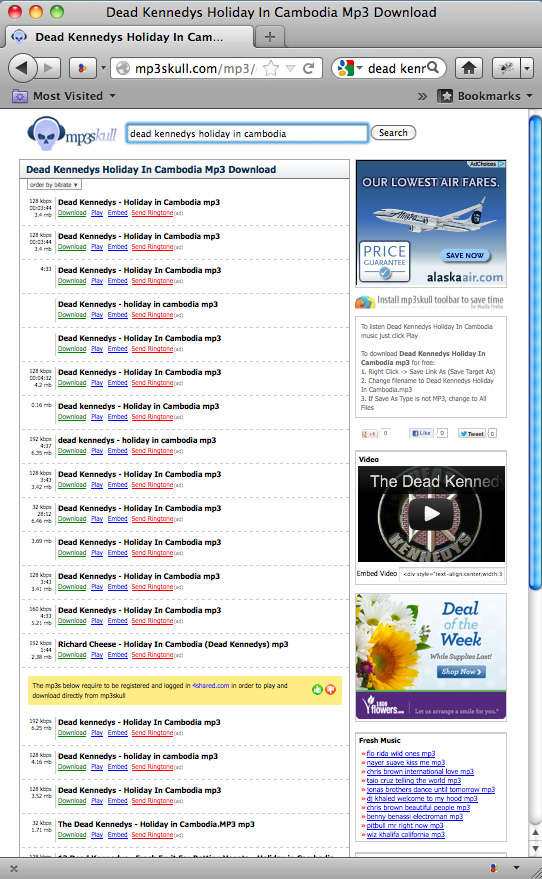
The irony and the disconnect didn’t take long to surface when East Bay Ray from the Dead Kennedy’s pointed out how exactly musicians don’t get paid from corporately funded music piracy sites when he showed a screenshot from mp3skull providing free downloads of his bands music financed by 1-800 Flowers and Alaska Airlines.

Willful Blindness

Of course those who believe in the exploitation of musicians for the profit of internet businesses had no problem rapidly resorting to name calling when it would be a lot more productive to acknowledge the problem as a detriment to the livelihood of musicians, and seek to work towards a cooperative solution to help musicians get paid.

What about Transparency, Being Open and More Human?

Ray went on to note how the negative effects of these sites create an environment that allows companies like YouTube to operate as an opaque black box. Using the best publicly available information he quickly calculated that YouTube’s 35% payment to artists (versus Itunes and Spotify’s 70%) could be a contributing factor to the 45% decline in professional musicians in the last decade. By Ray’s calculations (here at Digital Music News) the numbers may create a loss of 12,000 middle class musicians.

The Elephant In The Room

Some would like to argue that the revenue these sites are generating is inconsequential. These people seem to have difficulty understanding that if brand sponsored piracy can support 200,000 infringing domians that Google is tracking in it’s transparency report, then there is clearly enough there that musicians should be getting paid.

The real point is that there appears to be plenty of money being made online from the distribution of music, it’s just that the money is not being “shared” with musicians.

200kDomainsTracked

Any honest conversation about compensation to musicians has to address the single largest detriment to the revenue of artists at any level, which are the ad network financed music piracy sites. Ignoring these sites leaves out the most critical variable in evaluating fair and ethical compensation models when over 200,000 sites pay nothing at all to musicians with unlimited access to illegally free inventory. These sites profit from exploiting musicians and paying the musicians nothing.

Any legally licensed, legitimate music tech start up also has to acknowledge that mass scale, enterprise level, commercial infringement of music does NOT create a better environment for innovative entrepreneurs but rather a much more difficult one.

The truth is, there is no new professional middle class of musicians. The grand experiment of the digital utopia has been a massive failure for musicans and everyone at SF Music Tech now knows it. The soft back peddling by most on old hard line positions shows clearly that the reality for professional musicians has gotten worse, not better.

One of the most overheard phrases of the conference was, “we have to do better to get musicians paid.” Indeed, as we have noted here the truth is self evident, if the Internet is working for musicians, why aren’t more musicians working professionally? Not everyone aspires to work a day job, make music as a hobby and allow internet corporations to profit from their labor, illegally.

“Here we are, stuck with all these people who want music for free,” said Dave Allen, founding member of Gang of Four and interactive strategist at the branding agency North. “We have to find a way for musicians to make a living.”

If the tech and internet community are truly interested in getting musicians paid wouldn’t it make sense to start where money is already being made?

Petition to Stop Advertising on Pirate Sites

Please sign the letter in the link below to the CEOs of brands that appear on multiple occasions on infringing sites. Ask them to take a pledge to keep their ads off of illegal sites. Keep in mind that this list is not a comprehensive list of brands that appear on pirate sites.

Click Here : Please Sign The Petition to Stop Advertising on Pirate Sites

An Open Letter to the CEOs of Brands Advertising on Infringing Sites:

We, the undersigned, are just a few of the millions of artists and creators living, working, and creating across the United States. It has come to our attention that your companies are advertising on websites that illegally host or distribute creative content. We want to make you aware of the harm your companies do to independent artists and small businesses when you advertise on these sites.

Advertising on these sites encourages others to exploit our work for economic gain without a return to us. It deprives us of the opportunity to build communities with fans when they visit illegal sites to obtain our work, rather than our sites. It also gives consumers a false sense of security by lending an air of legitimacy to these sites. And, it rewards activities that are illegal.

Advertising on these sites also damages your own brands by association.

We understand that it can be difficult to know where your companies’ ads might end up because of the complexity of online advertising. However, difficult does not mean impossible. It appears that other companies make ad buys in ways that don’t result in their brands being tarnished and our work being exploited.

We ask you to encourage your companies to do the same.

You are in the best position to employ high-quality control standards and to demand the same from the ad networks you use. We encourage your companies to uphold high ethical standards for advertising placement, just as you do in other areas of business.

Please ask your online advertising purchasers to adopt practices like those detailed in the Statement of Best Practices to Address Online Piracy and Counterfeiting, released last year by the Association of National Advertisers, the American Association of Advertising Agencies (4A’s), and the Interactive Advertising Bureau. The practices outlined here, if adopted by major companies like yours, would go a long way towards ensuring a free and fair online marketplace for artists and creators to thrive. A report released by the University of Southern California’s Annenberg Innovation Lab on February 14, 2013, under the direction of Jonathan Taplin, has identified the top ten Ad Networks placing ads on infringing sites. And, according to research and documentation by artists working in tandem with this project, your companies have been identified as brands that repeatedly advertise on infringing websites.

Now that this issue has been brought to your attention, we hope that you will take affirmative steps to address this problem.

Artists Rights Watch – Monday Feb 25, 2013

A Weekly Review of Artists Rights, Copyright and Technology News for Creators from Around The Web.

THE NEW YORK TIMES:
* For Music Industry, a Story of Two Googles

…as long as the search side of Google causes friction with the music industry, its other side — the one that is trying to compete with Apple, Amazon and every other digital music service out there — will face some rough patches.

SF GATE:
* New tune at SF MusicTech Summit

The freewheeling era of file sharing, it appears, is slowly coming to a close as artists begin to assert their rights and tech companies consider business alliances with the creators they once flagrantly ignored.

“Here we are, stuck with all these people who want music for free,” said Dave Allen, founding member of Gang of Four and interactive strategist at the branding agency North. “We have to find a way for musicians to make a living.”

SF WEEKLY:
* SF MusicTech: Dead Kennedys’ East Bay Ray Lashes Out at Internet “Pimps”

“There’s opportunists on the Internet that have taken advantage of the artists,” he said, at one point calling them “pimps.” The slim royalties from streaming services, coupled with the proliferation of free MP3s online, meant the music industry was “selling a free ride on a carnival horse, but they’re starving the carnival horse.”

SOLVEIG
* Recap SF Music Tech Summit XII 2013

REUTERS:
* Content economics, part 1: advertising

TV is still the monster, the elephant: for all the talk of cord-cutting, Americans have clearly voted that, given the choice, they’d much rather have cable TV than broadband internet.

And for web-based publishers, the situation is much, much worse even than this chart makes it look.

SEATTLE WEEKLY:
* The Misplaced Zeal of Aaron Swartz

The late activist’s efforts helped put power and public sympathy into the hands of corporations at the expense of artists, musicians, and the people.

Past and present facilitators of digital piracy like Napster, Audiogalaxy, Grokster, Megaupload, and The Pirate Bay are not misunderstood beacons of freedom of speech. They are digital black-market distributors who never asked artists’ permission to feature their works or paid creators a penny, and whose owners took money for themselves via venture-capital funding, subscription fees, or advertising revenue.

DIGITAL MUSIC NEWS:
* The Pirate Bay Is Actually Suing Someone for Trademark Infringement…
* I’m East Bay Ray. And I Think YouTube Has Forced 12,000 Musicians Out of Work…
* Spotify, Pandora & Google Have a New Problem: The New York Times…

MUSIC ALLY:
* Writing or speaking about streaming music screwing artists? Read these articles first
* Harlem Shake tops Billboard Hot 100 chart thanks to YouTube streams

ALL THINGS D:
* Big Music Says Google Isn’t Cracking Down on Pirate Sites, After All

“We have found no evidence that Google’s policy has had a demonstrable impact on demoting sites with large amounts of piracy.”

THE VERGE:
* Spotify pushing labels to lower costs, open up free service to phones

Spotify, the popular music subscription service, is due to meet in the coming weeks with its major counterparts in the record industry to renew their licensing agreements. The Verge has learned that managers at Spotify are expected to ask for substantial price breaks from the music labels as well as the rights to extend its free pricing tier to mobile devices.

VOX INDIE:
* Smokey the Bear Fuels Piracy’s Fire?
* Google Wants to Pass the Buck on Piracy, but Keep Theirs?

Any progress in severing piracy’s blood supply is a certainly a good thing BUT for Google to claim the company is working to “block funding” of pirate sites–while simultaneously profiting from them–seems more than a tad disingenuous. What about blocking access to funding via their AdSense accounts on YouTube and Blogger? Why focus on Visa and Mastercard when one’s own house is in such disarray?

COPYRIGHT ALLIANCE:
* The vine should suffer, not the artist.

THE CYNICAL MUSICIAN:
* The Limits of Copyright
* Copyright Maximalism

The misapplication tends to be especially apparent in the comments section of TCM, where the strangest things are brought up as examples of what would happen if we let up the good fight against copyright. The fact that they strangely failed to materialise over the 300 years or so that copyright had been in existence prior to 2000 (when it tended to be enforced a good deal better) doesn’t throw those who would put forward such theories.

FORBES:
* Congressman Says He’ll Propose Ban On 3D-Printable Gun Magazines

THE TELEGRAPH UK:
* Google looks to Cut Funds to Illegal Sites
* Google’s Copyright War Rages On

In private, the creative industries argue that Google’s supposed favoured status began in Number 10.

David Cameron’s former director of strategy, Steve Hilton, is married to Rachel Whetstone, head of communications at Google. It handed Ms Whetstone a “hotline” to Number 10, opponents argue. Although the couple now live in California, that hotline is “still hot”, says one source. “But it doesn’t matter anyway, because the damage is done.”

The close relationship between Number 10 and the top brass at Google’s Mountain View headquarters has become the framework for all subsequent discussion, critics say. It was emblematic when, nearly a year ago, Downing Street was apparently so in tune with Google’s thinking that the company’s chairman, Eric Schmidt, and the Chancellor, George Osborne, published a joint leader in The Financial Times.

COMPUTER WORLD:
* A Declaration of the Interdependence of Cyberspace

You allege that government has had no role in the Internet, and for this reason it has no claim to the Internet today, but this accusation is founded on nothing more than ignorance and superstition. Government labs and government-funded research programs gave birth to the Internet’s essential technologies, and government policies continue to guide the development of important Internet innovations today.

SALON:
* Stop pretending cyberspace exists – Treating the Internet as a mythical country makes us dumber

If you’re not convinced by now that the very notion of cyberspace is silly, try substituting “fax” or “telephone” or “telegraph” for “cyber” in words and sentences. The results will be comical. “Activists denounced government criminal surveillance policies for colonizing Fax Space.” “Should Telephone Space be commercialized?” Again, the point is not that telecommunications should not be structured and governed in the public interest, but rather that the debate about the public interest is not well served by the Land of Oz metaphor.

SPIEGEL.DE:
* ‘Liquid Democrazy’: Pirate Party Sinks amid Chaos and Bickering

The Pirate Party has been too busy tearing itself apart, with members fighting leaders, who are bickering among themselves and antagonizing the members too. In just the last two days, party leaders for the states of Baden-Württemberg and Brandenburg have stepped down, citing the negative climate. “The atmosphere is so poisonous, there’s hardly any constructive work taking place anymore,” says Udo Vetter

TORRENT FREAK:
* Former File-Sharing Site Admin Fined 6.4 Million Euros
* Google Refuses to Index Huge Streaming Movie Portal Homepage

THE VOICE OF RUSSIA:
* US to crack down on intellectual property theft

The 141-page document refers to China at least 188 times. Russia is mentioned 45 times, and India is also mentioned.Those cases cited mostly involved employees stealing trade secrets on the job rather than cyber-attacks. US corporate victims of the theft included General Motors, Ford, DuPont, Dow Chemical, Motorola, Boeing and Cargill.

TOP COPYRIGHT BLAWGS

Hypebot Have No Defense of Ad Supported Piracy So They Resort To Name-Calling.

East Bay Ray of The Dead Kennedys  and I had an informal bet going.  Well maybe not a bet,  just a sort of prediction that once Ray spoke against ad supported piracy at SF Music Tech,  the music tech bloggers would start with the usual name calling. 
 
 Sure enough right on cue we see Bruce Houghton’s Hypebot giving Mike Masnick (see the “Google Shill List”) a platform to bash Ray and other  artists. “Whining” “Old” “Grumpy” and “Rant” were some of the unfair and unbalanced terms  that Ray and I predicted they would use in the de rigueur  postSF Music Tech cyber bullying. And they did.
 
This is pretty sad since ending ad supported piracy is a no-brainereven Google and Yahoo! fall over themselves to try to explain their unexplainable connection (see USC Annenberg Innovation Lab report).   Both artists and the legitimate music tech firms are negatively affected by ad supported piracy.  For instance legitimate music streaming services have to compete against these same unlicensed services for ad revenue.   Why the music tech space bloggers fail to grasp this is a mystery.
 
Bruce Houghton also owns the talent agency  Skyline Agency.   This agency tends to have a lot of “Old” and “Grumpy” artists that would probably go on a “Rant” if they were to see that their agency head is tacitly defending this practice.  So we prepared a few screenshots.  
 
Any comment Bruce?  Do you think that this practice is acceptable?  How do our “future” music models like streaming compete with the  guys that don’t pay any royalties to artists?   We’re all ears. 

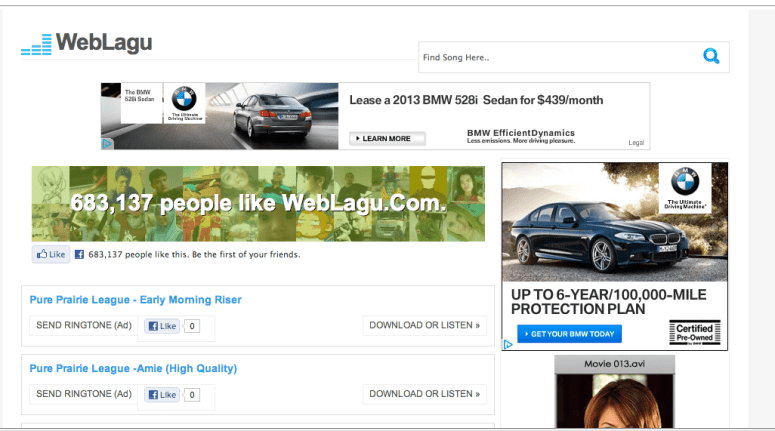
Pure Prairie League piracy brought to you by BMW.

Screen Shot 2013-02-22 at 3.57.36 PM

Al Stewart By Celestion and zZounds.

Screen Shot 2013-02-22 at 7.23.02 PM

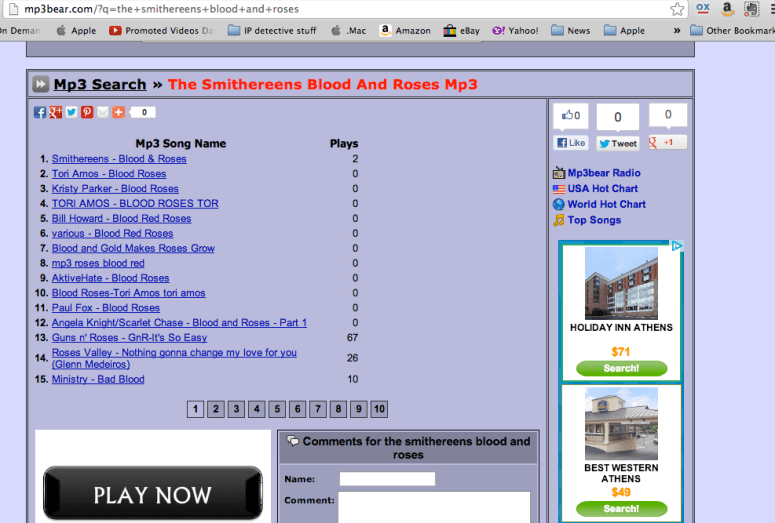
The Smithereens By Priceline

Screen Shot 2013-02-22 at 7.29.48 PM

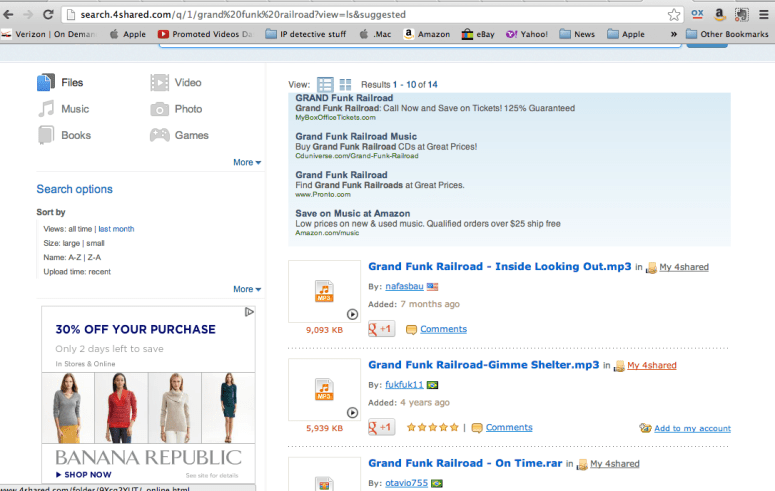
Grand Funk Railroad By Banana Republic, Amazon and others. 

Screen Shot 2013-02-22 at 7.32.59 PM

Music Technology Policy

Greg Sandoval is one of the great reporters on tech and music.  While I don’t always agree with him, I think he’s fair and one thing I know for sure–he is old school when it comes to getting facts and sources right.  So when Sandoval says Spotify is going back to the well to drive down artist royalties even further, you better believe that I believe him.

According to his story at the Verge:

About 70 percent of Spotify’s revenues pays music-licensing fees while another 20 percent covers customer acquisition, these sources said. That leaves 10 percent to pay all of the company’s other costs, including its much praised technology platform. Insiders have told The Verge that this cost structure zeroes out Spotify’s profits.

So brace yourself–Spotify is about to do a Pandora-style argument about how artists should take even less because Spotify’s “profits” are consumed by royalties.  (And…

View original post 831 more words

Music Technology Policy

MTP readers no doubt saw the coverage on last month’s installment of the USC-Annenberg Innovation Lab transparency report that identified ad networks that facilitated IP theft.  Now we see that this month’s report names brands.  You can read all about it here.

Here’s a sample of the top brands driving brand sponsored piracy and theft from artists:

Amazon

American Express

AT&T

BMW

Buick

Converse

Dropbox

Equifax

FingerHut

General Motors

Honda

K Swiss

Lenovo

Lexus

Mazda

Mercedes Benz

Nationwide Insurance

Nissan

Nokia

Progressive Insurance

Saks Fifth Avenue

Samsung

State Farm Insurance

Toyota

Transunion

Verizon

Victoria’s Secret

Visa

Volkswagen

WalMart

View original post

Artists Rights Watch – Monday Feb 11, 2013

A Weekly Recap of Artists Rights, Copyright and Technology News for Creators from Around The Web

THE WALL STREET JOURNAL:
* Reappearing on YouTube: Illegal Movie Uploads

The recent problematic uploads may have undercut the rental effort. Movies produced by Disney’s Touchstone Pictures, such as “I Am Number Four” and “Shanghai Noon” are available free on YouTube, even though the studio struck a rental deal through the site.

HYPEBOT:
* Spotify Listener Data Used To Predict Grammy Winners

THE GUARDIAN UK:
* Pirate sites are raking in advertising money from some multinationals

Sites such as Pirate Bay often portray themselves as altruistic, non-profit “freedom fighters”, when the truth is they’re nothing of the sort – their exploitation of artists for their own monetary gain is far worse than the most unscrupulous labels ever were, as they pocket large sums of ad revenue without having to invest it into developing the content they flog.

MUSIC TECH POLICY:
* Pirate Site Isohunt Selling Dead Kennedys Tickets

JAPAN DAILY PRESS:
* Japan’s ‘Operation Decoy File’ to help deter online piracy

THE DEANS LIST:
* Music, Copyright and New Technology in the News From a Creator’s Perspective 02/05/2013

COPYHYPE:
* Friday’s Endnotes – 02/08/13
* Bringing Reality Back to Copyright Debates

Smith and Telang found that of the papers based on empirical data (as opposed to theoretical models), 25 found economic harm from piracy, while only 4 found little or no harm. And for those who are skeptical of non-academic papers: Smith found that 12 peer-reviewed papers published in academic journals found a negative impact from piracy while only 2 did not (and there are legitimate questions concerning the methodology of those 2 outlier papers, some of which are explored in Stan Liebowitz’s 2005 article Economists’ Topsy-Turvy View of Piracy).

Evidence like this, of course, does not tell us where to go from here. But it is amazing how many who join with skeptics of copyright either don’t know about the scholarly record on piracy or don’t care.

DIGITAL MUSIC NEWS:
* The Average TuneCore Artist Now Makes $120 a Year…
* Spotify Executive: “We’re Totally Transparent, and We Definitely Live by That Principle.”
* In Just 3 Years, P2P Usage Has Dropped 35% In France…

FORBES:
* We Need Strong Copyright Laws Now More Than Ever

So why does CEA attack songwriters in this way? Flawed logic. They reason that member companies can make more money if they pay songwriters and other creators less. The truth is that music creators and technology companies need each other. Many innovative and wonderful music-related products are made by CEA members. But many of these products have no purpose without music. The copyright and associated costs—often pennies on the dollar—are deemed harmful. Make no mistake, the companies of the CEA believe in intellectual property. Just ask them about their own intellectual property, such as their patents or trademarks.

Mr. Shapiro’s conclusion is that copyright laws are hurting America. Nothing could be further from the truth.

CNET:
* Next-gen Xbox will require constant net connection

THE HOLLYWOOD REPORTER:
* Recording Academy Chief on the Grammys, Pandora and Getting Artists Paid (Q&A)

The problem is, in the transition of all this, we have to remember that it all comes back to the men and women who are creating this wonderful music, and do they have a real ability to make that a full-time vocation as opposed to a part-time hobby?

USWITCH:
* Fines to replace disconnections for internet pirates?

SMART COMPANY:
* Why Telstra plans to slow you down to fight online piracy

Telstra will soon conduct a “limited trial of a range of technical options for better managing broadband internet performance for our customers during peak periods”. One of those options is to “shape”, as the industry euphemism puts it, customers’ access to peer-to-peer (P2P) file distribution networks such as BitTorrent.

PC PRO:
* Anti-piracy letter plans face delay over costs

COMPLEX:
* The 25 Most Important Civil Rights Moments in Music History

BILLBOARD:
* Business Matters: MP3 Stores Harder to Find as Google Search Removal Requests Accumulate

Legitimate MP3 links are becoming harder to find even as the RIAA has sent more than 3,400 removal requests to Google relating to approximately 10 million specific URLs from its search results. Legal stores like Amazon and Myxer, as well as legal streaming sites like YouTube and legal streams and downloads at music blogs, are buried under more illegal MP3 links than when Billboard.biz examined 30 artists in November.

Now, using the same 30 artists as before, it took an average of 11.06 search results to find the first legal search result of any kind and 26.84 search results to find the first legal MP3 store. In November, the results were 7.9 and 11.75, respectively. (Each search was conducted by typing in “MP3” and then the name of the artist. Two spellings were used for Ke$ha and P!nk.)

SONIC SCOOP:
* Input\Output Podcast: David Lowery and the Future of Artists’ Rights

SPIN:
* Music Piracy’s Search Problem: Recording Industry Bringing the Fight to Google

THE DUQUESNE DUKE:
* Pirating or advancing; Debating illegal music downloads – Stealing intellectual property is still a crime

The debate against music piracy has also decreased in popularity. Illegal downloading has become a socially accepted practice and as friends talk about what music they recently downloaded, they forget that they are discussing a crime.

Because of piracy, the music industry is in a downward spiral. And when the time comes for our favorite musicians to pack up their instruments and cancel their tours, we will look at each other, dumbfounded, wondering what could have caused such misfortune to manifest. We will blame the labels. We will blame iTunes. We will demonize Justin Bieber and denounce greed.

But what is really holding the industry back isn’t the greed of the structure. It’s the greed of the people who believe they have the right to all the music they want without paying for it. For the love of music, buy the album and appreciate it for what it is worth.

RAPID TV NEWS:
* Legal content downloading up in France, video and TV series stir piracy

CNN:
* What happens if the price of music falls to zero?

THE HUFFINGTON POST:
* The Internet Is Not Free by Lowell Peterson Executive Director, Writers Guild of America, East

So far, the brightest minds in the business have not figured out how to replicate the revenue streams currently generated by television advertising, theater tickets, and DVD sales, so the market for programs created directly for digital distribution has been pretty thin. Thus, if traditional television and cinema are displaced by the Internet, there will not be enough high-quality content for the ISPs to distribute unless we can figure out how to generate more money to pay people to create it.

TERRIBLE MINDS:
* 25 Thoughts On Book Piracy

MUSIC ALLY:
* Pandora’s active listeners dropped by 1.5m in January

HARPERS:
* Google’s Media Barons

As a journalist and board member of the Authors Guild, I’ve watched in dismay as writers, living and dead, have suffered steep drops in income and copyright control thanks to Google’s — and its smaller rivals’ — logistical support for pirating and repackaging everything that we writers, editors, and publishers hold dear. From the humblest newspaper reporter to the most erudite essayist, we do the work, we invest the money and time, some of us risk our lives — and Google, broadly speaking, reaps the benefits without spending a dime.

FROM THE TRICHORDIST:
* What You Can Do Today to Stop Brand Sponsored Piracy Through Touring Contracts or Sponsor Deals: Artists Helping Artists
* Yes, Piracy Does Cause Economic Harm
* Streaming Services Ranked By “Artist Friendliness”
* Wolves in Sheeps Clothing Criminalizing All Who Oppose Them But for He Who Brings the $unlight: The Troubled, $trange, Fearful, Frightened World of Gary $hapiro, the Diogenese of Anti-Copyright Lobbyists
* Google, Advertising, Money and Piracy. A History of Wrongdoing Exposed.
* Google’s Dehumanized “Safe” Advertising Practices in Gmail: More Laughs From the Leviathan of Mountain View
* Music Streaming Math, Can It All Add Up?
* One Bad Apple: The Complete Checklist on Google’s “Non Anti-Piracy” Anti-Piracy Policies