Spotify’s Daniel Ek is Really Bad At Simple Math, “Artists Will Make a Decent Living Off Streaming In Just a Few Years”

The future of music for artist revenue streams seems more uncertain than ever. Digital Music News is reporting a quote from Spotify’s Daniel Ek on CNN Money which appears to show the failure of the companies CEO to perform simple math.

It should be noted that Daniel Ek was also the CEO of uTorrent, “the world’s most popular Bit-Torrent client” which is advertising funded.

Spotify CEO: “Artists Will Make a Decent Living Off Streaming In Just a Few Years” | Digital Music News

CNN: At what point can an artist survive on a Spotify income?

Ek: Well, I mean, the interesting thing here is that we’re just in its infancy when it comes to streaming. And we just last week had an artist announcement where we basically said if there would be 40 million subscribers paying for a service like Spotify, it would be more than anything else in the entire music industry, including iTunes.

We don’t want to say Mr.Ek is lying, but he does appear to be very bad at simple math and to be misinformed about the actual size of the record business and the revenue being generated by Apple’s Itunes.

Is anyone actually capable of doing simple math in a spreadsheet? Here goes. 40m Spotify Subs at $10 a month is only $3.3b in annual revenue to artists and rights holders at paying out 70% of gross. How is $3.3b “more than” the current $15b total annual global revenue or the $7b in domestic revenue in the US?

Here’s the simple math…

40,000,000 * $84 = $3,360,000,000

$84 dollars per subscriber annually is calculated at $10 per month per subscriber paying out 70% to Artists & Rights Holders or, $7 per month. $7 per month, multiplied by 12 months equals $84 per year, per subscriber payable to Artists and Rights Holders.

40m Subscribers x’s $84 per year = $3.3b in annual global revenue to artists and rights holders (assuming they really are paying out 70% of gross).

Simple math.

If you are an artist you might also read these links below:

Music Streaming Math, Can It All Add Up?

Venture Capitalist Admits Artists Can Not Make A Living On Streaming Royalties…

The Internet Empowered Artist? What 1 Million Streams Means To You!

Streaming Price Index : Now with YouTube pay rates!

It appears to us that music streaming can only truly be profitable to those with participating equity in the streaming company itself. Those with equity are leveraging their catalogs of assets against the potential revenue of an IPO (in which the catalog of assets is being leveraged for that equity). Thus far however, it appears that the artists and songwriters who have created those assets as the basis for that equity leverage do not participate in any profit sharing that the equity shares may earn.

So it’s not that music streaming can not be profitable, it’s just that it can not be profitable (or equitable) to artists.

Please tell us which artists are being compensated from the $3b sale of Beats music to Apple? Let’s see a show of hands… Bueller… Bueller… Bueller…

Remember when we were told that in countries where music streaming was the most successful that transactional sales also increased? We’ve got a bridge in Brooklyn to sell you too, and cheap. More food for thought below.

Streaming Isn’t Saving the Music Industry After All, Data Shows… | Digital Music News

Album Sales Hit A New Low | Billboard

No Surprise Here: Spotify Streams Soar While Track Sales Fall | Billboard


Pre-72 Red Herrings from Pandora’s Chris Harrison (and that’s not the IPO kind)

Pandora executives are still prancing around cashing out stock options while telling their stockholders that they are intentionally stiffing American artists on recordings released after 1972–well…sort of telling their stockholders.  If their stockholders are also copyright experts.  Because what Pandora doesn’t tell their stockholders is that not only is Pandora not paying royalties, Pandora’s position actually acknowledges that Pandora is still exploiting these pre-72 recordings without any rights.  This is exceptionally bizarre because if Pandora just paid the statutory webcasting royalties under the U.S. Copyright Act, they would at least have a fig leaf that they actually had some kind of license.  

By saying that the recordings are not subject to the compulsory license like all the other recordings Pandora exploits, they essentially have no license for the pre-72 recordings (but do have the compulsory license for the post-72 recordings).  So then they have to prove that when the Congress created the statutory license for webcasting and the royalty system for royalty payments, the Congress actually intended to exclude all sound recordings before 1972.  (The magic of 1972 is that is the year that the Congress first included sound recordings in the federal Copyright Act–sound recordings previously were covered by “common law copyright” not no copyright.)

According to Pandora’s latest Form 10-Q:

On April 17, 2014, UMG Recordings, Inc., Sony Music Entertainment, Capitol Records, LLC, Warner Music Group Corp., and ABKCO Music and Records, Inc. filed suit against Pandora Media Inc. in the Supreme Court of the State of New York. The complaint claims common law copyright infringement and unfair competition arising from allegations that Pandora owes royalties for the performance of sound recordings recorded prior to February 15, 1972.

The outcome of any litigation is inherently uncertain. Based on our current knowledge we believe that the final outcome of the matters discussed above will not likely, individually or in the aggregate, have a material adverse effect on our business, financial position, results of operations or cash flows; however, in light of the uncertainties involved in such matters, there can be no assurance that the outcome of each case or the costs of litigation, regardless of outcome, will not have a material adverse effect on our business. In particular, rate court proceedings could take years to complete, could be very costly and may result in royalty rates that are materially less favorable than rates we currently pay.

This risk factor is actually misleading–not only is Pandora being sued for money, the lawsuit also asks for the court to order Pandora to stop exploiting the pre-72 recordings altogether:

A preliminary and permanent injunction preventing, enjoining, and restraining Pandora and its respective agents, servants, directors, officers, principals, employees, representatives, subsidiaries and affiliated companies, successors, assigns, and those acting in concert with them or at their direction, from directly or indirectly infringing in any manner any right in any and all Pre-72 Recordings in which any Plaintiff owns or controls an exclusive right under statutory or common law, including without limitation by directly or indirectly reproducing and digitally publicly performing any of Plaintiffs’ Pre-72 Recordings….

Don’t you think that Pandora should have told their stockholders that they might actually lose the right to use pre-72 recordings altogether?

Now what is interesting about this is that Pandora chooses to take a position that hurts artists (and union players and singers) whose performances are on pre-72 recordings based on this arbitrary cut off date.  Somehow they seem to think that a recent Copyright Office study supports Pandora’s decision to screw artists.  Here’s what the Copyright Office actually said (on p. 129-130):

In reviewing the potential application of section 114 [Pandora’s compulsory license] to pre-1972 sound recordings, the [Copyright] Office believes that section 114’s statutory royalty requirements should apply to nonexempt, noninteractive digital transmissions of those recordings [meaning Pandora], thereby providing an additional revenue stream for older artists and works….The [Copyright] Office thinks it is unreasonable for the age of a sound recording to dictate whether royalties are paid on public performances by means of digital audio transmissions, so long as copyright subsists in that sound recording. Bringing pre-1972 sound recordings within the scope of federal protection would subject them to the statutory license and provide online music services with an easy means to offer lawful public performances of those recordings while offering copyright owners and performers a reliable new source of income.

What Pandora’s Chris Harrison (or “Artist Enemy Number 1” as he is known around the Trichordist) says about the lawsuit is that Pandora favors something called “full federalization” of the pre-72 sound recordings (or “the entire history of recorded music” as it is known around the Trichordist).

Harrison says that Congress made the decision not to include pre-72 recordings when it created the digital performance right for sound recordings in 1995.  We think this is actually false–many of the members of Congress who were on the House Judiciary Committee in 1995 are still on the committee, and none of them have acknowledged that it was a conscious decision of the Congress to exclude pre-72 recordings.  However, we’re looking forward to the conga line of congressmen linking up to take ownership of the decision to stiff old guys and dead cats and their heirs from webcasting royalties like Harrison wants to do.

Because…think about it.  Even if you were the man who fell to freaking Earth, would anyone in their right mind think that American elected officials would create a legal goodie in the form of a statutory royalty–which is actually fair compensation for rights the law takes away from artists and copyright owners in the compulsory license that is necessary to avoid a “taking” under the 5th Amendment–but these American officials would say but not for thee?  You American artists who gave the world the rich history of blues, jazz, rock, R&B before 1972, nothing for you, sorry.  That’s not only insane, it explains why there’s no legislative history evidence supporting Pandora’s position.

Harrison also equivocates when it comes to acknowledging this thievery:  “We’ll still pay the songwriter”.  Not the question being asked.  But Harrison tells us that the loophole is Congress’s fault.  No, it’s actually Pandora’s fault–they were paying until Harrison arrived on the scene.  We wonder what the confluence of these two events have to do with each other.  The reason that the RESPECT Act was introduced–which Pandora opposes–was to clarify this loophole, or the “Pandora loophole” as it’s known.  The RESPECT Act is really just a technical amendment and shouldn’t be opposed by anyone.

Yet Pandora rejects the RESPECT Act in favor of “full federalization” of sound recordings.  Why is this?  We think that this is one of those ice in winter situations where somebody dreams up a problem that they try to convince you that you somehow have, then wants you to give up something real in order to get them to relent.  Bullies are exceptionally good at this when they are holding on to your lunch money.  All you have to do is lick their boots and they promise to give your lunch money right back to you because they’re really only thinking of your nutritional well being.

The reasons Harrison gives for Pandora’s position start with the RESPECT Act unfairly targeting Internet radio, because Internet radio is the only one who would pay more.  If the RESPECT Act just included terrestrial radio, then that would be all better.  (That’s using the term “reason” rather loosely.)

This, of course, is the usual fallacious crap we hear from Harrison and Pandora.  The point of the RESPECT Act as told by the bill’s author Rep. Holding is a “rifle shot” solution to fix the the problem with the digital performance royalty that Pandora has created–to fix the Pandora loophole.  It has nothing to do with terrestrial radio–just like the 1995 change that created the digital performance right had nothing to do with terrestrial radio.

That’s the point.  So for Harrison to say that the problem is that the RESPECT Act only deals with Internet radio is like saying the antibiotic your doctor prescribed only dealt with the infection you have today, not the limp from the broken leg you got 10 years ago.

Harrison says that Pandora wants this full-federalization thingy for the protections built into the Copyright Act for copyright users like fair use, the ability of libraries to keep archival copies, rights of termination of transfers for artists–and of course the DMCA safe harbors.

The only problem with this list of supposedly high minded and pure souled desires of Pandora is that none of the issues Harrison identifies have anything to do with Pandora.  Pandora doesn’t rely on fair use because they get a statutory license, they’re not a library, they have proven quite unequivocally that they don’t give a rats ass about artists and songwriters, and they don’t rely on the DMCA.

Which is the revealing part–because you know who does care about most of that list?

Google cares.  This is why Pandora’s position on “full federalization” makes more sense as the position of the Digital Media Association.  Pandora’s “full federalization” position requires Pandora to take on considerable risk that is not in the interest of Pandora’s stockholders, especially compared to the ill-will, lawsuits and infringement exposure for Pandora stockholders from the decision by Harrison to stiff the old guys and the dead cats and their heirs–like Duke Ellington, The Beatles, Louis Armstrong, Roy Orbison, Johnny Winter and The McCoys.  The dominant member of the DiMA is–Google.  And Google robs artists every day with ad-sponsored piracy alone.  Not to mention the incompetent CMS and Content ID.  This smells like inside Washington back scratching to us.

And Google controls all the advertising on Pandora through DoubleClick thanks to the Antitrust Division of the Department of Justice that permitted the Google’s acquisition of DoubleClick–which gives Google such leverage over Pandora that Doubleclick has its own risk factor in Pandora’s SEC filings:

 We rely upon an agreement with DoubleClick, which is owned by Google, for delivering and monitoring our ads. Failure to renew the agreement on favorable terms, or termination of the agreement, could adversely affect our business.

We use DoubleClick’s ad-serving platform to deliver and monitor ads for our service. There can be no assurance that our agreement with DoubleClick, which is owned by Google, will be extended or renewed upon expiration, that we will be able to extend or renew our agreement with DoubleClick on terms and conditions favorable to us or that we could identify another alternative vendor to take its place. Our agreement with DoubleClick also allows DoubleClick to terminate our relationship before the expiration of the agreement on the occurrence of certain events, including material breach of the agreement by us, and to suspend provision of the services if DoubleClick determines that our use of its service violates certain security, technology or content standards.

If we’re wrong about this, we are looking forward to Chris Harrison’s explanation of exactly why all these “full federalization” issues are in the best interests of Pandora stockholders, particularly when compared to the potential downside of being found an intentional infringer under common law copyright, unfair competition and possibly some state criminal statutes.

But he can leave out his hearts and roses serenade about how much he cares about artists and songwriters getting the termination right for common law copyrights.  We can take care of ourselves without his “help” thank you very much.

Blake Morgan on How Google Alerts Drive Traffic to Pirates and Hurt Indie Artists and Labels

Music Technology Policy

After our post yesterday about how Google drives traffic to pirate sites through Google Alerts (also supported by Facebook and Twitter), I got a chance to speak to Blake Morgan of ECR Music Group.  (MTP readers will remember Blake from the #IRespectMusic campaign, still going strong.)

Blake had the same experience with his label mate Janita (whom we interviewed about her experiences in Washington, DC supporting the #IRespectMusic campaign).

nadler(L-R Tommy Merrill, Rep. Jerry Nadler (D-NY), Blake Morgan and Janita)

The point of this is that Google knows how many DMCA takedown notices it has received for certain sites.  Janita’s record was also pirated by myfreemp3 a site for which Google has received over 4,000,000 takedown notices just for Google search links.  How do we know this?  Google publishes the information in its “Transparency Report” (and for those who read this slide yesterday…

View original post 498 more words

Musicians POV: Spotify Isn’t Good for You – Full Post

The Trichordist

Mikey’s Not Here

If you remember the old “Life” cereal ads, they featured kids who didn’t want to eat Life cereal because it was “good for you” so who would like that?  Test it out on “Mikey”, the hyper critical eater—”Give it to Mikey, he hates everyhing!”  And surprise, surprise, Mikey likes it.

So it is with Spotify.  Mikey may eat it, Mikey may even proselytize about its wonders of valuation, but Spotify is not only not good for you, it’s actually bad for you.  The good news is (maybe) there’s something every artist can do about it.  Unless, of course, they listen to “Mikey”.

Here’s the proposition:  From a financial point of view, Spotify’s payable royalties are neglibible–marginally better than a pirate site.   (See “Streaming Price Index“) Spotify is, of course, a licensed service and it is encouraging to see investment pouring in to its coffers.  Make no mistake–we’re…

View original post 2,248 more words

David Lowery: Here’s how Pandora is destroying musicians | Salon

David Lowery has become both beloved and notorious over the last year as one of the musicians most critical of the ways musicians are paid in the digital era. The Camper van Beethoven and Cracker singer brings an artist’s rage and a quant’s detached rigor to his analysis of the music business.

He’s currently fired up about a federal lawsuit filed in New York in which several record labels have sued Pandora (and before that, Sirius FM) for neglecting to pay royalties for songs recorded before Feb. 15, 1972. Here’s how Billboard summarizes the suit: “The labels say both digital music services take advantage of a copyright loophole, since the master recording for copyright wasn’t created federally until 1972. … But the labels claim that their master recordings are protected by individual state copyright laws and therefore deserve royalty payments.”

Lowery thinks the loophole provides a way for Pandora to simply not pay older musicians for their work — while profiting from it themselves. The case could get bigger and change in strange ways, with broad implications.

READ THE FULL STORY AT SALON:
http://www.salon.com/2014/08/31/david_lowery_heres_how_pandora_is_destroying_musicians/

Call to Action: Don’t Let ICANN Give Our “Dot Music” Domain Names To Tech Giants, Hedge Funds and Shady Brokers.

screen-shot-2014-08-23-at-3-59-46-pm

 Some of the groups and companies vying for the .music gTLD.   That is, the people that will be selling you http://www.YourBandName.music back to you at possibly exorbitant prices. 

Let’s take a trip to the near future. It is August 2015 and the new .music  top level domain names (gTLD) have just launched.

Now, hypothetically let’s say you have a moderately successful  indie rock band named Leland Stanford’s Octopus.  Your band has  been around since 2005 and you’ve developed a loyal global following.   Yes I know , it’s a funny name for a band but perhaps you and your bandmates were particularly interested in California-based 19th century railroad monopolies, corrupt politicians and robber barons. And why not?  Leland Stanford like many railroad tycoons and robber barons of the 19th century had a hipster beard and a sort of devil-may-care longish hairstyle. You could do worse for band name inspiration.

Now for 10 years you’ve had http://www.lelandstanfordsoctopus.com as your main domain name, but with the launch of the new “dot music” domains like most bands you decide you want to migrate to the new .music gTLD.   The only problem?   The board of ICANN gave the rights to administer  the .music domain to a for-profit consortium formed by Google, Amazon and Cerberus capital.  Never mind that none of us ever voted for the members of ICANN and it’s not clear how they have amassed such awesome power with so little oversight or transparency.  With no real accountability to the public much less to your band, ICANN members simply let the close friendships and revolving door between ICANN and companies like Google  influence their decision. Thus they rewarded their cronies with the rights to the .music domain (and probably more of the dozens that these tycoons want to control).

And of course what will give the .music domain any value is not the consortium–it will be the artists and musicians who brand the gTLD by migrating to it.

Now in order to make it appear not to be a forced collectivization of hundreds of thousands of artists’ intellectual property rights for the benefit of some of the richest corporations on earth, there was a “sunrise” phase in which artists who had spent the thousands of dollars to trademark their names  and hundred more to register them with the Trademark Clearinghouse (TMCH) could get their domain name for a nominal fee.  However like most bands Leland Stanford’s Octopus didn’t have the money nor the wherewithal to trademark their name and register it internationally.  Now their domain name along with tens of thousands of artist’s domain names have been snapped up by mysterious brokers registered in places like Malta, Belize, Gibraltar and Panama City.

A mysterious former “Canadian pharmacy” promoter turned cybersquatting domain name broker is holding  www.lelandstanfordsoctopus.music and is asking $2,200 dollars for the domain name.  Of course you are outraged.  Having to buy back your own domain name from anonymous brokers?

So what are you gonna do?   Rationally, the cheapest thing to do is just to simply pay the shady broker (and indirectly Amazon, Google and Cerberus) to get your intellectual property back.  And soon, because next year it may not be the same price.

Far fetched?  Nope we’ve seen this sort of abusive cybersquatting happen with far less valuable and potent domain names while the registrars, governments and ICANN stand idly by.   It surely will happen with .music unless we have a group running .music that is truly on the side of artists and performers and empowered to decide that a band gets to control its own domain name with a .music gTLD.  If we are not vigilant this could be the choice facing many artists.

+++++++++++++++++++++++++++++++++++++++++++++++++++++

Here’s the problems the way I see it:

The .music gTLD should be owned by at least a neutral party with real knowledge of the business.  It shouldn’t favor record labels over artists (especially after labels sold artists down the river on streaming, trading low royalties for equity in these companies).  But most importantly  this valuable bit of virtual real estate should not be handed to  Silicon Valley and Wall Street.  And not just because they are the 1% of the 1% and have the cronies to get control of yet more Internet real estate.

Google and Amazon have shown their true colors and have no cred with creators.  Google actually funds ad sponsored piracy and uses their monopoly power to cram down deal terms on indie labels.  Amazon routinely jams up authors and uses indie record stores as unpaid showrooms with predatory pricing designed to drive mom and pop record stores out of existence.

Giving these people control over the .music domain would just be increasing their domination of the music business.  Google is already facing an antitrust complaint in Europe from indie labels.  UMG controls over 40% of the recorded music market no one in their right mind would give them exclusive control over the dot music domain.  So why would someone even consider giving Google  dot music when  YouTube has a virtual monopoly in online video (with much of it is illegally uploaded)?

This is like giving the fox control of the domain name .chickens.

This is just completely wrong and almost guarantees that the only artists who will use the .music gTLD will be those who don’t know any better until it is too late.

Please let ICANN know how you feel.  Be firm but polite.  Please write Akram Atallah  at  akram.atallah@icann.org

My letter is below.

To: Fadi Chehadé, ICANN President and CEO and Akram Atallah, President, Global Domains Division, ICANN


I’m writing to oppose your handing off control of the .music domain to any tech giant especially Google or Amazon (or both of them).  I am a songwriter and founder of the band’s Cracker and Camper Van Beethoven.   I also teach the economics and finance of the music business at the Terry School of Business at the University of Georgia.  I have spent many years studying the effects of the dominance of massive tech companies on the music industry as a whole as well as individual performers and songwriters.  Regulators not unlike yourselves have allowed theses companies to extract monopsony pricing and unjustified rents from artists. Giving these same companies control over the .music gTLD would essentially hand these enormous companies valuable intellectual property that rightfully belongs to the artists.  They would then be in a position to sell artists their own intellectual property back to them.  

After a review of the ICANN leadership, it is obvious that none of you have any real world experience in the music business.  After reviewing my resume, you should come to the conclusion that I have no experience with what you do.  Fair enough. 

 However when it comes to your decision as to who should control the .music gTLD, you are injecting yourselves into my business and you appear to be doing so in a way that increases the domination of already dominant companies like Google and Amazon.  Because you have chosen to do this, I must point out to you how ill qualified ICANN is to take such decisions.  I mean this with respect and with the full knowledge of how sensitive tech people are about their expertise.  While my criticism may sound insulting to those who carefully guard their turf and titles, it is not intended to be. 

However, the insults likely will come from far and wide if you hand over the .music domain to people who are culturally like yourselves but are largely despised by huge swaths of the professional creators as well as the larger music industry.  Why?  Amazon has made no bones about using it’s power to exact monopsony pricing from authors and recording artists.  What will happen when they control our most valuable domains?  In the case of Google, many of us believe that Google continues to  directly profiting from piracy—a crime—on a massive scale through its Adsense and Doubleclick operations. Google has also shown a willingness to use its online video monopoly to extract monopsony pricing from independent labels for its proposed YouTube music streaming service.   Further Google should be disqualified simply because they have demonstrated a willingness to do business with criminals.

 FACT:  Google paid a half a billion dollar fine to avoid CRIMINAL prosecution by the US Department of Justice  for assisting criminal groups in selling drugs in the United States.  

Google, Amazon and a host of other big tech companies lack the bona fides to control an asset as key to the music business as .music.  If you allow them to own it, you will be participating in just another Internet farce.  I for one will do everything I can to see to it that no self-respecting artist uses the .music gTLD.

The registrar for the new gTLD .music should have a record of treating artists fairly and should not be simply extracting further rents from artists by selling them back their own intellectual property at inflated prices. 


If the Internet is working for Musicians, Why aren’t more Musicians Working Professionally?

We keep hearing from web/tech gurus about how empowered artists are in the internet age, but yet, the numbers just don’t add up. It’s also ironic that tech bloggers like to promote the idea of  “touring and t-shirts” as a solution to the difficulties musicians are having online. But it really sounds to us, more like an admission that there is no money for artists online in the Exploitation Economy to develop new and sustainable professional creative careers.

This is why, an ethical internet for all citizens is so important. Sometimes, the facts are just so simple…

Ted Cohen: Breaking Through The Noise | | midemblogmidemblog

“The Internet was supposed to be the ultimate leveler, great music would be able to find its audience, the ‘big label’ gatekeepers would no longer control access to the masses.

It hasn’t exactly played out that way. According to my friend, Tommy Silverman/Tommy Boy Records and the co-founder of the New Music Seminar recently told me that he did the math and only 228 artists broke 10,000 units for the first time last year out of 105,000 albums.

That’s 2.17% but only 15 of those did it without the help of a real label.

That’s not very encouraging to the other ninety-eight percent. While tens of thousand of artists are self-releasing their music, their ability to get noticed in a meaningful way is stifled by the sheer volume of music that is arriving daily at iTunes, Amazon, Spotify, MySpace Music, Yahoo, Rhapsody, Pandora, iHeart and others. Ten years ago, there were roughly twenty-five thousand album releases a year.

In 2009, it is estimated that there will be over one hundred thousand albums put into digital distribution. That’s roughly a million new tracks a year, four million minutes of music, or almost three thousand days-worth of song. But, maybe, if I listen really, really fast, I could….nope!”

The numbers below are equally sobering. Not only did the volume of sales drop from 2009 to 2010, but also the number of new releases also dropped. Many promoting the exploitation of artists are also proposing that the new lower barriers for access to distribution will increase creative output, but that also appears to be false.

Business Matters: 75,000 Albums Released In U.S. In 2010 — Down 22% From 2009 | Billboard.biz

75,000 Albums Released In U.S. In 2010 — Down 22% From 2009

Not only were fewer albums released, but the weakest sellers took up a smaller share of new release sales. The 60,000 titles that sold from 1 to 100 units represented 0.7% of all sales from titles released in 2010. In 2009, 0.9% of sales came from the 80,000 titles that sold from 1 to 100 units.

So there were quite a few new albums that sold fewer than ten units.

Put another way, the 60,000 new releases that sold 100 or fewer units averaged just 13.3 units per title.

The statistics above do not support the assertion of the tech blogosphere that the internet has created more opportunities for professional creative careers, or expanded a working middle class of musicians. It’s actually very much so the opposite of their claim.

It’s clear from the numbers above (and continued below) that the democratization of production and distribution has not democratized talent. The most exploited music, is not surprisingly, the most popular. These are the artists and titles which are also developed and promoted by traditional media outlets.

Here’s another interesting stat reported by Digital Music News. Does this look like the empowerment of a new creative middle class to you?

99.9% of Tunecore Artists Make Less Than Minimum Wage…

99.875% – or nearly all – of Tunecore artists are making less than minimum wage through the platform, based on revenue figures recently shared by the company.

Despite this fact, some tech bloggers can’t even understand how the simplest mechanisms function in the recorded music business. In an attempt to discredit some of the reports above one tech blog let lose with this gem below, alleging that because Tunecore and CDBaby releases are not reported directly to Soundscan their releases are not counted in Soundscan stats creating a massive unreported pool of revenue being ignored by the industry.

TuneCore does not report results to Nielsen Soundscan and it puts out a hell of a lot of releases. Similarly, CDBaby/Disc Makers points out that Soundscan doesn’t count its releases either — which number around 50,000.

The problem with the above is not understanding that Tunecore and CDBaby can’t report to Soundscan, because Soundscan collects the data from the point of sale such as Itunes, Amazon, etc. So in fact, all Tunecore and CDBaby releases and sales are actually cataloged and reported by Soundscan afterall. So much for all that unreported sales and revenue.

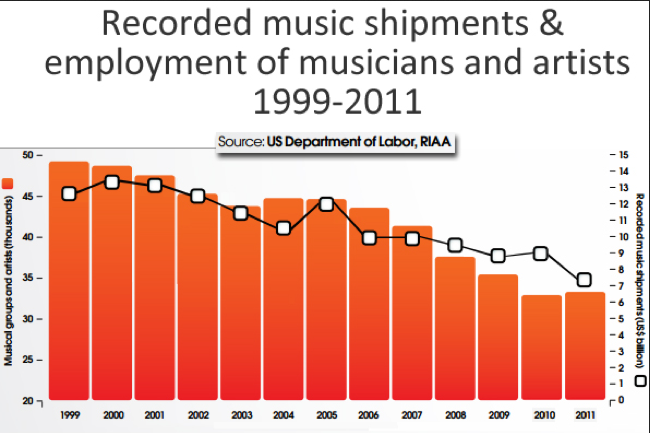
But of all the numbers, this one is the bottom line. Salon recently reported stats from the Bureau of Labor Statistics that number of working professionals in the music industry are suffering a catastrophic decline. If these numbers were reported by any other industry it would make national headlines:

No Sympathy for the Creative Class

“Musical groups and artists” plummeted by 45.3 percent between August 2002 and August of 2011.”

This is also graphically represented here at Digital Music News:

musiciansindecline

All of this gave us pause when we saw a report given by The Future Of Music Coalition (FOMC) in Digital Music News that artists earnings are benefiting from digital technologies? How? As opposed to what? I can see that some digital technologies may be helping artists, but “overall” is simply, statistically, not true given the information above. So it trouble’s us to see statements like the one below made in public by the organization’s Kristin Thomson at SF Music Tech in February of 2012.

 “Overall, digital technologies seem to be having a positive impact on musicians’ earnings capacity”

Really? Maybe it’s not surprising that FOMC is also aligned with Public Knowledge who held a joint workshop to help musicians understand that, “Copyright law is changing rapidly in the face of new technologies.” The only problem is, copyright law is not actually “changing rapidly,” but it appears that Public Knowledge would like it too! Make no mistake about it, Public Knowledge is advocating for less artists rights and protections.

So the real truth is this; if the internet is working for musicians, why aren’t more musicians working professionally?

###

The Trichordist

We keep hearing from web/tech gurus about how empowered artists are in the internet age, but yet, the numbers just don’t add up. It’s also ironic that tech bloggers like to promote the idea of  “touring and t-shirts” as a solution to the difficulties musicians are having online. But it really sounds to us, more like an admission that there is no money for artists online in the Exploitation Economy to develop new and sustainable professional creative careers.

This is why, an ethical internet for all citizens is so important. Sometimes, the facts are just so simple…

Ted Cohen: Breaking Through The Noise | | midemblogmidemblog

“The Internet was supposed to be the ultimate leveler, great music would be able to find its audience, the ‘big label’ gatekeepers would no longer control access to the masses.

It hasn’t exactly played out that way. According to my friend, Tommy Silverman/Tommy Boy…

View original post 918 more words