Is Google Running Hybrid Information Warfare Attack on EU Parliament?

“Google is the first imperialist power of the 21st Century” – Anonymous Comment.

Time is of the essence here.  Therefore this is just a rough outline of an argument that I would love to see this fleshed out by researchers and/or an investigative body of the EU. It also likely has more than the usual amount of typos.

My hypothesis is that Google lobbying has crossed the rubicon and is now indistinguishable from the kind of hybrid war and information war conducted by hostile states, foreign intelligence services, and terror groups.  Although Google doesn’t (yet) conduct kinetic operations, its activities seem to nicely fit all the other accepted tenets of hybrid war.  Especially in the use of proxies (“little green men”) and information manipulation, disturbance, degradation and denial.

IMHO Google’s machinations in the debate over the proposed EU copyright directive are so far beyond the pale it’s an open question whether Google as now constituted is compatible with free and functioning democracies. To a lesser extent almost all Silicon Valley firms employ these same sort of lobbying techniques.  Certainly these firms lend support to Google in these campaigns.  They don’t say no anyway.  Depending on your viewpoint there now exists a  sort of “Sandhill Pact” or “Sandhill Axis”  that is increasingly willing to undermine democratic processes through fakery and misinformation.

If you consider the Information Space as the 21st century theatre of war, Google is clearly the dominant power.  They have more resources than all nations states put together. Although democracies can be attacked and destroyed through kinetic warfare they appear to be even more vulnerable to information warfare.

Is time to seriously consider actions by Google in the “information space” as threats to national security?

Hybrid Warfare

Hybrid warfare is a military strategy that employs political warfare and blends conventional warfare, irregular warfare and cyberwarfare with other influencing methods, such as fake news, diplomacy and foreign electoral intervention. By combining kinetic operations with subversive efforts, the aggressor intends to avoid attribution or retribution. –Wikipedia Contributors.

While on first brush this may seem rather strong to compare Google interventions in the democratic processes of sovereign nations as warfare.  But this is largely because most people have a 19th century view of warfare as purely kinetic operations.  In the last 50 years the information component of war has grown in importance.  In the last 10 years it is arguably it  the most important and effective component of modern warfare.

I’m confident both United States and Russian military thinkers would agree that nations on the periphery of the Russian federation have been yanked in out of the American sphere of influence largely via hybrid/information warfare.  Kinetic operations were only used as a last resort.  Think of simmering conflicts in Ukraine and Georgia.  While ISIL has used stunning displays of violence to claim and hold territory, the group largely used this to further psychological campaigns and thus weaken opposing security forces. These forces “melted away” with little kinetic warfare. ISIL was able to expand its territory dramatically with a few thousand fighters.  If you step back from the violence, ISIL has largely conducted an information war.

Kinetic operations are relatively unimportant in modern warfare, so even though Google lacks kinetic elements, the rest of it’s operations are strikingly similar to the techniques used by state actors and terrorist groups.

Remember that a group or nation does not need to gain territory or achieve a clear victory to benefit from hybrid war. Simply weakening “adjacent” nations or opponents may produce tangible benefits.

Use of Proxies

Proxies have long been used in warfare. Russian czars and the Cossacks.  US and Hmong.  Hybrid warfare importantly relies on the use of proxies not just for kinetic operations but also in information warfare.  As noted in the wikipedia description of hybrid warfare  “by combining kinetic operations with subversive efforts, the aggressor intends to avoid attribution or retribution.”  The lack of attribution is key to Google’s strategy here in battle over the Copyright Directive. They don’t want to be punished by MEPs for seeming to have directly attacked them.
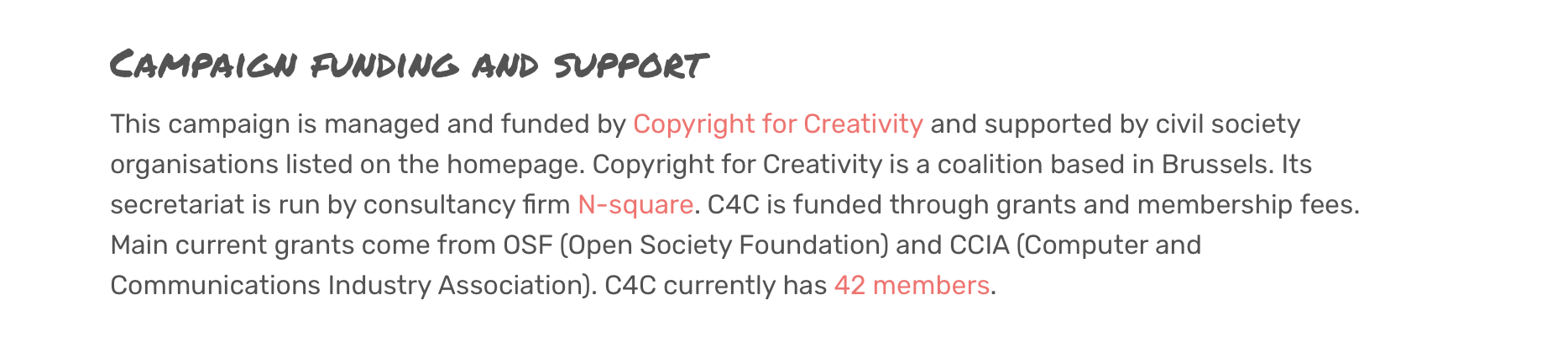
On a macro level the proxy here is pretty obvious.   The SaveYourInternet.eu campaign is run by N-Square consulting. (Read the text carefully.)

This firms biggest client is Google. Though many of the other listed clients receive Google funding as well. Most notably CDT.
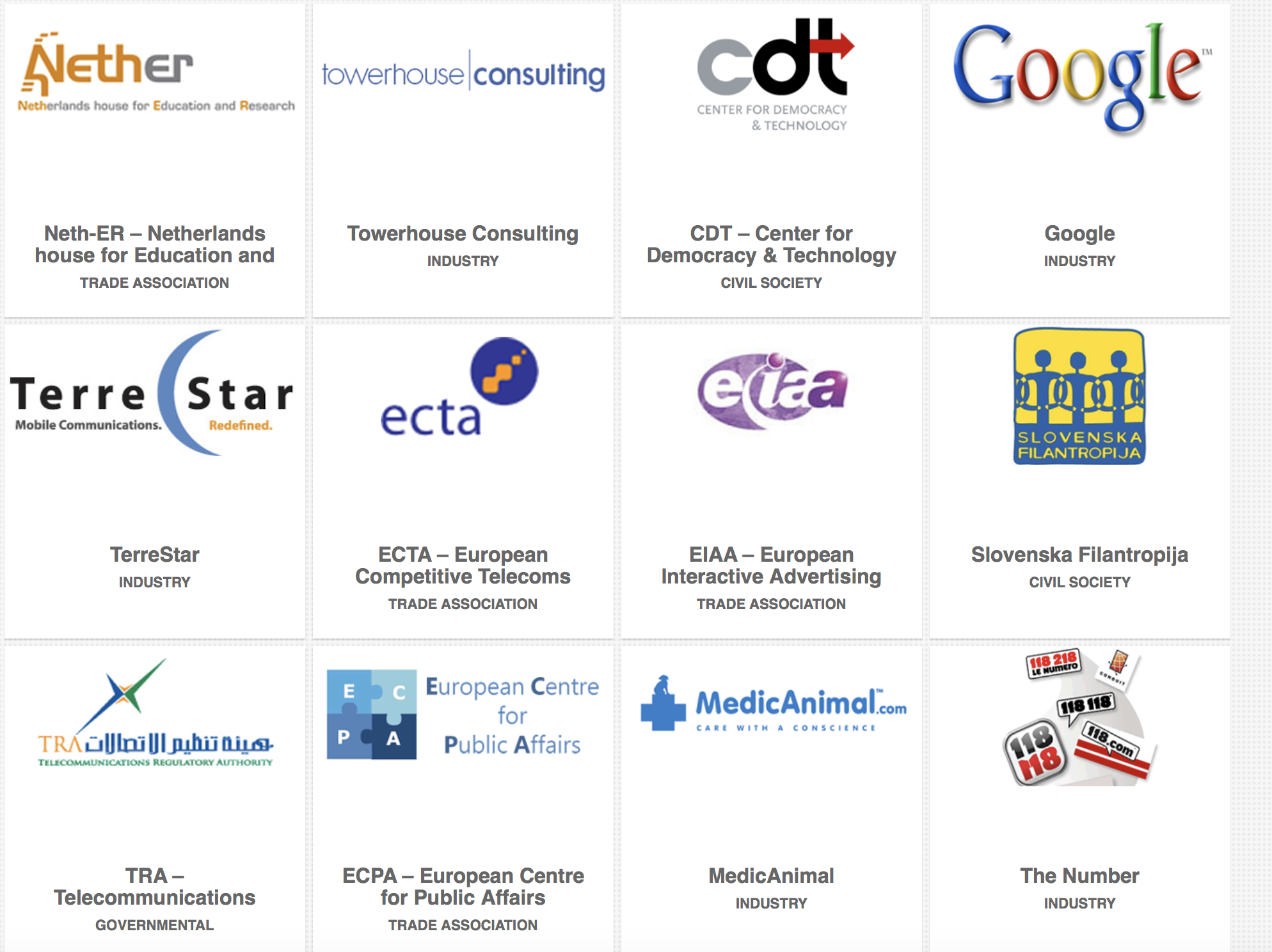
But on a micro level the campaign against Article 13 is much more disturbing. If you accept the premise the “real signal” or “information” the MEPs need for the vote is “what does the directive do” and “what do my constituents think”  fake constituents providing manipulated or outright false information are doubly effective. If they are once or twice removed proxies Google can again escape retribution.

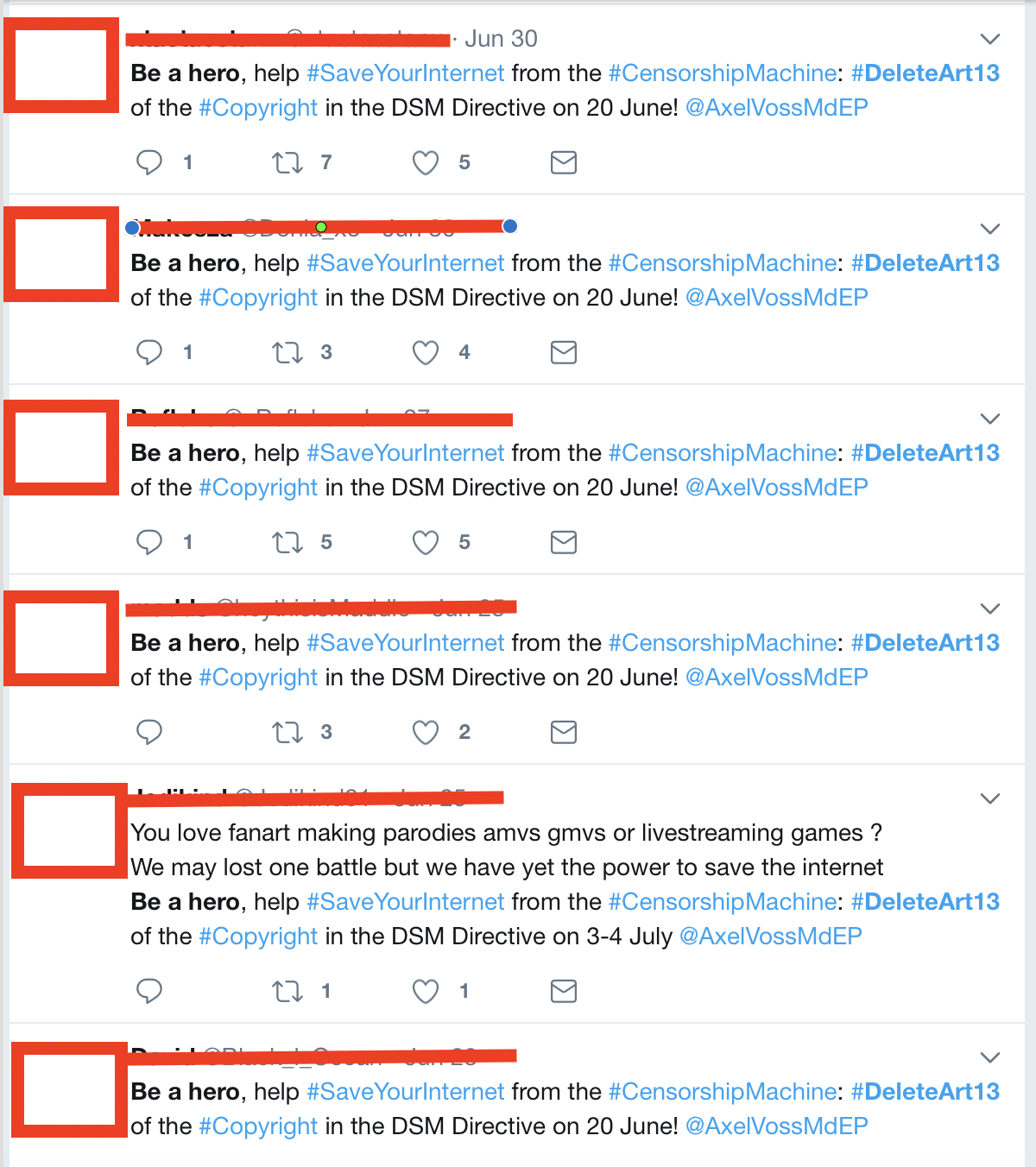
As supporters of the EU copyright directive began to push back and note Google opposition, a countering wave of misinformation was released.  Here is a twitter account distributing highly misleading information.
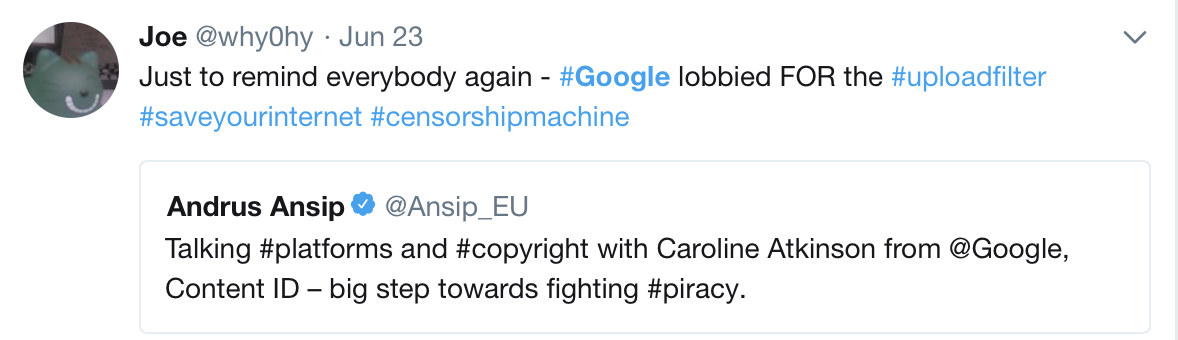
This does not seem to be true as Google did not lobby for upload filters. Or if they did, they simultaneously lobbied against the overall directive. Further the tweet that Joe highlights is old and taken out of context. And Joe knows this (see below). It’s a quote about Content ID (YouTube’s proprietary rights management system.) But since we are discussing proxies here, what’s more important is Joe is a Google proxy.
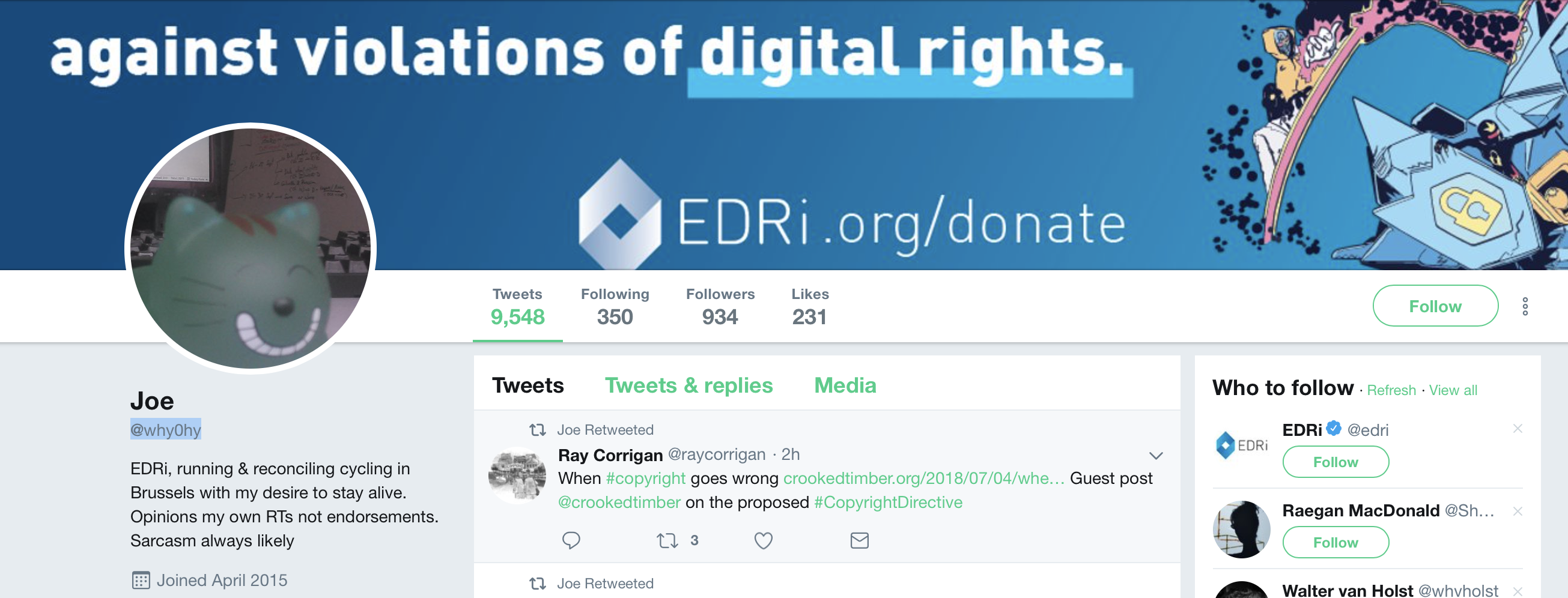
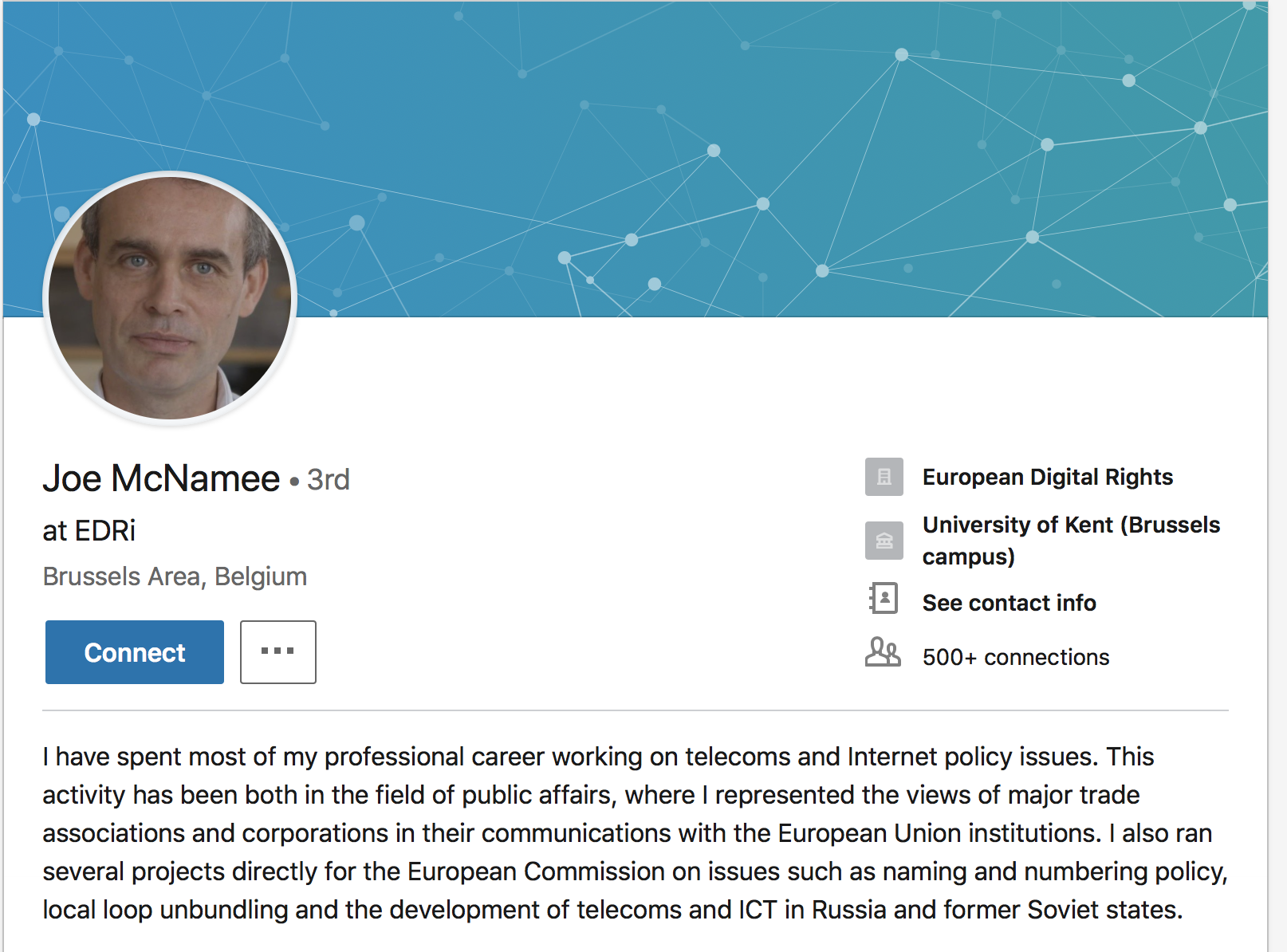
Joe is executive director of  EDRI.  And EDRI is funded by Google.
https://www.theregister.co.uk/2015/04/29/google_doubles_eu_lobbying/

And EDRI  is campaigning very hard against the EU copyright directive.

Proxies manipulating,disturbing and degrading information are all hallmarks of hybrid information war. That is exactly what this guy is doing.

Now one tweet is simply an anecdote. But this guy is a key figure and there are many similar tweets. I’m confident that one could easily build a convincing connectivity graph of tweets, retweets, followers and compare that to academics, lobbyists and NGOs fron the Google Transparency Project.  Look at some of the organizations/individuals in reports below and see if they are weighing in on the copyright directive.

     Featured Project Google Academics Inc. July 11, 2017 Read article    

     Blog Google Funds Dozens of Groups Fighting Sex Trafficking Bill September 27, 2017 Read article    

     Featured Project Google’s Academic Influence in Europe Read article    

  Blog US Congressional Privacy “Debate” Dominated by Google-funded Voices February 20, 2018  

     Blog Investigating Google’s European Revolving Door January 25, 2017 Read article    

     Featured Project Google’s European Revolving Door June 4, 2016 Read article    


Weapons of Information Warfare 

In a 1999 student paper a graduate student at Carnegie-Mellon University (Megan Burns) succinctly laid out the basic categories of weapons used in Information warfare.  These were summarized from a broader work on information warfare by Martin Libicki(1995) It’s a succinct read that’s why I highlight it (hope ms. Burns got an A). The key five elements are:

Information Collection

Information Transport

Information Protection

Information Manipulation

Information Disturbance, Degradation and Denial.

In information warfare the side that is able to dominate in all these weapons categories is impossible to to defeat.  At least without resorting to kinetic operations.

Information Collection

Google by the design has an extraordinary advantage over the EU Parliament.  Its Android OS, Gmail, Website analytics and ad networks give it crucial information on virtually everyone on the planet.  The EU government?  Not so much.

Information Transport

More than 90% of all web searches are conducted through Google’s search engine.  Also the default mobile search in the Apple iOS is Google. Android is a wholly owned Google product.  Most people click on the first few results. Google does not have to block information to suppress opponent information. They simply down rank links. Look at the screenshots below. These searches were conducted using private browser and VPN to minimize “browsing bubble” effect on search results.


Information Protection

“By scrambling its own messages and unscrambling those of the other side, each side performs the quintessential act of information warfare, protecting its own view of reality while degrading that of the other side.” -Martin Libicki

Information warfare is about distorting reality.  To win in information warfare your reality must win out over opponents reality. Even actual positivist reality.

It’s not just enough to control the information flow. In information warfare a entity must protect information that the other side could use to damage your capabilities.  In the case of Google they are expert at “Google washing” or obscuring damaging information.   There is no better example of this than the Google’s own “transparency report” that confuses opponents searching for “Google Transparency Project.”  Which one would your typical MEP staffer click on? By outranking adversary’s competing information,  Google partially shields  itself from damaging information.  Remember Google controls the Information distribution channel.  Essentially Google through the power of its search engine has the power to encrypt damaging information will decrypting and disseminating information that harms its opponents.

Information Manipulation 

Information manipulation in the context of information warfare is the alteration of information with intent to distort the opponent’s picture of reality. This can be done using a number of technologies, including computer software for editing text, graphics, video, audio, and other information transport forms. Design of the manipulated data is usually done manually so those in command have control over what picture is being presented to the enemy, but the aforementioned technologies are commonly used to make the physical manipulation process faster once content has been decided. – Megan Burns

In this instance we see Google Proxy SaveYourInternet.eu conduct a three step process, that allows them enormous command and control over information directed at MEPs.

Step 1.  Google proxy creates disinformation and images to share.
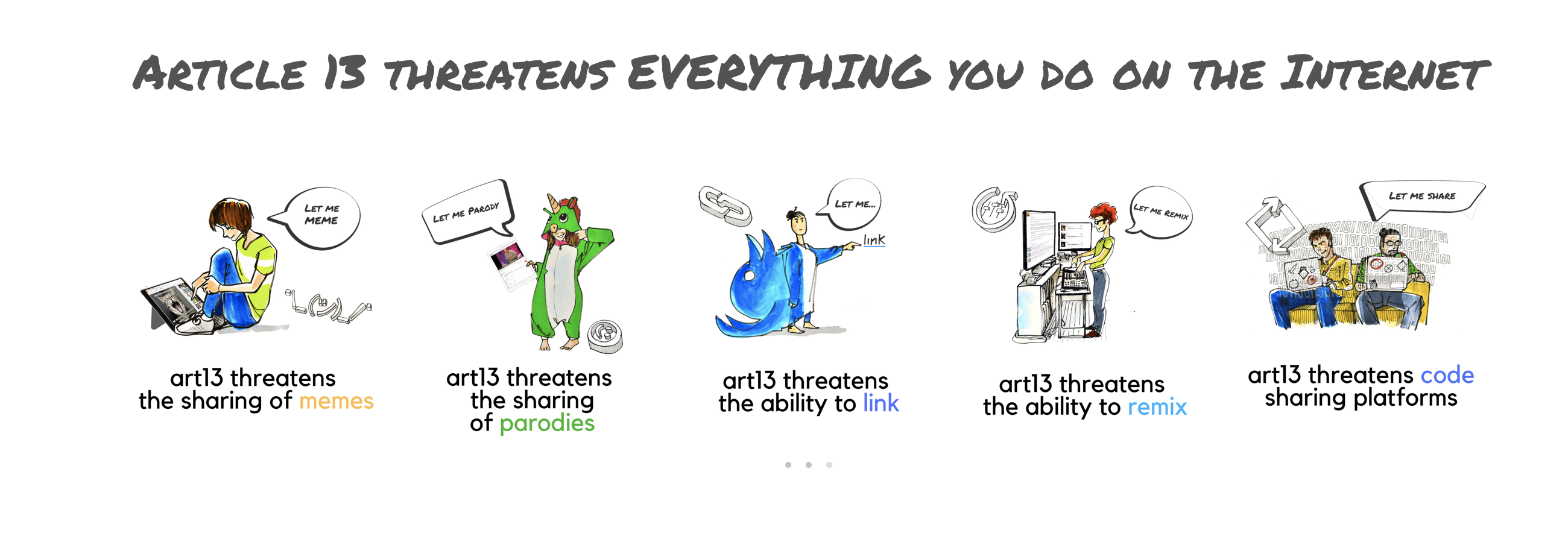
Step 2.   Google proxy creates technological tools to distribute the misinformation.

Step 3. Some real constituents use these tools.  But the tools were also used en masse by unknown(?) allied parties.

Any particular country’s MEPs can be targeted by SaveYourInternet.eu. As images indicate Axel Voss was being automatically targeted when image was captured.

Information Disturbance, Degradation and Denial.

“Spoofing is a technique used to degrade the quality of the information being sent to the enemy. The enemy’s flow of information is disturbed by the introduction of a “spoof”, or fake message, into that flow. The technique works because it allows you to provide “false information to the targeted competitor’s collection systems to induce this organization to make bad decisions based upon this faulty information,” Cramer 1996

Thousands of tweets against copyright directive have been sent to MEPs from fake twitter accounts. “The enemy’s flow of information is disturbed by the introduction of a ‘spoof’, or fake message, into that flow.” Zoom out and there is an grander fake message: thousands of constituents are outraged by the copyright directive.

Finally as  evidenced by the automated tweets, SaveYourInternet.com targeted specific MEPs at different times. “provide false information to the targeted competitor’s collection systems to induce this organization to make bad decisions based upon this faulty information.” See targeted robo tweets below. 
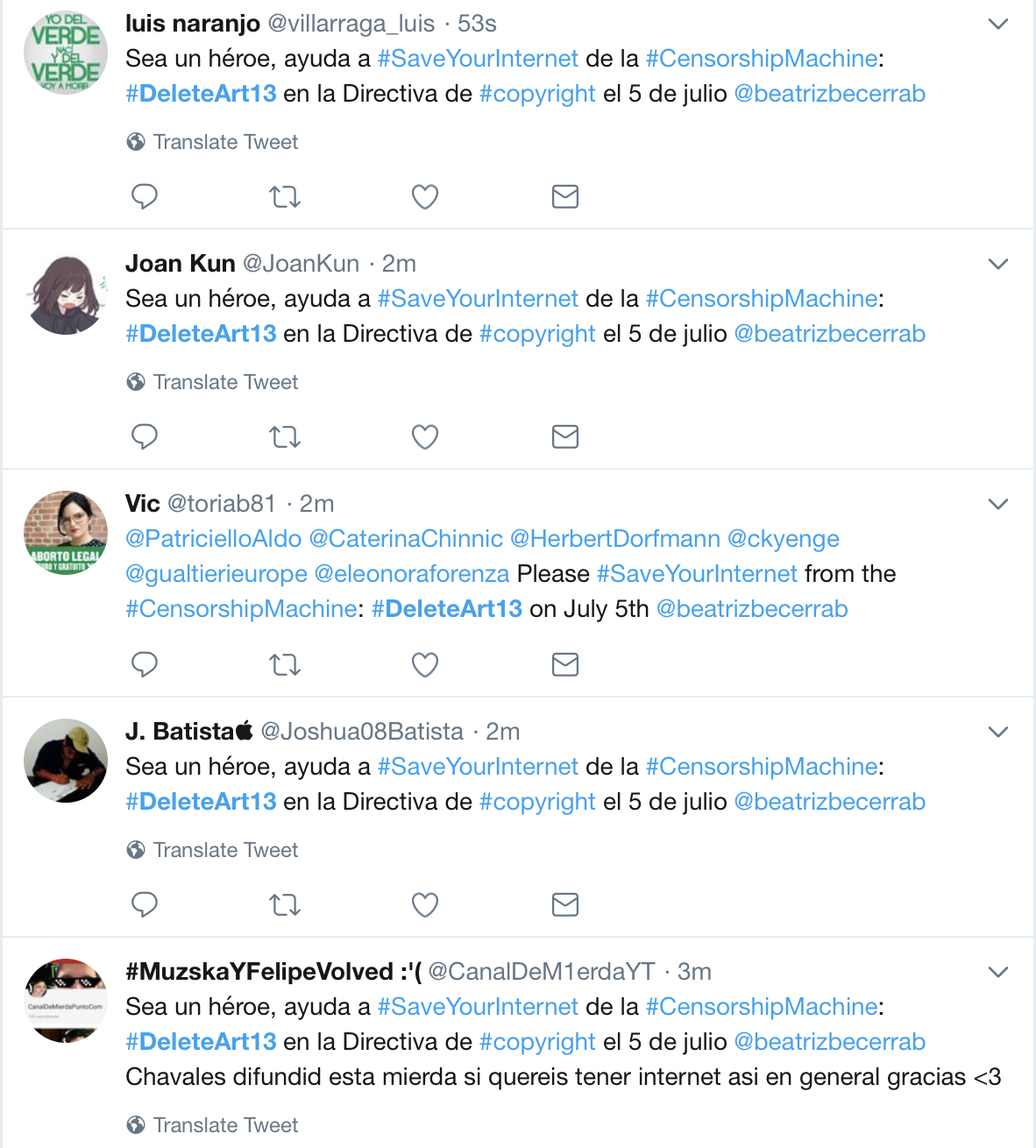
Hundreds of automated tweets an hour directed at MEP Beatriz Becerra.  Quite surprising since it’s the wee hours of the morning and the frequency of tweets seems to be increasing!?

So you got it?  A Google funded webpage using automated tools to misinform and mislead a member of EU parliament, using what often appears to be fake twitter accounts.  What do we call this?

“Another way to disturb the information being received by one’s opponent is to introduce noise into the frequency they are using. Background noise makes it difficult for the enemy to separate the actual message from the noise.” -Burns 1999

Again see above.  The volume of automated tweets makes it impossible for MEPs to “hear” information that Google does not want them to hear.  Say voices of artists and other creators that might be in favor of the copyright reforms.

“Finally, overloading is technique used to deny information to the enemy in both military and civilian settings. By sending a volume of data to the enemy’s communication system that is too large for it to handle, one causes a crash or severe degradation of the system’s ability to deliver information. The system is so busy dealing with the overload, it is unable to deliver the essential information to those who need it.”

By flooding MEPs with thousands of Spam messages, phone calls and emails, the fake information overwhelms all other information that might be useful to MEPs as they consider this bill.

Conclusion

The EU should investigate Google as their actions and those of their apparent proxies bear the hallmarks of hybrid information warfare.  The future of democracy in the EU is at stake.  These techniques could easily (and probably have been) replicated by state actors interested in undermining EU on other issues.
Authors Push Back on NTIA framing of Internet Policy Priorities


This is in response to the the National Telecommunications and Information Administration’s “Notice of Inquiry on International Internet Policy Priorities.”  This seemingly obscure agency has enormous influence over federal internet policy. The NTIA has asked for comments on Internet Policy Priorities. 

An ad hoc coalition of performers, songwriters, musicians, authors, and academics have submitted this letter to push back on the basic framing of the question in hopes of starting a dialogue that better reflects present day realities. 

Docket Number:

180124068–8068–01

Re: International Internet Policy Priorities

SUBMISSION OF THE AD HOC COALITION FOR COPYRIGHT AND DIGITAL PROSPERITY

The individuals and organizations identified below are a diverse group of performers, songwriters, musicians, authors, academics and others who share an abiding interest in expanding opportunities for the creative sector through internet commerce. The internet has the capacity to fuel a cultural renaissance, and enhance economic competitiveness. Alas, far too much of that potential has been lost as a result of the culture of lawlessness and lack of accountability that define broad swaths of the internet ecosystem. Recent events have helped to promote an awareness that societies are not prepared to accept lack of responsibility as the default setting for judging conduct on the internet. For internet commerce to drive global prosperity, it must be built on a framework that demands accountability. The NTIA document makes the following observation: “restrictions on the free flow of information are jeopardizing the economic, social, and educational opportunities provided by the internet. Perhaps even more importantly, the free flow of information on the internet enables basic human rights, such as the freedom of expression.” We believe that is misleading and incomplete. It is a more accurate reflection of the world to observe that while some restrictions jeopardize economic, social and educational opportunities, these opportunities are even more fundamentally limited and challenged by the absence of modern copyright laws to protect expression—the lack of accountability in the internet ecosystem rather than a surfeit thereof.


While the NTIA observation may be true for a certain limited number of countries operating under authoritarian rule, it does not accurately capture the nature of challenges in the US and other democracies. In short, we find the underlying premise of this exercise to be ill-considered and incomplete. NTIA is in fact not making a neutral observation of the world, but setting forth a partisan perspective on the nature of the challenges we confront in the internet space. It is predicated on a definition of freedom that examines only the existence of restraints and not whether expression is empowered. This celebration of a negative freedom risks creating a freedom in which expression is legally possible but practically impossible to exercise. It is a flawed vision that assumes a fixed and culturally neutral definition of “free flow of information” and “freedom of expression” when neither concept is capable of being understood absent context. It is a reflection of the cyberlibertarianism that has served as the guide for the first twenty years of the commercial internet, and which has failed us in many respects.   As articulated below, we urge a course correction based on the understanding that a failure to protect expression is inconsistent with freedom of expression, and that this more realistic freedom is dependent upon the rule of law and an appreciation for national sovereignty which reflects cultural, social and political distinctions between Nations.


In this relatively short submission, we highlight our belief in the potential of the internet to drive creativity and prosperity, but note that this potential will not be realized unless societies demand the technology neutral application of the law. We can not allow conduct to take place via the internet that we would find intolerable in the physical world, yet there are many who would lead us down that path. Internet freedom can not, in a civilized world, mean the freedom to act without regard to legality, and to be free of the consequences of one’s conduct.


To pave the way for the transformation to healthy digital commerce, it is necessary to establish the conditions for digital commerce to succeed in ways that have thus far eluded us. That includes a number of elements, but ultimately requires the development of more mature principles of law and business than those that propelled the first 20 years of innovation on the internet. As with many paradigm shifts, the first generation of internet policy-making was mostly predicated on governments and institutions getting out of the way of private actors. While that must remain a core element of future governance strategies, it is clear that it is, on its own, inadequate in addressing the needs of societies, workers and businesses in the new economy. Securing the technological application of the rule of law — and modifying the law where appropriate — are the prerequisites for advancing the digital economy and creating global prosperity.


We should strive to eliminate barriers and reduce costs for operating global services, including a liberalized framework for cross-border transmission of data, while providing means for governments to enforce their sovereign authority and to protect their nationals through the application of national laws. Web 1.0 assumed an homogenized global market without legal or cultural differences, and treated national prerogatives as impediments to the free flow of information. If we want to expand the growth of the “digital economy,” we must develop new modalities and tools for segmenting markets. While that seems a heretical thought from the standpoint of Web 1.0, it is increasingly obvious that it is a critical condition of expanding trust in the expansion of the digital economy. Web 1.0 thinking was too binary to sustain the development of a new global economy. To capture the potential of new technologies to drive global and shared prosperity, we need to marry discipline, restraint and freedom, understanding the multi-faceted nature of a freedom that doesn’t only contemplate lack of restraints on the actor.


Many of the elements of driving the global digital economy have been expressed in one forum or another, and many of them are quite obvious. We should eliminate unnecessary restraints on cross-border data flows. That has been a clear objective for businesses and some governments for some time now, but has been understood by others as a scorched earth campaign resting on the assumption that any restraint is unnecessary. It is time to move on — the only way that we can liberalize data flows is through explicit recognition that this doesn’t eliminate sovereignty. Governments have a responsibility to their people to uphold national laws regardless of the means by which commerce/information is distributed. Enhancing the legal and practical ability to uphold national laws should allow us to drive greater consensus about removing impediments to global data flows. Again, the key is to moderate the pervasive winner-takes-all approach of web 1.0 ideology.


That begins with a clear recognition that all restraints on data flows are not a form of digital protectionism. That includes various measures related to what we might deem censorship, as well as measures aimed at protecting privacy or otherwise applying the rule of law to communications or conduct affecting the relevant jurisdiction. A 21st century digital trade agenda needs to be far more pluralistic than the simple flat-earth, idealistic and culturally insensitive notions underlying the early development of the internet. Technology may allow information to easily cross borders, but that doesn’t eliminate national differences and the continued importance of national sovereignty.


Acknowledging that will facilitate the development of normative structures and global legal commitments that will foster global commerce based on countries taking the least restrictive measures to limit the flow of information and ability to do business across borders. But to achieve that, we need to cultivate trust at various levels — including trust that facilitating the growth of global digital markets does not equate to a loss of sovereignty. Governments have chosen to limit data flows or to force localization as a means of sustaining control, and have thereby increased costs and the stymied the development of global commerce that could bring significant benefits to their consumers.


Clarifying the jurisdiction of national courts to adjudicate online conduct without regard to the geographic location of the actor (assuming a proper nexus with the state asserting jurisdiction that doesn’t offend due process and fairness) could go a long way towards eliminating business costs associated with localization or other restrictions on data flows. But we will not prevail if our agenda for liberalization is seen as a demand for countries to demur to US practices and cultural preferences. That is not a winning strategy. There was much discussion of balkanization standing in the way of globalized prosperity and freedom during web 1.0. But this vision failed to acknowledge that our virtual world touches and affects people and businesses in ways that are very tangible, and that governments were not prepared — and more importantly, were right to not be prepared — to be relegated to addressing 20th century conduct. That technology allows borders to be crossed instantaneously doesn’t make those borders any less meaningful. By labeling every restriction as leading to a balkanized net or as an impediment to the free flow of information, we failed to articulate a sustainable model for internet governance which allowed us to make the critical distinctions between digital protectionism and reasonable efforts to uphold national laws in a technology neutral manner.


USTR has set out its “Digital 2 Dozen” which usefully sets out some basic trade objectives for expanding digital commerce, essentially outlining the framework for the least restrictive rules for digital trade while allowing flexibility to protect national sensitivities. We support these particulars, but note that they address only one aspect of expanding digital commerce — agreement of governments to refrain from overt digital protectionism. However, to sustain the growth and vitality of global digital commerce, nations need to work together to develop consensus on underlying issues of trust and security that, left unaddressed, will undermine the health of the global trading system. Gaps in cybersecurity, privacy and consumer protection will inevitably create unbearable strains on the digital ecosystem, leading to new restrictions on data flows and/or the introduction of new inefficiencies in global commerce. It is therefore critical that we seek to harmonize, to the greatest extent possible, national approaches to these key issues to engender greater trust in the ability of global institutions and bodies to address harms. Enhancing accountability of all actors in the internet ecosystem is a critical component of driving trust in the digital economy. Attempts to liberalize the rules of digital commerce will fail if advocacy is understood as an endorsement of lawlessness and/or an attempt to apply the First Amendment or other US laws as the default principles for global commerce. To support a global digital economy, and not just propel a global information commons, nations and businesses must coalesce around a series of rules that establish certainty and security in commercial transactions. We must build rules from the ground up and not merely encourage government restraint.


As participants in the creative community, we have witnessed first hand how the absence of adequate rules related to internet conduct can have dramatic and negative consequences on the ability of cultural/creative workers to sustain themselves from their craft—much to the detriment of societies. Luckily governments around the world have begun to understand how economic stability and cultural diversity have been harmed by rules which fail to require internet platforms to operate with a reasonable duty of care, and are beginning to reexamine internet governance principles adopted twenty years ago.


The European Commission has been particularly engaged, and is presently considering amendments to its framework of internet governance, work on which began in 2015 with the issuance of a Communication which reflected its recognition that the framework of legislation established in the mid-1990’s was no longer adequate. The Commission wisely observed: “An effective and balanced civil enforcement system against commercial scale infringements of copyright is central to investment in innovation and job creation. In addition the rules applicable to activities of online intermediaries in relation to copyright protected works require clarification, given in particular the growing involvement of these intermediaries in content distribution. Measures to safeguard fair remuneration of creators also need to be considered in order to encourage the future generation of content.”


The understanding of the need to rebalance rules is a very welcome reexamination of internet rules adopted in the late 1990’s (i.e. the era of dial-up and bulletin boards) that were designed to ensure that intermediaries were not held liable for third party content uploaded onto their networks over which they had no control or knowledge. The principles underlying safe harbors in the US and EU were sound, and helped to drive innovation in the digital space. However, they are clearly showing their age and are no longer operating as intended. Instead of providing reasonable protection to intermediaries that are operating responsibly, they have created incentives for online services involved in content distribution to implement architectures and practices to create plausible denial of knowledge of infringement, or willful blindness. One often hears the term “DMCA license” when no license is established under the DMCA. Safe harbors were not intended as alternatives to licensing for content distributors, but too often they have become just that. And takedown has replaced reasonable care in the conduct of intermediaries. But takedowns only occur once injury has already taken place, and infringing content is quickly re-uploaded in any event. In short, while notice and takedown may have worked in a more innocent and less technologically advanced age, it operates as a continuing injustice in an environment in which platforms engage in the willful distribution of infringing materials, subject only to the requirement to delete specific files when they are notified.


It is a matter of the first importance that we achieve clarification that only intermediaries that are truly passive and neutral with respect to the content that they host or communicate are eligible for safe harbors. Creators are dependent upon the effective functioning of the internet in order to grow and thrive, and would join others in opposing measures which placed unreasonable burdens on internet platforms or services. But simply clinging to 20 year old norms in an environment of rapid technological change is irresponsible, and we should encourage examination and experimentation. There are some in the US who, while touting “disruption” will insist on absolute fealty to the status quo. But if we are going to seize the potential for economic growth and job creation presented by developments in technology, we must look forward, and not merely cling to the past.


Particularly as the world’s greatest producer of copyright works, we believe that the United States should be as supportive as possible of efforts to create a more robust digital marketplace for the creative sector. Ensuring that safe harbors meet their intended purpose of promoting responsible conduct is a key element of a healthy digital future, and deserves your support. There has been an explosion of interest in the United States due in large part to issues which arose in connection with Cambridge Analytica/Facebook, but the underlying issues of internet governance go far beyond that. Facebook is not an outlier — they are an example, and far from the worst one, of maintaining governance strategies that essentially abandon democratic governance. Of pursuing a parochial vision of freedom based on cyberlibertarian principles that ignore the effects of one’s actions. Of celebrating permissionless innovation without due regard for making distinctions about what actions should require permission and/or oversight. Of believing that disruption on its own is worthwhile without regard for consequences.


We in the arts community have been canaries in the coal mine, and our experience is instructive. We have witnessed first hand how language of freedom is used to justify theft, and how the protection of expression is characterized as inconsistent with freedom of expression. As societies around the globe confront the implications of present internet business models, it seems a most appropriate occasion to recognize the unique role of artists in the flowering of free expression, and in creating the kind of world that we wish to inhabit. The author, Marty Rubin captured this nicely: “Artists, by their free expressions, encourage others to be free. This is the quality that makes works of art enduring.”


Yet, many groups continue to suggest that the protection of expression is a form of censorship or restriction on fundamental freedoms. We must end this assault on our humanity and the misappropriation of fundamental human rights. If the protection of expression is itself a restriction on freedom of expression, then we have entered a metaphysical Wonderland that stands logic on its head, and undermines core, shared global values about personhood. It is time to open the curtains and see these practices for what they are.


We must use this “Facebook moment” to rethink the celebration of disruption for its own sake. Disruption as a way of shaking up the status quo may be great, but not where the disruption is effected by facilitating theft or otherwise ignores the consequences of conduct. No reasonable definition of innovation should serve as an invitation to, or protection of, a business model based on the theft of intellectual property. It is a matter of the greatest importance — to our economy, our culture and our very humanity, to fully reflect the importance of consent and rules in the networked environment — a framework which promotes openness, not anarchy, and firmly rooted in celebrating works of expression that reflect and fuel our appreciation of the freedoms associated with expression.


There will always be individuals or enterprises who are prepared to steal whatever they can, but we can — and must — stop providing moral cover by conflating copyright enforcement with censorship, or by misapplying notions of internet freedom or permissionless innovation so that they extend to an embrace of lawlessness.


The potential of the internet and other communications technologies to drive economic growth, prosperity and cultural production has been greatly undermined by distortions in the marketplace caused by the lack of adequate governance that allows companies to illegally traffic in what are essentially stolen goods. Many of those who profit from the status quo like to disguise their self-interest in rhetoric about free expression. It is long past time to end this dangerous charade. We are not serving free speech by making it harder for creators to earn a living from their original expression. Free societies can no longer tolerate the continued indifference to the rights of creators.


We define our society by the extent to which we empower the exercise of free will and the ability — legal and practical, to determine the use of our identities and our property. Recent focus on the relationship between privacy and consent must serve as an invitation to examine the broader issues of consent and platform responsibility, or we will end up addressing only a symptom and not the cause. If the lesson of recent developments is that we should delete Facebook, then we will have sorely missed the point, and will continue to rely on a false narrative that human agency is a sufficient check on the functioning of tech platforms even as human agency is effectively eroded. What’s needed is democratic governance — the application of law and incentives for accountability.


Neil Turkewitz, on behalf of the following individuals and organizations who have come together in this ad hoc coalition for copyright and digital prosperity.


Richard Bennett, Founder, High Tech Forum

Jason Berman, former Chairman & CEO of the Recording Industry Association of America (RIAA) and IFPI

William Buckley Jr., Executive Director, FarePlay

Stephen Carlisle, Copyright attorney and former law professor

Chris Castle, Attorney

Dean Kay, Songwriter: “That’s Life” Curator: The Dean’s List

Phil Galdston, songwriter, co-founder Music Answers

David Golumbia, Associate Professor of Digital Studies, Virginia Commonwealth University

Alan Graham, Author, CTO & Co-Founder OCL

Devlin Hartline, Assistant Director, Center for the Protection of Intellectual Property

Hugh Hansen, Professor of Law & Director, Fordham IP Institute

Andrew Keen, Author of “How To Fix The Future”

David Lowery, Singer/Songwriter Camper Van Beethoven and Cracker

Brian McNelis, Music Executive

Blake Morgan,  Artist & songwriter, founder of #IRespectMusic campaign

David Newhoff, Writer

Mary Rasenberger, Executive Director, The Authors Guild

East Bay Ray, guitarist, co-founder, songwriter of Dead Kennedys

Marc Ribot, Guitarist, and Chair of Artist Rights Caucus of Local 802 AFM

Chris Ruen, author of “Freeloading”

Maria Schneider, Composer, bandleader

John Simson, Executive in Residence and Program Director, Business & Entertainment, Kogod School of Business, American University

Jonathan Taplin, Director Emeritus, Annenberg Innovation Lab, University of Southern California

Amanda Colleen Williams on behalf of Songpreneurs Community, https://www.songpreneurs.com/about

David Wolfert, songwriter/composer, co-founder Music Answers

Doug Wood, composer, co-founder Music Answers


Note: Unless otherwise specified, members of this Ad Hoc Coalition are signatory in a personal rather than representational capacity

EU MEPs Hacked: More than Half #DeleteArt13 Tweets Appear to be from Sock Puppets

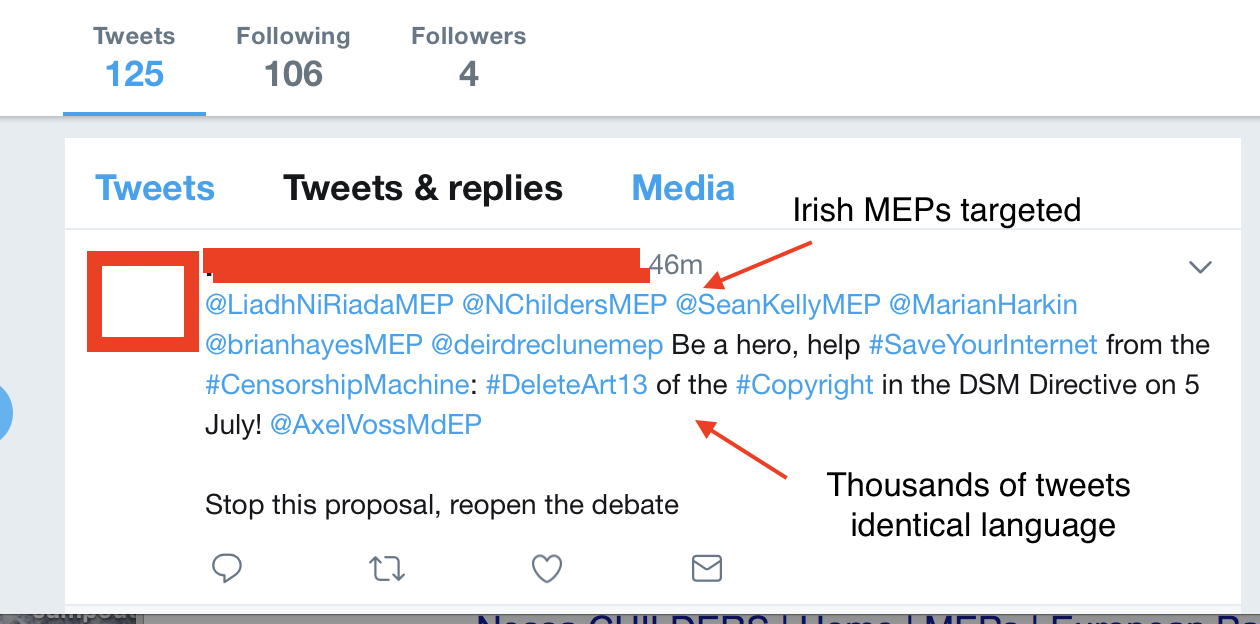
The twitter account used in this example is largely dormant.  Except every once in a while it is used to promote some suspect contest or website.  Thousands of tweets use this exact same template. 

To be clear. This is not a robust statistical survey.  It’s based on my random sampling of tweets to MEPs.  But it looks like in any 24 hour period the majority of tweets to MEPs opposing article 13 are coming from suspect accounts.  I encourage others to verify this.  Once the July 5th voting date passes, I encourage the European Parliament to investigate the use of suspect twitter accounts to influence voting. Why?  Because this is an attempt to subvert your democratic processes.  MEPs and staff may contact me and I can suggest a couple approaches to rigorously analyze this. Remember that MEP Julia Reda, SaveTheINternet.eu, Copyright4Creativity and EDRI (An EC funded civil society) Is actively sharing links to robo tweet, email and call MEPs.

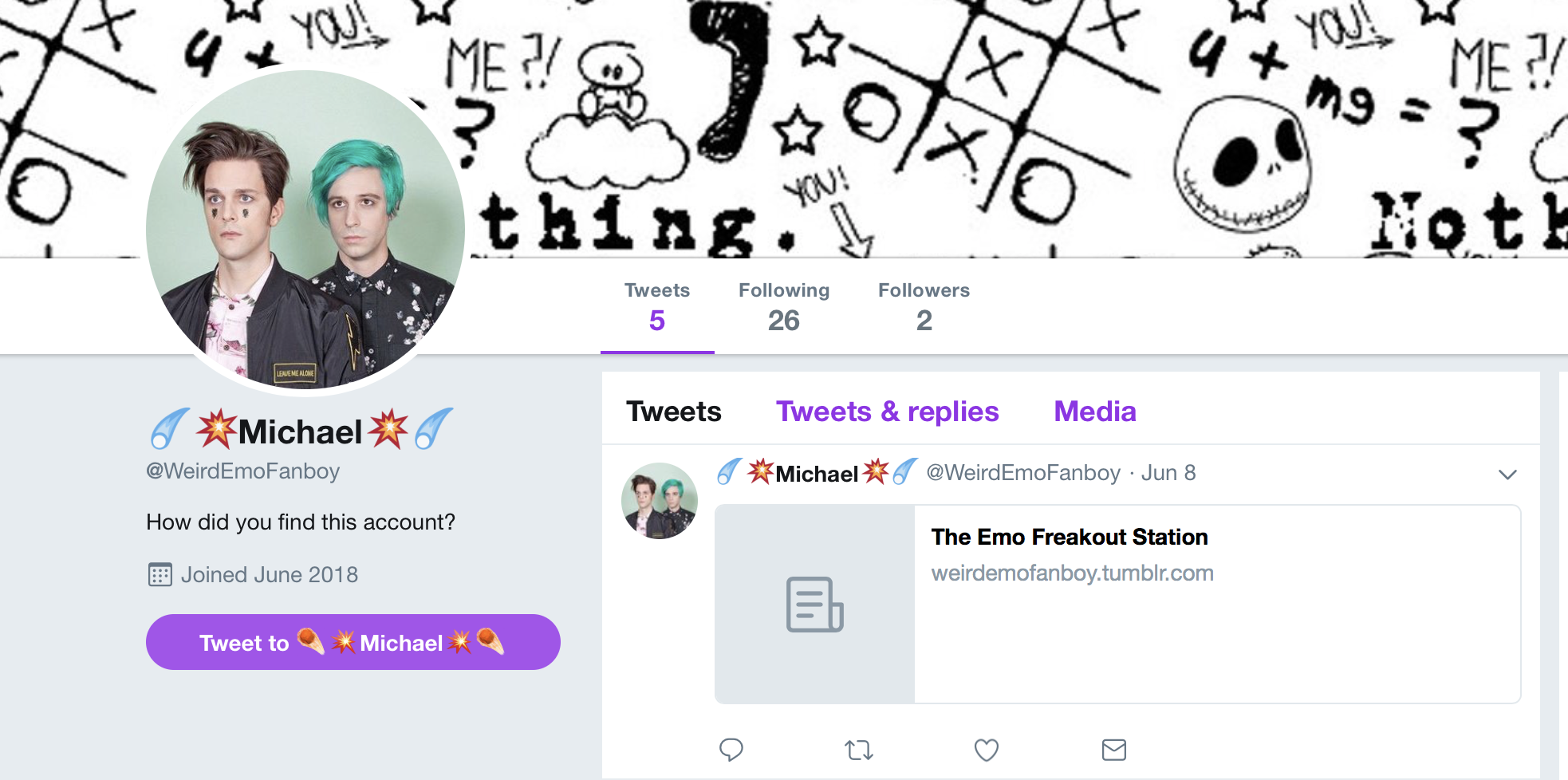
This account is newly created twitter account and links to a tumbler blog that was created the same day.  The photo depicts the musical duo “I Don’t Know How You Found Me.”  But this is not their official account. Hundreds of accounts used in the twitter campaign against Article 13 use other peoples photos as profile pics. This has marks of professionalism as they don’t actually claim to be “I Don’t Know How You Found Me.” But the account description is: “How did you find this account.”   A little bit of thought went into creating this account. 

Suspect accounts?

  1. Newly created accounts
  2. Very low number of followers
  3. Claim country different than language used in tweets
  4. Accounts dormant for long periods of times
  5. Very little unique content (Only retweets etc)

O

5 out of 6 tweets directed at MEP Axel Voss are identical.  

Automated generation of tweets.

The vast majority of the tweets are clearly coming from an automated source as they have identical formats.

Those operating the robo tweet operations seems to periodically target specific country MEPs. 

Specific MEPs and Countries Targeted

The last 24 hours suggest that whoever is automating these sock puppet tweets has focused on Irish MEPs.  Previously we saw Portuguese and Polish MEPs targeted.  This is clearly not an organic movement.  Some entity with vast resources is directing this campaign.


#SaveYourInternet Dog Whistles to Far Right with Pepe: Desperation or Stupidity?

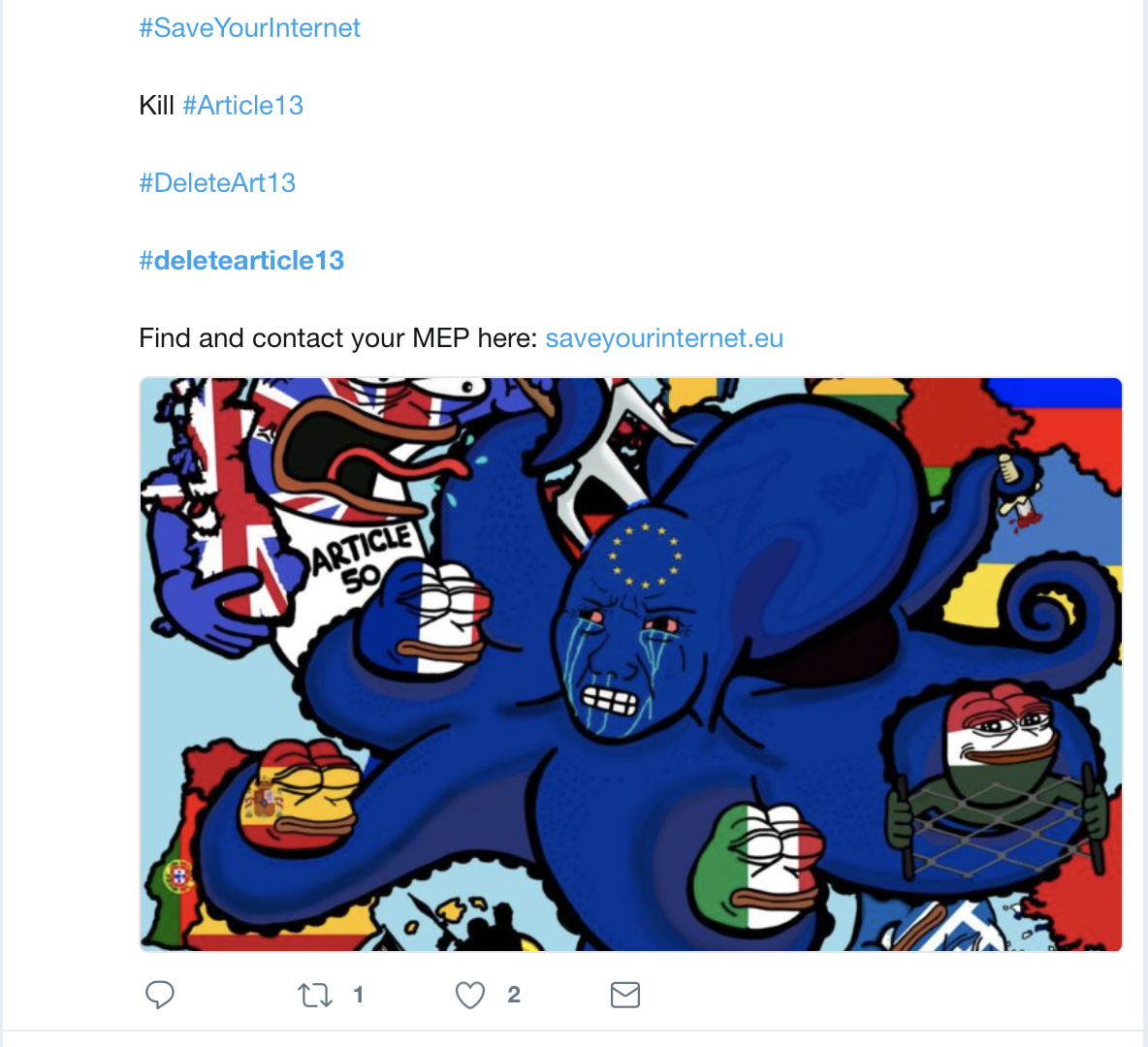
One of dozens of memes featuring “Pepe” urging calls to EU members of parliament against copyright directive. The image is recycled from a Southern Poverty Law Center listed group. 

For those of you not familiar with meme culture and Pepe the Frog you might want to start here.  The point of this article is not to debate whether every time some kid uses the Pepe meme it is racist.  Indeed as the linked article notes Pepe began life as a harmless comic character. However there is no doubt that Pepe has been adopted by many far right groups as a kind of anti-PC signifier. Or worse. The creator of Pepe recently killed off Pepe in his comic strip because he was distressed by its recent association with racism and antisemitism.

That is why it is absolutely stunning that opponents of the EU Copyright Directive Article 13 seem to be cultivating support from the far right by using Pepe memes.

There’s always a possibility that the ever insular copyleft doesn’t realize that not all “meme” culture is cute kittens and doesn’t understand the significance of Pepe.  Indeed Hanlon’s razor warns: never attribute to malice what can be adequately explained by incompetence and stupidity.

SaveYourInternet.eu website allows anyone to repeatedly robo call MEP.  MEPs of their choosing.  So they can target specific MEPs.  This is how they hack democracy. 

However anecdotal reports show that the MEPs that have been targeted with automated robo calls have largely been Eastern European MEPs with significant anti-immigrant or white nationalist movements.

Further we have previously documented the Copyleft and Pirate associations with the far right.

See here:

German Pirate Party MEP harassment of the Anne Frank foundation.

https://thetrichordist.com/2016/04/28/eu-pirate-party-mep-julia-reda-germany-doesnt-want-to-pay-for-diary-of-anne-frank/

And of course How do pirates tie their shoes?  In little nazis of course…

https://thetrichordist.com/2017/09/26/why-is-it-every-time-we-turn-over-a-pirate-rock-white-nationalists-nazis-and-bigots-scurry-out/

What is clear is that the “don’t break the internet” crowd has cried wolf one too many times.  And their attempts to raise a cybermob are falling short.  As of yesterday there were only 800 #DeleteArticle13 tweets on twitter.  And a cursory examination shows that about 80% of those tweets are from sock puppet accounts.

So is the appeal to far right trolls design or desperation?   SaveYourInternet.eu are you purposely targeting far right twitter users?

+++++++++++++++++++++++++++++++++++++++++

Update. So it is not stupidity. It was plan all along. Looks like Pirate Party MEP has been reaching out to far right. See screen capture of tweet below: