Translated from German. Mr. Rieck notes YouTube’s use of its own platform to spread misinformation about Article 13 of the Copyright Directive. How does one pass legislation that the information monopoly does not want passed?
YouTube’s new media order- Guest post by Volker Rieck.
The streaming platform is exploiting its community for its own ends in the controversy over copyright in Europe and hasn’t shied away from misrepresenting the truth.
The controversy surrounding European copyright reform has entered a new phase following the release of an open letter and a video addressed to the YouTube community. On 22 October 2018, YouTube CEO Susan Wojcicki addressed the operators of successful YouTube channels (“creators”) in a blog post and warned them that the implementation of Article 13 would result in numerous smaller channels being shut down and in important content becoming unavailable to viewers in Europe.
Screenshot from the YouTube Video on Article 13 Hundreds of thousands of jobs in the YouTube community would be placed at risk, Wojcicki claims, by the adoption of the new legislation. Even educational content like language classes or physics tutorials would be under threat, she maintains, if streaming platforms were to be made liable for the content on their users’ channels.
The YouTube boss completely ignores the purpose of Article 13: eliminating the copyright infringements that are currently rife on major video hosting platforms by inducing the platforms to take out paid licenses covering the content they provide. Platforms unwilling to take out licenses would have to find other ways to offer content legally or accept liability for rights infringements on the part of their users. The new directive attempts to close a legal protection gap that has enabled internet platforms to profit from content for many years without paying royalties to originators set at an appropriate level.
Wojcicki’s calculated move triggered the avalanche of outrage she sought to produce, and legions of creators passed the CEO’s dubious messaging on to their subscribers, in largely unfiltered form, in the days that followed. In a veritable game of Chinese Whispers, YouTubers outdid each other in their apocalyptic interpretations of the likely impact of Article 13 and their distortions of the content of the proposed directive. Wild claims circulated that YouTube channel operators would already see their livelihoods threatened in 2019, that Article 13 was a censorship law, and so on. The platform helped the videos made in response to its own appeal to become highly visible and to reach wide audiences by displaying them on user home pages and by categorizing them as “trending.” Three of the top 5 videos in the YouTube trending charts at the beginning of November transported these dystopian visions. A video from the channel “Wissenswert” (German for “worth knowing”) attained a number 1 ranking on YouTube even though the channel itself has a mere 300,000 followers. It has now been called up 3.7 million times, a twelvefold increase in the channel’s normal reach.
Screenshot: YouTube trending charts at the beginning of November, 2018
Many of the videos betray a lack of elementary knowledge regarding the EU legislative process. Even if the new directive is adopted early in 2019, its transposition into national law will still take quite some time. More grievous errors are also evident, however, with the channel “Wissenswert” even inventing an entire new EU institution, the EU Congress. Drastic forecasts predict that hundreds of thousands of legal actions will be taken against platforms every day as soon as Article 13 comes into force.
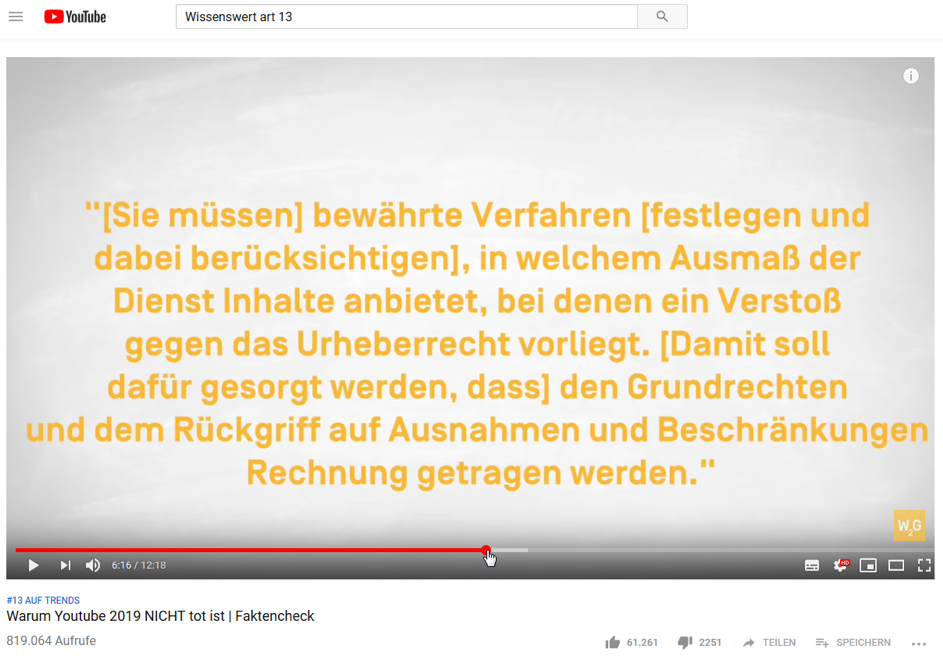
Journalistic balance, research and objectivity are in short supply on many channels run by private operators. Only a handful of channels have managed to take a more equivocal look at the situation. The channel “MrWissen2Go” operated by the public service network “Funk” provided an impartial fact check that could have mitigated the rampant hysteria – but didn’t make the top 5 list of trending videos on YouTube.
Screenshot from the Youtube Video by Mr.Wissen2go
The new YouTube media order is exploiting the YouTube community by deploying YouTube channels as propaganda outlets. In the process, a core issue has been elegantly relegated into the background: YouTube avoids any mention of why Article 13 could automatically lead to numerous smaller channels being shut down. YouTube seemingly finds the choice it is expected to make between taking out licenses covering protected content and/or filtering out illegal content unconscionable – even though it already possesses powerful filtering software (“Content ID”) perfectly suited to the latter purpose. The platform has also failed to explain its claims that educational channels are particularly at risk. And while the blog post by YouTube boss Wojcicki demands a compromise on the issue of liability for content and on Article 13, it makes no attempt to even sketch out what such a compromise might look like. The Google subsidiary YouTube has profited from a gap in copyright protection for years, and the precept of not accepting accountability for or paying for content hosted on the platform now seems to be so strongly ingrained in YouTube’s DNA that any proposal to implement liability rules automatically seems unreasonable and unacceptable.
Ultimately, the way YouTube channels have been pressed into the service of the platform demonstrates just how urgent the need for measured political regulation of the platform has now become and how easy it is for the platform to exploit the ecosystem of private and semi-professional pseudo-journalism it hosts for its own ends. At the end of her video appealto the community, the YouTube boss thanks her community for “building the next generation of media companies.” But let’s make that companies with zero accountability, please. And not have them do any research.
“[A]s you begin to act in harmony with nature the Law garottes & strangles you – so don’t play the blessed liberal middleclass martyr – accept the fact that you’re a criminal & be prepared to act like one.”
Hakim Bey from “T.A.Z.: The Temporary Autonomous Zone, Ontological Anarchy, Poetic Terrorism”
YouTube’s CEO Susan Wojcicki is frantically wheeling around Europe this week in a despairing effort to establish a US-style safe harbor in Europe and undermine Article 13, the Copyright Directive for a Digital Single Market.
Let’s understand that the very concept of a safe harbor for YouTube has its roots deep in the pirate utopias of Internet culture–a fact that may get overlooked if you aren’t a student of the Silicon Valley groundwater.
The Value Gap really owes its origins to the anarchist Peter Lamborn Wilson who wrote the seminal text on pirate utopias under the nom de plume“Hakim Bey” entitled “The Temporary Autonomous Zone, Ontological Anarchy, Poetic Terrorism” (1991) or, as it is known perhaps affectionately in hacker circles, simply “TAZ.” I for one am not quite sure what makes “poetic terrorism” different from unpoetic terrorism, utopian terrorism, anarchic terrorism, or just plain old terrorism, but it may explain why YouTube just can’t bring itself to block terrorist videos before they find an audience.
But the TAZ helps illuminate my own more truncated term for the Value Gap–the alibi. An alibi for a pirate utopia where the pirates run cults called Google and enrich themselves from the prizes they go a-raiding.
In the early days of online piracy there was a fascination with locating servers in some legal meta-dimension that would be outside of the reach of any law enforcement agency. Sealand, for example, captured the imagination of many proto-pirates, but Sealand is a little to clever to put themselves in a position requiring evacuation by the Royal Navy before the shelling begins. So Sealand was ruled out.
Instead, Google–largely through YouTube–created its own pirate utopia through manipulation of the DMCA safe harbor, one of the worst bills ever passed by the U.S. Congress–and that’s saying something. Google busily set about establishing legal precedents that would shore up the moat around their precious TAZ. None of Google’s attacks on government should be surprising–anarchy is in their DNA. As former Obama White House aide and Internet savant Susan Crawford tells us:
I was brought up and trained in the Internet Age by people who really believed that nation states were on the verge of crumbling…and we could geek around it. We could avoid it. These people were irrelevant.
And “these people” were stupid enough to give a safe harbor to protect the TAZ. Because here’s the truth–the safe harbor that has made Google one of the richest companies in the world while they hoover up the world’s culture actually is the quintessential temporary autonomous zone. It only exists in a changeable statute and the judicial interpretations of that statute, whether the DMCA or the Copyright Directive. And like HAL in 2001: A Space Odyssey, they’re not going to allow that disconnection without a fight.
But YouTube’s CEO Susan Wojcicki will not be singing “A Bicycle Built for Two” as she flails about in the disconnect of YouTube. Her basic argument is that “imposing copyright liability is destructive of value” for “open platforms” like YouTube. “Open platforms” bear a striking resemblance to the TAZ, yes? Ms. Wojcicki , of course, purveys a counterintuitive fantasy because unauthorized uses for which copyright liability accrues is what destroys the value of the infringed work. What Ms. Wojcicki is harping about is how copyright infringement destroys value for YouTubeand its multinational corporate parent, Google. This is what happens when stock options invade a pirate utopia.
Not only has she got it wrong, but what she is actually whingeing about is the threat posed to her YouTube pirate utopia by the Copyright Directive and the united creative community. And as HAL might say, the YouTube mission is too important for me to allow you artists to jeopardize it.
In Part I I outlined a basic history of internet exceptionalism, and then noted that when this pernicious notion is combined with techno-determinism you end up with something I call “internet imperialism.” Fundamentally internet imperialism challenges the legitimacy of representative governments and tries to unwind 400 years of the liberal democratic order, by removing vast swaths of human social and commercial activity from purview of institutions legitimized by the consent of the governed.
I presented the choice we face as this:
Do technology companies and their allies sit at the apex of power and determine what sort of world we live in? The boundaries and limits of our government, our commerce and our liberties defined by their algorithms and business models? Government is simply a janitorial service that cleans up the negative externalities.
Or do democratic institutions sit at that apex?
This is evolving as I write this, I’m honestly not exactly sure where this is going. Over the next few blogs I want to examine the current battle between tech companies (predominantly Google), and the European Union over the proposed Copyright Directive. This policy conflict is the perfect laboratory to study methodologies used by technology companies and their proxies as they attempt to undermine the ability of representative governments to impose such laws within their own borders. Specifically they do this by:
cynically pushing a fiction that “cyberspace” has its own geographical space that is outside national geographic boundaries;
Intimidating democratically elected officials by activating online mobs, sometimes real but largely artificial (“cyberturfing”);
Spreading disinformation using proxies while simultaneously denying use of such proxies (“little green men“); and
questioning the legitimacy of (non-pliant) governments by openly courting centrifugal forces that threaten those governments, including separatists, far right nationalist parties and extreme voices on right/left;
All of these together reduce a government’s will to enforce national laws in “cyberspace,” effectively reducing the power of that national government and allows tech companies (especially Google) to gobble up virtual territory that was once the domain of a representative governments. This is a terrible prospect.
But in order to do this I have to first explain how we got here. How this ideology was baked into the commercial internet from the very beginning.
A Declaration of Independence of Cyberspace
This is the Ur document. Published in 1996 by John Perry Barlow (Grateful Dead second string lyricist) and the founder of the Electronic Frontier Foundation. He presented this declaration from that cradle of hippy populism, Davos Switzerland as part of the 24 Hours in Cyberspace project. As Wikipedia notes it explicitly rejects the applicability of government, all government to the internet. Many people at the time (probably myself included) thought this was a “neat idea,” but largely a rhetorical exercise. I’m fairly certain only the glassy eyed true believers thought this was a serious idea at the time.
Non-serious, because it specifically declares that there is no consent of the governed in cyberspace nor is there likely to be one. Most serious people give up their anarcho-capitalist fixations once they get out of college or go someplace ungoverned like Somalia or tribal regions of Pakistan.
John Perry Barlow in OBL shirt. Photo Joi Ito Creative Commons license
“We have no elected government, nor are we likely to have one, so I address you with no greater authority than that with which liberty itself always speaks…”
and
“Governments derive their just powers from the consent of the governed. You have neither solicited nor received ours. We did not invite you. You do not know us, nor do you know our world. Cyberspace does not lie within your borders. Do not think that you can build it, as though it were a public construction project. You cannot. It is an act of nature and it grows itself through our collective actions.”
I’m gonna dismiss the accidental(?) pre Hobbesian reference as a mistake (“act of nature”) and unpack the two marginally more serious notions put forth here.
Cyberspace is a place, and
Liberty itself replaces institutions of governance for they are incompatible in cyberspace.
Is Cyberspace a place? No.
Senator Ted Steven (R, Alaska) was roundly mocked when he described the internet as a “series of tubes.” Public Knowledge a Google funded NGO that for all practical purposes is a public policy arm of Google, led the mocking of Senator Stevens. According to wikipedia: “On June 28, 2006, Public Knowledge government affairs manager Alex Curtis wrote a brief blog entry introducing the senator’s speech and posted an MP3 recording.” This later became an early internet meme reaching its peak when John Stewart of the Daily Show sarcastically adopted the language. Google later buried “easter eggs” in various products referencing the “series of tubes” statement. In the framework of semiotics, “series of tubes” became a second order signifier of technological illiteracy. Or in pseudo-religious terms: Heathens.
The problem is that Senator Stevens was more right than those who mocked him. The notion that Cyberspace is a place is the sort of idea that brings to mind the George Orwell quote:
“Some ideas are so stupid that only intellectuals believe them.”
Cyberspace can not exist without physical infrastructure. And where is that infrastructure? Further as deliniated by Barlow, Cyberspace can not exist without the human mind which obviously requires humans. Where do those humans live? The notion that someone is not subject to national laws and authority of the state when “in cyberspace” is not just a bad idea but when embraced by federal courts has led to horrible things like sex trafficking of minors with impunity. (See SESTA/FOSTA legislative debate).
The technology industry billionaire’s obsession with sea-steading (platforms in international waters) and data havens is telling. Many technologists see the storage of data beyond the reach of national governments as a key to the kabuki that “Cyberspace does not lie within your borders.”
A barge built with four levels of shipping containers is seen at Pier 1 at Treasure Island in San Francisco, Photograph: Stephen Lam /Reuters
Google went so far as to build what appears to be floating data barges for some such purpose. As CNET reported in 2013
“It looks like Google has been working on an oversize secret project on San Francisco’s Treasure Island. A water-based data center? Could well be. “
I was not inclined to believe the wilder conspiracy theories about Google’s data barges. Data centers require enormous amounts of cooling. Seawater is generally cool. Then Google came up with an implausible cover story for the barges: floating Apple Store like mobile exhibition space for Google Glass. Shortly after floating (no pun intended) this explanation Google scrapped and sold off the barges. Every time I think I’m an idiot for putting on a tin foil hat when examining Google motives it turns out I needed two. As a result I think it is plausible that those barges really were an attempt at “geeking around the nation state” in order to remove certain operations of the internet giant from purview of national governments.
Is Iceland Cyberspace and why was Lawrence Lessig there?
Screenshot from Julian Assange’s proposal for data haven 2009 Chaos Communications Congress. Iceland was the preferred location for the Pirate Utopia.
Then there is Iceland. Don’t get me wrong. I like Iceland. Icelandic people are pretty much still Vikings. My last Icelandair pilot insisted on trying to land in Reykjavik despite the weather. He/she did three (?) “go-arounds” before finally landing the plane in a gale. After go-around two, most non-viking passengers would have happily gone back to BWI.
Then again, Icelanders eat whales and a slim majority of the population still believe in elves. It’s therefore a pretty trippy place and if there were one country that could be the real world location of Cyberspace this could be it. The government wants to be “The Switzerland of Privacy” as if being Swiss in the secret banking/money laundering sense is a good thing. This is of course what Julian Assange proposed in 2009 after Iceland’s currency collapsed. Now that’s a guy you want to listen to when trying to rebuild your country! The country now has some of the toughest “data privacy” laws in the world. 2016 elections put the Pirate Party in a position to form a governing coalition (they declined). But as a result Iceland is essentially now a piracy/dark web haven. Or a Temporary Autonomous Zone (TAZ for short) if you prefer the terminology of the hacker underground. Though sadly most hackers don’t realize TAZ is an idea developed by anarchist and pedophilia advocate (yes you read that right) Peter Lamborn Wilson. (We will come back to that later for illegal pornography apologists appear semi frequently in internet history.)
Iceland is now a place where certain technology companies services sit outside the reach of the national government. Which is probably fine if you work at one of Iceland’s data centers. Not so much if you are a victim of cybercrime (or real crime) perpetrated by organizations using these data centers.
Lately Silicon Valley’s favorite professor (and presidential candidate) Lawrence Lessig has been mucking about in Iceland claiming to “help” the citizens create a new constitution that among other things would essentially permanently cede the internet to private companies. It’s a very weird situation. It’s not clear that anyone (especially Lessig) really has a right to force a new constitution on the Icelandic parliament (they rejected it once). It is no wonder Silicon Valley libertarian and seasteading proponent Peter Thiel gave the ostensibly “progressive” Lessig $500,000 for his US super PAC. This is Sealand all over again. Right down to the data havens. Instead of pirate radio, Iceland hosts pirate websites.
A Wall Street Journal article concerning Lessig’s political ambitions and strange bedfellows noted the odd company Lessig keeps:
Mr. Lessig’s quixotic approach reflects a common viewpoint in Silicon Valley: that the political system is broken. But while some libertarians in Silicon Valley want to work outside of institutions, Mr. Lessig is aiming to reform the government from within.
WTF does “work outside of institutions” mean. Presuming these institutions are our democratic governments? Don’t dictators and autocrats “work outside of institutions.”. Why would anyone say this shit out loud? I guess if you are rich enough you can live outside these institutions. It just sounds crazy to those of us who can’t and don’t want to.
The fact that Lessig is funded by many folks who don’t believe in “the system” and want to “work outside” the system, by which they mean liberal democracies, led me to brand him the “Manchurian Candidate” in his 2016 run for the US presidency.
Privacy Absolutism
This all considered, privacy arguments are simultaneously the best and worst arguments for an independent cyberspace beyond the reach of national institutions. Who wants the NSA reading their mail? Unencrypted internet traffic has helped the PRC tighten control of the Chinese population. I get it. Believe me.
But on the other hand, absolutist data privacy permanently beyond the reach of government also allows all sorts of cybercrime and terror to permanently thrive and stay beyond the reach of the nation state. There are very real negative externalities associated with this notion. We’ve had quite a bit of experience with this already. It’s called the dark web. It is likely few (if any) Silicon Valley and Harvard elites advocating for absolutist privacy have ever confronted these negative externalities in real life. Yes in an abstract statistical manner they may have read about the negatives of dark web drug sales. They may be aware of the negative. But unlikely they have experienced it. I’,m not trying to be dramatic her but I have. And after personally being faced with the deaths of two young men (still in their teens) at least partially because of substances they bought on the dark web it’s no longer abstract to me. The tangible grief of the parents, brothers, sisters and friends is something every internet freedom and privacy absolutist should be forced to confront. As a nation we’ve always balanced personal privacy with the need to prosecute criminal gangs involved in these enterprises. What is so different about the internet age that forces us to throw that balance away? I mean aside from cynical techno-determinist ideology?
Absolute privacy is a hard position to defend if you believe in protections that nations states provide. If you don’t believe in nation states and the protections they provide to victims it’s really easy to stake out an absolutist position on privacy.
What is liberty?
“We have no elected government, nor are we likely to have one, so I address you with no greater authority than that with which liberty itself always speaks…”
This just doesn’t mean anything. It’s pseudo intellectual bullshit that sounds like it means something. I’ve gotten up from my desk a dozen times cause it pains me to explain this notion. Stupid. But I must push on. For this particular piece of stupidity is taken seriously by thousands of folks in the technology industry, academia and public policy world.
First, I don’t want to get into a debate about political anarchism. (And yes that is what this is). I’ve already indicated I think anarchism is a completely childish notion. You will never convert me. And this blog is directed at those who (I’m pretty sure) think it’s a stupid idea, but didn’t know that when they signed up for “free internet ideology” they also signed up for some sort of corporate anarcho-capitalist hippy bullshit. (Or worse freaky Julian Assange/Peter Lamborn Wilson “Temporary Autonomous Zones.”)
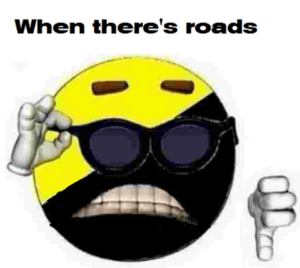
If you do argue with me about anarchism I will only respond with grammatically incorrect AnCap memes.
Like this:
Fundamentally Barlow and his ilk are proposing not a “free” cyberspace but an ungoverned cyberspace. These are not the same thing. We’ve spent the last 400 years trying to define freedom and the free society. We still haven’t perfected it but the consensus is that free societies also provide protections for individual rights. People doing whatever they want is not freedom.
There is a quote attributed to many people generally phrased as such:
“Your right to swing your fist ends at the tip of my nose”
Someone or something has to be there to stop that fist or to discourage the violation of your right to not be randomly punched in the nose. And you will get punched in the nose (Hobbes) and the authority that prevents the violation of your rights should have the consent of the governed (Hobbes and Locke). If there is no such authority you have an ungoverned cyberspace. Not a free cyberspace. Why do we have to re-learn what we already learned in the enlightenment? Fucking internet freedom stupidity.
Now, given a serious amount money, weaponry and a loyal armed militia I could probably go into an ungoverned area like Somalia or desert regions of Anbar province Iraq live a pretty good life and do whatever the fuck I want. Is this liberty? Am I free? Are the other denizens of this ungoverned space free? I don’t think so. Certainly the folks with the rifles pointed at them are not free. This is Barlow’s Cyberspace. it’s also the pre Hobbesian state of nature. And the way much of the internet operates. Barlow can be forgiven (barely) for spreading this hogwash twenty years ago. Before we knew what we know now. But current attempts to push this ridiculous notion should be seen for what it is:
A cynical attempt to pawn off the negative externalities of ungoverned computer/social networks onto the public. Privatized gains for those operating the networks. Socialized losses for the rest of us.
Fake news, cybercrime, copyright infringement and data breaches like Cambridge Analytics etc were baked in from the very beginning. We (the public) were always gonna pay the price. Silicon Valley was always gonna reap the profits.
Negative Externalities and the of role of government
Suppose that a factory or other such enterprise moves to town and begins producing pollution that causes respiratory problems among the town’s citizens. The costs of treating those respiratory problems are a negative externality. The factory does not pay those costs. Those costs do not appear on the company balance sheet or P&L statements. Instead those costs are borne by the public. Thus duly constituted local, regional or national governments impose regulations or taxes on companies that produce pollution. In a sense they put the cost of those negative externalities back onto the business. This seems fair and prudent. There are often debates as to the extent of regulation, specificity of those regulations, and the fees and taxes imposed, but generally it is accepted principle of modern democracies that governments have a right to impose this sort of regulation.
Except in Cyberspace. The embrace of “cyberspace independence” as an ideology by tech companies and their acolytes is not just starry-eyed utopianism. It is also commercially convenient. For if the government has no authority to regulate cyberspace, it also can not force those companies to carry the burden of their negative externalities. That might be fine if the negative externalities remained in cyberspace (or Iceland). But they don’t. Musicians have their music stolen. Human traffickers traffic real people. Real fentanyl is sold on the dark web (maybe even YouTube) and kids in your neighborhood sometimes die. The public carries the cost. Not the internet companies. And thus technology companies fight tooth and nail to make sure they get to keep what is in effect a massive subsidy from the public.
Tech company funded EFF hysterical warning about “internet censorship.” In reality the bill was a minor change that allowed prosecutors to go after platforms like Backpage that were clearly involved in sex trafficking.
This was clearly illustrated in the the SESTA/FOSTA fight in the US Senate. What started as a bipartisan bill to plug a hole in the 230 safe harbor so that sites that knowingly enabled sex traffickers could be more easily prosecuted, turned into a titanic battle between “internet freedom” dead-enders and normal folks. By normal folks I mean those who believe the people through their representative governments have a right to prevent sex trafficking. Even if it occurs “in cyberspace.” Judging by the hysterical headlines from the EFF (or as I prefer Google’s sock puppet), you’d think we were about to become North Korea. Look at the headline above! Talk about fake news. The bill does no such thing! This is propaganda worthy of a foreign adversary attempting to undermine faith in your government. Ahem.
Then again it’s not clear all of our duly elected representatives aren’t in on the scam. Google and many other Silicon Valley companies have large server farms in Eastern Oregon and have thus developed a reliable ally in Senator Ron Wyden. Not only does his position on the energy committee guarantee that cheap hydro electricity from the Columbia river keeps flowing to the server farms, the Senator is apparently willing to get up and dance for his supper. Wyden put a hold on SESTA before it ever went up for a vote. A hold by a single Senator requires the Senate to go through a much more complex and time consuming process to get a bill passed. Once it appeared the bill was going to pass, Wyden put on a rather dramatic show. Like some sort of techno-determinist millerite Wyden made an epic speech claiming that the bill would kill innovation! So stupid. It passed 98-2 and innovation proceeds.
Now Wyden could be forgiven for this stupidity… except that earlier Senate testimony featured a grieving mother whose teenage daughter was forced into sex trafficking and murdered. So think about that ugly bit of context as Wyden zealously defends his techno determinist belief. Wyden is in effect justifying the sacrifice of few young women for the innovation volcano gods. Icky right?
In the end SESTA/FOSTA was signed into law and Internet companies have more responsibility to monitor their own platforms for sex trafficking. This is a good thing. It makes these companies at least partially responsible for the negative externalities they force on the rest of us. But you would never know it from the propaganda they spread.
The EU Copyright Directive, GDPR and rejection of an independent cyberspace
In 2016 the EU debated and passed the General Data Protection Privacy Regulation. This law is intended to create uniform privacy protections across the EU. However from the perspective of US tech companies the bill was controversial because it put restrictions on the “export” and handling of EU users private data. Many US critics of the bill claimed that the law would require EU users’ data to be warehoused in the EU. While this turned out to not be true, it’s telling that the complaint centered on geography.
US internet companies and their allies chafed at what they saw as an assertion national authority into “independent” cyberspace. In actuality it was the other way around. The lack of effective regulation of internet companies and thus users private data had created virtual colonies within the EU for private US companies. Companies like Google and Facebook were conducting extensive commercial activities within the territorial boundaries of the EU without any effective oversight from democratically elective governments. The GDPR was an effort by the EU governments to reclaim lost virtual territory, and to put these activities under their authority. Silicon Valley hated this idea.
Similarly the EU proposed Copyright Directive ran into a wall of opposition from the same technology companies, affiliated NGOs, trade bodies and lobbyists. Like a broken record out came the exact same talking points used in the GDPR/SESTA/FOSTA debates and earlier attempts to reform safe harbors on copyright infringement.
“It will break the internet”
“It’s censorship”
“It will stifle innovation”
Once again we see the quasi religious appeal to techno-determinism. Any attempt by government to regulate internet platforms will make the innovation volcano gods angry! Infidels! Stone them! Spam them with robotically generated emails! However if you zoom out and look at this from the 36,000 ft level you still have the fundamental conflict. A duly constituted elected/representative government attempts to impose regulation and rules on internet companies. The response is essentially the opening paragraph of the Declaration of the Independence of Cyberspace
Governments of the Industrial World, you weary giants of flesh and steel, I come from Cyberspace, the new home of Mind. On behalf of the future, I ask you of the past to leave us alone. You are not welcome among us. You have no sovereignty where we gather.
— John Perry Barlow, “A Declaration of the Independence of Cyberspace”
But as I will show in Pt III, this time the response from US technology companies, especially Google went beyond the usual rhetoric and attempts to lobby the government. The tech giants, especially Google, crossed the rubicon. Google used its own platforms (especially YouTube), trade groups, lobbyists and pet NGOs to actively undermine the democratic process in the EU. The FAZ newspaper in Germany compared the avalanche of automatically generated, emails, tweets and phone calls to a DDoS attack on the European Parliament. This combined with blatant disinformation distributed and amplified by anonymous social media accounts made the whole shameful episode eerily similar to what military strategists would term a hybrid information warfare attack. I wrote an entire blog on it earlier this year. Read it here.
Was this the first offensive “active measures” campaign by Silicon Valley against a Nation State?
I’ll pick it up here with “Active Measures” in part III. Stay tuned.
“I was brought up and trained in the Internet Age by people who really believed that nation states were on the verge of crumbling…and we could geek around it. We could avoid it [The Nation State]. These people were irrelevant.” -Susan Crawford Former President Obama’s Special Assistant for Science, Technology, and Innovation Policy, speaking at Personal Democracy Forum 2010 New York City.
It is often an awkward moment when I present the statement above to my (generally liberal) musician friends and academic colleagues and then tell them it came from an Obama administration official. Yikes! Is usual reaction. To be fair, the statement itself is not the problem. It is profoundly prescient. The problem with Crawfords statement (watch the video) is she clearly thought “geeking around” the nation state was a good thing at the time! It is only in a post Cambridge Analytics world this statement seems quite sinister. Although Vladmir might disagree.
Obama was elected on promises of change from politics as usual. Like many other people I took him at his word and voted for him. And in many ways he fulfilled his promises. Obama cobbled together a very different governing coalition than previous presidents. One key component of his coalition was the tech industry writ large. Not just the executives and employees of giants like Google and Facebook, but also the assorted camp followers: wild eyed tech evangelists; smooth talking VCs; cyberlaw professors; open source software enthusiasts; tech policy wonks; big data gurus; NGOs, TED talkers; futurists; cyberspace lawyers; free culture radicals; pirates; cyber libertarians; and assorted cranks.
As a result Obama (like his predecessors Bush and Clinton) took a very neo-liberal approach to the technology industry. Hands-off the tech industry and in exchange the billionaires in Silicon Valley would make everyone’s lives better. Innovation will lift all boats. As someone with classical liberal tendencies I can’t say that this was a wrong decision. At least when you didn’t know then what we know now.
Now it looks stupid. But back then? It gets a pass.
The problem: in short order this part of the Obama coalition coalesced into a lobbying superpower in its own right. A strange mix of anti-establishment lefties, right libertarians, social progressives and lots and lots of corporate money. Google in particular used that money to shape the coalition agenda into a something that perfectly supported its business model. Yet never threatened it. For example, when Barry Lynn a researcher at the Google funded New America Foundation got out of line and praised the EU for fining Google $2.7 billion for violating antitrust laws? New America Foundation fired him for threatening their funding sources. EFF a “digital rights advocacy group” has received millions from Facebook and Google and regularly provides PR and legal cover for these companies. Almost a week passed before they commented on the Cambridge Analytics scandal. Good dog. Very good dog.
Of course this is all very predictable and what we would expect in corporate policy circles.
However a couple years after Susan Crawford made her speech, something radically changed. It started with a bill designed to slow online piracy SOPA. This bill emerged from years of bipartisan wrangling. In EU a trade agreement, ACTA enjoyed similar consensus support. Both were moving towards passage when they were met with what appeared to be fierce grass roots opposition.
In the US the campaign was largely directed by Google lobbyists (Marvin Ammori and Glen Echo Group) and lavishly financed through an opaque non-profit 501 (c) 3 called Fight For The Future. The campaign relied on simple hashtags like “Don’t Break the Internet.” Simple webforms allowed users to share, tweet, email and even phone legislators. Similarly in the EU an online campaign was created to block ACTA. Thousands eventually took to the streets in Poland.
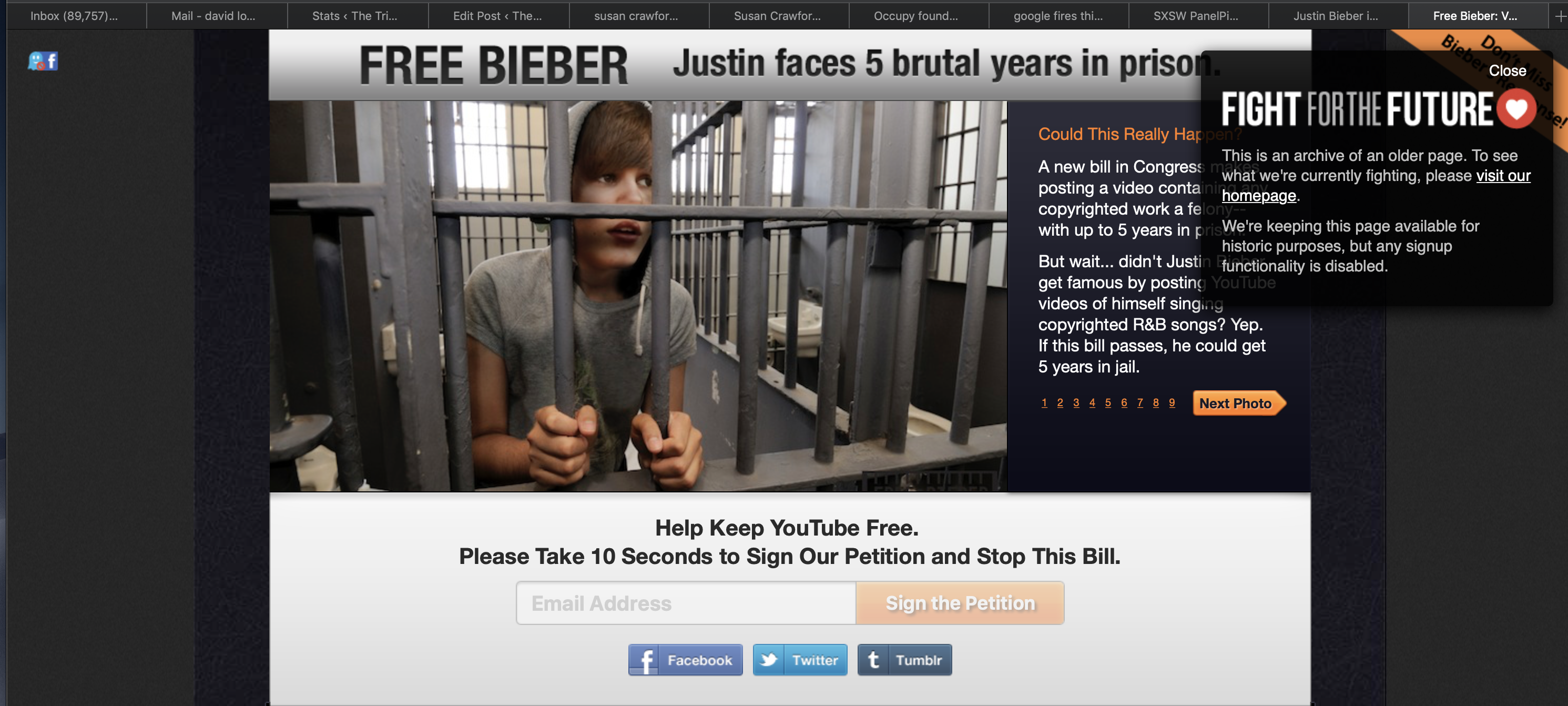
It wouldn’t be an online campaign if there wasn’t also some wild disinformation. And the anti-SOPA campaigners did not disappoint. The most shameful moment was Harvard Law Professor Jonathan Zittrain’s “Free Bieber” moment on the Steven Colbert show Dec 1st 2011. Zittrain used Justin Bieber’s breakthrough on YouTube singing covers as his primary example and falsely claimed that Bieber would have gone to jail if SOPA had been law. The problem is that this claim emerged from a website run by Google lobbyist Ammori and had been totally debunked long before Zittrains appearance. Judging by Zittrain’s other comments around the same time it would appear he was aware his claim had been debunked and was specious when he made it.
Unfortunately this kind of disinformation worked. When President Obama came out against the bill on Jan 16th 2012 the bogus “censorship” narrative was in the groundwater. Obama gave it real credence. On the 18th Google and dozens of other websites “blacked out” and provided interactive links that allowed repeated robo calls to congress. The results were predictable. Congress was flooded with unprecedented number of phone calls and emails. Think about it. The most popular website on the planet (Google search) directed all their web traffic at the US Congress with a misleading bit of click bait “Don’t censor the web.” It was essentially a distributed denial of service attack on the legislative branch. And it worked. Jan 20th 2012 the bill was withdrawn.
TAIL WAGS DOG
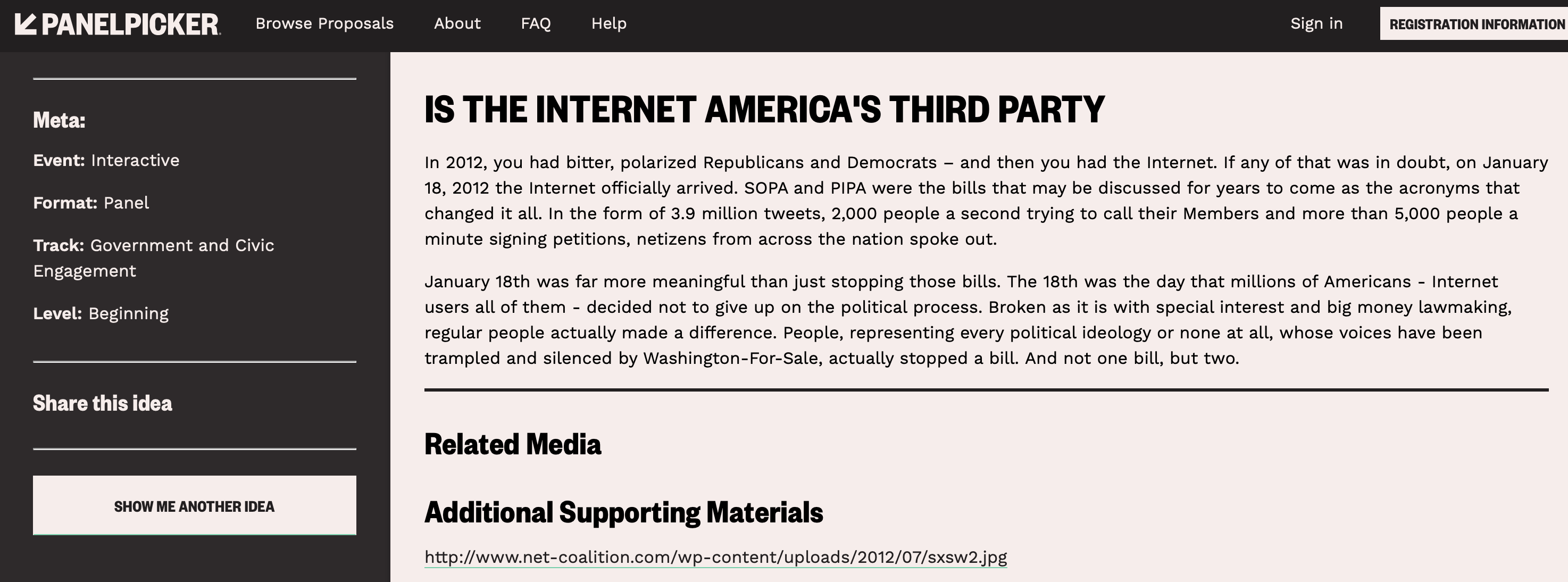
And that’s when it all changed. The tail discovered it could wag the dog. While the Obama administration may have thought they were being helped with “their” policy by the tech industry, the tech coalition saw it completely differently. They immediately declared themselves sovereign. In 2012 there was no more representative voice of the corporate internet industry than The Net-Coalition. It was basically Google with some grudging support from Amazon and everyone else dragged along at gunpoint. In July 2012 Katie Barr VP of The Glen Echo Group on behalf of the Net-Coalition organized this panel (above) in which they ask the primary question “Is the Internet America’s Third Party?” Among the proposed sub-questions was this gem: “We’ve done a lot of self-congratulating, but what do we do now?”
Fine but…Who’s “we?”
I mean who elected the people who declared themselves “The Internet?” Look at the panel. All but one is a lobbyist. What is this new kind of political entity? Is it really new? We’ve always had lobbyists. If “The Internet” is the thing that got real pissed off about SOPA, it is essentially a lobbyist directed online mob. Is that better than the representative democracy we have now? If we put the online mob in charge of everything won’t it just rename everything Boaty McBoatface? I’m being silly now.
Yet, doesn’t this seem like the scenario Crawford was talking about in the opening quote? The nation state is portrayed as crumbling. A “geeking around” the nation state is proposed with “the internet” (whoever that is) as its “third party” replacement. Sure a weak tea version. A sort of bubbly corporate billboard on the road to Little Dystopia. But when you combine it with the techno-determinism espoused by many of the technology leaders you get something quite nasty. You find yourself on the road to Big Dystopia.
TECHNO-DETERMINISM
Without repeating 40 pages of my doctoral dissertation, techno-determinism as preached by silicon valley is the notion that technology is an irresistible force that shapes society. We are powerless to even modify the coming innovations and thus we must shape our society, governments, institutions, laws and even our morals to match the technology. As my colleague East Bay Ray noted, techno-determinism is “a form of nihilism” that “demands we modify social norms, longstanding ethical principles and even human rights guarantees to match new technology rather than the other way around.”
As an example. The wave of industrialization in he 19th century led to the employment of children in the mills. Small stature and the ability to get into spaces that full grown men couldn’t made children valuable workers. Essentially a technological determinist would argue we adapt our society and shed our moral outrage at the employment of children. We didn’t. We banned the child labor and innovation progressed along nicely.
Humanity 1
Techno-Determinists 0
But this is no longer the 19th century and techno-determinism has evolved. There is now a pseudo religious quality to techno determinism in Silicon Valley. It comes in two forms. The first is the so-called Singularity. This is a notion that was popularized by the science fiction writer Ray Kurzweil. Kurzweil is also the chief of engineering for Google. From Wikipedia:
Kurzweil describes his law of accelerating returns which predicts an exponential increase in technologies like computers, genetics, nanotechnology, robotics and artificial intelligence. Once the Singularity has been reached, Kurzweil says that machine intelligence will be infinitely more powerful than all human intelligence combined. Afterwards he predicts intelligence will radiate outward from the planet until it saturates the universe. The Singularity is also the point at which machines intelligence and humans would merge.
Kurzwil is not just some outlier Google engineer with some wacky ideas on the side. Google and other Silicon Valley companies fund his Singularity University.
The second form of this pseudo-religious techno-determinism has less of a Millerite quality but is still pernicious. Essentially it posits it is a venal sin to stand in the way of technological innovation because those innovations may produce improvements for humanity down the road. Standing in the way of innovation causes humanity to suffer. “Forgive me Father for I have sinned. I have attempted to enforce my constitutional copyright protections.” This second form permeated the Clinton, Bush and Obama administrations and still permeates technology bureaucracies at the federal level under Trump. Again this is a notion that on the surface seems harmless. It sort of jibes with longstanding neo-liberal and classical liberal ideals.
So what is the problem?
Internet Imperialism
“Google is the first imperialist power of the 21st century”- Anonymous comment on Trichordist.
When one combines this pseudo religious techno-determinism, with naked political ambition you get something that I call Internet Imperialism. I’ll explore this more in part II. But Internet Imperialism is the notion that the Internet is outside of the realm of national or even international law. This might have seemed harmless or poorly thought out hippy bullshit when this was first proposed by EFF founder John Perry Barlow in the Declaration of Independence of Cyberspace. At the time the Internet seemed like undiscovered territory. The internet was a few hobbyists using dial up modems chatting via BBS. What was to be lost if Barlow and his corporate-funded EFF cronies declared it independent?
A Declaration of Independence of Cyberspace. Internet Imperialism can look like harmless hippy bullshit.
Now virtually all human interaction and much of the economy transits the the internet. Internet Imperialism reaches back and pulls large portions of our lives into a system that lacks the consent of the governed. That is a real loss. Do we really want that?
My contention is that internet companies in coordination are aggressively attempting to limit the scope of our democratically elected governments. We are allowing the vast internet-industrial complex to whittle down the authority of our national and even trans-nation institutions by removing much human activity from the scope of governance. We are losing sovereignty, virtual territory to unelected unaccountable private corporations. How are we any different than China in the 19th and early 20th century? Are our national institutions being slowly dismantled without our consent? Tellingly much of the campaigning resembles hybrid information warfare.
The battle lines are clearly defined now:
Do technology companies and their allies sit at the apex of power and determine what sort of world we live in? The boundaries and limits of our government, our commerce and our liberties defined by their algorithms and business models? Government is simply a janitorial service that cleans up the negative externalities.
Or do democratic representative institutions sit at that apex?
It’s as if we are undoing the enlightenment. Do we need to dig up John Locke and reanimate him through memes and gifs so folks understand the fundamental importance of the consent of the governed?
Further, whether they consciously intend it or not the internet-industrial complex is undermining western democracies in exactly the same manner that hostile foreign authoritarian governments have attempted to undermine the west for decades. Shouldn’t that freak us all out?
In part two I will explore this further using the corporate campaign against EU Article 13 as the case study. As I will show the anti-article 13 campaign seems specifically designed to block a law by limiting EU authority. Even more disturbing, there is also circumstantial evidence that they pandering to centrifugal forces on the far right/ far left that seek to break the EU apart.
*Correction. A earlier version of this blog implied ACTA was a statute rather than a trade agreement.
It’s hard to believe that after a good ten years of being called out, YouTube still–still–cannot manage to stop neo-Nazi and white supremacist material from getting posted on its network. We’ve been calling out YouTube on MusicTechPolicy and the Trichordist for these inexcusable failures again and again and again. And yet they keep recycling the safe harbor as an alibi–and they’re doing it again in Europe on Article 13.
I can understand that YouTube doesn’t want to “censor” users and there may be close cases from time to time. For example, I could understand why YouTube CEO Susan Wojcicki might not want to take down videos from Seeking Arrangement that encourages young women into a “sugar daddy” relationship to pay for college and health care.
But you know what’s not a close case? It’s right there in the title of the song–“Who Likes a N—“. You would think that one would get picked up in a simple text filter of debased language. But it wasn’t ten years ago and it still isn’t. Not a close case.
UPDATE: Author’s note–this YouTube video has been taken down and the account deleted–AFTER this post.
And then there’s “Stand Up and Be Counted” by the White Riders. It’s not that hard to figure out by listening to any of the many versions of this song that it’s a recruiting song for the Klu Klux Klan. And it’s not that YouTube doesn’t know it–this version of the hate song has clearly been filtered by YouTube–oh, sorry. Not by YouTube, but by the “YouTube community.” But why is it that a KKK recruiting song doesn’t violate YouTube’s terms of service if it doesn’t shock Susan Wojcicki’s conscience?
David Lowery called out YouTube and CD Baby for allowing hate rock to be distributed on their platforms. Within hours, CD Baby pulled the account. But not YouTube.
Let’s understand a couple things. First, this is not hard. The Anti Defamation League and the Southern Poverty Law Center have actual lists of these bands. Both MusicTechPolicy and The Trichordist have been hammering this issue for years. Simple word searches could accomplish a large percentage of the task–the N word, KKK recruiting and images of Adolph Hitler are not close cases.
And let’s understand something else. When users post movies, television shows and recorded music on YouTube, all of those materials have gone through some kind of legal review for standards and practices. That doesn’t mean there’s no fair use or that there are no parodies. It does mean that a human has thought about it because free expression is a judgement call.
Free expression is deserving of human examination. You cannot create a machine that will do this for you. You cannot rely on crowd sourcing to stop all uses of these vile terms and images–because in every crowd there’s someone who thinks it’s all just fine. That’s why they’re called mobs.
YouTube, Facebook and all the Article 13 opponents actually are using a complete spectrum of review. The problem is that they are cost shifting the human review onto artists and to a lesser extent their users for two reasons. First and foremost is that they hope not to be caught. That’s what the safe harbor is really all about. The value gap is just a part of it–the other part is the values gap. How do these people sleep at night?
But I firmly believe that the real reason that they shift the human cost onto those who can least afford it is because they’re too cheap to pay for it themselves. They are willing to take the chance because getting caught so far has been a cost of doing business.
The real cost of their business is the corrosive effect that they have on our discourse, our families and our children. There has to be a way to make YouTube responsible for their choices–and CD Baby showed this week that it’s not only possible but necessary.
If YouTube and their paid cronies want to try to convince legislators that they deserve special protection, they need to live up to the standard that CD Baby set this week And they need to do that before they get any further special treatment.
As we’ve said for years, the safe harbor is a privilege not an alibi.











 The Trichordist
You must be logged in to post a comment.