“ACTA2” Trolls Publish Hit List on Pastebin of Artists who Supported Copyright Directive in Europe — Music Technology Policy

Many independent musicians, authors, songwriters and photographers have been targeted on a blacklist from anti-copyright trolls associated with the Pirate Party and Anonymous.  As this is not only harassment but also an illegal commercial boycott you should ask your national anti-competition authorities to investigate.   Read more at MusicTechPolicy.com

“ACTA2” Trolls Publish Hit List on Pastebin of Artists who Supported Copyright Directive in Europe

via “ACTA2” Trolls Publish Hit List on Pastebin of Artists who Supported Copyright Directive in Europe — Music Technology Policy

MLC Candidates Agree to Hold Black Box Until 2023, Copyright Office to review unmatched distribution practices — Artist Rights Watch

[Editor Charlie sez:  It appears that the pressure on the Copyright Office to supervise black box distribution practices by the conflict-ridden Mechanical Licensing Collective procedures has resulted in a commitment to hold the initial distribution until 2023.  It is unclear if this also means that the designated MLC cannot offset its startup costs against the black box.  As Ed Christman reported in Billboard on June 26, 2019 (“House Judiciary Hearing on Copyright Office Reviews Music Modernization Act, Black Box Royalty Concerns”) the Copyright Office intends to commence their best practices study after designating the MLC on July 8, which should give everyone an opportunity to weigh in on how the MLC should operate.  Commenters could include the digital services who could voluntarily disclose the efforts that they and their outside vendors had in place during the period that the black box accrued.]


[U.S. Register of Copyrights Karen A.] Temple repeatedly assured the committee that the MMA gives the Copyright Office responsibility to distribute the black box money appropriately, noting that in addition to the agreement not to distribute before 2023, the Copyright Office has the responsibility to review the processes that the MLC is engaging to reduce black box money.

Read the post on Billboard


[Here is the code section from MMA about the Copyright Office study that appears to be the basis for regulations on the MLC’s distribution of unmatched funds, a study that may be the only time in a generation that songwriters get to be heard about these unmatched payments.]

UNCLAIMED ROYALTIES STUDY AND RECOMMENDATIONS.— (1) IN GENERAL.—Not later than 2 years after the date on which the Register of Copyrights initially designates the mechanical licensing collective under section 115(d)(3)(B)(i) of title 17, United States Code, as added by subsection (a)(4), the Register, in consultation with the Comptroller General of the United States, and after soliciting and reviewing comments and relevant information from music industry participants and other interested parties, shall submit to the Committee on the Judiciary of the Senate and the Committee on the Judiciary of the House of Representatives a report that recommends best practices that the collective may implement in order to— (A) identify and locate musical work copyright owners with unclaimed accrued royalties held by the collective; (B) encourage musical work copyright owners to claim the royalties of those owners; and (C) reduce the incidence of unclaimed royalties.


via MLC Candidates Agree to Hold Black Box Until 2023, Copyright Office to review unmatched distribution practices — Artist Rights Watch

No, Streaming Is Not Saving Us. Revenues still down by Half.

We’ve been hearing an alarming narrative that “record labels are making more money than ever from streaming, but they’re just not paying musicians”. To be clear, we certainly have our issues with major labels, however we also need facts and to be truthful.

The truth is, that a decade after losing half of it’s revenues due to piracy as reported by CNN (click here), record labels are now only getting back up to half of what the peak business was in 1999. Half of where we were in 1999, twenty years later. Let that sink in. As unpopular as he was twenty years ago, Lars Ulrich was right.

Twenty years later, and we’re still only half of where we were in 1999.

There are only three numbers that matter when looking at the record industry post-piracy and here they are:

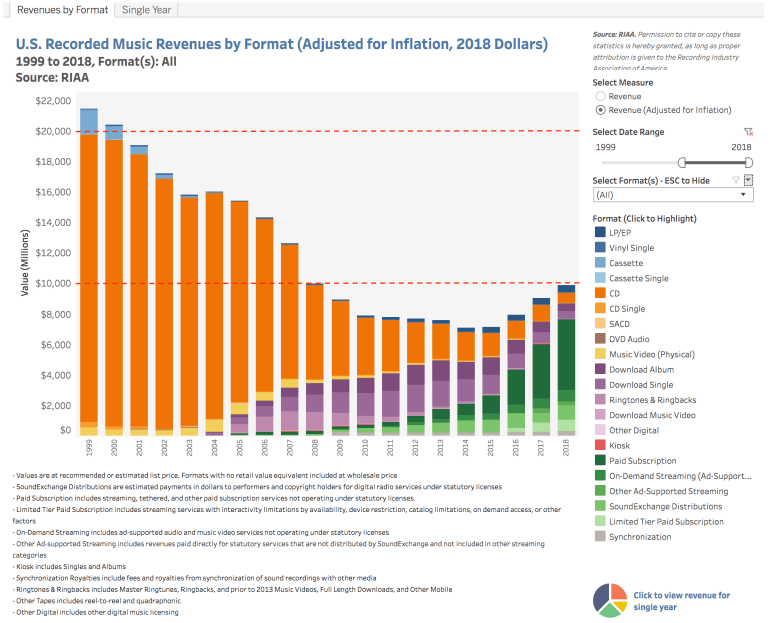
1999 : $14.6b = $22.01 in 2018 Dollars
2009 : $6.3b = $7.37 in 2018 Dollars
2018 : $9.8b = $9.8b in 2018 Dollars

This is clearly illustrated in the chart below provided by the RIAA, the trade group responsible for tracking these figures. At their lowest point in 2014, revenues from record sales were less than one third of their peak.

What this chart also shows is a decade long loss of $10b or more annually, which is over $100b in lost revenues to labels and artists. That’s $100b in lost revenues to labels and artists in just the past decade.

If we track total lost revenue to labels and artists since the launch of Napster in 1999 it totals just under $200 Billion Dollars in the USA alone.

The fundamental problem remains the same. There’s a hole in our bucket and all that revenue falling out though the bottom leads more or less to advertising funded piracy and YouTube. Many have suggested that YouTube is effectively the largest ad supported piracy platform. As we reported earlier this year in our updated Streaming Price Bible, the YouTube Value Gap is very, very real.

In future posts we’ll offer solutions and suggestions that should be under consideration at every major label. Not the least of which is transitioning subscription streaming models to incorporate a per stream transactional baseline, or a minimum wholesale price per stream.

In streaming, consumption does not grow revenues. More consumption and more streams do not generate more money. Revenue can only be generated by charging more for subscriptions, generating more advertising revenue (ad supported only, obviously) and expanding into more markets (gaining new subscribers). But eventually, everything flattens.

So the biggest question remains. What happens to overall revenues as streaming matures and cannibalizes the remaining revenue sources into purely niche markets. Digital Downloads will account for less than 10% of recorded music revenues by the end of the year, if not already. The CD market continues drop, and vinyl also declined slightly from 2017 (4.4%) to 2018 (4.3%).

Will streaming compensate for the lost revenues in other formats and continue to grow revenues towards a true recovery? It’s possible, but there will have to be some changes to address the economics presented to consumers despite what Goldman Sachs says. For the year of 2018 the industry reported $9.8b in revenues. To make that $37.2b by 2030 the industry needs to add nearly $3b a year for the next 10 years!

We don’t know what else they’ve got in that crystal ball that can predict revenues over a decade into the future but even by their bullish estimate of $37.2b in 2030, that is only $28b in 2019 dollars. Right now we’re still about $20b short.


@musictechpolicy: Wixen Music Publishing Files Lyric Infringement Lawsuit Against Pandora And Raises Questions About Lyric Licensing

Guest post by Chris Castle

In the “it was only a matter of time” department, Wixen Music Publishing has sued Pandora over infringing reproductions of the lyrics in songs it represents.  (For those reading along at home, Wixen is represented by badass David Steinberg, so good luck Pandora.)

All these cases against tech companies start with very similar facts–they were given a chance to fix the problem and they either entirely ignored the copyright owner (like David Lowery and Bluewater) or they obfuscated and tried to deflect blame, or did both.

Here’s the key fact from this Wixen case:

Plaintiff’s representatives put Pandora on actual notice of its infringing conduct in early 2018, yet Pandora did not even attempt to address its infringing conduct until May 2019, when it first purported to cease displaying some of the lyrics to the Musical Compositions on its service….Pandora’s infringement is therefore willful and deliberate.

In other words–Pandora apparently blew off its responsibilities for over a year and still didn’t fix the problem.  Here’s a practice point–when Wixen or someone like Wixen calls, you need to fix your problem.  Right. Now.

But this case raises an interesting side point that may indicate a likely waypoint down the trail.  There is a company called LyricFind that licenses lyrics for many publishers according to their advertising.  Wixen notes in the complaint:

Pandora may claim that it had obtained licenses to display the lyrics to the Musical Compositions from one or more sources, including an entity called LyricFind, the self-proclaimed “largest lyric licensing service” in the world, which claims that it “has licensing from over 4,000 music publishers, including all majors.” However, as Pandora knows, and has known, LyricFind did not have the authority to grant licenses to Pandora for the display of any of the lyrics to the Musical Compositions on its service.

How does Pandora know this?  Probably because Wixen (and possibly other publishers) told them so.  It’s entirely possible that Pandora has a license with LyricFind for the songs it represents, but if Wixen hasn’t authorized LyricFind to represent them for lyric licensing (which they evidently have not), then this is an irrelevant fact.

I have to believe until shown otherwise that LyricFind would be the first to tell their licensees that LyricFind does not purport to license all the lyrics for every song ever written or that ever may be written in any language from any songwriter or publisher in any country on the face of the Earth.

The problem seems to be the same problem that Big Tech has had with music from the beginning–the tech companies don’t want to have to confirm their rights because that involves human beings and human beings cost money.  It’s this dismally poor administration of licenses by the licensees that seems to be the stumbling block.

However, it does make for interesting viewing to see exactly what was said by whom when about what, and what assurances were given.  My bet is that the next step will be like the Music Modernization Act–a retroactive safe harbor with a blanket license and a statutory monopoly.

Read the Wixen complaint here.

Guest Post: @musictechsolve: Betting on the House: Issues that House Judiciary Should Investigate Against Google–End Supervoting Shares for Publicly Traded Companies

by Chris Castle

The House Judiciary Committee announced recently that it was opening an antitrust investigation into “tech giants” including Google.  Chairman Jerry Nadler said:

[T]here is growing evidence that a handful of gatekeepers have come to capture control over key arteries of online commerce, content, and communications…Given the growing tide of concentration and consolidation across our economy, it is vital that we investigate the current state of competition in digital markets and the health of the antitrust laws.

We’re going to do a series of posts about some issues Chairman Nadler should consider in the Judiciary Committee’s review of Big Tech business practices.  These posts will cover issues that relate both to Google as well as Facebook, Spotify and some others.  Let’s start with reforming corporate governance and bring eyesight to the willfully blind.

1.   One Share, One Vote, Not Ten Votes for the Special People:  Anyone in the music business has had just about enough of government oversight from the consent decrees to rate setting to the Music Modernization Act, so I don’t recommend it as a solution in general.  But–in the absence of marketplace transparency, the government is about the only place to go to bring reforms to well-heeled corporations.  So rather than ask the government to fix specific problems on an ad hoc basis, the government would do well to ask what causes the market to fail as it clearly has with Google.  Then rip out that problem root and branch.

The first question to ask when confronted with all of Google’s overreach is where was the board?  That’s an easy question to answer in Google’s case–they were in the pockets of the insiders as you will see.  But we ask that question because corporate boards of directors are supposed to be the first line of oversight to keep companies, especially publicly traded companies, from running off of the rails.

In Google’s case, the core problem is both easy to find and (I hope) easy to fix.  It lies in the voting structure of the shareholders.  Shareholder rights and corporate charters are state law matters and don’t relate to the federal government, but–the federal government does have a say about who gets to sell shares to the public. (For those reading along at home, I’m thinking of the Securities Act of 1933 and the Securities Exchange Act of 1934 under the jurisdiction of the Securities and Exchange Commission.)

The federal government also has an interest in protecting those who purchase the shares of publicly traded corporations.  It is this nexus that gives the House Judiciary Committee clear oversight authority over the corporate structure of at least publicly traded corporations.  Once a start up decides to feed from the trough of the public’s money, they should expect to answer to their public shareholders.

While anti-coup d’etat provisions might make sense for private companies whose investors are sophisticated financiers, or newspapers seeking to retain editorial independence, once that company is publicly traded a bald discrepancy that simply mandates voting power to the insiders forever seems like it has to go.  And as we have seen with Google, the lack of corporate oversight has resulted in unbelievable arrogance and a complete failure of corporate responsibility.  And worse yet, because Google got away with it, lots of other tech companies follow essentially the same model (including Facebook, Spotify and Linkedin).

Take stock buy backs for example, such as the $1 billion stock buy back announced by Spotify.  It must also be said that stock buybacks approved by a board where insiders who benefit from the buyback have supervoting shares and control the board is a practice that reeks to high heaven.  Buybacks and dual class supervoting shares have been widely criticized including by Securities and Exchange Commission Commissioner Robert Jackson who is also a critic of supervoting shares.

So how did Google come to give control to its insiders, essentially forever?  Google’s supervoting structure started when Google was a private company as a way for the founders to preserve control and avoid venture capital investors pushing them around.

OK, fine, I understand that. But once Google went public with their IPO that made those same insiders billionaires several times over, why should the insiders keep that level of control?

You may ask how that supervoting stock works?

Google (which is really its parent company, Alphabet) trades under two ticker symbols on the  NASDAQ: GOOGL Class A and GOOG Class C.

Oops.  What happened to Class B?  Ay, there’s the rub.

Class B shares are not publicly traded and are held by insiders only.  But as you will see, they control every aspect of the company.  So how do Google’s insiders get this share structure?  There’s actually a simple answer.  Class A shares (GOOGL) get one vote per share, Class B shares get 10 votes per share and Class C shares (GOOG) get no votes.

That’s right–Class B shares cannot be purchased and their holders get 10 times the voting power of the Class A holders, often called “supervoting” shares, because their super power is…well…voting.  (When sold, Class B shares convert to Class A shares.)

The Class C shares were created as part of a 1:1 stock split that doubled the number of shares, halfed the price per share, but resulted in no change of the voting power of the Class A and C shareholders.  Class A holders got double the shares but half the voting power post-split.

When the dust settled, the Google/Alphabet voting capitalization table looked something like this:

Class A: 298 million shares and 298 million votes, or roughly 40% of the voting power with votes counting 1:1.

Class B: 47 million shares and 470 million votes, or roughly 60% of the voting power with votes counting 10:1.

What this also means is that the holders of Class B shares voting as a bloc will never–and I mean never–be outvoted at a shareholder meeting, their board of directors will never be challenged much less replaced and shareholder meetings are a one way communication event where the insiders tell the stockholders how the insiders will spend their money.

Who controls the Class B shares?  I culled out some numbers for individual holders which may not be entirely accurate, but the individual holders are who you would expect.  These numbers shift around a bit depending on whose sold what (if you want to drill down, you can check the SEC’s Form 4 filings, such as this one for Sergey Brin).  These are the people that Commissioner Jackson might call the “corporate royalty“:

Larry Page: 20 million shares (as of 2017)

Sergey Brin: 35,300 Class B shares plus 35,300 Class A shares (as of 2018)

Eric Schmidt: 1.19 million Class B shares, 40,934 Class A shares, and 10,983 Class A Google shares, plus 2.91 million Class B shares through family trusts.

Sundar Pichai: 6,317 Class A shares and no Class B shares.

The House Judiciary Committee has a chance to correct the supervoting system as bad policy and implement a long-term fix across the board for all dual-class companies that want to trade on the public exchanges.

This means that the “corporate royalty” at Google, Facebook and Spotify would be much more accountable to shareholders which would help keep the company on the rails. I think that the Judiciary Committee might find that they are pushing on an open door at the SEC, especially with Commissioner Jackson.

The essential proposal is a simple tradeoff–if you want to keep supervoting stock, sell your shares privately to sophisticated investors under a registration exemption and don’t sell shares to the general public.  But if you want to sell shares to the public, keep your corporate governance at least arguably transparent and fair by sticking to one share one vote.

[A version of this post first appeared in Chris Castle’s MusicTech.Solutions blog]