
Does it have an index? @LizPelly’s Must-Read Investigation in “Mood Machine” Raises Deep Questions About Spotify’s Financial Integrity

Spotify Playlist Editors

By Chris Castle

If you don’t know of Liz Pelly, I predict you soon will. I’ve been a fan for years but I really think that her latest work, Mood Machine: The Rise of Spotify and the Costs of the Perfect Playlist, coming in January by One Signal Publishers, an imprint of Atria Books at Simon & Schuster, will be one of those before and after books. Meaning the world you knew before reading the book was radically different than the world you know afterward. It is that insightful. And incriminating.

We are fortunate that Ms. Pelly has allowed Harper’s to excerpt Mood Machine in the current issue. I want to suggest that if you are a musician or care about musicians, or if you are at a record label or music publisher, or even if you are in the business of investing in music, you likely have nothing more important to do today than read this taste of the future. 

The essence of what Ms. Pelly has identified is the intentional and abiding manipulation of Spotify’s corporate playlists. She explains what called her to write Mood Machine:

Spotify, the rumor had it, was filling its most popular playlists with stock music attributed to pseudonymous musicians—variously called ghost or fake artists—presumably in an effort to reduce its royalty payouts. Some even speculated that Spotify might be making the tracks itself. At a time when playlists created by the company were becoming crucial sources of revenue for independent artists and labels, this was a troubling allegation.

What you will marvel at is the elaborate means Ms. Pelly has discovered–through dogged reporting worthy of the great deadline artists–that Spotify undertook to deceive users into believing that playlists were organic. And, it must be said, to deceive investors, too. As she tells us:

For years, I referred to the names that would pop up on these playlists simply as “mystery viral artists.” Such artists often had millions of streams on Spotify and pride of place on the company’s own mood-themed playlists, which were compiled by a team of in-house curators. And they often had Spotify’s verified-artist badge. But they were clearly fake. Their “labels” were frequently listed as stock-music companies like Epidemic, and their profiles included generic, possibly AI-generated imagery, often with no artist biographies or links to websites. Google searches came up empty.

You really must read Ms. Pelly’s except in Harper’s for the story…and did I say the book itself is available for preorder now?

All this background manipulation–undisclosed and furtive manipulation by a global network of confederates–was happening while Spotify devoted substantial resources worthy of a state security operation into programming music in its own proprietary playlists. That programmed music not only was trivial and, to be kind, low brow, but also essentially at no cost to Spotify. It’s not just that it was free, it was free in a particular way. In Silicon Valley-speak, Ms. Pelly has discovered how Spotify disaggregated the musician from the value chain.

What she has uncovered has breathtaking implications, particularly with the concomitant rise of artificial intelligence and that assault on creators. The UK Parliament’s House of Commons Digital, Culture, Media & Sport Committee’s Inquiry into the Economics of Music Streaming quoted me as saying “If a highly trained soloist views getting included on a Spotify “Sleep” playlist as a career booster, something is really wrong.” That sentiment clearly resonated with the Committee, but was my feeble attempt at calling government’s attention to then-only-suspected playlist grift that was going on at Spotify. Ms. Pelly’s book is a solid indictment–there’s that word again–of Spotify’s wild-eyed, drooling greed and public deception. 

Ms. Pelly’s work raises serious questions about streaming payola and its fellow-travelers in the annals of crime. The last time this happened in the music business was with Fred Dannen’s 1991 book called Hit Men that blew the lid off of radio payola. That book also sent record executives running to unfamiliar places called “book stores” but for a particular reason. They weren’t running to read the book. They already knew the story, sometimes all too well. They were running to see if their name was in the index.

Like the misguided iHeart and Pandora “steering agreements” that nobody ever investigated which preceded mainstream streaming manipulation, it’s worth investigating whether Spotify’s fakery actually rises to the level of a kind of payola or other prosecutable offense. As the noted broadcasting lawyer David Oxenford observed before the rise of Spotify:

The payola statute, 47 USC Section 508, applies to radio stations and their employees, so by its terms it does not apply to Internet radio (at least to the extent that Internet Radio is not transmitted by radio waves – we’ll ignore questions of whether Internet radio transmitted by wi-fi, WiMax or cellular technology might be considered a “radio” service for purposes of this statute). But that does not end the inquiry.Note that neither the prosecutions brought by Eliot Spitzer in New York state a few years ago nor the prosecution of legendary disc jockey Alan Fried in the 1950s were brought under the payola statute. Instead, both were based on state law commercial bribery statutes on the theory that improper payments were being received for a commercial advantage. Such statutes are in no way limited to radio, but can apply to any business. Thus, Internet radio stations would need to be concerned.

Ms. Pelly’s investigative work raises serious questions of its own about the corrosive effects of fake playlists on the music community including musicians and songwriters. She also raises equally serious questions about Spotify’s financial reporting obligations as a public company.

For example, I suspect that if Spotify were found to be using deception to boost certain recordings on its proprietary playlists without disclosing this to the public, it could potentially raise issues under securities laws, including the Sarbanes-Oxley Act (SOX). SOX requires companies to maintain accurate financial records and disclose material information that could affect investors’ decisions.

Deceptive practices that mislead investors about the company’s performance or business practices could be considered a violation of SOX. Additionally, such actions could lead to investigations by regulatory bodies like the Securities and Exchange Commission (SEC) and potential legal consequences.

Publicly traded companies like Spotify are required to disclose “risk factors” in their public filings which are potential events that could significantly impact Spotify’s business, financial condition, or operations. Ms. Pelly’s reporting raises issues that likely should be addressed in a risk factor. Imagine that risk factor in Spotify’s next SEC filing? It might read something like this:


Risk Factor: Potential Legal and Regulatory Actions

Spotify is currently under investigation for alleged deceptive practices related to the manipulation of Spotify’s proprietary playlists. If these allegations are substantiated, Spotify could face significant legal and regulatory actions, including fines, penalties, and enforcement actions by regulatory bodies such as the Securities and Exchange Commission (SEC) and the Federal Trade Commission (FTC). Such actions could result in substantial financial liabilities, damage to our reputation, and a loss of user trust, which could adversely affect our business operations and financial performance.


[A version of this post first appeared in MusicTech.Solutions]
Step Right Up: The Chamber of Progress’s Ticketing Chamber of Horrors Fools Nobody

It’s one of those sad facts there are people you meet in life who just always seem to have the wrong side of the deal. Sometimes it’s emotionally understandable in the case of kids like the Cox character from William Boyd’s Good and Bad at Games or even Smike from Nicholas Nickleby. But when you see one of these cringy Silicon Valley policy laundries like “Chamber of Progress” keep getting the wrong side of the deal, there’s a much simpler explanation.

And now they are wrapping themselves in the flag of progressivism as they run the thimblerig on–of all things–ticketing. And cutesy names like “Chamber of Progress” notwithstanding, the group’s latest “report” if you can call it that would have state legislators believe that the StubHubs of this world are actually on the side of all that is good, just innocent puppies scampering across the stage with an IPO in their mouth. 

These high minded choir boys fancy their souls are just purer than everyone else’s in their cyberlibertarian progressivism who oppose asymmetrical commercial power except when it suits them and only when it suits them. We see it with Chamber of Progress’s “Generate and Create” obfuscation campaign to promote Silicon Valley’s interests in the “fair use” copyright exception absurdly applied to generative AI. This under the guise of “supporting” artists while destroying their craft and, yes, their humanity. OK, I went there. And we now we see it in ticketing, too. Can’t these guys get a real job?

As we will see, what the Chamber of Progress is really about when it comes to our community is locking in asymmetrical power relationships and protecting Silicon Valley’s cybergod-given right to extract money from relationships where they are not wanted and transactions where they don’t belong. Far from “forget the middleman”, StubHub’s entire business model is based on imposing themselves as the middleman with, it would appear, some pretty nefarious partners. While Chamber of Progress wants to point to the pending Department of Justice case against LiveNation as an excuse for just about anything you can think of, it is well to remember that pending cases don’t always turn out as advertised and flags can become shrouds. Since they seem to like DOJ investigations so much, let’s not forget there’s another one that may be in the offing they’ll like a lot less.

The Flawed Premise of Faux Property Rights

The report starts off from a very flawed premise and a classic projection about the plethora of state ticketing laws backed or opposed by StubHub & Co. The Chamber tells us that “legislators should adopt resale ticketing laws to foster competition, reduce ticket prices, and increase transparency.” Reduce ticket prices? Really? If anyone is acting to increase ticket prices it’s the middleman resellers whose very existence undermines the longstanding economic relationship between artists and fans. Economic relationships that thrive in an environment of classical enforceable property rights.

It begins like a lot of these propaganda campaigns do–identify your villains (those you want to unseat) and then trot out a parade of horrors you create by shading the facts. By the end, a busy legislator or staffer is ready to believe they discovered the cause of cancer and that the potholes are somebody else’s fault!

But here is the essential flaw that I think brings down the entire chamber of horrors this report tries to manufacture. They really want you to believe that once an artist sells a ticket, that ticket can then be resold or repackaged because the artist has sold the right to control the ticket to the purchaser. This tortured analysis of the artist’s property rights is simply incorrect and this one error is the beginning of a cascading effect of really bad stuff for everyone in the chain. Here’s what the report says:

The use of “license” language in ticketing legislation has created a loophole that unscrupulous venues can exploit. When a ticket is defined as a “license” rather than a property right, it gives venues and event organizers the power to revoke the license of any ticket that is resold. This means that even if a ticket was legally purchased, the venue can declare it invalid if it is resold to another party. 

Resale freedom laws provide essential benefits to consumers by ensuring their rights to buy, sell, and transfer tickets without arbitrary restrictions by primary sellers like Live Nation. These laws help to keep ticket prices affordable and enhance consumer choice and access to live events. Resale freedom laws ban anti-consumer practices and empower fans to find tickets on the platform of their choice, increasing their chances of securing seats for popular events. 

See what they did there? First, they are selling “freedom” as in “resale freedom.” This is both laughable but truly Orwellian Newspeak, as in SLAVERY IS FREEDOM. This is not supposed to be a funny joke, somebody paid a lot of money for this report. Yet what do you expect from people who think “Chamber of Progress” is a great brand?

But seriously, they skip over the fact that the artist sets the price for their ticket. They skip over it because they have to if they want to make their sponsor’s case. That doesn’t make them correct, however. The report bungles the economic relationships in ticketing because they either fail to understand or don’t want to understand the reality.

The Report Gets the Economics Backwards

Live shows are not fungible or interchangeable. The ticket starts out as the artist’s property and the artist decides the ticket’s face price based on the economic relationship the artist wants with their fan. As David Lowery has said many times, the economic relationship between artists and fans is analogous to a subscription, it’s not a one-time transaction from which the artist wants to extract the net present value of all possible transactions with the fan. The resellers have the opposite relationship with the fan because to them, fans are fungible. Resellers want to extract the maximum from each fan transaction because they don’t care about a long-term relationship with the fan. Upside down world, right?

When the artist sells a ticket, they sell a right to attend the show under certain conditions. They don’t sell a piece of property. They don’t sell a pork belly or a can of Coke. They sell an emotional connection. That’s not a “loophole.” Pretending that a ticket is a pork belly is creating a loophole out of thin air.

That is true of cover charge for bands at your local dive bar and it is true of Taylor Swift at your local soft-seat venue or stadium. It’s also true in dynamic pricing situations–I’m not a fan of dynamic pricing, but I respect the artist’s decision if they think it’s right for them. Big or small, this is the core relationship that must be respected if you want live music to survive and it’s something I think about in Austin where the city styles itself the Live Music Capitol of the World.

So Chamber of Progress objects to state laws that confirm this license relationship, and that’s an important distinction. These laws confirm the reality of the true original property right, they don’t recreate an alternate reality out of whole cloth. The fact that it is even necessary to pass these laws belies the oligopoly power of StubHub & Co. 

But Chamber of Progress goes even further because the point of the report is to identify a villain. And here is where the fudging starts. They tell you “When a ticket is defined as a “license” rather than a property right, it gives venues and event organizers the power to revoke the license of any ticket that is resold.”

Not true. The artist has that right and delegates that right to the venues as part of the ticketing function. But even StubHub is leery of attacking artists directly so they devise this bizarre rhetorical construct of licensing vs. ownership in order to blame venues, and for what? Preventing scalpers from profiting from their scams and preventing resellers from profiting from their arbitrage. 

Bots and Scammers

This fallacy alone is really enough to refute the entire report, but wait, there’s more. There are two key foundations for the ticket reselling business at scale: bots and making a market for scammers to sell what they don’t own, aka speculative ticketing. They need bots because it allows scalpers to beat fans to tickets in quantity and they need spec ticketing because it allows them to sell a ticket that doesn’t even exist yet but for which there is demand.

Remember–bots are illegal. The Better Online Ticket Sales Act of 2016 sponsored by Senators Marsha Blackburn and Richard Blumenthal banned the use of bots for ticket sales in the US. The National Independent Talent Association asked the Federal Trade Commission to investigate open and notorious bot technologies on sale at the big ticket resellers convention:

Our organization recently attended the World Ticket Conference organized by the National Association of Ticket Brokers (NATB). At this event, we observed a sold-out exhibition hall filled with vendors selling and marketing products designed to bypass security measures for ticket purchases, in direct violation of the BOTS Act.

Realize, this isn’t a question of whether or not resellers profit from the use of bots on their platforms–the question is why aren’t people being prosecuted for violating the BOTS Act. But the Chamber of Progress wants you to believe there is something wrong with passing state laws to give state Attorneys General the power to prosecute these laws shoulder-to-shoulder with the overworked and under-resourced FTC.

Bills that purportedly claim to enhance transparency through speculative ticket bans, protect consumer rights through anti-bots legislation, or improve access through customer data sharing often contain hidden provisions that restrict competition and limit consumer choices. 

In other words, the report opposes banning speculative ticket sales–selling something you don’t own is already illegal, probably since the dawn of our legal systems–and opposes state anti-bots legislation–already illegal under the federal BOTS Act. This should tell you all you need to know.

It’s Just Business: Racketeering, Silicon Valley Style

The real story that goes unreported is that StubHub is currently being sued in a New York class action for violating the civil Racketeer Influenced and Corrupt Organizations laws in selling tickets to a UK football match without rights. They have managed to punt that case based on their one-sided adhesion contract requiring arbitration in their terms of service, but interestingly the federal judge overseeing the case has retained jurisdiction. Imagine the risk factor in the StubHub IPO prospectus about how they could be subject to the RICO laws.

I recently posted about a “model” ticketing legislation that some of these characters were trying to get adopted by ALEC (the conservative state lobbying operation) which I gather has been dropped since the old link to the model bill is dead. It looks to me like the Chamber report is a new offensive rising out of the ashes of the ALEC lobbying effort. 

“Progressives” Who Fail to Address Asymmetry between Big Tech and Artists are Not Progressives

So once again, our friends in Silicon Valley are trying to elbow their way into a place they are not wanted, not needed, and are poisonous all in the aid of making them even richer all under a miasma of crap about “reseller freedom.” Fortunately, the public is getting wise to their scams no matter how much they try to sell their oppressive tactics as some kind of freedom. If they want to really be progressive, they’d help artists establish a resale royalty so that we could share in the riches from their arbitrage in return for a right to resell our tickets. Don’t hold your breath.

As we’ve seen with their logical backflips in AI and now with ticketing, the Chamber of Progress may be a lot of things, but “progressive” they ain’t. Maybe we can help them find productive work in this season of hope.

[A version of this post first appeared on MusicTechPolicy.]

DMCA Take Two: UK Government is to Propose Death Blow Opt-Out for AI Training

Americans are freedom loving people, and nothing says freedom like getting away with it.
Long Long Time, written by Guy Forsyth

Big Tech is jamming another safe harbor boondoggle through another government, this time for artificial intelligence. The defining feature of the DMCA scam is every artist in the known universe having to single-handedly monitor the entire Internet to catch each instance of theft in the act. Once caught, artists have to send a DMCA notice on a case by case basis, and then overcome what is 9 times out of 10 a BS counternotification. Then if they disagree with the BS counternotification, artists are faced with having to file a federal copyright infringement lawsuit which they don’t file because they can’t afford it.

And so it goes.

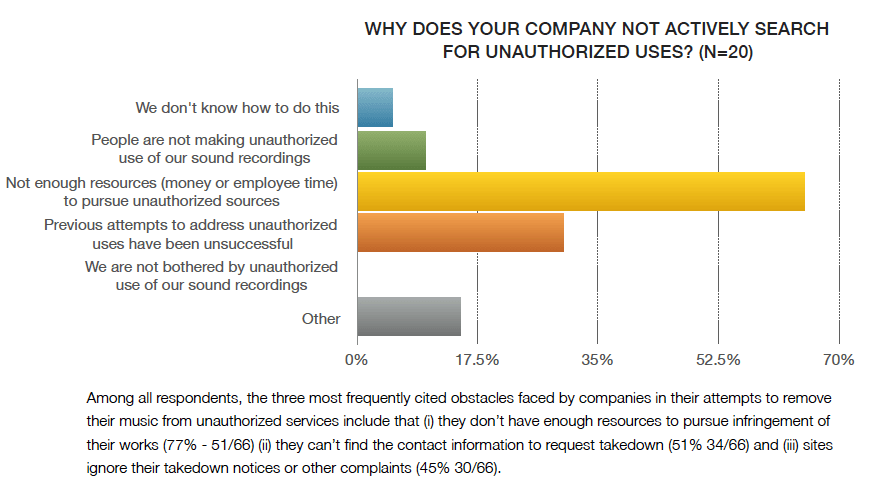
This is what an “opt-out” looks like. We have seen this movie before and we know how it ends–it’s called getting away with it. Let us be very clear with lawmakers: Notice and takedown and “opt out” is bullshit. It has never worked and has imposed a phenomenal cost on the artist community to the point that many if not most artists have just given up. The Future of Music Coalition and A2IM surveyed their members and determined that over half don’t even bother to look anymore because they can’t afford to run the search. The next largest group give up because they get no response from the notices.

Let’s understand–every time an artist gives up even looking for infringers, that’s a win for Big Tech. That’s why year after year, there are over a billion DMCA notices sent to a variety of infringers.

Ask yourself in all honesty, are you surprised? What head up the ass buffoon would ever think that an opt out would work? Unless the plan was to let Big Tech run wild and give both the biggest corporations in commercial history and the lawmakers a big fig leaf to cover up the theft?

That same approach is rearing its head again in both the US Congress and the UK. But this time it is being applied to artificial intelligence training and outputs. This is stark raving madness, drooling idiocy. At least with the DMCA an artist could look for an actual copy of their works that could be found by text-based search, audio fingerprints or just listening.

With AI, the whole point is to disguise the underlying work used to train the AI. The AI platform operator knows what works they used, which sites they scraped, or other ways to identify the infringed works. When sued, these operators have refused to disclose the training materials because they say that the sources of those materials are supposedly a trade secret and confidential.

Once a work is ingested into the AI, the output is also purposely distorted from the original. Again, impossible to conclusively identify. So what exactly are you opting out of? To whom do you send your little notice?

This entire opt-out idea is through the looking glass into the upside down world. Yet is is true.

The most current manifestation of this insanity is the UK government’s intention to pass legislation that would force artists to use an opt-out model, possibly on a work-by-work basis. And the worst part is that somehow they have been led to think that an opt-out is a protection for artists.

Orwellian.

Fortunately the UK government may seek public comment on this opt-out proposal. We will keep you posted on what the UK government actually proposes and how you can comment.

In the meantime, if you live in the UK, it’s not to early to contact your MP and ask them what the hell is going on. You may want to ask them why you can call the police when your car is being stolen but there’s nobody to call when your life’s work is being stolen. Particularly when the government protects the thieves.

The Madness of Amazon’s Song Royalty Refund Demand

You can check out any time you like, but you can never leave.
Hotel California, written by Don Felder, Glenn Frey and Don Henley

There’s no opt-out in either the Hotel California or the compulsory song license. And Amazon’s demand for a royalty refund from songwriters demonstrates once again the madness of the Copyright Royalty Board rate-setting procedures. Whether it creates enough ripples in the booming business around buying out songwriter royalties remains to be seen.

How did we get to this point in the circus act? You may have noticed that sliced bread is in close competition with fire and the wheel for second place behind Greatest Human Accomplishments. Both fire and the wheel are yielding to streaming mechanical royalty rates in the Phonorecords III remand negotiations.  Yes, the so-called “headline rates” in Phonorecords III (or “PR III”) are a Nobel-worthy accomplishment.  At least according to the press agents.

And yet something curious has happened.  I’m told that Amazon, through its agent Music Reports (MRI), has posted what is essentially a demand letter in the MRI user portal.  This demand letter instructs publishers who have directly licensed songs to Amazon to pay up because of an overpayment of streaming mechanicals due to the adjustment required by the new-ish Phonorecords III remand rates that finally set the streaming mechanical rates for the industry.  Something similar may be happening at the MLC; we’ll come to that below in just a bit.

In a testament to just how whack the Copyright Royalty Board system actually is, the PR III remand concerns royalties paid from 2018 through 2022.  That’s right—starting six years ago.  This is largely due to the failure of the publishers to obtain a waiver of the PR III decision as a negotiating chip when they gave away the rest of the farm in Title I of the Music Modernization Act (also hailed as a great gift to songwriters). But I’d say it is primarily due to the desire of digital music services like Amazon—including the largest corporations in commercial history—to crush the kitchen tables of songwriters.  Because judging by the massive overlawyering in the Copyright Royalty Board, that sure looks like the motive.

And when it comes to the services crushing the little people, money is no object, even if they spend more on litigation than the royalty increase cost them.  Evidently the sadistic psychic benefit greatly exceeds the cost.

But Amazon evidently has discovered that even after all the shenanigans with PR III, it appears that they paid too much and now they want it back.  That’s right—Amazon shamelessly wants you to cut them a check.  Because a market value over $2,000,000,000,000 is just not enough. I wonder which buffoon advised Mr. Bezos that was a good idea.

Here’s what it looks like on MRI:

A few questions come to mind.  First, realize what Amazon is saying.  They were evidently accounting to publishers at the rates for Phonorecords II during the several years that the PR III rates were on appeal and then re-litigated before the Copyright Royalty Board.  The final PR III rates (sometimes called “remand rates”) issued in August of last year (2023) were supposed to be an improvement over the PR II rates don’t you know.  At least according to the braying that accompanied the announcement.  In fact, the PR III remand rates where it all ended up were themselves supposed to be an improvement, meaning that publishers were to be paid more under PR III than under PR II. Maybe that’s the difference between an increase in the payable rates compared to an increase in the payable royalties.

So if that’s true, and if Amazon paid PR II rates during the lengthy PR III appeal, why is there now an overpayment by Amazon?  An overpayment that they now want you to pay back? Wouldn’t you expect to see the true-up on new rates result in publishers receiving a credit for increased rates?  Especially if the stream counts and subscriber totals stayed the same on these previously-issued accounting statements? (Not to mention this may be happening at other services, too.)

Some of these PR III statements pre-date and overlap with the MLC’s creation and the “license availability date” for the 2021 blanket license established under Title I of the MMA.  That means that if you or your publisher had a direct deal with Amazon during the PR III rate period, there may be overlapping periods when the MLC took over Amazon’s accountings.

It has long been the standard industry practice that overpayments are just debited to your royalty account.  Nobody asks you to cut a check. Debiting your account is not much better–you still have to pay them back, and the so-called “overpayment” will still potentially zero out your MLC accounts, too. If you did a royalty buyout that included an assumption that these royalties would be paid, your financier may come up short under either direct license or MLC.

This is particularly true for publishing administrators.  If a service were to debit an administrator’s account, that might result in the administrator having to go out of pocket in order to pay some of their publishers for the amount of the demand. If that overpayment is large enough, that administrator may owe royalties to publishers that did not have the benefit of the overpayment. This is pretty elementary math, 2 plus 2 being what it is. You don’t even have to carry the 1.

However, great news!  Amazon will give you an interest-free payday loan so you can pay down your new debt over six months. Or before they send it to collection.

Now the MLC—it’s entirely possible that Amazon is pulling the same stunt under the statutory license. However, it appears that MLC is doing what is normally done in these situations and will be debiting and crediting as necessary.  If you’re concerned, it would be worth checking and asking for an explanation from the MLC.

Even so, it does not change anything about why there is an overpayment in the first place.  If there were ever a situation that cried out for an intensive royalty compliance exam, this is it.  It is hard to believe that all this to-ing and fro-ing with your royalty payments across multiple rates in multiple accounting periods hasn’t resulted in mistakes.  No crime, it’s complex.  That’s why we have audits. At a minimum, Amazon needs to provide publishers with a detailed breakdown of how the repayment was determined along with an explanation of where the rates changed that caused the overpayment.

That’s why Amazon and any other similarly situated service should welcome an extensive audit.  In fact, the MLC should just include the true-up (or true-down in Amazon’s case) in their already-noticed audit of Amazon. This episode also raises the question of who else is going to pull the same stunt.

This slice of life demonstrates once again how unworkable the entire Copyright Royalty Board system is for streaming mechanical royalties. The services get to drag out appeals forever, and songwriters pay the consequences. But like the man said, you can never leave. And the Music Modernization Act just got every one locked in even deeper.

[A version of this post first appeared on MusicTechPolicy]

It’s the Stock, Stupid:  Will the Centrifugal Force of the Public Market Nix the TikTok Divestment?

It’s a damn good thing we never let another MTV build a business on our backs.

In case you were wondering, the founder of TikTok’s parent corporation Bytedance is now reportedly China’s richest man according to the Hurun Rich List at a net worth of US$49.3 billion.  Is that because of “profits”?  Ah, no.  It’s due to his share of the Bytedance stock valuation. This is why any royalty deal with Big Tech that is based solely on a percentage of revenue rather than a dollar rate based on total value is severely lacking.

Revenue is a factor in determining stock valuation, of course.  ByteDance’s first-half 2024 revenue increased to $73 billion, making Bytedance’s revenues almost as big as Facebook but potentially growing faster. (Meta/Facbook’s first half  revenue increased about 25% to $75.5 billion.)

But where does TikTok’s revenue come from? ByteDance’s international revenue reached $17 billion in the first half of 2024, largely driven by TikTok. Non-China revenues for ByteDance rose by nearly 60% during this period. ByteDance continues to leverage TikTok to expand into international e-commerce, sustaining its global popularity. So the company is throwing off a pile of cash–yet they are unable to come up with a functioning royalty system.

Then what would a Bytedance IPO price at?  We kind of have to guess because Bytedance is not publicly traded and doesn’t report its financials to the public (and even if they did, China-based companies got special beneficial treatment during the Obama Administration so PRC companies haven’t reported on the same basis as everyone else until recently).  Continuing the Meta/Facebook comparison, Meta has a market capitalization of $1.4 trillion give or take, while ByteDance’s valuation on the secondary market for private stocks is about $250 billion, according to a CapLight subscriber. 

That gap is not lost on our friends at mega-venture capital firm Sequoia China and other influential investors in Bytedance such as Susquehanna,  SoftBank, and  General Atlantic.  And, of course, the Chinese Communist Party investing through its Cyberspace Administration of China censorship operation. The CCP’s CAC owns elite “golden shares” in Bytedance that allows it to name directors to the board.  These cats did not put up cold hard cash for a distress asset sale of Bytedance’s principal operating unit aka TikTok.  

Assuming a constant growth rate, Bytedance is trading at a paltry 1.7 times its 2024 revenues compared to Meta which is trading at about 8.7x its revenues.  There are some differences between Meta and Bytedance, like operating profits:  Meta has a 38% operating margin compared to Bytedance at about 25%.  But we all know why Bytedance’s valuation is depressed—the TikTok divestment which seems to be on track to happen on or about January 19.

The Protecting Americans from Foreign Adversary Controlled Applications Act aka the TikTok Divestment Act, requires that Bytedance must sell TikTok.  There’s a pretty good argument that the divestment is enforceable for a variety of reasons.  The law applies not only to TikTok, but also to any entity controlled by China, Iran, North Korea or Russia that distributes an application in the United States.  That’s a pretty significant barrier to IPO riches, or at least one major risk factor that could sour underwriters if not investors.  How to get around it?

As we saw with the Music Modernization Act that solved Spotify’s IPO issues due to the company’s massive copyright infringement business model, if you spread enough cash around Capitol Hill, it’s astonishing what can happen with the vast number of people on the take.  Whatever it costs, lobbyists and lawmakers are cheap dates compared to IPO riches.  Even so, it doesn’t look like the US government is quite ready to allow one of the biggest foreign agent data harvesting and user profiling operations in history to get its snout in the public markets trough.  At least not yet.

But an argument could be made that Bytedance is missing about $1 trillion in market cap.  Greed and resentment are a powerful combination.  To add insult to injury, even Triller managed to get to the public markets, so things could start to get weird while Mr. Tok watches his paper billions evaporate on January 19.

[This post first appeared on MusicTech.Solutions]