Just Watch, “Shiv Act” Advisory Panel Will Be Stacked With Google Backed Organizations

Prediction: Public Interest groups that are “married” to Google’s views on copyright will be used to stack the Shiv Act advisory panel in favor of Google and broadcasters.  (Photo credit Cory Doctorow 2006 Creative Commons License Attribution-ShareAlike 2.0 Generic CC BY-SA 2.0) 

Sen Sensenbrenner (R-WI) has introduced an extremely regressive bill that would essentially eliminate songwriters right to take legal action against services that use their works without a license. In effect this rewards infringing services like Spotify and Google while punishing the victims (songwriters).  Read more here, here, here and here.

We just want to point out one more thing.  The bill sets up an “advisory panel” appointed by the highly problematic Google backed  Librarian of Congress.   There is a curious clause that states that”public interest” groups will be members of this advisory group.   The idea is that the panel is “balanced” by having technology companies, entities that represent songwriters and then groups that purport to represent the public.

The problem is, that everyone knows which kind of public interest groups will likely be picked. Our prediction is it will be EFF and Public Knowledge.  Both of these groups  have received significant funds from Google and methodically file amicus briefs in support of Google or Google’s legal positions, such as the EFF’s supporting Backpage in the well-known Jane Doe human trafficking of minors case. 

These two groups have essentially become a crucial part of Google’s legal and lobbying efforts. You could even say they are “married” to Google’s positions on copyright 🙂  The appointment of these public interest groups or similar groups will tilt the advisory panel n favor of tech and against songwriters.

RICO SUAVE: Does the Sensenbrenner Bill Mean It’s Time For A Grand Jury?


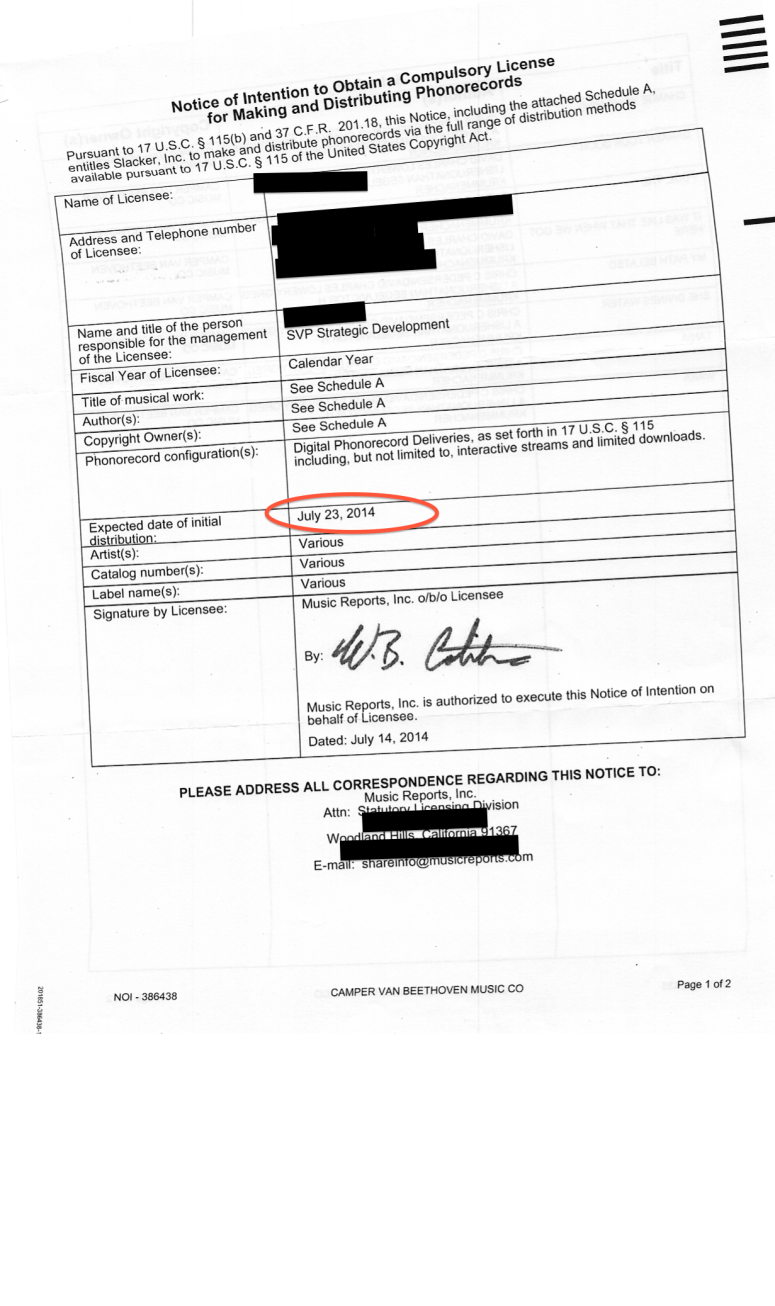
What appears to be a backdated NOI sent to the author. If this was intentionally backdated this is fraud. Note MRI is simply a third party that sent the notice on behalf of the service.  All legal responsibility rests with the service. 


Digital music services are trying to end songwriters ability to ever sue broadcasters and digital music services for copyright infringement with this bill.   In order to sue for copyright infringement you have to mount a case in a federal court.  Not your local district court.  This is extremely expensive.   I would estimate you need about $250,000 to effectively fight a case.   This bill takes away statutory penalties and legal fees, even when the songwriter prevails.  This makes it impossible for independent songwriters to exercise their legal rights. NAB Broadcasters and digital services like YouTube and Spotify can safely ignore songwriters, especially independent songwriters with no resources. Songwriters and publishers would have never been able to achieve the recent settlements against Spotify, without statutory penalties and legal fees.

So this may surprise you but I say “fine!” Take away our ability to mount copyright infringement lawsuits?  We still have plenty of other (sometimes much more severe) remedies available.  Most songwriters don’t really care about the money.  The royalties are pretty paltry to begin with.  This is really about the principle. This is about justice.

I’m no lawyer but the more I learn about the predicament of songwriters in the US, it feels like something more than just copyright infringement seems to be going on.  My layman’s reading of the situation makes me wonder if this isn’t exactly what the authors of the RICO laws had in mind. Imagine a digital music executive in the next season of Orange is the New Black!  Not saying that’s what is going on happen here.  Just saying something like that would restore creators faith in the fairness of the system.  And that kind of outcome in my mine really matches the severity of the problem.

Let me reiterate I am not an expert and I am not saying a criminal prosecution is really warranted but there are enough questions here that it seems like someone should at least look at it.  My knowledge is limited, but it looks like lots of wrongdoing spread across many interrelated businesses, advised by a small group of consultants and lawyers with conflicted interests.  Its very complicated.  But isn’t this the kind of complex situation that a Grand Jury is designed to investigate?

To be clear I’m not intending to mount a case myself,  I’m just saying going forward rights holders should consult someone more knowledgable than myself and then consider whether conspiracy, fraud or other complaints are more applicable.  Especially those songwriters that suspect they have received backdated or somehow falsified “notices of intent” from digital services or others. Backdated notices are key cause they clearly don’t pass the smell test. There is no honest reason to do that.  Even without “smoking gun” evidence songwriters should not be shy about complaining to federal and state authorities that “something just doesn’t seem right.”  And really what’s the harm in looking?  Similarly lawyers and accountants who are involved (or have been involved) with this licensing mess, should perform a gut check: Is what I’m doing (I did) legal?  What are the consequences for my career? Am I following the ethical guidelines of the organization that licenses my profession?

LETS REVIEW:

Here are some definitions from an online dictionary.  I am not a legal expert. I am using these terms as a layman. These definitions seem to match my understanding of the words “conspiracy,” “collusion,” “fraud,” “mail fraud,” “accounting fraud”  and “false advertising.” There are probably legal interpretations that may be different and vary from one jurisdiction to another. 

Streaming services and broadcasters have a problem.  It’s a problem they created.  They failed to take the basic steps to secure licenses for millions of songwriters.  And then willfully used the songs anyway.  Once class action lawsuits were launched some of the parties involved took actions that suggest collusion and cover up.  The evidence to support these statements is all publicly accessible on the web. Lets go through it.

+++++++++++++++++

First check this page on the US Copyright Office website.  Digital services have filed 45 million “address unknown” notices in the last 15 months. This means for these recordings they don’t know who owns the rights to the songs.  If they don’t know who owns the songs, they haven’t cleared licenses and paid royalties.  In order for this copyright infringement dodge to maybe  (just maybe) work the services would also have to file yearly “certified statements of account” with someone.  Who?  The address unknown loophole doesn’t appear to have been intended for anything but a temporary reprieve.  A year has passed since the first of the  “address unknown” NOIs were filed.

Mass copyright infringement?

Can you imagine if  any other business had 45 million unlicensed anything?  And they told the federal government about it?  Wouldn’t someone investigate?

+++++++++++++++++

As we demonstrated in an earlier post many of the songs which are listed as “address unknown” are pretty well known songs.  The services thus appear to fail any sort of good faith test.  Should services be filing millions of notices with the federal government claiming they can’t find a copyright holder, when they clearly have not conducted a proper search?

Misrepresentation?

 If there is a lawsuit in the works maybe Bad Faith?

Are these things filed under oath or with some promise of accuracy? Not a rhetorical question, I don’t actually know.

Perjury?

Can you imagine if oil companies didn’t bother to check and filed 45 million inaccurate notices with a regulatory agency? There would be howls of outrage.  Wouldn’t someone investigate?

+++++++++++++++

Almost all services are filing these notices.  This was an obscure rarely invoked procedure until last year.  The entire decade 2006-2016 there were less than 6000 such notices filed.   Suddenly in the Spring of 2015 nearly all services, notably Google, Amazon, Spotify and Pandora started filing millions of notices.

Appearance of collusion, conspiracy or coordination?  

Can you imagine if Verizon, AT&T, Sprint and T-Mobile all simultaneously  arrived at a very novel interpretation of a FCC rule and began exploiting it in order to avoid paying suppliers? Wouldn’t this raise eyebrows? Wouldn’t someone investigate?

+++++++++++++++

All these services at various times have explicitly or implicitly claimed their catalogues were fully licensed.

Misrepresentation?  False advertising?

Imagine if a large grocery chain purported to sell only organic chicken.   But then it turned out that 45 million of those chickens were not organic?  Wouldn’t someone investigate?

++++++++++++++

Various streaming services have admitted that they have a problem with unlicensed songs.  Here is a quote from Billboard magazine:

“Unfortunately, especially in the United States, the data necessary to confirm the appropriate rightsholders is often missing, wrong, or incomplete. When rightsholders are not immediately clear, we set aside the royalties we owe until we are able to confirm their identities.”  Spotify spokesperson Billboard 2015

Willful mass copyright infringement? 

Can you imagine if several of the largest insurance companies admitted publicly they were not complying with the law.  Wouldn’t someone investigate?

+++++++++++++++++++

Some streaming services have loudly proclaimed the problem is the fault of songwriters or record labels.  This is untrue and the services know this is untrue. The problem started when streaming services started “ingesting” recordings. They often didn’t include a field to collect songwriter/publisher information, despite the fact the law is very clear that streaming services are responsible for notifying songwriters and paying royalties.  This sure walks and talks like a “lie.” Whether by design or error these sorts of statements have likely misled the public and investors.

Negligence?
Failure of fiduciary responsibility to shareholders?

Can you imagine if a large publicly traded company claimed that they couldn’t pay suppliers because the suppliers didn’t supply billing information?  But it turned out the company didn’t ask for billing information and provided no way for suppliers to submit billing information.  And it wasn’t the suppliers responsibility anyway to provide the information. Wouldn’t this firm be guilty of misleading public and investors?  Wouldn’t someone investigate?

+++++++++++++

Then when the lawsuits hit, many services began sending to songwriters what would appear to be fraudulent “notices of intent.”  See example above.  I have dozens of these from dozens  of companies. I can’t imagine I am the only songwriter to receive such notices.  These were sent to me via the US Mail.  These notices seem designed to trick me into believing that I no longer have the right to make a potentially much more valuable direct license with the streaming service since the window on the compulsory license has passed.

Mail/Wire Fraud?

Can you imagine if lawyers from a large record label sent out letters to songwriters which misled them into thinking they had licensed their song to that record label?   Wouldn’t someone investigate? (Ed note: Surely Spitzer would have investigated. Schneiderman?)

+++++++++++++++++++++++
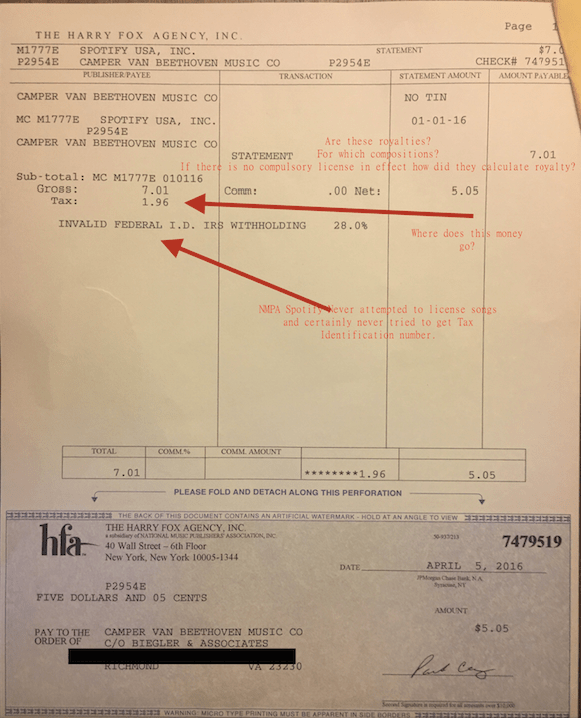
What about the accountants that prepared royalty statements and checks sent to me.  If I have no license how did they come up with a royalty rate with which to prepare these statements?  They know they don’t meet the conditions for the compulsory license?  So someone knows there is no royalty rate from which to compute this check, yet send it anyway?  How is this not an effort to mislead me, and trick me into thinking they have a valid license? Or tricking one of my employees into depositing the check so they could argue an “implicit license.”  This smells to high heaven.

Mail Fraud?

Accounting Fraud? 

Remember what happened to Arthur Andersen?  Enron’s accounting firm?  It went bankrupt and and many people lost their licenses. Didn’t someone investigate that? Isn’t that how that happened?

+++++++++++++++++++++++++++++++++++++

Why did more than one firm engage in this exact same practice?  It is a very odd and risky strategy.  How did two companies separately come to the conclusion that this was the best course to take?

Conspiracy? Collusion? 

Since it is more than one firm attempting to mislead songwriters, isn’t this more like the tobacco lawsuits?   Why wouldn’t someone investigate this for the same reasons.

++++++++++++++++++++++++++++


This check was received during the time the class action lawsuit against Spotify was active.  Despite being told to communicate with my attorney. They sent these notices directly to me.  How many class members received similar checks during this time?

Improper communication with plaintiff and class members?

Suppose there was a class action directed at a large pharmaceutical company like Pfizer for overcharging customers. Can you imagine what would happen if Pfizer had started sending refund checks directly to plaintiffs and potential class members?  Surely someone would investigate this.

+++++++++++++++++++++++

Finally lets go back to the public accounting firms that certify the royalty statements and financials of the streaming services. How can they possibly claim to have fulfilled there legal obligation by certifying streaming statements from companies that lacked a significant number of valid licenses.   Surely these public accounting firms were aware that the services had large numbers of unlicensed tracks.  The key point here is if a track is unlicensed there is no agreement as to what the royalty rate should be.   Since songwriter royalties are a pro-rata from a pool of revenue, this calculation is based on the false assumptions that the unlicensed tracks receive the same rate that the licensed tracks receive. The statements are ALL incorrectly calculated. Further, did these firms disclose to the investors the extent of the infringement liabilities?   Clearly the services know exactly how many tracks are unlicensed.  Did the accountants?  Did the shareholders?

Accounting fraud? 

Again look at Enron.  Someone investigated that.

+++++++++++++

While this may all just be smoke and no fire,  federal, state and local authorities have investigated suspicious situations with a lot less compelling



Sensenbrenner’s Extreme Moral Hazard: Bill rewards infringers and punishes songwriter victims

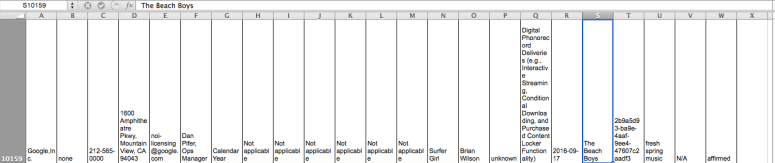
The company that claims to organize the worlds information, could not figure out how locate a songwriter named Brian Wilson, he wrote a little song called “Surfer Girl.”   They filed an “address unknown” notice with the US Copyright Office.  Wtf?

Sen. Sensenbrenner has introduced a bill called “The Transparency in Licensing Act.”  We songwriters call it “The Shiv Act.” It’s pure doublespeak. It has nothing to do with “transparency.”  It is clearly designed to stab songwriters in the back while greatly benefitting the largest members of the Mic-Coalition.org. Read more here, here and here.

In case you are not familiar, the Mic-Coalition is an astroturf group made up of mostly tech behemoths and broadcasters.  At last count these companies’ combined market share exceeded 1.5 trillion dollars. The bill purports to support small businesses like the independent brewers represented by The Brewers Alliance, but it does not.  In fact my unscientific sampling of independent brewers seems to indicate 1) Independent Brewers didn’t know they were supporting this bill, 2) are unaware they were even part of the alliance 3)didn’t know they had urgent music licensing concerns requiring legislative fix. (Maybe the DC policy rep for Brewers Association should explain rationale to members?).

This bill seems to have been designed by the Very Large Business Administration (as opposed to the Small Business Administration). The bill is a complete giveaway to the likes of  Google, and ClearChannel. So just normal pay to play government legislation, right? Nothing to see here people, move along.

No, it’s a little uglier than usual.  The problem is that many of these Mic Coalition companies (along with Amazon) are blatantly flouting the law by using songwriters’ work without proper licenses or paying royalties.  That’s why I call this bill an extreme moral hazard, because it rewards the mass infringers with new protections while stripping the victims (songwriters) of ability to take legal action.

And it’s not a matter of these companies accidentally using a few unlicensed works here and there; or a few dozen songwriters are going unpaid. Between Amazon, Google, Spotify and Pandora, these companies openly admit they are using millions of songs without any idea who to pay (which clearly implies they don’t have licenses). How do we know this?  Well, quite helpfully these Mic Coalition companies along with Amazon have filed over 45 million “address unknown” notifications with the US Copyright Office since March 2016.  Presumably this little maneuver was used to buy a little time while they came up with this bill.  These notices are hiding in plain sight on the US Copyright office website:

https://www.copyright.gov/licensing/115/noi-submissions.html

(These zipped NOI files have up to a hundred thousand songs each)

Open up one of the zipped files and it’s apparent these services are not even bothering to cary out a proper search for the songwriters.  Look at the screenshot above.  It didn’t take but two minutes to find the first outrage.  Google couldn’t locate a guy named “Brian Wilson” who wrote a little song called “Surfer Girl.”  Has anyone in Sensenbrenner’s office bothered to look at these NOIs to see if these services are even trying?

No?  Didn’t think so.

These services have had more than a year and a half since the first class action lawsuits were filed against them to get their shit together.   But instead of actually coming up with a system to identify unlicensed works, or to engage a responsible third party that can do the work, they apparently spent their time and energy coming up with a bill to  make their legal liabilities go away.

Why innovate when you can pay-to-play legislate?  Silicon Valley is so full of shit when it comes to “innovation.”  Sometimes I wonder if we songwriters have been doing this all wrong.  Instead of spending hours writing, collaborating and innovating new songs, maybe we should just get a federal lobbyist and  some Senator to mandate us a living?  Why should anyone work hard and play by the rules if being lazy and cheating pays better?

Here’s a better idea: Washington DC should do nothing. Stay out of the way and let the matter sort itself out.  Interfering in this manner is hindering the development of effective licensing mechanisms. As long as the feds keep trying to bail these services out they won’t get their shit together.  As Madison presciently  noted in The Federalist Papers No. 44

“[Government] interference is but the first link of a long chain of repetitions, every subsequent interference being naturally produced by the effects of the preceding.”

Sadly, this bill is crony capitalism at it’s finest.  This bill will reward the digital services that have infringed on millions of works, and punish the songwriters, the victims.


The Shiv Act: Imagine the Federal Government Forced You To Airbnb Your House Because Your Neighbor Did

So if  digital music service or broadcaster  has a license with some random third party they get to limit my rights?   How is this even constitutional?

The recently proposed “Transparency in Music Licensing and Ownership Act” (Sensenbrenner R-WI)  or as we prefer “The Shiv Act” looks to me like an unconstitutional “taking” under the fifth amendment. I am not a lawyer, but I don’t see how the letter and spirit of the law are not violated.  Of all the problems with this bill, this one is the most egregious.   Whether it is poorly written or intentionally designed this way is irrelevant.  The bill has nothing to do with “transparency” as we explained earlier this week.   The bill is simply a series of conditions (impossible to fulfill) that would take away a songwriters rights to receive statutory penalties and legal fees when a service fails to license and pay royalties. The only recourse songwriters have to mass infringement from digital services  is to sue the service in  Federal Court.  My experience suggests it’s a minimum of $250,000 to mount such a case.  Without legal fees and statutory penalties as currently required under the copyright act, services will simply use songwriters songs without license and payment.  There will be no effective recourse for songwriters.

The way in which this bill achieves this result is highly questionable.  First the bill forces songwriters to submit specific information to a mandatory federal database that songwriters cannot know in advance.  If the songwriter fails to do this, the songwriter loses their rights.  This is the Catch-22 flaw.   The second flaw is what I call the “Mandatory Airbnb” loophole.

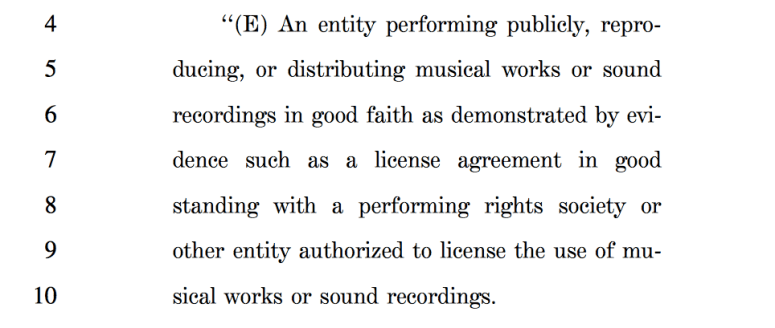
The paragraph in the screenshot above is a paragraph of the bill.  It is a “sufficient” condition that activates the previous limitation on songwriters rights.  In layman’s terms this paragraph says, if a service has one license with ANY composition or recording owner, then all other songwriters are bound by this third party contract.  Whether a songwriter has a contract or license with the service or not they can never sue for damages or receive legal fees.  Even if the songwriter wins.  Further the royalty rate the third party has agreed to is now your royalty rate.  How is this even constitutional?

So let’s put it in terms of Airbnb.  Suppose your neighbor rents their house under a contract with Airbnb. Then one day Airbnb negligently (or willfully) rents out your house.  You have no contract with Airbnb.  This is a clear violation of your exclusive property rights so you sue Airbnb.   If the rules of this bill were applied to the house rental market, you would not be entitled to penalties or legal fees,  instead Airbnb would simply have to pay you the nightly rate your neighbor received, that’s it. In effect the government is taking your property and making it part of the Airbnb service to rent out under the terms of your neighbor’s contract.  This takes away a valuable right of millions of property owners to write their own contracts to rent their houses.

And what if the homeowner already has an exclusive contract with someone other than AirBnB?  Suppose that you have a contract with GMR Vacation House Rentals (a fictional company).   GMRVHR rents your home for a significantly higher amount than the maximum Airbnb is required to pay under this law.   But because Airbnb keeps renting out your house and you have no effective recourse to stop them, the government is effectively “taking” the difference between the two rates without compensation or due process.  Further the government is making a previous legal contract between GMRVHR and you invalid without compensation or due process.

I could go with example after example but I think most readers will grasp the insanity of the bill from this.  The whole thing is particularly unbelievable when you consider that it is a mass transfer of wealth from rank and file songwriters, to Google, Amazon, Apple, Spotify, Clear Channel and the Silicon Valley and Wall Street billionaires that back these companies.

Pale Ail: Why Are Micro Breweries Supporting Bill That Takes Away Songwriter Rights @PoliticsBrewing

Pale Ail:  Boulder Colorado based Brewers Association supports a regressive bill that strips songwriters of key legal rights. This is the second time they’ve been involved in anti-songwriter federal regulation that doesn’t clearly benefit independent brewers.  So what is really going on?

This is stunning.  The Brewers Association which represents thousands of independent breweries is supporting the Shiv Act,  or as it is formally known “Transparency in Music Licensing and Ownership Act” (Sensenbrenner R-WI). As we have detailed previously, the bill really has nothing to do with transparency in music licensing.

The bill  forces songwriters to participate in a mandatory federal database, in order to retain their full legal rights. Let’s forgo the constitutionality of this for a moment.  The immediate problem is the database requires songwriters to provide information in advance for which they have no access. Failing to provide this data strips songwriters permanently of legal protections for those songs. It’s a complete Catch-22.  It’s clear the database is a poison pill, really intended as an insurmountable barrier that separates songwriters from their legal rights.   Actually quite an appalling tactic if you think about it. The federal government is forcing us to dig our own graves.    Read the details here.

https://thetrichordist.com/2017/07/30/heres-how-you-know-mic-coalition-shiv-act-is-about-screwing-songwriters-not-transparency/

To understand where we are coming from, independent brewers should imagine for a moment that the Federal Government has created a mandatory database for micro brew brand trademarks, but the information required is impossible to provide, and as a result the feds takes away your legal rights to enforce you trademark. That’s what the Brewers Association is helping do to us.

But there is also something more puzzling. I’ve read the bill at least a dozen times and I don’t really see how this bill helps microbreweries with music licensing.  I see plenty that helps the NAB, ClearChannel, YouTube, Spotify, Amazon etc but nothing that helps independent brewers.   In fact this bill combined with the last years “100% licensing” scheme (also endorsed by the Brewers Association) will result in a more fragmented landscape for music licensing. This will hurt micro brewers more than help them.  Think it’s a pain in the ass dealing with BMI/ASCAP/SESAC?  Imagine if the licensing landscape required dealing with thousands of individual songwriters, publishers, record labels and independent licensing administrators.  This sort of complexity favors big companies over little ones.

If songwriters are the rank and file workers of the music business, this is simply an attack on the most beaten down and abused workers in the entire entertainment industry. You’ve seen headlines like this right?  It looks like the Brewers Association instead of fighting for independent brewers, has decided to join Google, YouTube, NAB and Spotify in kicking an injured dog.  This is not a good look.

In some ways independent brewers and independent songwriters/musicians have a lot in common.  We are both in businesses that are highly regulated and dominated by large monopolistic distributors.  Did you know that aside from movie,tv and commercial “synch” licensing, every other royalty rate is set by federal regulations? The federal government controls more than 2/3 of our licensing and there are basically three multinational conglomerates that distribute almost all music?  Sound familiar to you?

So why are you folks fighting us?

@musictechsolve: Don’t Believe the Astroturf: Yet More Regulations Won’t Help Songwriters or Small Business

Here’s a deep dive on the so-called Transparency in Music Licensing and Ownership Act. As we have detailed the last two days, the “transparency” and “small business” aspects are a smoke screen to hide the abolishment of certain long held rights by songwriters,  in order to favor large digital and broadcasting monopolies. Think about it. In this day and age the government (a Republican no less) is intervening in the marketplace to help some of the largest companies on the planet.

Artist Rights Watch--News for the Artist Rights Advocacy Community

By Chris Castle

“[Government] interference is but the first link of a long chain of repetitions, every subsequent interference being naturally produced by the effects of the preceding.”

James Madison, The Federalist Papers No. 44

There is a bill in Congress backed by the mega lobbying juggernaut called the MIC Coalition that would force songwriters and artists to “register” with the government in order to protect their rights from the biggest corporations in the world.  Failing to do so would take away the stick of statutory damages and an award of attorneys fees to songwriters or artists who are victorious in copyright infringement litigation.  Statutory damages and attorneys’ fees are the only real protection that the government gives these creators–the smallest of small businesses.

Why?  Because the government does virtually nothing to protect the rights of artists.  If it weren’t for statutory damages and attorneys’ fees there would be nothing…

View original post 1,398 more words

Here’s How You Know Mic-Coalition “Shiv Act” Is About Screwing Songwriters Not Transparency


Yesterday we detailed one of the main problems with the so-called “Transparency in Music Licensing and Ownership Act” or as Artist Rights Watch termed it “The Shiv Act.”   The bill would take away from songwriters legal remedies like attorney’s fees and  statutory damages.  Thus making it virtually impossible for individual songwriters and small publishers to  sue websites and digital services that use their works without licenses.   This bill is Robin Hood in reverse.

Today we look at why the whole call for transparency is utter bullshit.

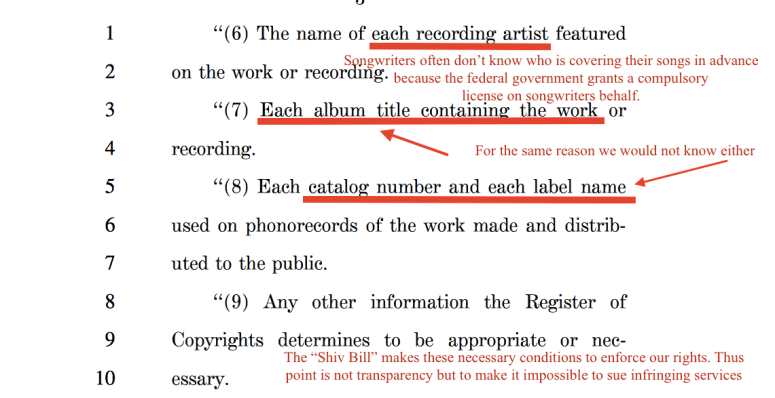
The proposed “transparent” database is really just a new impossible-to-mount  bureaucratic hurdle to prevent songwriters from ever exercising their rights.  Transparency is not the point.  It requires songwriters to provide information on cover tracks recorded by other performers the moment these covers are released to the public, or otherwise they lose rights.

The problem is federal compulsory licenses grant streaming services and cover artists’ automatic licenses.  Songwriters almost never know these recordings exist until long after they are released.    THIS IS THEREFORE AN IMPOSSIBLE TASK! See screenshots above.

But here is where the bill is particular cruel.  If a songwriter does not report information on a single cover, the way the bill is written, the songwriter then loses their rights for EVERY recording.  I don’t think this is an accident.  This actually creates a mechanism for depriving every songwriter of legal fees and statutory damages, on every song ever written.  Just record a song and upload it to a streaming service.  This is the ultimate poison pill for songwriters’ rights.

Technically digital services are supposed to send a “notice of intent” to songwriters to let them know that their songs are being used.  But the terrible new Librarian of Congress has also been allowing digital services to exploit a loophole that allows Amazon, Google, Spotify and others to file an “address unknown” notice with the copyright office.  These notices are then “published” by uploading (sometimes enormous) zip files with hundreds of thousands of sound recordings. Further although these files appear to be “zipx” files they aren’t your normal run of the mill zipx files as they seem to require a sophisticated decompression program in order to read them.  If the purpose is to serve notice to the public that compulsory licenses have been granted, this is a complete failure.
Further in the previous decade 2006-2016 less than 6,000 of these notices were ever filed.  Since March of 2016 digital services have filed over 45 million of these notices.  Many of these notices are for easily recognized songs written and performed by artists like The Beach Boys and Sting.  A simple search of the web provides proper contact information.  PaperChain.io  an Australian company estimates that as a result of these sorts shenanigans there are over $2.5 billion in unpaid royalties world wide.

Billion.

Irrelevant to this post, but where is that investigation?

Maybe it is time to dust off those old “private attorneys general” statutes. L

You Think it’s Bad For Songwriters Now? Wait Until the Sensenbrenner (R-WI) “Shiv Bill” Passes!

Sen Jim Sensenbrenner (R-WI), longtime antagonist of songwriters,  has just introduced a bill he calls he calls “The Transparency in Music Licensing and Ownership Act.”  Complete doublespeak. While yes, there is something in the bill about empowering a panel, to study the potential for building a database of songs and owners, to one day maybe assist in licensing song,  lets be absolutely clear that’s not what this bill is about.  Look at the details.  It’s plain as day. This bill is an attempt to take away the only thing that guarantees songwriters eventually get paid: The threat of a lawsuit. Most copyright infringement cases are heard in federal court.  In my experience you need a minimum of a quarter of million dollars to mount a case against an infringing corporate entity.   This section of the bill eliminates the legal fees and statutory damages.  Even if songwriters prevail in the case.   While major publishers may still be able to afford to litigate theses cases under these onerous circumstances , (and for complex reasons that’s a big maybe) individual songwriters and small music publishers will never be able to afford to sue again.

You don’t have to be an expert in game theory to see where this ends up.  This bill makes it cost effective for services to infringe songwriters copyrights on a mass scale. Something they are already doing!  Niche and indie songwriters will be particularly hard hit.  This bill will increase the number of unlicensed tracks and increase the size of the “black box” pools of unpaid royalties.  This is less transparency not more.   Thus it is truly doublespeak.

(You also have to wonder that since this bill is pushed by an alliance of companies with significant infringement problems that it isn’t effectively a conspiracy to cover up past illegal activities.)

There is already ample evidence that digital services like Google, Amazon, Pandora and Spotify have given up trying to license songs and account to millions of songwriters.  In the last 15 months these services have filed mass songwriter “address unknown NOIs” with the copyright office, representing over 45 million recordings. Some of these obscure recordings and “unknown songwriters” include Sting and The Beach Boys.

Make no mistake, this bill ensures that many many songwriters will never receive their royalties, providing an enormous subsidy to Google, Amazon, Spotify, etc.    This has nothing to do with transparency in licensing. This is just more tricky lawyering from Google and their fellow travelers.

(BTW we predicted that something like this bill was coming months ago.  Why is it that what is essentially the Scooby Doo gang doing the heavy lifting for the entire music industry?”)

@repjerrynadler: Reps. Nadler, @DarrellIssa Pre-1972 Copyright Fix with Introduction of CLASSICS Act

Breaking! Congressmen Nadler and Issa introduce bill to fix loophole on pre-1972 recordings. Legacy artists will finally get digital royalties. Also Pandora has lent their support to the bill. Thanks to all who worked so hard on this but especially Blake Morgan!

Artist Rights Watch--News for the Artist Rights Advocacy Community

[PRESS RELEASE]

WASHINGTON, D.C. — Today, Ranking Member Jerrold Nadler (D-NY) and Chairman Darrell Issa (R-CA) of the House Judiciary Subcommittee for Courts, Intellectual Property and the Internet introduced bipartisan legislation to close a long-standing gap in federal copyright law. The Compensating Legacy Artists for their Songs, Service, and Important Contributions to Society Act (the CLASSICS Act), H.R. 3301, resolves uncertainty over the copyright protections afforded to sound recordings made before 1972 by bringing these recordings into the federal copyright system and ensuring that digital transmissions of both pre- and post-1972 recordings are treated uniformly.

The CLASSICS Act serves as an update to the “pre-72 treatment” of the Fair Play Fair Pay Act – a broader music licensing bill introduced by Chairman Issa and Ranking Member Nadler earlier this Congress – and represents a broad consensus from a variety of stakeholders across the music landscape.

Congressman Jerrold Nadler: “For…

View original post 1,150 more words

Is The Spotify “Fake Song” Scandal Really About Lowering Songwriter Royalties Across the Board?

The Spotify “fake artist” scandal that broke last week has been a real head scratcher.   Did they really save that much money?  I mean they paid billions out to rights holders,  but NYTimes puts the “savings” on fake songs at $3 million dollars?  Was it worth it? Especially considering the public relations damage it does to the brand.

Certainly the most likely explanation is that this is just a bonehead move, a crony favor for a fellow Swedish music tech company that appears to represent most of these songs.

But we should consider two alternate theories:

The lower songwriter royalties paid on these tracks may end up as evidence of “free market” rates before the Copyright Royalty Board that sets rates for songwriters. Yes,songwriter royalty rates in US are not just set, they are capped by the US government!  The CRB is bound to consider free market rates.  If they consider these rigged rates as free market ALL songwriters would get lower royalties.   While this may seem like a “bankshot” this exact scenario has played out twice before.  The most recent was when the indie label licensing group Merlin, cut a deal with non-interactive streamers. This deal guaranteed a lower rate for more spins for Merlin licensed tracks.  A kind of reverse payola.  This effectively lowered the per spin rate,  non-interactive broadcasters then took this deal to the CRB  as evidence and the CRB used it to lower rates.   This likely cost rights holders: $1 billion dollars in lost royalties.

This could be used in exactly the same way.

The second theory is a little harder to explain, but basically songwriter spin rates, vary from month to month.  They are capped by the federal government at 10.5% of streaming service revenue.   And the formula per spin is simply 10.5% of rev divided by the total number of spins, pro-rated based on popularity of a song.   So if you somehow increase the number of spins using “fake” tracks wouldn’t you reduce royalties across the board by a small but significant amount?