Songwriter/Artist Advocates Reelected to Board Of UK PPL, Turn Back MMF Power Grab

I just realized that we left this story hanging. We are always so busy between Thanksgiving and Dec 28th. Excuse our tardiness.

Crispin Hunt and Mark Kelly beat out Jon Webster a former label exec and president of the UK Music Managers Forum (MMF) for the two performer director positions on the UK public performance licensing authority PPL.  This is very good news.   Crispin Hunt and Mark Kelly have always been  strong advocates for artists and songwriters rights.   Jon Webster and his UK MMF?  Not so much.  In general we thought the whole effort to replace  bona fide songwriter/performers with a manager/label executive from the MMF was just a little to “old boss.”   Smacked a little too much of the old  “don’t worry we really do have your best interests at heart.”    Cause managers and executives never rip off artists right?  I mean it’s usually the other way around? That’s why there are so many music movies where it turns out that the artist has been cheating the manager out of commissions for years!

Congratulations Crispin and Mark!  Forward into 2016!

The Mother of All “Friday News Dumps” Spotify Admits it has an Unpaid Royalty Problem


Donna: What’s take out the trash day?
Josh: Friday.
Donna: I mean, what is it?
Josh: Any stories we have to give the press that we’re not wild about, we give all in a lump on Friday.


From West Wing episode “Take out the Trash Day.” 

According to Taegan Goddard’s Political Dictionary a “Friday News Dump” is the practice of  “releasing bad news or documents on a Friday afternoon in an attempt to avoid media scrutiny.”  And this is exactly what we are seeing from Spotify this week.   Last night Ed Christman reported in Billboard that Spotify has announced plans to develop a database to “properly manage royalties.”   Properly?  Uh oh!   Technically Billboards editors are going a little soft on Spotify here as the real problem is that Spotify apparently never licensed many of the songs in their catalogue in the first place.  Which implies copyright infringement on a massive scale.

But wait this is not Friday?  Exactly but the week before Christmas is a week of Fridays. And the evening of the 23rd is the mother of all Fridays.  It’s the last day you can get anyone to report on a news story before the holidays. And you get 7-10 days of Saturdays for the story to dissipate.

Got to hand it to Spotify’s new global head of communications & public policy Jonathan Prince.  He is really bringing skills mastered during his time in the Obama/Clinton administrations  to bear on the problem.   This news release wasn’t just a Friday news dump it appears timed with the announcement of a Obama/Biden Spotify playlist (announced on the official White House website, a taxpayer funded government website I might add).  Given that Spotify appears to be illegally hosting a significant amount of unlicensed songs wouldn’t this be the equivalent of  George W appearing on the Enron Christmas card after they admitted to fraud?

Merry Christmas Silicon Valley Billionaires!  And fuck you artists.  – Your friends at Spotify (and The White House.)


Jury Rules For BMG on Cox Media P2P Piracy

Details are still slim, but it looks like a victory for artists and rightsholders.  Court agrees ISPs are supposed to have real policy for disconnecting repeat infringers.  Cox basically had a “fake” cutoff  policy and lost DMCA protections. Fox is now liable for user’s infringement.

Law360, Washington (December 17, 2015, 12:38 PM ET) — Internet service provider Cox Communications must pay music publisher BMG Rights Management $25 million for turning a blind eye to illegal music downloads by its subscribers, a Virginia federal jury found in a verdict Thursday, holding the ISP guilty of willful contributory copyright infringement.

http://www.law360.com/topnews/articles/739353/breaking-cox-must-pay-bmg-25m-for-user-piracy-jury-finds

David Lowery “Whiteboard” Comments on DOJ 100% PRO Licensing Proposal

November 18, 2015

David C. Kully
Chief, Litigation III Section
Antitrust Division
U.S. Department of Justice
450 5th Street NW, Suite 4000
Washington, DC 20001

Re: Comments on PRO Licensing of Jointly Owned Works

Dear Mr. Kully:

I am a founder and principal songwriter of the bands Cracker and Camper van Beethoven. I appreciate the opportunity to participate in the public comments on modifications to the ASCAP and BMI consent decree regarding jointly owned works.

I have worked in the music business over 30 years. Both my bands are still together. We release records regularly and tour the world. During this time I have been signed as a songwriter to major publishing deals, self-administer and everything in between. I also write The Trichordist blog on artist rights and am in touch with many other songwriters in the U.S. and elsewhere.

In writing this letter it is not my intent to address this issue in dry legal terms or to get “down into the weeds” on the consent decrees. Firstly and foremost I am not an attorney and I am certainly not an expert in antitrust laws. But secondly I think it is important that we discuss the issues surrounding the PRO consent decrees at a macro level and in terms that the public and songwriters will understand. The lawyers that work for companies like Google, Apple, IHeart Media, ASCAP and Warner Music Group should not be the only audience for these discussions. Hence I have adopted an unorthodox narrative to illuminate my thoughts on the matter. I intend no disrespect to your office, I simply believe that songwriters and the public need to clearly understand what is at stake.

My understanding of the question is this:

Should the consent decree be modified so that ASCAP or BMI (that SESAC or the new Kobalt-Google Ventures owned AMRA surely will follow) can license 100% of a song even if their affiliated songwriter only owns say 5% of that song?

My smart aleck answer is an emphatic “yes!” The ensuing chaos of unintended consequences from 100% licensing will reduce any lingering rationale for the consent decrees to a Kafka-esque absurdity. It will make the licensing system less efficient and more complex. It will undermine the PRO system–one of the few organizations that actually work to make licensing more efficient.  It will further favor enormous broadcasting (iHeart Media), webcasting (Pandora) and streaming concerns (YouTube and Spotify) that already have dominant market shares.

It seems to me that 100% licensing will unlawfully take private property rights by overturning private contracts (co-administration agreements) between songwriters. It will inhibit freedom of expression by making songwriters think twice about collaborating with songwriters from a different PRO. It seems to me it will violate the Department of Justice’s own guidelines and antitrust mandate. And finally it will effectively take away the rights of songwriters who are not members of ASCAP or BMI and who never agreed to be subject to consent decrees.

The last seems extraordinarily important (at least to this non-lawyer) as the affected songwriters have not agreed to have their rights limited; admitted to any wrong doing; and received no due process or just compensation for the rights the government would be taking away.

Nor has the legislative branch passed a law that would limit songwriters’ rights to be taken away as the DOJ proposes. At least legislation would have some imprimatur of legitimacy from the consent of the governed. In my high school history classes I seem to remember that an important advance in western civil society was the elimination of “writs of attainder” that were used by kings to punish individuals without trial. Doesn’t the DOJ’s proposed modifications sound similar?

The Department of Justice is attempting to change the rules of the road to something manufactured out of thin air and then pretend those new rules were there all along.  Songwriters must ask why?

So again my smart aleck answer is “Yes, go ahead and add 100% licensing to the already unworkable consent decrees, because surely there is some clever constitutional lawyer out there who will now obliterate these decrees that have gone way beyond their intended purpose—and are bald faced takings without just compensation prohibited by the 5th Amendment.”

++++++++++++++++++++++++++++++++++++++++++++

But I understand that my answer while satisfying and darkly amusing to my fellow songwriters and me probably is not amusing to those of you that work at the DOJ. I imagine that most of you went to work for the DOJ because you believed in the system and wanted to see our nations laws applied fairly. You did not go to law school to navigate technicalities, conjure up impressive legal “gotchas” or read/write endless petitions by those with the resources to endlessly petition.

You probably didn’t go to the DOJ because you wanted to help multinational corporations or powerful billionaires unjustly become richer and more powerful. You certainly didn’t go to the DOJ because you yourself wanted to get rich in public service. And if you are in the antitrust division you definitely didn’t go there to get elected to public office because very few voters understand what you do. Most songwriters would say, “Antitrust? What’s that? You’re against trust?”

I would guess that your law school classmates who went into lawyering to get rich and accumulate power are working for the white shoe firms. They are busy making the rich and powerful more rich and powerful. And while you are riding the train into DC from some suburb in Maryland or Virginia your more ambitious and less idealistic classmates are probably in a car service riding down the Palisades into Manhattan. But I assume that doesn’t bother you. You are comfortable with your choices. And I sincerely respect you and admire you for making that choice. So the last thing you need is some moderately successful songwriter/performer with a blog criticizing you from what you probably perceive to be the sidelines.

The law and associated jurisprudence is often a beautiful thing. I understand someone wanting to devote a life to it. It often involves creating logical structures that are not unlike real physical structures like bridges and modern glass and steel towers.   Often times the structures are beautiful and awe inspiring. Other times they are confusing, shabby things held together with gaffers tape and baling wire. Or like Gaudi’s Sagrada Familia the legal structures can be both beautiful and shabby at the same time. Is it a cathedral or something that sentient wasps built?

And then once in a blue moon our legal system creates a hideous legal abomination. Like the ASCAP and BMI consent decrees.

“Well we started out wanting to build a beautiful bridge but it somehow turned into a demon infested tower that sprays a fine mist of raw sewage and radioactive smallpox germs across the city. So we just kind of went with it.”

I’m not trying to make light of the serious antitrust concerns that could arise from allowing certain workers like songwriters to collectively bargain. But I say we should step back and look at the monstrosity that has been created since the first consent decree was implemented in 1941. Is it really doing what it was supposed to do? Or is it actually simply allowing the broadcasters, webcasters and streaming services to unfairly take advantage of songwriters?

In addition to being a performer I am also an instructor at the University of Georgia. I teach a music publishing class.   As part of the section on PROs I have to go into some detail on the two consent decrees that govern the operations of the songwriter performing rights societies.   As a result I recently spent an entire class period explaining what IMHO are the absurdities of the consent decrees and proposed changes.   What follows are my whiteboard illustrations with a brief description of my complaints.   I hope that you find this both amusing and illuminating.
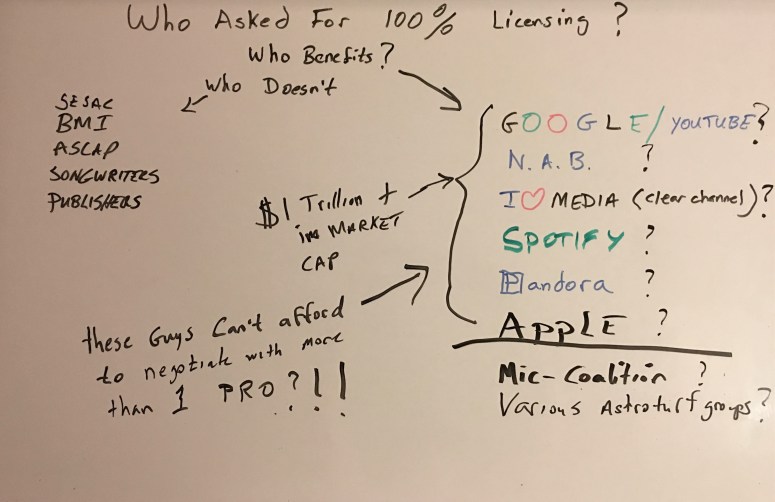
 

 who asked for 100 percent licensing

Who asked for 100% licensing? Certainly not songwriters! Do these multi-billion dollar companies really need the help? Are they really saying something like: “We don’t have enough time/resources to negotiate with all 3 performing rights societies” I don’t understand. No one forced them to go into a business that requires obtaining licenses for songs.  (Or paying royalties–but that’s another story.)
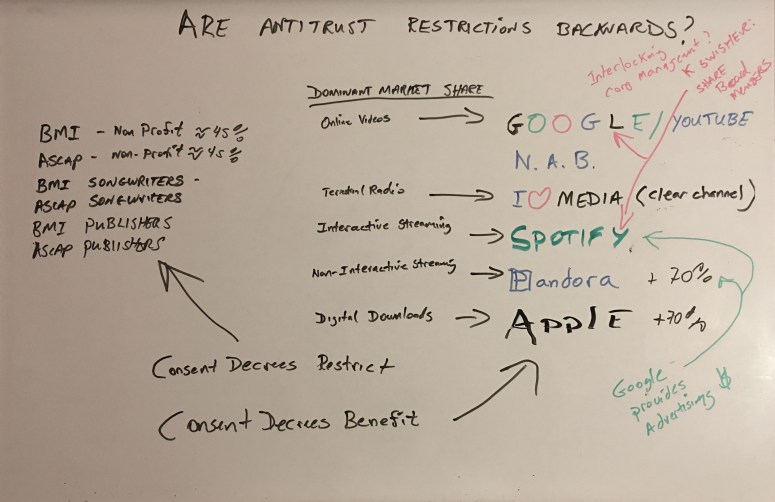

 antitrust backwards

Is the whole antitrust regime backwards? Aren’t the companies on the right side of my whiteboard themselves monopolies or at least dominant? It has been reported that Google and Spotify have some sort of interlocking management/board members. Further Pandora and Spotify rely on Google for ads and revenue. How do they avoid collusion? Why are the antitrust laws still pointed at songwriters?
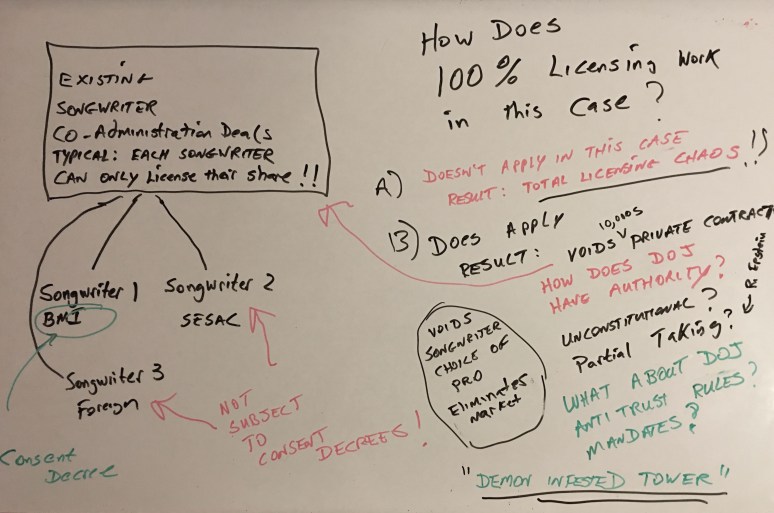
Songwriter co-administration deals demon infested tower

Back to the practical effects of 100% licensing.  This is the demon-infested tower.   How does 100% licensing work when songwriters have co-administration contracts? And only one songwriter is subject to a consent decree? How about if none of the songwriters are subject to the consent decree? It either voids hundreds of thousands–if not millions-of private contracts or creates licensing chaos. I don’t understand where the DOJ would derive authority to void these private contracts?
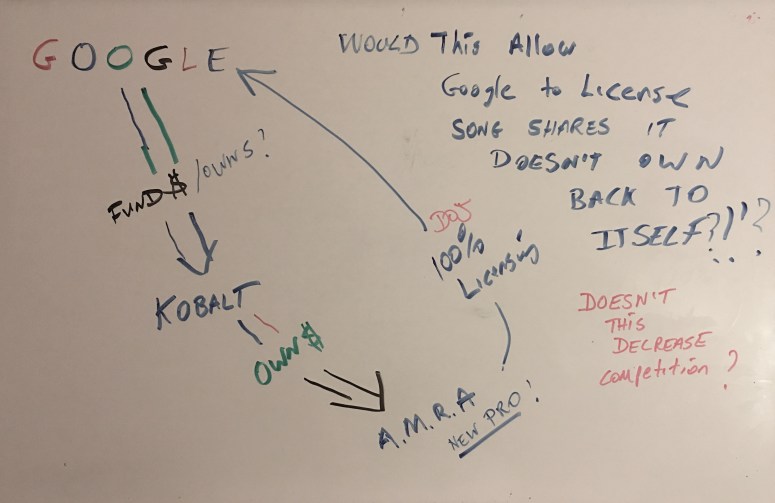
 

 Google Kobalt Amra License Google

Google Ventures recently led a $60 million series C investment in the money losing Kobalt. In turn Kobalt bought the new “global” PRO AMRA. Don’t you think that AMRA will say they are “forced” to adopt 100% licensing for AMRA writers if the DOJ requires it of ASCAP and BMI? Isn’t this the monopolist Google licensing music back to itself on a certain level? And shares of songs it doesn’t control? If you say not true, then please show your work.  Trust me, this will not end well.
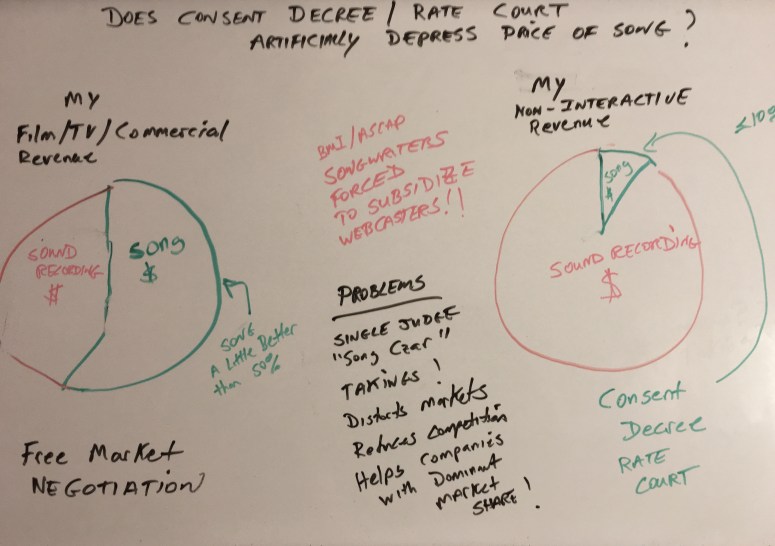
Does Consent decree depress price

How can the government set wage and price controls through the rate court to approximate a free market when there hasn’t been a free market for songwriters since 1941?  With my catalogue it appears that the BMI consent decree is pushing the price of the song below market value. This is in effect a subsidy from individual songwriters to well connected companies with dominant market share. How is this not an abuse of the antitrust laws? This sure looks like crony capitalism to me. Surely others must view it the same way. Why is the DOJ sullying its reputation by allowing this to continue year after year? This doesn’t just hurt songwriters, it reduces trust in the federal government.
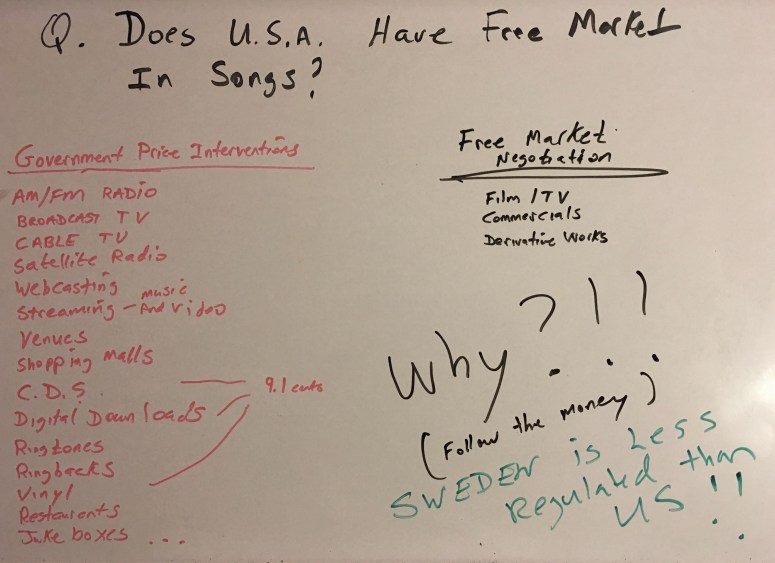
Is USA Free Market in Songs 

Why? Why are  US songwriters so regulated? Doesn’t the US government have more important things to do?   What if the DOJ and Federal government did less in the markets for licensing songs? What if they completely withdrew and did nothing? Would the economy collapse? Would the sky fall? No. Would companies that want to license music and songwriters come to mutually agreeable terms? Most likely, because that is the way it works in the unregulated parts of the economy like say synchronization licenses. Why wouldn’t it work with collective licensing?

Wouldn’t competition increase as AMRA, ASCAP, BMI, Global Music Rights and SESAC competed for greater market share? Take note, it is the multi-billion dollar corporations that are asking the U.S. government for protection from free markets not songwriters. Songwriters aren’t the ones asking for a handout, they are simply asking for a level playing field.  

Thank you for allowing me to participate in this important discussion.

Sincerely,

David Lowery

THE UK FEATURED ARTIST COALITION IS DEAD: Endorses Ex-Record Exec from Spotify Funded MMF to Represent Performers at PPL

Screen Shot 2015-11-16 at 11.12.11 AM

The once mighty advocate for artists’ rights in the UK is no more.  Yes, there is a zombie organization that still bears the name, but it seems a lifeless and corrupted shell of an organization, routinely parroting every MMF press releases.  But it is their latest email that leaves us with no other conclusion than they have been taken over by the Spotify and Google funded “Music Manager’s Forum”.   They have now officially endorsed Jon Webster CEO of the  MMF to represent “performers” on the PPL. (The PPL collects performers royalties on behalf of artists.)  Jon Webster is a former record executive and as far as I know his only  experience as a performer is “acting” like he represents performers and not MMF or the companies that fund it.  It should be noted that the FAC does not endorse former FAC head Crispin Hunt.  Hunt along with a group of other performers stepped down from the FAC last year reportedly because MMF wanted to control the messaging and he and others objected to the Spotify and Google funding.   Now in what appears to be a vindictive putsch that would make Stalin proud they are trying to push Crispin Hunt off the board of the PPL.

Fuck these guys. Let’s send Webster not Hunt to the Goolag.  If you are eligible to vote, vote! Now!  You only have 2 days left!  You of course are free to make up your own mind, but we believe that UK artists are better represented by a vote for Crispin Hunt and Mark Kelly.

If you are an eligible PPL voter here is the form.

https://drive.google.com/file/d/0B0RzH0EU6nJxVW1MVDhZN3F6dzA/view

Confirmed: Google/Spotify Funded MMF is Trying to Replace Performers On PPL Board with Former Record Exec

Earlier this week we reported that it appeared that  UK Music Managers Forum was trying to replace Crispin Hunt and Mark Kelly as the performer representatives on the board of  UK PPL with former record executive and MMF CEO Jon Webster.  We now have the confirmation email:

From: Fiona McGugan <fiona@themmf.net>
Date: November 13, 2015 at 4:40:13 PM EST
Subject: ICYMI 62

Dear US Managers,

Jon is in Japan this week, so perhaps apt for me to let you know that he has confirmed that he will be stepping down as CEO of the MMF in January. But he will not be resting as he is running for a seat on the PPL board and concentrating on Performers’ Rights as they come under threat with the developments in digital licensing: http://www.completemusicupdate.com/article/jon-webster-confirms-he-will-stand-down-as-mmf-ceo-as-ppl-elections-announced/ He will continue working with us on this and other issues.

A look at superfans in the streaming environment: http://www.recordoftheday.com/news-and-press/superfans-in-a-streaming-environment-david-balfour Artist ownership of data will be an issue in the future….

Have a great weekend,
Fiona

Yes indeed, performer’s rights are under threat.  As usual they are under threat by managers.  And under threat in exactly the same way they always are. While pretending to look out for artists the managers are secretly taking payments under the table from the companies (Spotify/YouTube) that are sending tiny royalty checks to performers.   Its like the 1970s music manager business just with less cocaine. (Ed Note-Probably,you can never really be sure with managers.)

But at least this time you can do something about it.  You get to vote. That’s right if you are a UK performer and you have received a check from PPL in the last couple of years you can vote.  And you should vote for actual performers,  like say Crispin Hunt and Mark Kelly.  Not MMF CEO and former major label record executive Jon Webster.  Here are the instructions from our UK friends:

Online voting opened yesterday as planned, and will run until 5pm on 20 November. Electoral Reform Services (ERS) has sent details of the online voting process to all of this year’s Eligible Performers (i.e. those performers registered with PPL who have received a payment from PPL in 2013 and/or 2014). Most of these communications went out by email, but some went by post (where the performer has not currently provided PPL with a valid email address).

Those communications from ERS communications provide the performer with a link to the secure online voting website, and set out the security information they will need in order to be able to log in and cast their votes, so all performers need to do is follow the instructions in those communications. As there are two positions being elected, each Eligible Performer can cast two votes (i.e. one for each of their preferred two candidates – it is not possible for them to cast both their votes for the same candidate).

When they log into the online voting website, performers are able to review the candidates’ election statements before casting their votes. (Those statements are also available from the dedicated APM 2015 page on the PPL website: http://www.ppluk.com/apm2015 (and via our news story announcing the candidates in the Press section of our website)).

The ERS online voting process is very simple, and should only take a few minutes. Alternatively, those Eligible Performers who (for whatever reason) do not vote online during the online voting window can still vote at the APM itself (either in person or by proxy).

We will then combine the online votes with any votes cast at the APM itself, in order to be able to announce the final election results during the APM on 25 November.

Apple Job Listing and Unpaid Songwriters: Spotify Fixes Blame While Apple Fixes Problem

Screen Shot 2015-11-11 at 9.11.51 AM

Apple Music job listing: fixing the problem not fixing the blame

As reported by the Wall Street Journal and here at The Trichordist, streaming services appear to have a vast pool of unlicensed songs (mass copyright infringement) and as much as 150 million dollars in unpaid songwriter royalties.

Above is a job posting from Apple.  It appears that this is a proactive move to address the problem of unpaid/unlicensed songwriters at the streaming services. It is after all Apples obligation to license songs and pay songwriters.  It is not songwriters and publishers that are supposed to be chasing down their royalties and licenses.

Meanwhile Spotify continues its propaganda campaign which attempts to blame the victims.  Here is Spotify’s head of global communications on the problem.

“We want to pay every [fraction of a] penny, but we need to know who to pay,” Prince said. “The industry needs to come together and develop an approach to publishing rights based on transparency and accountability.”

The industry needs to come together to fix your problem?  By industry you mean songwriters? No, I don’t think so.  Songwriters don’t need to be burdened with more overhead in order to collect their royalties.  That’s essentially a tax on creators to fix your problem.  You chose to go into the streaming business.  Songwriters didn’t force you.  This is a database problem that could be easily fixed by Spotify when they “ingest” songs.  Require publishing information at that point or do not make available!  Problem solved.  Invoice is in the mail.

Anyway look at how absurd this is.   Isn’t Spotify in the technology business?  Isn’t it Spotify that should have the expertise to fix this problem? Asking songwriters to fix a Spotify database issue is like calling the plumber to do brain surgery.

Crickets from MMF-Rethink-Berklee-Kobalt On Spotify Unpaid Songwriter Royalties

OLYMPUS DIGITAL CAMERA

UK Music Managers Forum, Rethink Music, Berklee College of Music and Kobalt Music at music transparency confab in Boston Oct 2nd 2015.

There are genuine and legitimate voices that call for transparency in the music business.  These calls include transparency starting at the top of the revenue stream, you know, from digital services like Apple, Spotify and YouTube.

Then there’s the transparency kabuki being conducted in lockstep by The Music Managers Forum,  Rethink Music, Berklee College and Kobalt that does not.   The whole purpose of this fake transparency charade seems to be to distract the public’s attention away from the meager compensation paid by streaming services and focus attention elsewhere. (Actually it is a lot like the parable of the Wall Street banker, the union worker and the box of donuts, here.) This is the most outrageous and brazen propaganda campaign I have witnessed since I started my artists rights campaign 4 years ago.

Each of these institutions receive significant funding from either Google/YouTube or Spotify. So predictably we haven’t heard one thing from these organizations on the Spotify/YouTube unpaid royalty crisis.  And I don’t expect they ever will.

But hey, maybe they’ll prove me wrong.   They could join my call to have the NY State AG investigate and distribute the unpaid Spotify/YouTube royalties. What do you think MMF, Rethink Music, Berklee College of Music and Kobalt?  Got any  principles?  Got the balls to go against your corporate masters?

The Wall Street Banker and Box of Donuts Parable vs MMF-Berklee-Rethink-Music-Kobalt Transparency Charade

So here’s a little parable that I often have heard in union and labor circles.

A group of Wall Street bankers, hedge funds and private equity firms buy out a small manufacturing company with both union and non-union workers. The bankers set about dismantling much of the company. They sell off parts of the company, they liquidate the pension and health funds and load the company up with unsustainable debt. When they have worked all the usual financial angles, they send a young banker out to the factory to find more ways to extract more value from the company. The banker is hungry and exhausted from his long trip. He goes into the workers break room and sees a box of a dozen donuts. He sits down and promptly eats 11 of the 12 donuts. Just as he’s finishing donut 11 a union worker walks in. The union worker looks at the nearly empty box of donuts, looks around, shrugs and takes the last remaining donut. Just then a non-union worker walks in. The non-union worker looks at the empty box of donuts and is totally outraged. The banker points at the union worker and says “he ate your donut.”

This is the MMF-Rethink-Berklee-Kobalt transparency charade. These organizations all receive considerable funds from Spotify/YouTube. They are essentially the bankers. And these institutions refuse to acknowledge that the bankers ate 11 of the 12 donuts. When performers and songwriters ask where the money is they point their fingers at players much farther down the revenue stream, like PROs, publishing companies, HFA, SoundExchange and record labels.  Get it?

Orders from Spotify/Google? Reports Suggest MMF is Trying to Push Artist Advocates off Board of UK PPL

As we have reported here the parent organization MMF which also funds the Featured Artist Coalition has reportedly been taking substantial funds from Google and the streaming service Spotify (according to some reports now 80% of its budget).   Since that time advocacy efforts by MMF and FAC have slanted towards the streaming service Spotify,  despite artists and songwriters continuing complaints of unsustainable rates.

In 2014 three highly regarded FAC artist executives Crispin Hunt ,Mark Kelly and Martyn Ware ( Human League/Heaven 17) resigned reportedly due to a lack of artist autonomy and concerns over the Google and Spotify funding. And now we have reports that MMF are trying to neutralize Hunt and Kelly by having MMF chief executive Jon Webster challenge them for a board seat at the PPL Director Elections. PPL is the UK organization that collects and distributes public performance royalties to performers and labels. Crispin and Mark currently occupy a board seat reserved for artists representatives.

So the managers are standing against the artists for a hard fought artists position? MMF want to remove an artist from the board and replace them with a pro Spotify manager/former record executive? How is that even allowed? In what capacity is he a performer or possibly represent performers? Manager? Give me a break. The history of pop music shows managers rarely have the long term interests of artists at heart. Why don’t we just go ahead and let the foxes guard the henhouse also?

This is a dick move.  Doesn’t MMF already have an attendee seat at PPL?  They want two?  But I doubt that MMF care about the optics.   This is the kind of thing that petty and small men are compelled to do. They can’t help it.
And this is why I officially declare the MMF  dead.  It is not that it is ineffective or failing to advocate for managers and artists. No, it is now actively fucking with two of the UK’s most outspoken advocates for artists rights.   Time to wind MMF down and put it out of its misery.  Featured Artists Coalition should go its own way.