@DavidSacks Isn’t a Neutral Observer—He’s an Architect of the AI Circular-Investment Maze

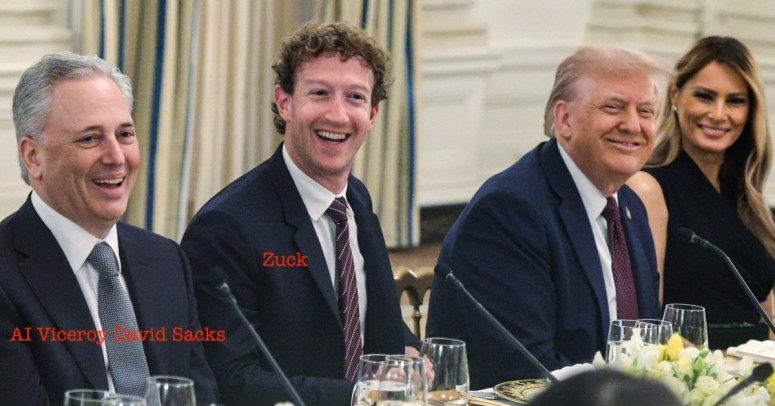
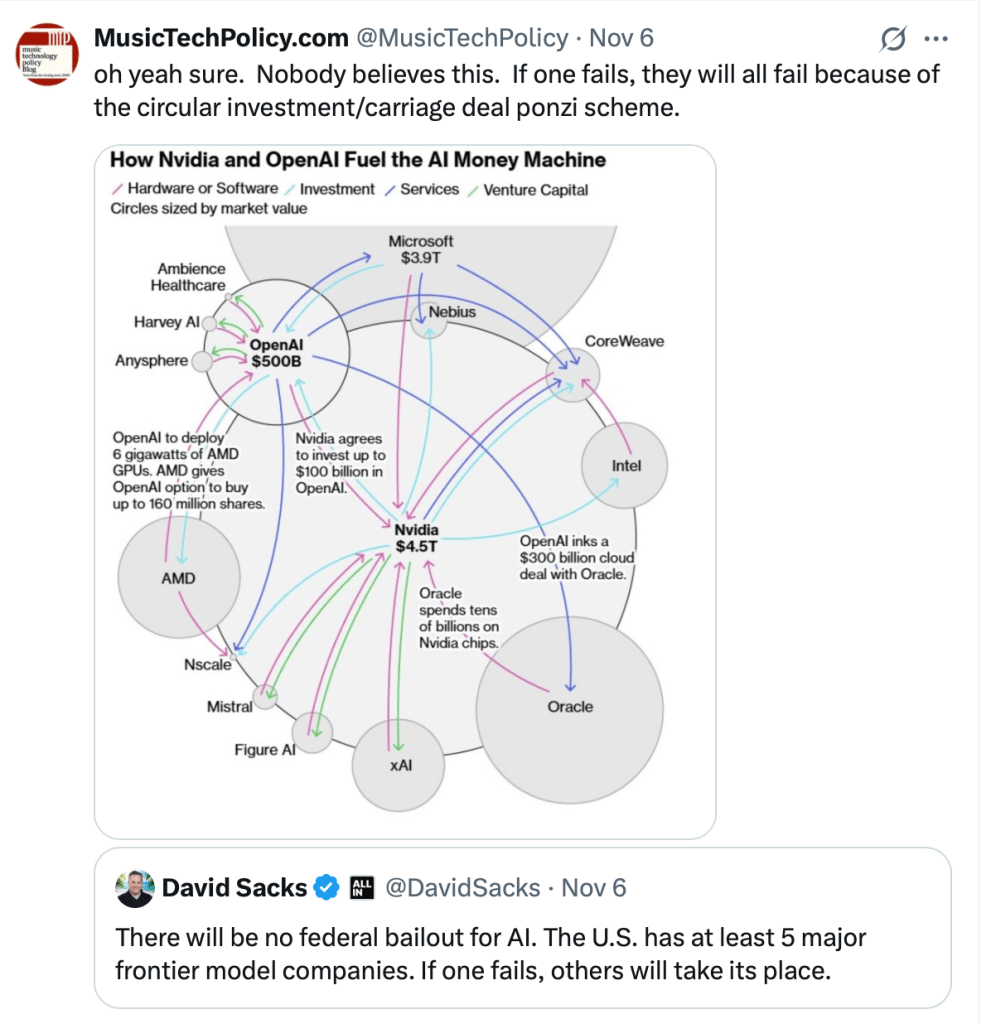
When White House AI Czar David Sacks tweets confidently that “there will be no federal bailout for AI” because “five major frontier model companies” will simply replace each other, he is not speaking as a neutral observer. He is speaking as a venture capitalist with overlapping financial ties to the very AI companies now engaged in the most circular investment structure Silicon Valley has engineered since the dot-com bubble—but on a scale measured not in millions or even billions, but in trillions.

Sacks is a PayPal alumnus turned political-tech kingmaker who has positioned himself at the intersection of public policy and private AI investment. His recent stint as a Special Government Employee to the federal government raised eyebrows precisely because of this dual role. Yet he now frames the AI sector as a robust ecosystem that can absorb firm-level failure without systemic consequence.

The numbers say otherwise. The diagram circulating in the X-thread exposes the real structure: mutually dependent investments tied together through cross-equity stakes, GPU pre-purchases, cloud-compute lock-ins, and stock-option-backed revenue games. So Microsoft invests in OpenAI; OpenAI pays Microsoft for cloud resources; Microsoft books the revenue and inflates its stake OpenAI. Nvidia invests in OpenAI; OpenAI buys tens of billions in Nvidia chips; Nvidia’s valuation inflates; and that valuation becomes the collateral propping up the entire sector. Oracle buys Nvidia chips; OpenAI signs a $300 billion cloud deal with Oracle; Oracle books the upside. Every player’s “growth” relies on every other player’s spending.

This is not competition. It is a closed liquidity loop. And it’s a repeat of the dot-bomb “carriage” deals that contributed to the stock market crash in 2000.

And underlying all of it is the real endgame: a frantic rush to secure taxpayer-funded backstops—through federal energy deals, subsidized data-center access, CHIPS-style grants, or Department of Energy land leases—to pay for the staggering infrastructure costs required to keep this circularity spinning. The singularity may be speculative, but the push for a public subsidy to sustain it is very real.

Call it what it is: an industry searching for a government-sized safety net while insisting it doesn’t need one.

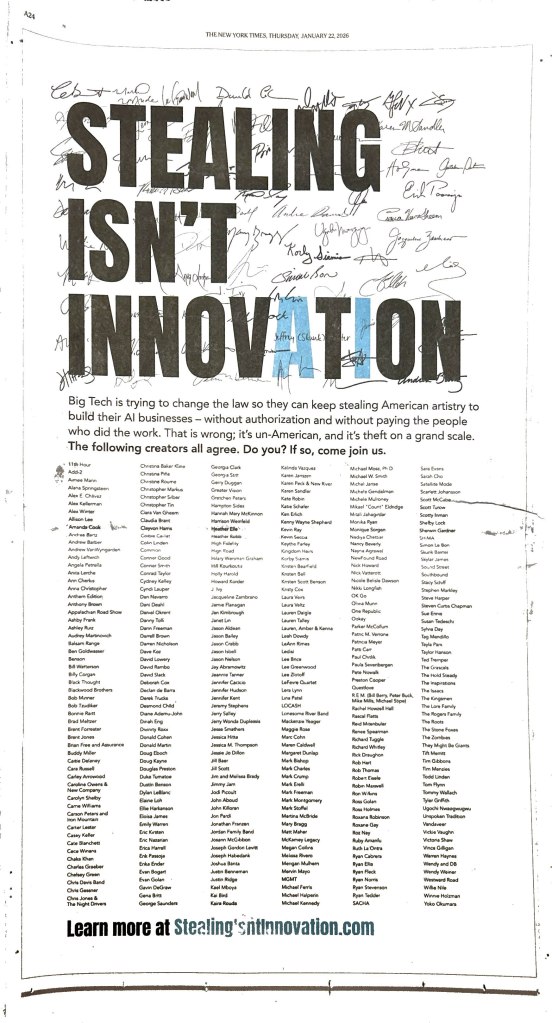
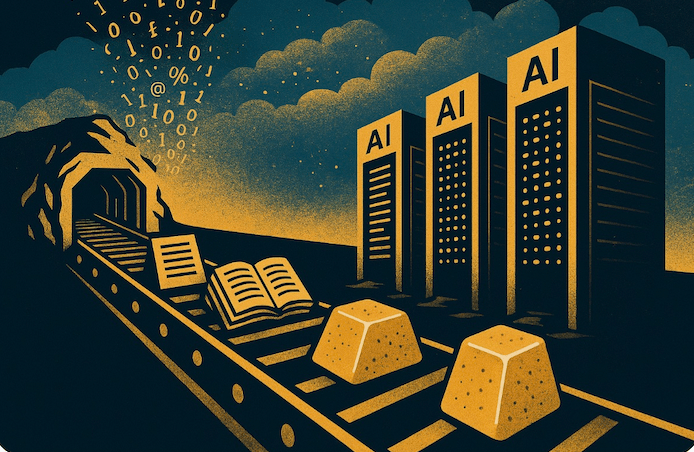
In the meantime, the circular investing game serves another purpose: it manufactures sky-high paper valuations that can be recycled into legal war chests. Those inflated asset values are now being used to bankroll litigation and lobbying campaigns aimed at rewriting copyright, fair use, and publicity law so that AI firms can keep strip-mining culture without paying for it.

The same feedback loop that props up their stock prices is funding the effort to devalue the work of every writer, musician, actor, and visual artist on the planet—and to lock that extraction in as a permanent feature of the digital economy.

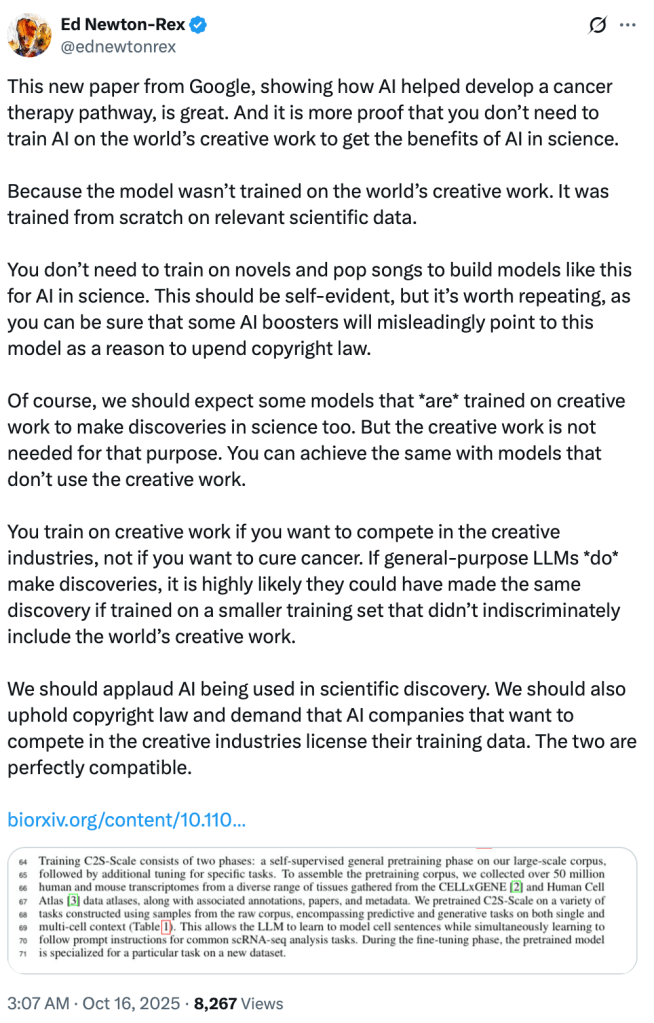
“You don’t need to train on novels and pop songs to get the benefits of AI in science” @ednewtonrex


You Don’t Need to Steal Art to Cure Cancer: Why Ed Newton-Rex Is Right About AI and Copyright

Ed Newton-Rex said the quiet truth out loud: you don’t need to scrape the world’s creative works to build AI that saves lives. Or even beat the Chinese Communist Party.

It’s a myth that AI “has to” ingest novels and pop lyrics to learn language. Models acquire syntax, semantics, and pragmatics from any large, diverse corpus of natural language. That includes transcribed speech, forums, technical manuals, government documents, Wikipedia, scientific papers, and licensed conversational data. Speech systems learn from audio–text pairs, not necessarily fiction; text models learn distributional patterns wherever language appears. Of course, literary works can enrich style, but they’re not necessary for competence: instruction tuning, dialogue data, and domain corpora yield fluent models without raiding copyrighted art. In short, creative literature is optional seasoning, not the core ingredient for teaching machines to “speak.”

Google’s new cancer-therapy paper proves the point. Their model wasn’t trained on novels, lyrics, or paintings. It was trained responsibly on scientific data. And yet it achieved real, measurable progress in biomedical research. That simple fact dismantles one of Silicon Valley’s most persistent myths: that copyright is somehow an obstacle to innovation.

You don’t need to train on Joni Mitchell to discover a new gene pathway. You don’t need to ingest John Coltrane to find a drug target. AI used for science can thrive within the guardrails of copyright because science itself already has its own open-data ecosystems—peer-reviewed, licensed, and transparent.

The companies like Anthropic and Meta insisting that “fair use” covers mass ingestion of stolen creative works aren’t curing diseases; they’re training entertainment engines. They’re ripping off artists’ livelihoods to make commercial chatbots, story generators, and synthetic-voice platforms designed to compete against the very creators whose works they exploited. That’s not innovation—it’s market capture through appropriation.

They do it for reasons old as time—they do it for the money.

The ethical divide is clear:

  • AI for discovery builds on licensed scientific data.
  • AI for mimicry plunders culture to sell imitation.

We should celebrate the first and regulate the second. Upholding copyright and requiring provenance disclosures doesn’t hinder progress—it restores integrity. The same society that applauds AI in medical breakthroughs can also insist that creative industries remain human-centered and law-abiding. Civil-military fusion doesn’t imply that there’s only two ingredients in the gumbo of life.

If Google can advance cancer research without stealing art, so can everyone else and so can Google keep different rules for the entertainment side of their business or investment portfolio. The choice isn’t between curing cancer and protecting artists—it’s between honesty and opportunism. The repeated whinging of AI labs about “because China” would be a lot more believable if they used their political influence to get the CCP to release Hong Kong activist Jimmy Lai from stir. We can join Jimmy and his amazingly brave son Sebastian and say “because China”, too. #FreeJimmyLai

Don’t forget tomorrow—Artist Rights Roundtable on AI and Copyright at American University in Washington DC

Artist Rights Roundtable on AI and Copyright: 
Coffee with Humans and the Machines     

Join the Artist Rights Institute (ARI) and American University’s Kogod’s Entertainment Business Program for a timely morning roundtable on AI and copyright from the artist’s perspective. We’ll explore how emerging artificial intelligence technologies challenge authorship, licensing, and the creative economy — and what courts, lawmakers, and creators are doing in response.

This roundtable is particularly timely because both the Bartz and Kadrey rulings expose gaps in author consent, provenance, and fair licensing, underscoring an urgent need for policy, identifiers, and enforceable frameworks to protect creators.

 🗓️ Date: September 18, 2025
🕗 Time: 8:00 a.m. – 12:00 noon
📍 Location: Butler Board Room, Bender Arena, American University, 4400 Massachusetts Ave NW, Washington D.C. 20016

🎟️ Admission: Free and open to the public. Registration required at Eventbrite. Seating is limited.

🅿️ Parking map is available here. Pay-As-You-Go parking is available in hourly or daily increments ($2/hour, or $16/day) using the pay stations in the elevator lobbies of Katzen Arts Center, East Campus Surface Lot, the Spring Valley Building, Washington College of Law, and the School of International Service

Hosted by the Artist Rights Institute & American University’s Kogod School of Business, Entertainment Business Program

🔹 Overview:

☕ Coffee served starting at 8:00 a.m.
🧠 Program begins at 8:50 a.m.
🕛 Concludes by 12:00 noon — you’ll be free to have lunch with your clone.

🗂️ Program:

8:00–8:50 a.m. – Registration and Coffee

8:50–9:00 a.m. – Introductory Remarks by KOGOD Dean David Marchick and ARI Director Chris Castle

9:00–10:00 a.m. – Topic 1: AI Provenance Is the Cornerstone of Legitimate AI Licensing:

Speakers:

  • Dr. Moiya McTier, Senior Advisor, Human Artistry Campaign
  • Ryan Lehnning, Assistant General Counsel, International at SoundExchange
  • The Chatbot

Moderator: Chris Castle, Artist Rights Institute

10:10–10:30 a.m. – Briefing: Current AI Litigation

  • Speaker: Kevin Madigan, Senior Vice President, Policy and Government Affairs, Copyright Alliance

10:30–11:30 a.m. – Topic 2: Ask the AI: Can Integrity and Innovation Survive Without Artist Consent?

Speakers:

  • Erin McAnally, Executive Director, Songwriters of North America
  • Jen Jacobsen, Executive Director, Artist Rights Alliance
  • Josh Hurvitz, Partner, NVG and Head of Advocacy for A2IM
  • Kevin Amer, Chief Legal Officer, The Authors Guild

Moderator: Linda Bloss-Baum, Director, Business and Entertainment Program, KOGOD School of Business

11:40–12:00 p.m. – Briefing: US and International AI Legislation

  • Speaker: George York, SVP, International Policy Recording Industry Association of America

🎟️ Admission:

Free and open to the public. Registration required at Eventbrite. Seating is limited.

🔗 Stay Updated:

Watch this space and visit Eventbrite for updates and speaker announcements.

Waterloo Records remastered: Iconic vinyl shop celebrates grand re-opening

We could not be happier for our friends at Waterloo Records in Austin on their reopening down the street. Read about it here. Support your local record store!

The famous record shop, which for decades sat at the corner of West Sixth Street and North Lamar Boulevard, finally lowered the needle on its new location Saturday; the soundtrack a mashup of excited shoppers, intermittent announcements about prizes and giveaways, and, of course, music. 

Waterloo’s grand re-opening party marked the culmination of months of collaboration and planning among former majority owner John T. Kunz and new co-owners and operators Caren Kelleher and Trey Watson.

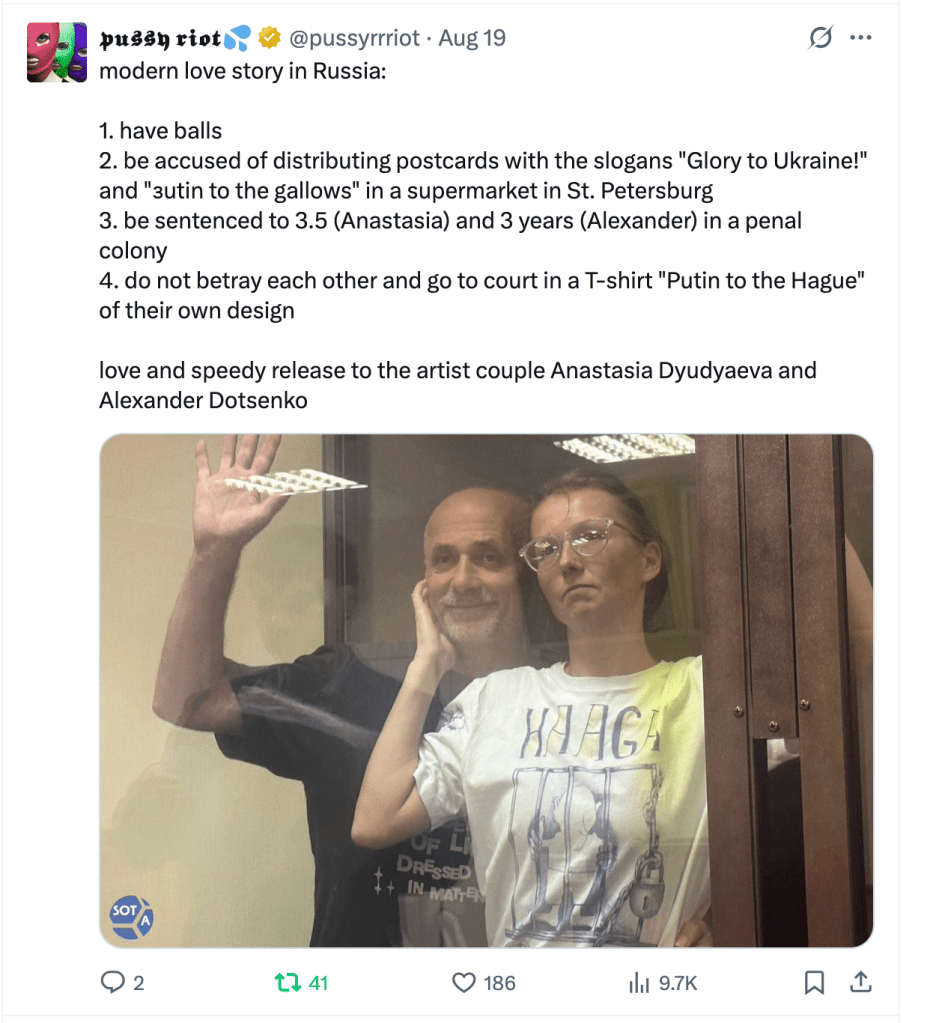
хулиган: Love to Anastasia Dyudyaeva and Alexander Dotsenko

In July 2024, a military court in Saint Petersburg convicted Russian artists Anastasia Dyudyaeva and her husband Alexander Dotsenko on charges of “public calls for terrorism” after they placed anti-war messages—some in Ukrainian, one reading “Putin to the gallows”—on napkins or postcards in a Lenta supermarket. Dyudyaeva received a 3½-year sentence; Dotsenko, three years. They denied wrongdoing, asserting their creative expression was mischaracterized. Their home, which had hosted anti-war exhibitions, was searched, and they were added to Russia’s registry of “terrorists and extremists.” 

Read about it in the Art Newspaper

Fake Pics on Facebook

Who’s Really Fighting for Fans? Georgia Music Partners Comment in the DOJ/FTC Ticketing Consultation

The Department of Justice and Federal Trade Commission were directed by President Trump to conduct an investigation into ticket scalping pursuant to Executive Order 14254 “Combating Unfair Practices in the Live Entertainment Market.”

This led directly to both agencies inviting public comments on the state of the live event ticketing market—an industry riddled with speculation, opacity, and middlemen who seem to make money without ever attending a show. Over 4000 artists, fans, economists, state attorneys general, and industry veterans all weighed in. And the record reveals something important particularly regarding resellers: there’s a rising consensus that the resellers are engaged in some really shady practices designed for one purpose–to extract as much money as possible from fans and artists without regard to the damage it does to the entire artist-fan relationship.

Today we’re posting Georgia Music Partners’ comment that highlights how unchecked secondary ticketing practices—particularly speculative ticket listings, bot-driven price inflation, deceptive branding, and the resale of restricted tickets—are systematically dismantling the live music ecosystem. These practices strip artists of control, mislead fans, and commoditize the artist-fan relationship for the sole benefit of resellers. The comment urges the DOJ and FTC to treat these behaviors as unfair and deceptive trade practices, enforce the BOTS Act, and distinguish reseller abuse from the separate issues posed by Live Nation case, emphasizing that the artist’s intent and trust with fans must be protected.

United for Artists’ Rights: Amicus Briefs Filed in Vetter v. Resnik Support Global Copyright Termination for Songwriters and Authors: Brief by the National Society of Entertainment & Arts Lawyers

In Vetter v. Resnik, songwriter Cyril Vetter won his trial case in Baton Rouge allowing him to recover worldwide rights in his song “Double Shot of My Baby’s Love” after serving his 35 year termination notice on his former publisher, Resnik Music Group. The publisher appealed. The Fifth Circuit Court of Appeals will hear the case and currently is weighing whether U.S. copyright termination rights include “foreign” territories—a question that strikes at the heart of artists’ ability to reclaim their work worldwide (whatever “foreign” means).

Cyril’s attorney Tim Kappel explains the case if you need an explainer:

An astonishing number of friend of the court briefs were filed by many songwriter groups. We’re going to post them all and today’s brief is by the National Society of Arts & Entertainment Lawyers. The brief argues that the Copyright Act’s plain text and legislative history support a unified, comprehensive termination right that revokes all rights granted in a prior transfer, regardless of geographic scope. It rejects the notion of a “multiverse” of national copyrights, citing international treaties like the Berne Convention and longstanding U.S. policy favoring artist protection. Limiting terminations to U.S. territory, the brief warns, would gut the statute’s purpose, harm artists, and impose impossible burdens on creators seeking to reclaim their rights.

We believe the answer on appeal must be yes–affirm the District Court’s well-reasoned decision. Congress gave creators and their heirs the right a “second bite at the apple” to regain control of their work after decades, and that promise means little if global rights are excluded. The outcome of this case could either reaffirm that promise—or open the door for multinational publishers to sidestep it entirely.

That’s why we’re sharing friend of the court briefs from across the creative communities. Each one brings a different perspective—but all defend the principle that artists deserve a real, global right to take back what’s theirs, because as Chris said, Congress did not give authors a second bite at half the apple.

Read the brief below, watch this space for case updates.

Who’s Really Fighting for Fans? A Closer Look at the DOJ/FTC Ticketing Consultation

The Department of Justice and Federal Trade Commission were directed by President Trump to conduct an investigation into ticket scalping pursuant to Executive Order 14254 “Combating Unfair Practices in the Live Entertainment Market.”

This led directly to both agencies inviting public comments on the state of the live event ticketing market—an industry riddled with speculation, opacity, and middlemen who seem to make money without ever attending a show. Over 4000 artists, fans, economists, state attorneys general, and industry veterans all weighed in. And the record reveals something important particularly regarding resellers: there’s a rising consensus that the resellers are engaged in some really shady practices designed for one purpose–to extract as much money as possible from fans and artists without regard to the damage it does to the entire artist-fan relationship.

Over the next several posts, I’ll be highlighting individual comments submitted to the DOJ/FTC inquiry. Some are technical, some personal, and some blisteringly direct—but all speak to the fundamental imbalance between artists, fans, and the multi-layered resellers, bots, and platforms that profit from both ends of the transaction.

This isn’t just about high prices. It’s about ownership, transparency, control, and accountability and the lenders who fuel the fraud. Many of the commenters argue that ticketing is no longer just a marketplace—it’s a manipulated, closed-loop ecosystem in which the reseller’s house always wins. And for too long, the architects of that system have claimed there’s nothing to see here. There is plenty to see here.

Each post in this series will spotlight one of these submissions that I have selected—not just to amplify the voices that took time to respond, but to help connect the dots on how the ticketing industry got here, who’s benefiting, and what needs to change.

We all have to be grateful to Kid Rock who brought this debacle to President Trump’s attention and to the President himself for making it a priority. We also have to thank Senator Marsha Blackburn for her continued defense of artists through her BOTS Act co-sponsored with Senator Blumenthal. Senator Blackburn has long opposed the use of automated fraudster systems to extract rents from fans and artists and we hope that the DOJ/FTC inquiry will also shed light on why there have been so few prosecutions.

Stay tuned for the first in the series. Spoiler alert: it’s going to be hard to argue that this is a “free market” when fans are bidding against bots and artists are not allowed to control the face value of their own shows. 

This is a summary of a lot of the more involved issues that came up in the comments:

1. Speculative Ticket Listings

Resellers frequently list tickets for sale without possessing them, misleading consumers and inflating prices. These listings distort market data and should be treated as deceptive under federal consumer protection law.

2. Price Manipulation Through Bots

Automated bots are used to hoard tickets and create artificial scarcity, driving up resale prices. This not only violates the BOTS Act but enables unfair competition that harms consumers.

3. Deceptive Use of Venue, Artist, or Promoter Branding

Resellers often use official names and branding in ads, URLs, and metadata as well as typosquatting or URL hacking to trick consumers into believing they are purchasing from authorized sources. These deceptive practices undermine market transparency.

4. Misleading “Sold Out” or Urgency Claims

Some platforms advertise that events are “sold out” or create false urgency (e.g., “only 2 left at this price”) when primary tickets are still available. These tactics constitute false advertising and manipulative marketing.

5. Concealment of Total Ticket Cost 

Fees are often hidden until checkout, misleading consumers about the true price. This “drip pricing” violates FTC guidance on transparent pricing and impairs consumers’ ability to comparison shop.

6. Resale of Non-Transferable or Restricted Tickets

Resellers list tickets that are explicitly non-transferable or designated will-call only, often in violation of the event organizer’s terms. Consumers risk being denied entry without recourse.

7. Lack of Delivery Guarantees and Refund Accountability

Many platforms offer no guaranteed delivery or refund protection when tickets are invalid or undelivered—despite charging substantial markups—leaving consumers with no remedy.

8. One-Sided Arbitration and Waiver Clauses

Some resale platforms impose forced arbitration clauses and class action waivers, effectively denying consumers access to meaningful remedies, even in cases of systemic fraud.

9. Failure to Disclose Broker Status or Ticket Quantities

Platforms often fail to identify brokers or disclose the number of tickets held, undermining market transparency and the ability of venues and regulators to detect fraud or hoarding.

10. Bankruptcy as a Shield Against Accountability

Resellers may use bankruptcy to discharge obligations arising from fraudulent or deceptive conduct. Congress should consider amendments to make such claims nondischargeable, similar to fraud-based exceptions under 11 U.S.C. § 523(a).

11. Federal RICO Liability for Coordinated BOTS Act Violations

The use of automated ticket-buying tools in coordinated schemes between resellers and bot developers may give rise to federal RICO charges under 18 U.S.C. §§ 1961–1968. The following are three plausible RICO predicates when tied to a pattern of violations:

   (a) Wire Fraud (18 U.S.C. § 1343): Automated bulk purchases made using false identities or obfuscated IP addresses may constitute wire fraud if they involve misrepresentations in interstate commerce.

   (b) Access Device Fraud (18 U.S.C. § 1029): Bot schemes often involve unauthorized use of payment cards, CAPTCHA bypass tools, or ticket platform credentials, qualifying as trafficking in access devices.

   (c) Computer Fraud and Abuse (18 U.S.C. § 1030): Bypassing ticket site security measures may amount to unauthorized access under the CFAA, particularly when done for commercial advantage.

These acts, when carried out by a coordinated enterprise, support civil or criminal RICO enforcement, particularly where repeat violations and intent to defraud can be established.