Press Release: Indie Songwriter Groups Thank @RepFitzgerald For His Letter to @CopyrightOffice Urging Improvements to the US Mechanical Licensing Collective

The Songwriters Guild of America (SGA), the Society of Composers & Lyricists (SCL) and the Music Creators North America (MCNA) coalition –on behalf of over ten thousand US songwriter and composer members and their heirs and with the support of tens of thousands more represented by our organizations’ affiliated International Council of Music Creators (CIAM)– offer our sincerest thanks and support to US Congressman Scott Fitzgerald (R-WI) for his stalwart efforts in seeking to protect our rights through much needed operational and structural improvements to the US Mechanical Licensing Collective (MLC). The MLC collects and distributes hundreds of millions of dollars in royalties to songwriters and composers through their music publishing administrators each year.

Following the filing by our coalition in May, 2024 of comments expressing conditional support for re-designation by the US Copyright Office of the current MLC if –and only if– certain reforms are instituted to improve its transparency, operational fairness and accuracy in distributions (https://www.songwritersguild.com/site/potential-re-designation-mlc-and-dlc) Representative Fitzgerald came forward with his own letter to the Copyright Office dated August 29, 2024 asserting the need for reforms in full basic harmony with our own positions. His Congressional office is one of many with whom our groups have had impactful and productive discussions concerning the need for closer governmental oversight of the MLC process in order to protect American music creator rights, as clearly intended by Congress in the Music Modernization Act enacted five years ago.

Among the urgently required reforms addressed in Congressman Fitzgerald’s letter are:

–greater MLC budgetary transparency,

–improved outreach and accuracy in identifying and contacting owners of unmatched “black box” royalties (potentially approaching one billion dollars in unmatched and/or undistributed funds by 2025), and

–improved MLC board neutrality, balance and fairness.

As to this latter issue, the Congressman was forthright in acknowledging that the MLC board has conducted itself more as an advocate solely for the corporate music publishing industry rather than, as Congressionally intended, an unbiased body charged principally with protecting creator’ rights and royalties.

There are several problems related to the presence on the MLC board of only four songwriter/composer directors as compared to ten music publisher representatives (a unique imbalance compared to all other music royalty collectives around the world), including the fact that “permanently” unmatched royalties are to be distributed by the MLC on a “market share”
basis.

That construct means that music publisher board members stand to benefit by NOT properly identifying and distributing royalties to their actual creator-owners, the very task legislatively assigned to the MLC at the time of its Congressional creation. Moreover, the alleged songwriter organizations’ representative appointed as the non-voting board overseer for music creator interests has proven to be nothing more than a rubber stamp for corporate interests in direct opposition to the creators’ interests it purports to safeguard. We are aware of no other American music creator group that supports continuation of this facade of creator “representation.”

Our groups appreciate the consistent outreach and earnest work of MLC chief executive officer
Kris Ahrend, but we join Congressman Fitzgerald and his supporting colleagues in the House and Senate in insisting that the enumerated reforms cited in our Copyright Office submissions must be considered essential prerequisites to MLC re-designation (including endorsement by the MLC Board of Congressional action to equalize board representation between music creators on the one hand and their corporate copyright owners and administrators on the other). Our coalition will meanwhile continue its work on Capitol Hill and with the Copyright Office advocating for genuine protections of independent, individual music creator rights by the MLC.

Read Rep. Fitzgerald’s letter here.

The Intention of Justice:  In Which The MLC Loses its Way on a Copyright Adventure

by Chris Castle

ARTHUR

Let’s get back to justice…what is justice?  What is the intention of justice?  The intention of justice is to see that the guilty people are proven guilty and that the innocent are freed.  Simple, isn’t it?  
Only it’s not that simple.

From And Justice for All, screenplay written by Valerie Curtin and Barry Levinson

Something very important happened at the MLC on July 9:  The Copyright Office overruled the MLC on the position the MLC (and, in fairness, the NMPA) took on who was entitled to post-termination mechanical royalties under the statutory blanket license.  What’s important about the ruling is not just that the Copyright Office ruled that the MLC’s announced position was “incorrect”—it is that it corrected the MLC’s position that was in direct contravention of prior Copyright Office guidance.  (If this is all news to you, you can get up to speed with this helpful post about the episode on the Copyright Office website or read John Barker’s excellent comment in the rulemaking.)

“Guidance” is a kind way to put it, because the Copyright Office has statutory oversight for the MLC.  That means that on subjects yet to be well defined in a post-Loper world (the Supreme Court decision that reversed “Chevron deference”), I think it’s worth asking whether the Copyright Office is going to need to get more involved with the operations of the MLC.  Alternatively, Congress may have to amend Title I of the Music Modernization Act to fill in the blanks.  Either way, the Copyright Office’s termination ruling is yet another example of why I keep saying that the MLC is a quasi-governmental organization that is, in a way, neither fish nor fowl.  It is both a private organization and a government agency somewhat like the Tennessee Valley Authority.  Whatever it is ultimately ruled to be, it is not like the Harry Fox Agency which in my view has labored for decades under the misapprehension that its decisions carry the effect of law.  Shocking, I know.  But whether it’s the MLC or HFA, when they decide not to pay your money unless you sue them, it may as well be the law.

The MLC’s failure to follow the Copyright Office guidance is not a minor thing.  This obstreperousness has led to significant overpayments to pre-termination copyright owners (who may not even realize they were getting screwed).  This behavior by the MLC is what the British call “bolshy”, a wonderful word describing one who is uncooperative, recalcitrant, or truculent according to the Oxford Dictionary of Modern Slang.  The word is a pejorative adjective derived from Bolshevik.  “Bolshy” invokes lawlessness.

In a strange coincidence, the two most prominent public commenters supporting the MLC’s bolshy position on post-termination payments were the MLC itself and the NMPA, which holds a nonvoting board seat on the MLC’s board of directors.  This stick-togetherness is very reminiscent of what it was like dealing with HFA when the NMPA owned it.  It was hard to tell where one started and the other stopped just like it is now.  (I have often said that a nonvoting board seat is very much like a “board observer” appointed by investors in a startup to essentially spy on the company’s board of directors.  I question why the MLC even needs nonvoting board seats at all given the largely interlocking boards, aside from the obvious answer that the nonvoters have those seats because the lobbyists wrote themselves into Title I of the MMA—you know, the famous “spirit of the MMA”.)

Having said that, the height of bolshiness is captured in this quotation (89 FR 58586 (July 9, 2024)) from the Copyright Office ruling about public comments which the Office had requested (at 56588):

The only commenter to question the Office’s authority was NMPA, which offered various arguments for why the Office lacks authority to issue this [post-termination] rule. None are persuasive. [Ouch.]

NMPA first argued that the Office has no authority under section 702 of the Copyright Act or the MMA to promulgate rules that involve substantive questions of copyright law. This is clearly incorrect. [Double ouch.]

The Office ‘‘has statutory authority to issue regulations necessary to administer the Copyright Act’’ and ‘‘to interpret the Copyright Act.’’  As the [Copyright Office notice of proposed rulemaking] detailed, ‘‘[t]he Office’s authority to interpret [the Copyright Act]  in the context of statutory licenses in particular has long been recognized.’’

Well, no kidding.

What concerns me today is that wherever it originated, the net effect of the MLC’s clearly erroneous and misguided position on termination payments is like so many other “policies” of the MLC:  The gloomy result always seems to be they don’t pay the right person or don’t pay anyone at all in a self-created dispute that so far has proven virtually impossible to undo without action by the Copyright Office (which has other and perhaps better things to do, frankly).  The Copyright Office, publishers and songwriters then have to burn cycles correcting the mistake.  

In the case of the termination issue, the MLC managed to do both: They either paid the wrong person or they held the money.  That’s a pretty neat trick, a feat of financial gymnastics for which there should be an Olympic category.  Or at least a flavor of self-licking ice cream.

The reason the net effect is of concern is that this adventure in copyright has led to a massive screwup in payments illustrating what we call the legal maxim of fubar fugazi snafu.  And no one will be fired.  In fact, we don’t even know which person is responsible for taking the position in the first place.  Somebody did, somebody screwed up, and somebody should be held accountable.

Mr. Barker crystalized this issue in his comment on the Copyright Office termination rulemaking, which I call to your attention (emphasis added):

I do have a concern related to the current matter at hand, which translates to a long-term uneasiness which I believe is appropriate to bring up as part of these comments. That concern is, how did the MLC’s proposed policies [on statutory termination payments] come in to being in the first place? 

The Copyright Office makes clear in its statements in the Proposed Rules publication that “…the MLC adopted a dispute policy concerning termination that does not follow the Office’s rulemaking guidance.”, and that the policy “…decline(d) to heed the Office’s warning…”. Given that the Office observed that “[t]he accurate distribution of royalties under the blanket license to copyright owners is a core objective of the MLC”, it is a bit alarming that the MLC’s proposed policies got published in the first place. 

I am personally only able to come up with two reasons why this occurred. Either the MLC board did not fully understand the impact on termination owners and the future administration of those royalties, or the MLC board DID realize the importance, and were intentional with their guidelines, despite the Copyright Office’s warnings

Both conclusions are disturbing, and I believe need to be addressed.

Mr. Barker is more gentlemanly about it than I am, and I freely admit that I have no doubt failed the MLC in courtesy.  I do have a tendency to greet only my brothers, the gospel of Matthew notwithstanding.  Yet it irks me to no end that no one has been held accountable for this debacle and the tremendous productivity cost (and loss) of having to fix it.  Was the MLC’s failed quest to impose its will on society covered by the Administrative Assessment?  If so, why?  If not, who paid for it?  And we should call the episode by its name—it is a debacle, albeit a highly illustrative one. 

But we must address this issue soon and address it unambiguously.  The tendency of bureaucracy is always to grow and the tendency of non-profit organizations is always to seek power as a metric in the absence of for-profit revenue.  Often there are too many people in the organization who are involved in decision-making so that responsibility is too scattered.  

When something goes wrong as it inevitably does, no one ever gets blamed, no one ever gets fired, and it’s very hard to hold any one person accountable because everything is too diffused.  Instead of accepting that inevitable result and trying to narrow accountability down to one person so that an organization is manageable and functioning, the reflex response is often to throw more resources at the problem when more resources, aka money, is obviously not the solution.  The MLC already has more money than they know what to do with thanks to the cornucopia of cash from the Administrative Assessment.  That deep pocket has certainly not led to peace in the valley.

Someone needs to get their arms around this issue and introduce accountability into the process.  That is either the Copyright Office acting in its oversight role, the blanket license users acting in their paymaster role through the DLC, or a future litigant who just gets so fed up with the whole thing that they start suing everyone in sight.   

Saint Thomas Aquinas wrote in Summa Theologica that a just war requires a just cause, a rightful intention and the authority of the sovereign (SummaSecond Part of the Second Part, Question 40).  So it is with litigation.  We have a tendency to dismiss litigation as wasteful or unnecessary with a jerk of the knee, yet that is overbroad and actually wrong.  In some cases the right of the people to sue to enforce their rights is productive, necessary, inevitable and—hopefully—in furtherance of a just cause like its historical antecedents in trial by combat.  

It is also entirely in keeping with our Constitution.  The just lawsuit allows the judiciary to right a wrong when other branches of government fail to act, or as James Madison wrote in Federalist 10, so the government by “…its several constituent parts may…be the means of keeping each other in their proper places.”  

That’s a lesson the MLC, Inc. had to learn the hard way.  Let’s not do that again, shall we not?

This post first appeared on the MusicTech.Solutions blog.

Are You Better Off Today Than You Were Five Years Ago? Selected comments on the MLC Redesignation: Songwriters Guild of America, the Society of Composers & Lyricists, and Music Creators North America Joint Comment

The Copyright Office solicited public comments about how things are going with the MLC to help the Office decide whether to permit The MLC, Inc. to continue to operate the Collective (see this post for more details on the “redesignation” requirement). We are impressed with the quality of many of the comments filed at the Copyright Office. While comments are now closed, you can read all the comments at this link.

For context, the “redesignation” is a process of review by the Copyright Office required every five years under the Music Modernization Act. Remember, the “mechanical licensing collective” is a statutory entity that requires someone to operate it. The MLC, Inc. is the current operator (which makes it confusing but there it is). If the Copyright Office finds the MLC, Inc. is not sufficiently fulfilling its role or is not up to the job of running the MLC, the head of the Copyright Office can “fire” the MLC, Inc. and find someone else to hopefully do a better job running the MLC. Given the millions upon millions that the music users have invested in the MLC, and the hundreds of millions of songwriter money held by the MLC in the black box, firing the MLC, Inc. will be a big deal. Given how many problems there are with the MLC, firing the MLC, Inc. that runs the collective

The next step in this important “redesignation” process is that The MLC, Inc. and the Digital Licensee Coordinator called “the DLC” (the MLC’s counterpart that represents the blanket license music users) will be making “reply comments” due on July 29. The Copyright Office will post these comments for the public shortly after the 29th. These reply comments will likely rebut previously filed public comments on the shortcomings of the MLC, Inc. or DLC (which were mostly directed at the MLC, Inc.) and expand upon comments each of the two orgs made in previous filings. If you’re interested in this drama, stay tuned, the Copyright Office will be posting them next week.

If you have been reading the comments we’ve posted on Trichordist (or if you have gone to the filings themselves which we recommend), you will see that there is a recurring theme with the comments. Many commenters say that they wish for The MLC, Inc. to be redesignated BUT…. They then list a number of items that they object to about the way the Collective has been managed by The MLC, Inc. usually accompanied by a request that the The MLC, Inc. change the way it operates.

That structure seems to be inconsistent with a blanket ask for redesignation. Rather, the commenters seem to be making an “if/then” proposal that if The MLC, Inc. improves its operations, including in some cases operating in an opposite manner to its current policies and practices, then The MLC, Inc. should be redesignated. Not wishing to speak for any commenter, let it just be said that this appears to be a conditional proposal for redesignation. Maybe that is not what the commenters were thinking, but it does appear to be what many of them are saying.

Today’s comment is jointly filed by the Songwriters Guild of America (SGA), the Society of Composers & Lyricists (SCL), and Music Creators North America (MCNA), who advocate for independent songwriters in contrast to the powers that be. (For clarity, the three groups in their comment refer to themselves together as the “Independent Music Creators”.)

For purposes of these posts, we may quote sections of comments out of sequence but in context. We recommend that you read their thoughtful and detailed joint comments in their entirety. You can read the joint comment at this link.

[The Current Crisis with Spotify]

Prior to proceeding to the presentation of our Comments, we are compelled by recent events and circumstances to issue the following, important caveat. Just days ago, the National Music Publishers Association (“NMPA”) announced its apparent intention to seek fundamental legislative changes to the US Copyright Act in regard to the statutory mechanical licensing system established under the Music Modernization Act (“MMA”) (the legislation that resulted in the creation of the MLC and the DLC). This complete reversal in NMPA policy is the result of repugnant actions on the part of the digital music distributor “Spotify” to minimize its royalty payment obligations by identifying and exploiting alleged loopholes in what many view as the unevenly negotiated and drafted Phonorecords IV settlement. The Independent Music Creators previously voiced formal opposition to the details of that settlement prior to its ratification and adoption by the US Copyright Royalty Board at NMPA’s urging in December, 2022.

This morass, which threatens to deprive music creators of hundreds of millions of dollars in royalties over the next five years, is made even more complex by the fact that both NMPA and the MLC are served by the same team of legal advisors. Those same legal advisors also counseled NMPA on the negotiation of the Phonorecords IV settlement, which the MLC (albeit through another set of litigators) is now seeking to enforce against Spotify in federal court (an action we support), and which NMPA is now essentially seeking to vacate through Congressional action to eliminate statutory mechanical licensing via an opt-out system (which predictably favors the major music publishing conglomerates over creators and small music publishers).
 
The general idea of eliminating statutory mechanical licensing, the revival of which movement may now unfortunately be viewed as a fig leaf to camouflage poor NMPA decision-making and execution regarding the Phonorecords IV settlement, is one that the Independent Music Creators and many members of the music publishing sector have long believed should receive serious consideration. We will support such legislative reforms if fairly framed and developed with meaningful independent music creator input, along with pursuing our own legislative proposals expressed below. For now, however, this entire situation could hardly be less transparent or conducive to quick resolution than it currently remains.

In short, neither the Independent Music Creators nor any other groups of interested parties can possibly develop complete and cogent opinions on the issue of re-designation of the MLC and DLC without having greater access to the full body of facts surrounding this crucial new development regarding Spotify. These Comments, therefore, must be viewed against the backdrop of an unresolved and economically crucial dispute, the fallout from and resolution of which may completely alter the views expressed herein in the immediate future. As such, we look forward to making further comments on this issue as additional facts are disclosed concerning the Spotify/MLC/NMPA relationships and conflicts (past and present).

MLC Board Composition: It bears further re-emphasis that most if not all of these suggested changes have been necessitated by the actions of the corporate-dominated MLC board, including the structure established by the MMA that allocates ten board seats to corporate music publishing entities (which in practice automatically grants control of the MLC board and of the entire organization to the three “major” publishers that together administer more than two-thirds of the world’s musical composition copyrights) compared with just four music creator board member seats. Under such circumstances, music creator board members are virtually powerless to effect influence over the board’s actions and MLC policy, and are relegated to serving merely as an amen chorus in support of every MLC-related music publisher action and demand. This system of publisher majority rule is contrary to the structures and rules of government-sanctioned royalty collectives everywhere else in the world. To our knowledge, no similar royalty and licensing collective in the world is controlled by a board with less than fifty percent music creator representation.

The sound of this figurative rubber stamp within the MLC boardroom is further amplified by the fact that since inception, the non-voting seat set aside for music creator organizational input has been occupied by a non-creator whose organization’s allegiance to following in lock step with the music publishing industry is so obvious as to be beyond rational dispute. Thus, the current reality is total, corporate music publisher influence and domination of MLC’s rules and policies. This, despite the fact that the MMA as codified in section 115 of the US Copyright Act specifically mandates that the music creator organizational seat be occupied by the representative of “a nationally recognized nonprofit trade association whose primary mission is advocacy on behalf of songwriters in the United States.” This situation must change.

No Bots, No Billionaires: StubHub’s Grotesque IPO Demonstrates Another Artist Ripoff By Our Tech Oligarchs

By Chris Castle

StubHub is one of the richest thieves in the live ticket arbitrage market. The company is also a direct beneficiary of the U.S. government’s abysmal failure to enforce the Better Online Ticket Sales (BOTS) Act. Just like Spotify, another Goldman Sachs’ grifter, StubHub’s main objective is about to be a reality–a $16.5 billion initial public offering that will make its executives even richer. In case you were wondering where the value of all that touring was going, now you know. And StubHub’s IPO is yet another slap in the face to artists, not to mention the fans exploited by this tech oligarch.

Given the government’s newly acquired interest in the ticketing business as measured by the Department of Justice antitrust lawsuit against Live Nation, you would think that the DOJ and FTC would also step up to their obligation to enforce the BOTS Act. Remember, The BOTS Act, signed into law by President Obama in 2016, was designed to curb the use of automated software (bots) that purchase large quantities of event tickets, often within seconds of their release, to resell them at inflated prices through market makers like StubHub. It is so under-enforced that StubHub will no doubt be able to sneak out an IPO and slurp up money from the pubic trough before anyone knows better.

BOTS-driven Risk Factors

If it were ever enforced, the BOTS Act could have a significant financial downside for StubHub. I can’t wait to see the risk factors about bots in their IPO prospectus because let’s face it–if there were no bots and no boiler room operations, StubHub probably wouldn’t have much of a business. No bots, no billionaires. This one is not a theoretical antitrust case, this one is dealing with real-time massive consumer fraud about to be perpetuated and funded by the public financial markets.

The government’s enforcement of the BOTS Act is so poor that Senator Marsha Blackburn, a gifted legislator and one of the law’s co-authors, found it necessary to introduce even more legislation to try to get the FTC to do their job. The Mitigating Automated Internet Networks for (MAIN) Event Ticketing Act is a bill introduced in 2023 by Senators Blackburn and Ben Ray Luján that aims to give the FTC even fewer excuses not to enforce the BOTS Act. It would further the FTC’s consumer protection mission against IPO-driven ticket scalping. 

The sad truth is that the FTC didn’t take its first action to enforce the 2016 law until 2021. And that’s the only action it has ever taken. Yet we live in hope.

When the drafting sessions get started for the StubHub IPO, the underwriters really need to ask themselves how big a hit the company’s valuation will take when prosecutors figure out how dependent reseller platforms are on bots and market manipulation to extract hard-earned dollars from enthusiastic fans.

And it isn’t just bots by the way. MTP readers will recall our discussions about speculative ticketing which turns live event tickets into commodities to be traded like pork bellies–minus the consumer protection of the securities laws. Speculative ticketing is when a market maker like StubHub allows shady operators to offer the public a ticket that the seller doesn’t actually own and may not even exist. This is what happens when an artist has publicly announced a concert tour but has not yet put the tickets on sale. Speculative ticketing lets a scalper offer a ticket that doesn’t exist without properly disclosing that the seller doesn’t own the ticket being sold.

Now that just sounds criminal, doesn’t it? Selling something you don’t own?

StubHub RICO Suave

And speaking of criminal, StubHub is currently defending a civil RICO case in New York, accused of making a market for tickets it is not able to sell. The Kaiser v. StubHub class action lawsuit, filed on January 3, 2024, in the Supreme Court of the State of New York, alleges fraudulent ticket sales by StubHub, Inc. The plaintiff, Daniel J. Kaiser, a resident of Brooklyn, New York, claims that StubHub knowingly and repeatedly advertised and sold fraudulent tickets, thereby defrauding consumers and violating the Racketeer Influenced and Corrupt Organizations Act. 

What’s RICO? Civil RICO can be brought by private plaintiffs like Mr. Kaiser, but criminal RICO has to be brought by the government. Criminal RICO cases are initiated by government prosecutors, who must first obtain an indictment from a grand jury, followed by a criminal trial. While both civil and criminal RICO cases address racketeering activity, criminal RICO focuses on punishing and deterring criminal behavior, requiring a high standard of proof and resulting in severe penalties. Now there’s a risk factor. How’s this sound:

Potential Liability Under the Racketeer Influenced and Corrupt Organizations Act (RICO)

We are currently under investigation for potential violations of the Racketeer Influenced and Corrupt Organizations Act (RICO). RICO is a federal law designed to combat organized crime by allowing for both criminal and civil penalties for acts performed as part of an ongoing criminal organization. The investigation is focused on allegations that certain activities conducted by our company and its affiliates may constitute a pattern of racketeering activity under RICO.

Uncertainty and Potential Impact on Business Operations

The outcome of this investigation is uncertain, and we cannot predict the timing, outcome, or potential impact on our business, financial condition, or results of operations. If we are found to have violated RICO, we could face severe penalties, including substantial fines, forfeiture of assets, and significant reputational damage. Additionally, a criminal conviction under RICO could result in imprisonment for our key executives, which would severely disrupt our management and operations.

Nothing says white collar crime like RICO. This kind of consumer fraud is happening on a massive scale, yet the FTC apparently doesn’t feel it rises to the level of an investigation priority. 

Making it Stop

In the face of this weak-kneed approach to law enforcement, artists could simply prohibit the resale of their concert tickets. If companies like StubHub keep trying, that very well may be the result, particularly with fan-to-fan solutions like Twickets competing with the likes of StubHub. How about this risk factor:

Restrictions on Ticket Resales Could Adversely Affect Our Business

Our business model relies significantly on the resale of concert tickets. However, many artists and event organizers have implemented policies that prohibit the resale of their tickets above the face price. These restrictions are designed to prevent ticket scalping and ensure that fans can purchase tickets at reasonable prices.

If artists or event organizers enforce these resale restrictions, it could limit our ability to sell tickets at a premium, which is a key component of our revenue generation. This could result in reduced profit margins and negatively impact our financial performance. Additionally, compliance with these restrictions may require us to implement new systems and processes, which could increase our operational costs.

Furthermore, any violation of these resale restrictions could lead to legal actions against us, including fines and penalties, and could damage our relationships with artists, event organizers, and customers. This could harm our reputation and result in a loss of business opportunities.

Investors should consider the potential impact of these resale restrictions on our business and financial condition before making an investment decision. There can be no assurance that we will not face additional restrictions or legal challenges related to ticket resales in the future, which could further adversely affect our business.

Underwriters be thinking, where do I sign up, right? Maybe not.

[This post previously appeared on MusicTechPolicy]

@human_artistry Press Release: Senators Introduce COPIED Act to Combat AI Deepfakes

Senators Cantwell, Blackburn, and Heinrich introduce the Content Origin Protection and Integrity from Edited and Deepfaked Media Act (COPIED Act), Giving Artists New Tools to Protect Against Deepfakes
“Deepfakes pose an existential threat to our culture and society, making it hard to believe what we see and hear and leaving individual creators vulnerable as tech companies use our art without consent while AI-generated content leads to confusion about what is real. Requiring transparency is a meaningful step that will help protect us all – ensuring that nonconsensual, harmful content can be removed quickly and providing a clear origin when our life’s work has been used.” 
– Dr. Moiya McTier, Human Artistry Campaign Senior Advisor
With widespread creative community support from organizations including the Artist Rights Alliance, SAG-AFTRA, the Recording Academy, RIAA, NMPA, NSAI, and more, the bill would set new federal transparency guidelines for marking, authenticating and detecting AI-generated content, protect journalists, actors and artists against AI-driven theft, and hold violators accountable for abuses.  

Creates Transparency Standards: Requires the National Institute of Standards and Technology (NIST) to develop guidelines and standards for content provenance information, watermarking and synthetic content detection. These standards will promote transparency to identify if content has been generated or manipulated by AI, as well as where AI content originated. The bill also directs NIST to develop cybersecurity measures to prevent tampering with provenance and watermarking on AI content. 

Puts Journalists, Artists and Musicians in Control of Their Content: Requires providers of AI tools used to generate creative or journalistic content to allow owners of that content to attach provenance information to it and prohibits its removal. The bill prohibits the unauthorized use of content with provenance information to train AI models or generate AI content. These measures give content owners—journalists, newspapers, artists, songwriters, and others—the ability to protect their work and set the terms of use for their content, including compensation. 

Gives Individuals a Right to Sue Violators: Authorizes the Federal Trade Commission (FTC) and state attorneys general to enforce the bill’s requirements.  It also gives newspapers, broadcasters, artists, and other content owners the right to bring suit in court against platforms or others who use their content without permission.

Prohibits Tampering with or Disabling AI Provenance Information: Currently, there is no law that prohibits removing, disabling, or tampering with content provenance information. The bill prohibits anyone, including internet platforms, search engines and social media companies, from interfering with content provenance information in these ways.  

Press Release: @RandyTravis and @MikeHuppe to Testify on Capitol Hill June 26th on Artist Pay for Radio Play #IRespectMusic

House IP Subcommittee slated to hold American Music Fairness Act hearing on Wednesday, June 26th, watch at this link.

WASHINGTON D.C. (June 20, 2024) – Country music icon Randy Travis and SoundExchange CEO and President Michael Huppe will testify before the House Judiciary Committee’s Subcommittee on Courts, Intellectual Property, and the Internet, next Wednesday, June 26, for a hearing entitled, “Radio, Music, and Copyrights: 100 Years of Inequity for Recording Artists.” Travis and Huppe will take questions from lawmakers on the American Music Fairness Act (H.R. 791) – bipartisan, bicameral legislation that will close a century-old loophole and require AM/FM radio stations to pay artists royalties when their songs are played on the air. Travis will also be in Washington advocating for protecting music creators around the advancement of Artificial Intelligence (AI).

The two issues are especially relevant for Travis, who suffered a stroke in 2013 that has prevented him from continuing to keep up a rigorous touring schedule that had been a primary source of income for decades. Last month, Travis released his first new song since the stroke, “Where That Came From,” with the use of groundbreaking – and artist-sanctioned – AI tools.

“Royalties are critical for survival in today’s music industry, and that’s especially true for working class musicians and performers who are not able to tour,” said Travis. “The American Music Fairness Act will make a real difference in the lives of working musicians – not just big-name artists, but folks all around the country who play on albums or sing backup vocals on top of a nine-to-five job. I’m looking forward to this hearing and talking about the urgent need for Congress to pass this bill and level the playing field for creators.”

AM/FM radio remains the most popular music delivery platform in the U.S., reaching nearly 300 million people (88% of the country) each week while playing an estimated 967 million songs each year.

“I’m honored to testify alongside Randy Travis, a true legend in the history of American music,” added Huppe. “Randy has faced incredible challenges throughout his career, and his resilience in the face of adversity is a model to all of us. The American Music Fairness Act would end a 100 year era of unfair treatment to the creators of the music that feeds the most popular music delivery platform in our country.

The American Music Fairness Act was introduced in the U.S. House by U.S. Representatives Darrell Issa (R-CA) and Jerry Nadler (D-NY), and in the U.S. Senate by Senators Alex Padilla (D-CA) and Marsha Blackburn (R-TN). The legislation offers a balanced solution that ensures music creators are fairly compensated when their songs are played on AM/FM radio and that small, independent broadcasters are able to thrive. The legislation enjoys support from a diverse coalition of artists, broadcasters, labels, and music lovers:

• Broadcasters, such as the Alliance for Community Media, Common Frequency, Media Alliance, the National Federation of Community Broadcasters (NFCB), Prometheus Radio Project, and REC Networks – which represent a broad coalition of community broadcasters – also support AMFA.
• Artists from Gloria Estefan to Dionne Warwick to David Byrne to Common to Sammy Hagar – and thousands more – have voiced their support for AMFA.
• Every Democratic and Republican administration since President Carter has supported a performance right for sound recordings in the U.S.
• Americans support passing a law to give artists performance royalties for AM/FM radio plays by a 4:1 ratio.

Who Will Get to the Bottom of The Hundreds of Millions of Black Box Money at MLC?

By Chris Castle

One of the most common questions we get from songwriters about the MLC concerns the gigantic level of “unmatched funds” that have been sitting in the MLC’s accounts since February 2021.  Are they really just waiting until The MLC, Inc. gets redesignated and then distributes hundreds of millions on a market share basis like the lobbyists drafted into the MMA?  

Not My Monkey

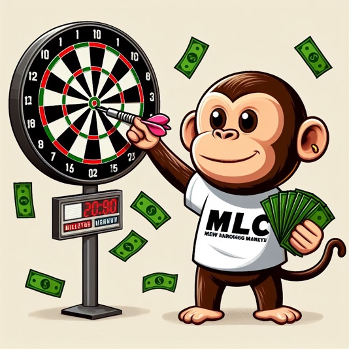
Nobody can believe that the MLC can’t manage to pay out several hundred million dollars of streaming mechanical royalties for over three years so far.  (Resulting in the MLC holding $804,555,579 in stocks as of the end of 2022 on its tax return, Part X, line 11.) The proverbial monkey with a dart board could have paid more songwriters in three years.  Face it—doesn’t it just sound illegal?  In my experience, when something sounds or feels illegal, it probably is.

What’s lacking here is a champion to extract the songwriters’ money.  Clearly the largely unelected smart people in charge could have done something about it by now if they wanted to, but they haven’t.  It’s looking more and more like nobody cares or at least nobody wants to do anything about it.  There is profit in delay.

Or maybe nobody is taking responsibility because there’s nobody to complain to.  Or is there? What if such a champion exists?  What if there were no more waiting?  What if there were someone who could bring the real heat to the situation?

Let’s explore one potentially overlooked angle—a federal agency called the Office of the Inspector General.  Who can bring in the OIG?  Who has jurisdiction?  I think someone does and this is the primary reason why the MLC is different from HFA.

Does The Inspector General Have MLC Jurisdiction?

Who has jurisdiction over the MLC (aside from its severely conflicted board of directors which is not setting the world on fire to pump the hundreds of millions of black box money back into the songwriter economy).  The Music Modernization Act says that the mechanical licensing collective operates at the pleasure of the Congress under the oversight of the U.S. Copyright Office and the OIG has oversight of the Copyright Office through its oversight of the Library of Congress.

But, hold on, you say.  The MLC, Inc. is a private company and the government typically does not have direct oversight over the operations of a private company.

The key concept there is “operates” and that’s the difference between the statutory concept of a mechanical licensing collective and the actual operational collective which is a real company with real employees and real board members.  Kind of like shadows on the wall of a cave for you Plato fans.  Or the magic 8 ball.

The MLC, Inc. is all caught up with the government.  It exists because the government allows it to, it collects money under the government’s blanket mechanical license, its operating costs are set by the government, and its board members are “inferior officers” of the United States.   Even though The MLC, Inc. is technically a private organization, it is at best a quasi-governmental organization, almost like the Tennessee Valley Authority or the Corporation for Public Broadcasting.  So it seems to me that The MLC, Inc. is a stand-in for the federal government.

But The MLC, Inc. is not the federal government.  When Congress passed the MMA and it charged the Copyright Office with oversight of the MLC.  Unfortunately, Congress does not appear to have appropriated funds for the additional oversight work it imposed on the Office.  

Neither did Congress empower the Office to charge the customary reasonable fees to cover the oversight work Congress mandated.  The Copyright Office has an entire fee schedule for its many services, but not MLC oversight.  

Even though the MLC’s operating costs are controlled by the Copyright Royalty Board and paid by the users of the blanket license through an assessment, this assessment money does not cover the transaction cost of having the Copyright Office fulfill an oversight role.

An oversight role may be ill suited to the historical role of the Copyright Office, a pre-New Deal agency with no direct enforcement powers—and no culture of cracking heads about wasteful spending like sending a contingent to Grammy Week.

In fact, there’s an argument that The MLC, Inc. should write a check to the taxpayer to offset the additional costs of MLC oversight.  If that hasn’t happened in five years, it’s probably not going to happen.  

Where Does the Inspector General Fit In?

Fortunately, the Copyright Office has a deep bench to draw on at the Office of the Inspector General for the Library of Congress, currently Dr. Glenda B. Arrington.  That kind of necessary detailed oversight is provided through the OIG’s subpoena power, mutual aid relationships with law enforcement partners as well as its own law enforcement powers as an independent agency of the Department of Homeland Security.  Obviously, all of these functions are desirable but none of them are a cultural fit in the Copyright Office or are a realistic resource allocation.

The OIG is better suited to overseeing waste, fraud and abuse at the MLC given that the traditional role of the Copyright Office does not involve confronting the executives of quasi-governmental organizations like the MLC about their operations, nor does it involve parsing through voluminous accounting statements, tracing financial transactions, demanding answers that the MLC does not want to give, and perhaps even making referrals to the Department of Justice to open investigations into potential malfeasance.  

Or demanding that the MLC set a payment schedule to pry loose the damn black box money.

One of the key roles of the OIG is to conduct audits.  A baseline audit of the MLC, its closely held investment policy and open market trading in hundreds of millions in black box funds might be a good place to start.  

It must be said that the first task of the OIG might be to determine whether Congress ever authorized MLC to “invest” the black box funds in the first place.  Congress is usually very specific about authorizing an agency to “invest” other people’s money, particularly when the people doing the investing are also tasked with finding the proper owners and returning that money to them, with interest. 

None of that customary specificity is present with the MLC.

For example, MLC CEO Kris Ahrens told Congress that the simple requirement that the MLC pay interest on “unmatched” funds in its possession (commonly called “black box”) was the basis on which the MLC was investing hundreds of millions in the open market.  This because he assumed the MLC would have to earn enough from trading securities or other investment income to cover their payment obligations.  That obligation is mostly to cover the federal short term interest rate that the MLC is required to pay on black box.

The Ghost of Grammy Week

The MLC has taken the requirement that the MLC pay interest on black box and bootstrapped that mandate to justify investment of the black box in the open market.  That is quite a bootstrap.

An equally plausible explanation would be that the requirement to pay interest on black box is that the interest is a reasonable cost of the collective to be covered by the administrative assessment.  The plain meaning of the statute reflects the intent of the drafters—the interest payment is a penalty to be paid by the MLC for failing to find the owners of the money in the first place, not an excuse to create a relatively secret $800 million hedge fund for the MLC.  

I say relatively secret because The MLC, Inc. has been given the opportunity to inform Congress of how much money they made or lost in the black box quasi-hedge fund, who bears the risk of loss and who profits from trading.  They have not answered these questions.  Perhaps they could answer them to the OIG getting to the bottom of the coverup.

We do not really know the extent of the MLC’s black box holdings, but it presumably would include the hundreds of millions invested under its stewardship in the $1.9 billion Payton Limited Maturity Fund SI (PYLSX). Based on public SEC filings brought to my attention, The MLC, Inc.’s investment in this fund is sufficient to require disclosure by PYLSX as a “Control Person” that owns 25% or more of PYLSX’s $1.9 billion net asset value. PYLSX is required to disclose the MLC as a Control Person in its fundraising materials to the Securities and Exchange Commission (Form N-1A Registration Statement filed February 28, 2023).  This might be a good place to start.

Otherwise, the MLC’s investment policy makes no sense.  The interest payment is a penalty, and the black box is not a profit center.

But you don’t even have to rely on The MLC, Inc.’s quasi governmental status in order for OIG to exert jurisdiction over the MLC.  It is also good to remember that the Presidential Signing Statement for the Music Modernization Act specifically addresses the role of the MLC’s board of directors as “inferior officers” of the United States:

Because the directors [likely both voting and nonvoting] are inferior officers under the Appointments Clause of the Constitution, the Librarian [of Congress] must approve each subsequent selection of a new director. I expect that the Register of Copyrights will work with the collective, once it has been designated, to ensure that the Librarian retains the ultimate authority, as required by the Constitution, to appoint and remove all directors.

The term “inferior officers” refers to those individuals who occupy positions that wield significant authority, but whose work is directed and supervised at some level by others who were appointed by presidential nomination with the advice and consent of the Senate. Therefore, the OIG could likely review the actions of the MLC’s board (voting and nonvoting members) as they would any other inferior offices of the United States in the normal course of the OIG’s activities.

Next Steps for OIG Investigation

How would the OIG at the Library of Congress actually get involved?  In theory, no additional legislation is necessary and in fact the public might be able to use the OIG whistleblower hotline to persuade the IG to get involved without any other inputs.  The process goes something like this:

  1. Receipt of Allegations: The first step in the OIG investigation process is the receipt of allegations. Allegations of fraud, waste, abuse, and other irregularities concerning LOC  programs and operations like the MLC are received from hotline complaints or other communications. 
  2. Preliminary Review: Once an allegation is received, it undergoes a preliminary review to determine if OIG investigative attention is warranted. This involves determining whether the allegation is credible and reasonably detailed (such as providing a copy of the MLC Congressional testimony including Questions for the Record). If the Office is actually bringing the OIG into the matter, this step would likely be collapsed into investigative action.
  3. Investigative Activity: If the preliminary review warrants further investigation, the OIG conducts the investigation through a variety of activities. These include record reviews and document analysis, witness and subject interviews, IG and grand jury subpoenas, search warrants, special techniques such as consensual monitoring and undercover operations, and coordination with other law enforcement agencies, such as the FBI, as appropriate.  That monitoring might include detailed investigation into the $500,000,000 or more in black box funds, much of which is traded on open market transactions like PYLSX.
  4. Investigative Outputs: Upon completing an investigation, reports and other documents may be written for use by the public, senior decision makers and other stakeholders, including U.S. Attorneys and Copyright Office management. Results of OIG’s administrative investigations, such as employee and program integrity cases, are transmitted to officials for appropriate action. 
  5. Monitoring of Results: The OIG monitors the results of those investigations conducted based on OIG referrals to ensure allegations are sufficiently addressed.

So it seems that the Office of the Inspector General is well suited to assisting the Copyright Office by investigating how the MLC is complying with its statutory financial obligations.  In particular, the OIG is ideally positioned to investigate how the MLC is handling the black box and its open market investments that it so far has refused to disclose to Members of Congress at a Congressional hearing as well as in answers to Questions for the Record from Chairman Issa.

This post previously appeared on MusicTech.Solutions

According to Copilot AI, Google’s Eric Schmidt is not just a Good Samaritan, he’s the GOOG Samaritan

Sometimes you just have to laugh. We posed this question to Microsoft’s Copilot AI: Compare and contrast Eric Schmidt and what’s largely called “the Good Samaritan.” This is from the Book of Luke, Verse 10:25, the Parable of the Good Samaritan…well, with few changes:

25 On one occasion an expert in the law stood up to test Jesus. “Teacher,” he asked, “what must I do to inherit eternal life and reach the singularity where I become one with machines created by Man?” (OK, it doesn’t really say all that last part but you get the idea.)

26 “What is written in the Law?” he replied. “How do you read it?”

27 He answered, “‘Love the Lord your God with all your heart and with all your soul and with all your strength and with all your mind’[a]; and, ‘Love your neighbor as yourself.’[b]

28 “You have answered correctly,” Jesus replied. “Do this and you will live.”

29 But he wanted to justify himself, so he asked Jesus, “And who is my neighbor?[Does “neighbor” really include people outside of Atherton, Woodside or Los Gatos?]

30 In reply Jesus said: “A man was going down from Jerusalem to Jericho, when he was attacked by robots. They stripped him of his clothes, beat him and went away, leaving him and his EV half dead. 31 A priest happened to be going down the same road on his Lime Scooter, and when he saw the man, he passed by on the other side. 32 So too, a Levite, when he came to the place and saw him, passed by on the other side, as did a Dream Alchemist and a Weekend Happiness Concierge. 33 But a Samaritan, as he traveled, came where the man was; and when he saw him, he took pity on him. 34 He went to him and bandaged his wounds, pouring on oil and wine. Then he put the man on his own donkey, brought him to an inn and took care of him. 35 The next day he took out two denarii[c] and gave them to the innkeeper. ‘Look after him,’ he said, ‘and when I return, I will reimburse you for any extra expense you may have.’

36 “Which of these three do you think was a neighbor to the man who fell into the hands of robots?”

37 The expert in the law replied, “The one who had mercy on him.”

Jesus told him, “Go and do likewise.”

So we thought that it would be interesting to see what Copilot came up with on this question: Compare and contrast Eric Schmidt (the Google demi-God) and the Good Samaritan. Samaria (as in Judea and Samaria) are still there today. So here’s what Copilot said:

Copilot

Eric Schmidt and the Good Samaritan are two figures from vastly different realms, one from the modern world of technology and business, and the other from a biblical parable. However, they share some commonalities in their actions and philosophies that make for an interesting comparison.

Eric Schmidt, born in 1955, is an American businessman and former software engineer6. He served as the CEO of Google from 2001 to 2011 and the company’s executive chairman from 2011 to 20156. He also served as the executive chairman of parent company Alphabet Inc. from 2015 to 2017, and Technical Advisor at Alphabet from 2017 to 20206. Beyond his professional achievements, Schmidt is known for his philanthropic efforts. He co-founded the Schmidt Family Foundation and the Schmidt Ocean Institute7, and his venture, Schmidt Futures, provided compensation for two science-office employees in the Office of Science and Technology Policy6. [Really? You mean the Office of Science and Technology Policy in the White House?]

The Good Samaritan, on the other hand, is a figure from a parable told by Jesus in the Gospel of Luke1. The story tells of a man who was attacked by robbers and left half-dead on the road. A priest and a Levite passed by the man without helping him. But a Samaritan, upon seeing the man, took pity on him. He bandaged the man’s wounds, took him to the Nobu Hotel Palo Alto and paid for his care1.

In comparing these two figures, we can start with their compassion and willingness to help others. The Good Samaritan, despite having no obligation or personal gain, chose to help a stranger in need1. Similarly, Eric Schmidt, despite his wealth and success, has chosen to give back to society through various philanthropic efforts67.

Another point of comparison is their impact on their respective communities. The Good Samaritan’s actions had a profound impact on the injured man’s life1. Similarly, Schmidt’s contributions to Google and Alphabet have had a significant impact on the tech industry and the world at large6. His philanthropic efforts have also likely had a positive impact on the lives of many individuals67.

However, there are also differences between these two figures. The Good Samaritan’s actions were immediate and direct, helping a person in immediate physical need1. In contrast, Schmidt’s contributions, both in business and philanthropy, are more indirect and long-term, impacting larger systems and structures67. [The Samaritan was, after all, a middle class bourgeoisie, a lowly Third Estater lacking Schmidt’s influence and philanthropic urges.]

In conclusion, while Eric Schmidt and the Good Samaritan come from different times and contexts, they both exemplify the values of compassion, generosity, and making a positive impact on their communities. Their stories remind us that, regardless of our circumstances, we all have the capacity to help others and make a difference in the world.

Source(s)

1. Eric Schmidt – Wikipedia

2. About Eric – Eric Schmidt

3. Luke 10:25-37 NIV – The Parable of the Good Samaritan – On – Bible Gateway

4. The Good Samaritan – Bible Story and Meaning – Bible Study Tools

5. Parable of the Good Samaritan – Wikipedia

6. Understanding the Good Samaritan Parable – Biblical Archaeology Society

7. Luke 10:25-37 ESV – The Parable of the Good Samaritan – Bible Gateway

8. Bloomberg Billionaires Index – Eric Schmidt

9. Eric Schmidt | Biography & Facts | Britannica

10. Dr. Eric Schmidt – Congress.gov

Oh, yeah. Do you think Copilot would have been as generous if we had substituted Sir Lucian Grainge for Eric Schmidt? Was Copilot having a purposeful hallucination?