

Buy one of these beautiful posters here https://store.moonalice.com/collections/stanley-mouse and help a great artist on the long road to stroke recovery.
Buy one of these beautiful posters here https://store.moonalice.com/collections/stanley-mouse and help a great artist on the long road to stroke recovery.
By Chris Castle
U.S. Representative Darrell Issa and the House Judiciary Subcommittee on Courts, Intellectual Property, and the Internet that he chairs will hold a field hearing on Tuesday, June 27, 2023, at 10:00 a.m. CT at Belmont University, Gabhart Student Center, in Nashville, Tennessee. The hearing, entitled “Five Years Later – The Music Modernization Act,” will focus on the entire blanket licensing regime added to the Copyright Act by the MMA to (1) administer blanket mechanical licenses for “covered activities” (largely streaming) and (2) to collect and distribute compulsory mechanical licensing royalties.
Most importantly, the IP Subcommittee website tells us that “[t]he hearing will also explore whether the legislation is operating as intended by Congress and consider reforms.” So why is this happening and why is it happening right now given everything else that Congress is dealing with.
Congress considers whether to renew The MLC, Inc.‘s designation as the mechanical licensing collective. If that sentence seems contradictory, remember those are two different things: the mechanical licensing collective is the statutory body that administers most of the compulsory license under Section 115 of the Copyright Act that was the entirety of Title I of the Music Modernization Act (aka the Harry Fox Preservation Act). The MLC, Inc. is the private company that was “designated” by Congress through its Copyright Office to do the work of the mechanical licensing collective. This is like the form of a body that performs a function (the mechanical licensing collective) and having to animate that form with actual humans (The MLC, Inc.). The MLC, Inc. was designated by the Copyright Office in 2019.
Congress reviews the work product of The MLC, Inc. every five years (17 USC §115(d)(3)(B)(ii)) to decide if Congress should allow The MLC, Inc. to continue another five years. That is, Congress has the right to fire The MLC, Inc. and find someone else if they fail to perform. Hence, “Five Years Later” in the title of the field hearing. This process is called “designation” or “redesignation” and is performed for Congress by the U.S. Copyright Office in their soft oversight role.
That five year period is actually up next year, so Congress may be getting an early start to identify performance benchmarks for The MLC, Inc. so that the Copyright Office doesn’t have to wing it. If you have some thoughts about what The MLC, Inc. could be doing better or is doing well, you have a chance to write to your representative or even members of the subcommittee before (or after) the June 27 hearing and let them know.
The witness list is well-chosen and seems unlikely to produce the usual propaganda from the controlled opposition that the lobbyists usually try to spoon feed to lawmakers:
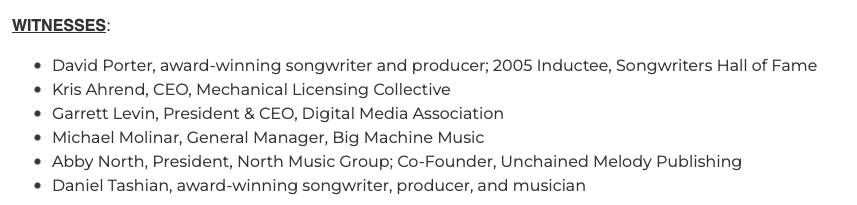
I have a few concerns myself.
By Charles J. Sanders
We’ve all seen the headlines from around the world. Musicians, songwriters and composers attacked as rabble-rousers and enemies of the state. Singers arrested, their performances banned as un-patriotic or sacrilegious. We’ve even seen lethal attacks committed against music creators for refusing to perform, or simply for attempting to entertain, not even to proselytize or lampoon. And just in the past few days, we have seen legal action instituted by a foreign global power against the performance of domestic protest music on a global basis.
No matter our individual political or musical affiliations, the mission of the American music community is clear. We must quickly and effectively formulate ways to help curb this global, governmental trend of singling out artists and music creators for punishment, due in large measure to the perceived, “dangerous” power of music. Case in point:
In 2019, amid civil unrest in Hong Kong over Chinese Government efforts to crack down on what it deems unacceptable speech, a pro-Hong Kong Independence movement leader known only by the pseudonym “Thomas dgx yhl” penned a song known as “Glory to Hong Kong.” The composition was immediately embraced by Hong Kong street protesters, translated into various languages on the Internet, and eventually widely recorded and distributed. In short order, those recordings were being played not only on the Net but in Hong Kong shopping malls and at sporting events and other gatherings, prompting public sing-alongs that have increasingly alarmed Chinese Government officials in Beijing.[1]
Two weeks ago, on June 5, 2023, the Beijing-aligned Government of Hong Kong announced it had heard enough. Having previously banned the secessionist anthem “Liberate Hong Kong” after protests began in 2019, it went to court seeking an even broader injunction against “Glory to Hong Kong” that if granted would bar performance, broadcast, and distribution of the song throughout China (and potentially lead to the punishing of Chinese citizens and companies operating in China for violating the ban elsewhere in the world). According to the Government’s court submissions, the song’s lyrics are meant to provoke secessionist acts in violation of Chinese law, and the court should act to eliminate the dangerous confusion that has been caused by the “mistaken use” of the song in place of the official Chinese national anthem at local and international events in Hong Kong and elsewhere.[2] Court hearings are scheduled to resume in Hong Kong on July 21, 2023.
As is often the case when governments attempt to ban musical works, the song instantly skyrocketed in popularity. Within days of the court filing, “Glory to Hong Kong” topped the Apple iTunes charts, which may have resulted in further governmental action behind the scenes. The original version of the song recorded by DGX Music (presumably related to Thomas dgx yhl) has now reportedly been pulled from global music streaming platforms such as Spotify, Apple Music, Facebook and Instagram’s Reels system. According to DGX, the disappearance of its version from these services is due to the company’s “dealing with some technical issues related to streaming platforms,” and it expressed regret for this “temporary” issue. The specter of likely governmental coercion against the creator(s), the label and its distributors, however, continues to hang heavily over the entire incident.
Obviously, what we are witnessing in real time is yet another in a nearly endless series of attempts by governments and powerful interests around the world to forcibly remove politically contentious musical works from the public sphere and punish their creators.
This past March, the National Music Council of the United States (NMC), in partnership with the International Music Council (IMC) based in Paris, explored the historical roots of this phenomenon in the hopes of helping the world-wide music community to fashion strategies for ensuring more effective, speech-related protections for music creators in the future. The NMC’s extensive briefing papers for the symposium trace the long litany of repression and coercion against individual creators who used their music to protest social and political injustice, including the murder by the extreme right-wing Pinochet regime in Chile of folksinger Victor Jara, the genocide carried out against Cambodian musicians and composers by the extreme left-wing Khmer Rouge Regime, and the attempted erasure of Native American/First Nation/Aboriginal music and culture by Constitutional democracies including the United States, Canada, the UK and Australia—efforts that often resulted in the brutal deaths of those who resisted.[3]
Music-based repression and coercion, the NMC concluded, are clearly global problems unlimited by either their political or geographic origins:
Music’s dual, facile ability to serve as both a powerful tool of propaganda and as an existential threat to power structures and political leaders has made it a prime focus of nervous governmental concern over the entire span of history….[M]usic creators and performers have [thus] not only been frequently subject to pressure to conform and participate in governmental propaganda efforts, but also to repressive actions up to and including murder to enforce the silence of those dangerous, high-profile individuals who will not comply. In many cases, this effectively neuters the most persuasive voices of protest, while at the same time setting an example of what happens to those less visible citizens who choose dissent. The repression of music and creators is a government’s way of warning all of its people, “if this is what we’ll do to them, imagine what we’ll do to you.”
For the American music creator community, it’s that last point that should be our initial, paramount concern. While we may argue over whether certain a musical expression (other than outright hate speech) constitutes patriotism or treason, it is incumbent upon us to champion the position that violence and imprisonment for expressing unpopular views should not be imposed on any person by any government, anywhere. Though speech freedom advocates may argue for a far broader effort to protect free musical expression –and in the future that may come– job one is to protect the lives and liberties of music creators who have been singled out today for political punishment.
How? By not remaining silent.
At the NMC/IMC symposium, international experts and activists such as Ole Reitof of UNESCO, Julie Trébault of the Artists at Risk Coalition, Mark Ludwig of the Terezin Music Foundation, Dr. Ahmad Sarmast of the Afghanistan National Institute of Music, and Arn Chorn Pond of the Cambodian Living Arts organization, all agreed on the opportunities for the US music community to protect fellow, global music creators and performers from official repression by speaking out in appropriate ways. Their advice may be distilled to three basic principles:
First, do no harm. This Hippocratic starting point for every effort to assist requires that all international actions must be carefully calibrated to avoid backlash against the endangered individual or group, and should be undertaken only in consultation with those knowledgeable about the local intricacies related to each incident.
Second, take action by shining a spotlight in the United States on the most egregious cases of music suppression wherever in the world they take place. Write letters to the White House, to Congress, and to the US State Department and the US Trade Representative concerning individual cases, requesting that the US Government take appropriate steps to save the lives and freedoms of those at risk. (Other actions may be contemplated, but only after the “no harm” principle has been fully strategized).
Third, for those not willing or unable to take such actions, lend support to organizations engaged directly in protecting the lives and liberties of members of the music community around the world.[4]
Artistic activism and the defense of it will never be an act of courage devoid of risk. The ability in the US to speak out on such issues principally without fear of government reprisal, however, places on us a special responsibility to shine that brighter light on these escalating injustices and attacks. Our community’s responsibilities are to ensure that such anti-democratic activities not remain hidden in the shadows, no matter where in the world they occur—including within our own borders.
If history has taught us one thing about the persecution of artists and creators, it is that silence is neither an effective nor an acceptable strategy.
Charles J. Sanders
Chair, The National Music Council of the United States
[1] An English language version of the song is accessible at https://www.youtube.com/watch?v=6yjLlYNFKCg.
[2] Hong Kong, a former British protectorate the rule over which was transferred to Beijing in 1997, has continued to maintain its own political and economic systems for the past quarter-century. Within the past decade, however, the Government of China has concentrated its efforts on bringing Hong Kong more closely in line with Beijing’s governing philosophies—including the stricter control of political speech. In its submission to the court, the Government pre-emptively sought to quash accusations of censorship by asserting that Beijing “respects and values the rights and freedoms protected by the Basic Law (including freedom of speech), but freedom of speech is not absolute…. The application pursues the legitimate aim of safeguarding national security and is necessary, reasonable, legitimate, and consistent with the Bill of Rights….”
[3] See, https://www.musiccouncil.org/music-politics-history/. The author of this statement was also the author of the Briefing Papers on behalf of the NMC.
[4] For a list of some non-profit organizations engaged in such activities, see, https://www.musiccouncil.org/protecting-free-speech-in-the-global-music-landscape/
Also read Associated Press “Former Bytedance executive says Chinese Communist Party tracked Hong Kong protesters via data” (Bytedance is the parent company of TikTok.)
Spotify follows bidding of tyrannical Chinese Communist Party while long time Hong Kong freedom fighter Jimmy Lai rots in prison after show trial.

If you’re like us, you have an office pool on who will win the eagerly anticipated release of the MLC’s 2022 tax return! “Winning” in this case means who will get the biggest salary and bonus bump–for what, we’re not sure, but don’t that stop anything.
Based on the MLC’s 2020 tax return, these employees were the only ones disclosed:
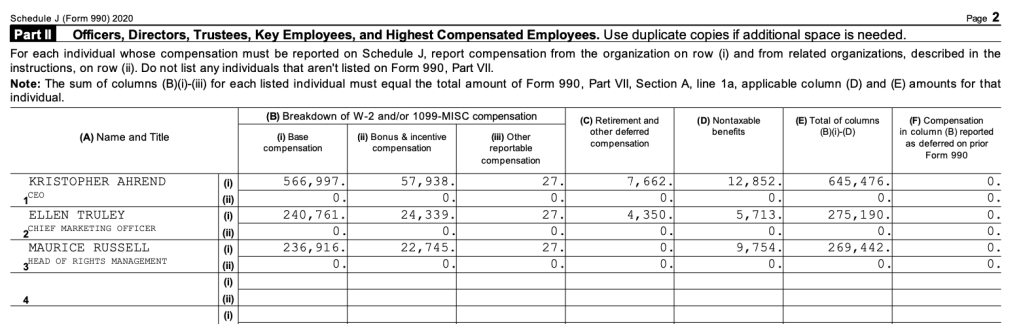
But on the 2021 tax return, the MLC must have exceeded expectations so much that everyone got a raise and they staffed up! Nothing but blue skies on the sunlight uplands!
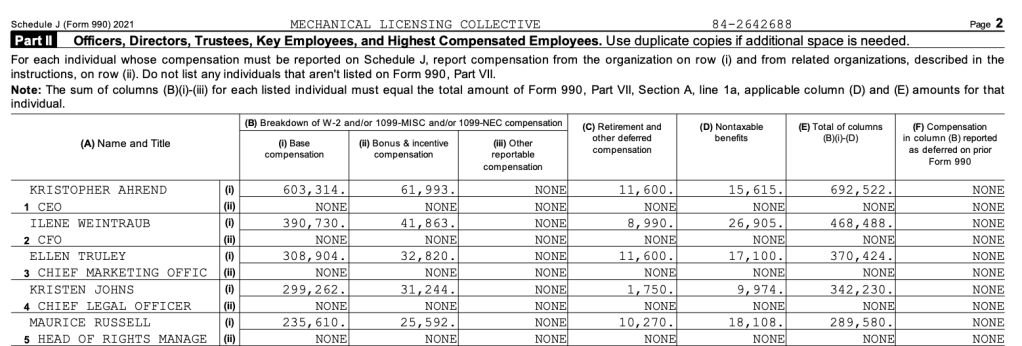
CEO Kris Ahrend went from a mere $566K a year base with a $57K bonus in 2020 to $603K base and an even bigger bonus in 2021. Ellen Truley also had a fantastic year with her base moving like a rocket from a mere $240K to $308K! During COVID!! And her bonus practically doubled. But for some reason Maurice Russell’s salary actually declined slightly from $236K to $235K, but maybe they pushed it into his bonus which rose from $22K to $25K.
But stay tuned for the 2022 results and maybe bet the trendline going up, because the MLC gets a statutory cost of living adjustment that is not based on performance! Just like streaming royalties they administer!
No wait–the MLC gets the cost of living adjustment not the songwriters, sorry. No, remember that songwriters are told that they will do better if the services do better on revenues. Not on the services’ stock price, but rather on revenues for people who never raise their prices but make millions on selling stock. Except for the physical royalty paid by the labels that agreed to give the songwriters they depend on a higher mechanical rate AND a cost of living bump. But these trillion dollar market cap Big Tech music users don’t ever include the real money in the rising tide that sinks all boats with the trickle down royalty. But we’re told to put it all on red and let it ride.
But we’re glad that the MLC employees are so well compensated and that their salaries are protected in the highest inflation in 40 years with that built-in inflation adjustment.
Chris Castle says: If you are seeing contract language that allows the other side to use your name, image, likeness, voice, etc., take a close look at the rights granted. It may not be that obvious. Like all other configuration changes in the past, artists, producers and songwriters need to look at their existing agreements and see how old language will be interpreted to cover AI.
Example: Label will have (i) exclusive record artwork merchandising rights; and (ii) exclusive rights to sell merchandise embodying three (3) exclusive designs per contract period, alone and in conjunction with Artist’s names and approved pictures, likenesses and other identifications, subject to Artist’s approval with respect to such matters as product design and manufacturing.
“in conjunction with”, “other identifications” and “approval with respect to such matters as” each take on new meaning.
Example: Artist acknowledges that Label is the exclusive owner of all rights of copyright in Masters and Records embodying the results and proceeds of Artist’s recording services made pursuant to the Recording Agreement or during its term, including the exclusive right to copyright same as “sound recordings” in the name of Label, to renew and extend such copyrights (and all rights in and thereto are hereby assigned to Label), and to exercise all rights of the copyright proprietor thereunder as provided in the Recording Agreement.
Recordings “made pursuant to the Recording Agreement or during its term” could mean AI works.
Example: As used in this agreement, “Other Entertainment Services” shall mean any and all entertainment industry activity that are not otherwise provided for in this recording agreement, including, without limitation, the following: (a) the exploitation in any and all media of the name(s) likeness(es), visual representations, biographical material and/or logo(s) of or relating to Artist or any member of Artist (all of the intellectual properties relating to Artist referred to above are sometimes referred to herein collectively and individually as “Artist Properties”), either alone or in conjunction with other elements, including without limitation merchandise for sale at the site(s) of any and all live concert engagements performed by Artist or any member of Artist, premiums such as products which bear a third party’s trademarks or logos together with Artist Properties, tie-ins, “bounceback” merchandising, and fan club merchandise, whether or not in connection with Master Recordings, including, without limitation, exploitation by any Person other than Label of any rights granted in this recording agreement; (b) endorsements, special marketing arrangements, sponsorships (including tour sponsorships), strategic partnerships or other business relationships with third parties; (c) live performance engagements as a musician, vocalist and/or performer by the Artist or any member of Artist in all media, including but not limited to musical performances on tour, in concerts, on television broadcast or cable casts (including pay-per-view telecasts), radio, “webcast” and all other means.
| Washington, DC—Today, Copyright Alliance CEO Keith Kupferschmid issued the following statement in support of the Biden administration’s announcement that Deborah Robinson has been nominated to be the next Intellectual Property Enforcement Coordinator (IPEC): “The position of Intellectual Property Enforcement Coordinator (IPEC) is crucial to the United States’ continued strong and effective support for intellectual property (IP) laws and policies, both here and abroad. The Copyright Alliance is pleased to learn that the White House has nominated Deborah Robinson to be the next IPEC and urges the Senate to expeditiously consider and approve her nomination. “Deborah Robinson is an accomplished attorney, experienced IP content and protection specialist, and former prosecutor who has real world experience. We are confident that, upon Senate confirmation of her nomination, she will do a tremendous job in this very important role as she works to further IP protections across the country.” |
| ### |
| ABOUT THE COPYRIGHT ALLIANCE: The Copyright Alliance is a non-profit, non-partisan public interest and educational organization representing the copyright interests of over two million individual creators and over 15,000 organizations in the United States, across the spectrum of copyright disciplines. The Copyright Alliance is dedicated to advocating policies that promote and preserve the value of copyright, and to protecting the rights of creators and innovators. For more information, please visit our website. |
We knew this would happen. The Copyright Office has empowered the Mechanical Licensing Collective to decide whether a song (or a sound recording) can be copyrighted all under the guise of AI. If the MLC–not the Copyright Office–decides that your song is not capable of being registered for copyright, the MLC can hold your money essentially forever.
Where’s the regulation on this important subject? Did you get a chance to comment on these crucial regulations and precedent?
Ah…no. You didn’t miss any notices in the Federal Register. No, we know this because of this cozy “guidance letter” to MLC CEO Kris Ahrend from the general counsel of the Copyright Office. That’s right, a letter that we just happened to run across. That letter states:
More specifically, the Office advises that a work that appears to lack sufficient human authorship is appropriately treated by The MLC as an “anomal[y],” consistent with its Guidelines for Adjustments, and The MLC should “place [associated] Royalties in Suspense while it researches and analyzes the issue.” Such research could include corresponding with the individual or entity claiming ownership of the work or [could include] inquiring whether the Office has registered the work and whether there are any disclaimers or notes in the registration record.
If The MLC subsequently concludes that the work qualifies for copyright protection and the section 115 license, it should distribute any royalties and interest in suspense to the copyright owner. Alternatively, if The MLC believes that the work does not qualify for copyright protection following its research and analysis, it should notify the individual or entity claiming ownership of the work of its determination and that associated royalties will be subject to an adjustment. This conclusion and adjustment may be challenged by initiating an “Adjustment Dispute” consistent with The MLC’s policies. If legal proceedings are initiated to challenge The MLC’s actions, the disputed royalties and interest should remain suspended until those proceedings are resolved.
So just in one paragraph, the Copyright Office has effectively delegated its role in the U.S. government to a private corporation controlled by the largest music publishers and financed by the largest tech companies in the world (actually the largest corporations in the history of commerce). If the MLC decides that your song “appears to lack sufficient human authorship” The MLC can hold your money while they research the issue.
Note this doesn’t say who makes that decision, it doesn’t say when they have to notify you, it doesn’t say they have to give you an opportunity to be heard, it places no timeline on how long all this may take. “The MLC” (whoever that is) could sit on your money for years without ever telling you they are doing it and also keep invoicing the DSPs for your royalties while they “research and analyze the issue”.
The only time they have to give you notice if they “believe” (whatever that means) “that the work does not qualify for copyright protection” then “it should” (not the mandatory “shall”, but the permissive “should”) notify you of that determination. You can then file an “adjustment dispute” based on the MLC’s own guidelines which you will not be surprised to learn places no disclosure obligations on them, imposes no timeline and cannot be appealed.
Note that this guidance from the Copyright Office pretty expressly contemplates that the MLC may dispute a work that has already been registered for copyright without qualification–which raises the question of what a copyright registration actually means, and where is it written that the MLC has the authority to challenge a conformed Copyright Office registration.
It also places the MLC in a superior position to the Copyright Office because it allows the MLC to initiate a dispute resolution system outside of the Copyright Office channels. Is this written somewhere besides a burning bush on Mount Horeb?
The letter does seem to suggest that you can always sue the MLC or that the MLC could be prosecuted for state law crimes, perhaps, like conversion, but it would help to know who at the MLC is actually responsible.
This also raises the question of why the MLC is invoicing the DSPs in the first place and what happens to the money every step along the path. Because of the idiotic streaming mechanical royalty calculation, it seems inevitable that the royalty pool will be overstated or understated if the MLC is claiming works that are not subject to copyright (like it would for public domain works it invoiced).
Ever wonder what prompts letters like this to get written?
Play your part, dude. Go back to sleep.
By Chris Castle
[This post first appeared on MusicTechPolicy]
We are told that artificial intelligence is a powerful tool that may end up being either the end of humanity through automated super soldiers making autonomous decisions regarding their own AI devised rules of engagement, or life saving medical procedures and diagnostic tools like House meets HAL. As usual–both outcomes are probably equally likely if humanity doesn’t keep the deus in the machina. We really don’t want them thinking “Hell is other machines.”

The question I have is how will we keep humanity around when companies like Google are hell-bent on achieving the Singularity ASAP. This is particularly true of creators–let’s not kid ourselves that the Google Books project was some altruistic motivation to build the digital library of Alexandria rather than a massive digitization project to build a large language model to train artificial intelligence through corpus machine translation. And still is. As Kurt Sutter (show runner for Sons of Anarchy) taught us about Google, “[t]he truth is, they don’t give a shit about free speech, and are the antithesis of their own mantra, ‘Don’t be evil.’” That was 2014 and boy was he right. And he still is. It’s not just Google, but Google is emblematic of Silicon Valley.
One of the lessons we learned from the 1990s is the calvary is not coming. We have to take our own steps to work both cooperatively and defensively against a tech threat. The Human Artistry Campaign and its AI Principles effort is a hopeful indicator that the creative community and its partners are coming together to get ahead of both the threat and the promise of AI.
Let’s not forget that it’s not just about us, it’s also about the fan, our “consumers” if you will. The biggest threat to creators in my view is destroying the relationship of trust that exists between fans and creators. If AI can allow a machine to impersonate a creator, that deception harms the creator, surely. But it also harms the fan.
One of the AI principles from the Human Artistry Campaign jumped out at me as addressing this vital issue:
- Trustworthiness and transparency are essential to the success of AI and protection of creators.
Complete recordkeeping of copyrighted works, performances, and likenesses, including the way in which they were used to develop and train any AI system, is essential. Algorithmic transparency and clear identification of a work’s provenance are foundational to AI trustworthiness. Stakeholders should work collaboratively to develop standards for technologies that identify the input used to create AI-generated output. In addition to obtaining appropriate licenses, content generated solely by AI should be labeled describing all inputs and methodology used to create it — informing consumer choices, and protecting creators and rightsholders.
Informing consumer choices. For a moment forget the artistic integrity, forget the human intervention, forget the free riding, just for a moment because these are all vital issues, too. At the core of the AI problem is deception and that issue is as old as time. You can’t essentially deceive fans about the origin of a work and you certainly can’t build a machine that does this all the livelong day and pretend you didn’t.
In Book 2 of Plato’s Republic, he uses the legend of a magic ring that turns the bearer invisible to illustrate a dialog on the nature of justice. The ring turns the wearer invisible so that they are capable of doing all manner of things while invisible–or anonymous–that would clearly be both unjust and punishable without the ring. Plato asks if an act is unjust solely because you get caught or is it unjust regardless of whether you are hidden from sight or apprehension. Yep, those Greeks were onto this early.
Deception is not genius. At the core of our concerns about AI is keeping them honest to protect our fans and the bedrock of the creator-fan relationship. Consumers should be able to rely on the reality of what appears to be an artist’s work that it actually does come from that artist.
We do this with almost any other product or service that is placed into commerce, so why not with creative works? After all, artist rights are human rights.
We were happy to endorse the AI principles and encourage you to find out more about it at the Human Artistry Campaign or Artist Rights Watch and sign the petition.
 The Trichordist
You must be logged in to post a comment.