Selected Comments on the Copyright Office Proposed Rule on Termination Rights and MLC Operations: North Music Group

The Copyright Office has asked for comments from the public on important issues for rulemakings under the Music Modernization Act. This will potentially affect the operations of The MLC and related rights especially because the Copyright Office recently extended the scope of that rulemaking. The proposal drew a mixed response.

We will be posting selected comments that we think might be interesting to Trichordist readers. The project is a bit wonky, but important to stay informed on.

This comment to the Copyright Office from Abby North of North Music Group raises important issues including whether the MLC should have the ability to create disputes on its own, what happens to samples, interpolations and medleys, and the need for substantial consultations by the Copyright Office with rights holders large and small.

Abby’s thesis is:

The Supplemental Proposed rule is simply too broad.  Without customary Copyright Office consultations with industry working groups and roundtables to allow stakeholders to participate in the decision-making, the Office runs the risk of creating rules that are contrary to music publishing industry practices and costly to implement administratively. Further, without extensive consultation and revisions, it is nearly impossible to avoid unintended consequences as we are currently experiencing with the unreimbursed transaction costs imposed on publishers and songwriters of verifying and correcting data at The MLC.

Neither the first proposed rule, nor the supplemental rule addresses termination in the context of interpolations and medleys. If a work that has been terminated was included as an interpolation into another work prior to termination, the songwriter’s post-termination publisher or administrator should be able to terminate related to the interpolated work as well. 

There must be a mechanism for the songwriter and/or his/her post-termination publisher or administrator to notify The MLC of derivative interpolations/samples and medleys and become the royalty recipient for the applicable share of mechanicals generated by those works.

This proceeding raises the question of whether The MLC itself should have standing to initiate a dispute when no stakeholder has done so.  Due to the absence of rules and due process applicable to The MLC, it seems that The MLC should be prohibited from creating disputes on its own motion.  Alternatively, if The MLC is the party initiating a dispute, there should be some process and constraints applicable to its actions.  This might include limiting any review by The MLC to a fixed time to complete a review. The Office should define what that review entails; notice requirements so that copyright owners are made aware that The MLC is initiating a dispute on its own; under what circumstances The MLC is permitted to hold the funds of a copyright owner; where those funds are to be held (such as a segregated bank account); and how the MLC’s decision must be communicated to copyright owners and how copyright owners can appeal.  The MLC should not be allowed to interrupt the payment of royalties based on mere suspicion.  

Following is Abby’s entire comment.

Hon. Suzanne V. Wilson
General Counsel and Associate Register of Copyrights
U.S. Copyright Office
101 Independence Avenue, S.E.
Washington D.C. 20559-6000

Re: Termination Rights And The Music Modernization Act’s Blanket License: Response to Request For Public Comments Regarding Supplemental Notice of Proposed Rulemaking – The Applicability of the Derivative Works Exception To Termination Rights Under the Copyright Act To the New Statutory Mechanical Blanket License Established by the Music Modernization Act (“MMA”).

FR  Doc. 2023-20922
Docket No. 2022-5

Dear Associate Register Wilson:

I appreciate the opportunity to submit comments in response to the Supplemental Notice of Proposed Rulemaking regarding the applicability of the derivative works exception to termination rights under the Copyright Act.

I am a music rights manager who represents many estates and legacy songwriters and composers who have exercised, and plan to exercise their right to recapture their copyrights.

As interactive streaming has clearly become one of the biggest sources of royalty income for music publishers and songwriters, it is imperative that not only the derivative work exception be clarified related to the Section 115 Blanket Mechanical License, but further, the rules and processes The MLC follows in navigating distribution of royalties and dispute resolution after a termination has been perfected must also be defined.

ORIGINAL PROPOSED RULE VS. SUPPLEMENTAL PROPOSED RULE

The original proposed rule specifically addressed the issue of the Section 115 statutory blanket license not having a derivative work exception. Clarification is/was required, which the proposed rule provides.

The Supplemental Proposed rule is simply too broad.  Without customary Copyright Office consultations with industry working groups and roundtables to allow stakeholders to participate in the decision-making, the Office runs the risk of creating rules that are contrary to music publishing industry practices and costly to implement administratively. Further, without extensive consultation and revisions, it is nearly impossible to avoid unintended consequences as we are currently experiencing with the unreimbursed transaction costs imposed on publishers and songwriters of verifying and correcting data at The MLC.

RECIPIENT OF ROYALTIES POST-TERMINATION

For example, the Proposed Rule states that royalties under the blanket license should be distributed to the owner at the time of usage, rather than to the owner at the time of royalty distribution.  If the work has been claimed and matched to recordings by copyright owners, and there is a post-term collection period and the usage occurred during the term of that post-term collection period, the original grantee should receive the royalties. If the post-term collection period has ended, or there was no post-term collection period, the post-termination publisher should be the royalty recipient.

Once a songwriter/composer terminates his/her agreement with a publisher, that publisher no longer is the assignee of that songwriter’s copyrights, and consequently should not be the recipient of the songwriter’s mechanicals. While most publishers continue to distribute applicable post-term royalties they receive to songwriters whose agreements have terminated, they do so as a courtesy, but they may decide to stop doing so. If a songwriter ends a relationship with a publisher because the publisher exhibits weak administration skills or the business relationship was unfavorable, it is simply unfair to the songwriters to require them to continue a relationship with that publisher.

If the original grantee neglected to claim works and match to recordings during its term, but the post-termination publisher administers comprehensively and does claim and match, that post-termination publisher should be the recipient of the royalties once the post-term collection period has ended. Currently, the burden and cost to “play our part” is placed on the publishing administrators. However, because of the amount of time and resources (both human and tech) required to efficiently, accurately and comprehensively claim and register musical works and then match those works to all the recordings of the works, some publishers cannot afford to do the work. Often, larger publishers prioritize the highest earning works, simply because resources are limited even for them. If the post-termination publisher, who faces the same limitations in resources does put in the work, does register and claim the works that were not comprehensively and accurately registered or claimed, and does perform the very time-consuming process of manually matching recordings to those works to “play our part,” certainly that publisher should be compensated for its time and efforts.

SAMPLES/INTERPOLATIONS AND MEDLEYS

Neither the first proposed rule, nor the supplemental rule addresses termination in the context of interpolations and medleys. If a work that has been terminated was included as an interpolation into another work prior to termination, the songwriter’s post-termination publisher or administrator should be able to terminate related to the interpolated work as well. 

This language in 17 USC §304(c)(5) suggests that a voluntary agreement (such as an interpolation agreement) does not trump the right of termination:

 Termination of the grant may be effected notwithstanding any agreement to the contrary, including an agreement to make a will or to make any future grant.

There must be a mechanism for the songwriter and/or his/her post-termination publisher or administrator to notify The MLC of derivative interpolations/samples and medleys and become the royalty recipient for the applicable share of mechanicals generated by those works.

DISPUTE RESOLUTION

The Proposed Supplemental Rule sets forth three Dispute Resolution scenarios. Each of these attempts to facilitate resolution when the dispute is between or among rightsholders. The third scenario attempts to prevent disputed funds from being held indefinitely. If the parties to a dispute do not voluntarily agree on a resolution, the Proposed Supplemental Rule requires that the party initiating the dispute must commence a legal proceeding to maintain the hold. In my experience, copyright litigation will always arbitrarily favor the better funded party and should not be the default dispute resolution tool.

There needs to be a timeline imposed for the scenario in which the party collecting royalties does not respond to the dispute. If there is no response within a fixed period of time, such as 90 days, I recommend The MLC begin distributing these royalties to the party initiating the dispute, both retroactively and prospectively. This approach will help to incentivize parties to participate in the dispute resolution.

Further, this proceeding raises the question of whether The MLC itself should have standing to initiate a dispute when no stakeholder has done so.  Due to the absence of rules and due process applicable to The MLC, it seems that The MLC should be prohibited from creating disputes on its own motion.  Alternatively, if The MLC is the party initiating a dispute, there should be some process and constraints applicable to its actions.  This might include limiting any review by The MLC to a fixed time to complete a review. The Office should define what that review entails; notice requirements so that copyright owners are made aware that The MLC is initiating a dispute on its own; under what circumstances The MLC is permitted to hold the funds of a copyright owner; where those funds are to be held (such as a segregated bank account); and how the MLC’s decision must be communicated to copyright owners and how copyright owners can appeal.  The MLC should not be allowed to interrupt the payment of royalties based on mere suspicion.  

If the MLC fails to comply with these rules or cannot demonstrate good cause to continue to hold funds, or if the copyright owner appeals, The MLC should then release funds to the copyright owner or The MLC member with which it initiated the dispute and pay applicable royalties prospectively.

In conclusion, I acknowledge that some stakeholders in the music industry are anxious for resolution and would prefer not to have a protracted process. To that end, I recommend the Copyright Office finalizes the original proposed rule that specifically clarified the derivative works exception. However, The Copyright Office should pause the process related to the Supplemental Rule and its many very complex and nuanced elements that go beyond clarifying the derivative works exception. The industry must be given time and a process to evaluate and report on the impact of the Proposed Supplemental Rule. 

It is essential that the Copyright Office conducts a consultation on the Rule with a very substantial table with seats for many more voices that have experience in royalty distribution and dispute resolution. Experts and songwriter advocates must be given the opportunity to assist in the creation of the royalty distribution and dispute resolution processes and systems. It is crucial to take the necessary time to evaluate and prevent unnecessary or unintended consequences. To prevent complications, errors, and the need for even more clarifying Rules, we absolutely must get this right from the start.

I am thankful for the opportunity to express my views and concerns.

Best,

Abby North, North Music Group                   

BMI’s Insult that Keeps On Insulting! @hypebot: Radio doesn’t pay performers, but iHeart will get $100M from BMI sale to Google/Private Equity

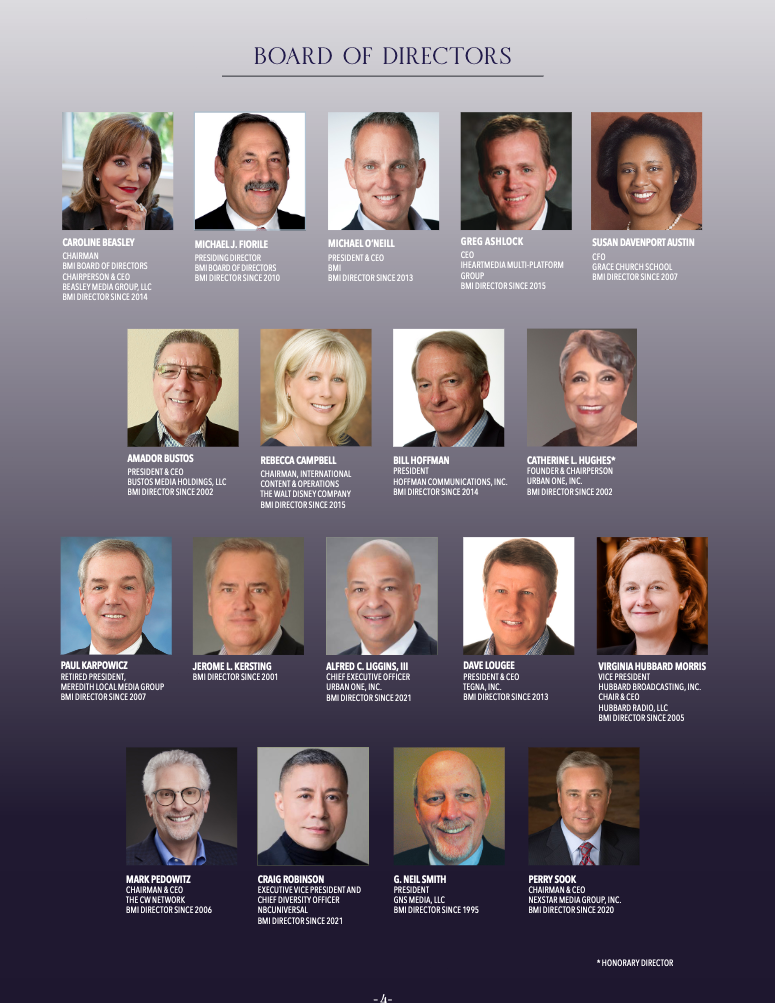
[T Editor sez: Remember how we have all fought alongside #IRespectMusic, Blake Morgan and MusicFirst to get artists paid for radio play of their recordings on terrestrial radio? Remember how iHeartMedia and the rest of the National Association of Broadcasters used their lobbying muscle to block our heroes in Congress like Reps. Jerry Nadler, Ted Deutch, and Darrell Issa and Senators Marsha Blackburn and Alex Padilla from passing the American Music Fairness Act? And are blocking it to this day? Well, adding insult to injury, the broadcasters who apparently own BMI, the for-profit PRO, are making serious bank for selling their shares to Google and private equity fund New Mountain. You know, Broadcast(er) Music, Inc.? Thus screwing songwriters, but screwing artist/songwriters TWICE. Who are they? According to the most recent BMI annual report we could find they are probably the same companies with board seats which are these smiling faces:

Bruce Hougton at Hypebot fills us in on the details of just how profitable the sale for Google’s blood money really is for one stockholder owner of BMI, iHeart Media (formerly Clear Channel). iHeart is, of course, the largest radio station owner in the US and poster child for media consolidation and screwing artists. iHeart profits from blood money stealing from artists and then does it again stealing from songwriters. And if iHeart is doing it, the rest of the BMI owners are, too. Of course you can complain to your songwriter-board member of BMI…oh wait, you don’t have any. Unlike ASCAP and SoundExchange. Of course, the question is whether those Members of Congress who worked so hard on the American Music Fairness Act and its predecessors will exercise their oversight role and investigate the sale. As well as the series of moves that lead to Google acquiring songwriter personal data that we don’t think belonged to BMI in the first place. It may not just be insulting, it may also be illegal. And answer the musical question, how big is your black box?]

 In an ironic twist, iHeart Media, the largest owner of broadcast radio stations in the US, will receive $100 million from the sale of BMI to New Mountain Capital [and Google’s CapitalG venture fund]. The windfall is a result of iHeartMedia’s equity interest in BMI.

Read Bruce’s post on Hypebot

Selected Comments on the Copyright Office Proposed Rule on Termination Rights and MLC Operations: SpiritMusic

The Copyright Office has asked for comments from the public on important issues for rulemakings under the Music Modernization Act. This will potentially affect the operations of The MLC and related rights especially because the Copyright Office recently extended the scope of that rulemaking. The proposal drew a mixed response.

We will be posting selected comments that we think might be interesting to Trichordist readers. The project is a bit wonky, but important to stay informed on.

Spirit’s thesis:

We commend the US Copyright Office (USCO) for its highly regarded work in protecting rightsholders and their intellectual property rights. Your efforts have achieved great strides to prevent the misuse and abuse of music copyrights.

Although the [Notice of Proposed Rulemaking]’s original intent was to address the ambiguity in certain aspects of the Termination Right, the USCO’s extension of the scope beyond Termination Rights disrupts standard practices that have been long tested and put into practice by rightsholders. The administrators of copyrighted material are best suited to understand the most current and pragmatic business practices. As such, the administrators should be the ones to establish the day-to-day standards of copyright administration and to make the recommendations pertaining to the administration of copyrights and their respective payments at the MLC.

We believe the administrators’ standard practices and pragmatic solutions must be considered.

Must Read Post by @ednewtonrex on Why He Resigned from Stability AI Over Fake Fair Use Defense

I’ve resigned from my role leading the Audio team at Stability AI, because I don’t agree with the company’s opinion that training generative AI models on copyrighted works is ‘fair use’. 

First off, I want to say that there are lots of people at Stability who are deeply thoughtful about these issues. I’m proud that we were able to launch a state-of-the-art AI music generation product trained on licensed training data, sharing the revenue from the model with rights-holders. I’m grateful to my many colleagues who worked on this with me and who supported our team, and particularly to Emad for giving us the opportunity to build and ship it. I’m thankful for my time at Stability, and in many ways I think they take a more nuanced view on this topic than some of their competitors. 

But, despite this, I wasn’t able to change the prevailing opinion on fair use at the company. 

This was made clear when the US Copyright Office recently invited public comments on generative AI and copyright, and Stability was one of many AI companies to respond. Stability’s 23-page submission included this on its opening page: 

“We believe that Al development is an acceptable, transformative, and socially-beneficial use of existing content that is protected by fair use”. 

For those unfamiliar with ‘fair use’, this claims that training an AI model on copyrighted works doesn’t infringe the copyright in those works, so it can be done without permission, and without payment. This is a position that is fairly standard across many of the large generative AI companies, and other big tech companies building these models — it’s far from a view that is unique to Stability. But it’s a position I disagree with. 

I disagree because one of the factors affecting whether the act of copying is fair use, according to Congress, is “the effect of the use upon the potential market for or value of the copyrighted work”. Today’s generative AI models can clearly be used to create works that compete with the copyrighted works they are trained on. So I don’t see how using copyrighted works to train generative AI models of this nature can be considered fair use. 

But setting aside the fair use argument for a moment — since ‘fair use’ wasn’t designed with generative AI in mind — training generative AI models in this way is, to me, wrong. Companies worth billions of dollars are, without permission, training generative AI models on creators’ works, which are then being used to create new content that in many cases can compete with the original works. I don’t see how this can be acceptable in a society that has set up the economics of the creative arts such that creators rely on copyright. 

To be clear, I’m a supporter of generative AI. It will have many benefits — that’s why I’ve worked on it for 13 years. But I can only support generative AI that doesn’t exploit creators by training models — which may replace them — on their work without permission. 

I’m sure I’m not the only person inside these generative AI companies who doesn’t think the claim of ‘fair use’ is fair to creators. I hope others will speak up, either internally or in public, so that companies realise that exp

The Videogame Industry is Larger Than Film and TV Combined, Why Aren’t They Paying Musicians Fairly?

The videogame industry is larger than the film and tv industries, combined. Despite this, most if not all of the composers creating original videogame music are not paid the same as they would be doing the same work for films and tv shows. Here’s why.

Composers who create the music for your favorite films and tv shows are paid a fee which generally covers the actual hard costs of writing, producing and recording the music for that show. Most of the time that fee doesn’t leave a lot for the composer to live on after the hard costs listed above. However, film and tv composers also typically receive a royalty in the form of an additional payment when the film or show is broadcast or streamed.

This is called a public performance royalty. In most countries the composers are also paid in the same manner for theatrical exhibition (the United States is one of the few countries that does not pay this).

In addition to the public performance royalty most countries also pay a mechanical reproduction royalty. Both of these royalties may vary slightly from territory to territory but both are long established norms for the composer as the songwriter, and hence the creator of the copyright of the original music.

It is these royalties that have long been established as an essential form of compensation that allows composers to actually make a living. Videogame Composers however do not receive these long established payments that their film and tv composer counterparts receive.

To be fair to the videogame industry the early distribution methods of games and gameplay operated in a very different manner than that of film & tv. Even in the 90s for example, games were still distributed on cartridges and music was written for the hardware chipset of each console (or standard pc soundcard).

Since that time the videogame industry has evolved significantly with emerging technologies bringing the gameplay closer to traditional media in user experience and workflow. In fact the videogame industry has grown so large, that its annual revenues now exceed those of the film & tv industries combined. Unfortunately for videogame composers, they are still being compensated under a business model that is half a century old, where music was played by a chipset, not a live orchestra (and the commercial internet was in its infancy).

Game composers are now working under many of the same requirements and expectations as film and tv composers, delivering massively epic scores recorded at major studios with large classical orchestras. In fact, the process of writing music for videogames is a larger and more complex process and requires writing much, much more music due to the scale of the games.

The distribution methods of games has changed as well with many now streamisng in real-time multiplayer modes across a range of consoles, computers, phones and tablets. Some streaming games are free to play, but generate billions of dollars from in-game purchases. Videogame Composers do not participate in any of these revenues created by the new distribution technologies (both downloads or streaming).

The current labor strikes in Hollywood by Writers and Actors highlight and underscore the changing economic realities for creatives presented by these new distribution technologies such as streaming media. A similar situation affects the videogame industry who are transitioning from physical transactional sales to various types of streaming models. Streaming equals broadcast. Broadcast requires both public performance and mechanical reproduction royalties (although these may differ slightly from territory to territory). Streaming is not a transactional model. Streaming is a real-time broadcast and delivery of the media. This is not controversial. Even audio only interactive music streaming services are also bound by these same long established standards and norms.

There is talk of SAG (the Screen Actors Guild) extending the reach of their strike from traditional linear media to video game production. It should be noted that film & tv composers are barred from unionizing and have no collective bargaining power. It is against this backdrop that Videogame Composers recognize their need to advocate for the same royalties that have been long established by traditional media which are currently being reevaluated and updated for the streaming era.

In conclusion, now is the time for this fundamental and long overdue misaligned inequity to be addressed and resolved. A healthy industry is one the invests in itself, its talent and its next generation of creatives who will continue to ensure the growth of the business.

Press Release: Rep. @DeboarahRossNC Introduces Protect Working Musicians Act of 2023 #IRespectMusic

September 19, 2023

Today, Congresswoman Deborah Ross (NC-02) introduced the Protect Working Musicians Act of 2023. This legislation will give small independent artists and music creators the power to collectively negotiate with both streaming platforms and generative artificial intelligence (AI) developers for fair compensation.

Under current laws, small and independent musicians have little ability to bargain for market value rates for the use of their music by global streaming platforms, such as Spotify and Apple Music. Instead, they are forced to accept whatever terms are offered by these platforms, while also having almost no ability to engage with AI companies who routinely scrape and use their music without permission or consent. This legislation allows independent artists to band together and collectively negotiate with large streaming platforms and AI developers, without the obstacles of antitrust laws. 

“North Carolina has long been home to outstanding artists and a vibrant music scene that plays a vital role in our state’s culture and economy,” said Congresswoman Ross. “Working musicians and small independent labels face urgent challenges to their livelihoods posed by the market power of streaming platforms as well as the explosion of AI applications that use their work without licensing or pay. This legislation will help give small, independent music creators a level playing field, empowering them to stand together for fairer compensation and giving them a voice in important negotiations that will determine the future of the music industry.” 

The Protect Working Musicians Act is endorsed by the American Association of Independent Music (A2IM) and the Artist Rights Alliance (ARA).

“Musicians today are fighting for fair treatment on so many fronts, including both in the online streaming marketplace and against the growing threat posed by AI companies who exploit creators’ work without permission,” said Jen Jacobsen, ARA Executive Director. “The ‘Protect Working Musicians Act’ will give small and independent artists a shot at facing these challenges by allowing them to negotiate collectively with the large and powerful entities who profit from musicians’ hard work. We thank Rep. Ross for her leadership in empowering creators with tools to navigate this ever-changing market.”

“Thank you, Rep. Deborah Ross, for championing the rights of artists through the introduction of the Protect Working Musicians Act,” said Dr. Richard James Burgess MBE, President & CEO of A2IM. “The PWMA would help level the playing field for indie artists who struggle to make a living from the mega corporations that control the streaming marketplace.” 

“I’m so grateful to my fellow North Carolinian Deborah Ross for fighting for independent music and the future of creativity,” said singer-songwriter Tift Merritt, Co-Chair of the Artist Rights Alliance. “Artists, songwriters, and independent labels have never needed each other more, and this legislation will ensure our voices are heard and we receive fair pay for our work.” 

“The Protect Working Musicians Act is a necessary tool for independent artists and labels to compete in today’s marketplace and receive fair compensation for their work from streaming platforms and AI companies,” said ARA Co-Founder John McCrea of CAKE. “It is amazing that it even needs to be said, but people who make things have a fundamental right to negotiate with the giants who use and distribute their work.” 

“We at Merge would like to thank Congresswoman Ross for endorsing the North Carolina music scene as the strong cultural and economic force it is and taking this step to make sure we can compete and succeed in the digital world,” said Laura Ballance, Co-Founder, Merge Records and member of the band Superchunk.

The bill text is available here

The Copyright Office Sends Modernized Regrets

As we reported in a prior post about George Johnson’s grass roots effort to ask the Copyright Office to review that status of the compulsory license which is the raison d’être for the existence of their Mechanical Licensing Collective, the US Copyright Office turned him down. The Office has refused to look into a study on the continued viability of the compulsory license in the United States as part of the five year review of their Mechanical Licensing Collective. The five year review is the perfect opportunity to consider whether the compulsory license itself is fit for purpose.

This is particularly true after the near-fiasco of the MLC’s testimony to the House IP Subcommittee which is well worth watching, particularly the Subcommittee’s “show me the money” questioning about what the MLC is doing with the hundreds of millions that the MLC is “investing”. The only reason the MLC has these hundreds of millions is because of the compulsory license. This requires an explanation that nobody seems interested in making to the songwriters like George Johnson.

It seems to us impossible to consider one without the other and we appreciate George Johnson taking the time to make that argument to the Copyright Office. In coming days we will have some additional thoughts about the continued viability of the compulsory and look forward to a robust debate on the topic. We may have to conduct that conversation outside of the Imperial City, but that’s OK. There are many international interests involved as well as motivated constituents all around this country.

Here is the Copyright Office rejection letter. There are a number of assumptions it makes, such as the negotiation of Title I of the MMA was a free and open process and not a star chamber for the insiders. We’ll get to these in coming days.

Dear George,

Thank you for your letter requesting a study concerning repealing the section 115 compulsory license.  As you know, the section 115 license was previously explored by the Office and it was recently amended by Congress as part of the Music Modernization Act (MMA).  As the changes made to the license through the MMA have been effective only for the past two and a half years, the Office believes that it would be premature at this time to engage in a new study of the section 115 license.

To briefly recap this history, in 2015, the Copyright Office issued its policy report “Copyright and the Music Marketplace,” which reviewed the then-current conditions affecting the U.S. music marketplace and made various suggestions for reform, including with respect to the section 115 license.  The report was built on input we received from organizations and individuals, including yourself, who shared their insights and experiences in written comments and in roundtable discussions. 

With respect to the section 115 license, the report observed that “[m]any parties have called for either the complete elimination or modernization of section 115, citing issues such as the administrative challenges of the license, the inaccuracy and slowness of the ratesetting process, and frustration with government-mandated rates.”  Ultimately, however, the Office recommended modernizing, but not repealing, the section 115 license.  While the Office was sympathetic to arguments in favor of repealing the license, it was also concerned that eliminating the license would cause extraordinary difficulties associated with negotiating individual licenses for the millions of musical works offered on digital music providers’ services.

Three years later, Congress updated the section 115 license as a part of the MMA—an Act that Senator Grassley referred to as “the product of long and hard negotiations and compromise.”  One of the Act’s cornerstones was the new compulsory blanket section 115 license, which became available on January 1, 2021.  

Although we do not intend to undertake a new study of the section 115 license at this time, we want to remind you that the Office welcomes input from stakeholders and members of the public to better inform our decision-making.  I would like to thank you again for your letter and any additional views that you may wish to provide to the Office in the future.

Sincerely,

Suzy Wilson

General Counsel and Associate Register of Copyrights

U.S. Copyright Office

How Good is Greed? What is to be done about the BMI sale

Greed is good!! Or not.

We’ve all looked on in horror as executives at BMI are structuring a way to extract the value that generations of songwriters have bestowed on the broadcasters’ PRO. Because BMI had operated as a nonprofit corporation since 1939, extracting that value in the form of a sale of BMI was a bit of a problem because nonprofits have pretty extensive restrictions on who they can sell to (most prominently, other non profits and not the for profits who have the money) not to mention the responsibility of board members and no stock ownership by board members, liquidation preferences, etc. Some songwriter advocacy groups sent a letter asking a number of questions to BMI’s head honcho Mike O’Neil. You can read the letter and O’Neil’s non-answer on Music Business Worldwide. After reading the nonanswer see if you have the same reaction a lot of people have had–yep, it’s bullshit.

Enter the team that BMI and their broadcaster board plays for: The White Shoes of Wall Street with their notorious manager Goldman “Shifty” Sachs. As we know, the most dangerous geography in the world is the conflict zone between Shifty Sachs and fees not yet doing the english shift into Shifty’s pockets. So unsurprisingly, BMI did some kind of rollout (aka the Delaware two step) that presto changeo turned BMI into a for profit company ready for serving up on Shifty’s fees menu. And extracting songwriter value for BMI executives with tips all round for Shifty and his White Shoes.

And they’re getting away with it by the look of things. Are you surprised?

One reason they are getting away with it is that the rumored competitive offer from a songwriter buyer group hasn’t materialized yet. But the main reason they are getting away with it is because somehow a firm that has no connection to the music business (North Mountain Capital) seems to be interested in forking over a rumored $1.7 billion price tag for BMI. And that’s a lot of streams.

Because North Mountain have no detectable connection to the music business (aside from a valuation firm which to our knowledge hasn’t humped a trap case in quite a while) they are not really focused on a songwriter revolt against a business whose core asset is rented songs. We say “rented” because any BMI songwriter or publisher agreement can be unilaterally terminated by the songwriter or publisher. Even though that termination can be delayed a while, we wonder if Shifty has really taken that into account.

Of course, North Mountain itself may have some investors who are familiar with the music business. We can’t help noticing that the MLC invests hundreds of millions of other peoples black box money and they may very well have put some of your millions into North Capital as they have with mutual funds in which they are a “controlling person.” Since MLC refuses–under oath–to disclose their investments for the ludicrous reason that they might move markets…sheesh…and since the Copyright Office doesn’t compel the MLC to disclose those investments, we have no idea what they are up to. (There may be a simple explanation for this lack of spine given the Copyright Office’s past revolving door activities.) But we cannot rule out that the black box might be used to fund, albeit indirectly, an acquisition that the songwriters don’t want. In fact, there’s nothing to say that MLC has not already either directly invested in a takeover fund or made loans of black box money to publishers or their buddies who want to buy catalogs.

Unless something’s changed this morning, the BMI sale still isn’t done yet, but we have every confidence in Shifty and the White Shoes.

Because as Gordon Gekko taught us, greed is good.