The public does get to comment on these rates. The frozen rates are so bad that the comments were all opposed to the proposed settlement. The comments were so negative that the Copyright Royalty Board took the unprecedented step of re-opening the public comments.
Your comments matter! The Copyright Royalty Board has to take into account the public’s participation in the rules they make and nobody has ever objected to the frozen mechanical rate before (mostly because nobody knew it was happening back in Washington, DC). And here we are 15 years later.
[Editor Charlie sez: Our friend and supporter Blake Morgan has an important opinion post on the bi-partisan American Music Fairness Act (AMFA) in The Hill, a long-time and influential DC insider journal. Blake tells the human story of why artists need the AMFA legislation and the #IRespectMusic campaign.]
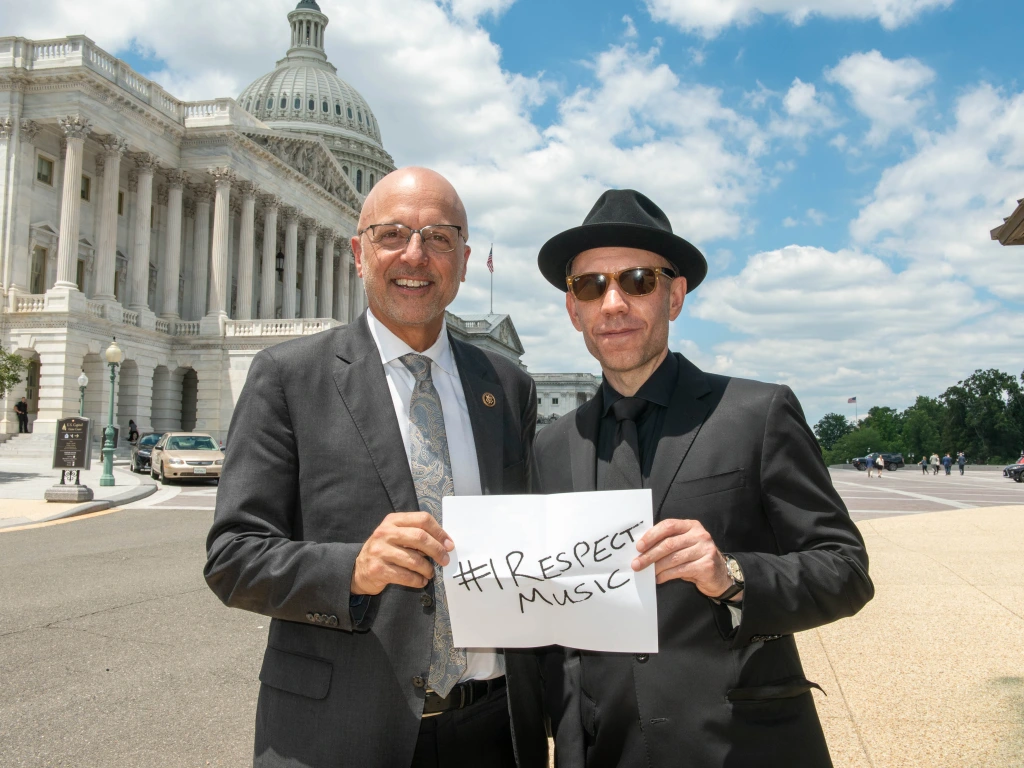
Rep. Ted Deutch and Blake Morgan
We musicians are used to fighting. For our livelihoods, our families, our dreams. In recent years we’ve fought battles we’ve neither sought nor provoked, against powerful corporate forces devaluing music’s worth. Streaming companies, music pirates, and AM/FM radio broadcasters who, in the United States, pay nothing––zero––to artists for radio airplay.
It’s shocking, but true: The United States is the only democratic country in the world where artists don’t get paid for radio airplay. Only Iran, North Korea, and China stand with the United States in this regard. ADVERTISEMENT
Broadcasters make billions of dollars each year off our music, and artists don’t earn a penny. This impacts not only the artist, but session musicians, recording engineers, songwriters. Virtually everyone in music’s economy.
Isn’t being paid fairly for one’s work a bedrock American value?
As a torrent of bad press consumes Facebook — or whatever the company may soon be renamed — it’s worth remembering that to become an industry-dominating social-media Goliath, sometimes you need a little help from your friends. Perhaps they’re better described as co-conspirators.
Over the past year, a series of court filings by 15 state attorneys general have exposed what amounts to secret collusion between Google and Facebook to rig the online ad market in their favor and to keep out competitors. Details keep percolating up — last week, a New York judge unsealed yet more documents shining light on the arrangement — but we’ve already learned a great deal, revealing just how far two tech giants will go to preserve their lucrative hold over online advertising. (A Google spokesperson said the claims in the suit are “baseless” and riddled with inaccuracies.”)
Long story. But a private agreement between major publishers and major labels was part of the Copyright Royalty Board settlement. Seemed sleazy to many songwriters. We protested and the judges did right thing. Reopened comments. https://t.co/IDoV0wuzcR
In an unusual–if not historic–move, the Copyright Royalty Board has decided to re-open public comments in the controversial “frozen mechanicals” rate hearing to set the government rate for mechanical royalties paid on physical records and downloads. It is absolutely crucial that the Judges have reopened the comments because it indicates that they are bending over backwards to demonstrate their interest in being fair and deliberative and not allowing themselves to be used to bootstrap an unfair freeze on mechanical royalties. (If you need to catch up, there are many posts on Trichordist about “frozen mechanicals“.)
The Board gave this reason for reopening the comments:
The Joint Submission [by the NMPA, NSAI and the major labels] included arguments that the MOU is irrelevant to the Judges’ consideration of the proposed partial [frozen mechanicals] settlement and proposed regulations and that the MOU does not call into question the reasonableness of the proposed partial settlement and proposed regulations. Because interested parties other than those who submitted the Joint Submission may have been unable to adequately view or comment upon the MOU prior to the close of the Judges’ extended comment period, the Judges are reopening the comment period. The Judges will allow 30 days for comments [from October 19] regarding the impact, if any, that the MOU should have on the Judges’ consideration of whether the proposed partial settlement and proposed regulations provide a reasonable basis for setting statutory rates and terms.
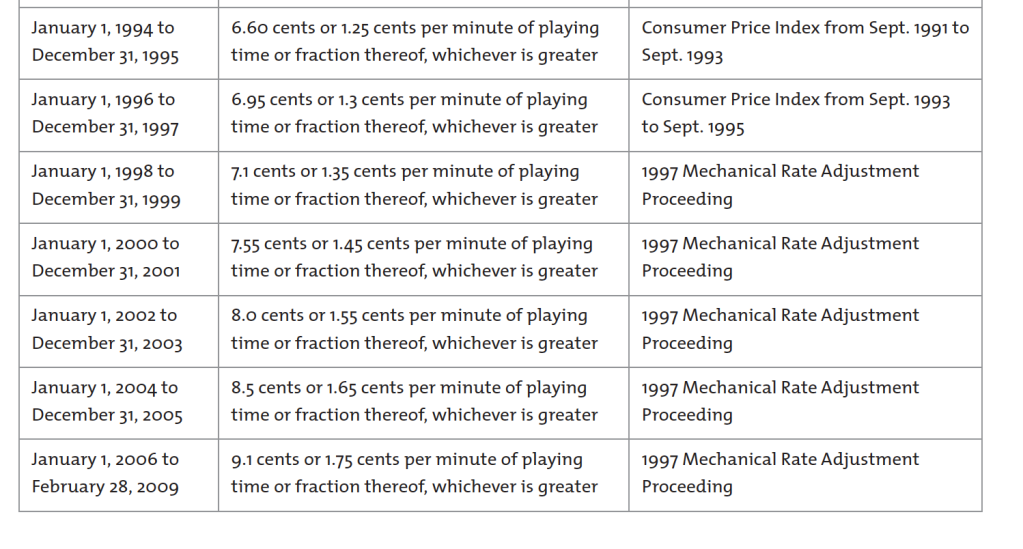
Quick recap–remember that the NMPA, NSAI and the major record companies decided to keep the freeze on mechanical royalties for physical and downloads that these same groups and companies decided to impose on the world back in 2006. If these people win this argument before the Copyright Royalty Board, the rate will be frozen at 9.1¢ for another five years–until 2027. NMPA and the major labels also made a side deal (called an “MOU”) as a quid pro quo that appeared to be additional incentive to the NMPA to accept the frozen mechanical rate that applied to every songwriter but includes undisclosed payments.
What is particularly offensive about this freeze is that the majors and a lot of indie labels have “controlled compositions” clauses in their recording agreements that give them all kinds of downside protection against rate increases. These include a “rate fixing” clause that freezes the mechanical rate for songs at the rate in effect when the recording is initially released. That’s why there are still many songwriters paid at the 2¢ rate that hasn’t been around since 1977. So giving a rate increase is not anywhere near a 1:1 cost increase for the record companies.
David joined with Helienne Lindvall and Blake Morgan to file a comment asking for the Copyright Royalty Board to give the NMPA and NSAI the deal they made but raise royalty rates for songwriters who don’t get the benefit of the MOU payments (whatever they are). Many other distinguished songwriters, songwriter advocacy groups (12 in total) and publishers filed their own comments opposing the freeze.
[Chris Castle says: Here’s the context of this post. As it turns out, the CRB extended the filing deadline for comments due to what they said was a technical difficulty, although we have yet to meet anyone who couldn’t file their comment on time. This extension seems contrary to the CRB’s February revised rules for filings by participants. The CRB procedures presciently have an email filing procedure in the case of technical problems arising out of their “eCRB” document filing system. It will not surprise you to know that the NMPA, NSAI, and major labels filed what is essentially a reply comment after the close of business on the last day of the extension, after at least our if not all commenter accounts were disabled, the practical effect of which was that no one could respond to their comments through the eCRB, i.e., on the record.
We tried, and drafted a reply to the most important points raised in the majors’ comment. We emailed our comment to the CRB during business hours on the next day in line with the CRB’s own “Procedural Regulations of the Copyright Royalty Board Regarding Electronic Filing System” (see 37 CFR §303.5(m)) or so we thought. But not so fast–we were told by an email from a nameless person at the CRB that we would need to file a motion in order to get approval to file the comment less than 24 hours late for good cause–which of course, we are not able to do since we are not “participants” in the proceeding. See how that works? According to this person’s email, we’d also need to contact CRB technical support to get our accounts reopened which would make the comment later still even if we were able to file a motion. Instead, we decided to just post our reply comment on the Internet. A wider audience. Unfortunately not part of the record, but we’ll see what happens.]
We all have to be grateful to the Copyright Royalty Board for re-opening comments on the frozen mechanicals crisis. That is an indication that the Judges do not intend to be a rubber stamp and let the rich use the CRB to bootstrap their private deal onto every songwriter in the world.
We want to stongly encourage you to file your own comments in the frozen mechanicals hearing, tell your own stories and give your own point of view about how to handle the crisis. If you want to file a comment, you need to register for an account at the Copyright Royalty Board. Chris Castle has a helpful guide to setting up your account.
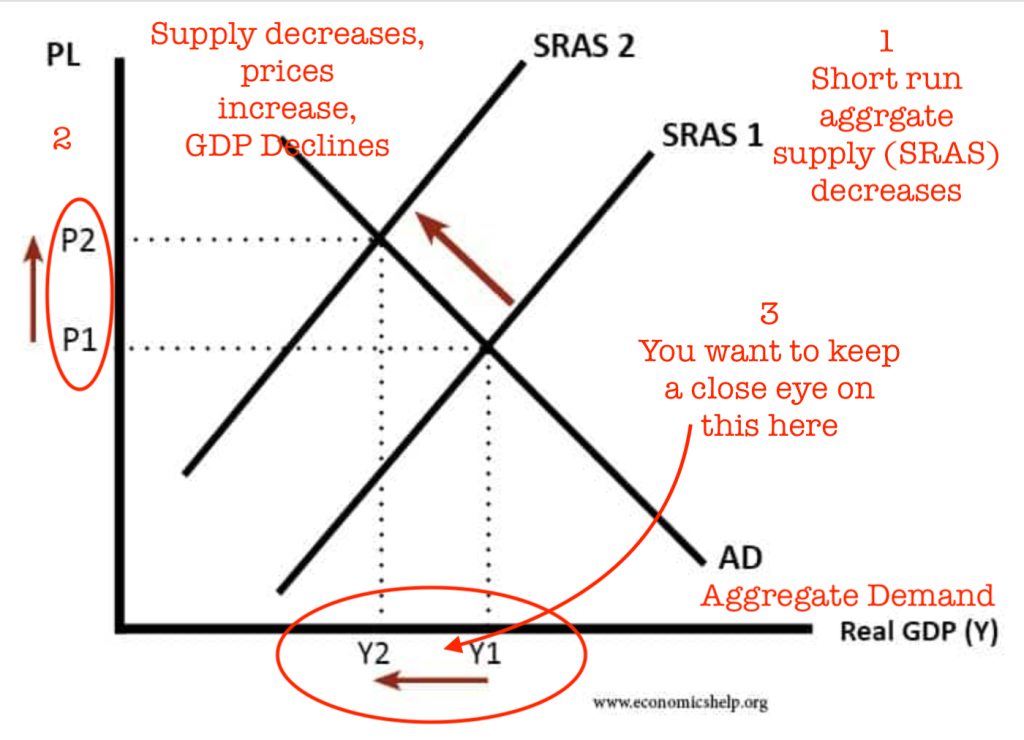
In a word: Stagflation. Maybe. In more words, classic stagflation occurs when supply side shocks lead to the costs of goods increasing while the real economy declines. We certainly have had and continue to have supply side shocks and it’s hard to tell what the real economy is doing because of distortion. Due to the COVID pandemic, the global economy has been hit with a cascading series of supply side shocks. For example, one shock is due to supply chain disruptions which look something like this:
If you’ve ever been on one of the very large cargo ships, you will know that is a big mofo. (When a sailor looks at all those elephants churning up the water, you can’t rule out a collision which could have really big problems depending on where and how bad that collision is.)
There currently are something like 500,000 shipping containers sitting on ships off of the Port of Los Angeles that can’t unload. That means someone has ordered the goods in the containers, perhaps paid in advance all or part of the cost of those good, but can’t get the goods to sell. And that’s just Los Angeles. That’s also called a supply side shock.
A supply side shock may cause an increase in the prices of the goods that are available to sell which causes a shift in the aggregate prices in the economy as a whole.
Another supply side shock may occur when inflation causes the price of goods to increase over the level that a firm can eat to avoid passing on the cost to their customers. This causes earnings to decline and eventually share prices to decline. If the market does not re-establish equilibrium fairly quickly, right after earnings decline, the price may get passed on to the consumer which may cause demand to drop which will ultimately cause earnings to decline. This is cost-push inflation which is a bit different from what you normally hear about too many dollars chasing too few goods or demand-pull inflation.
So to recap: cost-push inflation is a decrease in the aggregate supply of goods and services caused by an increase in the cost of production, and demand-pull inflation is an increase in aggregate demand from one or more or all of households, business, governments, and foreign customers.
Inflationary pressure is compounded by an increase in the money supply, especially a sharp increase in the money supply.
All this should be sounding familiar if you follow the news.
The Stagflation Three Point Play
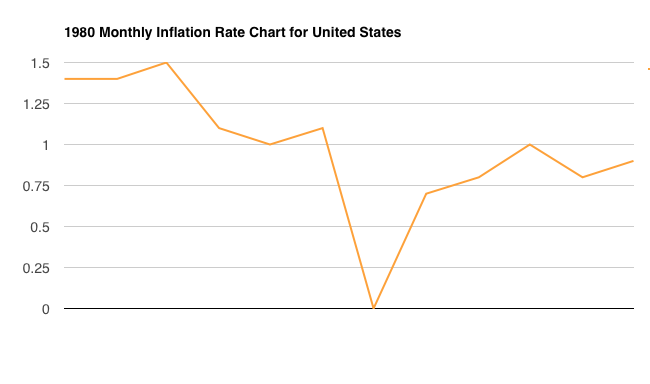
Historical examples of stagflation events in the US are particularly related to energy cost shocks and OPEC’s use of oil embargos to influence US foreign policy and support for Israel. We’ll come back to this, but remember that the crippling stagflation of the 1970s was largely due to one input–energy. The gas lines of the 1970s and heating oil price increases were particularly profound and the resulting stagflation influenced the increase in interest rates to a prime rate of 21.5% in December of 1980 after President Jimmy Carter lost reelection. It may be hard to comprehend a prime rate of 21.5% in this low interest rate environment, but don’t feel bad–it wasn’t so easy to understand then, either. The shys were jealous.
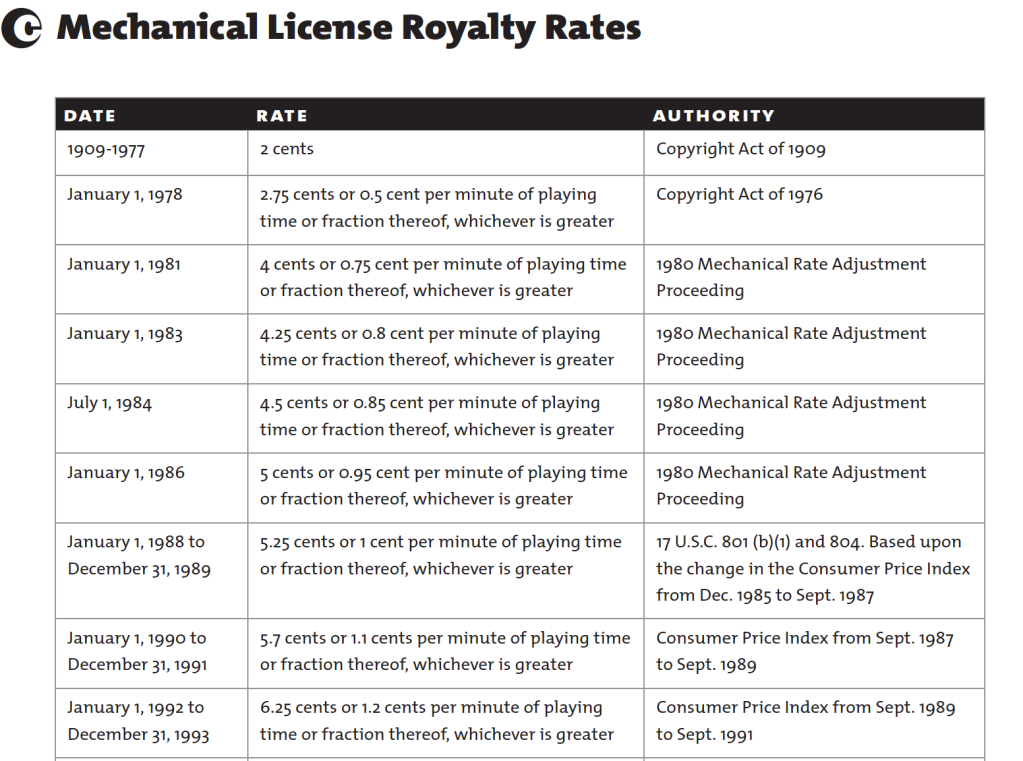
Could it happen again? At this point, I think it’s hard for anyone to rule it out entirely, so the probability is a positive integer. What did songwriters do during the stagflation era of the 1970s? Unlike most of the rest of the peacetime economy, songwriters had mechanical royalties set by the government at a fixed price. Starting in 1909, the federal government set songwriter royalties at 2¢ per unit and never changed the price until 1978. Needless to say, the stagflation of the 1970s destroyed the government’s fixed songwriter royalties. By 1978 it’s not an overstatement to say that songwriters earned a negative royalty rate if you adjusted for inflation. This was all due to the government’s wage controls on songwriters. (You can argue that this is the primary reason songwriters get paid so little today.)
Why did this happen? Government mandated wage and price controls were common in wartime–during World War II, military expenditures exceeded 40% of gross domestic product (GDP) so the government had an interest in controlling labor and materials costs. They accomplished this through the War Labor Board and the Office of Price Administration. If that sounds positively Soviet, it was. Unlike songwriter royalties, the government mandate was temporary.
By the time the 1976 revision to the Copyright Act rolled around, songwriters lobbied effectively for their statutory mechanical rate to be increased. However, given the rampant inflation of the time, they needed protection because even with prices reset after five year periods, inflation could easily eat away any gains. That’s one reason why after the 1976 revision, mechanical rates gradually increased and eventually were increased based on the Consumer Price Index (called “indexing”) for many years.
If you followed the recent commentary opposing an extended freeze of the mechanical royalty rate for physical and downloads, the inflation issue is front and center once again. And if you observe the current state of the economy and the likely future, you’ll understand why indexing may be crucial to preserving the value of whatever mechanical royalty is set by the Copyright Royalty Board, the songwriter’s version of the WWII era Office of Price Administration. And who would bet against inflation?
Of course, the CRB heard absolutely no evidence on the inflation issue from the NMPA, NSAI and the major labels that essentially put their finger in the air and decided to freeze rates. That’s not the end of the story, though. The relevant information on inflation is readily available in the public domain and the CRB can take notice of it if they want.
Remember, the 1970s stagflation was a highly unusual economic condition caused by a supply side shock of one input–energy. Here’s a few examples of current supply side shocks from multiple inputs. I think it should give everyone pause before they rule out a need to index the statutory rates for songwriters.
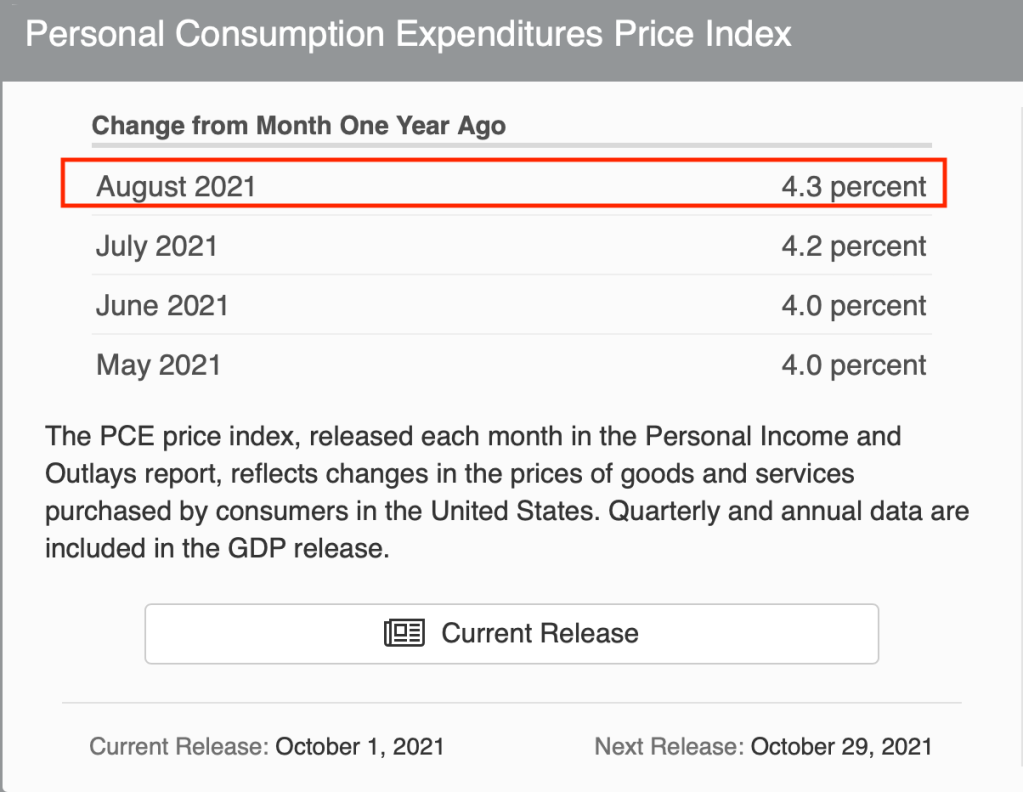
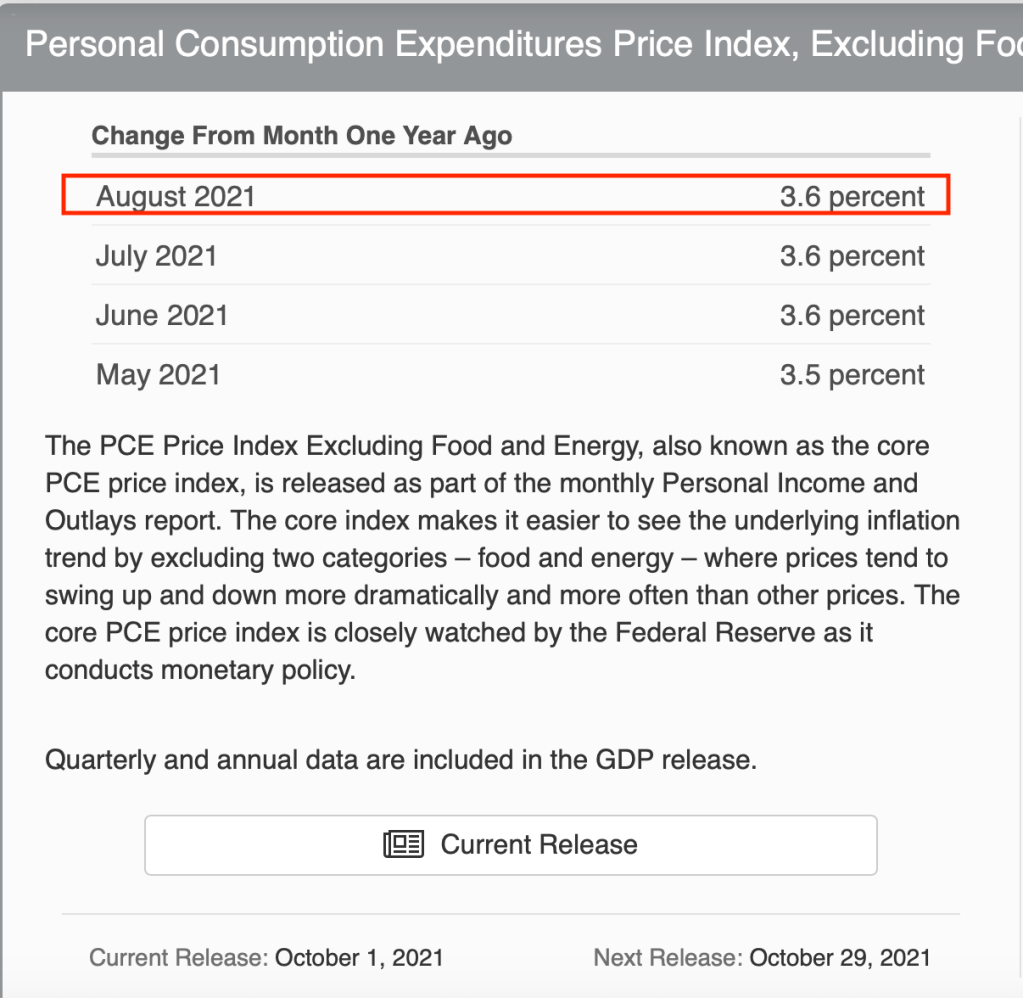
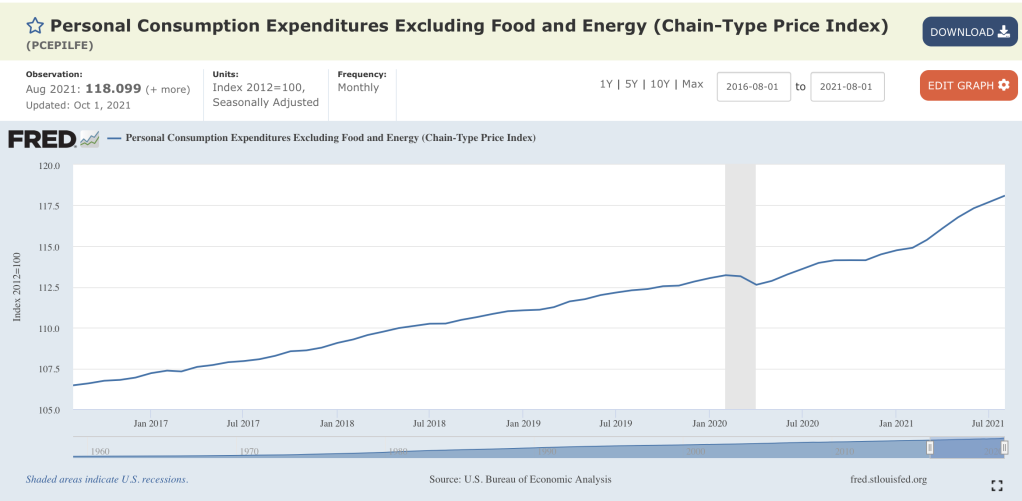
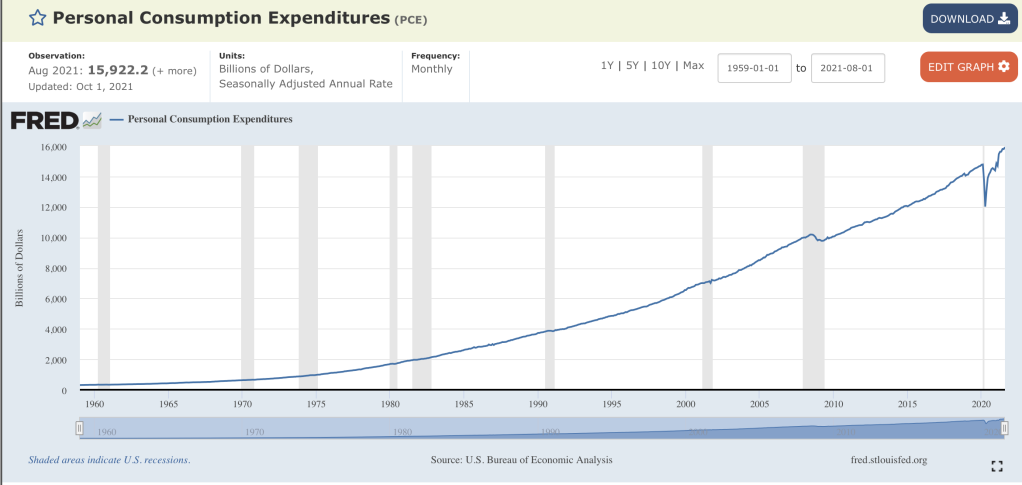
The “PCE” and “Core PCE” are indexes that economists monitor (such as the economists at the Federal Reserve) to track inflation trends. So let’s see what these metrics tell us about the inflationary trends that would be an argument to support indexing mechanical royalties.
“Core PCE” is another look at consumer prices that excludes the cost of food and energy which doesn’t make much sense to you and me, but is another way to look at underlying inflation trends for economists. This is important because it can influence decisions about interest rates at the Federal Reserve.
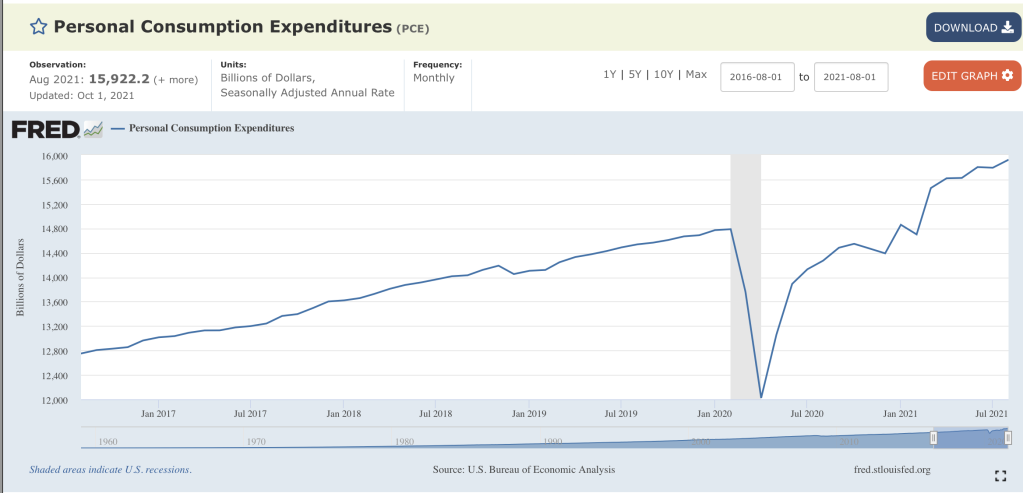
For perspective, here’s a five-year look at PCE and at PCE excluding food and energy:
The data tell us that the five year inflationary trend is up and to the right with an increasing slope. It is the sharpness of that increasing slope that gives pause–the inflationary trend has been up since 1959 per the following chart, but the steepness over the last 12 months is unusual.
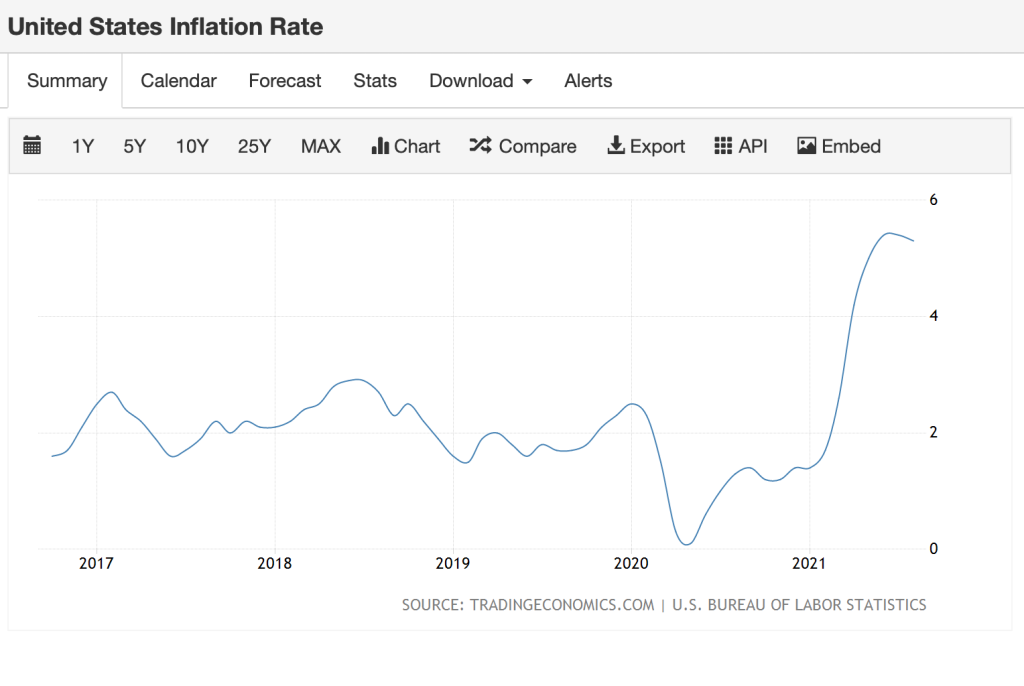
Overall US Inflation Rate
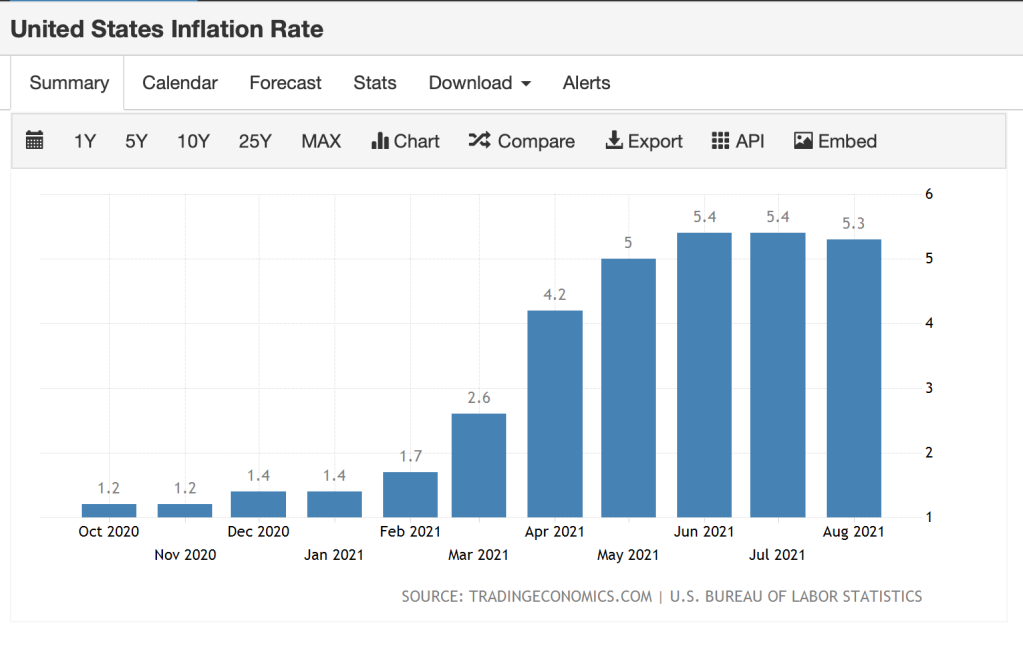
The PCE and Core PCE is confirmed by the overall U.S. inflation rate as measured by the U.S. Bureau of Labor Statistics:
You see the trend here. Inflation has sharply increased. Consider the last twelve months–inflation has more than quadrupled.
Do we think it will continue to increase or will it decline? Let’s consider the inputs that can cause that supply side shock we talked about above.
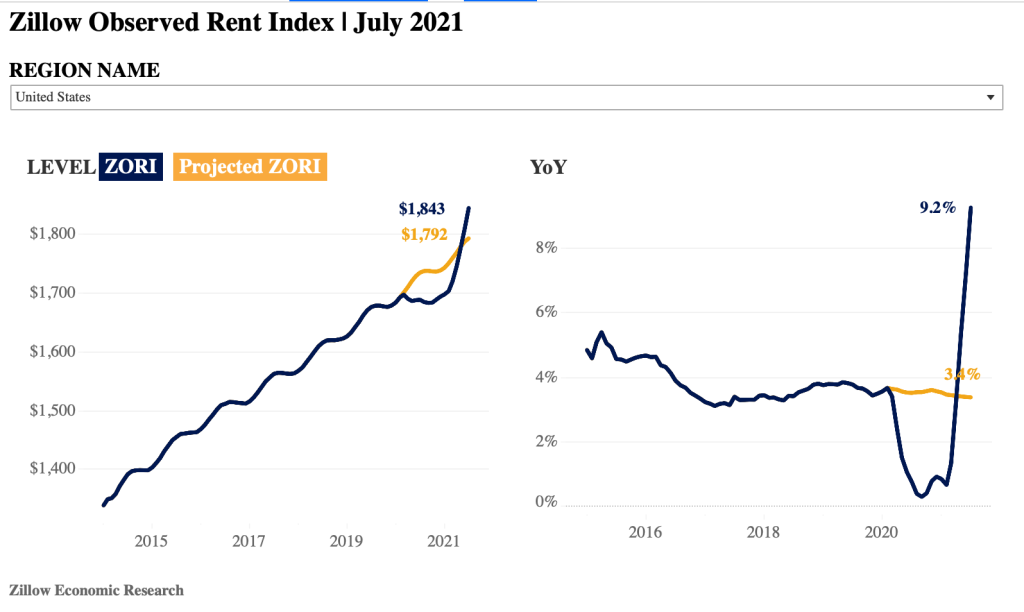
Residential Rent Prices
According to Zillow, “[t]ypical U.S. rents grew 9.2% year-over-year in July, according to the Zillow Observed Rent Index (ZORI) — the fastest recorded by Zillow records in data that reaches back through 2015 — to $1,843/month. Projecting forward historical ZORI values from February 2020 — the last full month before the COVID-19 pandemic hit the U.S. in earnest — we estimate that the U.S. ZORI in July was 2.9% ($52) higher than where it would have been if the last roughly 18 months had been more ‘normal.’ “
After dipping last spring, rents around the U.S. have not only recovered but are now blasting past their pre-pandemic levels. In 44 of the nation’s 50 largest metro areas, rents have surpassed where they were before the health crisis, according to data from Realtor.com. Nationwide, the median rent reached a record high of $1,575 in June, an increase of 8% from a year ago.
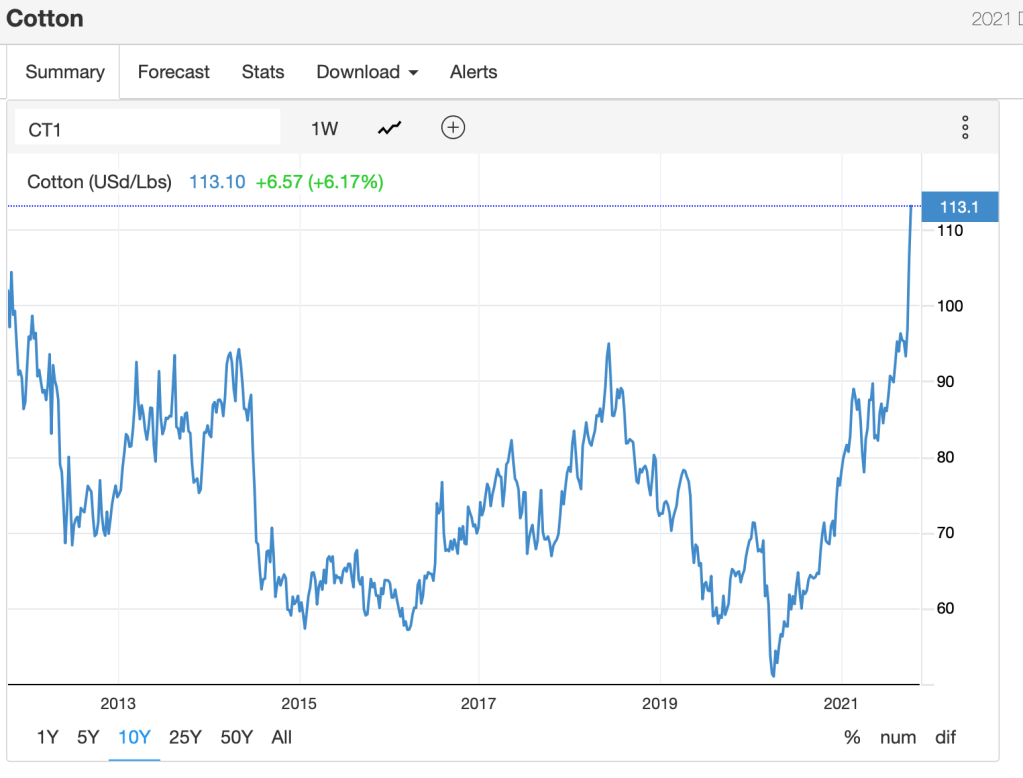
Cotton
Cotton is a commodity that finds its way into many goods. The Wall Street Journal reports that cotton prices have surged to their highest level in a decade, but that Levis won’t be passing on the cost increase to consumers–yet. Remember cost-push inflation?
Levi’s commentary on the cotton-pricing issue should soften some of those fears—at least in the near term. On its earnings call Wednesday evening, the apparel company said that much of its own cotton prices have already been negotiated for the first half of 2022 and that it expects its cost of goods sold to increase 1% in the first half of 2022 compared with 2021 levels. For the second half of 2022, the company said it might be able to negotiate prices that will lead to a mid-single-digit percentage increase in costs compared with 2021 levels. Cotton accounts for about a fifth of the cost of producing Levi’s jeans.
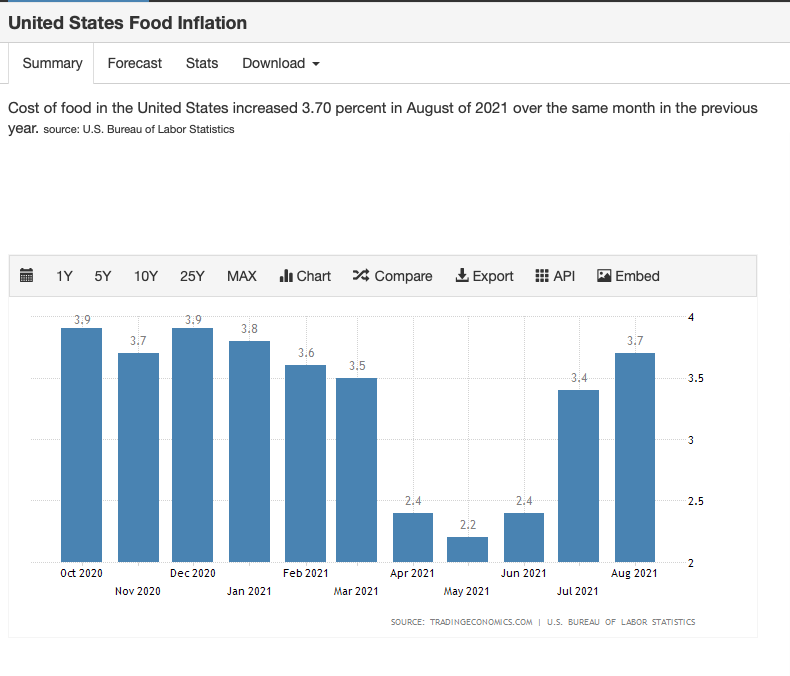
Food Inflation
If you’re going to just look at the core PCE without food and energy, you can’t just ignore those two key inputs if you want to know what is going on at the micro level. We’ll look at both food inflation as well as inflationary effects on a few key energy components, especially for touring bands. Consider this chart of food inflation in the US over the last twelve months which itself is slightly higher than the core PCE.
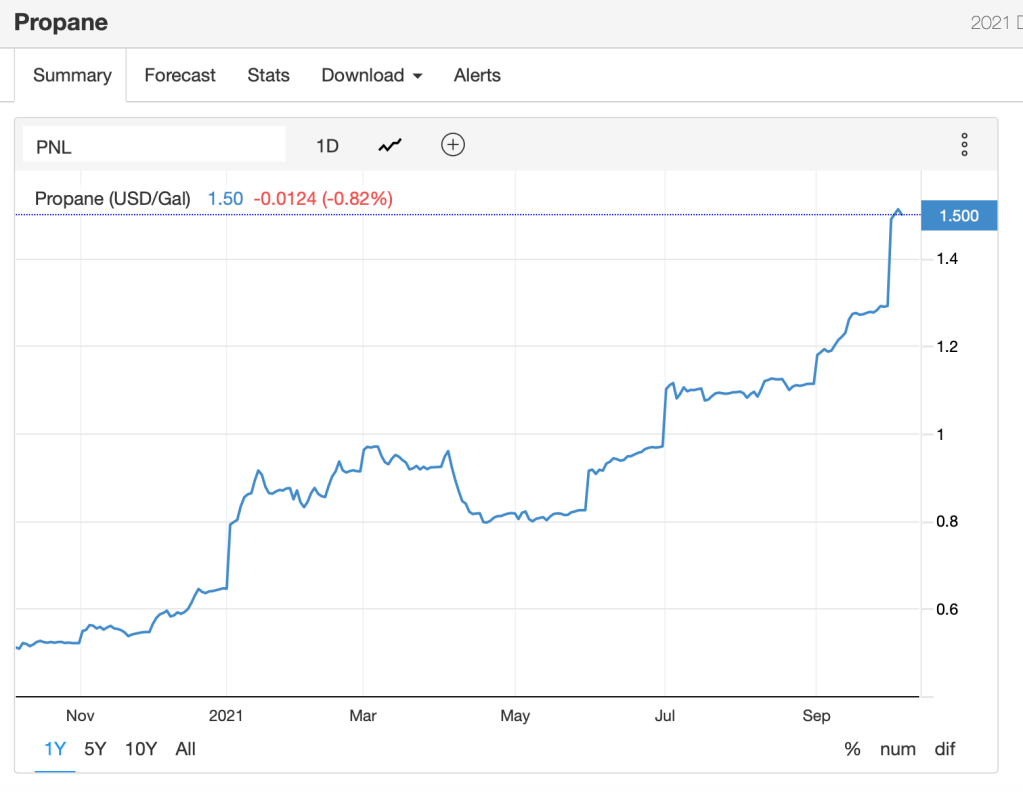
Propane
Propane–also known as heat–is a lot more relevant to consumers particularly as we head into winter. Propane generators are of particular interest to anyone who suffered a power outage during a polar vortex–ahem–and as you can see, propane prices are already through the roof.
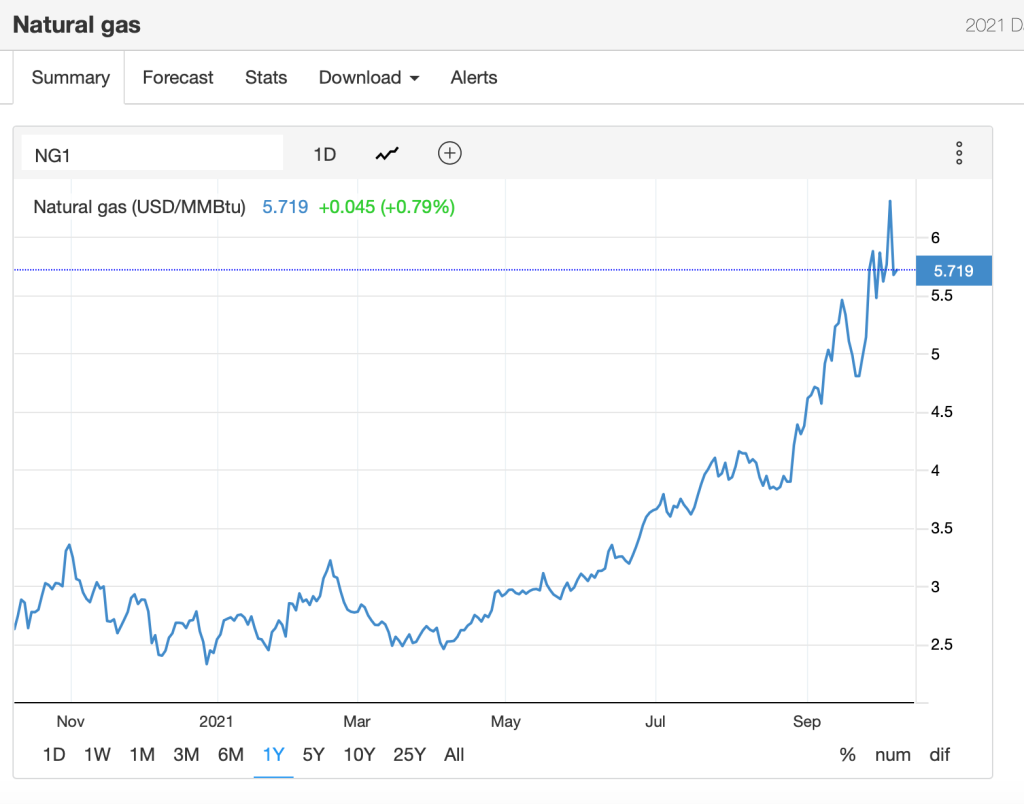
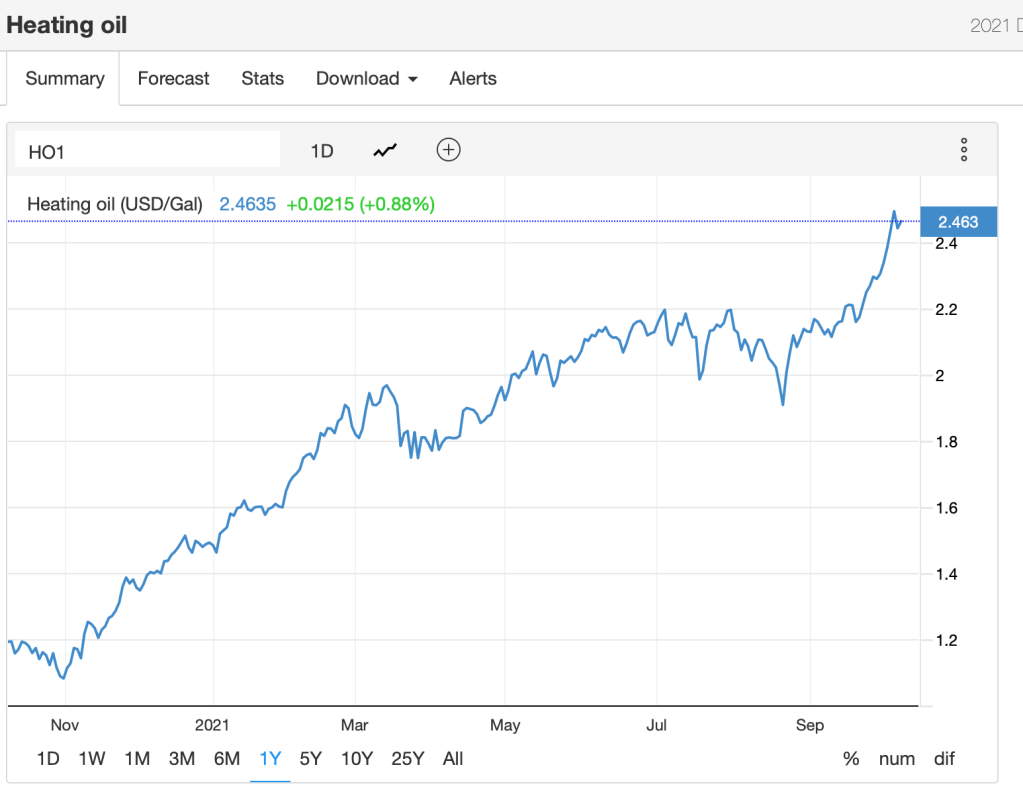
Same story for natural gas and heating oil.
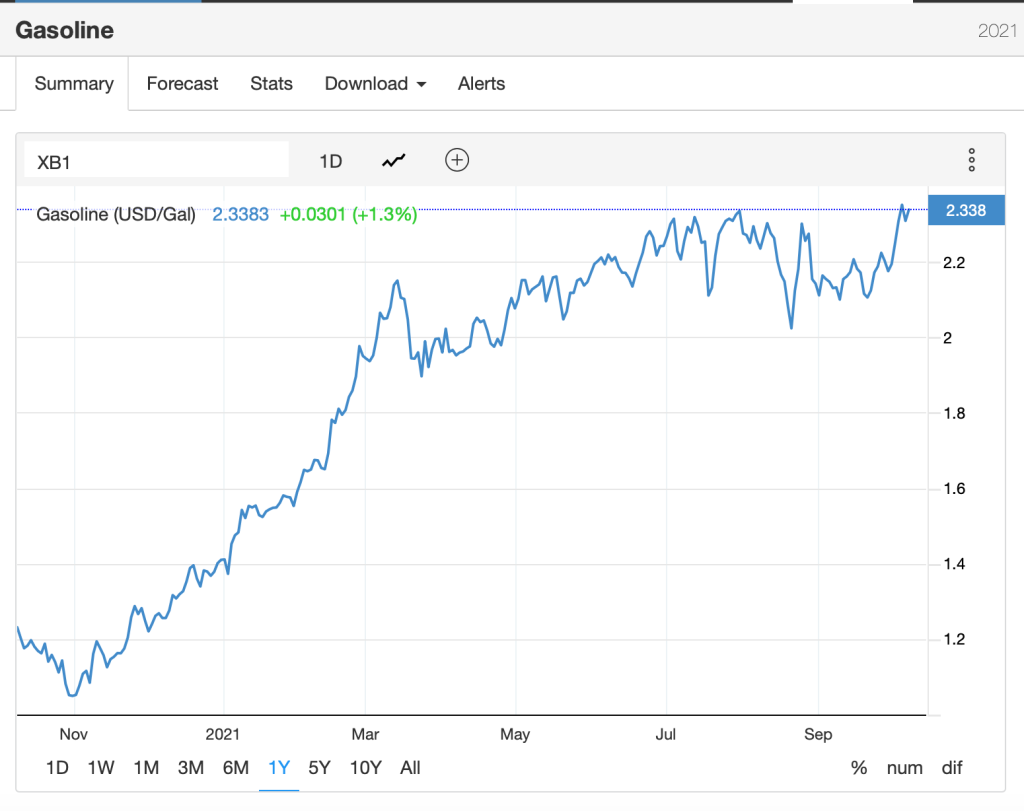
Gasoline
If you’re planning a ground tour, keep an eye on the price of gasoline, also up and to the right.
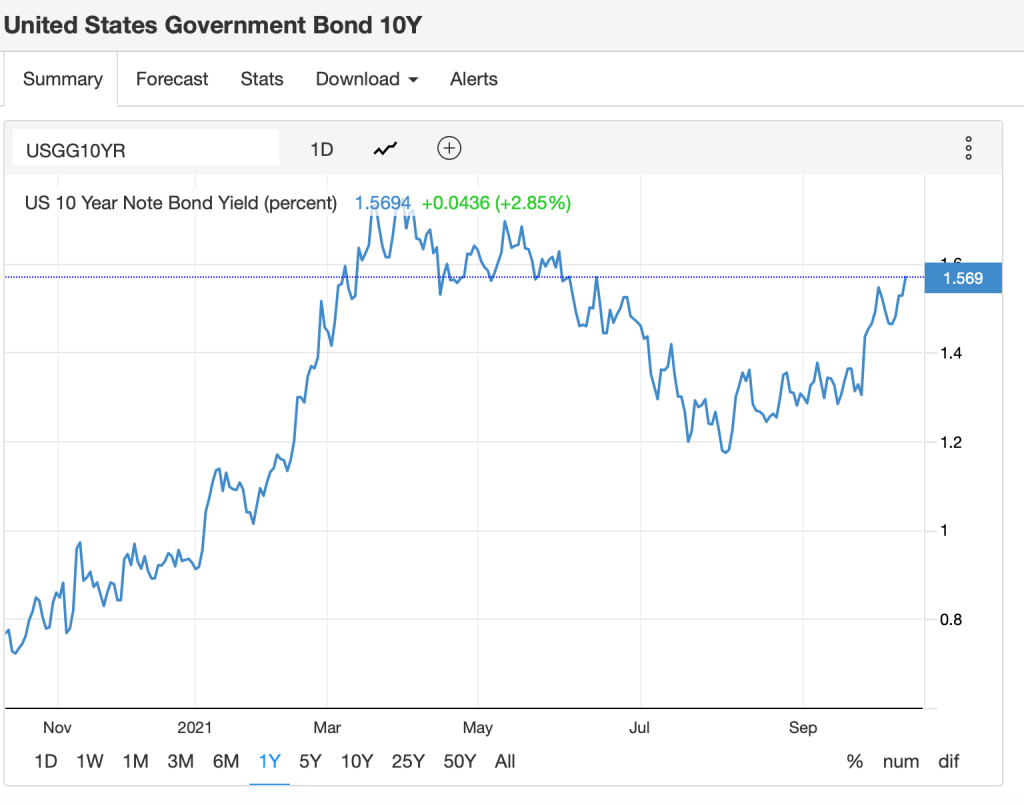
10 Year US Treasury Bonds
You may not be aware of it, but practically everything in your financial life is affected by the 10 Year US Treasury bond. The “10 Year” is used as a reference point for a multitude of financial instruments and interest rates around the world. This includes mortgage rates and credit card rates. As you can see, over the past 12 months, the yield on the 10 Year treasury note has increased or nearly doubled. And remember that the bond market is orders of magnitude larger than the stock market. The bond market is also run by sophisticated traders–I’ve never heard of day traders in the bond market.
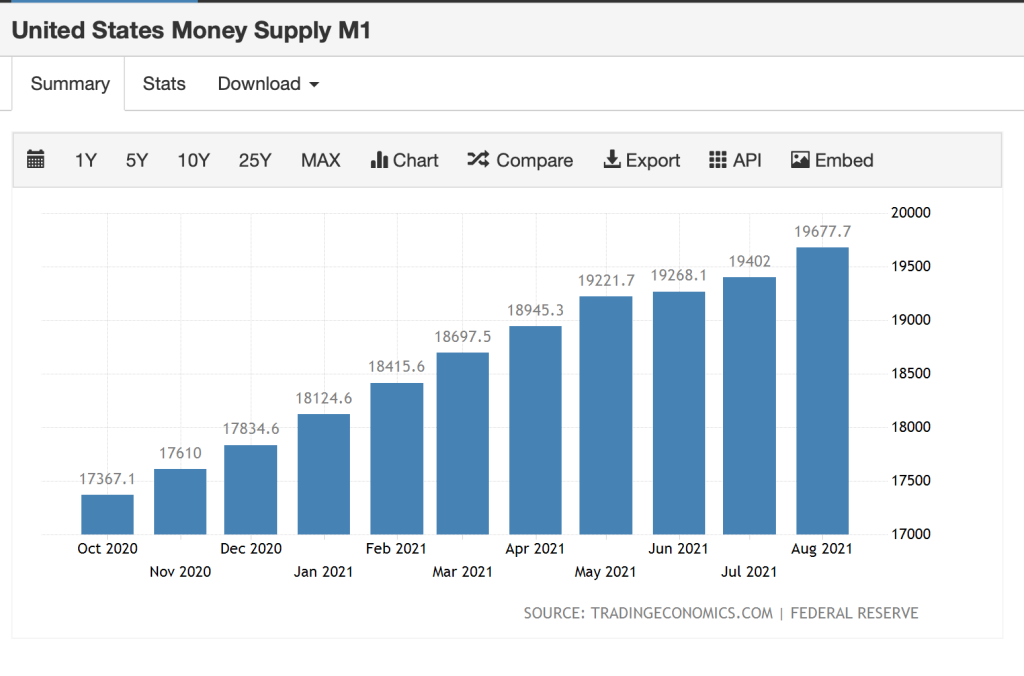
You want to keep a good eye on the 10 year because the Federal Reserve plans to “taper” which is one of those fancy names like “quantitative easing” that sounds like a caramel macchiato but is actually not. What that means in a nutshell is that the Federal Reserve plans on buying fewer treasury bonds than they have done–sopping up however much debt that Congress wants to take on. (Some people say this is a lot like printing money–remember that increasing the money supply is one of the causes of inflation, particularly sharp increases in the money supply.)
A cynic–certainly not me–might say that the Federal Reserve keeps the interest rates low because if the U.S. government ever had to pay anything like a market interest rate, the country would go under. But this cannot go on forever, hence “tapering”.
People may disagree with this “printing money” analogy, but the money supply has substantially increased in the last 12 months and it came from somewhere.
Conclusion
If you stayed with me this far, thank you. I hope I’ve persuaded you that it in the current environment it is highly dubious that songwriters should ever agree to a fixed mechanical rate for any configuration that is not indexed to inflation. Even if you don’t think that stagflation is around the corner, we are certainly seeing considerable inflation in a number of inputs–the supply side shock that is the hallmark of a period of stagflation may not come solely from energy this time. Just because energy was the culprit before doesn’t mean that the economy will not succumb to stagflation by a thousand cuts in the future.
TO: Interested Parties FROM: musicFIRST Coalition DATE: September 22, 2021 RE: NEW POLL: Americans support bold actions to get artists paid for AM/FM radio airplay
A new national poll commissioned by musicFIRST — the voice for fairness and equity for music creators — shows that the American public backs bold action to ensure that artists are treated with respect and paid when their songs are played on AM/FM radio.
For decades, dominant corporate broadcasters like iHeartRadio and Cumulus Media have refused to pay artists despite raking in billions of dollars in advertising revenue every year. While these corporations use music creators’ work to fill their airwaves, and in turn bring in advertisers, they claim they cannot afford to give compensation to the artists.
At a time when America is focused on the plight of hard-working Americans, this is exploitation of the tens of thousands of working-class singers and musicians.
These same broadcasters then turn to their lobbyists at the National Association of Broadcasters (NAB) to do their dirty work on Capitol Hill to maintain the unjust status quo, claiming that providing fair compensation to artists for their work would harm “local radio.” The truth is that the six largest broadcast conglomerates have wiped out local jobs at the 2,000 radio stations they own across the country.
While most Americans are unaware of these injustices playing out between broadcasters and music creators, once they learn of this issue they not only agree it is unfair, and that music creators deserve to be paid when their music is played, but they support artists and advertisers taking strong action — up to and including boycotting AM/FM radio stations or supporting artists from withholding their music — to force broadcasters to do the right thing.
Hopefully, it won’t come to that. That’s why musicFIRST is supporting the American Music Fairness Act (AMFA), bipartisan legislation introduced by Reps. Ted Deutch and Darrell Issa in June of this year and backed by a majority of Americans, according to this survey. If passed, the AMFA would require broadcasters to, would finally, fairly compensate artists when they play their songs on their radio stations, while protecting truly local radio stations by exempting small and noncommercial broadcasters.
Most Americans don’t know that artists aren’t paid for radio airplay — and they side with artists when they find out
One key reason that broadcasters have been able to get away without paying artists for so long is that most Americans simply don’t know it’s happening. .
In this survey, only 30% of Americans said they were aware that artists aren’t paid when their music is played on AM/FM radio. Meanwhile, over half reported that they knew that streaming services like Spotify and Pandora do pay artists for streams.
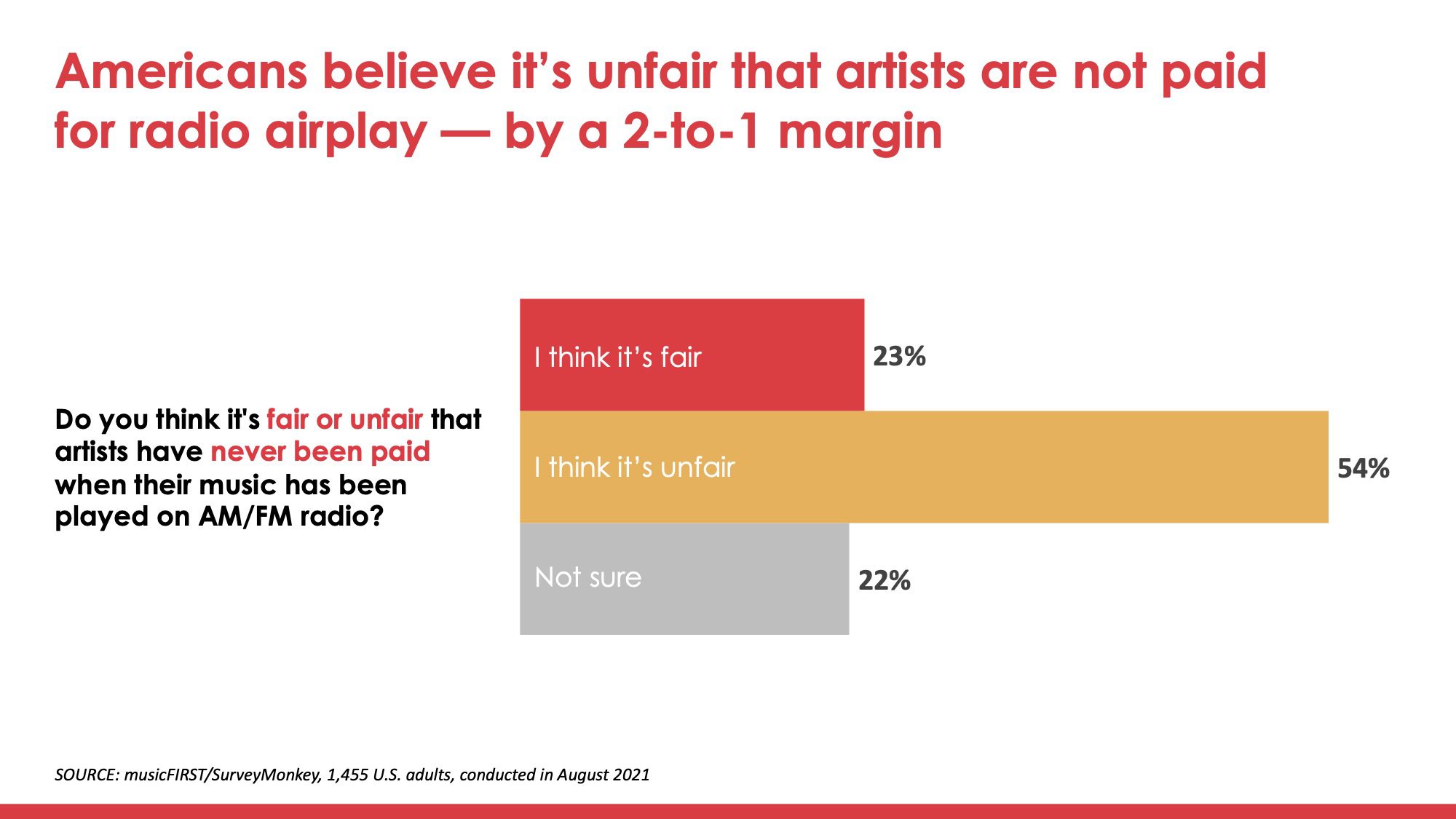
The NAB is banking on the public remaining in the dark on this issue. Because once they do become aware, Americans overwhelmingly believe it’s unfair that music creators and artists are not paid when their music is played on the radio — by a 2-to-1 margin, 54%-22%. Once average people start speaking up, standing, alongside leading artists and voices in the music industry, the pressure to finally provide fair compensation may be too much for corporate broadcasters to withstand.
Americans support strong actions by artists, advertisers and Congress to overturn the unjust status quo
But American music fans don’t stop at simply finding this situation to be deeply unfair. This new survey also shows that they believe artists, Congress and even advertisers should take bold steps to upend the status quo.
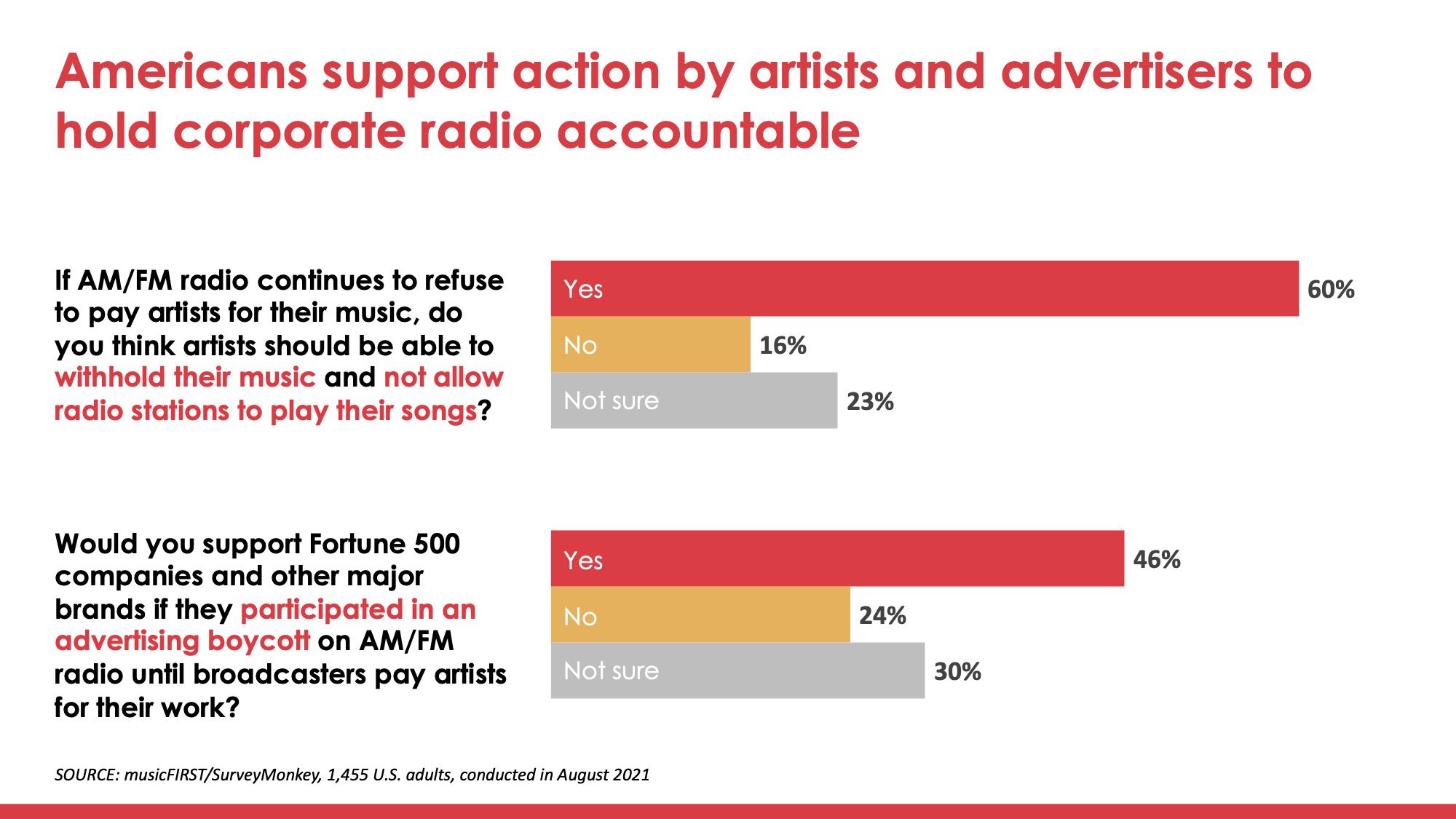
By a more than 40-point margin (60%-16%), survey respondents say that artists should be able to withhold their music and not allow radio stations to play their songs if they’re not being paid for it. And big corporations like iHeartRadio and Cumulus may have some difficulty selling ad space if they no longer have music to bring people to their stations, since nearly 3- in- 5 Americans (57%) say that music is what attracts them to listen to the radio. And one step further, roughly two-thirds (65%) of Americans say they would also support Fortune 500 companies and other major brands engaging in a boycott of advertising on traditional radio stations if they continue to refuse to play fair.
But most immediately, this is an issue that Congress can remedy by updating our outdated and unjust laws — and Americans are urging lawmakers to do so. In this survey, over half of respondents (54%) said they would support Congress passing a bill that would require radio stations to compensate artists when they play their songs, such as the AMFA, with only 20% opposed.
Most Americans are turning to streaming services and digital platforms to discover new music and artists, contradicting the NAB’s “promotional value” myth.
Since the beginning of radio, broadcast corporations and their executives have claimed they are doing artists a favor by providing “promotional value” to artists for free. This may have been the case in the 1960s when Americans mostly discovered new music through the radio, but this outdated and exaggerated myth no longer flies in 2021.
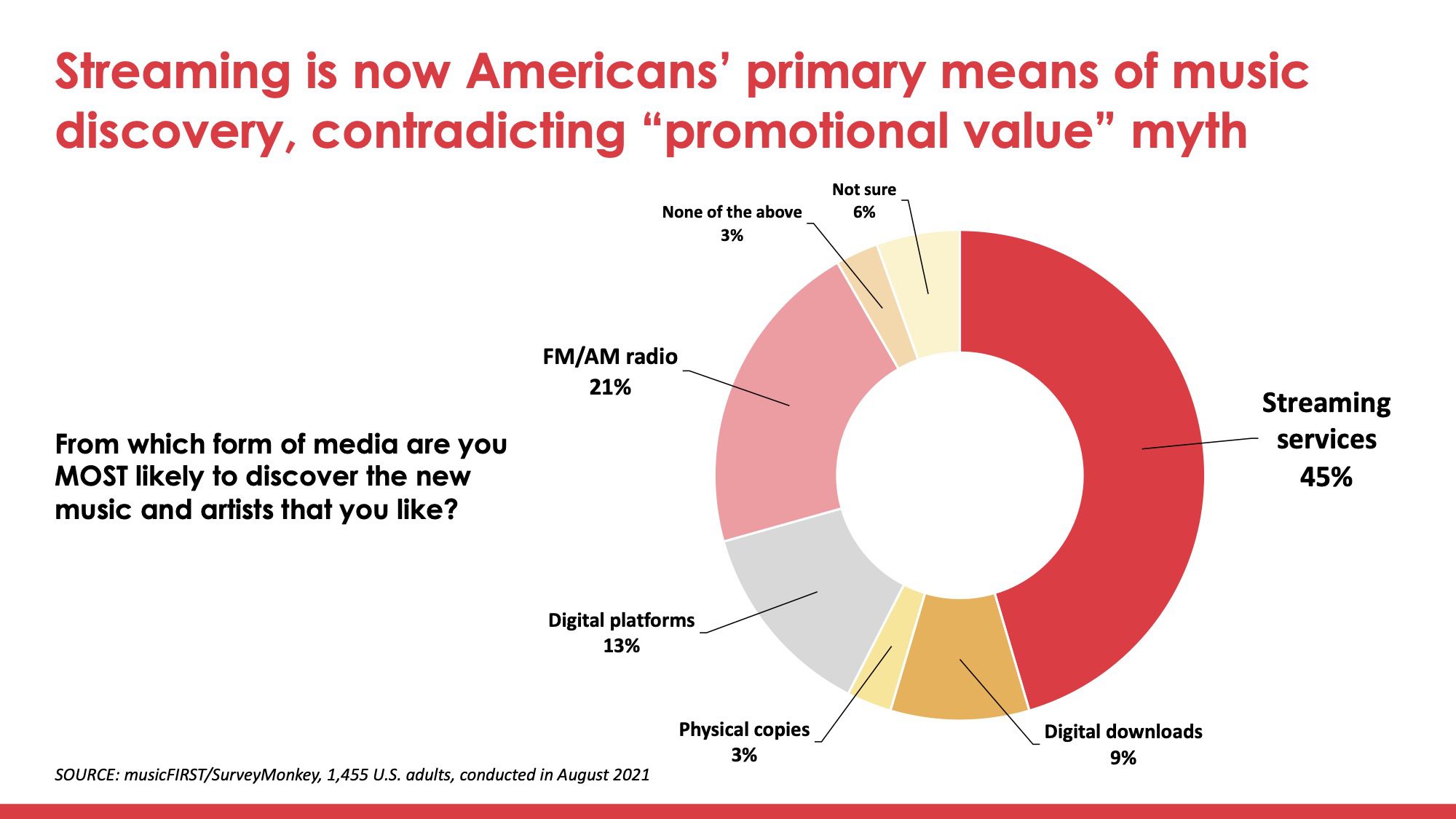
The new survey shows the truth: Times have changed and roughly two-thirds of Americans now use digital sources, such as streaming services and digital platforms, as their primary means for finding new artists and music. Meanwhile, only 1- in- 5 (21%) of Americans say they use traditional AM/FM radio stations to discover new artists they like — and that number will only continue to drop. Of the coveted younger generation (18-29 years old), only 7% point to AM/FM radio as the most likely place to discover new music.
These days, songs and artists are much more likely to go viral on platforms like TikTok or get featured on a popular Spotify playlist, which helps them shoot to the top of the charts. In turn, these same songs are then played on the radio. These are 2021’s order of operations, not vice versa.
This so-called “free exposure” from radio stations is merely more exploitation. Yet the NAB continues to use this argument to defend why they shouldn’t have to pay artists. However, the data is clear: their claims on this and many other issues are, at best, outdated and, at worst, intentionally misleading — and music fans have had enough.
Americans want music creators — those they already know and those they haven’t yet discovered — to be paid for their work. It’s time for the NAB and the corporate broadcasters they represent to finally listen.
About This Poll
This poll was commissioned by musicFIRST and conducted online via SurveyMonkey from August 30-31, 2021, with a national sample of 1,455 Americans. The margin of error was +/- 2.5%.
About musicFIRST
musicFIRST works to ensure music creators get fair pay for their work on all platforms and wherever and however it is played. We rally the people and organizations who make and love music to end the broken status quo that allows AM/FM to use any song ever recorded without paying its performers a dime. And to stand up for fair pay on digital radio — and whatever comes next.
###
Get Involved!
Contact your Members of Congress and tell them you stand against Big Radio. Click here to CONTACT CONGRESS
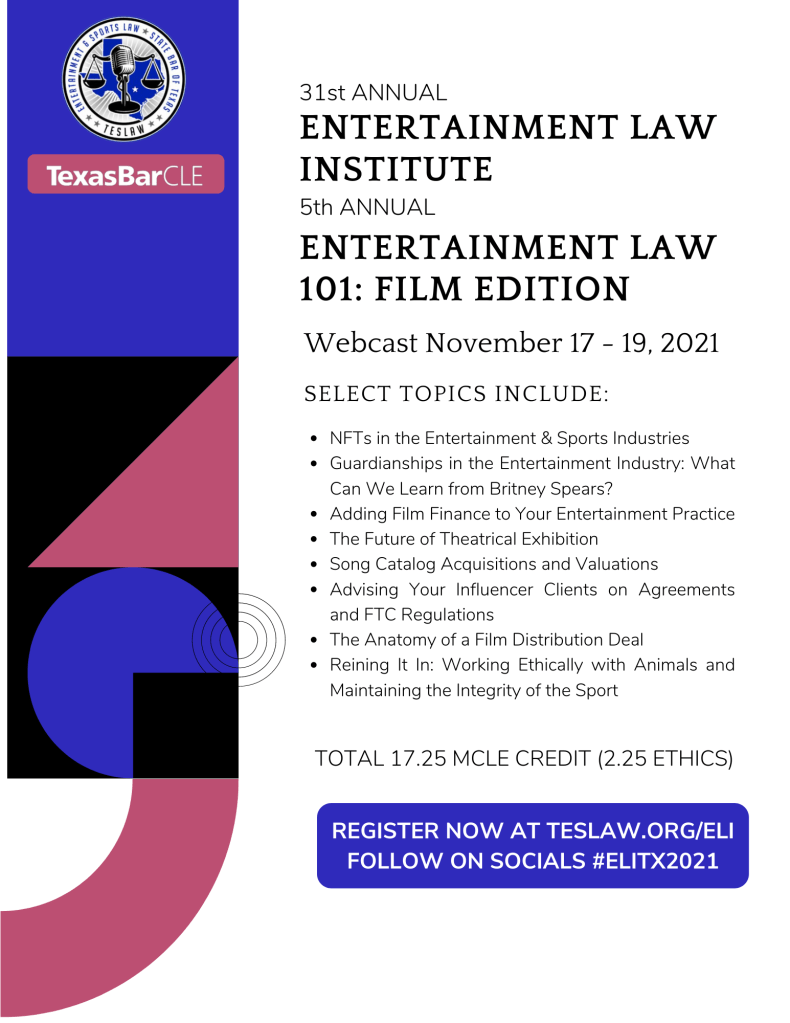
Registration is open for the Texas Entertainment Law Institute that Chris Castle is directing this year. The Institute will be virtual so it’s much easier to attend. We have a bunch of great speakers and panels so please check it out and register here!
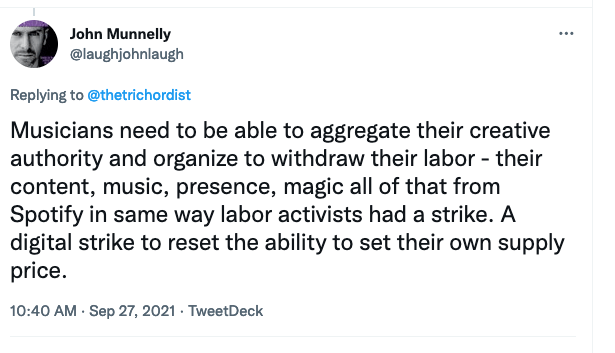
We’re hearing more and more commentary like this post from John:
So how would that work? It probably couldn’t be a “strike” of the same kind as the UK Musicians Union strike against the BBC in 1980, the Writers Guild strike in 2007 or some of the handful of other famous ones. Those strikes were all related to creators who were employed by employers and that employment formed the basis of a collective bargaining agreement. Strikes are authorized by a vote of the membership and are a sign that collective bargaining has not produced a fair result.
Strikes or work actions usually produce images like this:
Another difference between collective bargaining strikes and artists against streaming is the striking workers’ well being. Strikes impose a cost on both sides and the costs are often a heavier burden for the worker.
Streaming is not that way. For most artists, streaming cannibalizes more sales that it offsets with income. David has written about this extensively. The choice for most artists is not getting streamed more–that is the false promise that Spotify tries to get you to buy into with their various payola schemes that are blatant exploitation.
Songwriters have led the way on this with the Ferrick and Lowery class action against Spotify and David’s class action against Rhapsody. The uprising against the ruling class in the frozen mechanicals protest is another example of songwriters standing together against exploitation.
Streaming presents different choices. The choice is whether to be on a streaming platform at all. YouTube can force you to participate due to their scummy manipulation of the loophole ridden DMCA, the worst nightmare that an incompetent and lard layered Congress ever imposed on creators at the behest of lobbyists, and that’s saying something. If you’re not careful, you’ll end up with another MLC to make sure you know your place.
So you have to think about what a streaming strike would actually look like. It certainly would not have great economic impact for most artists because the income they would give up starts so many decimal places to the right.
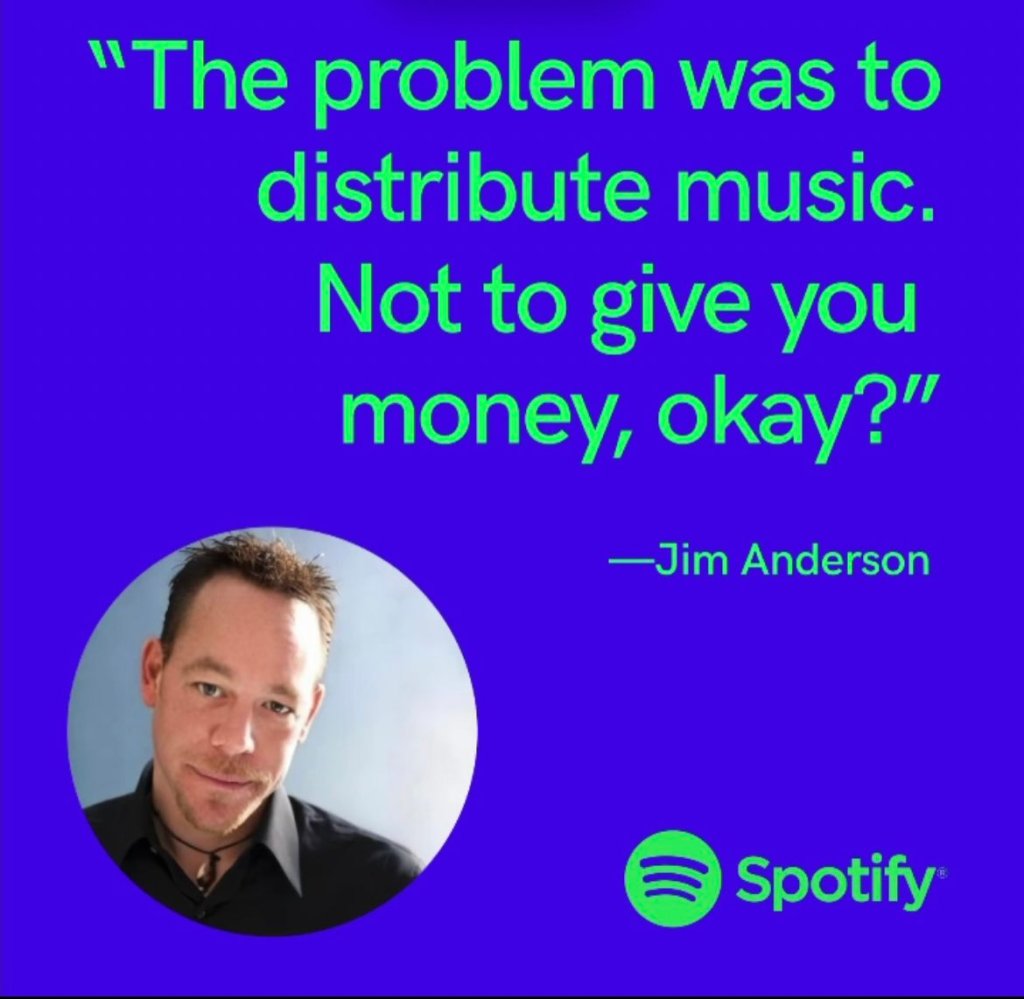
One way to get started is to maintain an “Unfair” list for services that engage in anti-artist behavior. Like this guy:
What should the criteria be to get on the “Unfair” list? What would we all do with the unfair list?
We’ll be taking suggestions and thinking about exactly how this would work.
If anyone connected to The Mechanical Licensing Collective, Inc. quango brings up the $424,000,000 black box payment that the MLC received in February as part of services claiming their safe harbor under the Music Modernization Act Title I giveaway, it’s usually in the context of claiming credit for the payment as in “Aren’t we great, we got the services to pay $424,000,000 of black box money owed to songwriters.” (Followed shortly by so where’s my bonus?)
Notice what’s not mentioned in that sentence? True, some services paid some money to the MLC which was required by Title I in order for the major infringers like Spotify to enjoy yet another safe harbor. But the payment was not made to songwriters or publishers–it was made to the MLC quango, which is where it sits today, seven months later.
How could this be, you say? Very simple. Nobody made sure that the MLC was in a position to pay the money out before they took the money in. This is the kind of thing that you would make sure is tied down in the two-plus years the MLC was operational before they got the money. You know, like when did Noah build the Ark? Before the rain.
This is the kind of thing you might expect to be mentioned in the MLC’s annual report which was due June 30 but seems to have been delayed. What should have happened, of course, is that the Copyright Office in its supposed oversight role for the MLC quango should be closely reviewing MLC’s progress with paying out a half billion of other people’s money. This is what you would expect from a bit-in-the mouth hard-driving approach to oversight of hundreds of millions that Congress tasked to the Copyright Office.
Ask yourself (or maybe the Library of Congress Inspector General) whether you think that a pre-New Deal federal agency that has never had enforcement powers is culturally suited to the kind of rigorous prosecution that the oversight role requires? Having created the MLC self-licking ice cream cone, does anyone seriously think that the Copyright Office will rock the boat, particularly when the lawyers seem very interested in landing a job at Spotify (regulated by the Copyright Office) or the National Association of Broadcasters both of which have an ontologically hostile relationship with songwriters? Do you think anyone at the MLC is looking over their shoulder because they’re afraid of the Copyright Office? And if they don’t fear the oversight, what incentive do they have? Nobody else will be twisting their arms.
So should it come as a surprise to anyone that people are asking “where’s my money?” Or that no one is answering?
[Editor Charlie sez: Artists and songwriters should consider how their music is used for child data exploitation and Internet addiction. Not surprising that Europeans are investigating TikTok for data protections for children under 13 and the transfer of personal data by TikTok to China military-civil authorities likely under Articles 7 and 14 of China’s National Intelligence Law.]
Reddit CEO and co-founder Steve Huffman called TikTok “fundamentally parasitic” due to concerns over privacy during an appearance at the Social 2030 venture capital conference this week (via TechCrunch). Huffman specifically called out TikTok’s practice of fingerprinting to track devices as being of particular concern.
“Maybe I’m going to regret this, but I can’t even get to that level of thinking with [TikTok],” Huffman said at the event, “because I look at that app as so fundamentally parasitic, that it’s always listening, the fingerprinting technology they use is truly terrifying, and I could not bring myself to install an app like that on my phone.”








 The Trichordist
You must be logged in to post a comment.