
Fight For The Future Of Corporate Astroturf Ripping Off Creators!

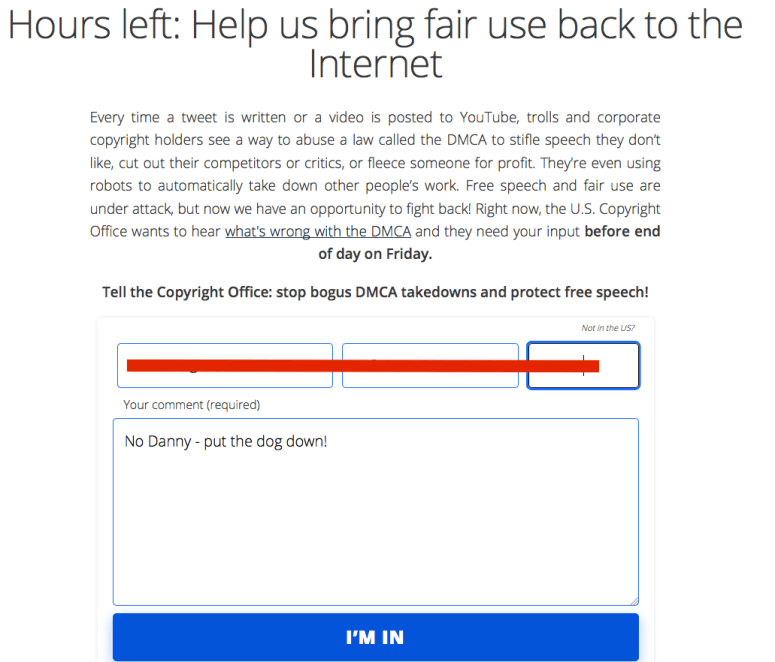
Musicians, know who your friends are and are not. Here is another example of big tech money, corporate astroturf, attempting to remove your rights. In the last hours of the submissions to the Copyright Office for comments on the DMCA a webform was introduced.

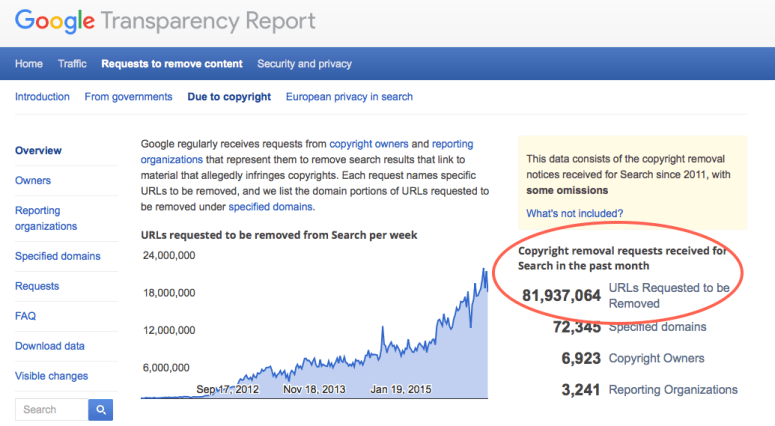
Note the fear-inducing reference to “robots”–“robots” must refer to the tools that Google itself gives to big companies to automate sending DMCA notices to Google for infringing links.  So by definition, “corporations” use Google’s own “robots” at Google’s request.  80 million infringing links this month alone!  (And remember, the Google “transparency report” does not include DMCA notices sent to YouTube, Blogger or any other Google property, it just covers Google search.)  EEP! ROBOTS!  DON’T BREAK THE INTERNET!
Google DMCA 3-31-16

This letter is exceptionally misleading because Google doesn’t allow independent artists to use these tools.  That means even the handful of artists who can monitor Google search 24/7 have to send manual notices.  So what the astroturf group is really complaining about is that EVERYONE should have to send notices manually which would increase the amount of time that Google has to profit from links to infringing content by data profiling or advertising sold on pirate sites.

This webform did not even verify if those sending the automated letter to the US Copyright Office were actually US Residents or machines…or made an intelligible comment on the questions the Copyright Office asked for public comment.  So, we had some fun with it, see bel0w.

David Newhoff at The Illusion Of More has an excellent piece looking much deeper at how these corporations and their funded organizations are working aggressively to take away the protections granted to individual creators in copyright.

Read it here, at the link below.

Astroturf Organizations Typically Hysterical on DMCA | The Illusion Of More
 

fightforthefuture....png

The Truth About Vinyl And Streaming – And It Is Not Pretty…

More talk about vinyl and streaming, here’s more clarity…

The Trichordist

vinylcu

There’s a romanticism about vinyl, and we share that enthusiasm of the format for obvious reasons. However it should be noted that the romanticism that surrounds vinyl, is largely that- romanticism. Below we’ve assembled a number of recent editorials and reports about the state of vinyl production to shed some light and much needed perspective on this subject.

There several important take-a-ways from our friends who are on the front lines of vinyl production that are also noted in the reports below.

1) Vinyl revenues are grossing more than free streaming receivables. This sounds impressive at first but said another way it means that free streaming is just not generating a lot of revenue in the aggregate of the total business (not a surprise, free streaming is a big problem).

Second, and more sadly is the fact that vinyl production is very expensive and miscalculations on selecting a title or…

View original post 904 more words

If Streaming Is The Solution To Piracy, Why Is Piracy Still Increasing?

Music Business Worldwide is reporting that “GLOBAL MUSIC PIRACY DOWNLOADS GREW BY ALMOST A FIFTH IN 2015″.

The amount of music downloaded on illegal piracy sites grew by 16.5% in the second half of 2015 compared to the year’s opening six months.

That’s according to leading content protection and market analytics company MUSO, which tracked web activity on 576 sites which were ‘wholly dedicated to music piracy or contained significant music content’.

Across these sites, MUSO analysed over 2 billion visitor traffic hits globally.

READ THE FULL STORY AT MUSIC BUSINESS WORLDWIDE:
http://www.musicbusinessworldwide.com/global-music-piracy-downloads-grew-by-almost-a-fifth-in-2015/

Netflix Is The Model for Spotify, Watch And Learn…

Ahem… we were making these observations in 2013 when we wrote, “Why Spotify is not Netflix (But Maybe It Should Be)“. In that piece we detailed the practical and philosophical divide between the record business and the film/TV businesses online.

Nowhere is that divide in logic, reason, investment and profit more profound than the differences between Spotify and Netflix. It’s time for the record business to recognize and understand there is a mature digital business model that exists in digital distrbution, and it includes both streaming and capital investment for the development of new works.

Music Business Worldwide Reports:

Netflix is doing a lot of things that Spotify isn’t.

This year, across licensed content and its own original shows, the company will spend $5bn on programming.

It’s just launched in 109 countries, including India, where Daniel Ek is yet to tread.

It boasts around 75m paying subscribers – three times that of  Spotify.

Oh, and it’s turning a profit.

And you know what else, Netflix has NO FREE TIER and rotates inventory MONTHLY.

Watch and learn people. Seriously, it’s not that hard.

READ THE FULL STORY AT MUSIC BUSINESS WORLDWIDE:
http://www.musicbusinessworldwide.com/netflix-is-putting-all-sides-of-the-music-business-to-shame/


Why Spotify is not Netflix (But Maybe It Should Be)

Consumer Spending On Digital Music Actually Fell In 2014 (Yes You Read That Right) | Music Industry Blog

The Problem With Streaming, Is The Problem With Streaming… Mark Mulligan Reports.

down

“Though the drop was small – 1% – it was still nonetheless a drop at a period when digital spending should be booming.  In some key markets the consumer spending decline was significantly larger, such as a 3% fall in the UK.”

It’s just math. Better late than never… and here’s another newsflash from the way back machine that folks might want to start looking at again, Music Streaming Math, Can It All Add Up? That was 2013…

“The end goal has changed: Just under a third of free streamers go onto buy the music of artists they discover on these service while 37% simply stream newly discovered artists more. Both use cases will coexist for some time, but with with music purchasing fading phenomenon, the latter will dominate.”

The problem is at the top of the waterfall. This means the downstream economics are not going to get better than what’s going on at the top. This is the truth, no matter what nonsense they come up with over at CALinnovates, it’s the musicians are are right to demand better economics and transparency from the streaming companies.

READ THE FULL BLOG AT MUSIC INDUSTRY BLOG:
https://musicindustryblog.wordpress.com/2015/12/04/consumer-spending-on-digital-music-actually-fell-in-2014-yes-you-read-that-right/

Spotify Hit With $150 Million Class Action Over Unpaid Royalties | Billboard

Vocal artist rights advocate David Lowery brings a massive action against the largest streaming service.

Camper Van Beethoven and Cracker frontman David Lowery, retaining the law firm of Michelman & Robinson, LLP, has filed a class action lawsuit seeking at least $150 million in damages against Spotify, alleging it knowingly, willingly, and unlawfully reproduces and distributes copyrighted compositions without obtaining mechanical licenses.

READ THE FULL STORY AT BILLBOARD:
http://www.billboard.com/articles/business/6828092/spotify-class-action-royalties-david-lowery-cracker-150-million

#irespectmusic

Artists Rights Advocates Make Gains in 2015… Web/Tech Admissions Laid Bare.

So many of the issues we’ve been talking about for years are finally becoming part of the larger and more mainstream conversations about artists rights and an ethical internet.

Seems like there is a little bit more than a slight draft blowing on house of cards that Silicon Valley has built. Here’s a quick recap.

FREE, UNLIMTED, AD-SUPPORTED, ON DEMAND STREAMING IS UNSUSTAINABLE.

Pandora CEO Mike McAndrews first started teasing this talking point during an earnings call in October. You can read those comments at Re/Code. But it was the more direct article McAndrew’s authored for Business Insider that really cemented what we’ve been saying all along…

“This gray market is unsustainable. If consumers can legally listen to free on-demand music permanently without converting to paying models, the value of music will continue to spiral downward to the benefit of no one.”

There is no turning back from this admission.

It’s funny how in years past so many in the music and tech communities could not and would not admit to this simple fundamental truth often telling musicians the true value of their platform was “exposure” so artists could “tour and sell t-shirts”. Well it now looks like the wheels have been run off that nonsense for good.

What would be really great is to see Pandora join the fight with artists against Ad-Funded Piracy. Pandora, Spotify, YouTube and every other Ad-Supported music platform must be aware of the fact that the downward pressure from these infringing pirate sites not only diminishes the value of music, but also the value of advertising on legitimate and licensed paltforms.

WINDOWING WORKS. ASK ADELE, TAYLOR SWIFT AND THE MOVIE BUSINESS.

Taylor Swift, Adele, Beyonce, Prince, Coldplay, The Black Keys, Thom Yorke and other artists have proved that Hits Don’t Need Spotify, but rather Spotify Needs Hits. The Wall Street Journal reports that Spotify is caving in on windowing.

Now, the service is caving in, according to people familiar with the matter.

In private talks, Spotify has told music executives that it is considering allowing some artists to start releasing albums only to its 20 million-plus subscribers, who pay $10 a month, while withholding the music temporarily from its 80 million free users. The company is only interested in withholding albums that can be kept off of other free music sites, such as Alphabet Inc.’s YouTube, for the same amount of time, one of these people said.

There is no turning back from this admission.

This means that Spotify has admitted that it is NOT a discovery medium, it is a retail outlet. Spotify is the digital cut-out bin offering the lowest amount of value to artists. The big problem for Spotify now is who decides who is a lessor or greater artist? Who is going to have that conversation with artists and managers that they are a lessor artist and not worthy of Spotify’s stamp of approval to only be streamed to paying subscribers? Ironically, but predictably the new boss is worse than the old boss.

As with Pandora’s admission about unlimited free streaming being unsustainable, Spotify also recognizes that Ad-Funded Piracy, particularly of the YouTube variety (and mentioned by name) must be managed effectively for windowing to work.

YOUTUBER’S GET PIRATED ON FACEBOOK EXACTLY HOW MUSICIANS GET PIRATED ON YOUTUBE, AND THEY DON’T LIKE IT.

Here’s a shocker. YouTuber’s who create original content through their own investment of time, money and resources are outraged when Facebook users “Freeboot” (aka Pirate) those videos depriving the original creator of the revenue. Hank Green writes a post on Medium that breaks it down.

According to a recent report from Ogilvy and Tubular Labs, of the 1000 most popular Facebook videos of Q1 2015, 725 were stolen re-uploads. Just these 725 “freebooted” videos were responsible for around 17 BILLION views last quarter. This is not insignificant, it’s the vast majority of Facebook’s high volume traffic.

There is no turning back from this admission.

Every argument that has been used against musicians, filmmakers and other creators for using the DMCA to protect their work suddenly takes on new dimensions when the tables are turned.

Larry Lessig had convinced a generation that they we’re being criminalized because musicians were “out of touch” with the “sharing economy”. When musicians issued DMCA notices to YouTube they were vilified, taunted and publicly shamed “Sorry that video is no long available due to a copyright claim by the artist.

THE DMCA IS NOT A “LICENSE” FOR INFRINGEMENT, COX LOSES SAFE HARBOR IN JURY VERDICT. 

Perhaps the single greatest ruling of the year involves Cox Communications losing it’s safe harbor under the DMCA. Digital Music News reports on the jury verdict.

Ultimately, the court found the situation to be more complicated than that, with Cox now ruled guilty of both contributory and willful contributory copyright infringement by a federal jury.  The jury award is $25 million, though that probably represents a small prelude to damages that could ultimately push into the hundreds of millions.

There is no turning back from this verdict.

For those of you keeping score at home it is the DMCA abuse that has been used as a shield against copyright infringement liability by the internet and web/tech communities. Many businesses including many ISP’s and content hosting platforms such as YouTube have used the DMCA to build massively profitable businesses that are largely comprised of infringing works, otherwise known as User Pirated Content. That may be about to change thanks to this ruling.

THE PIRATE / FREE CULTURE MOVEMENT HAS FAILED. 

In a recent interview Peter Sunde, the founder of The Pirate Bay, the flagship of the free culture movement admitted he had failed and was giving up. The most interesting admission by Sunde is at the end of the interview where he echoes what we and other’s have been saying for years.

So, is there like a concrete thing we should focus on? Or do we need to aim for a new way of thinking? A new ideology?

Well, I think the focus needs to be that the internet is exactly the same as society.

There is no turning back from this admission.

There is an excellent open letter in response to Sunde by David Newhoff at The Illusion of More that is well worth reading with a detailed look at why Sunde has failed. But it is Sunde himself who makes the most profound admission.

We have centuries of rule of law for civilized societies that respect and protect individual creators rights in the authorship of their work. The United Nations Universal Declaration of Human Rights, Article 27, part 2 states “Everyone has the right to the protection of the moral and material interests resulting from any scientific, literary or artistic production of which he is the author.”

The greatest irony here is that Sunde set up The Pirate Bay as an attack on capitalism, but he started by attacking artist’s and creator’s moral rights firsts. The paradox of “pirate logic” expands when one recognizes that The Pirate Bay was said to be making over four million dollars year. Yeah, that’s the way to fight capitalism, attack the ability for artists to survive and pocket four million a year. We couldn’t make this up if we tried.

SO LETS CHECK THE MATH HERE AT THE END OF 2015

  • Pandora attacks Spotify stating the Unlimited, Ad-Supported, On Demand, Free Streaming is Unsustainble.
  • Spotify attacks YouTube stating that Windowing Can Only Work If Windows Can Be Enforced.
  • YouTuber’s attack Facebook stating that Stealing and Monetizing their work Without Permission is bad.
  • Cox Communications attacked the DMCA stating “F*ck The DMCA” and lost.
  • Peter Sunde attacks Capitalism stating that… oh well, forget it… it’s nonsense.

There is a lot of work to be done, however these admissions set the framework for the future of these conversations going forward.

jean michael jarre IRM 1

[NOTE : THIS ARTICLE WAS UPDATED ON SATURDAY DEC 19 TO ADD THE PARAGRAPH ABOUT COX COMMUNICATIONS]

An Open Response to Peter Sunde | David Newhoff @ TIOM

The Pirate Bay’s Peter Sunde has recently stated he’s given up. His interview can be read here. David Newhoff at the Illusion Of More responds to Sunde in a brilliant open letter that is required reading.

This is what comes of evangelizing the idea that it’s okay to exploit other people’s investment of real labor and real capital in goods and services that would otherwise have regenerative value. And exploiting these types of investments is precisely what you and your colleagues did with The Pirate Bay.

At least part of the Internet you don’t like is what comes of preaching to a whole generation that they can have whatever they want, free of charge, as long as it’s just a mouse click away.  And indeed, we are lately seeing the wheels come off that naive (and frankly predatory) idea. As the leaders of Pandora and Spotify begin to see that “freemium” isn’t a business model; as Facebook’s video service “freeboots” the promised ad-share value out of the pockets of YouTube creators; and as the global network of pirate sites is revealed to be a malware-infested and sophisticated black market that preys on individual consumers, you seem to have missed the point, Peter. The “fight” you lost is not with the MPAA and the principles of real capitalism—but with the unfettered greed you helped foster on the Internet you asked for.

READ THE ENTIRE POST AT THE ILLUSION OF MORE:
http://illusionofmore.com/an-open-response-to-peter-sunde/

Pirate Bay Founder: ‘I Have Given Up’ | Motherboard.Vice

This interview is fascinating on so many levels and deserving of it’s own in depth post to explore Sunde’s comments.  Here is just a teaser…

What is it exactly that you have given up?

Well, I have given up the idea that we can win this fight for the internet.

The situation is not going to be any different, because apparently that is something people are not interested in fixing. Or we can’t get people to care enough. Maybe it’s a mixture, but this is kind of the situation we are in, so its useless to do anything about it.

We have become somehow the Black Knight from Monty Python’s Holy Grail. We have maybe half of our head left and we are still fighting, we still think we have a chance of winning this battle.

So what can people do to change this?

Nothing.

PLEASE READ THE FULL POST AT VICE-MOTHERBOARD:
http://motherboard.vice.com/read/pirate-bay-founder-peter-sunde-i-have-given-up

Karma Meets Irony. “Freebooted” YouTuber’s Feel The Sting Of Piracy…

Watch and learn… We can’t make this up. Seriously you have to watch this video.

If we had a nickle for every YouTuber or Tech Journalist that advised musicians that “YouTube” was the SOLUTION TO PIRACY we’d be rich. Really rich. I mean, really, really, really rich. We we’re told YouTube was “promotion” and “exposure” to make money other ways.

We were told how if you just “made stuff people wanted” and “connected with fans” then they would reward you with loyalty and support. Musicians were told they were “whining” about piracy and that they should “adapt and evolve” to the “new way” and just embrace all of this “awesome internet empowered promotion”.

Funny how it is when the shoe is on the other foot. See here’s the thing. All of these YouTuber’s make money from the advertising that runs on their YouTube videos. But when those videos are ripped from YouTube by fans and uploaded to Facebook guess who doesn’t get paid? Yup, you guessed it… the YouTuber’s are getting stiffed and they don’t like it.

Where is Larry Lessig to help these folks out? Remember kids, don’t break the internet! It’s “sharing economy” afterall. You do the work and silicon valley shares the profits.

Soooo… when a musician’s work is pirated on Napster, Grockster, Kazaa, Limewire, The Pirate Bay, oh and YouTube… Musicians should “get over it”. But when a YouTuber’s work, labor and creative output is devalued, or worse monetized by a third party (Facebook) who doesn’t pay them anything, well then, you know, that’s “bad”.

The issue gained national attention this year earning editorials and reports from the likes of Slate, “Facebook’s Piracy Problem” in July. Time followed with a story in August, “This Is Facebook’s Biggest Problem With Video Right Now.” And recently as November AdWeek chimed in, “Facebook’s ‘Freebooting’ Piracy Problem Just Cost Casey Neistat 20 Million Views“.

This quote from the AdWeek story above kind of says it all…

But then they ran into a problem known as “freebooting,” which entails republishing videos on social sites without the consent of the folks who made the clips. In essence, it’s a practice of intellectual-property theft that’s plagued Facebook more than other digital platforms—PR-wise, at least—in recent months thanks to a few whistle-blowers.

They go on…

“I spent roughly a week issuing take downs on Facebook—a convoluted process,” Neistat told Adweek. “I crowdsourced the process of finding the freebooters because there is no way to search Facebook. In all, I took down well over 50 different posts—[which was] not nearly all of them. I simply gave up after a while. I anecdotally kept track of the view counts—over 20 million views on the videos I took down.”

Here’s more to chew on from a post by Hank Green on Medium, “Theft, Lies and Facebook Video“.

According to a recent report from Ogilvy and Tubular Labs, of the 1000 most popular Facebook videos of Q1 2015, 725 were stolen re-uploads. Just these 725 “freebooted” videos were responsible for around 17 BILLION views last quarter. This is not insignificant, it’s the vast majority of Facebook’s high volume traffic. And no wonder, when embedding a YouTube video on your company’s Facebook page is a sure way to see it die a sudden death, we shouldn’t be surprised when they rip it off YouTube and upload it natively.

Facebook’s algorithms encourage this theft.

Hmmmmm… where have we heard this story before? Maybe it was Daily Finance back in 2010, “Viacom vs. YouTube/Google: A Piracy Case in Their Own Words“.

• On July 19, Chen wrote to Hurley and Karim: “Jawed, please stop putting stolen videos on the site. We’re going to have a tough time defending the fact that we’re not liable for the copyrighted material on the site because we didn’t put it up when one of the co-founders is blatantly stealing content from from other sites and trying to get everyone to see it.” Four days later, Karim sent a link to the other founders, and Hurley told him that if they rejected it, they needed to reject all copyrighted material. Karim’s reply: “I say we reject this one but not the others. This one is totally blatant.”

• A July 29 email conversation about competing video sites laid out the importance to YouTube of continuing to use the copyrighted material. “Steal it!” Chen said , and got a reply from Hurley, “hmmm, steal the movies?” Chen’s answer: “we have to keep in mind that we need to attract traffic. how much traffic will we get from personal videos? remember, the only reason our traffic surged was due to a video of this type.”

Yup, Karma meets irony… How very interwebs… Ok, Ok, Ok… Sorry, just one more…

Everyone’s creativity deserves to be protected. All creators should be united against the illegal, infringing and exploitative uses of their work (especially for profit) without consent or compensation.