Copyright Critics Don’t Quite Get Artists | The Illusion Of More

A must read from David Newhoff for all creators with many points, well made.

Further, if it is true that a copyright-free future could shrink the pool of producers to those already financially secure (as predicted above), this suggests that all of the non-remunerative benefits of copyright might be of even greater value to those authors still willing and able to produce. And in the absence of those rights, we could easily see a reduction not only in the number of producers, but also in the number of works produced by that elite few. In a practical example, imagine the trustafarian artist working in the most altruistic manner, producing wonderful works solely to be experienced; he doesn’t care about money, but he does have to accept that McDonald’s can use his work to sell hamburgers, which betrays everything he is expressing. It is not farfetched to imagine the artist in this example will withhold works from public view, even if he continues to produce for his own pleasure.

READ THE WHOLE POST AT:
http://illusionofmore.com/copyright-critics-dont-get-artists/

The Streaming Price Bible – Spotify, YouTube and What 1 Million Plays Means to You!

Several of our posts on streaming pay rates aggregated into one single source. Enjoy…

[UN to Airlift Calculators, Behavioral Economics Textbooks to Digital Music Industry]
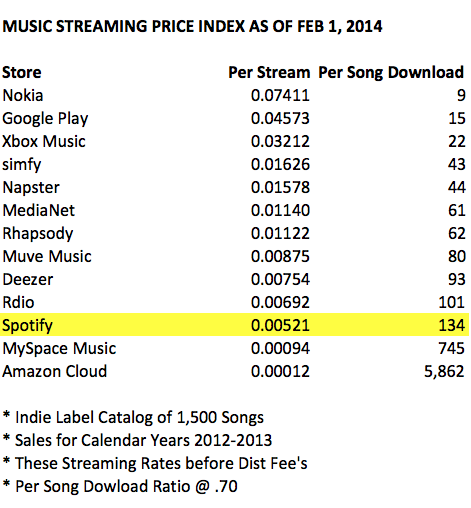
musicstreamingindex020114[EDITORS NOTE: All of the data above is aggregated. In all cases the total amount of revenue is divided by the total number of the streams per service  (ex: $5,210 / 1,000,000 = .00521 per stream). In cases where there are multiple tiers and pricing structures (like Spotify), these are all summed together and divided to create an averaged, single rate per play.]

If the services at the top of the list like Nokia, Google Play and Xbox Music can pay more per play, why can’t the services at the bottom of the list like Spotify and YouTube?

We’ll give you a hint, the less streams/plays there are the more each play pays. The more plays there are the less each stream/play pays. Tell us again about how these services will scale. Looking at this data it seems pretty clear that the larger the service get’s, the less artists are paid per stream.

So do you think streaming royalty rates are really going to increase as these services “scale”? No, we didn’t either.

[ BREAKING! Apple Announces Itunes One Dollar Albums and Ten Cent Song Downloads In Time For The Holidays! | Sillycon Daily News ]
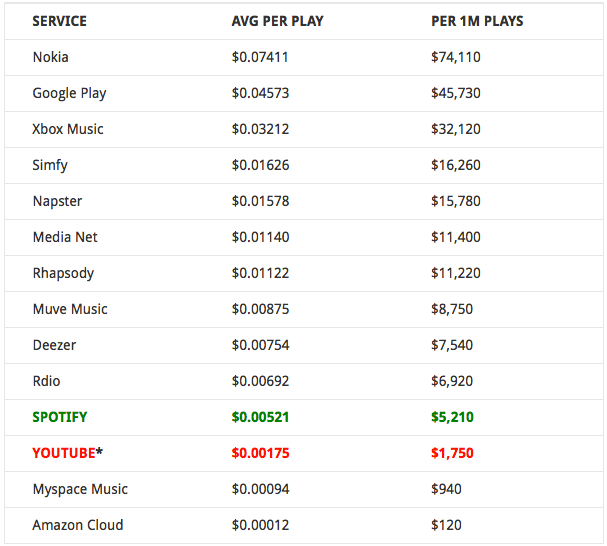
 

StreamingPriceIndexwYOUTUBE

We’ve been waiting for someone to send us this kind of data. This info was provided anonymously by an indie label (we were provided screenshots but anonymized this info to a spreadsheet). Through the cooperative and collaborative efforts of artists such as Zoe Keating and The Cynical Musician we hope to build more data sets for musicians to compare real world numbers.

In our on going quest for openness and transparency on what artists are actually getting paid we’d love to hear from our readers if their numbers and experience are consistent with these numbers below. At the very least, these numbers should be the starting point of larger conversations for artists to share their information with each other.

Remember, no music = no business.

whatyoutubereallypaysFor whatever reason there appear to be a lot of unmonetized views in the aggregate. So let’s just focus on the plays earning 100% of the revenue pool in the blue set. These are videos where the uploader retains 100% of the rights in the video including the music, the publishing and the video content itself.

Plays  Earnings  Per Play
2,023,295 $3,611.84 $0.00179
1,140,384 $2,155.69 $0.00189
415,341 $624.54 $0.00150
240,499 $371.47 $0.00154
221,078 $313.47 $0.00142
TOTALS TOTALS AVERAGE
4,040,597 $7,077.01 $0.00175

So it appears that YouTube is currently paying $1,750 per million plays gross.

We understand that people reading this may report other numbers, and that’s the point. There is no openness or transparency from either Spotify or YouTube on what type of revenue artists can expect to earn and under what specific conditions. So until these services provide openness and transparency to musicians and creators, “sharing” this type of data is going to be the best we’re going to be able to do as East Bay Ray comments in his interview with NPR.

As we’re now in a world where you need you need a million of anything to be meaningful here’s a benchmark of where YouTube ranks against Spotify.

Service  Plays  Per Play  Total  Notes 
Spotify To Performers/Master Rights 1,000,000 0.00521 $5,210.00 Gross Payable to Master Rights Holder Only
Spotify To Songwrtiers / Publishers This revenue is for the same 1m Plays Above 0.000521 $521.00 Gross Payable to Songwriter/s & Publisher/s (estimated)
YouTube Artist Channel 1,000,000 0.00175 $1,750.00 Gross Payable for All Rights Video, Master & Publishing
YouTube CMS (Adiam / AdRev) ** 1,000,000 0.00032 $321.00 Gross Payable to Master Rights Holder Only

The bottom line here is if we want to see what advertising supported free streaming looks like at scale it’s YouTube. And if these are the numbers artists can hope to earn with a baseline in the millions of plays it speaks volumes to the unsustainability of these models for individual creators and musicians.

Meet the New Boss: YouTube’s Monopoly on Video | MTP

It’s also important to remember that the pie only grows with increased revenue which can only come from advertising revenue (free tier) and subscription fees (paid tier). But once the revenue pool has been set, monthly, than all of the streams are divided by that revenue pool for that month – so the more streams there are, the less each stream is worth.

All adrev, streaming and subscription services work on the same basic models as YouTube (adrev) and Spotify (adrev & subs). If these services are growing plays but not revenue, each play is worth less because the services are paying out a fixed percentage of revenue every month divided by the number of total plays. Adding more subscribers, also adds more plays which means that there is less paid per play as the service scales in size.

This is why building to scale, on the backs of musicians who support these services, is a stab in the back to those very same artists. The service retains it’s margin, while the artists margin is reduced.

[** these numbers from a data set of revenue collected on over 8 million streams via CMS for an artist/master rights holder]

Here’s what 1 million streams looks like from different revenue perspectives on the two largest and mainstream streaming services.

Service  Units Per Unit  Total  Notes 
Spotify 1,000,000 $0.00521 $5,210.00 Gross Payable to Master Rights Holder Only
Spotify same million units as above $0.00052 $521.00 Gross Payable to Songwriter/s & Publisher/s (est)
YouTube 1,000,000 $0.00175 $1,750.00 Gross Payable for All Rights Video, Master & Publishing
YouTube CMS Master Recording (Audiam / AdRev) 1,000,000 $0.00032 $321.00 Gross Payable to Master Rights Holder Only
STREAMING TOTALS  3,000,000 $7,802.00 TOTAL REVENUE EARNED FOR 3 MILLION PLAYS ON SPOTIFY AND YOUTUBE 
Itunes Album Downloads 1,125 $7.00000 $7,875.00 Gross payable including Publishing

Here are some compelling stats on the break down of what percentage of videos on YouTube actually achieve breaking the 1 million play threshold, only 0.33%

CHART OF THE DAY: Half Of YouTube Videos Get Fewer Than 500 Views | Business Insider

Some 53% of YouTube’s videos have fewer than 500 views, says TubeMogul. About 30% have less than 100 views. Meanwhile, just 0.33% have more than 1 million views.

That’s not a huge surprise. But it highlights some of the struggles Google could have selling ads around all those unpopular videos, despite the money it has to spend to store them.

An artist needs to generate THREE MILLION PLAYS on the two largest and most popular streaming platforms to equal just 1,125 album downloads from Itunes. This is an important metric to put in context. In 2013 only 4.8% of new album releases sold 2,000 units or more. So if only 4.8% of artists can sell 2,000 units or more, how many artists can realistically generate over four million streams from the same album of material?

in 2013 there were 66,565 new releases, only 3,237 sold more than 2,000 units = 4.8% of new releases sold over 2,000 units

in 2013 there were 915,482 total releases in print, only 14,856 sold more than 2,000 units = 1.6% of ALL RELEASES in print sold more than 2,000 units.

This is even more important when you start to consider that many artists feel that growing a fan base of just 10,000 fans is enough to sustain a professional career. Note we said solo artists because these economics probably need to be multiplied by each band member added for the revenue distribution to remain sustainable. So a band of four people probably need a sales base of 40,000 fans to sustain a professional career for each member of the band.

Each 10,000 albums sold on iTunes (or 100,000 song downloads) generates $70,000 in revenue for the solo artist or band. To achieve the same revenue per 10,000 fans in streams, the band has to generate 30 million streaming plays (as detailed above) if they are distributing their music across the most common streaming services including Spotify and YouTube.

In 2013 the top 1% of new releases (which happen to be those 620 titles selling 20k units or more) totaled over 77% of the new release market share leaving the remaining 99% of new releases to divide up the remaining 23% of sales.

This appears to confirm our suspicion that the internet has not created a new middle class of empowered, independent and DIY artists but sadly has sentenced them to be hobbyists and non-professionals.

Meanwhile the major artists with substantial label backing dominate greater market share as they are the few who can sustain the attrition of a marketplace where illegally free and consequence free access to music remains the primary source of consumption.

What’s worse is that it is Silicon Valley corporate interests and Fortune 500 companies that are exploiting artists and musicians worse than labels ever did. New boss, worse than the old boss, indeed.

So whose feeling empowered?

RELATED:

UN to Airlift Calculators, Behavioral Economics Textbooks to Digital Music Industry

Streaming Is the Future, Spotify Is Not. Let’s talk Solutions.

Who will be the First Fired Label Execs over Spotify Fiasco & Cannibalization?


#irespectmusic Blake Morgan on his CNN Interview and the Latest Spotify Debacle

#irespectmusic Blake Morgan on Spotify and Artists….

Music Technology Policy

MTP: I watched your CNN interview with Poppy Harlow and you made some significant points that don’t get picked up much.  Let’s start with the last one:  Spotify could be the next Myspace.  I think we all remember when Myspace was viewed as the Second Coming and then one year it just evaporated.  I was trying to remember the CEO’s name. What about Spotify reminds you of Myspace?
Blake Morgan: The false idea that Spotify is inevitable and gargantuan. In fact, if they don’t evolve, they may find themselves more like Goliath. And we all know what happened to Goliath, right? If you don’t, just ask MySpace. Streaming is not itself in question here, any more than MySpace’s failure called the idea of social media into question. It didn’t. Its failure was a reflection on MySpace, and its model. Same thing here. Streaming may or may not be a viable…

View original post 824 more words

How to Fix Music Streaming in One Word, “Windows”… two more “Pay Gates”…

We’ve written about this before in two posts, Why Spotify is not Netflix (But Maybe It Should Be) and Streaming Is the Future, Spotify Is Not. Let’s talk Solutions. In Both posts we talk at length about how the problem is not technology or streaming itself, but rather the very restricted business models and poor economics that currently exist. No amount of selective double speak from Daniel Ek will change the bad math that Spotify can not scale at current rates.

Jason Aldean now joins Taylor Swift in removing his music from Spotify which leads us to wonder how many more artists with the ability to do so will remove their new releases and/or catalogs as well. This may also be a good time to revisit those two previous posts mentioned above.

So here is the question, is the record business really utilizing the new digital platforms correctly to address the current market place? Perhaps by looking at the options available to consumers from movie streaming, rental and download businesses we can find more robust and flexible opportunities for artists.

At the very least windowing releases allows artists, their managers and even labels the ability to manage and maximize current revenue streams more effectively. Windowing opens up strategic decisions about tier based pricing relative to the value proposition for both the artist and the consumer. Windowing may not fix all of the problems artists are facing in music streaming but it will be a great first step towards recognizing that the artists should have some direct participation in deciding how their work is consumed.

It’s not that streaming can’t work. It can. It’s that Spotify is a bad business model that has unsustainable economics and exploits artists because it is a wall street financial instrument and not a music company.

Pay Gates may be another solution (which is essentially a window). For example, Spotify premium paid subscribers could access the new Taylor Swift record, but not those using the free version of the service. This also allows artists to determine which songs can be accessed for free for greater promotional value, and which songs are intended to maximize revenue.

Why does Spotify unilaterally get to dictate to artists, managers and labels how to best maximize their relationships and revenues with their own fans?

As Spotify is a destination platform, and not a discovery platform we could see where the current hit singles are only available to paid subscribers while select album tracks could be accessible for free. The tracks on the free tier are monetized only by advertising revenue which pays very little, but there may be a promotional benefit to build awareness on lesser know songs.

Even the old school record business had tier based pricing. There were front-line, mid-line and budget pricing tiers. Front-line titles were often deeply discounted for premium in-store positioning. Mid-line titles were discounted as an incentive to stimulate more sales from recent catalog titles. Budget titles were mostly oldies and very deep back catalog. Primitive as they were, these were windows.

Yes, we know the choir of “or else they’ll steal it” from piracy apologists will claim that anything less the complete devaluation of music as fodder for advertising revenue is pointless. We’ll take our chances with Jason Aldean, Taylor Swift, Adele, Coldplay, Beyonce’, The Black Keys, Thom Yorke and the growing number of artists that are either removing their catalogs from Spotify, or windowing them.

Bring on the windows and pay gates! Let’s see some “innovation” and “disruption” that actually works for artists and not just the new boss. The outcry (from Spotify) of artists removing their songs also proves another very important point – all music is not equal. If some weekend hobbyist does not put their music on Spotify or pulls it off Spotify it doesn’t make headlines. Taylor Swift, Adele, Beyonce, The Black Keys, Thom Yorke, etc – all make headlines because people  actually do VALUE professional music. Professional music, has a professional price.

If Spotify is such a good business for artists, why not let each artist decide if Spotify works for them? Why does Spotify publicly shame artists to convince them how good they are? The lady doth protests too much, wethinks…

It’s funny how long it’s taken the record industry to realize that if you keep allowing something to be given away for free there is no incentive to pay. Who knew?

calculator


RELATED:

Why Spotify is not Netflix (But Maybe It Should Be)


Streaming Is the Future, Spotify Is Not. Let’s talk Solutions.


Spotify’s Daniel Ek is Really Bad At Simple Math, “Artists Will Make a Decent Living Off Streaming In Just a Few Years”

Internet Consultants Are Wrong : Confused About Musicians, The Internet and Piracy

Piracy and Streaming seem to have a lot in common in the (false) arguments presented by tech bloggers…

The Trichordist

There’s a post on a tech blog from 2009 following The Pirate Bay guilty verdict titled “Paul McCartney’s Confused About The Pirate Bay” that truly illustrates how many internet consultants and tech blogger’s appear feel about musicians. The  comments responding to Sir Paul McCartney speaking about the Pirate Bay verdict show just how much these people don’t seem to understand musicians.

In this one post we see all of the major anti-artists talking points that Silicon Valley interests still use against creators in a disinformation campaign that is over a decade long:

– artists are easily confused about the internet and technology
– artists don’t know what’s best for them (let the “consultant”  help you!)
– artists can get paid, but as long as its not via a “government mandated tax” ie, copyright (!?)
– artists shouldn’t be able to live off of one song (royalties)…

View original post 351 more words

Let The Heads Roll…More Genius From The Record Industry Braintrust or Mark Mulligan Gets a Calculator…

Happy Halloween and welcome to the scary stupid post of the day…

We’ve been saying this for a long time, music streaming math just doesn’t add up. Would someone please buy some calculators for the record industry braintrust that keeps making these stupid deals? Seriously, it’s just math and it’s not that hard… even Mark Mulligan is getting it… no kidding…

$2.3 Billion In Net Loss To Artists and Labels Per Year

The report extrapolates that YouTube Music Key will generate $400 million in revenues in its first year. But over the long run it will also be responsible for more than $2.6 billion in lost subscription revenue yearly. That’s a negative net impact of $2.3 billion in lost music revenue every year, according to the study.

Ok, that’s YouTube. Let’s revisit how the Spotify math works…

If you own a calculator, let’s just do the math one more time, real slow and simple like…

1) Spotify and former uTorrent CEO Daniel Ek says Spotify only needs 40m paid subscribers for streaming to be sustainable for artists. But that math just doesn’t work.

2) $10 per month subscription = $120 per year per subscriber

3) $120 per year, per subscriber paying out 70% of gross to rights holders equals $84 per subscriber, per year.

4) $84 per subscriber, per year x’s 40 million subscribers equals $3.4b per year in top line gross revenue to ALL rights holders. That’s $3.4b for labels, artists, publishers and songwriters combined.

5) $3.4b per year is HALF of the current revenue of $7b per year where the domestic business has been flat lined.

6) Assuming you could DOUBLE the subscription base to 80m PAID in the USA within two years by dropping the price in HALF to $5 per subscriber per month you still only gross (wait for it…) $3.4b a year in revenue.

We know this is shocking to the math impaired, but doubling scale (imagined as it is) while cutting the subscription fees in half, actually nets you the same amount of money. Shocking the things one can learn with a calculator or a spreadsheet.

Maybe we’re all screwed, but we will not go quietly and we’re gonna call it how we see it on the race to the bottom. We will document the stupidity undoing the business. Maybe it’s time for Lucian Grange to get out that axe again and let people know what time it is? #stopthemadness

READ THE FULL POST AT HYPEBOT:
http://www.hypebot.com/hypebot/2014/10/youtube-music-service-could-cost-artists-labels-23-billion-in-lost-income.html

RELATED:

Music Streaming Math, Can It All Add Up?

Who will be the First Fired Label Execs over Spotify Fiasco & Cannibalization?

Streaming Is the Future, Spotify Is Not. Let’s talk Solutions.

Government Capture and Google’s Crony Capitalism Assault on America

Music Technology Policy

In case you haven’t noticed, Google has been conducting an all out assault on powerful positions in the U.S. Government.  Note that I say “the U.S. Government” and not “the Obama Administration” for a reason–it just happens, it is merely coincidental that President Obama is the occupant of the White House during Google’s rise to power.  Focusing on the political party of the White House misses the point–David Duke could get elected president and Google would still be playing the same game.  And it’s a game as old as mankind.  Using money to gain influence and using influence to gain power.

Because, as Erik Telford writes in Townhall, “Google [is] the Halliburton of the Obama Administration.”  Even Politico’s Google booster Tony Romm said “The Obama Administration recently plundered the search giant’s ranks.”  Andrew Orlowski wrote four years ago in the Register, “Google is Obama’s Halliburton: So Who’s…

View original post 440 more words

Blake Morgan Explains the #irespectmusic AND I VOTE! campaign and the Importance of @respectcreators at @thebitterend Show in NYC

Music Technology Policy

On October 14, Blake Morgan and a great line up of performers hosted a sold out standing room only live show for the #irespectmusic AND I VOTE! campaign at the legendary Bitter End in Greenwich Village.  In addition to stellar performances by City of the Sun, Jus Post Bellum, Coyle Girelli and Janita as well as a rousing speech supporting artist rights by Congressman Jerry Nadler that brought the house down, Blake told the story of the #irespectmusic activism and the voter registration campaign.  (See event review here at Doo Bee Doo Bee Doo.)

I highly recommend watching this video of Blake’s inspiring short speech about the evolution of his activism, the voter registration drive and the Congressional Creative Rights Caucus.

Tell your friends, sign the petition and VOTE on November 4!

image

View original post

Shootout At the Fantasy Factory Part 2: What Should Streams Mean for Royalty Escalations?

If 100 streams = 1 Song Download, why doesn’t the money match?

Music Technology Policy

As we noted in a prior post, Billboard reported on what might be called the “chart value” of streams compared to downloads.  To the extent that streams are counted in both the Billboard charts and the UK’s Official Charts, streams are valued at 100 streams to one permanent download.  This ratio was touted by Spotify at the recent artist meetings hosted by the Featured Artist Coalition in New York.

When you consider the royalty value of that ratio, however, those 100 streams are rewarded at a much, much lower penny rate than a download, even if you compare 100 streams to the $0.70 price of the lowest iTunes wholesale price of downloads.  As we noted previously, the 100:1 ratio implies a per-stream royalty of $0.007.

What About the Royalty Value?

Experience suggests that this seems high.  Quite high.  So just to confirm what Spotify representatives actually said at the…

View original post 1,836 more words

When Iggy Pop can’t live off his art, what chance do the rest have? | The Globe and Mail

But a new reality has tripped him up and it’s the same one shafting artists all across the world: Namely, that everyone wants to listen, and no one wants to pay. This week, Iggy gave a lecture for the British Broadcasting Corp. called Free Music in a Capitalist Society. Artists have always been ripped off by corporations, he said; now the public is in on the free ride, too: “The cat is out of the bag and the new electronic devices, which estrange people from their morals, also make it easier to steal music than to pay for it.”

To keep skinny body and maverick soul together, Iggy’s become a DJ, a car-insurance pitchman and a fashion model. If he had to live off royalties, he said, he’d have to “tend bars between sets.” As I listened to his enthusiastic stoner Midwestern drawl, I thought: If Iggy Pop can’t make it, what message does that send to all the baby Iggys out there? In a society where worth is judged by price, for better or worse, what are you saying to someone when you won’t pay for the thing he’s crafted?

READ THE FULL STORY AT:
http://www.theglobeandmail.com/globe-debate/when-iggy-pop-cant-live-off-his-art-what-chance-do-the-rest-have/article21154663/