DMN : 7 Reasons Why Artists Should Skip a BitTorrent ‘Media Partnership’

Worth repeating here from Digital Music News by Helienne Lindvall.

Lately, BitTorrent, Inc. has made a concerted effort to appear “legit”, courting both artists and their managers.  It’s even managed to become a “tech partner” of the UK Music Managers Forum.  But is partnering with BitTorrent – and its uTorrent client – really a good idea for artists?

READ THE FULL POST HERE AT DIGITAL MUSIC NEWS:
http://www.digitalmusicnews.com/permalink/2013/20130529bittorrentjustsaynoearbud

Quincy Jones talks music, legacy and piracy…

Quincy Jones is a living legend. We find it interesting that despite the common insights of some of the most respected artists, songwriters, performers and producers there are still those who claim musicians are better off in the post-internet world, and that piracy has not negatively effected them. Quincy disagrees, and rightfully so.

Q: How have you adapted over the years to the way the industry has changed?

A: The industry doesn’t change your production – you still do what you believe in. What’s sad is that there is 98 percent music piracy everywhere on the planet. It’s just terrible.

What if these kids (who download music illegally) worked for me for two months and then I said, “I’m not going to pay you.” That’s just not right.

READ THE FULL INTERVIEW HERE:
http://www.accessatlanta.com/weblogs/atlanta-music-scene/2013/may/21/quincy-jones-talks-music-legacy-and-why-he-likes-l/

Jerry Cantrell (Alice In Chains) Talks Music Piracy: You hardly have any control over your own music.

Jerry Cantrell of Alice In Chains talks about another important issue about music piracy that effects both the band and it’s fans, the inability to safely share new material.

But with the advent of the Internet and sharing and shit going everywhere, you can’t do that anymore. We really haven’t been playing anything off the new record that’s not out yet.

We used to play new stuff all of the time. When we were touring ‘Facelift,’ we probably played half of ‘Dirt’ on the end of that tour. It’s a cool thing to be able to do, but you hardly have any control over your own music.

We’d rather wait until you get the best quality version of what we created before you start getting shitty iPhone versions from crappy gigs.

READ THE FULL STORY HERE:
http://www.ultimate-guitar.com/news/general_music_news/jerry_cantrell_talks_music_piracy

BUY THE DEVIL PUT DINOSAURS HERE AT ITUNES:
https://itunes.apple.com/us/album/the-devil-put-dinosaurs-here/id622941441

BitTorrent, “Not Designed For Piracy”… Really? Seriously? 99% Infringing…

Bit Torrent creator Bram Cohen is either one of the most misinformed people on earth, or one of the most intellectually dishonest… and here’s why… Remember this one?

BitTorrent: Bram Cohen Says ‘I commit digital piracy’?

I build systems to disseminate information, commit digital piracy, synthesize drugs, maintain untrusted contacts, purchase anonymously, and secure machines and homes. I release my code and writings freely, and publish all of my ideas early to make them unpatentable.

Uhmmmm…. So why this is surprising?

Only 0.3% of files on BitTorrent confirmed to be legal | Ars Technica

This report echoes similar results out of Princeton that were published earlier this year. Though the top categories were slightly different—Princeton found that movies and TV were the most popular, while music fell behind games/software, pornography, and unclassifiable files—that study found that all of the movie, TV, and music content being shared was indeed infringing.

Overall, Princeton said that 99 percent of the content on BitTorrent was illegal.

Oh and that Princeton Study…

BitTorrent census: about 99% of files copyright infringing | Ars Technica

It has never been a secret that the majority of files being shared over BitTorrent are movies and music that are likely being shared illegally.

But wait there’s more…

Census of Files Available via BitTorrent

Overall, we classified ten of the 1021 files, or approximately 1%, as likely non-infringing, This result should be interpreted with caution, as we may have missed some non-infringing files, and our sample is of files available, not files actually downloaded.

Still, the result suggests strongly that copyright infringement is widespread among BitTorrent users.

Fast forward to 2012…

Keen On… Bram Cohen: Has BitTorrent Killed The Music Industry?

His denial was categorical. Not only did Bram deny any role in shrinking the sale of recorded music, but he actually disputed that the music industry is in decline, claiming “data” showed it to be in a quite healthy state.

Well Bram, you might want to look at this, and this

and… as another #SFMusicTech begins BitTorrent is one of the lead sponsors… To be fair, SFMusicTech get’s to run it’s event and do business with whom it chooses. Unfortunately musicians are not given the same choice of having their work “torrented.” So how about a little honesty?

This conversation is really just about consent and compensation. Two very simple fundamental principles that pretty much everyone can agree are the foundations of not just ethical business practices, but also the basis for a fair and just society.
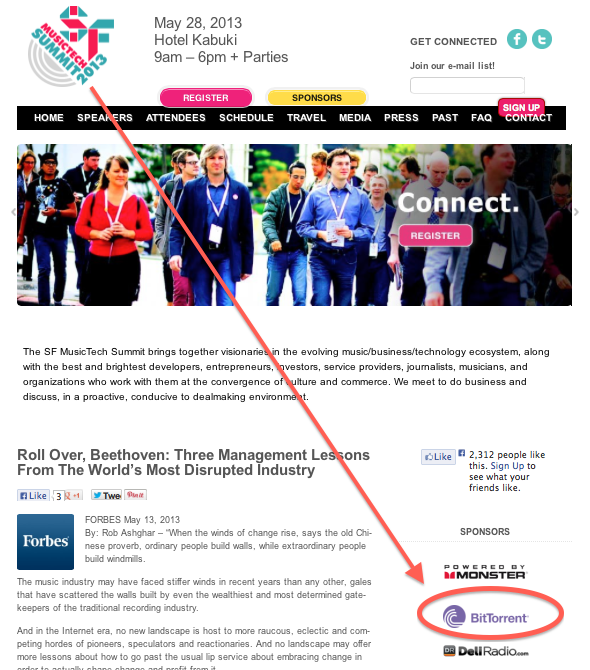
SFmusicTechBitTorrent

Music Tech Policy explores the question, “Can 5 Billion Ads Served a Month Be Wrong”:
MTP : BitTorrent Profits from Piracy By Serving Ads To UTorrent Client

“Options, not rules”: BitTorrent Profits from Piracy By Serving Ads To UTorrent Client

We highly recommend not just reading this post at MTP, but also don’t miss the hyperlinks!

RELATED:
Only 0.3% of files on BitTorrent confirmed to be legal | Ars Technica

This report echoes similar results out of Princeton that were published earlier this year. Though the top categories were slightly different—Princeton found that movies and TV were the most popular, while music fell behind games/software, pornography, and unclassifiable files—that study found that all of the movie, TV, and music content being shared was indeed infringing. Overall, Princeton said that 99 percent of the content on BitTorrent was illegal.

Music Technology Policy

As galling as it may be, About.com actually has a post calledThe Best Torrent Downloading Software 2013.”  And who is the winner of the best client to use for stealing music and movies?

“Here they are: the most popular ‘music pirate’ downloading software for torrent file sharing. This list is compiled from hundreds of user comments and reader suggestions. Currently, the two most popular tools are uTorrent and Tixati. But definitely look at all the choices below for yourself.”

So what is “uTorrent”?  Why the handy application from SF Music Tech sponsor Bit Torrent, Inc. of course.  uTorrent has been downloaded over 20 million times from download.com alone, so you won’t be surprised to hear that the ad supported application servesover 5 billion ads a month.

According to Torrentfreak:

Based on the stats reported by BitTorrent, the uTorrent client serves more than five billion ads…

View original post 899 more words

ADWEEK : “Ad Industry Takes Major Step to Fight Online Piracy”… Again…

Stop me, oh uh, stop me, if you think you’ve heard this one before…

The advertising industry took a major step Thursday in fighting rogue websites that steal copyrighted material and sell counterfeit goods. To cut off the financial support that keeps rogue sites alive, the nation’s two major ad industry associations recommended agencies and marketers take steps to keep brands’ ads off those sites.

While the debate remains contentious, there has been universal agreement that the key to shutting down rogue websites was to cut off the money that keeps them alive.

Recognizing advertising was the first line of attack, GroupM last year became the first ad shop to adopt a comprehensive anti-piracy policy, compiling last summer an updatable black list of some 2,000 websites that are cut off from ads from blue-chip clients like Ford, AT&T, Unilever and Dell.

READ THE ABOVE FULL ARTICLE HERE AT ADWEEK:
http://www.adweek.com/news/technology/ad-industry-takes-major-step-fight-online-piracy-140014

So the above is from May 3, 2013… and here’s an insightful article below from the advertising trade publication CLICKZ.COM on April 18, 2011… Yes, 2011…

What is the purpose of me bringing this up? To raise awareness and perhaps ask publicly that those involved in this industry become better corporate citizens. If you are running one of those exchanges or networks and feel that it’s only a “transparency” issue, please consider that you are funding not only these websites but organized criminal organizations that run them.

This is not a victimless crime, but instead one that is affecting musicians, programmers, artists, designers – and businesses of all sizes.

As an industry, here are some suggestions of what we can do:

1. Ensure every network that you work with has a no-warez/piracy/torrent policy. Ask around about the networks that do support this. Even if they claim that your ads aren’t going on there, be aware that many of these networks aren’t honest.

2. Put pressure on exchanges that you work with to ensure no network that has this type of inventory is on that exchange. If a few agencies call the exchanges and make it clear they won’t buy media until they are assured these sites are completely off the exchange, then maybe those in charge will consider it a serious issue.

3. Refuse to pay networks that you discover violate this policy and show your advertisements on those sites. Make it clear that you find this behavior not only illegal, but unacceptable for your agency, network, or product.

YOU CAN READ THE FULL ARTICLE HERE (FROM 2011) AT CLICKZ:
http://www.clickz.com/clickz/column/2041366/advertising-networks-supporting-piracy

Accountability?
Responsibility?
Transparency?
Anyone?
Hello?

Ready The Clown Car : Kim Dotcom Contemplates Suing Google, Twitter and Facebook

Serious folks, we can’t make this up.

“Twitter introduces Two-Step-Authentication. Using my invention. But they won’t even verify my Twitter account?!,” Dotcom tweeted.

“Google, Facebook, Twitter, Citibank, etc. offer Two-Step-Authentication. Massive IP (intellectual property) infringement by U.S. companies. My innovation. My patent,” he added.

But it get’s better…

“I never sued them. I believe in sharing knowledge & ideas for the good of society. But I might sue them now cause of what the US did to me,” he said.

However, he said a more productive approach would be if the tech giants helped cover his legal bills to fight prosecution under the Digital Millennium Copyright Act (DCMA), which he estimated would exceed US$50 million.

“Google, Facebook, Twitter, I ask you for help. We are all in the same DMCA boat. Use my patent for free. But please help fund my defence,” he tweeted.

So essentially he’s threatening to sue the very same people he’s asking for money. Interesting strategy. We’re not sure that Google, Facebook and Twitter feel they are in the same boat. It’s difficult to believe these companies would want to be anywhere near the imploding public spectacle known as Kim Dotcom.

READ THE FULL STORY HERE:
http://www.channelnewsasia.com/news/technology/kim-dotcom-mulls-suing-tech-giants-for-c/685072.html

you may also enjoy…

UPDATE:
Kim Dotcom claims he invented two-factor authentication—but he wasn’t first | Ars Technica

Dotcom’s European patent was revoked in 2011 largely because AT&T had a patent on the same technology with a priority date from 1995. (Thanks to Emily Weal of patent law firm Keltie for pointing out Dotcom’s European patent travails in the IP Copy blog.)

While Dotcom’s patent in the US is still in force, AT&T also has a US patent pre-dating hisThe Guardian pointed out that Ericsson and Nokia also have patent filings for two-factor systems predating Dotcom’s.

The Constitutional Foundations of Intellectual Property Law

via copyhype:

Randolph May and Seth Cooper of the Free State Foundation look at some of the philosophical underpinnings that drove the inclusion of copyright and patent protection into the United States Constitution. According to May and Cooper, the origin of the right is explicitly Lockean, while the protection of the right is explicitly Madisonian. An engaging and enlightening read.

READ THE FULL REPORT HERE:
The Constitutional Foundations of Intellectual Property Law

Two Sincere Questions for The Future Of Music Coalition #SFMUSICTECH

We notice that Future of Music Coalition has submitted testimony to congress asking that they “represent” artists in the Copyright Reform process begun by Congress.

So since they’ve  volunteered to represent us.  We feel it only fair that they answer these two questions:

1. Who selects your advocacy positions?  
AFM, AFTRA, NARAS, Nashville Songwriters Assn, and ASCAP all have democratically elected boards who set the organizations’ positions.  Do you have members who vote for leadership?  If not, who is making those decisions?

2. Who funds your organization?
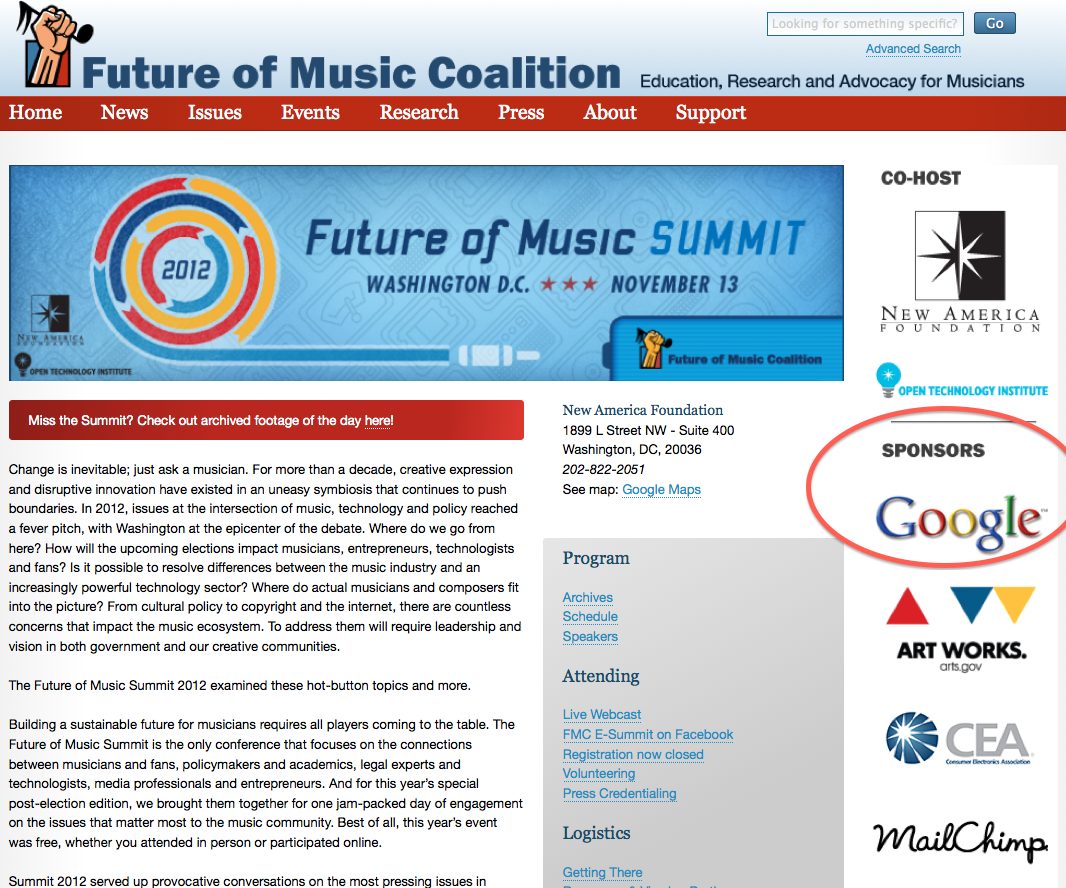
Google is listed as your first sponsor of your primary event.
http://futureofmusic.org/events/future-music-summit-2012

How much money do you get from Google?  Do you think you should be taking funding from a source many artists believe to be opposed to their interests?

FOMC Spondors