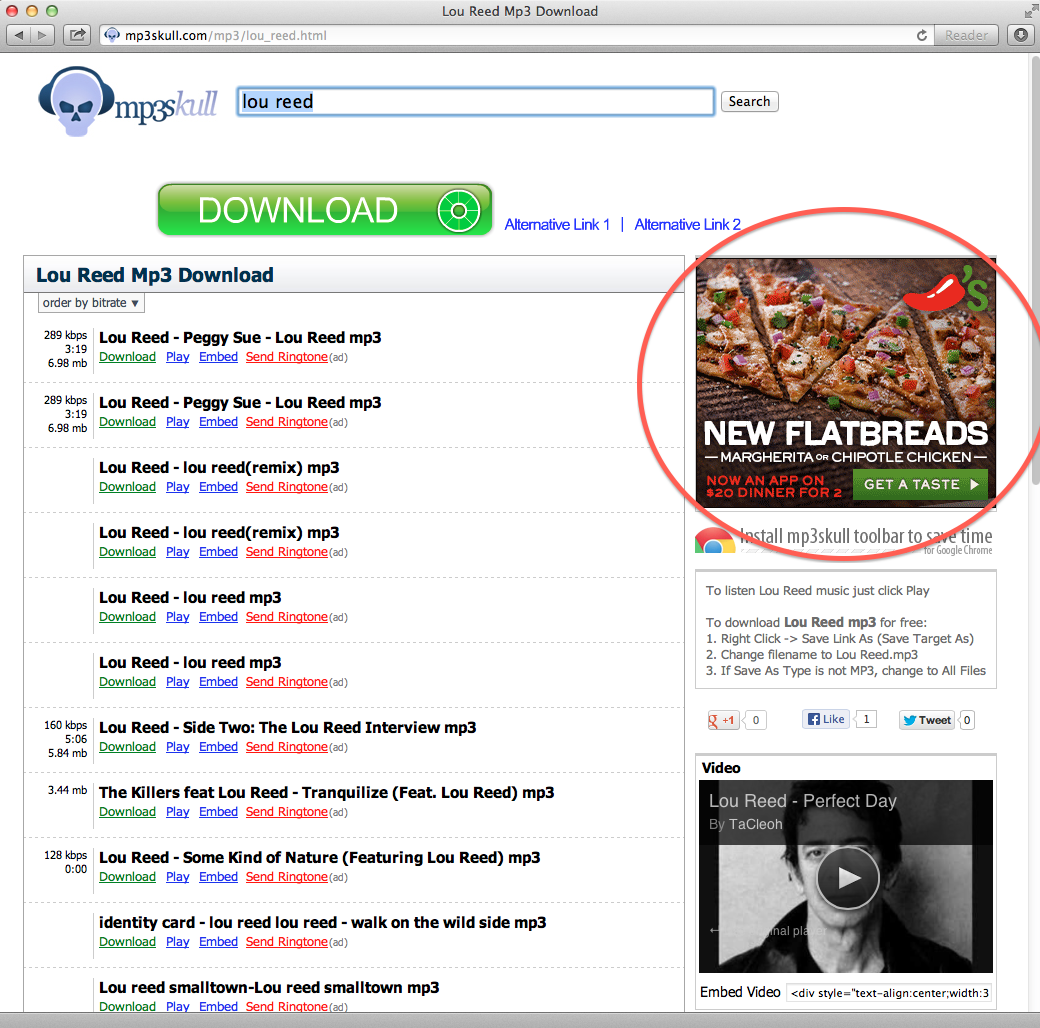
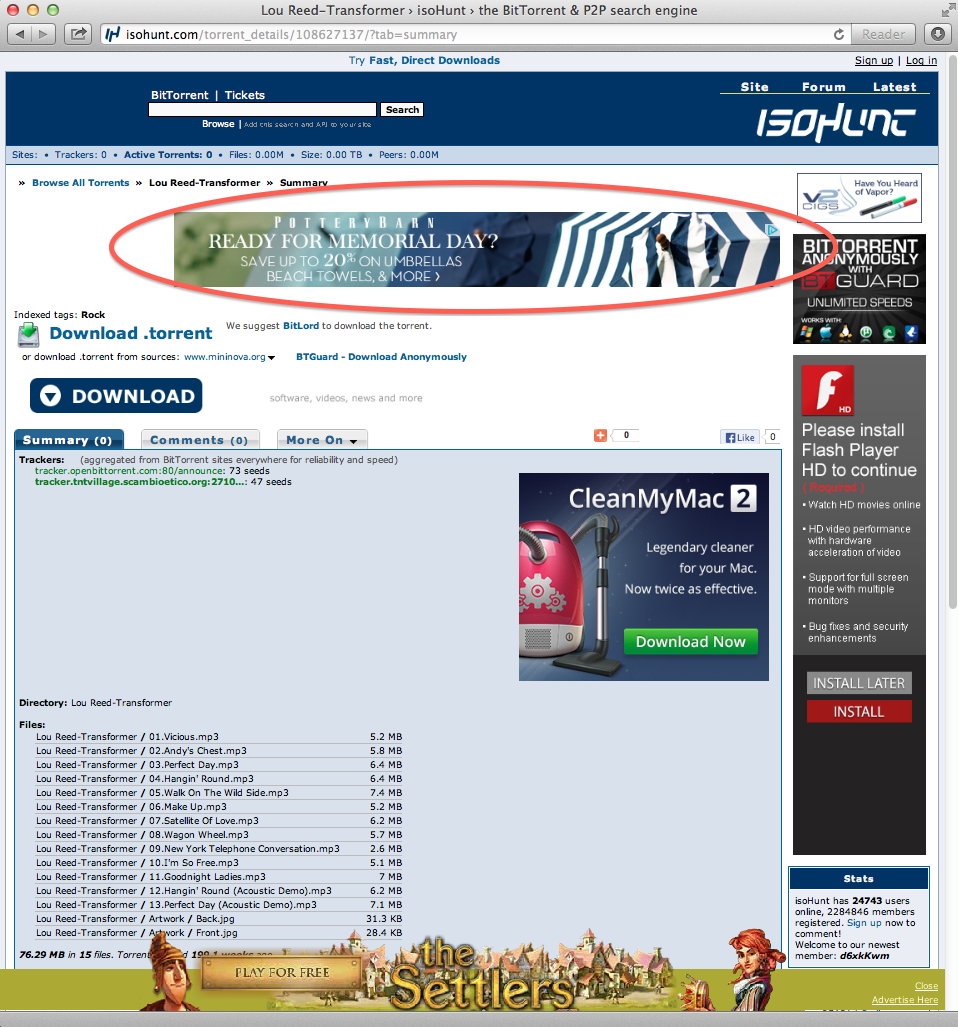
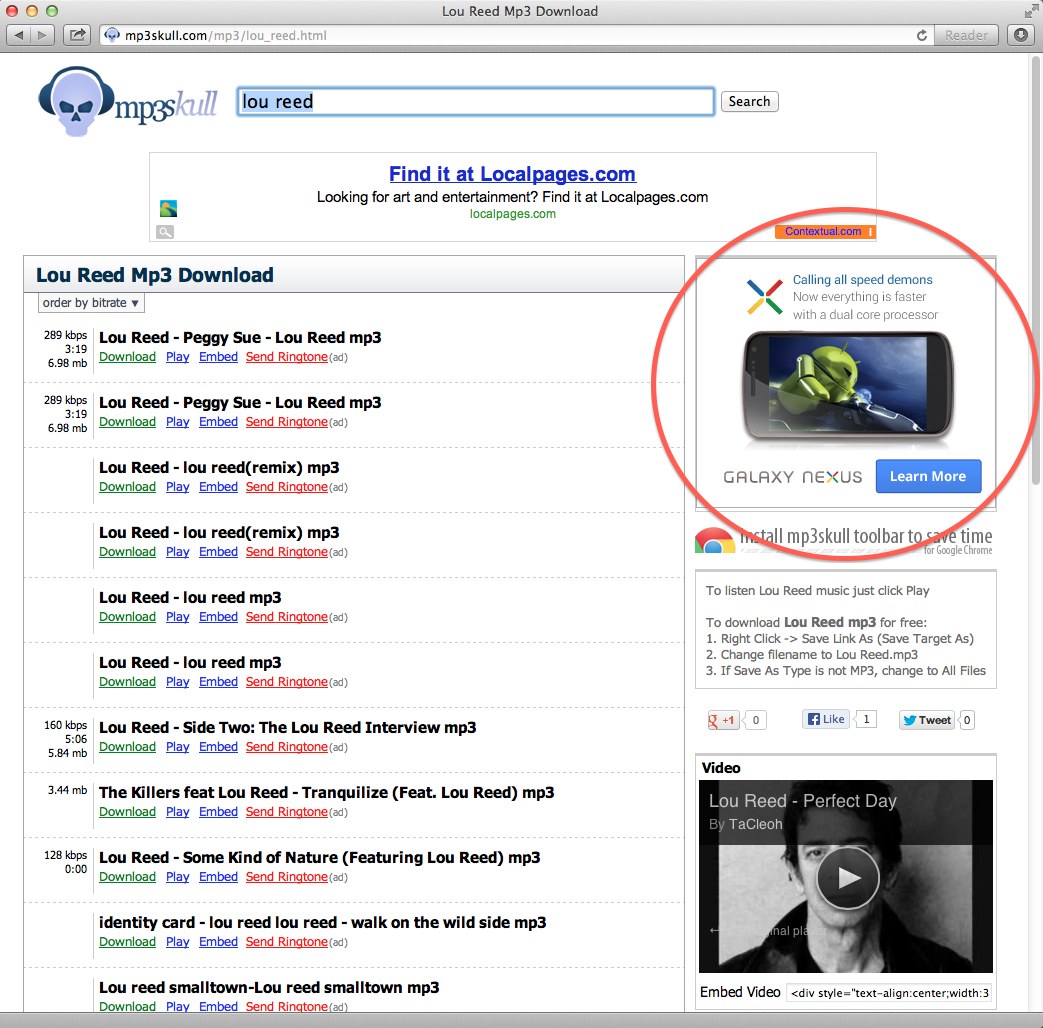
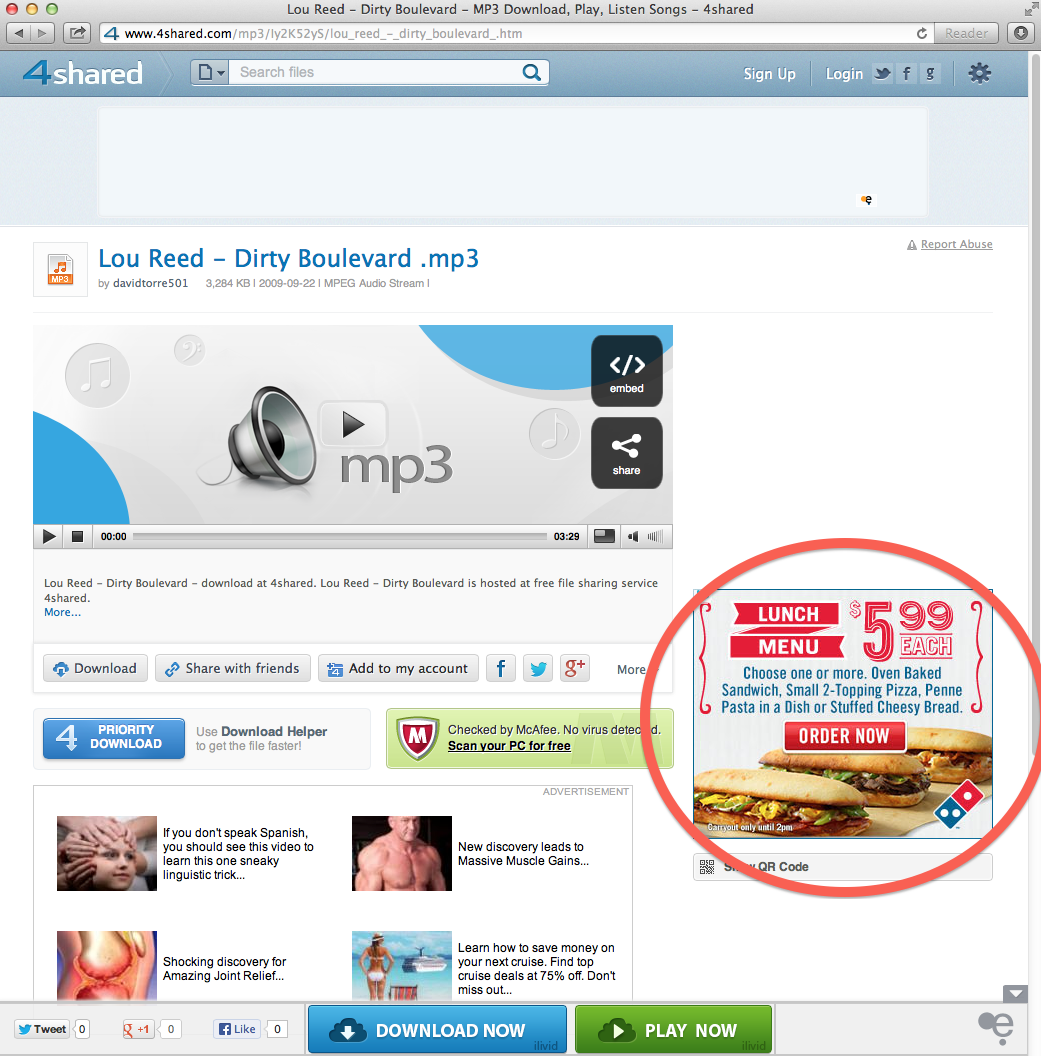
Lou Reed Exploited By American Express, AT&T, Chevrolet, Chili’s, Lysol, Pottery Barn, Vons, Domino’s Pizza, Netflix, Galaxy Nexus and Ron Jeremy!

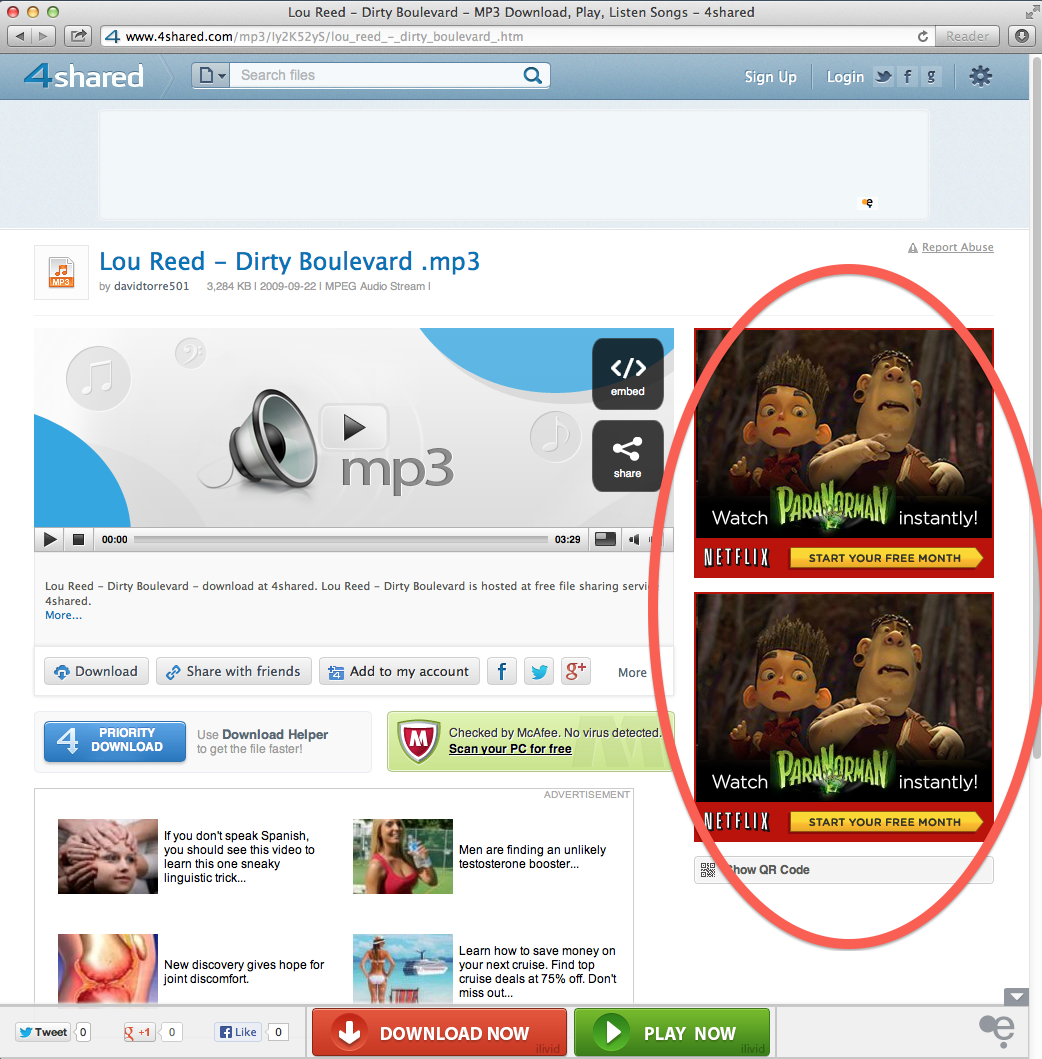
Here we go again… We can go to Google and within minutes search for an artist of stature such as Lou Reed and quickly find unlicensed and infringing internet businesses exploiting his life’s work illegally while paying the him nothing, zero, zilch, nadda, zippo.

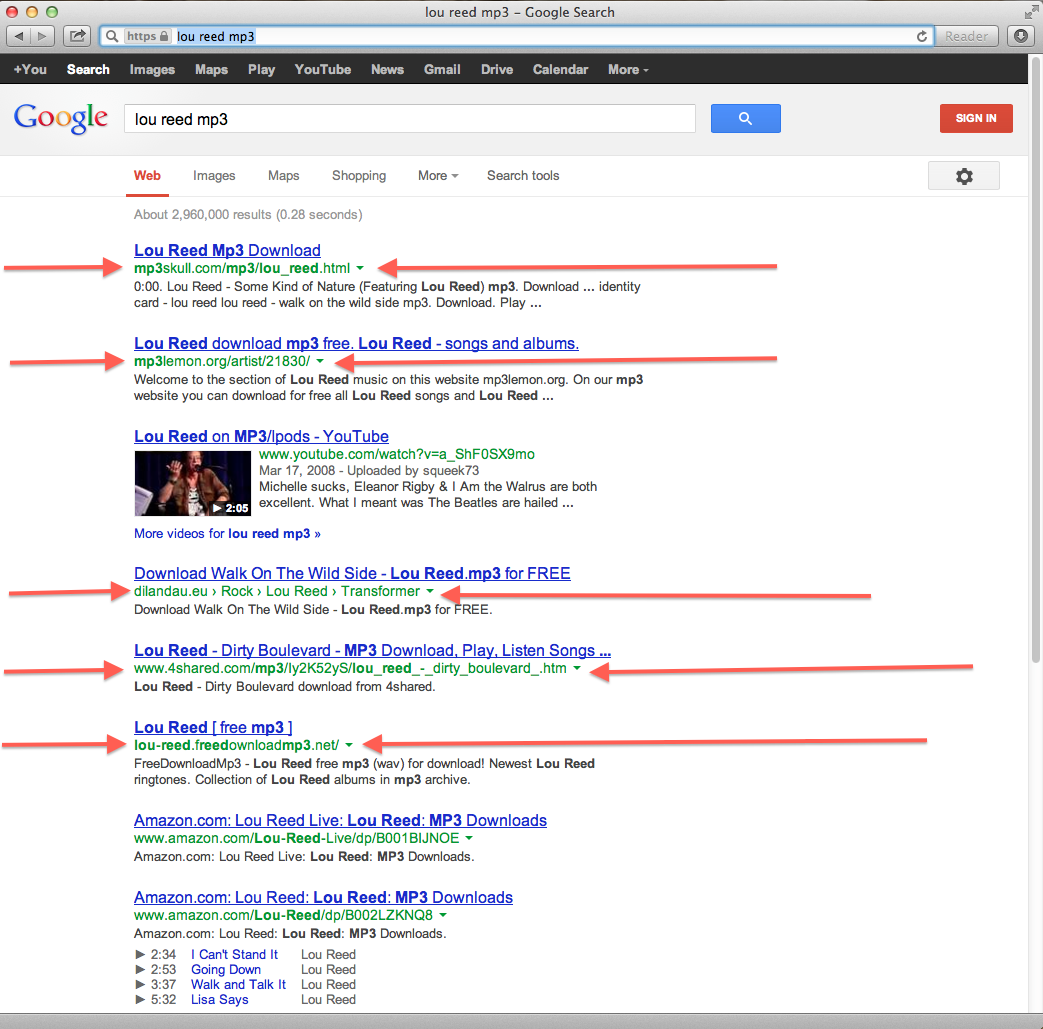
There are many disappointing things about all of this, but the first is that when doing a simple Google search for “Lou Reed Mp3” the first five returns are for illegally operating and infringing sites.

This doesn’t count YouTube which may or may not be infringing, and may or may not actually be paying Lou from the advertising revenue (on this video, in the screen shots below for example). This is all the more troubling because we know that this can be easily filtered if there is the will to do so.

The ad networks have been highlighted in the fantastic work done by Jonathan Taplin in the USC Annenberg Innovation Lab’s Advertising Transparency Reports.

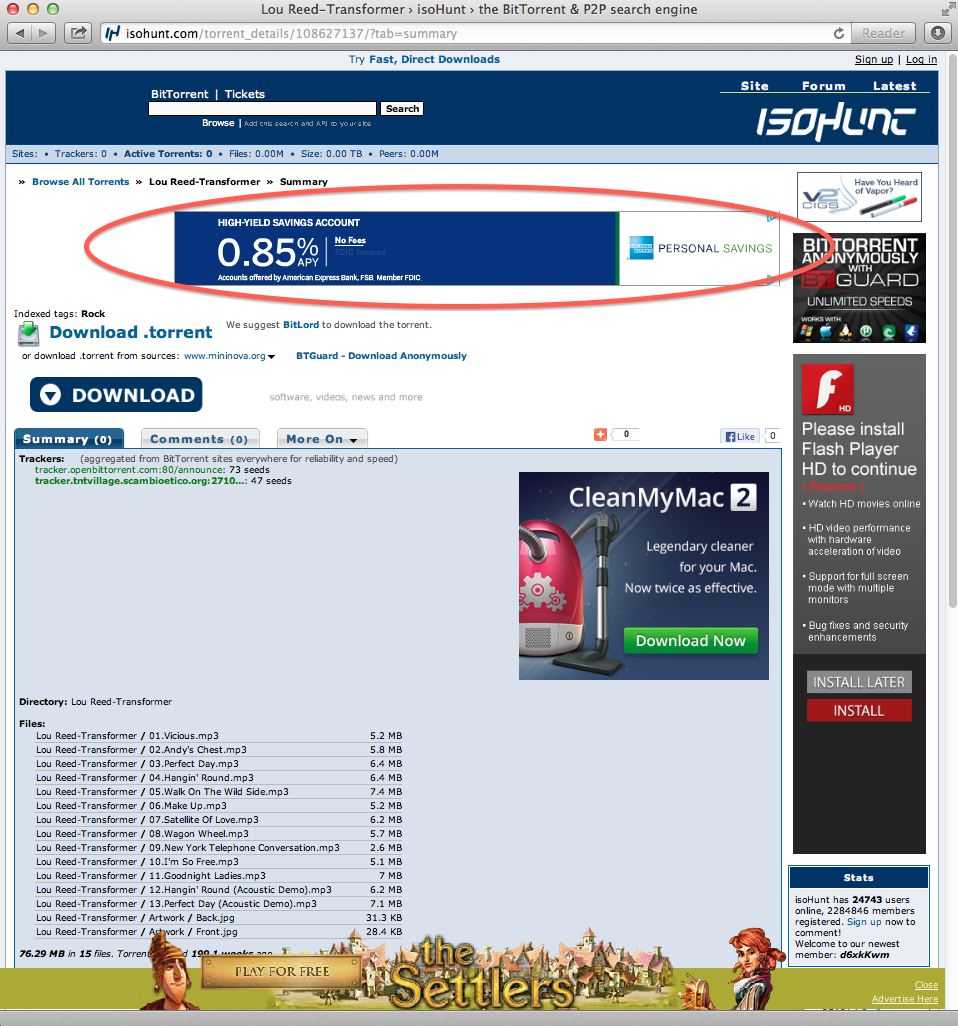
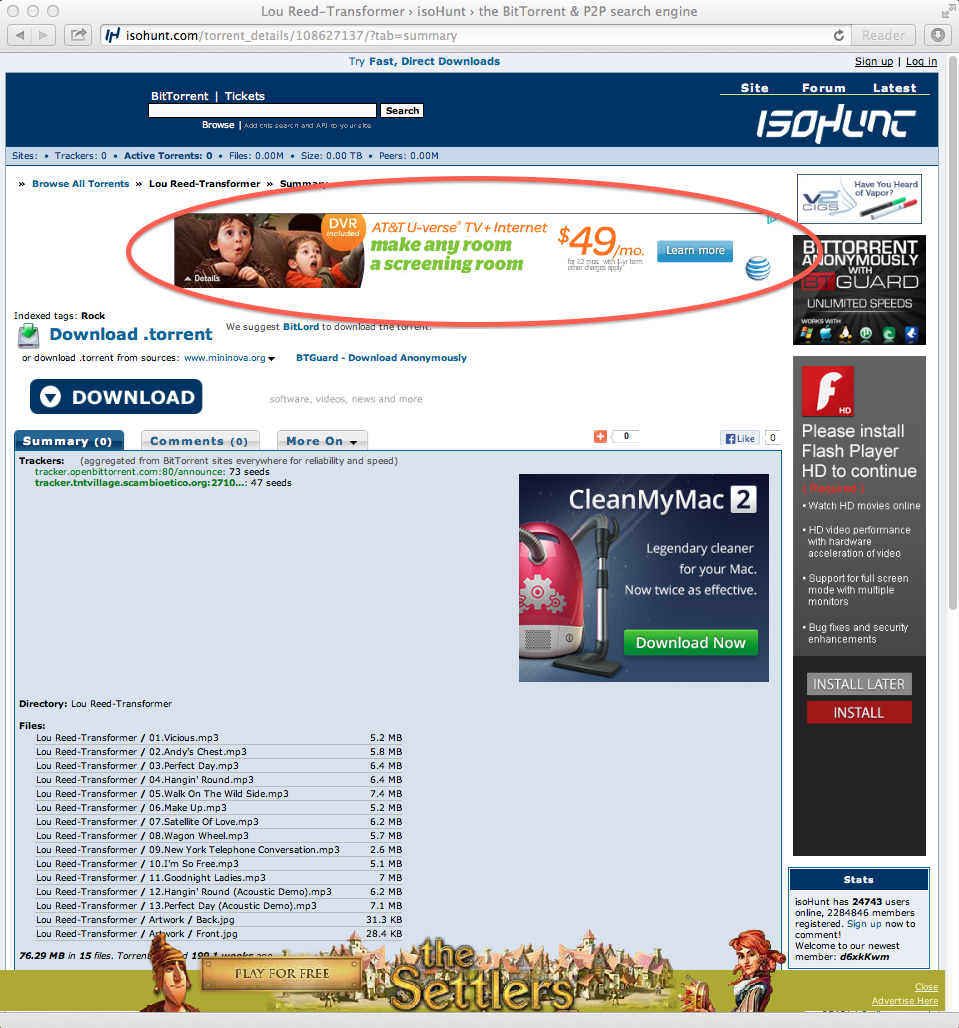
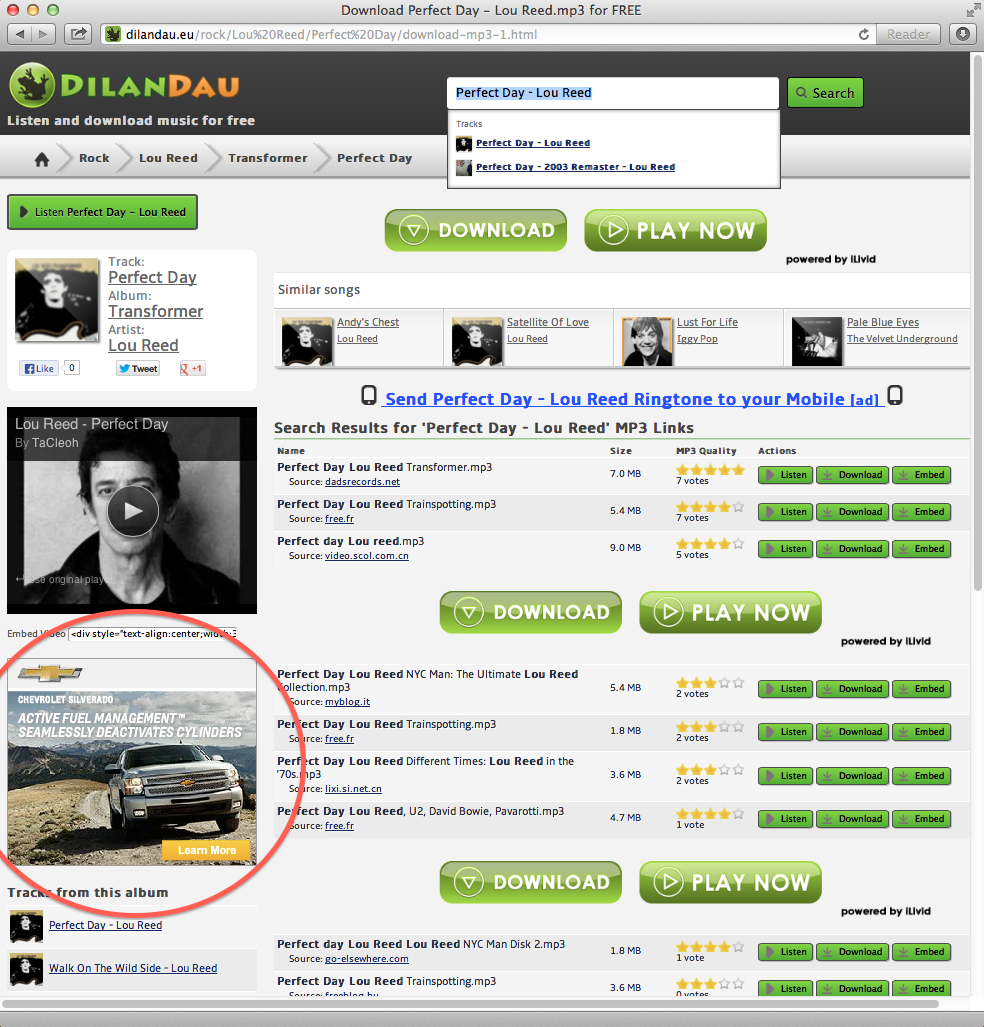
Perhaps most disappointing however is that major companies like American Express, AT&T Chevorlet, Chili’s, Lysol, Pottery Barn, Vons, Domino’s Pizza, Netflix and Galaxy Nexus are still supporting the this exploitation of artists with corporate advertising dollars. These companies not only supply the funding for these sites exploiting artists to exist, but perhaps even worse they add legitimacy to music piracy by lending their brand identity to it.

Clearly there is a lot of money being made in the distribution of music on the internet. Sadly not much of that money (or in this case NONE of it) is being distributed (or uhm, “shared”) with the artists themselves.

In any value chain where the artists work is being distributed and/or exploited for profit, the artist should be included in that value chain.

LouReedGoogleSearch

LouReedAMEX

LouReedATT

LouReedCHEVY LouReedCHILI'S LouReedLYSOL

LouReedPOTTERYBARN

LouReedGalaxyNexus

LouReedDOMINOS

LouReedNETFLIX

Not only do we see the major companies supporting these sites but there’s also the scam ads, rip offs and bogus services. And here’s where it gets even uglier…on sites like The Pirate Bay the work of Lou Reed is promoting adult (escort services?) and porn products like the one offered by Ron Jeremy below.

LouReedTPBPORN

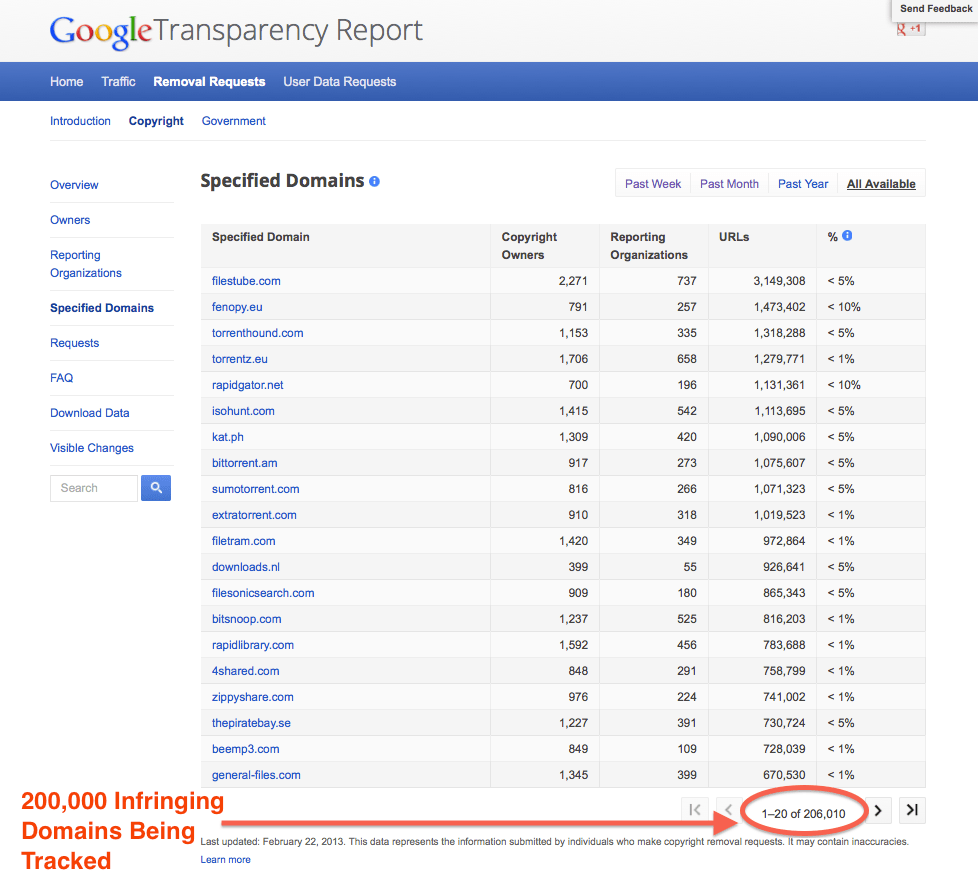
Let us not forget that the above examples represent a drop in the ocean of the over 200,000 infringing sites that Google alone is tracking.

See more Corporate Advertising Funded Exploitation of Artists:
Tom Waits * Neil Young * Aimee Mann * Neko Case * U2 * Ben Gibbard/Death Cab For Cutie * East Bay Ray / Dead Kennedy’s * Billy Corgan/Smashing Pumpkins

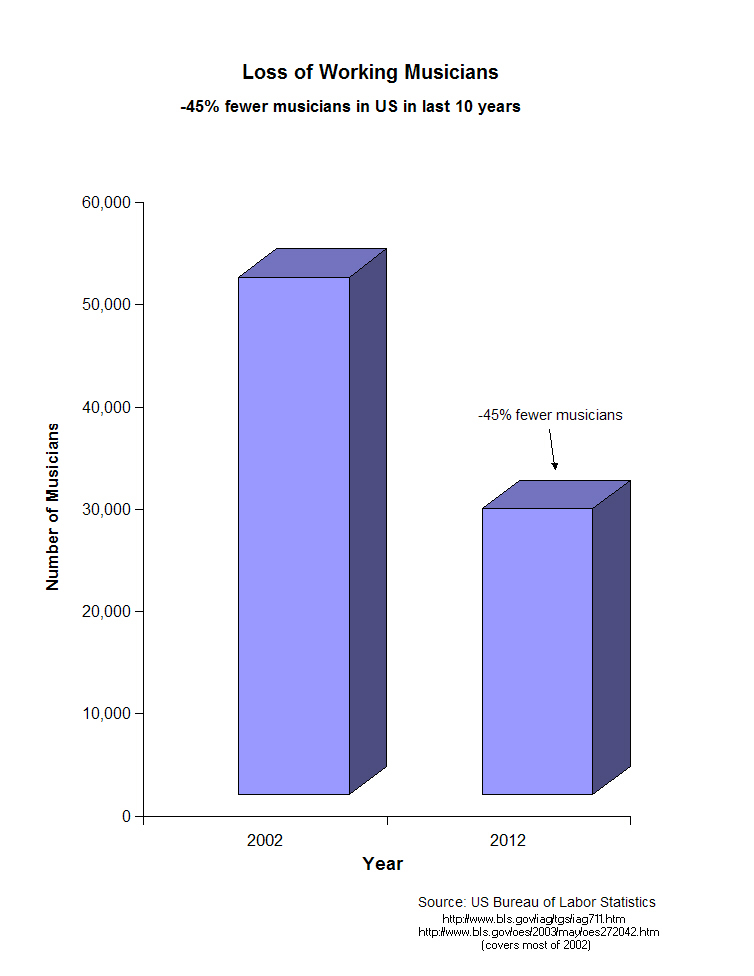
45% Fewer Professional Working Musicians Since 2002

The numbers are simple and staggering. The internet has not empowered musicians, it has exploited them.

-45% fewer working musicians-2

Of course there will always be people to nit pick the numbers, to argue and quibble about the Bureau Of Labor Statistics (BLS) methodology. It may be impossible to estimate the exact effect of unethical internet exploitation, but the trend is definite.

Those who debate the exact numbers are using that to delay action. Their job is similar to the commentators and ‘scientists’ funded by oil companies’ to deny global warming or say it needs “more study.”

The Bureau Of Labor Statistics is an agnostic government agency, not the RIAA.

It is also important to note that these cuts are made from the bottom up, not the top down. It is the struggling and middle class musician that gets hurt first. The difference between “making a living, making music” or not is represented in these numbers.

We should also like to point out that while musicians are making less money, those in Silicon Valley are making more money. Jaron Lanier says that “the internet destroyed the middle class” and we can see for ourselves that through the systematic process of removing the cost of labor from their offerings the elite few, are making more money, while everyone else is doing more of the work.

The New Ruling Class of Silicon Valley and Their Exploitation Economy

The Daily Beast published a must read on the new ruling class and the transfer of wealth in the economy, America’s New Oligarchs—Fwd.us and Silicon Valley’s Shady 1 Percenters. Of particular interest was one sentence in this paragraph,

Perversely, the small number of jobs—mostly clustered in Silicon Valley—created by tech companies has helped its moguls avoid public scrutiny. Google employs 50,000, Facebook 4,600, and Twitter less than 1,000 domestic workers. In contrast, GM employs 200,000, Ford 164,000, and Exxon over 100,000. Put another way, Google, with a market cap of $215 billion, is about five times larger than GM yet has just one fourth as many workers.

This is an equation that defines inequality: more and more wealth concentrated in fewer hands and benefiting fewer workers.

Here is the operative sentence from the paragraph above with one word added…

Google, with a market cap of $215 billion, is about five times larger than GM yet has just one fourth as many [PAID] workers.

It occurs to us in the new exploitation economy of loser generated content that many people are “working” for Google and other tech companies supplying endless hours of consumer created content from Facebook posts to Instagram photos. That’s just the stuff that people are willing to give away by consent (although we don’t know how much privacy they are actually consenting to give up in the process).

But the larger truth is even more scary. Google and other internet businesses profit greatly by avoiding paying for the cost of the goods they are monetizing (primarily by advertising). YouTube is a company built on infringement and theft as a business model.

In other words, it’s a lot easier to make money when you don’t have to pay for the labor or fixed costs of developing and producing a product. You know products like music, film, books, software, etc.

Obviously if all of these creators and producers were paid fairly in the value chain to which their work is creating revenue, than there would be less profit for the distributor. What we have now is a distribution mechanism that profits without paying the creative producers. Which is exactly how a company like Google can earn such extraordinary wealth, essentially through stolen labor.

Read the whole story here at The Daily Beast:

http://www.thedailybeast.com/articles/2013/05/14/america-s-new-oligarchs-fwd-us-and-silicon-valley-s-shady-1-percenters.html

The Constitutional and Historical Foundations of Copyright Protection

The Constitutional and Historical Foundations of Copyright Protection
By Paul Clement, Viet Dinh & Jeffrey Harris [1]

Article I, section 8 of the Constitution grants Congress authority “[t]o promote the Progress of Science and the useful Arts, by securing for limited Times to Authors and Inventors the exclusive Right to their respective Writings and Discoveries.”  There was little debate over this provision during the Convention, but James Madison (as Publius) emphasized in Federalist 43 that “[t]he utility of this power will scarcely be questioned,” and “[t]he copyright of authors has been solemnly adjudged, in Great Britain, to be a right of common law.”  With respect to both copyrights and patents, Madison asserted that “[t]he public good fully coincides in both cases with the claims of individuals.”

*     *      *

This history flatly refutes any notion that copyright law is a matter of legislative grace intended solely to serve utilitarian ends. The Copyright Clause of the U.S. Constitution was inspired by a long intellectual tradition—extending back to the very origins of printing and publishing—in which legislators, jurists, scholars, and commentators recognized authors’ inherent property rights in the fruits of their own labor.

Just as the scope of the pre-existing right informs both the contemporary public understanding of, and the Supreme Court’s interpretation of, the right enshrined by the Second Amendment, see Heller, 554 U.S. at 592, 603, this pre-constitutional history is useful both in interpreting the scope of Congress’ copyright power and in informing policy debates about how that power should be exercised. The Supreme Court itself has harkened back to the Statute of Anne in interpreting the copyright laws. See Feltner, 523 U.S. at 349-50. A view of the copyright laws that ignores this history is sorely incomplete.

READ THE FULL REPORT AT:
http://cfif.org/v/index.php/commentary/42-constitution-and-legal/1679-the-constitutional-and-historical-foundations-of-copyright-protection

Universal Declaration of Human Rights – Article 27

Somethings are so simple, fundamental and common sense they cross the boundaries of countries and culture. If only these same principles could penetrate the fortress walls of Silicon Valley which now claims “the internet” as a nation state outside the governance or protection of human rights.

Universal Declaration of Human Rights

The Universal Declaration of Human Rights (UDHR) is a milestone document in the history of human rights. Drafted by representatives with different legal and cultural backgrounds from all regions of the world, the Declaration was proclaimed by the United Nations General Assembly in Paris on 10 December 1948 General Assembly resolution 217 A (III) (French) (Spanish) as a common standard of achievements for all peoples and all nations. It sets out, for the first time, fundamental human rights to be universally protected.

Article 27.

(1) Everyone has the right freely to participate in the cultural life of the community, to enjoy the arts and to share in scientific advancement and its benefits.

(2) Everyone has the right to the protection of the moral and material interests resulting from any scientific, literary or artistic production of which he is the author.

Artists Rights Watch – Monday May 13, 2013

MUSIC TANK:
* Follow The Money: Can The Business Of Ad-Funded Piracy Be Throttled?

Piracy is not some romantic fantasy of rebellious teenagers sharing music and sticking it to the man; it is brand-sponsored – with advertisements for major blue chip FTSE and Fortune 500 corporations being served systematically to the most nefarious corners of the Web on an industrial scale – keeping the likes of MP3Ape and 4Shared in business, while diverting much-needed revenues from the pockets of creators.

We are delighted to announce that David Lowery (Artist & Commentator ) and Theo Bertram (UK Policy Manager, Google ) will both be key speakers at this event.

WIRED:
* The Real Danger of Copying Music (It’s Not What You Think)

It is one thing to sing for your supper occasionally, but to have to do so for every meal forces you into a peasant’s dilemma: The peasant’s dilemma is that there’s no buffer.

ADLAND:
* David Lowery’s UGA study compiles Top 40 list of brands supporting piracy

But isn’t it strange that Dodge Dart, Victoria’s Secret, AT&T and the like are advertising in illegal places. But I guess they figure why not, because money. Right? Maybe. But the more Taplin and Lowery (and Adland, for that matter) calls you out on it, the greater the chances your reputation, and your brand will take a hit.

DIGITAL MUSIC NEWS:
* Dear Congress: Please Consider These Points for Your Massive Copyright Overhaul…
* The RIAA Just Made It Easier to Earn a Gold Plaque Than to Pay Rent…
* Pandora Tries to Convince a Musician That He Isn’t Getting Screwed…

From: Blake Morgan
To: Tim Westergren @ Pandora

Without us, you don’t have a business.

The idea of “allowing” us to “participate” in a business that is built solely on distributing and circulating our copyrighted work is like a grocery store saying it has an idea to “allow” the manufacturers of the goods it carries to get paid. The store isn’t “allowing” Del Monte to get paid for their cans of green beans, right? Of course not.

COPYHYPE:
* Do Kim Dotcom’s lawyers think he’s guilty? The answer may shock you.

Taking your case to the court of public opinion could be a sign that your case in a court of law is not going well.

THE TELEGRAPH:
* Ads for Australia’s big brands on-sold to piracy websites

The companies were unaware their ads were running on a piracy website before being alerted by news.com.au. And the list of those affected is long, with Westpac, Telstra, ING Direct, Allianz Insurance, The Iconic, ANZ, The Good Guys, Commonwealth Bank, AustralianSuper and Medibank included.

JUNKEE:
* Combating The Cost Of The Free Economy

You can see where this is going: paying little for digital goods, which make up the majority of all goods sold, means that profit margins drop dramatically. So even when we are using these legal alternatives like Spotify, iTunes and Amazon, the goods they are selling are vastly undervalued – are ebooks really worth only $0.99? We need to get used to paying more for digital goods than we have been, because they are worth a lot more than what we have been paying. They aren’t just files and bytes of information — they are the goods now. For the incredible convenience alone, what we pay should be a lot more than we do.

We also need to stop thinking in terms of physical objects, and thinking in terms of the man hours that went into creating what we are consuming – ultimately, the medium through which we consume it does not dull our engagement with or enjoyment of those works.

TONEDEF:
* The Campaign To Stop The World’s Major Brands From Funding Music Piracy

“Whenever we talk to a brand about the fact that their ads are all over the pirate sites, they’re like, ‘Oh, how did that happen?’” says Taplin. “We thought it would be easier if they knew what ad networks were putting ads on pirate sites — so they could avoid them.”

MUSIC TECH POLICY:
* From EFF to Obstruction of Justice
* The Copyright Principles Project: The Arrogant Thimblerig of Contrived Consensus
* The Copyright Principles Project Misses the Point on Copyright Registration–we have registration now, where is the benefit?
* YouTube Beats TV With 1 Billion Watching….TV, and loves them some payola, escorts and drugs

THE STREET:
* The Digital Skeptic: Here’s All the Music Money Lost to the Web

I could model, sample and tinker with the numbers, as long as I gave the association credit. But now, taxiing for takeoff flying to the once-and-future monument of decay — Venice, Italy — all I can say is, it’s stunning how sad a song these numbers sing.

MUSIC WEEK:
* Google and Trichordist to debate piracy profits in London

In 2013, it seems somewhat amazing that advertising from major corporations is still being served to unlicensed music services – especially when, in theory, creative and tech businesses could pragmatically and constructively tackle the practice.

HOME MEDIA MAGAZINE:
* Report: Copyright Enforcement Needed Outside U.S.

Although copyright law and other remedies under the [Digital Millennium Copyright Act] remain an effective tool against infringing services located in the United States, most, if not all illegal services have moved off shore to territories that lack effective enforcement mechanisms making it nearly impossible to slow the proliferation of infringing download and streaming services,” the report reads.

VOX INDIE:
* Kim Dotcom’s Truth = Nothing but Lies (mega lies)
* Steven Soderbergh Speaks out Against Online Piracy in his “State of Cinema” Address at SFIFF
* MacKeeper Software Ads Blanket Pirate Websites, Providing Profits to Thieves
* Google’s Hypocrisy-Seeing the World Through Green Colored Glasses

THE JAKARTA POST:
* Piracy may cost record firms $1.65m a day

The illegal download of Indonesian songs through the Internet has also caused a sharp decline in the sale of music CDs in the country. Last year, the sales of original music CDs totaled only 11 million copies, far lower than the average 90 million copies a year several years ago.

THE TIMES OF INDIA:
* International film piracy gang busted in Indore

For an year now, the duo were capturing full-length new Bollywood and Hollywood releases, first day-first show from major cine-plexes, Velocity and Sky Lounge section of Satyam Cineplex, and then sharing high-quality products via the internet with operators of pirated movie markets across the globe.

The duo was charging prices ranging between Rs 25,000 to Rs 3 lakh from the buyers, depending on the product quality.

MUSIC ALLY:
* Devo’s Kickstarter-funded DevoBots synthesizer iOS app goes live
* Event report: ‘Copyright in Crisis’ ft. PRS for Music and Pirate Party
* Hoping for Apple iRadio launch in June? Dealmaking continues…
* Music Dealers: ‘Brands are picking up the pieces of the music industry’

PRIVACY.NET:
* Why is Video Piracy Still Called A “Censorship” Problem?

Why is video piracy still called a censorship issue? And when did it become a threat to privacy? What I continue to find amazing is the fact that supporters of video piracy continue to refer to the attempts to block illegal access as “censorship.”

TORRENT FREAK:
* Pirate Bay Takes Over Distribution of Censored 3D Printable Gun
* Game Pirates Whine About Piracy in Game Dev Simulator
* Police Flex Muscles Again, Arrest Admin of Sweden’s #2 BitTorrent Site
* FileServe Hit With $1,000,000 Movie Piracy Lawsuit

THE WOMB:
* I Just Signed Copyright Alliance Petition Against Brand Sponsored Piracy

Permission, Privacy and Piracy : Where Creators and Consumers Meet

It’s amazing how situationally dependent perspectives about the internet appear to be that something as fundamental as consent (aka permission) would be controversial. Much ink has been spilled over a consumers right to privacy in the digital age and that concern now extends beyond the internet to personal privacy fears over the potential misuse of domestic drones.

The irony of course about all the hysteria being discussed about drones (military, commercial or private) is that the greater threat to personal privacy is much more local than an unmanned aircraft at 14,000 feet, or even a home built quad copter. The real threat that will bring the real world to the same persistent observation (and cataloging) of our daily lives will be Google Glass (where is the EFF when you need them?).

Google Glass is a device that records to the cloud a persistent stream of visual and audio data as the user experiences it. Anything, and everything a person would have experienced as a personal and private experience will be recorded, cataloged, geo-tagged, and stored online. Automated face recognition technology will make it less possible to be anonymous in the real world than it currently is in the online world via the use of avatars.

But what does this have to do with piracy? Specifically what does this have to do with content piracy? How are privacy and piracy related? It’s simple, both privacy and piracy revolve around how we view the importance of the individuals right to grant consent. An individual should have the right to grant the specific permissions to access information about us and how that information can be used. Agreed?

This is the same fundamental individual right that governs the protection of a creators work from illegal exploitation. Permission is the cornerstone to a civilized society. Maybe ask these women in Texas about it?

Below is a recent example of how ordinary people, who are also creators got a first hand lesson in “permissionless innovation” aka, “you will be monetized” or “all ur net proceeds now belong to us.”

When Instagram attempted to change it’s terms of service that would allow the company to monetize the work of the individual without the individuals permission, consumers went ballistic. It seems that permission is not such a difficult concept to grasp when people are personally effected. This is why privacy is a much more universal issue, because everyone is effected by it.

It is strangely ironic (or not really) that the companies who were so quick to threaten an “internet blackout” really have no such motivation in detailing how individual personal data is being collected and monetized. Even when that data is from children. So much for being open and transparent.

What’s worse is that Google has been repeatedly caught red handed violating the privacy of not just it’s users but also unsuspecting consumers. Two cases that immediately come to mind are the Safari privacy scandal and resulting settlement and the much broader real world illegal data collection scheme known as Wi-Spy.

So, just like everyone understands the basic fundamental right to privacy is built on the permissions we grant by consent to other citizens, businesses and institutions, individual creators also have the same right to grant permission to who and how their work can be exploited (yes their work, as in labor) for profit and gain.

This is even more important when those doing the profiting are corporations and businesses like Google, various advertising networks and others.

Artists Rights Watch – Monday April 22, 2013

POLITICO:
* Creators need Copyright Protection

So let’s agree that certain principles should be the foundation of any update of the Copyright Act:

Creators should receive fair compensation for their work when it is exploited. Too often we’ve heard that new and old businesses should be allowed to use creators’ works at a below-market (or zero) royalty rate to protect a flawed business model. Creators want to be partners with distributors, but they should never be forced to subsidize those businesses.

A right is meaningless without reasonable enforcement.Without effective enforcement, copyrights will have little value. If creators are to benefit from the fruit of their labor, they must have confidence that their work will be protected in the constantly evolving digital marketplace.

Freedom of expression depends on copyright. Copyright gives individual creators the freedom to choose how they express themselves. With copyright, writers and artists can decide how and when to use their work. They can freely give their work to the public, to a cause they believe in, or they can try to earn a living from it. Consent is a critical part of the creator’s freedom.

HUFFINGTON POST:
* Online Piracy, Following The Money
* Grammys On The Hill 2013: Jennifer Hudson Honored By Clive Davis, Yolanda Adams, Kara DioGuardi

Recognizing that proceeds from Grammys on the Hill benefit the Grammy Signature Schools Program, which fights to keep music education in schools, Hudson noted the importance of her own childhood music teachers, admitting, “That why I had perfect attendance in school — because I could not miss music class. I didn’t really care about any other class — even on my lunch break, I would go to music.”

MUSIC TECH POLICY:
* How YouTube “Monetizes” Your Songs to Sell Illegal Goods

Note three things:  The video is “user generated content” (“user” in this context means a YouTube user not a drug user.  We think.)

Second, the video has a music bed.  Ironically, it is “Teardrop” by Massive Attack which is also the theme from the House television show.  I seriously doubt that Massive Attack has any idea that their song is being used to sell drugs through this sketchy video.

We know that YouTube knows the song in the video because they have a link to it by name on Google Play.

Finally, the video is monetized–ads are playing on the page, pre-roll before the video, and inside the video–in fact, the same ads are in each, so the campaign is coordinated.

ZOE KEATING INSTAGRAM:
* Me, Barbara Lee, Sheila E and Melvin Watt @ U.S. Capitol – House Of Representatives

VENTURE BEAT:
* Sarah Hanson, the 19-year-old teen who auctioned 10% of her income for a $125K startup investment, may not exist

DIGITAL MUSIC NEWS:
* If Only the Tech Industry Understood the Music Industry They Want to ‘Replace’…
* Just Got My YouTube Royalty Check In the Mail…
* How Artists Who Support “Piracy” Can Avoid Looking Like Hypocrites…

TORRENT FREAK:
* Hijacker Tears Large BitTorrent Site Apart, Succeeds Where U.S. Authorities Failed
* Interpol Probe Targets Funds of Major File-Hosting Services
* Pirate Bay Founder Charged With Hacking Companies and a Bank

THE DEAN’S LIST:
* Music, Copyright and New Technology in the News From a Creator’s Perspective

REUTERS:
* New anti-piracy law should keep Spain off U.S. watch list – minister

Spain is working on a new anti-piracy law which will be robust enough to keep the country off a U.S. watch list of copyright violating countries, Education and Culture Minister Jose Ignacio Wert said.

NIGERIAN TRIBUNE:
* Spinlet to proffer solution for music piracy

Artists Rights Watch – Monday April 15, 2013

VICE:
* Chris Ruen Is Taking the Anti-Piracy Argument Back from the Music Industry

… If we can agree that artists have legitimate rights to their own work, it follows that we have some duty as individuals and as a society to respect those rights”.

NEW YORK TIMES:
* The Slow Death of the American Author

The Constitution’s framers had it right. Soviet-style repression is not necessary to diminish authors’ output and influence. Just devalue their copyrights.

BILLBOARD:
* Martin Mills’ Call to Action: His Billboard MIDEM Speech In Full

I want to address the lack of support that governments, politicians and bureaucrats worldwide show to the creative industries. Many pay lip service to the value and importance of the creative economy, but most fail to match that with their actions.

Creative industries are built upon strong and defendable intellectual property rights, and without that they will inevitably wither and fail. It is impossible to make the investments to produce new creative goods without the security that ownership of them is protected.

BRISBANE TIMES:
* Why are you still stealing Game of Thrones?

Is there some sort of internet freetard math I’m unaware of that lets the producers of GoT spend millions of actual dollars making the show while you suck it down off the intertubes for free because somehow the ‘exposure’ will put enough money in their bank accounts to pay for all the writers and actors and camera guys and set designers and costume makers and caterers and editors and special effects dudes and CGI mavens and musicians and lighting and sound techs and drivers and so on whatever and ever amen?

SPIN:
* Marc Ribot’s Ceramic Dog Slam Free Culture on Art-Grinder ‘Masters of the Internet’

“We have a new business model / We’ll blow you for a nickel”

AD LAND:
* Artists to TBWA Chiat Day and American Eagle: Screw You

Artists vs. American Eagle. An edgy campaign asking people to take a stand on shoplifting and selling out. Wink wink. Artists Vs American Eagle recreates the Ghost Beach site right down to the color palette. But instead of asking you to pick a side on piracy, they’re asking you to pick a side on shoplifting from American Eagle. They even have hashtags at the read. #AGAINSTSHOPLIFTAEO and #FORSHOPLIFTAEO

BWHAHAHAHAHA.

VOX INDIE:
* Who Really Gets “Chilled” by Chilling Effects?

THE ILLUSION OF MORE:
* Copyright is Anti-Civil Liberties?

The truth is that the total volume of free expression produced by creative artists is one of the greatest buffers against social injustice within democratic societies.

In one hand the artist holds the right of free expression, and in the other, he holds copyright. Wielded together, these tools have done more social good than any politician could ever hope to achieve.

THE REGISTER:
* P2P badboys The Pirate Bay kicked out of Greenland: Took under 48 hours

TPB had hoped that when it registered itself in the tiny country – an autonomous constituent of Denmark with a population of just 57,000 people – it would finally have a safe home. Its new host had other plans, though.

“Tele-Post has today decided to block access to two domains operated by file-sharing network The Pirate Bay,” the company said in a statement.

ALL AFRICA:
* Namibia: Nascam Takes Action Against Piracy

DIGITAL MUSIC NEWS:
* A Reader Asks, ‘Why Do You Hate Spotify So Much?’
* 40 Years of Music Industry Change, In 40 Seconds or Less…
* Artist Group Asks: ‘Is Shoplifting from American Eagle Stealing, or Sharing?’

WIRED:
* Report: US government agencies’ adverts inadvertently support piracy

Along with corporate brand names appearing on the sites, from Adidas and Amazon to Walmart and World of Warcraft, the US Army found its way on to alleged pirate sites, the Verge first pointed out.

THE VERGE:
* US government agencies are advertising on accused pirate sites

LIMERICK LEADER:
* Priests and piracy: Retailers reel from illegal downloading

AHRAM ONLINE:
* Arab Publishers failing to fight book piracy, risking future

BERKLEY TECHNOLOGY LAW JOURNAL:
* The Purpose of Copyright? Examining the Retracted Republican Study Committee Brief

Which are the relevant facts, figures, and considerations to the debates surrounding the extent and limitations of copyright? After comparing Khanna’s brief and Hart exegesis, what emerges seems to be a disagreement about not only the direction copyright reform should take, but also the philosophical precepts that determine source of law, historical interpretation, and, in essence, reality.

MUSIC ALLY:
* The challenge of connecting the streaming music silos
* US music sales fell 0.9% in 2012 as digital revenues topped $4bn

The $7.1bn is still above 2010′s low point of $7bn, but it’s not yet the sustained bounce-back that the industry was hoping for.

TORRENT FREAK:
* IMAGiNE Piracy Group Founder Jailed For 23 Months
* YouTube’s Deal With Universal Blocks DMCA Counter Notices

YouTube enters into agreements with certain music copyright owners to allow use of their sound recordings and musical compositions.

In exchange for this, some of these music copyright owners require us to handle videos containing their sound recordings and/or musical works in ways that differ from the usual processes on YouTube.

In some instances, this may mean the Content ID appeals and/or counter notification processes will not be available.

REASON:
* The Long, Fruitful History of Music Piracy

Rather the book is valuable because it shows how long, and how thoroughly, the history of recorded music has been the history of “pirated” music. It turns out that the Internet isn’t apocalyptically transformative. It’s just a new extension of an old dynamic. And that means that rather than creating apocalyptically transformative new legislative solutions, we could instead perhaps look to the past for ideas.

CREATIVE AMERICA:
* Study finds that removing just one pirate site benefits creators.

Artist Rights Watch – Monday March 25, 2013

THE HILL:
* Protect rights of artists in new copyright law

Should Congress take on the challenge of updating the Copyright Act, it must do so guided by sound principles, and its deliberations must be based in reality rather than rhetoric.

Chief among these principles is that protecting authors is in the public interest. Ensuring that all creators retain the freedom of choice in determining how their creative work is used, disseminated and monetized is vital to protecting freedom of expression. Consent is at the heart of freedom, thus we must judge any proposed update by whether it prioritizes artists’ rights to have meaningful control over their creative work and livelihood.

ZIMEYE:
* Mukanya’s Concern on Music Piracy: The New Zimbabwean Epidemic

Personally, I take unbridled umbrage at such individuals who are tired of working real jobs and are now trying to snatch easier ways to cut corners and make survival here in the Diaspora. By committing such nasty internet acts of pirating on our Zimbabwe musicians products they are feeding on other people’s blood.

This is in cases where most of our entertainers throw in their blood, sweat and tears to emerge with such scintillating music hoping to make headlines, best sellers and earn decent income. I would then wonder why someone would, from the blues, make such an evil act of trying to benefit from someone’s work using the internet, hoping not to be caught.

BUSINESS WEEK:
* Congress Reviews the Copyright Act in the Digital Age

BILLBOARD:
* Business Matters: Digital Piracy Study Conflicts with Two Papers it Cites

There have been numerous studies that have concluded file sharing hurts recorded music sales. The JRC study is different because it focuses only on file-sharing’s effect on digital purchases.

* SXSW: David Lowery and Co. Lash out Against Industry ‘Pimps’

Lowery said it was incumbent on artists to speak out about the importance of paying for music. Many artists who defer to corporate interests suffer from a kind of “Stockholm Syndrome,” he said.

“Lars Ulrich was the first to speak out and they put his head on a stake,” Lowery said, referring to the backlash against the Metallica singer after he took Napster to court in 2000. “But Ulrich was right. If you go back and watch his interview with Charlie Rose, everything he said came true. The technologists were wrong.”

COPYRIGHT ALLIANCE:
* Worth the Wait: 9th Circuit Delivers Big Win for Creators in Isohunt Case

the court pointed to numerous instances in which Fung was instrumental in assisting users in finding, acquiring, and burning infringing content. The court also explained how Fung profited off this infringement:

“Fung promoted advertising by pointing to infringing activity; obtained advertising revenue that depended on the number of visitors to his sites; attracted primarily visitors who were seeking to engage in infringing activity, as that is mostly what occurred on his sites; and encouraged that infringing activity. Given this confluence of circumstances, Fung’s revenue stream was tied directly to the infringing activity involving his websites, both as to his ability to attract advertisers and as to the amount of revenue he received.”

THE MUSIC VOID:
* EU Piracy Report – Ramifications For The Music Business

More importantly, there can be no argument that Google has played a massive unarguable part in helping piracy to thrive. Whether that was intentional or not is a moot point. The fact is you can type in any artist name and you links will have links to pirate site’s outnumbering those to legal sites.

The recent campaign to shame brands who’s advertising supports illegal file sharing sites is a worthy cause which TMV supports.

It would be helpful if Google gave all of the revenue it earns from SEM directly related to pirate sites back to the industry so rights holders and ultimately artists actually got paid from pirate sources. Hitting the pirates in the money pocket is exactly the right way to bring them to the negotiating table. Why do we want to negotiate with such people – because the user data is of immense value to brands and music rights holders themselves.

BRAND-E.BIZ:
* Ads fund illegal music, says IFPI

“Brand owners typically want to avoid the reputational damage that can be caused when their advertisements are placed on websites that engage in or facilitate unlawful activity,” says the IFPI. “They also want to be sure their advertising budget is not providing financial support to unlicensed websites.”

VOX INDIE:
* A Good Week for Copyright
* Mirror, Mirror…Why Does the Anti-Copyright Lobby Live in Opposite World?

The talking points echoed by the panel at SXSW reflected the anti-copyright lobby’s disingenuous mantra that content creators seeking to protect their work from theft should be viewed as criminals, while those who brazenly steal (and monetize) the work of others are somehow the “innovators.” Are you serious? I hate to break it to these folks, but the tech industry does not have first dibs on the adjective “innovative.”

Creative artists have always thrived on the cutting edge–and while the modern-day tech industry has developed new means of delivery and consumption–their innovations would be useless were it not for the content their products deliver. In many ways, creative content is the fuel has fed the tech revolution. Why can’t we have a discussion that acknowledges this symbiosis, rather than diminishes it?

THE ILLUSION OF MORE:
* More Than 3Dimensions
* Copyright, copyright everywhere…

So, for anyone who reads this blog and is not knee-deep in the gore of the copyright battle, the big picture as I see it this: I believe the copyright system will change over the next decade or so, but if that change is predicated too much on the self-serving premises of its tech-industry antagonists, the results for artists in particular, and for society in general, will be regressive rather than progressive. It would be like allowing the oil industry to overly influence emissions policy.

MUSIC WEEK:
* IFPI slams EU piracy study as ‘flawed and misleading’

The findings seem disconnected from commercial reality, are based on a limited view of the market and are contradicted by a large volume of alternative third party research that confirms the negative impact of piracy on the legitimate music business.

CENSORSHIP IN AMERICA:
* Music Censorship – A Timeline

SPITFIRE HIPHOP:
* What You Can Do Today – To Stop Brand Sponsored Piracy Through Touring Contracts or Sponsor Deals: Artists Helping Artists

If you are like most artists, you feel overwhelmed by the alliance of Big Tech and Fortune 500 companies allied against us in the intricate network of brand sponsored piracy.

ABC ONLINE:
* Internet Piracy – is it a right to not pay artists you like?

The self-righteous anger of free downloaders reveals much about the weakness of human nature and the often heartless and faceless nature of what constitutes debate on the internet.

This is one of the most revealing books about how technology shapes us I have ever read. It goes far beyond the normal platitiudes and in forensic detail explains the connections between human endeavour, morals, consumption and commerce.

DIGITAL MUSIC NEWS:
* Streaming Accounts for Just 4 Percent of Global Recording Revenues, Study Finds…
* For the First Time Ever, Song Downloads Are Declining In the US…
* Chevrolet Is Now Financing Grooveshark’s Mobile Expansion…
* Why Non-Disclosure Agreements Are Making It Impossible to Watch a Video In Germany…

A source close to one of the other negotiations with YouTube said that the rights holders had proposed that they’d base the deal on a revenue share – a proposal that seems more than fair. Only problem, the source said, is that Google/YouTube won’t tell anyone what its revenue and profits are.

For a corporation that has based its entire business on the sharing of information, it’s somewhat ironic how reluctant it is to share its own.

THE VERGE:
* Google accidentally blocks entire Digg domain from search, is working on a fix

MASHABLE:
* Supreme Court Refuses to Hear $220k Music Piracy Case

This is the third time the court has refused to hear a peer-to-peer piracy case. One of the other cases was that of Joel Tenenbaum, the other person who refused to settle with the RIAA, and was sentenced to pay $675,000 for downloading 30 songs. The Supreme Court declined to hear his case in May.

TORRENT FREAK:
* Spain to Crackdown on Pirate Sites and Outlaw File-Sharing
* isoHunt Loses Appeal Against the MPAA, Keyword Filter Remains
* Fresh Calls to Congress to Make Movie and Music Streaming a Felony
* MPAA: Pirates Can’t Hijack Freedom of Expression

THE SUN DAILY:
* Putting a stop to digital piracy

Internet companies all work together to block IP addresses that broadcast spam (www.spamhaus.org/). This doesn’t “break the internet” or “violate free speech”. The notion that brilliant technologists in the US$400 billion telecom business that is growing at 10% a year and the US$28 billion internet advertising business that is growing 10% a year can’t help make the internet a just and ethical marketplace for musicians is false.

DIGITAL TRENDS:
* Set-top showdown: Apple TV vs. Roku 3 vs. Boxee Box vs. WD TV Play vs. Google TV

TORONTO STAR:
* Government urged to invest in music industry to drive economic activity

Music Canada has come up with 17 recommendations in a report, “The Next Big Bang: A New Direction for Music in Canada,” released at Canadian Music Week this week.

SPYGHANA:
* Dying Musicians cry out over 1M CD sales drop to 50K

The National Chairman of Ghana Musicians Rights Organisation (GHAMRO,) Mr. Carlos Sakyi, has lamented the increasing rate of piracy in the industry saying it is collapsing Ghana’s music industry.

THE INDIAN EXPRESS:
* Piracy Equals Drunken Driving

Flipkart made a clear distinction about guilt-free downloads, paid or otherwise. It was an affirmation that downloading music (or movies) off torrents has now become a sort of uncool behaviour…much like drunken driving.

THE FUTURE OF COPYRIGHT:
* Controversial copyright bill passes German Upper House

On 1 March 2013, the Bundestag, the Lower House of the German Parliament, approved a new legislative proposal that aims to protect the copyright of publishers on the Internet. The new bill would require search engines and news aggregators like Google News to pay a fee for displaying content longer than “individual words or short excerpts” (snippets). Read more in our previous article on this topic.

THE DEANS LIST:
* Music, Copyright and New Technology in the News From a Creator’s Perspective

THE LEFT ROOM:
* Piracy, free books, etc

5. What I think

I have endless and fantastically violent contempt for the sites making money off the back of work they didn’t help create, and for the people behind them. I have nothing, really, against the ordinary people who illegally download my books – I can’t stop you, most of you wouldn’t have bought them anyway, and I just hope that, if you enjoy them, you consider buying some of them at some point, to support not just me, but also the other people, less visible, whose work made my books possible in the first place.

WIRSINDLEGION:
* The Pirate Bay and human rights

STOP THE CYBORGS:
* Google Glass ban signs

For a complete listing of every weekly update of the Artists Rights Watch, CLICK HERE!