
Derek Khanna is Wrong: Copyleft Mystery Man’s Misleading Memo Creates its Own Myths…

There has been a lot of ink spilled on the retracted and disowned “memo” titled Three Myths of Copyright that was posted on the Republican Study Committee (RSC) website. Notwithstanding the fictional revisionist history of the op-ed the usual suspects are insisting on grand conspiracy theories worthy of a tin foil hat.

For those who are unaware the RSC “memo” was authored by one Hill staffer working at RSC named Derek Khanna.  Shortly after the memo was posted on the RSC website, it appeared nearly simultaneously on several locations in the anti-copyright echo chamber (e.g., Ars Technica’s Tim Lee, Techdirt, etc.).  Within hours of its posting, the “memo” was not only removed by the RSC, but also disavowed by the organization itself.

It’s important to note that Mr. Khanna acknowledged (on Reddit) that he was freelancing–no one asked Mr. Khanna to write the memo.  How he was able to post the memo on the RSC’s website–which would tend to give the memo the imprimatur of the RSC to the casual reader–is anyone’s guess (although someone surely must know).

khannareddit

So if the RSC didn’t request it, we wonder where the inspiration came from as the memo appears to repeat many of the same old tired talking points we see repeatedly in the anti-copyright and tech blogosphere echo chamber. Some may suspect that Khanna could be hoping to earn favor in the corporate sector who have the same goals in seeing artists rights in copyright diminished, but who knows. Perhaps a staffer at the end of his run with the committee tried to shoot a three pointer as the clock was running out?

What is clear however, is that Derek (who is what the lobbyists call a “Covered Legislative Branch Official“) is publicly engaged in communication with several executives at Google–who have one lobbyist for every six members of Congress and is a government contractor.  Mr. Khanna’s public LinkedIn profile says he is currently employed as:

  • Professional Staff: Homeland Security, Defense and Technology at Republican Study Committee

  • Cyber-Security Policy Adviser at DoD Defense Science Board on Cyber-Security

These are clearly areas that Google is interested in–particularly as it is widely rumored that Google is the outside contractor for the National Security Agency’s massive data collection facility at Bluffside, Utah (in Rep. Jason Chaffetz’ district).

William Patry currently serves as senior copyright counsel to Google Inc. Vint Cerf has worked for Google as a Vice President and Chief Internet Evangelist since September 2005.

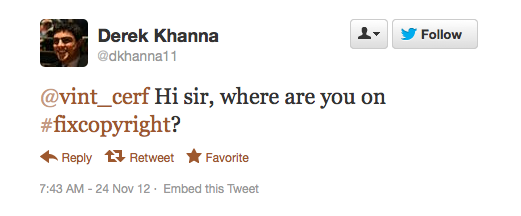
KhannaWillamPatry

DerekKhannaVintCerf

Not withstanding where the inspiration may have come from for the erroneous memo, perhaps the events are best stated by the fantastic analysis written by Thomas Sydnor II & Debbie Rose titled, “Capitalist Copyrights: A Republican Reply to “Three Myths about Copyright.

“Three Myths claimed that US copyright laws violate “nearly every tenet of laissez fair capitalism” and constitute “corporate welfare” that thwart capitalism, hamper science, stifle libraries, penalize journalism, hurt innovation and consumers, and even conceal Nazis.

The next day, the RSC Executive Director firmly disowned Three Myths. He explained that it had been “published without adequate review within the RSC” and that it violated RSC publication standards because it failed “to provide informative analysis of major policy issues… that accounts for the range of perspectives held by RSC Members and among conservatives….” The stated reasons for the RSC disavowal seemed valid, especially since many Republicans consider copyrights to be one of the many private property rights that encourage private production of valuable goods, services, and books.

But Khanna then undermined the RSC by publicly embracing the just-disowned paper and associating himself with the “tech community” at TechDirt: “I am the author of this memo, and I hope the tech community continues to add to these ideas….” Khanna then appended a link to… TechDirt.

Predictably, “copyright skeptics” erupted in outrage. Skeptics then accused the RSC of disowning the typo-ridden Three Myths—not because it actually was uninformative and biased—but because bad copyright-industry lobbyists must have strong-armed the stronger-armed RSC into suppressing Three Myths because it had spoken truth to power. To assess the validity of such accusations, the quality of the analyses in Three Myths can be tested against the RSC’s standards for publication and external realities—a test that Three Myths fails miserably.

But that’s not the end of it. Slate reported later on that Derek Khanna was separated from the RSC. Of course this wouldn’t be the least bit surprising given the information above (but this also doesn’t appear to be verified either). Don’t shed a tear for Derek, we’re sure he’ll land with some good opportunities, perhaps even at Google?

The fairy tales spun by the young Republican are easily debunked as the facts about Copyright haven’t changed so much as he would like to think otherwise. Scott Cleland makes quick work of refuting the so called myths in his post, “The Copyright Education of Mr. Khanna.” Cleland states,

“Mr. Khanna has obviously and grossly mischaracterized Constitutional first principles, property rights, and free markets beyond recognition.”

The so called myths are completely deconstructed by the amazing and always insightful work of Terry Hart at CopyHype. The two part analysis are titled Republican Study Committee Policy Brief on Copyright: Part 1 and Republican Study Committee Policy Brief on Copyright: Part 2 respectively.

“…any debate or dialogue should begin with sound premises. This policy brief doesn’t. Instead, like an unfortunate strand of copyright skepticism, it runs from reality, rewrites history, and hides from logic.”

What the irrational anti-copyright movement had hoped would give them legitimacy in the form of an endorsement from a major political party has instead had the opposite effect of highlighting the desperate attempts to rewrite history in such a shallow and over reaching way as to invalidate an honest debate or dialog based in facts. No doubt, somewhere out there is basis of Khanna’s “memo” and it’s unlikely that he did little more than parrot the existing talking points of those who rallied around him in the wake of the memo’s demise.

One other quick note about “Who is Derek Khanna anyway?” reveals that this is the same guy who jumped in the fray to start a campaign to get “Joe The Plumber” elected to congress, as the Toledo Free Press reports,

Derek Khanna, a junior and executive political director of the Massachusetts Alliance of College Republicans, and his friend Trevor Lair, the organization’s chairman, have launched a Web site to gather signatures to petition Samuel J. Werzulbacher to challenge Rep. Marcy Kaptur, D-Ohio, in 2010.

Not to mention “Derek Khanna Removed from Student Government Association Senate Meeting” in his school daze.

Over 50 Major Brands Funding Music Piracy, It’s Big Business!

Below is a partial list of over 50 major brands who are advertising on pirate sites and therefore supporting not only music piracy, but also the mainstream piracy of films and every other kind of digitally distributed work. As we’ve stated before the content industries may have the ability to address mass scale, enterprise level, commercial infringement without necessarily requiring any new legislation.

What we find frustrating is that the major content companies and corporations must have existing relationships with these brands as the content and media distribution companies own the television networks (at the very least) that these brands are dependent upon for the mass scale and mainstream promotion of their products and services.

The major content companies as well as their well respected institutions such as The Academy Of Motion Picture Arts and Sciences (The Oscar’s), The National Association Of Recording Arts and Sciences (The Grammy’s) and The Hollywood Foreign Press Association (The Golden Globes) all host annual award shows where many of these brands are also advertising. Why isn’t it possible to use that opportunity to educate these brands about the damage they are doing to the creative community? In other words, where are the adults?

What is disappointing is that the same people pushing for new legislative solutions could also be leveraging their relationships with the brands and advertising agencies directly to educate them about the seriousness of this problem. The same goes for the banks and payment processors such as American Express, Master Card, Visa and others. At least one company, Paypal has been very proactive in severing it’s ties and services with illegal and infringing sites, we wish more would to the same.

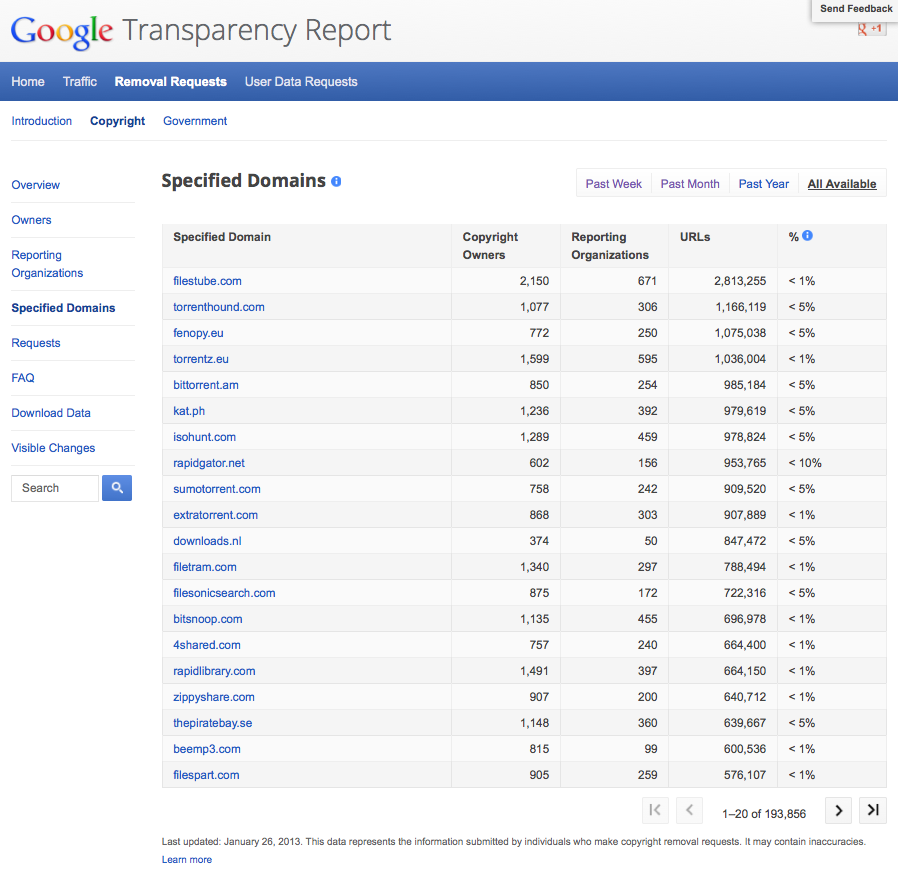
The US Trade Representative’s list of sites in the Notorious Markets List combined with Google’s transparency report for copyright infringement via legitimate DMCA notices to delist links from its search engine provides a very effective list of sites where no advertising should appear as a simple baseline of “best practices”.  (Of course, the Google list does not include YouTube or Blogger.)

http://www.google.com/transparencyreport/removals/copyright/domains/?r=all-time

GoogleTransparencyReport

Keep in mind the screen shot above only lists the Top 20 sites of the almost 200,000 in total that are receiving DMCA notices for copyright infringement.

Clicking on the name of any of the brands below will take you to a post that contains the screen shot of the ad itself. What is also important to note is what brands are NOT on this list.

Brands like Coke and Pepsi do not seem to appear on pirate sites, and that can’t be an accident anymore than it not being an accident that these other brands do appear on pirate sites. So for that, we applaud Coke and Pepsi for their respect to the creative community.

Who knows, perhaps the content industries should use their might, weight and prestige to create an award for brands who respect the creative community in a public forum that enhances value for the brand by the endorsement of artists, musicians, filmmakers and other creators. Just a thought if anyone is reading…

We might also suggest that the brands on this list think about adopting the Bill of Rights for Online Advertisers by Benjamin Edelman of The Harvard Business School.

Five rights to protect advertisers from increasingly powerful ad networks — avoiding fraudulent charges for services not rendered, guaranteeing data portability so advertisers get the best possible value, and assuring price transparency so advertisers know what they’re buying.

Brand  Pirate Site  Artist
Adobe Files Tube Tom Waits
Adobe Files Tube 30 Seconds To Mars / Jared Leto
Adobe Torrent Reactor Neil Young
Adobe Iso Hunt Neil Young
Adobe Kick Ass Torrents Neil Young
ADT Security 4Shared Tom Waits
Alaska Air Iso Hunt Neil Young
Alaska Air Kick Ass Torrents Neil Young
Alaska Airlines Torrent Reactor U2
Amazon 4Shared U2
American Express 4Shared Adele
American Express Delta Airlines Card Mp3 Twister Black Keys
AT&T Mp3 Twister Black Keys
AT&T 4Shared Smashing Pumpkins / Billy Corgan
AT&T Mp3Skull Smashing Pumpkins / Billy Corgan
AT&T 4Shared Adele
AT&T mp3 Skull U2
AT&T mp3 Skull John Mellencamp
AT&T Kick Ass Torrents Neil Young
Audi Mp3Skull Smashing Pumpkins / Billy Corgan
BMW 4Shared Smashing Pumpkins / Billy Corgan
BMW Kick Ass Torrents Tom Waits
Boston Market 4Shared Smashing Pumpkins / Billy Corgan
Boy Scouts of America Torrent Reactor Neil Young
British Airways Kick Ass Torrents Adele
British Airways Mp3 Crow Adele
Century 21 4Shared U2
Charmin Toilet Paper Iso Hunt Neil Young
Charter Cable mp3 Raid U2
Citi Bank 4Shared Smashing Pumpkins / Billy Corgan
Citi Bank 4shared John Mellencamp
Cooper Mini (BMW) Files Tube Neil Young
Cox Cable 4Shared John Mellencamp
Crate & Barrel Files Tube U2
Direct TV Kick Ass Torrents Neil Young
Dish Network Mp3 Twister Black Keys
Ebay Kick Ass Torrents Neil Young
Electronic Arts Need for Speed Mp3 bear Neko Case
Emirates Airlines Files Tube 30 Seconds To Mars / Jared Leto
Ferguson Kick Ass Torrents Talib Kweli
Ford Files Tube 30 Seconds To Mars / Jared Leto
Ford Files Tube Neil Young
Go Pro Files Tube 30 Seconds To Mars / Jared Leto
Google Chrome Mp3 Juices Talib Kweli
Hertz Rent A Car 4Shared Smashing Pumpkins / Billy Corgan
Hewlett Packard Files Tube Neil Young
Hewlett Packard Mp3 Skull U2
Hewlett Packard Files Tube U2
Hewlett Packard Mp3 Skull U2
Hewlett Packard h33t U2
Hilton 4shared Tom Waits
Hyatt 4Shared Tom Waits
Hyundai Mp3Skull Smashing Pumpkins / Billy Corgan
Jet Blue h33t U2
Kayak h33t U2
Kohler Kick Ass Torrents Talib Kweli
Legal Zoom Iso Hunt Neil Young
Levi’s Mp3 Bear Neko Case
LG Files Tube 30 Seconds To Mars / Jared Leto
LG Files Tube Neil Young
LG Files Tube Tom Waits
M&M’s (Mars) Share Beast Black Keys
Macy’s Mp3 bear Neko Case
Marvel Avengers Alliance Mp3 Bear Neko Case
Mazda Mp3Raid Smashing Pumpkins / Billy Corgan
Mini Cooper (BMW) Files Tube Tom Waits
Mitt Romeny 4Shared Tom Waits
Movie 43 (Relativity Media) Mp3 Boo Black Keys
Musicians Friend 4Shared Smashing Pumpkins / Billy Corgan
Nationwide Insurance MediaFire Mp3 Aimee Mann
Neiman Marcus Mp3Skull Smashing Pumpkins / Billy Corgan
Neiman Marcus Mp3 Juices Talib Kweli
Netflix Mp3 Skull John Mellencamp
Nissan Mp3 Boo Black Keys
Nissan Mp3 Take Adele
Nissan MP3 Ape Adele
Priceline 4Shared Tom Waits
Princess Cruises Files Tube Neil Young
Princess Cruises Mp3 Bear Neko Case
Register.Com Kick Ass Torrents Talib Kweli
Rejuvenation Files Tube U2
Sheraton Hotels mp3 Skull U2
Sheraton Hotels 4Shared U2
Skype Mp3 bear Neko Case
Sprint Torrent Reactor U2
State Farm Insurance Mp3 Crank Tom Waits
State Farm Insurance Torrent Reactor U2
State Farm Insurance Kick Ass Torrents Talib Kweli
State Farm Insurance Torrent Reactor Neil Young
State Farm Insurance Iso Hunt Neil Young
State Farm Insurance Kick Ass Torrents Neil Young
State Farm Insurance Mp3 Skull U2
State Farm Insurance 4Shared John Mellencamp
State Farm Insurance Mp3 Skull U2
Sweetwater 4Shared John Mellencamp
Target Mp3Skull Smashing Pumpkins / Billy Corgan
Target MP3 Ape Adele
Target Kick Ass Torrents Neil Young
Target Mp3 Crank Tom Waits
Target Files Tube 30 Seconds To Mars / Jared Leto
Tunecore 4Shared John Mellencamp
United Airlines mp3 Bear U2
United Airlines Files Tube U2
United Airlines h33t U2
Urban Outfitters 4Shared Smashing Pumpkins / Billy Corgan
Urban Outfitters Files Tube Tom Waits
Urban Outfitters mp3 skull U2
Virgin Atlantic IsoHunt Smashing Pumpkins / Billy Corgan
Visa Mp3 Crank Tom Waits
Volkswagen Files Tube 30 Seconds To Mars / Jared Leto
W Hotels 4Shared John Mellencamp
Weight Watchers 4Shared Tom Waits
Wendy’s Kick Ass Torrents Tom Waits
Westen Hotels Kick Ass Torrents Neil Young
Westin Hotels Kick Ass Torrents Tom Waits
Westin Hotels 4Shared U2
Westin Hotels mp3 Raid U2
Westin Hotels 4Shared John Mellencamp
Williams Sonoma IsoHunt Smashing Pumpkins / Billy Corgan
Yahoo Mp3 Bear Neko Case
Yahoo Dilandau Tom Waits

Remember all change is local, and you vote with dollars. If we don’t take action directly ourselves we can’t really blame others. These brands are paying the pirate sites to give away your music (directly or indirectly). One tweet a day to any of these brands is all it takes to start building awareness.

You, yes you, can make a difference. Which of these brands do you support with your money? Let them know you don’t want your money, that you pay to them, being used to promote online music piracy and artist exploitation.

We’re going to be tweeting a brand a day starting tomorrow. Retweet us if you like.

Here’s a directory of the brands on Twitter. Please feel free to copy/paste this simple suggested tweet to them:

@Brand Stop Supporting Online Music Piracy #StopArtistExploitation http://wp.me/p2hvgt-1xH

@Adobe – https://twitter.com/Adobe

@ADTstaysafe – https://twitter.com/ADTstaysafe

@AlaskaAir – https://twitter.com/AlaskaAir

@amazon – https://twitter.com/amazon

@AmericanExpress – https://twitter.com/AmericanExpress

@ATT – https://twitter.com/ATT

@Audi – https://twitter.com/Audi

@BMWUSA  – https://twitter.com/BMWUSA

@bostonmarket – https://twitter.com/bostonmarket

@boyscouts – https://twitter.com/boyscouts

@British_Airways – https://twitter.com/British_Airways

@CENTURY21 – https://twitter.com/CENTURY21

@CharterCom – https://twitter.com/CharterCom

@Citibank – https://twitter.com/Citibank

@MINIUSA – https://twitter.com/MINIUSA

@CoxComm – https://twitter.com/CoxComm

@CrateandBarrel – https://twitter.com/CrateandBarrel

@DirecttTv – https://twitter.com/DirecttTv

@DishSatellite  – https://twitter.com/DishSatellite

@eBay – https://twitter.com/eBay

@EA – https://twitter.com/EA

@Air_Emirates – https://twitter.com/Air_Emirates

@FergusonShowrms – https://twitter.com/FergusonShowrms

@Ford – https://twitter.com/Ford

@GoPro – https://twitter.com/GoPro

@googlechrome – https://twitter.com/googlechrome

@HertzCWB – https://twitter.com/HertzCWB

@HP – https://twitter.com/HP

@HiltonHotels – https://twitter.com/HiltonHotels

@HyattPR – https://twitter.com/HyattPR

@Hyundai – https://twitter.com/Hyundai

@JetBlueAirlines – https://twitter.com/JetBlueAirlines

@KAYAK – https://twitter.com/KAYAK

@Kohler – https://twitter.com/Kohler

@LegalZoom – https://twitter.com/LegalZoom

@LGUS – https://twitter.com/LGUS

@MyMMscom – https://twitter.com/MyMMscom

@Macys – https://twitter.com/Macys

@_MarvelAvengers – https://twitter.com/_MarvelAvengers

@MazdaUSA – https://twitter.com/MazdaUSA

@musiciansfriend – https://twitter.com/musiciansfriend

@Nationwide – https://twitter.com/Nationwide

@neimanmarcus – https://twitter.com/neimanmarcus

@netflix – https://twitter.com/netflix

@NissanUSA – https://twitter.com/NissanUSA

@priceline – https://twitter.com/priceline

@PrincessCruises – https://twitter.com/PrincessCruises

@Register_com – https://twitter.com/Register_com

@RejuvenationInc – https://twitter.com/RejuvenationInc

@Sheraton_Hotels – https://twitter.com/Sheraton_Hotels

@Skype – https://twitter.com/Skype

@sprint – https://twitter.com/sprint

@StateFarm – https://twitter.com/StateFarm

@SweetwaterSound – https://twitter.com/SweetwaterSound

@Target – https://twitter.com/Target

@TuneCore – https://twitter.com/TuneCore

@UNITED_AlRLINES – https://twitter.com/UNITED_AlRLINES

@UrbanOutfitters – https://twitter.com/UrbanOutfitters

@VirginAtlantic – https://twitter.com/VirginAtlantic

@Visa – https://twitter.com/Visa

@VW – https://twitter.com/VW

@WHotels – https://twitter.com/WHotels

@WeightWatchers – https://twitter.com/WeightWatchers

@Wendys- https://twitter.com/Wendys

@Westin – https://twitter.com/Westin

@WilliamsSonoma – https://twitter.com/WilliamsSonoma

@Yahoo – https://twitter.com/Yahoo

Artists Rights Watch – Sunday Jan 27, 2013

Grab the coffee!

Recent Posts:
* Two Simple Facts about Technology and Piracy : iTunes Vs. YouTube
* Kim Dotcom’s “End Of Piracy”, that was easy…
* Obama Inauguration and White House IP Policy via IPEC, Victoria Espinel
* UPDATED: The Real Gangnam Style: Was Google Off a Couple Magnitudes on Earnings Call?
* With Friends Like These: Amazon Advertising Against Illegal Camper Van Beethoven Links While Camper Van Beethoven Gives Amazon Exclusive Content.
* Grammy Award Nominated Black Keys Exploited by… American Express Delta Airlines Card, AT&T, Dish Network, M&M’s (Mars), Nissan and others…

From Around The Web…

COPYHYPE:
* Three Reasons Copyright is Not a Monopoly

THE CYNICAL MUSICIAN:
* Commodities, Monopolies, Remixes and Rights – A Symphony

Copyrighted works are not commodities, nor are the distributors and users of such works able to operate completely independently – they depend on the creators to provide them with works to distribute and use. Thus, the restrictions imposed by copyright are not a monopoly – a distributor or user can still ply his business with regards to other works, the only thing he cannot do is use someone’s work without their permission. This law is simply an extension of the natural control a creator enjoys when he is the sole possessor of his work.

STOP FILE LOCKERS:
* Mega Piracy: It’s just the beginning
* Hotfile terminated by Paypal.
* DigiWeb accepting Payments for Kim Dotcom via Paypal and Credit Card

ILLUSION OF MORE:
* What I’d tell my own kids about piracy. Why scarcity is a good thing.

VOX INDIE:
* Content Leeches-The Dark Underbelly of YouTube’s Content Monetization
* Chronic, Ill-Gotten Gains–Google’s Web of Piracy Profit

Over the past two and a half years I’ve written extensively about Google’s ongoing link to ad piracy profits. Earlier this month USC’s Annenberg Innovation Lab released a report documenting the fact that search giant is at the head of the pack when it comes to monetizing (and subsidizing) online piracy via its ad networks. The relationship between Google and online piracy seems clear as day.

DIGITAL MUSIC NEWS:
* Aimee Mann: “My Record Isn’t on Spotify. Artists Don’t Make Money on Spotify.”
* MEGA Declares War on Pirate-Based Google Advertising…
* In the Last Year, Google Takedown Demands Have Increased 1,300%…

BUZZ FEED:
* Why Does Google Still Reward Content Scraping?

THE INDEPENDENT UK:
* Stream-age kicks: Is Spotify a musician’s friend or foe?

POP UP PIRATES:
* YouTube (and Netflix) Monetize Online Piracy

Google/YouTube will, as always, claim that it’s the rights holder’s job to police YouTube and to request that infringing content be removed.  Of course, in the interim, Google’s happy to make money and Netflix is happy to attract new customers (and make money).

THE HOLLYWOOD REPORTER:
* We’re Kind of Terrified to Search After Sundance’s ‘Google and the World Brain’

NPD GROUP:
* Driving Under The Influence (Deconstructing the “Pirates Buy More Music” Myth)

DIGIDAY:
* 10 Bad Apples of Digital Media

The Thought Leader
They write articles that get published in AdExchanger, Digiday, etc. They sit on all the panels at OMMA, Adtech, etc. Here’s a thought: Stop talking, and do what you say. I’m tired of hearing pitch after pitch about how their company is changing the world with proprietary technology, but when it’s time to put their money where their mouth is, nothing works. Then their reply is, “Well, we’re still in the infancy of this business.” It’s all bullshit, and they know it. But if they can get enough clients on the line and generate enough buzz, some stupid company will acquire them with little to no due diligence.

IRISH TIMES:
* A middleman in the great internet copyright debate (Robert Levine)

PAID CONTENT:
* Amazon opens music store for Apple devices, songs start at 69 cents

GQ:
* Kim Dotcom and the decline of HMV are not unrelated

No matter what you think of Kim Dotcom, or upload sites, it’s impossible to deny that people using sites like Megavideo for illegal downloads is a major (though not the only) reason these people are about to be unemployed. Whether that is Dotcom’s fault or that of its users – half a million signed up for Mega in the first 24 hours – is up to the courts to decide. But Dotcom’s assertions that he is opposed to privacy ring false. He claimed that “because of the business model Hollywood has, they are forcing people into piracy,” before arguing that the answer is a flat fee subscription model like Netflix or Spotify. But that isn’t the site that he has launched. He could have done just that but instead, he has intentionally created a new version of Megaupload, the most intricately designed tool for stealing other people’s hard work for free ever made, and simply made it harder for people to blame him.

TORRENT FREAK:
* Hadopi Plans Large File-Sharing Warning Increase For 2013

JONATHAN TAPLIN:
* Aaron Swartz

Two Simple Facts about Technology and Piracy : iTunes Vs. YouTube

Fact number one.

Unlike Google’s YouTube, Apple’s Itunes Store does not have a piracy problem, nor does it have an unmanageable issue with DMCA notices. This is often explained that this is because Apple does not allow user generated content from just anyone, therefore there is a barrier to entry that prevents such issues. But this is simply just not true, anyone can upload an album of music to Itunes using any one of the third party aggregation services such as Tunecore or CDbaby. And yet, there are not (as far as we know) hundreds or thousands of DMCA notices and content take downs on Itunes per day, as there are on YouTube. So why is this? In a word, intent.

If Apple, Spotify, Amazon and virtually every other legal and licensed distributor of digital music can put into place, the checks and balances that are capable of managing these rights effectively why is it so hard for Google to do the same YouTube? Think about it.

Fact number two.

YouTube can effectively filter content if it wants to. Since day one, we have never, ever seen any live porn on YouTube. Not a single live link to porn, ever. In debates in various online forums we have often proposed the challenge to anyone to present an active live link to full fledged porn on YouTube. It has NEVER happened. No one has EVER been able to present a live link to an active porn video on YouTube in the six plus years we and our friends have presented the challenge. Talk about a crowd sourcing FAIL.

What these two facts reveal is that rights management online, the protection of copyrights and the enforcement of Intellectual Property require nothing more than the intent and will to do so. But don’t take our word for it, listen to Google’s own Chief Economist Hal A Varian from his book “Information Rules” where he describes “Bitlegging.”

“Bitlegging” can’t be ignored: there’s no doubt that it can be a significant drag on profits.

Bitleggers have the same problem that any other sellers of contraband material have: they have to pet potential customers know how to find them. But if they advertise their location to potential customers, they also advertise their location to law enforcement authorities. In the contraband business it pays to advertise… but not too much.

This puts a natural limit on the size of for-profit illegal activities: the bigger they get, the more likely they are to get caught. Digital piracy can’t be eliminated, any more than any other kind of illegal activity, but it can be kept under control. All that is required is the political will to enforce intellectual property rights.

So Apple, Amazon, Spotify (and hundreds of others) can effectively manage digital distribution without triggering millions of DMCA notices. YouTube can effectively filter porn, and yet the internet is not broken as best as we can tell.

Maybe, just maybe this isn’t so complicated after all. That is unless one has a specific intent and motive from which they perhaps profit from the mass scale aiding of commercial level infringement.

Obama Inauguration and White House IP Policy via IPEC, Victoria Espinel

As we’ve written before much of the big internet, anti-copyright blogosphere seems to live in a persistent state of denial regarding The Copyright Policy Reality Gap. We applaud not only President Obama’s support for better protection of Copyright and IP, but also Vice President Biden and we look forward to the next four years of progress for creators rights.

“What’s more, we’re going to aggressively protect our intellectual property.  Our single greatest asset is the innovation and the ingenuity and creativity of the American people.  It is essential to our prosperity and it will only become more so in this century.  But it’s only a competitive advantage if our companies know that someone else can’t just steal that idea and duplicate it with cheaper inputs and labor. ” – President Barack Obama

“…piracy is theft. Clean and simple. It’s smash and grab. It ain’t no different than smashing a window at Tiffany’s and grabbing [merchandise].” – Vice President Joe Biden

In his first term President Obama appointed Victoria Espinel to the position of US Intellectual Property Enforcement Coordinator, which was created during the Bush administration in 2008. Intellectual Property Enforcement is a bi-partisan issue that reaches across all sectors of the United States economic interest.

Intellectual property are the ideas behind inventions, the artistry that goes into books and music, and the logos of companies whose brands we have come to trust.   My job is to help protect the ideas and creativity of the American public.  One of the reasons that I care about this is because I believe it is enormously important that the United States remain a global leader in these forms of innovation – and part of how we do that is by appropriately protecting our intellectual property.  Our intellectual property represents the hard work, creativity, resourcefulness, investment and ingenuity of the American public.  Infringement of intellectual property can hurt our economy and can undermine U.S. jobs.

To learn more about the work being done, you can go here:

http://www.whitehouse.gov/omb/intellectualproperty/spotlight

Artists, photographers, authors, illustrators, filmmakers and creators of all types who rely upon the protection of their copyrights and intellectual property are encouraged to also express their gratitude and appreciation to one of our best and dedicated champions on Capital Hill.

We encourage and suggest that all creators email their support of the great work done by Victoria Espinel and the Office of the U.S. Intellectual Property Enforcement Coordinator at:

intellectualproperty@omb.eop.gov

Artists Rights Watch – Sunday Jan 13, 2013

Grab the coffee!

Recent Posts:
* The Copyright Policy Reality Gap
* Free Culture’s Epic Fail – If Free is Working, Why Fight Copyright?
* Reading Between The Lines Google Tells The Truth On Ad Supported Piracy
* “Maintain Choice For Everyone” Vint Cerf On Internet (and Google) Regulation #2013CES
* The Return of Orphan Works: Trojan Horse: Orphan Works and the War on Authors by Brad Holland, Part 5 (Conclusion)
* CES Fart Club aka The Slaptastic “Pro-Artist Copyright Policy Panel” features Anti-Copyright Advocates and Google Named Shills #2013CES

FROM AROUND THE WEB

THE HUFFINGTON POST:
* Verizon Copyright Alert System Would Throttle Internet Speeds Of Repeat Online Pirates
* Copyright Alert System: How ISPs Will ‘Break Your Internet’ If They Catch You Pirating

THE ILLUSION OF MORE:
* Paying Attention to the Echo Chamber at CES Copyright Panel Discussion

I think it’s safe to say that, before we were on the Internet, before everything could become sharable data, that nobody would rationally have argued that selling bootleg CDs out of a car trunk would be an act protected by free speech. That being the case, the philosophical/legal question is, “What’s really changed?”

POP UP PIRATES:
* Youtube Allows Pirate “Partners” to Profit From Illegal Movie Uploads
* R.I.P. myArtCinema2 (A.K.A. YouTube Pirate)

BRITISH JOURNAL OF PHOTOGRAPHY:
* Photography industry shows mass opposition to government copyright changes

More than 70 organisations representing photographers, agencies and picture libraries – from Associated Press, Getty Images, Magnum Photos to the Press Association, Reuters and Tate – have joined forces, urging Parliament to vote against proposed changes to UK copyright law, BJP can exclusively reveal

CURTIS AGENCY – PUBLISHING IN THE 21st CENTURY:
* Curtis Agency, E-Reads Deploy Program to Neutralize Pirates
* Long Before E-Book Revolution, War for Control of E-Rights Was Lost

DIGITAL MUSIC NEWS:
* Levi’s Was First. Now, Several Major Brands Want to Pull Their Pirate Site Advertising…
* Spotify Is Now Deploying 6 Different Types of Cookies…
* It’s Official: Vinyl Sets Another Sales Record In 2012…

VOX INDIE:
* Consumer Electronics Show’s Copyright Panel – Certain Artists Need Not Apply

BILLBOARD
* Album Sales Down in 2012, But Digital Shows a Healthy Boost

Digital-track sales enjoyed 5.1% growth to 1.34 billion units and thanks to that robust performance, album sales plus TEA (track equivalent albums whereby 10 tracks equal one album), only declined 1.8% for the year.

TORRENT FREAK:
* RapidShare: Traffic and Piracy Dipped After New Business Model Kicked In
* Verizon’s “Six Strikes” Anti-Piracy Measures Unveiled

COPYRIGHT ALLIANCE:
* Copyright and the 113th Congress

“Maintain Choice For Everyone” Vint Cerf On Internet (and Google) Regulation #2013CES

Vint Cerf the man credited with being a co-creator of the internet spoke at CES today and was asked about internet regulation by and audience member. What is interesting about Cerf’s response is that it echoes the sentiments that artists, creators and rights holders have been arguing are important to have a fair, ethical and sustainable internet for all citizens that does not unfairly favor specific companies are corporate interests.

As reported by Ars Technica, Zero regulation for telcos could endanger neutrality, Internet co-creator says.

One audience member asked Cerf what kind of regulation is necessary to protect consumers from predatory practices on the Internet, and from companies favoring certain kinds of content over others. The audience member mentioned that the question is relevant to Google, Cerf’s employer.

Cerf answered, “With regard to the regulatory practices, what I am after more than anything else is to inhibit anti-competitive behavior. It’s necessary to make sure that people who control underlying resources don’t do so in such a way as to distort the market. If there is a distortion—and you have to demonstrate that if you want to take regulatory action—then… you need to do something about it to maintain choice for everyone and make sure the market is open for competition.”

We pretty much agree with everything Vint is saying above in bold as media piracy facilitated and aided by companies like Google appear to be distorting the market due to a lack of regulation and anti-competitive behavior.

Further more, as much so is our mantra, we find that we could not agree more with Vint’s observation that you need to maintain choice to ensure a fair and competitive market.

We’re encouraged by Mr. Cerf’s comments in that we can clearly see that he truly understands the need for regulated markets so that they can function fairly for all stakeholders. Unfortunately his comments are with respect to broadband access and not a fair and regulated internet that would address the market distortion created by media piracy whereby the choice of where to distribute their work is removed from creators without consent.

The Copyright Policy Reality Gap

We hear a lot from the free culture movement and the CopyTheft advocates about where they think Copyright and IP Protection should be headed, but it’s important to note what the actual values are for Copyright protection on Capital Hill. Perhaps there’s no place better to start than with the White House itself…
“”What’s more, we’re going to aggressively protect our intellectual property.  Our single greatest asset is the innovation and the ingenuity and creativity of the American people.  It is essential to our prosperity and it will only become more so in this century.  But it’s only a competitive advantage if our companies know that someone else can’t just steal that idea and duplicate it with cheaper inputs and labor. ” – President Barack Obama
“…piracy is theft. Clean and simple. It’s smash and grab. It ain’t no different than smashing a window at Tiffany’s and grabbing [merchandise].” – Vice President Joe Biden
Also, let’s be clear (as is noted below) that at this point there is nothing the least bit controversial about acknowledging the degree of the seriousness that online piracy presents to American jobs and the US economy.
“Let us be clear—online piracy is a real problem that harms the American economy, threatens jobs for significant numbers of middle class workers and hurts some of our nation’s most creative and innovative companies and entrepreneurs.  It harms everyone from struggling artists to production crews, and from startup social media companies to large movie studios. While we are strongly committed to the vigorous enforcement of intellectual property rights, existing tools are not strong enough to root out the worst online pirates beyond our borders. ” – whitehouse.gov

Artists and creators live a different lifestyle with many trade offs from conventional employment often working long odd hours for lower than minimum wage and without benefits. For artists and creators this is balanced out in the rights and protections granted in copyright that allow the artist a sustainable living. As a society we have granted these rights to creators as an incentive to produce a meaningful cultural economy. So effective have these protections been that America has the most profitable and most exported popular culture throughout the world.

“Recently, I’ve had a chance to read letters from award winning writers and artists whose livelihoods have been destroyed by music piracy. One letter that stuck out for me was a guy who said the songwriting royalties he had depended on to ‘be a golden parachute to fund his retirement had turned out to be a lead balloon.’ This just isn’t right.” – US Commerce Secretary Gary Locke

Now is the time to have a serious and meaningful conversation about the future of a fair and ethical internet that does not punish the innovative artists and creators who enrich our lives. Technology may change but principles do not. The internet and digital technology have opened up many new opportunities for artists, but it has also opened up new opportunities for those who wish to exploit those artists for personal or corporate gain.

We call upon the administration and both parties to protect the fundamental rights of artists and creators by adopting a fair and ethical set of principles for internet policy.

Free Culture’s Epic Fail – If Free is Working, Why Fight Copyright?

One of the argument’s that is often trotted out by free culture advocates and the copytheft hive mind is to make hay of any artist or creator who gives away their work willingly as an example of how free models can work to benefit creators. Well, the truth is that creators have been employing “Freemium” models long before the birth of the internet. Previously, musicians would for example employ street teams to canvas consumers exiting the concert of a similar type artist and give them free music.

However, it was also the creators choice to determine what would be given away for free, how much of it and for how long. In other words, the creator embracing the power of free, also retained the power of choice. Unfortunately the simple concept of choice and consent has been lost and the faucet free can no longer be turned off.

The power of free, works best with the creators power of choice.

After all, anyone can surrender their Copyright, opt out, or even use Creative Commons. Which also begs the question, if Creative Commons is the solution, shouldn’t there be enough content available after 10 years to show how much better Creative Commons is for artists and creators than traditional copyright protections?

If there are really so many people, creating so much great content, and willing to give it away for free wouldn’t this alone render Copyright a useless and antiquated concept? Why argue so aggressively to take what is not given, when there is so much being given away freely?

It makes no sense to oppose the protections granted in Copyright or to deny these rights to those who wish have them, when there is so much content being made available for free. Why so little faith in free markets? Why not honor the artists and creators who chose not to give their work away by removing their work from the businesses of the exploitation economy? Why not let an honest marketplace chose between the products made available willingly for free, and see how they perform against those who wish to charge?

If we are talking about free markets, wouldn’t there be a great benefit to the artists and creators who embrace “permissionless innovation”? If there are so many benefits to artists and creators in “permissionless innovation” it would attract more than enough creators eager to reap the rewards. We think the answer is pretty obvious as to why so many in the free culture movement insist on wanting to take rights away from artists and creators. Simply put, “permissionless innovation” is nothing more than theft for profit, without consent or compensation.

It appears many of these so called new business models are so deeply flawed as to be incapable of functioning with only willing participants. In other words, they can only function with unwilling participants, who have not granted consent and who are not being compensated.

The epic fail of the free culture and copytheft movement is to have so little faith in their own philosophy so as to not believe that creators and artists would actually, willingly surrender enough content of high enough quality to allow their models to function.

CES Fart Club aka The Slaptastic “Pro-Artist Copyright Policy Panel” features Anti-Copyright Advocates and Google Named Shills #2013CES

Not even kidding, just match the Anti-Copyright Google shills to the panelist list below. Talk about letting the fox guard the hen house. Wow, these are the same people who whine when not invited to trade organization and policy meetings like the TPP, but are so opposed to a balanced conversation they couldn’t actually invite a single artist rights representative! Ok, wow.

This is looking like a Silicon Valley Smug Alert, or otherwise known as Fart Club.

Beyond SOPA: Creating a Pro-innovation, Pro-artist Copyright Policy

Copyright policy – once an esoteric and legal backwater – now has a critical impact on our ability to work, play and communicate. In 2012, millions of Americans contacted their member of Congress to protest restrictive copyright proposals, while intellectual property issues took center stage in Washington and at the Presidential debates.

Join a group of entrepreneurs and DC policymakers as we discuss how to protect IP while maintaining a vibrant internet and creating new opportunities for content creators.

Moderated by:
Declan McCullagh, CNet Reporter

Featuring panelists:

Also on Tuesday January 8th, our own Hank Shocklee will be the DJ at The Innovation Movement party at Surrender at Encore from 7-10 pm.

Hit us up if you’re in town for the show – we’re still taking business meeting requests if you’d like to meet up.
See you in Vegas!

Google names names in amended ‘shills’ list – Employees, consultants, trade groups outed | The Register UK

In addition to the CCIA, Google named the Electronic Frontier Foundation, Public Knowledge, the Center for Democracy and Technology, and the Competitive Enterprise Institute as organizations who have received funds from Google…

Oh, and yeah… Mike Masnick is listed as a Google shill as well in the article at the link above too…

