Press Release: Songwriters Guild Of America Files Reply Comments With Us Copyright Office Again Urging Stringent Oversight Of Music Licensing Collective

We wanted to post this press release from the Songwriters Guild regarding its reply comments to the Copyright Office public consultation on regulating the Mechanical Licensing Collective.

The Guild generously raises some very helpful issues and also is concerned about David’s departure from the MLC.  Unfortunately, the Guild’s comment is still not available on the Regulations.gov website, so Artist Rights Watch linked to a copy of it.  We’re not quite sure why the Copyright Office hasn’t gotten around to posting the Guild’s comment (or David’s yet for that matter) along with the 32 others they have posted before the Christmas break, but we’ll keep you informed on their progress.  Hopefully that’s just an oversight that we noticed because we’re back to work now.

Here’s the press release.

New York, December 20, 2019–  The Songwriters Guild of America (SGA), the longest established and largest music creator advocacy and copyright administrative organization in the United States run solely by and for songwriters, composers and their heirs, has submitted a series of comments and requests to the US Copyright Office regarding oversight of the newly-formed Mechanical Licensing Collective (MLC).  Its comments were filed on December 20, 2019 at the invitation of the Register of Copyrights, pursuant to the duties assigned to the Librarian of Congress and the Copyright Office under the Music Modernization Act of 2018 (MMA).  SGA’s comment is here.

“Due to the inherent and sometimes unavoidable conflicts of interest surrounding the formation and activities of the MLC under the law,” states SGA president and songwriter Rick Carnes, “the music creator community believes that the highest degree of scrutiny must be applied by the US Government in overseeing MLC activities.  Hundreds of millions of dollars in songwriter and composer royalties will be at stake on an annual basis, and to protect us from conflicts of interest within the MLC in regard to such issues as matching currently unclaimed royalties to their proper owners, Congress wisely placed the responsibility of evaluating MLC  activities for fairness, transparency and accuracy to the US Copyright Office.  SGA fully supports the efforts of the Register of Copyrights to formulate regulations that protect the rights of music creators as Congress intends, and will work with the Office to help ensure it is enabled to vigorously and effectively perform its oversight functions.”

Specifically, the comments filed by SGA include requests for regulations governing the MLC that mandate:

  1. Recognition of the obvious and overwhelming necessity for inclusion of songwriter and composer information in the MLC Musical Works Database;
  2. Adoption of internal MLC rules requiring adherence by board and committee members to strict conflict of interest policies;
  3. Inclusion in the MLC by-laws of a process for replacing music creator board and committee members that includes meaningful music creator community participation in the selection process without music publisher interference, and review and approval by the USCO and the Librarian of Congress of all such music creator candidates and appointees. (“To do otherwise,” states Carnes, “would be akin to empowering the wolves to select the watchdogs that purportedly guard the sheep”);
  4. The immediate compilation, calculation and publication of the aggregate amounts of unmatched royalties being held or already transferred to the MLC by digital music distributors, and to update such information on an ongoing basis;
  5. The allocation of sufficient funds specifically enumerated in the MLC budget to be utilized solely for mounting a bona fide, global effort to identify unmatched royalties.

SGA also applauded the recent appointment of Maria Strong to serve as Acting US Register of Copyrights, and urged the Librarian of Congress to select as permanent Register a person  especially knowledgeable about and sympathetic to the rights and needs of the creator and author community, and without conflicts of interest in regard to prior affiliation with digital distributors, big tech, and/or corporate copyright owners (and their respective trade associations).

Finally, SGA suggested that the Copyright Office exercise diligent oversight in reviewing certain recent MLC initiatives, including the awarding of contracts to potentially controversial third parties such as The Harry Fox Agency and ConsenSys, and in investigating the sudden withdrawal from participation on the MLC  Unclaimed Royalties Oversight Committee of songwriter, recording artist and music creator rights activist David Lowery.

“SGA’s intended role in this process,” concludes Carnes “is to serve as an independent monitor of MLC activities, working with the US Copyright Office and other US Government agencies in ensuring that the rights and interests of music creators under the MMA are fully observed.  We have operated as an organization for over 85 years with a two-word mission statement: Protect Songwriters. And that is exactly what we intend to do in this case.”


Happy Holidays and David’s Copyright Office Comments

We wanted to wish all our readers happy holidays and thank you again for supporting the Trichordist!

As some of you may know, the Copyright Office comment period for MLC regulations just closed.  We will be posting David’s comments and selected other commenters here for some holiday reading starting tomorrow.

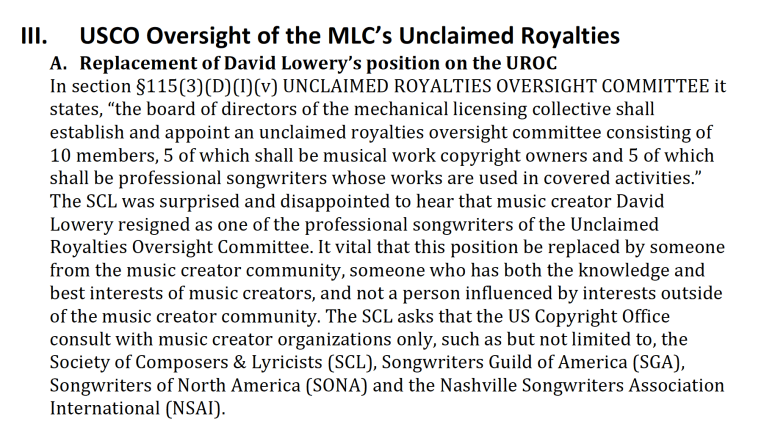
We want to thank the Society of Composers and Lyricists for mentioning David in their comments.

SLC NOI Reply Comments


RIP Scott Timberg and GoFundMe Page

We were devastated to hear of the death of Scott Timberg, a good friend of the artist rights movement and gifted writer.  His most recent work the definitive Culture Crash: The Killing of the Creative Class will be a vital resource for advocates for many years to come.

A GoFundMe memorial and college fund page was set up by David Dailey for Scott’s wife and son.  We urge everyone to contribute something however small.

As if it weren’t hard enough: @TheFOWShow Covers the Direct Shot Supply Chain Debacle–MusicTechPolicy

by Chris Castle

If you are lucky enough to have an independent record store in your community today (mine is the fabulous Waterloo Records), you may not realize just how lucky you really are.  For an independent record store to have survived the last 20 years is something of a modern miracle.  (I think the Waterloo story should be a Harvard Business School case study, frankly.)

It’s also important to realize that physical configurations contributed to 25% of global recorded music revenues in 2018.  Vinyl alone accounts for 3.6% of global revenue.  But–all the majors have outsourced their U.S. physical distribution to a company called “Direct Shot” and the result is a disaster for this delicate ecosystem.  I find it hard to believe that any sales guys had much to do with that decision–it has that extra special Boston Consulting Group stench to it.

The point is that the one way that it could be harder for retailers than it already is due to contractions in the market and streaming cannibalization is if the labels also contracted their stock, shorted them, or just simply didn’t timely deliver the records the stores ordered.  It’s also a silly move for the labels–that’s a nice 25% of revenue you got there, be a shame if something happened to it.

This episode of the first-rate Future of What podcast hosted by the brilliant Portia Sabin is one of the first in depth public conversations on this vital topic we’ve seen.  You may also want to read the open letter from retailers to the major labels that appeared earlier this year, as well as an in depth post about the Direct Shot debacle in the MusicBiz blog.

Stay tuned.

Guest Post: MIC Coalition Filing Reveal: The Zombie Transparency in Music Licensing and Ownership Act–@ArtistRights Watch

By Chris Castle

Remember the horrific Transparency in Music Licensing and Ownership Act from the last Congress?  (See “The Transparency in Music Licensing and Ownership Act: The Domesday Book Meets A Unicorn“.)

Well, guess what–it’s not really dead!  A little tea-leaf reading suggests that the MIC Coalition (one of the largest and most anticompetitive lobbying groups in history) have plans to amend the Music Modernization Act’s blanket license to all licensing verticals if they had their way.  That would include “general licensing” in bars and restaurants to satisfy their hotel, restaurant and “beverage” folks.  So there’s definitely some there there.


MIC Coaltion Members 2019
MIC Coalition Members

The MIC Coalition cartel filed a comment with the Copyright Office that makes one thing clear–this rule making is going to be a scorched earth donnybrook of epic proportions.

The big reveal in the MIC Coaltion’s filing is based on this passage in the legislative history for the Music Modernization Act:

Testimony provided by Jim Griffin at the June 10, 2014 Committee hearing highlighted the need for more robust metadata to accompany the payment and distribution of music royalties. With millions of songs now available to subscribers worldwide, technology also has a role to play through digital fingerprinting of a sound recording. However, there is no reliable, public database to link sound recordings with their underlying musical works. Unmatched works routinely occur as a result of different spellings of artist names and song titles….Music metadata has more often been seen as a competitive advantage for the party that controls the database, rather than as a resource for building an industry on.

The entire concept of maintaining a static look up database of not only all songs in the history of recorded music, but also all sound recordings in the history of recorded music that can be queried in real time is really not that different than the Domesday Book–when William the Conquerer made a big list of all property, people and chickens in England in the “Great Survey” in 1086.  Like the Domesday Book, the “musical works database” will be full of mistakes due to the dynamic nature of the things it is purporting to count.

But the reveal is the heaping praise on the horrific Transparency in Music Licensing and Ownership Act which was designed to destroy the PRO system (just like the MIC Coalition):

In response to the Copyright Office recommendations, Representative Jim Sensenbrenner introduced the Transparency in Music Licensing and Ownership Act, H.R. 3350, in July of 2017, which was cosponsored by several members of the House Judiciary Committee. The bill would provide for a database, housed at and overseen by the U.S. Copyright Office, to aid businesses and establishments that publicly perform musical works and sound recordings in identifying and compensating the holders of rights in those works. 

Fasten your seatbelts, it’s going to be a bumpy night.

Guest Post: UK Official Investigating PledgeMusic Directors, Asks the Public for Information

By Chris Castle

Don’t believe the headlines–just because there’s no money for artists from the PledgeMusic bankruptcy does not mean that the story is over.  It just means that justice is going to take longer.  If you were paying attention, it should have been obvious from the beginning that PledgeMusic was a financial roach motel–the money goes in but doesn’t come out.

In the least suspenseful story of the decade if not longer, it appears that PledgeMusic’s officers and directors ran the company straight into the ground.  It’s unclear from the Official Receiver’s report (which is available here) whether Pledge had any cash on hand when it filed for liquidation.  The Official Receiver appears to value the company’s intellectual property at £20,000 as its only asset.  Pledge had £7.4 million in “debt” so nothing for the artists or anyone else.

However, the really important part of the Official ReceiverReceiver’s report relates to the officers and directors.

Pledge Liquidator 1

So unpacking that paragraph, the directors seek to avoid liability by saying they weren’t involved with the “day to day running of the company”.  Well, no kidding.  That’s why they are directors.   But they are answering a question that isn’t relevant.  The question is not whether they were involved with the day to day, the question is what did they know about the company’s insolvency and when did they know it?  A related question is whether they were willfully blind about the financial condition of the company?

It is difficult to understand how they couldn’t have known about the company’s financial condition.  This is not something you find out from interviewing Benji Rogers.  This is something you find out by examining board minutes, financial statements, internal accounting, and of course internal emails.

It must be said, of course, that stating that “the company continued to operate as previously” begs the question “previously” to what date?  And of course, if it continued to operate as an insolvent, that doesn’t really help them.  At all.

Let’s not forget that to a large degree, once the board becomes aware that their company is insolvent, their fiduciary duty shifts from the shareholders to the creditors, especially if the board fails to disclose the insolvency to creditors and fails to seek bankruptcy protection (which goes by different names in the UK, administration or liquidation).

And that last sentence is also telling.  Why did the board seek legal advice about whether the pledge monies were or were not trust monies?  Again, answering a question that wasn’t asked exactly.  Who gave them this advice, what prompted the board to ask for it, when did they ask for it and what happened after they got the advice?  Did the lawyer also tell the board that they could tell the public they were soliciting funds for one purpose and then use the money for an entirely different purpose for their or the company’s own benefit?

You see, it doesn’t really matter whether the monies were held in trust if the entire process was a fraud.  But I’d still like to hear from that lawyer as to exactly what he or she told them–I seriously doubt that it’s quite as broad as all that.

But here is the punchline of the Official Receiver’s report:

Pledge Liquidator 2

It does not sound to me like the Official Receiver (the liquidator) views her work as completed.  What it appears remains to be determined now is whether the cause of the insolvency (or bankruptcy) requires further action, including a referral by the Official Receiver to Scotland Yard and/or the Crown Prosecution Service (which is essentially the prosecution arm of the Home Office–the people with the white wigs for the BBC watchers).

Artists should feel free to call the Official Receiver at the number they gave or I believe you can still email to LondonB.OR@insolvency.gov.uk using the matter LQD5671373 in the subject.

Guest Post by @cagoldberglaw:  Scared as Hell: Section 230 Denies Access to Justice, Not Free Speech Protection via @musictechpolicy

By Carrie A. Goldberg

[Chris Castle editor’s note:  We should all be aware that in addition to the “value gap” of the DMCA safe harbor, Big Tech also has another safe harbor in Section 230 which I call the “values gap.”  You have to ask yourself, how do they sleep at night?  We are honored to be able to post this article by one of the great lawyers of our time, Carrie Goldberg, author of the new book Nobody’s Victim: Fighting Psychos, Stalkers, Pervs, and Trolls and victim rights lawyer extraordinaire.  Carrie is going after Grindr for putting a product into commerce with a design defect that allows stalkers to use the app to assault users.  This argument is similar to the Ford Pinto’s exploding gas tank.  This post started as a Twitter thread, and we’re very pleased that Carrie agreed to let us post it as an article.]

For the past 2-1/2 years my firm has been in the fight of our life in the case Herrick vs. Grindr which involved owners and operators of the Grindr gay dating app refusing to assist our client, Matthew Herrick, when mobs of strangers were coming to his home to have sex with him.

Using Grindr’s geolocating and other technology, Herrick’s ex impersonated him and directed over 1200 men to him in person. Sometimes 23 a day. Herrick went to the police and got an order of protection. Nothing Herrick was able to do helped to stop this assault.

And neither did Grindr. No, Grindr said in court they didn’t need to help Matthew because the Communications Decency Act Section 230 protected them from any legal responsibility for harms caused by their app.  The district judge agreed. We appealed it to a panel of judges sitting on the Second Circuit Court of Appeals.

The Second Circuit panel also said Grindr bore no responsibility to Matthew and that the earlier judge was right to throw the case out. We sought a rehearing en banc before all the judges on the Second Circuit trying to explain that we were not suing for words or communications from a user (for which Grindr would get Section 230 immunity) but rather, we were suing Grindr because its product was defective.

Why?  Because Grindr designed their product without an internal system or other protective functionality to save users and the world at large from people abusing their product to impersonate, stalk, prey—easily foreseeable harms that a reasonable person could have predicted might happen before Grindr was put into commerce.

In August we submitted a cert petition for the Supreme Court of the United States to review the Second Circuit’s ruling and reverse it. We’ll know Oct. 1 if they will. In my practice, I see a lot of people like Matthew whose lives were destroyed because apps and social media companies ignored them.  People who are victims of revenge porn, sextortion, harassment, doxxing, horrible content coming up in search engines, all of which could be prevented by eliminating these design defects and putting people over profits.

These Big Tech companies have ZERO incentive to build safety precautions into their products because this 1996 law Section 230 has been interpreted by the courts to shield tech companies from just about any responsibility.  It means we as individuals CAN NOT sue them. A bunch of politicians, lobbyists and even some professors will say that Section 230 protects our speech.

That is not true.

What Section 230 does is remove options for us as individuals when lives are destroyed through tech. Our courts are no longer an option for us to get justice.  I can’t overstate how extreme it is for there to be companies that are UNTOUCHABLE by our courts.

Our tort system is centuries old and it is the great equalizer enforced by the courts—an entire branch of government and integral to our entire concept of checks and balances. In almost every kind of harm, for a couple hundred bucks a single person can use the tort law and the courts to hold the most powerful person or company responsible if they caused us harm and we can stop them from further hurting us which is Matthew’s case.

The ramifications of Section 230 immunity don’t just impact those harmed. Section 230 harms us all as a society. We are entering an era of greater surveillance, Artificial Intelligence, self-driving cars, facial recognition technology.  Companies developing this have ZERO incentive to be thinking about how their products will be abused and exploited by bad actors. Why?  First and foremost because there is no pressure on them from the threat of litigation.

So in addition to Matthew’s battle with the courts, my big discovery is that our politicians are now inserting language into our international trade agreements that echos Section 230.

If they succeed and we are injured by some other country’s negligent tech product, app or social media company, our country is immunizing those companies too. Those international companies now can’t be sued by us either.

Look at Article 19.17 of NAFTA 2.0 nafta excerpt

The language, which is even MORE expansive than Section 230 in protecting tech companies was already included in NAFTA.

And we have some politicians working to include it in trade deals with Japan, India, and the EU.  This is INSANE.

These politicians are taking away our rights against tech companies in our own country and others. This means they can all be as exploitive of users and privacy and human rights as they want.

Everybody should be scared as hell. Section 230 is NOT about online speech. It is about access to justice.  No other industry is immune like this. These companies basically have sovereign immunity. The most powerful, wealthy, omniscient, omnipotent industry in the history of the world has as much or more protections from being sued as a government.

We need to hold our politicians accountable. We need to expose those who are fighting against our individual rights and voting to exclude these companies from judicial systems around the world. Additionally, if our American companies don’t like changes we make to Section 230, they’ll just relocate to a country with whom we have a trade agreement.

Who in congress is THAT owned by Big Tech that they would betray the American people and strip them of all recourse for injuries that occur online?

Guest Post: The Coming Crisis: Just in time for #ClimateStrike, #SayNoToZoe on CASE Act Threats

Guest post by Chris Castle

The new copyright small claims court legislation (The CASE Act) passed the House Judiciary Committee, but not without thuggery from Rep. Zoe Lofgren and the Internet Association. Chris Castle narrates the issues and proposes a solution for Big Tech’s “Senate strategy” that inevitably includes Senator Ron Wyden, the grifter from Oregon and proud father of Section 230 of the Communications Decency Act.  Lofgren’s threat comes about 8:27:00 on the YouTube video here.

Internet Association Statement on CASE Act

Michael Beckerman

We are up against a direct threat on stopping the CASE Act from Rep. Zoe Lofgren (D-Google) and our old “friend” Senator Ron Wyden, the data center senator.  Just in time for #ClimateStrike, the political muscle that comes from jamming electricity burning data centers down the throats of politicians in exchange for backroom deals on tax reductions for a company that pays very little tax anyway.

We usually associate the iconic ACLU brand with good things, but not when it comes to Google.  When it comes to giving indie artists a remedy for their rights in the CASE Act, ACLU sides with the multinational culture devouring Big Tech companies.  For example, in a fine example of policy laundering, ACLU takes a gratuitous swipe at the Copyright Office using a Google “study” to allege bias.  ACLU Statement on CASE Act

See: ACLU Gets $700,000 from Google Buzz Award musictechpolicy.com/2011/10/31/the-…r-the-company”/

ACLU Helps EFF With DMCA Delaying Tactics musictechpolicy.com/2010/07/07/aclu…laying-tactics/

ACLU Cribs from Google Lobbyists on Pro-Piracy Letter to Congress musictechpolicy.com/2016/05/04/why-…ns-from-google/

aclu cy pres

Here’s the background on data center lobbying that almost sank the CLASSICS Act–if we have a radio station in every congressional district and data centers sucking down electricity in every state, artists have an even bigger burden than ever before on policy justice.

Why Artists Should Care About Data Center Lobbying

Ron Wyden’s Teachable Moment: Should one Senator be allowed to stop 415 Members of Congress on the Pre-72 Fix

Did a Wyden Campaign Donor Fund Hedge Fund Operated Out of Senator’s Basement?

Google Investing $3.3 Billion in Data Centers in Europe  (How will this affect Google’s Copyright Directive, privacy and antitrust lobbying?)

From Nature:

Already, data centres use an estimated 200 terawatt hours (TWh) each year. That is more than the national energy consumption of some countries, including Iran, but half of the electricity used for transport worldwide, and just 1% of global electricity demand (see ‘Energy scale’). Data centres contribute around 0.3% to overall carbon emissions, whereas the information and communications technology (ICT) ecosystem as a whole — under a sweeping definition that encompasses personal digital devices, mobile-phone networks and televisions — accounts for more than 2% of global emissions. That puts ICT’s carbon footprint on a par with the aviation industry’s emissions from fuel.

According to The Oregonian (Senator Ron Wyden’s home state):

Data centers have become one of Oregon’s biggest industries, with Google, Apple, Facebook and Amazon spending billions of dollars to buy and equip online storage facilities in rural parts of the state. They’re lured primarily by tax savings, which can shave tens of millions of dollars from a server farm’s annual operating cost.

heres-steam-shooting-out-of-the-dalles-data-center-in-oregon-as-its-cooling-down
Google’s Massive Data Center in The Dalles, Oregon

Google CEO on EU charm offensive says about their plans to hog Europe’s electricity and vaporize lakes and rivers:

Today I am in Helsinki, Finland, to meet with Finnish Prime Minister Rinne to discuss his priorities for the European Union Presidency, from building sustainable economic growth to achieving a carbon-free future.

The Nordic countries are great examples of how the internet can help drive economic growth. As part of our vision to build a more helpful Google for everyone, we are supporting Europe’s digital ambitions in two ways.

First, by continuing to invest in sustainable digital infrastructure across Europe. Today, I announced that we plan to invest 3 billion euros to expand our data centers across Europe over the next two years. That will bring our total investment in Europe’s internet infrastructure to 15 billion euros since 2007. Our investments generate economic activity for the region and support more than 13,000 full-time jobs in the EU every year, according to a study published today by Copenhagen Economics.

Are Data Centers The New Cornhusker Kickback and the Facebook Fakeout?

The Mother’s Milk of Algorithms: Google Expands Its Data Center Lobbying Footprint in Minnesota–Home to Senator Amy Klobuchar


@sound_wavves: Charleston musicians are challenging Spotify’s business model at rallies across the country

Artists across the country stand up to Spotify’s hyperefficient market share payouts!

The back patio at The Royal American, an uptown Charleston dive bar and music venue, serves as a hangout for those looking to sip a signature rum punch away from the bar, smoke an American Spirit between sets or play a round of cornhole.

Last Friday night, however, it served as a gathering spot for musicians protesting Spotify’s business model, which they said fails to pay artists their due.

A group of Charleston musicians — electronic artist Diaspoura (Anjali Naik), classical violinist Vivek Menon, singer Niecy Blues (Deniece Williams), drummer Chase Bunes and jazz and hip-hop-inspired producer Contour (Khari Lucas) — was responsible for the rally, one of five organized across the country. Other locations were Portland, Maine, Los Angeles, New York City and Spartanburg. The Charleston musicians started with a small gathering in the New York City subway, then decided to branch out, working with colleagues in each of the participating cities….

Spotify’s press team did not respond to requests for comment.

Because of the streaming problem, musicians rely heavily on playing live shows and selling merchandise such as T-shirts, CDs and vinyl to generate income. Most work part-time, or even full-time, jobs in addition to writing, practicing and performing.

Read Kalyn Oyer’s post on the Post and Courier site

Also read the Austin Music Census that confirms the problem with data.