Another Misleading Rabbit Hole from Rethink Music @berkleecollege

The “transparency report” from the Rethink Music Initiative at the Berklee Institute of Creative Entrepreneurship has a number of real howlers in it.  As one might suspect from an organization backed by the Google-funded Berkman Center, the “transparency report” contains recommendations that are both highly beneficial to the tech industry and entirely out of touch with reality.  The Berkman Center was founded by Charles Nesson, the bizarre Harvard Law School professor whose catastrophic losing representation of p2p defendant Joel Tenenbaum in an absurd file-sharing case yielded a resounding thud.

The Berkman Center is home to a lot of strange ideas.  Who can forget Nesson and fellow-Berkmanite Lawrence Lessig‘s backing of the Harvard-based “Global Poker Strategic Thinking Society” (an apparent astroturf operation) right about the time that Creative Commons got big bucks from one of the founders of online gambling company Party Gaming who pleaded guilty to violating U.S. gambling laws  and paid a $300 million fine.  (In a strange coincidence, Party Gaming was also an early ad partner of Megavideo alongside Google and AdBright.)

We could go on, but you get the idea.  Very Googley.

Take this passage for example.  Not to speak ill of the dead, but as we noted last week, the Berklee report admiringly recounts some business ideas that demonstrate that the late Mr. Dave Goldberg may have been a great tech executive, but had no clue about artist development.  None.

Also released in the Wikileaks emails [from the “North Korea” hack of Sony Pictures] was a memo requested by the Sony [Pictures] CEO from recently deceased Dave Goldberg, former head of Yahoo! Music, about how to pivot the company into a revamped all-digital enterprise. “The record company needs to act like a music publisher for new releases—putting up very little money but not trying to hold artists for long contract periods or to keep as much of the revenue. Advances would be $50,000 with a 40 percent revenue share after the advance… Most fixed headcount in new releases will need to be eliminated, artists will need to be paid quickly and transparently, deals will need to be simple and fair and catalog replenishment is the only goal of the new release business. Artist contracts that have large fixed marketing costs will need to be restructured or sold off as there will no longer be headcount to do the work. New releases will be tested on consumers before added money is spent to ensure that it isn’t wasted. In short, the new release business will become like an independent label.” To date, these recommendations have not been implemented.

Perhaps we can all agree on the premise that if it were that easy, everyone would be having hits.  Or if you lower the bar far enough for what a “hit” means, then everyone will be doing it.  As one commenter noted, this sounds vaguely like one Guy Hands, another who thought that because he went to a nightclub and bought a CD, he could tell everyone how to run the music business as he ran EMI straight into the toilet.  And we never hear anyone saying, what would Guy think?

So consider these excepts from Mr. Goldberg:

1.  “The record company needs to act like a music publisher for new releases—putting up very little money but not trying to hold artists for long contract periods or to keep as much of the revenue.”  This one is, of course, absurd on its face.  Publishers pay artist/songwriter advances based on (A) competitive forces and (B) their projection of the future earnings of artist-written songs on a current album plus songs that don’t exist yet.  It is ridiculously out of touch to act as if music publishers “put up very little money” as a matter of business practice.  “New releases” are valued in part by taking the temperature of the record company spending the marketing dollars to sell the records and earn mechanicals, performances and hopefully syncs for the publisher.  So you can see that this sentence is essentially a nonsense statement and has serious causal flaws of logic.

Like a record deal, term artist/songwriter co-publishing agreements are usually a series of options.  Granted, the typical co-publishing deal may be for fewer albums than a record deal, but the exploitation term is usually for the life of copyright with some contingent reversions.  Is that all that different than a recording artist agreement?  Not so much.  While a major label record deal may have a term of 4-5 albums, those are still usually options.  Given the drop rates at major labels, staying signed is not that big a problem anymore.  Most artists hope they stay signed long enough to get their first album released.

So “long contract periods” are something of a red herring in reality.

Publishers paying an advance will typically keep 100% of the song revenue until recoupment (other than the writer’s share of PRO monies), so how is it that they don’t “keep as much of the revenue”?  Labels don’t keep the artist share of SoundExchange royalties, either.  And by the way, publisher advances are often tied in large part to the release of the album by the record company.

Is this the statement of an informed person?

2.  “Most fixed headcount in new releases will need to be eliminated, artists will need to be paid quickly and transparently, deals will need to be simple and fair and catalog replenishment is the only goal of the new release business

If “most fixed headcount” is “eliminated”, exactly what will be driving the sales that are to produce revenues that will recoup advances and result in payments to artists (aka Berklee students and grads)?  And by the way, good luck getting anyone to sign to a label that proudly announces it has “eliminated” “most fixed headcount” for the personnel necessary to break new artists.

Particularly if you tell the artist that the reason for their existence is for “catalog replenishment”.  We can understand why “catalog replenishment” might be the goal of the tech company wishing to commoditize all music, but that’s not the reason that artists get into the music business.  Send the intern out for some fava beans and a fine Chianti.

3.  “Artist contracts that have large fixed marketing costs will need to be restructured or sold off as there will no longer be headcount to do the work. New releases will be tested on consumers before added money is spent to ensure that it isn’t wasted. In short, the new release business will become like an independent label.

This is the biggest howler of all.  “Artist contracts that have large fixed marketing costs will need to be restructured or sold off as there will no longer be headcount to do the work”.  Now there’s a selling point for artists, eh?  First of all, what they do if there’s an artist agreement with big marketing commitments for the next record that have become unrealistic is drop the artist.  And if that’s the case, exactly who is going to be the buyer if the contract is “sold off”?  Artists are not chattel, you know, the idea that a label can just sell off an artist agreement tells you a lot about the perspective of the speaker.

It’s just insulting.

But check this out: “New releases will be tested on consumers before added money is spent to ensure that it isn’t wasted.”  Right–because nobody does market research and the market research that is done is always correct?  And the new release business will become like indie labels?  That statement is so nonsensical it’s not worthy of comment.

Do you think that Ahmet Ertegun, Sam Phillips, Berry Gordy, Clive Davis, Chris Blackwell, Jim Ed Norman, Marty Bandier, Herb Alpert & Jerry Moss, Jimmy Iovine, Doug Morris, Russell Simmons or any of the great record guys did focus group testing to find hits?

By the way–here’s a significant part of that email that Rethink didn’t quote.  Notwithstanding Rethink’s best efforts to make him look like an idiot, the late Mr. Goldberg understood exactly what he was getting into:

If you still want to discuss this after you digest this, I am happy to find a time to come down to talk about it more. I think this amount of reinvention has rarely been done inside a public media company and it would be tough for Sony as a company to stomach the complaints from artists, employees and related parties (RIAA budget would be slashed, as an example). We would have to really decide if it was possible if you agreed with my thesis. I would also want to do a lot of actual work prior to implementing to validate the data behind the assumptions and understand the sequencing. I think it is a two-three year project to shrink the company down to the end state with a lot of noise in that period….With catalog providing the base profits, new releases need to be cut back dramatically to the point where the new business either breaks even or loses a small amount of money (justified by the long term catalog income stream of those songs).Thus, if the new release business is oriented towards building new deep catalog, it changes the entire process from trying to pick big hits to safely getting some good music out that has longevity. This will bias new releases to genres like rock and country that typically have had strong catalog. These also happen to be the genres that don’t have expensive producers so more music can be created for the same A&R dollars.

Mr. Goldberg clearly expected “noise” from artists.  He’s partly right about that–but the “noise” would stop pretty quickly as the version of Sony Music that Rethink Music wants to see would be the one that no artist would want to do business with and no songwriter would sign to.  So unless every record company followed the Rethink model, the one that did–and we predict there would be one–would lose every signing to the sane people.

If you want to read the entire email thread, you can find it here.

Berklee’s Misplaced Reliance on Sony Pictures Hack

The Berklee College of Music’s bizarre “transparency report” is a gift that keeps on giving.  One of the odder parts of the report is a quotation from one of the confidential emails stolen from Sony Pictures–allegedly by “North Korea”–and published on Wikileaks.  Let’s put aside for a moment the antitrust implications of the coordinated goals of Google and Spotify’s interlocking management teams and take a closer look at the section of the Berklee report that uses one of these stolen emails to justify the ad supported business models of Spotify and YouTube.

This quotation is in a confidential “music strategy” email from the late David Goldberg to Sony Entertainment and Sony Pictures CEO Michael Lynton.  We have to assume the Berklee authors (whoever they are as none were given a “written by” credit that we could find) actually read the confidential email if they didn’t study it in detail.  Goldberg’s confidential “music strategy” is a prime example of what happens when a tech executive thinks they can solve the music businesses problems–problems that often are created by other tech executives.  It also shows what happens when a tech executive gets the ear of a senior manager in an entertainment conglomerate–in fantasy land, tech executives think they can jam their ideas down the throats of the guys who actually sell records and develop artists (see the Bertelsmann/BMG fiasco involving Napster and Thomas Middelhoff).  In reality, it’s not so easy assuming you actually want to have a record company when the dust settles.

Here’s the excerpt from the stolen confidential Goldberg email as quoted by Berklee:

Sony has at least considered how to move more solidly into the digital realm. Also released in the Wikileaks emails was a memo requested by the Sony CEO from recently deceased Dave Goldberg, former head of Yahoo! Music [which he left in 2007–eight years ago and had not worked in the real music business since 2001–14 years ago, and essentially pre-Internet], about how to pivot the company into a revamped all-digital enterprise. “The record company needs to act like a music publisher for new releases—putting up very little money but not trying to hold artists for long contract periods or to keep as much of the revenue. Advances would be $50,000 with a 40 percent revenue share after the advance… Most fixed headcount in new releases will need to be eliminated, artists will need to be paid quickly and transparently, deals will need to be simple and fair and catalog replenishment is the only goal of the new release business.  Artist contracts that have large fixed marketing costs will need to be restructured or sold off as there will no longer be headcount to do the work. New releases will be tested on consumers before added money is spent to ensure that it isn’t wasted. In short, the new release business will become like an independent label.”  To date, these recommendations have not been implemented.

To date, Sony Music is a very successful record company, notwithstanding the failure to implement these bizarre ideas.  While the pitch is that Mr. Lynton sought out Mr. Goldberg’s advice (which we find no evidence of), CEOs tend to get ideas from a lot of people, and just because one of them gives some input doesn’t mean that their input becomes the operational plan.  Give Mr. Lynton a little credit, please.  Maybe the recommendations didn’t get implemented because we’re not the only ones who found them insane.

All Your Hits Are Belong To Us

With apologies to Mr. Lynton, we went back and read the actual confidential stolen email, which we highly recommend if you have about 20 minutes of your life you’re willing to sacrifice.  Here’s the gist:  Goldberg wants to convince Michael Lynton that Sony Music essentially should be converted into a catalog company because most of Sony Music’s revenues come from catalog.  That’s right–Goldberg wanted to more or less eliminate the front line catalog and just keep the back line catalog.  With no thought given to how…the front line hits…become the back line hits….rut roh.

That’s right.  Because magic.

Let’s set aside the fact that, with all due respect, Michael Lynton has little to do with Sony Music on an operational basis although organizationally he seems to sit on top (which means, no doubt, his salary and bonus includes Sony Music’s performance, another possible explanation for not implementing the Goldberg strategy).   Here’s the general thrust in a quote from Mr. Goldberg’s email:

If Sony Recorded Music (ex-Japan) is doing $250MM in EBITDA today, catalog is probably generating approximately $500 MM and the new release business, which is 98% of the headcount, is losing $250MM per year. The catalog is also primarily generating this revenue off “deep” catalog that is at least 5 years old or older. The great classics of pop music are stable earners, much like the consistent songs that generate most of the music publishing revenues.

“Deep catalog is at least 5 years old or older.”  Really.  Records released five years ago are very likely featuring current roster artists.  How’s that become “deep catalog”?

Let’s assume Goldberg’s numbers are actually correct–if there are a couple hundred new releases a year at a major like Sony, but Sony’s catalog dates back to 1888 when Columbia Records was founded (as a successor to the Volta Gramophone Company), what balance is there between new releases and Sony’s sizable catalog?  If you didn’t know anything else, might you possibly think that the back catalog makes more money than new releases because there’s a lot more of it?  And it reflects the investment in recording, marketing, promotion and artist development at the time the catalog titles were themselves the new releases that Mr. Goldberg now wants to eliminate?  With 98% of headcount allocated to new releases?  Really?  Any evidence of that?  (And by the way, to our knowledge there is no division of Sony Corp. named “Sony Recorded Music”.)  We’re not going to take the time to go chase down the real numbers, but eyeballing Mr. Goldberg’s baseline assumptions says they’re a little shaky.

But he goes on:

With catalog providing the base profits, new releases need to be cut back dramatically to the point where the new business either breaks even or loses a small amount of money (justified by the long term catalog income stream of those songs). Thus, if the new release business is oriented towards building new deep catalog, it changes the entire process from trying to pick big hits to safely getting some good music out that has longevity.

“Good music that has longevity” that isn’t “big hits”?  What music is that exactly?  And if the “music strategy” that Berklee is holding out to us is designed to replenish the hits that are already in the Sony catalog, will the go-forward catalog be “good music that has longevity” but not “big hits”?  What does that even mean?  Aside from a dramatic reduction in opportunities for Berklee students and grads?

Yep, that sequential thought thing is a bitch.

Some Good Music with a Good Beat You Can Dance To

You would have thought that a once prestigious institution like Berklee would have figured out this stuff before putting their name on a flawed report.  But there must be some explanation for this strange interest in  a stolen email?

Here it is:

Music is becoming a purely digital product. A digital- only  recorded music company will be a much more profitable one after one-off restructuring costs [of mind-numbing proportions]. It will have lower revenue and higher margins. Its revenue will be very stable and grow with the overall digital music market growth. It will be a much more valuable company with its revenue base solidly coming from subscription and ad revenue. (emphasis ours)

In other words, it will be just like Google and Spotify but with “good music that has longevity” replacing “big hits”.  And because there’s “lower revenue and higher margins”…wait for it, wait for it…they’ll make it up on volume!  It is the Internet, after all.  Only problem–we’re looking forward to meeting the artist who would sign to Goldberg’s (and now Berklee’s) vision of Sony Music.  Particularly if the competition didn’t find a deckchair on the Titanic next to Berklee.

So then Sony’s business would be entirely dependent on catalog with revenue from subscription and advertising–funny, just like Spotify’s business model.  What a bizarre coincidence.  Let’s just overlook that pesky fact that about 50% of revenue still comes from CDs.

Look, we’re sorry that Berklee picked the confidential writing of the late Mr. Goldberg who died too young and was by all accounts a great guy.  Given that he’d been out of the business since 2001, we have no way of knowing whether Mr. Goldberg would have wanted his thoughts included in the Berklee report in the form of the stolen email–a stolen email marked “confidential”.  Perhaps on further review and discussion he might have relented and agreed with us that his music strategy email was not his finest hour.  No crime there.  But Berklee included the email nonetheless.

However sympathetic and tragic Mr. Goldberg’s situation might be, had Berklee not included the stolen email in their report, none of this criticism would have ever come up.  Our beef is not with someone who is not alive to defend himself, our beef is with Berklee who decided to take his work with no regard for Mr. Goldberg’s wishes or for Mr. Lynton’s privacy.

Rethink Music’s Grand Deflection: Big Tech Points Fingers at Everyone But Themselves

You probably have seen the breathless announcement of the “Rethink Music Transparency and Money Flows in the Music Industry” from the Berklee College of Music.  David wrote about it earlier this week.

The Berklee “report” starts with this premise:  If you have a problem with your streaming royalties, your problem is with your record company–assuming you’re signed–because record company accounting is not “transparent”, whatever “transparent” means.  In other words, the report seems to glorify Big Tech as holding the keys to truth and justice and points fingers at record companies and PROs as being the source of low royalties.  Or as some people call streaming royalties, cryptocurrency.

This premise will sound familiar if you have been following Daniel Ek’s embarrassing diatribes against his label “partners” in the public press.  In fact, there is some oddly similar language between the report and statements made both by Ek and Christophe Muller a YouTube executive at Midem 2015 that predate the report’s release date.  It’s almost like they had seen an advance copy.  (In fact, Christophe Muller is thanked in the Berklee report’s acknowledgements.  Midem has their logo on the Rethink Music website right next to Google beneficiary the Berkman Center.)

In fact, two of the companies directly lauded by the report are Spotify and Kobalt.  (Kobalt received a $60 million investment from Google Ventures and apparently paid for the Berklee report.  Spotify reportedly has Google’s Chief Business Officer on their board.)  The Berklee report continues Spotify’s attack on Taylor Swift.  There are many other cues that confirm the Berklee “transparency report” is not only not transparent, but not particularly self-critical either.

This all might be easier to understand if we could find a “written by” credit anywhere in the report so we could tell the authors biases.  Particularly since the “report” is not peer reviewed in any traditional academic sense.   There’s lots of acknowledgements that take the circular congratulatory award–more about them in another post–but if you can find an actual “written by” credit, please let us know.

We suggest starting with a different premise:  How can artists and songwriters be empowered to verify whether the revenue-share royalties they receive from services like Spotify and YouTube are in fact correctly calculated?  Why should this be the bedrock principle on which a creator’s relationship with a user of music is based?  Very simple–if you can’t confirm whether you are getting a straight count, then what good is any royalty statement?

As the U.S. Copyright Office summed it up in the Music Licensing Study:

At bottom, the issue in the music industry is that participants want reassurance that they are being treated fairly by other actors.

Confirming your straight count is called a “compliance examination” or a “royalty audit.”  A royalty audit has nothing to do with the kind of work your CPA does when the IRS audits your tax return or “audited financials” that you see with the preparation of a company’s income reports.  It doesn’t really have anything to do with Generally Accepted Accounting Principles (GAAP).

The royalty examiner is focused on verifying whether you were paid correctly under your contract, not whether the company correctly depreciated its assets or some other GAAP principle that has nothing to do with whether you were paid accurately.  A “royalty audit” is simply a forensic-type investigation that matches transactions to income reporting based on the terms of a contract whether it is Tunecore’s click through agreement or Spotify’s major label contracts.

Record companies and music publishers are subject to royalty audits by every writer, artist and songwriter.  Relatively few artists or songwriters have the right to audit Big Tech companies or digital aggregators–typically only the major labels and publishers have the right to audit companies like YouTube or Spotify.

You know–artists and songwriters like Berklee College of Music students and grads.

So if you were writing a report about “transparency” like the Berklee report, wouldn’t transparency start with the source of the revenue–the digital services? We’re not worried about GAAP, we’re worried about GIGO–garbage in, garbage out.

The only time this issue comes up in the transparency report is in a reference to the Copyright Office recommendation about changing the U.S. Copyright Act to “Allow songwriters and publishers to audit a licensee’s statements”.  Including a digital services statements.

There is nothing to stop digital services from voluntarily agreeing that all songwriters, artists, record companies and music publishers can conduct royalty audits TODAY.  It doesn’t require amending the Copyright Act.  The fact that the Berklee report fails to call for voluntary transparency should tell you all you need to know about who controlled the pen in writing the Berklee report.

It wasn’t the Berklee students or the grads.

More importantly, if you are going to go to the trouble of conducting a royalty examination of companies like YouTube and Spotify that pay based on a share of advertising revenue, you should also be able to verify the advertising revenue allocated to your music.  Where do these numbers come from?  How is it that YouTube accounts for a significant chunk of Google’s revenues but pays out squat when music is such a huge part of YouTube spins?  How does Spotify calculate the revenue that they are sharing with artists and songwriters?  Why are some spins on YouTube accounted at different rates including zero?  Aside from the Google NDA culture of secrecy–never mentioned in the Berklee report.

If we are being paid on a revenue share basis and YouTube revenues are up (Google’s insiders made $8.3 billion in one day last Friday), shouldn’t our share of revenue also rise at roughly the same rate?  If not, why not…”partner”?

If you can’t ever check the revenue side, then how would you ever know?  So it’s not a question of whether the split is 70% or x%, the question is x% OF WHAT?  70% OF WHAT?  Even if you can confirm that you were paid on the right spins, if you can’t ever check if the revenue was properly calculated, what use is any of it?

That’s the kind of transparency recommendation we would have expected from the Berklee College of…you know…Music.

Speaking Truth to Power and Speaking Truth to Friends

Music Technology Policy

VERMILLION
Hell, I got lots of friends.

DOC
I don’t.

Tombstone, written by Kevin Jarre

A friend is someone whom you trust to do the right thing.  Sometimes you’ll hear people say that a friend did something uncharacteristic.  If they are really your friend, you will be the one to stand with them in those moments and say that just can’t be right.  Give them another chance to prove themselves.

So it is with National Public Radio’s short-lived membership in the MIC Coalition, the massive lobbying group organized by…someone…to oppose the Fair Play Fair Pay Act guaranteeing artist pay for radio play.  By the looks of it, those organizers were the usual suspects at the National Association of Broadcasters and Google.

As I mentioned in my presentation last week at the Copyright Society of the USA in Austin, the MIC Coalition members are companies and trade associations with a combined…

View original post 537 more words

Spotify Windows App Store Subscriptions, Now with Added Misleading Advertising

If Spotify finds the App Store deal so unethical, there’s an easy solution: Pull down the Spotify App from the App Store. They can leave any time.

Music Technology Policy

You’ll remember that The Verge ran the leak of Spotify’s agreement with Sony Music.  Now The Verge is running a story about subscriptions to the Spotify app from Apple’s App Store:

Spotify is trying to raise awareness around the fact that it’s cheaper to subscribe on the web instead of through Apple’s App Store. The leading subscription music service plans to email iPhone customers the below note encouraging them, if they haven’t already, to start paying at Spotify.com and save a few dollars. “In case you didn’t know, the normal Premium price is only $9.99, but Apple charges 30 percent on all payments made through iTunes,” the email blast reads. “You can get the exact same Spotify for only $9.99/month, and it’s super simple.”

Here’s the actual emails:

Spotify Attachment-1.0

Quick–based on what you just read, who sets the price for the Spotify subscription through the App Store?  Apple or Spotify?

I bet you…

View original post 484 more words

The MMF’s Google Problem

Music Technology Policy

David Lowery’s recent post on the Trichordist reveals the disclosure by an apparent whistleblower that the Music Managers Forum and to some extent the Feature Artist Coalition have each been taking undisclosed money from Google and Spotify.  (Given the context, I assume the whistleblower is referring to the MMF chapter in the UK.)  Why is this important?  Because when confronted with the artist rights grass roots movement that Lowery personifies, we can expect Google to do what they always do–try to co-opt it one way or another.

Want evidence?  If you’ve had a look at the Public Citizen report “Mission Creep-y“, Google’s technique of buying their way into issues or industries and increasing their dominance in their ownership and influence through control of resources should come as no surprise.  The venerable good government group provides extensive documentation of Google’s massive investment in indirect lobbying through funding a host…

View original post 883 more words

Save the Date, July 8 at @thecsusa in Austin: Panel on the New Grassroots, #irespectmusic and the Fair Play Fair Pay Act

image

NOTE TIME CHANGE:

The Copyright Society of the USA Texas Chapter and the Austin Bar Association Entertainment & Sports Law Section have are co-sponsoring a panel with Chris Castle and Austin manager Ray Flowers with this title that pretty much sums it up:

“We’re Not Going To Take It”

The New Grass Roots,
#irespectmusic, and
The Fair Play Fair Pay Act

Wednesday, July 8 2015

12:00 pm-1:30pm

Jackson Walker L.L.P.

100 Congress Avenue, Suite 1100
Austin, TX

This event is particularly timely given the expanding campaign to get artist pay for radio play.  Don’t forget to join 13,000 of your friends and sign the #irespectmusic petition at IRespectMusic.org!  If you’re in Austin, follow IRespectMusic Austin @irmaustin and online at www.irespectmusicaustin.org.

New Study Explains Why YouTube is Always at the Top of Google Search Results

Music Technology Policy

For years now–since Imeem days at least–I’ve been wondering why it is that the top videos in Google search results were always from YouTube (or from Vevo through YouTube).  Like many others, including…let’s see…Senator Mike Lee and the European Commission for starters…I just assumed that Google was stacking the deck to favor YouTube, its wholly owned subsidiary.

According to Brad Stone writing in Bloomberg, a newly released study by Tim Wu (“Is Google Degrading Search?  Consumer Harm from Universal Search”) explains the phenomenon and further backs Google into an antitrust corner.  The study’s thesis is that “Google is able to leverage its dominance in search to gain customers for [Google’s competing] content.  This yield’s serious concerns if the internal content is inferior to organic search results.”  Brad Stone reported:

Google is facing a new high-profile adversary in the roiling fight over whether its monolithic search engine violates antitrust law: Columbia…

View original post 271 more words

David Discusses NPR’s Membership in the MIC Coalition with Adam Ragusea on The Current

One Of These Things Is Not Like the Others

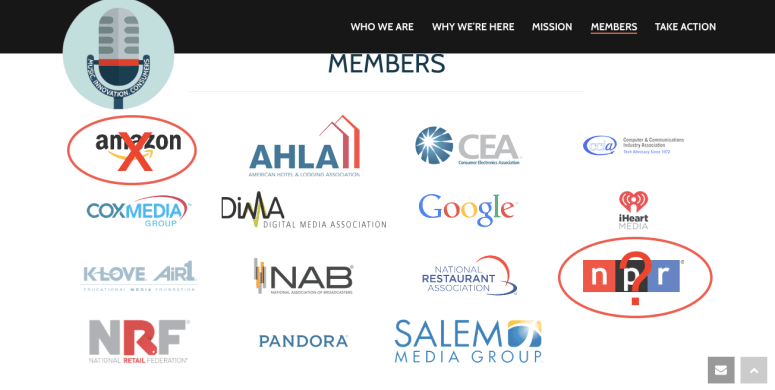
We’ve taken National Public Radio to task for joining the “MIC Coalition” (or as we call it the “McCoalition”), a group of megacorporations and lobbying groups formed to oppose the Fair Play Fair Pay Act.  Here’s all the logos of the McCoaltion members (Amazon has dropped out already):

mccoaltion - Amazon

As soon as we saw that NPR was a member, there was something about NPR’s membership in this group of some of the biggest corporations in the world that just felt bad.  Thanks to Adam Ragusea’s interview with David, we can articulate that bad feeling much better.

In his introduction to the episode, Adam asks the question, “Should musicians finally be paid for radio play?  Should public radio stand in the way?…I too find it very weird that I find myself on the opposite side of NPR on a big issue.”

But the really insightful part of Adam’s lead in to David’s interview is the way he contrasted for-profit radio and non-profit radio.  This is, of course, the main distinction between NPR and every other corporate member of the McCoalition (and really every member unless you want to say that somehow trade associations comprised of for-profit corporations are like NPR–we’ll leave that argument to someone like Michael Petricone).

Adam says that a non-profit ought to have a different organizational duty of loyalty–instead of the for-profit’s duty to shareholders:

At least the way I figure it, [a non-profit’s] loyalty should be to your institution’s mission, not to the institution itself….And yet I often see public media institutions, mostly in little ways, doing things that serve the institution over its mission.

And that right there is an eloquent statement of what sticks in the craw about NPR’s membership in the McCoalition.  We’ve always believed–and are more convinced than ever–that NPR’s membership in the McCoalition was more the product of the suits in the lobbying department and not the journalists working in the news and music areas.

Have a listen to the show–Adam’s lead in to David’s interview starts around 20:20, but listen to the rest of it, too.  We really appreciate Adam giving David a platform to have a dialog about the issues.

“YouTube for YouTube” @midem: @davidclowery and @theblakemorgan Review “YouTube For Artists” Part 2

Blake Morgan answers the same questions about YouTube for Artists as David Lowery in Part 2

Music Technology Policy

In a crescendo of antagonism starting with the Sony Pictures hack that leaked confidential documents demonstrating that the film studios have had it with Google, Google’s lawsuit against a state attorney general seeking to stop his investigation of Google’s bad behavior and the leak by somebody of the Spotify agreement with Sony Music, the New York Post reports that YouTube (Google’s wholly-owned subsidiary) is going to the MIDEM conference this week for the purpose of attacking the record company/artist relationship.

I find this to be particularly bizarre given that Google has also formed a massive coalition fighting against artist rights in league with familiar faces like Pandora, the National Association of Broadcasters, the Digital Media Association (DiMA), the Computer and Communications Industry Association (CCIA), the Consumer Electronics Association (CEA) and a host of others.  After doing that, YouTube’s attack on labels at MIDEM is triangulation of the first water particularly…

View original post 1,900 more words