@jannarden gets the Lars Treatment from QuickHitz Broadcaster

Astonishing bullying against an artist by apparently unregulated broadcasters.

Music Technology Policy

We’re trying to get confirmation of what actually happened, but it looks like Canadian artist Jann Arden was banned from a 100 station radio chain in Canada–because she spoke out against a radio format that literally cuts recordings in half. Why would anyone even think of such a vile format? My guess up is that it’s just so the stations can sell more advertising.

This is kind of like YouTube for radio.

Remember that Canadian broadcasters are supposed to help foster Canadian artists, and most of them do. This is why I have to believe that this format is all about the bean counters who love money and not the jocks who love music. Giving artists the Lars treatment is what we expect from SiliconValley money grubbers who profit from piracy. At least the pirates steal the entire song.

And banning an artist from the peoples airwaves because she spoke…

View original post 20 more words

Is the QuickHitz Format the Sweeney Todd of Radio? The Incomparable @JannArden Stands Up for Artist Rights

Music Technology Policy

Jann Arden has made some of the best records of the last 20 years and is a Canadian treasure.  I first heard her when she was signed to A&M Records and have been a fan ever since.  So when Jann speaks up about music, I’m all ears.

Jann is speaking up about the latest attack on artist rights:  The “QuickHitz” radio format that chops up records.

According to the QuickHitz website:

QuickHitz is a game-changing mass appeal music format built especially for the needs and lifestyle of today’s multitasking, attention challenged listeners. Imagine more music per hour than any other radio station ever!  QuickHitz is a break-out alternative to Top 40 radio that immediately repositions the competition with a fresh approach to music discovery and all the interactivity of Social Media. Quite literally, QuickHitz is “twice the music in half the time.”

“Twice the music in half the time”.  “How…

View original post 479 more words

The Royal Scam Part 1: How the rush for the equity trough trades artist royalties for stock

“All animals are equal, but some animals are more equal than others.”

Napoleon in Animal Farm by George Orwell

The U.S. Copyright Office has raised a relevant question in its request for comments on music licensing:

Please address possible methods for enhancing transparency in the reporting of usage, payment, and distribution data by licensees, record labels, music publishers, and collective licensing entities, including disclosure of non-usage-based forms of compensation (e.g., [1] advances against future royalty payments and [2] equity shares).

Many artists and indie labels are probably not even aware that some deals they are being asked to opt-in for have some hidden economics that make the deal better, and often much better, for some artists or labels than others.  We first noticed this underhanded approach in the DMX-type deals where companies like DMX paid early adopters to take a low royalty in return for a big advance that may have been non recoupable.  Then they hold out that low royalty as an MFN type rate to others without disclosing the advance paid to the early adopters.  We’ve seen it perpetuated in the Spotify deals and maybe some other recently announced licensing deals.

Why is this a problem?  Because it’s not formally disclosed to the less equal animals, and sometimes it hides behind the NDA culture that Google has introduced into the music business.  It’s also a problem because those who need the money most are paid the least.

This is different than the “I’ll give you some stock if you say something nice about me to your friends” deals that we see all the time.  Those are corrupt for a different reason, the same reason that payola is against the law on radio and TV (and we all know how much Pandora wants to be treated like a radio station and YouTube thinks they’ve replaced TV).  Be careful what you wish for.

Thankfully, the U.S. Copyright Office is now focused on these under the table payments as a matter of public policy and we commend them for that stance.

Digital Music News has done a great job of surfacing this issue of the inequity of equity.  As Paul Resnikoff reported (How Streaming Services are Screwing Lady Gaga (and Every Other Artist), there are clauses in artist agreements, even highly negotiated ones, that deny artists a share of advances that are made for a label’s entire catalog in a clause like this one that Paul posted:
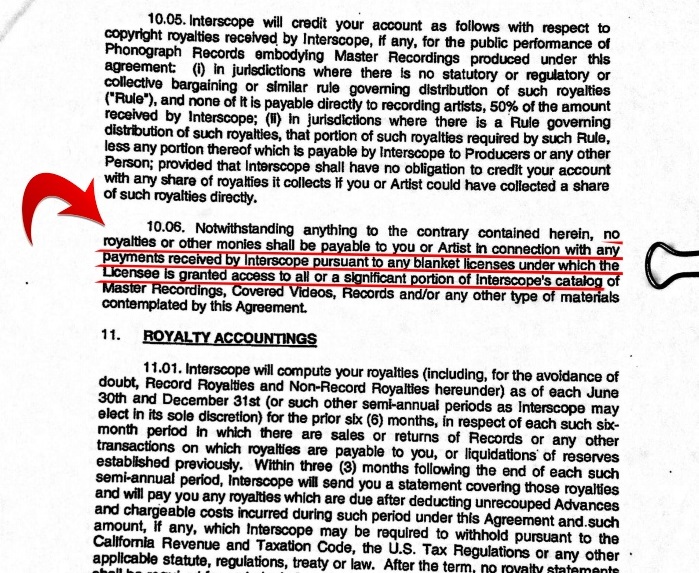
gagacontract small

Focus closely on what this clause actually says:  If the label gets “payments…pursuant to any blanket licenses” for the label’s catalog, the artist–the one whose contract it is–doesn’t get any of those “payments.”  Paul uses this clause to attack the equity that labels got in streaming services.  He’s kind of right, but not for the reason you might think.

This clause is a very old concept in record deals and it has a legitimate above the table rationale and also a below the table one.  If a label makes a distribution deal for a blanket license of their entire catalog they typically negotiate a minimum guarantee, sometimes called an “advance”, against revenues that come in for their catalog during the life of that distribution deal.  The minimum guarantee is paid up front by the distributor, so it is a kind of bet by the distributor that the catalog will produce enough money to recover (or “recoup”) the minimum guarantee from royalties otherwise payable to the licensing label.  (Leave aside for the moment whether this is a “license” or a distribution deal for sales–see the Eminem litigation.)

That advance earns out over time depending on how the label’s catalog sells.  Advances are typically “recoupable but nonreturnable.”  The advance is recoupable, i.e., applied against the label’s share of the catalog’s sales during the distribution term.  The advance is “nonreturnable” meaning it doesn’t have to be paid back if the label’s share of revenues during the deal don’t equal or exceed the amount of the advance.  If the label is “unrecouped” at the end of the deal, the label keeps that delta.

Example:  Label X gets an advance of $100 from Distributor Y for the country of Airstrip One.  The deal lasts 5 years.  At the end of 5 years, Label X’s catalog has earned $90.  Distributor Y just sends royalty statements to Label X showing an unrecouped balance and doesn’t have to pay the $90-because Label X has already had it in the form of the advance.  If the deal is still unrecouped when it ends–meaning Label X got a bigger advance than it earned–then Label X keeps the extra $10.

From Label X’s point of view, Label X still has to pay its artists their royalties for the $90 of sales.  Say Label X has three artists, Hear, See and Speak.  Assume that artist Hear earns $85, See earns $5 and Speak has no sales.  (It’s actually more complicated because the artists will get less than 100% of the money, but leave that aside.)

The advance, then, is a kind of bet that Distributor Y makes on the Label X catalog.  It’s paid in cash and it’s paid up front, like ante.  Because that advance is a payment against actual future sales, there’s really no fair way to divide it up among the artists on the day that the deal is done, that is, before there are any sales.

This is the reason that you get for why this clause is in there.  That’s the “above the table” reason.

Here’s the “below the table” reason.  What if Label X was very valuable to Distributor Y, either because it was a huge catalog without which Distributor Y wouldn’t really have much of a business, or it was just a very hit-rich catalog and was likely to continue to be valuable to Distributor Y in Airstrip One.  Label X could very easily say to Distributor Y, you know that $100?  I have to share that with my artists.  How about you pay me $20 of that flat and just give me an $80 advance?  Meaning–Distributor Y pays Label X $20 on a nonrecoupable basis (“flat”) and Label X puts that money in its pocket.  And because it’s a “payment” for the blanket license, the label doesn’t have to share it with any artist.

Is it fair?  Is a nonrecoupable payment just a way to get a higher royalty or revenue share for the label?  That depends on how you look at it, but one thing that is certain is that the reason that the label is able to get this nonrecoupable payment is because of the value of the catalog.  That value is a mix of the work product of the label’s investment in the artist, but it’s also partly the value of the present and future work product of the artists.  And you won’t be surprised to know that we think it’s largely the work product of the artists.

Consider another aspect of the same example.  If the deal with Distributor Y is a true license, most of the time the revenue is split 50/50 with the artist (this is what the Eminem case was all about.)  However that advance earns out, you can see that if there is a portion of the money that is nonrecoupable, the nonrecoupable part is not shared with the artist.  Distributor Y will still have to pay Label X for sales occurring after the advance part is recouped, so it’s not like the artists are not getting paid for their sales.  (Assuming that Label X is accounting properly.)  There’s just a chunk of cash that never hits the artist royalty statement because it is paid directly to Label X as what some might call a vig.

The practice has been that when the label leverages the work product of their artists to get a payment for the label that they don’t share, they trot out this clause that Paul has found as the justification.  It’s still often kind of revenue neutral for the individual artists, it’s not like the label said give me this money and underreport sales, or give me this money and I won’t audit you.  Well…maybe they did say I won’t audit you.  But from the artist perspective the deal should be revenue neutral.

Now consider the same facts, but in addition to the nonrecoupable payment, Label X also demands shares of stock in Distributor Y.  Distributor Y says hold on there–I already gave you the nonrecoupable payment and you want stock, too?  What are you giving me for the stock?  Hmmm….who is not at the table here?  Let’s take their money.  So the label says sure, if you give me stock and a nonrecoupable payment, I will let you [increase your distribution fee/decrease the royalty base price/decrease the net sales on which the artist royalty is calculated/increase the reserves that are never liquidated] that determines the royalty I have to pay to the artist.  But only by a believable amount.  Say 10-20%.  This works particularly well in places like say Venezuela, China or Cambodia.  Or on the Internet.  Any place no one expects to get a decent accounting.  Or feels lucky to get any payment at all due to rampant piracy.  (Remember the three legged stool from Old Boss, New Boss.)

Why does this happen?  Because if you are not at the table, you are on the menu.

Back to Lady Gaga’s contract.  Do you think that this clause also covers stock that was extracted in return for a lower royalty rate?  In other words, what if the clause that Paul quotes ended with “in return for lowering your royalty rate to an abysmal and unsustainable level while your label gets rich beyond their wildest dreams”?  Or even if it said “payments in cash, shares of stock or other securities or other things of value”?  How do you think that would go down with the artist’s representative?

Another part of the vig is what happens at the end of Distributor Y’s contract if Label X is unrecouped.  Frequently, Distributor Y is allowed to extend the term under some conditions to try to recoup the unrecouped balance.  This doesn’t go on forever but it might be another 6 months or a year.  In the land of Internet where the living is easy, the fish are jumpin’ and the cotton is high, when the deal is over, the unrecouped balance often is not rolled into additional time on the contract.  Instead, the term is renegotiated and a new advance is paid for a new deal.  This pocketing of the unrecouped balance is sometimes called “breakage.”  Does Label X share the breakage with their artists?

What do you think?

If this is just a miscalculation by Distributor Y, that’s one thing.  If, on the other hand, Distributor Y for the Land of the Internet overpays the advance by what anyone would find to be an amount that is highly unlikely to recoup, and also has a crappy accounting system so that the accountings that Label X will use to account to their artists underreports sales–like reducing the percentage of net sales in the physical world–who benefits?  If Label X gets a big enough nonrecoupable payment, high enough breakage and enough shares of stock in a company that is likely to go public or have a big exit–while still making most of its current revenue from sources other than the Land of the Internet–do they really care that much?  Particularly if they distribute some of those shares of stock to Label X executives to hold personally?  Who’s going to complain?

If you’re not at the table, you are on the menu.

Of course if Label X lacks market power, it is unlikely that Label X will be able to extract any of these vigs.  And this leads us to the indie labels’ claims against YouTube.

To Be Continued.

After YouTube’s Indie Label Catastrophe, Why Did Spotify Let Google Buy Its Way Onto Their Board of Directors?

You’ve all been following YouTube’s absolutely tone deaf “take it or leave it” brinksmanship strategy with indie labels represented by Merlin and WIN.  This one sided “negotiation” appears to still be grinding on.  Why would it take so long?  Why wouldn’t YouTube simply say, we’ll treat you like everyone else and close up the problem.

So what is Google’s next move to calm the waters?  Google buys its way onto the Spotify board and the Spotify board allowed them to do it.

If we ever needed proof that Spotify intends to keep screwing artists and songwriters, we just got that confirmation.  Without so much as blinking an eye, Spotify embraces Google like a long lost brother returning to the family.  Whether this is just the first step toward Google buying Spotify or a step toward a “powered by Spotify” Google music service will be told in the future.

But what we definitely know is that two companies have joined together to pursue their common goal of paying minuscule royalties to songwriters and artists.

By welcoming Google onto its board, Spotify has lost the last shred of a fig leaf for screwing artists and songwriters.  With Spotify, you just get reamed because the deals are awful and you’ll never participate in any of the stock that Spotify gave to major labels and their senior executives (and probably some select superstars).   These under the table advances and equity shares in exchange for lower royalties are so bad that even the U.S. Copyright Office has raised it as a concern!

But with Google you get reamed because the royalty rates are absurdly miniscule when paid by Google’s legitimate front businesses like YouTube and are actually negative when you take into account the pirate sites Google profits from through its unscrupulous AdSense business.

Doesn’t Spotify have enough artist relations problems without adding Google to the list?

Not if Google writes a big enough check!  There’s a couple ways that Google could invest in Spotify.  They could buy newly issued shares (probably in a new series of preferred stock) OR…Google could buy existing shares from existing stockholders.  For example, if you were an executive of a major label who had gotten Spotify stock and you were thinking of “pulling a Jimmy” and getting some island money, one way you could do it would be to sell your shares to Google (sometimes called a “selling stockholder”).

But whatever happened, Spotify has now embraced the pariah of the music business.  Google is on their board, votes on everything the board votes on, including royalty rates, under the table money, the works.

Not only that, but why would Google allow Spotify to renew their deals through the Harry Fox Agency when Google owns Rightsflow?

If Spotify had artist and writer relations problems before, that’s nothing compared to what they’re going to have.

Pandora’s Chris Harrison Songwriter Enemy Number #1?

christopher-harrison

Informal Trichordist  poll calls Chris Harrison Songwriter Enemy #1.  Here’s  some reasons why songwriters feel this way about Pandora’s litigator in chief.

We don’t know quite why, but Pandora seems to have put Tim Westergren on ice. If we had to guess, we’d guess that this is because Westergren has served his purpose to the corporate overseers at Pandora. You know, you’ve done good job, Tim, we’ll take it from here.

Tim’s made bank on his project, we figure he’s closing in on $20 million or so. Pandora is sitting on top of about $200 million in cash. The corporate overseers gave the old management team a chance to get their numbers up the old fashioned way—screw the artists and songwriters. This artist friendly crap is over. Tim Westergren, Joe Kennedy, etc., got iced. The big dogs want the real cold blooded types now because they’re gonna get their money. And the shirts off our backs.

Enter Christopher Harrison. You may not have noticed him until recently, but he’s now firmly in charge of the artist screwing crew. Our bet is that he’ll do what the Wall Street overseers want every time like a good boy and roll over for the tummy scratch and a big green bone in his mouth—cash or stock. For whatever reason, from what we can tell he’s had a big one for creative types for a long time, especially songwriters and most particularly ASCAP.

The rumor is that this started when Harrison was at the DMX background music service. The story goes that he got the company to partner up with Music Reports (you’ve probably gotten a few thousand NOIs from them along with penny checks) to try to make an end run around the songwriter PROs. DMX—apparently led by Harrison—went out to make direct deals with publishers. The rumor is that they went to a big publisher and paid them money under an NDA to get them to give a low rate. Then they supposedly told a bunch of other songwriters and publishers what the rate was and convinced them to take most favored nations on the rates, but left out the part about the up front money. Some people might call this lying.

Then the rumor is that Harrison took the direct deals to the rate courts and showed them as evidence of a “free market rate” and the rate court Song Czars forced the PROs to take the chump MFN rate on all the songs that DMX didn’t have direct deals with, thus rat stumping all songwriters, including foreign writers.

Pretty slick!

Since the DOJ supervises pretty much anything to do with Songwriters  it’s mighty mighty curious they have never investigated this.

So if you’re a corporate overseer at Pandora and want to find someone whose really got a major big one for songwriters and artists, Harrison has to be on your short list. He’s already made his bones. If the rumors are true.

And if you look at the last Congressional hearing where Pandora appeared, guess whose bright and shiny…face…showed up at the witness table. And he you can tell he. Just. Loves. It.

He’s a serial songwriter stumper. Songwriter enemy Number 1. Can’t you just see him rolling over and barking for the corporate overseers to throw him a bone?

Other notable outrages committed by Pandora under Chris Harrison 

– This addendum compiled  by David Lowery

*Apparently colluded with Sirius and Clear Channel to stop paying royalties to legacy artists with pre-1972 recordings.  The bizarre rationale simultaneously taken by all these companies is that there is no copyright for pre 1972 recordings. ( Where is DOJ on this collusion?)  As a result Pandora will pay no royalties to civil rights icons The Freedom Singers.

The revolution will be webcast but performers won’t be paid.

Write Pandora and ask them why they are doing this:  investor@pandora.com  and pandora-press@pandora.com.  Institutions should consider the moral implications of investing pension funds in this company.

* Under Chris Harrison’s leadership Pandora has repeatedly sued songwriters. These suits have cost songwriters at least 10 million dollars in legal fees..  It likely cost the US Taxpayers and Pandora just as much.   This was all so Pandora and Chris Harrison could save $4 million dollars in 2013.. These suits are so cost ineffective you have to wonder if Pandora is simply doing this to pump up their stock price.  Fake good news for the wall street stock analysts that are pedaling this crap to little old ladies and pension funds?  You need buyers when  all the  top executives  are selling tens of millions of dollars of stock each year while the company is hemorrhaging  money.  I am not a lawyer but where is the SEC investigation of this?

* Pandora may have pretended to buy a South Dakota radio station and trumpeted this to stock analysts  and the US Congress as a way to lower payments to performers.  The problem is we have been unable to find any evidence that Pandora actually owns this station.  If you have contrary evidence please send it to us.  We are stumped.  If it turns out Pandora did not buy this station they should be investigated for all manner of fraud.

* Under Chris Harrison’s direction Pandora pushed the Orwellian named Internet Radio Fairness Act.  I say Orwellian named because it claimed to level the playing field for internet broadcasters to compete with terrestrial broadcasters like Clear Channel.  Yet Clear Channel supported the bill.  How does that work.  In truth it would have slashed digital royalties owed to performers by as much as  %85 percent for Clear Channels on their web simulcasts. False and misleading statements again. How do the feds let these guys get away with this over and over again? Especially since this was trumpeted to stock analysts.

*Pandora used the virulently anti-gay Rep  Chaffetz of Utah to co-sponsor the IRFA bill.  They also contributed money to this demagogue.  Again institutions should consider the moral implications of investing in Pandora.

*I believe Pandora (and Sirius) has engaged in false advertising by claiming to pay royalties to artists performers that they no longer pay royalties to under their bizarre interpretation of the copyright act.   I don’t understand why the feds have given them a free pass on this?

*I suspect that Pandora lobbyists or  operatives  under the direction of Chris Harrison instructed Greg Barnes (DiMA and moderator of the semi-secret hearing on Capitol  Hill monday July 21st 2014) to block me from asking questions during the public panel.  Fact: I observed a woman in the row in front of me frantically texting someone. Later I observed her smartphone displayed the following two texts. “David Lowery” and “Watch out.”  Shortly before this Greg Barnes had visually indicated that he would take my question  but after the frantic texting, he told me that he was only accepting questions from “staffers.” How did he suddenly know I wasn’t a staffer? Was that a result of the text message?   (He then took a question from a law student.)  I could be  mistaken but I’d like to remind you that Pandora could  easily clear this up by publishing the text messages of all operatives and lobbyists sent from that room at that time.

*Pandora false and highly misleading statements about me personally on national television and to national  press. These were  to counter a blog post explaining how I was paid less than $17 dollars in songwriter performance royalties for a million spins of the song Low on Pandora.    These statements  were clearly intended to damage my credibility and personal reputation. Yes a 6 billion dollar company has to resort to the dirtiest of tricks to counter a single songwriter. I believe that Chris Harrison wrote or at least approved this carefully constructed obfuscation. I could have easily launched a lawsuit against Pandora but I did not. I suggest shareholders consider the reckless nature of those at the helm of this company.

Here is the statement.  It accuses me of grossly misstates Pandora’s payments to songwriters when I did not.  I have the royalty statements to prove it.

“Mr. Lowery misrepresents and grossly understates Pandora’s payments to songwriters,” a Pandora spokesperson said in a statement. The spokesperson said that Pandora must pay BMI and ASCAP, the organizations that represent songwriters and publishers, along with other parties — adding up to “many times more” in songwriter royalties than what Lowery noted in his post.

See how they did that?  To date Pandora has not retracted or apologized for this false and misleading statement despite my request to do so.


A Stain on the People’s House: The Fraud of DiMA, CCIA and NAB’s Secret Meeting in the People’s House

Music Technology Policy

Yesterday, the lobbyists for Pandora, Sirius and Clear Channel held a “staff briefing” in the Rayburn House Office Building entitled “Governing ASCAP and BMI”.  What they left out of that title was any reference to songwriters–of course if the title was “Governing ASCAP and BMI Songwriters” that would have had a certain antebellum tone.  Not what Pandora was going for.

So understand what this is:  An invitation only meeting held in the public offices of the U.S. House of Representatives conducted by lobbyists to advance their agenda.  These kinds of meetings happen frequently on Capitol Hill in the people’s buildings and can only be held if a Member of Congress authorizes the use of the meeting room.  What that means is that somebody’s lobbyist calls and asks for the space, and then lobbying teams work on inviting the “right people” to the presentation.  And if you think that the presentation…

View original post 610 more words

The MTP Interview: Canadian Artist Suzana Barbosa Who Really Did #walkmilesformusic

An artist walked 500 miles to the Googleplex, but Google would not meet with her, not even to buy her a cup of coffee at one of their fancy campus restaurants?

Music Technology Policy

Suzana Barbosa is a Canadian artist who walked from Los Angeles to the Googleplex (well…not inside the Googleplex) and used her #walkmilesformusic campaign to call attention to the absurdly low streaming royalties that are cannibalizing sales.  In a serendipitous coincidence, Suzana’s protest coincided with the release by the Copyright Board of Canada of its new statutory rates for Pandora in Canada.  Remember those really low rates that Pandora pays in the US?

The Canadians are now paying less than 10% of those rates for sound recordings thanks to Pandora’s lobbying efforts.

That’s right.  $0.000102 per play.  And of course the artist’s share is 50%–got your scientific calculators ready?–$0.000051.

So Suzana’s direct action couldn’t have come at a better time in both her home country and in the U.S. as Pandora is trying to do the same to artists in the U.S. in a rate proceeding with SoundExchange.

We were lucky…

View original post 2,132 more words

Pandora CEO says “Pandora is Radio” so Pandora shouldn’t pay artists at all–and CEO Pay is Up 3,882%

The update to this post is stunning: Straight from the highly objective and reliable Morningstar investor service, Pandora CEO Brian P. McAndrews makes over $29 million (with cash salary of “only” $500,000) and Pandora executive compensation has grown nearly 400% in one year alone. And they are still screwing songwriters and want to do it to artists, too!

Music Technology Policy

Sometimes it pays to read the transcripts from earnings calls, especially for company’s like Pandora, our latest set of fake “friends” in the tech community.  Always striving to keep their executive salaries high, Pandora’s CEO let their true strategy slip out in yesterday’s earnings call (see the full transcript on Seeking Alpha):

For the landscape around content licensing remains a complex topic. We reached the important milestone related to content cost during Q1, with a decision in the ASCAP trial. In her ruling, Judge Cote, confirmed our longstanding belief that “Pandora is Radio”. An important finding was wide ranging legal implications for our company.

Additionally the court set a rate of 1.85% of Pandora’s revenue for the five years ending December 31, 2015, which was the upper end of our proposed range of rates. And this decision followed the court’s issuance of summary judgment in September 2013…

View original post 691 more words

Welcome to Skynet: Google Expands the Google Terminator Division

Permissionless innovation baby!
 
https://www.youtube.com/watch?v=wE3fmFTtP9g

Music Technology Policy

by Chris Castle

BILLY

[Looking at passing Google driverless car]

It’s only scary because it’s new.

The Internship

Sometimes it’s scary because it’s scary.

According to the widespread press reports (including the New York Times), Google is rapidly expanding its Skynet operations with major acquisitions of military grade robots from Boston Dynamics (developed with money from DARPA).  When you consider that fellow Gang of Four member and mainstream media mogul Jeff Bezos is pushing robots delivering goods to your house, and Google is already sending thousands of cars driving all over the world snarfing down your wifi and taking pictures of your house, don’t be surprised if Google’s definition of “driverless cars” includes Terminators.  I mean…”Wildcats” like this one:

No wonder Google cut the driverless car crash scene from The Internship.  Of course, since it’s a Google Terminator, they will probably call it Cupcake or something with…

View original post 50 more words