Austin readers of Trichordist please save the date! David will be speaking in Austin tomorrow night, see this post for details!

Four Nights of Music Rights

Can you believe that we made it to Meeting 4!!

October 30: Music Clearances for Tech Startups and Artist Rights: Do Good Business and Protect Your Work

Guest Speaker:  David Lowery, of Cracker and Camper Van Beethoven and editor of The Trichordist, on artist rights.

Band Basics Mini-Topic: Bank accounts, bookkeeping, taxes, health issues and insurance coverage. Staying Healthy:  SIMS Foundation and HAAM Guest Speaker: Jennifer Stowe, Director of Services, Health Alliance for Austin Musicians

Please register at this link.

View original post

Sign the @musiciansunion (AFM) Letter: Friends don’t let friends get IRFA’d!

If you’ve been following the growing opposition to IRFA, the Internet Radio Fairness Act (aka the “Pandora Shakedown Act”), you won’t be surprised to know that Pandora has now enlisted the Über National Association of Broadcasters to help them screw musicians.  (NASDAQ: P)

You’ll remember the NAB–they are the ones who led the dirty tricks campaign against the Performance Rights Act that would have really leveled the playing field by paying American musicians and singers for the same rights that every other country pays them for when records are played on the radio.

So it’s not surprising to see Pandora lining up the lobbying muscle and huge political donations of the dreaded NAB, one of the few trade associations that has a news outlet in every Congressional district.

Do we just have to take it and get bullied?  Not without fighting back.

Here’s a start, a few things you can do:

First–make sure you and your band are registered to vote.  Can I Vote? is a good place to start if you’re not.  If you’re going to be on the road on election day, be sure you find out about early voting or getting an absentee ballot.

You can look up your representative at Tweet Congress and tweet them to vote against IRFA.

You can follow us on Twitter and search for #opposeirfa, then you can decide if you want to retweet our tweets or RTs to Members of Congress, especially members of the House and Senate Judiciary Committees, or

You can use the letter to Congress interface that the American Federation of Musicians has put together for you.  The link will lead you to an interface to enter your zip code to find out who your representatives are, then it pulls up an editable suggested form letter.  You can either use that letter or write your own using the web page.

And remember–friends don’t let friends get IRFA’d!

Safe Harbor Not Loophole: Five Things We Could Do Right Now to Make the DMCA Notice and Takedown Work Better

By Chris Castle

There has been considerable discussion about how the DMCA notice and takedown procedures are “broken.”  We don’t think that this is quite true—the procedures are manipulated, misunderstood and abused on a grand scale.  That doesn’t mean that the notice and takedown procedure is “broken” any more than the laws against burglary, theft and tax evasion are “broken.”  No statute can control unethical behavior by those who use the law as a flimsy excuse to get away with bad behavior.

Many Internet companies have interpreted the DMCA to permit bad behavior until the victim of the bad behavior notified the bad actor that they were behaving badly—each time they behaved badly.  This “catch me if you can” interpretation of the DMCA was not at all what the Congress had in mind.  We would go further and suggest that not only was it not what the Congress had in mind, it also wasn’t what the participants in the discussions and negotiations and drafting of the statute had in mind, either.

A review of the history suggests that the true purpose of the DMCA notice and takedown procedure was to provide a little latitude to reasonable actors acting reasonably.  There is nothing—nothing—in the legislative history that suggested that key legislative leaders were ever thinking that any one company would receive a million notices in a year, much less a million notices in a week, week after week after week. (Google recently announced that it receives a million notices a week for search alone.)  [Editor note:  Since we first published this post in 2012, Google now receives more like FIVE MILLION NOTICES A WEEK!]

What is in the history is that the purpose of the DMCA was to provide a relatively low cost alternative to litigation for both creators and Internet companies when creators spot an unauthorized use of their work which should be a rare occurrence—and we think should be accorded a little latitude if reasonable people are acting reasonably.  That’s what a safe harbor is for—and the DMCA was intended to create a safe harbor, not a loophole.

There is also a threshold qualification to getting the safe harbor in the first place: The site operators shouldn’t actually know or have reason to know that there is infringement occurring on their premises.  If they find that some users are repeat infringers, the site needs to take them off.  Sounds fair, right?

Actual knowledge is the kind of thing that was documented in the Viacom v. YouTube and Isohunt discovery.  Having reason to know is called “red flag” knowledge, that you have so many indications that infringement is going on that it’s like someone is waiving a red flag in your face that anyone could see.  Like if you got a million notices a week that infringing was going on.

Another problem is that we have heard that some companies take the position that in countries where there is no safe harbor, they “deem” US law to apply.  Aside from the obvious cultural arrogance, if you ask the local courts and lawmakers, we seriously doubt they would be so accepting of US law, so let’s not deem that US law applies.  Also known as “pretending” that US law applies.

With this in mind, here are five things that could be done today to preserve the good in the DMCA without having to open up the legislation in a negotiation between artists and Big Tech—a process we think would lead to an extraordinarily mismatched negotiation given the tens—soon to be hundreds–of millions that Big Tech is spending on lobbying in the US alone.  These would apply as appropriate to any of the various companies that take advantage of the DMCA safe harbors.

1.  Stop Playing Games with Red Flag Knowledge:  If you receive a million DMCA notices a week, you look pretty stupid if you deny you have actual knowledge, and you seem incapable of sequential thought if you deny you have red flag knowledge that infringing is occurring.  A more plausible explanation of this extraordinary burden that such a system places on the economy is that the system is defective, like an exploding gas tank.

Just like a car with an exploding gas tank, the car may do a lot of good and may be useful to consumers.  But not with that gas tank.  That gas tank has to go.  And one reason it has to go is that the car with the exploding gas tank creates an unacceptable level of risk and harm to innocent people who randomly come in its path.

What search companies should do when they consistently receive thousands of notices for a particular site is block that site from search results, not just push them down in search results and continue referring customers to them.  The burden would then shift to that blocked site to prove that all those millions of DMCA notices were wrong—even though Google has acknowledged that 97% are accurate.

The reality is that these sites will slither off into the Internet to find something else to do.

2.  Block the File, not the Link to the File:  The point of the DMCA was to stop the infringement, that is, block the infringing material, not to stop one link to the infringement.  It has been interpreted by many, if not all, offending sites or search engines to require a link by link notice, or to require that artists litigate each link to a final nonappealable judgment before the link can be disabled, much less the file can be deleted.

This is a ridiculous interpretation of the law and is solely designed to allow the site to profit from infringement for as long as possible in the hopes that the less-well heeled will simply give up.

Google is particularly well-suited to discover blocked files due to its ContentID system on YouTube.  [Editor Note:  In the years since this post was originally published, it has come to light that Google crawls the hash for most if not all infringing files.  By blocking the hash, a single notice could take down a multiple number of infringing files.  Between the fingerprint or the hash, Google could easily block infringing copies whether the copies appear on YouTube or in the wild on the Internet.]  This is not a burdensome task.

3.  Don’t Treat Sites that Haven’t Registered a DMCA Agent as Though They are Entitled to the Safe Harbor:   You don’t get DMCA protection if you haven’t registered a DMCA agent with the Copyright Office.  This costs about $150.  Other countries have similar laws.  Don’t act as if a site that hasn’t even registered an agent (as a threshold step to claiming the safe harbor) is the same as one that has.  If search engines and ISPs act as if sites like Hotfile are entitled to the safe harbor without going through the required steps, this only protects the bad guys and trivializes the proper safe harbor protection for legitimate actors (like those same search engines and ISPs).

4.  Don’t Support Automatic Reposting:  Don’t support automatic reposting of links you disabled under a DMCA notice.  This turns the entire process on its head because as soon as an artist goes through the expense of taking down an infringing link, the web site allows the link to be reposted automatically and then requires the artist to send the notice all over again.  This is not only outside the intent of the law, it is sadistic.  Another reason why major offenders need to be blocked from search results by search engines that want to be in the business mainstream.

5.  Issue Google-Style Public Transparency Reports:  Google’s “transparency report” is commendable and provides useful information as far as it goes.  Note that the millions of notices Google reports it has received are just from the “premium” web tools it provides to heavy users.  Imagine what the numbers would look like if it included notices that were sent manually and included all Google properties.

If each major search engine prepared these public transparency reports, it would be possible to prepare a list of websites that were major offenders based on the number of accurate DMCA notices received.  That way, the Department of Justice could have better information on which to determine where to allocate its prosecutorial resources.

Since Google is so interested in letting the world know about the DMCA notices it receives by releasing them through Chilling Effects, surely Google will not object to organizing this part of the world’s information as well.

Music Technology Policy

The Canadian bit torrent site and Geist darling Isohunt was found in 2010 to be a copyright infringer in no uncertain terms (probably because they are clearly a massive and intentional infringer).  According to the Financial Post:

…Canada’s most notorious file sharing Website is facing increasing legal pressure from legal authorities in the United States.

On Thursday, U.S. District Court Judge Stephen Wilson in Los Angeles issued a permanent enjoinment against Gary Fung, the Richmond, B.C. owner of Isohunt, one of the largest BitTorrent search engines on the Internet.

The ruling comes as a result of a lawsuit launched against the Canadian Website several years ago by the Motion Picture Association of America, the group which represents the biggest movie studios in Hollywood.

According to yesterday’s judgment, Judge Wilson decided to permanently enjoin Isohunt and the 27-year-old Mr. Fung from continuing to engage in copyright infringement because the MPAA “have…

View original post 389 more words

The orphan works issue is back and being
jammed through the UK Parliament right now

Music Technology Policy

[Editor Charlie sez:  Given that the Google Party in Europe is jamming a new orphan works on steriods bill through the UK and EU Parliaments, this is a good time to repost this history of orphan works from last year.  See “UK’s Brazen Copyright Landgrab Sneaked Into Enterprise Bill” and Photography Organisations Raise Objections to EU Orphan Works Law]

In the aftermath of the Google Books debacle, we are starting to hear noises that Google will back a new orphan works bill in this Congress.  There are some commentators—truly misguided in my view—who are calling for Congress to bring back the failed legislation from 2008 known as the “Shawn Bentley Orphan Works Act”.  (The late Shawn Bentley was a tech industry lobbyist and former Senate Judiciary staff counsel.)  Let’s review that legislation in light of what we now know.  (For a more detailed account, see Unhand That…

View original post 1,631 more words

Musician’s POV: Five Things Spotify (and others) Could Do Today to Level the Playing Field for Independent Artists

Guest post by Chris Castle

We’ve talked about piracy, but now let’s change that conversation to talk about the “New Boss” licensed services.  One of the problems for artists selling their music, films or books in the legitimate digital space is getting a fair deal from the New Boss distributors.  And that is exactly what they are–digital distribution requires artists and labels to outsource what are essentially manufacturing and distribution functions.

That’s fine if it creates efficiencies, but what it also has done is create a huge dodge for the “New Boss” who tries to say that any problems that artists have with them is a problem with the “Old Boss” who made the deal the artists don’t like.

That gloss doesn’t work for independent artists, though, because there is no “Old Boss” to point the finger at.  Even if there were, the Old Boss is usually a union signatory under a collective bargaining agreement that allows a negotiation team to air grievances directly with the labels.  That doesn’t happen with the New Boss.  There’s a reason why Senator Rockefeller said that the big tech companies (pretty clearly meaning you know who) were worse than the monopolist Standard Oil (which was run by John D. Rockefeller, Senator Rockefeller’s great grandfather).

As far as we know, there is no New Boss who is a union signatory.  In fact, the old joke goes that tech companies know so little about unions that they think collective bargaining is venture capitalists setting a target’s valuation.   For example–YouTube refuses to be audited by independent publishers.  That would never happen at a record company–they might take an edge in other ways, but if they ever denied an audit right there would be a revolt.  In fact, the New York Attorney General sued major labels over “unclaimed” royalties and California has laws about transparency in record company statements thanks to Don Henley.  The sheer indifference and arrogance from the New Boss companies is startling and leads to one answer–they do it because they can get away with it.  And nothing says Internet Freedom like getting away with it, right?

Nowhere is this indifference to artists more apparent than in subscription services.  (We have some thoughts on a la carte download services, too, but that’s a subject for another day.)

We tried to think of five things that Spotify (and their competitors in the subscription business) could do today to level the playing field for independent artists.  These are things that wouldn’t cost them much, but that would be very helpful to artists making less than say $2500 a year from the service.  Leave a comment if you have other ideas or if you disagree.  (And you’re welcome, Spotify, Rhapsody, Napster, Google this is free market research for you.)

1.  Remember, nobody ever negotiated royalty terms with independent artists, it was just presented as take it or leave it.  Make the royalty rate more fair and transparent in two ways:  First, stop deducting out of pocket costs for advertising sales commissions (and all other advertising-related costs) off the top from independent artists.  Spotify and the others shoud eat those costs out of their revenue share rather than making independent artists bear 50% of these costs.  Second, pay artists a per-stream minimum across all your products.

2.  Spotify can start linking from Spotify’s internal artist profile page to places that actually might help the artist, like artist websites or tour information.  As Zoë Keating said “I wish Spotify would do more to facilitate the connection between listeners and artists — i.e show that the artist is playing nearby, or add links to buy music.”  We think she’s got a great point and we’re sure that most artists would be happy to reciprocate with a link to Spotify.

3.  Promise to pay each independent artist on the service a fixed amount of money as a bonus if Spotify goes public or is sold.  $5,000 each sounds good to us, and if Spotify has a $1 billion valuation now…. They will certainly be able to afford it if their valuation is high enough for a firm commitment underwriting (aka IPO).  This promise will not cost Spotify anything right now and won’t slow down its growth–which seems to be the most important thing to Daniel Ek.   Spotify would only pay it at the liquidity event, i.e., when they have the money.  Remember–sharing is caring.

4.  Let independent artists sign up for Spotify for free.  Either give the artists access to upload their music, or cover the costs of forcing artists to use an aggregator by grossing up their royalty split.  Please don’t charge us to make you rich.

5.  Contribute something to music education foundations, like Instruments A Comin’ (Tipitina’s Foundation) or to a musicians health care organization like the Health Alliance for Austin Musicians.  Would this really be so hard?  Start with 1% of revenue, even 1/2% of revenues.  And please don’t set up your own charity so you can have parties and give yourselves awards every year.  We already have those.  Save the money on the back patting and give it to people who are already doing the good works.  It would make a big difference in the lives of the next generation of artists and to families.  Good PR for Spotify, too, you could use some.

It feels good to do some good.  If that’s not enough reason, think of it as preserving your supply chain.

The Wall of Shame Continues: Tell Them If You Do Not Want Your Records and Tours Advertised on Pirate Sites–no @mcdonalds for you

We’ve been posting about advertising on illegal lyric sites and it has become apparent that these sites are pretty clearly direct infringers–meaning they don’t get safe harbors.  This is because all seem to directly copy the lyrics themselves.

It’s also very apparent that the sites are based in China and other locations outside of US law.  Yet–of course–they all prattle on about how they respect the “DMCA” as though US law applied to them wherever they are located and that they are entitled to the “DMCA” safe harbors, which they pretty clearly are not.

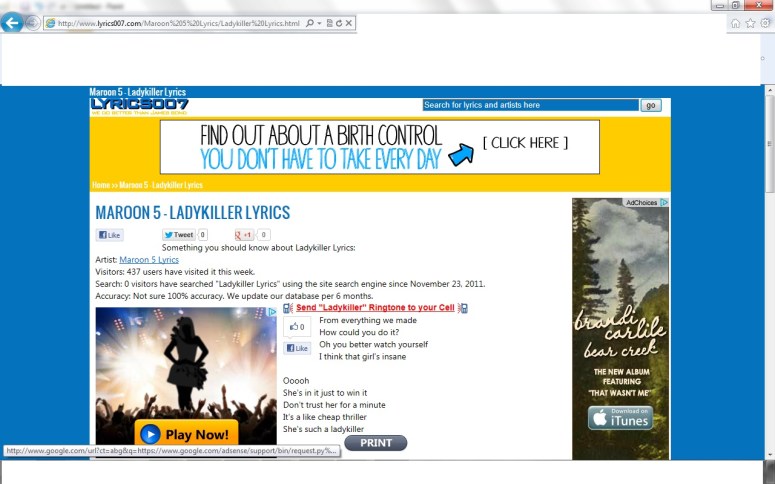
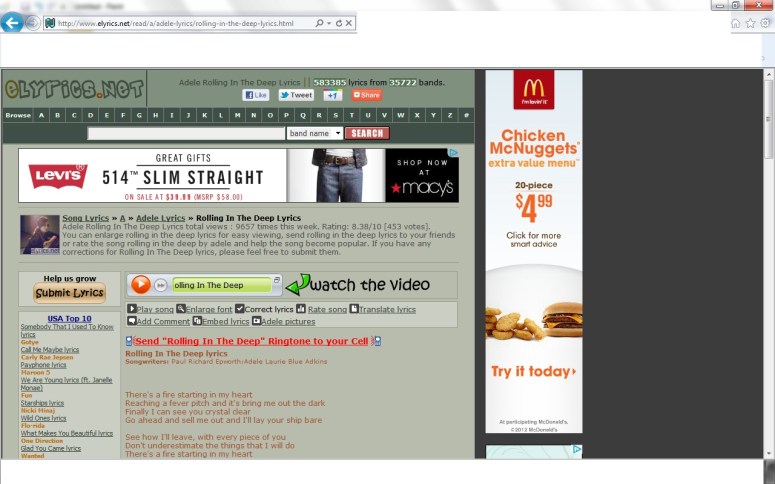
Plus, these sites sell a ton of advertising, have referrals for spyware and illegal ring tones, link to artist videos on YouTube,and both the sites and the advertisers free ride off of the brand identity of artists and songwriters whose lyrics are stolen.  This advertising is not only from US companies, but is mostly from Fortune 500 companies like McDonalds, Macy’s, Levi’s and CVS Pharmacies.  Do these companies care so little about artists and songwriters that they are willing to associate their brands with unlicensed lyric sites?

Unfortunately, we have also seen several instances of legitimate artist ads being served to pirate sites such as this Brandi Carlisle ad (below on the right) served to an the Lyrics007.com illegal lyric site.  This ad for Brandi Carlisle’s new album is served next to Maroon 5 lyrics and a click through ad to a spyware toolbar that attracts users with the hope of acquiring more “free” mp3s–and we all know what “free” means.

The Brandi Carlisle ad is served by Google’s “AdChoices” adserving network and we saw many that were served by Doubleclick.  (In case you missed it, “AdChoices” used to be called “Ads by Google” but was changed during the SOPA debate for some unknown reason.)

And the answer to how in the world does a record company’s ad show up on an illegal lyric site probably lies with the adserving network.  That ad network–Google in this case–knows where the ad inventory exists, but won’t tell the advertiser where their brand is being promoted.  So you get these incongruous pairings.

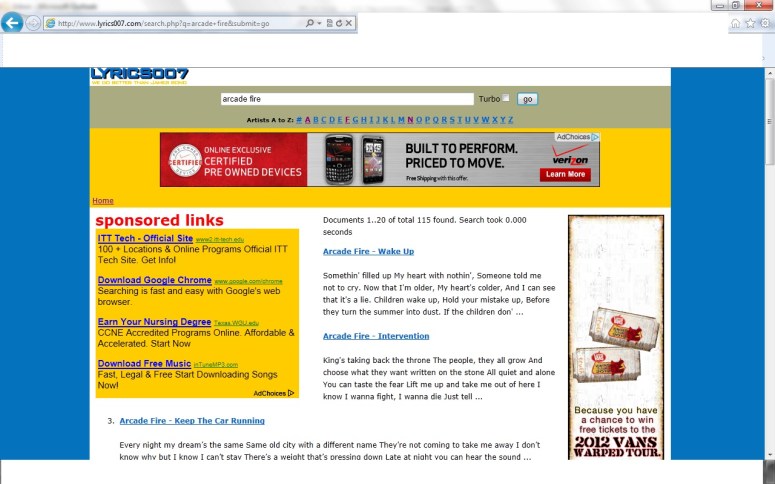
And then there is another legitimate ad for the Warped Tour served next to illegal lyrics for Arcade Fire as well as Google AdChoices sponsored links for Google Chrome and what appears to be a pirate mp3 download application (more likely spyware but we didn’t want to find out) as well as some other bogus looking stuff.

So what can you do as the artist or the artist’s negotiator?  Tell your lawyer or manager that you require in your record deal or tour contract that your name and brand cannot be used in advertising served to illegal sites.  You can even list examples of the sites.  In your tour contract, require that the tour not advertise on pirate sites and give examples.  There may be some advertising networks that are so corrupt that they shouldn’t be used at all.

Don’t stop there–also require that the tour obligate sponsors (or their ad agencies) to not advertise on pirate sites.

Before you throw up your hands and say “forget it, they’ll never agree to that” remember–artists didn’t used to get approval over singles, approval over the use of their music in commercials, or in political ads.   Now it’s pretty routine.

You don’t get if you don’t ask.

[ WHY ARENT MORE MUSICIANS WORKING ] [ ARTISTS FOR AN ETHICAL INTERNET ]

The Human Rights of Artists

By Chris Castle

Given the plight of Chinese poet Zhu Yufu today is a good day to think about the human rights of artists. The human rights of artists is a different concept from intellectual property rights, such as copyright. Intellectual property rights are created by national laws, and the human rights of artists are recognized as the fundamental rights of all persons by all of the central human rights documents to which hundreds of countries have agreed.

These rights resonate in a number of international and national documents, but a good international agreement to consider first is the International Covenant on Economic, Social and Cultural Rights that was ratified by the United Nations General Assembly on December 16, 1966. It is important to remember that human rights are fundamental, inalienable and universal entitlements belonging to individuals, individual artists in our case. As a legal matter, human rights can be distinguished from intellectual property rights as intellectual property rights are arguably subordinate to human rights and actually implement at the national level the human rights recognized as transcending international and national intellectual property laws.

The Covenant recognizes everyone’s right—as a human right–to the protection and the benefits from the protection of the moral and material interests derived from any scientific, literary or artistic production of which he or she is the author. This human right itself derives from the inherent dignity and worth of all persons. The Covenant recognizes these rights of artists (in article 15, paragraph 1 (c):“The right of everyone to benefit from the protection of the moral and material interests resulting from any scientific, literary or artistic production of which he or she is the author.”

These human rights are transcendent and timeless expressions of fundamental entitlements of humanity that safeguards the personal link between authors and their creations as well as their basic material interests. These rights are personal to the authors and artists concerned and are arguably of broader scope than the rights that can be enforced under particular national intellectual property regimes.

The human rights of authors are recognized in a multitude of international agreements, including article 27, paragraph 2, of the Universal Declaration of Human Rights: (“Everyone has the right to the protection of the moral and material interests resulting from any scientific, literary or artistic production of which he is the author”); article 13, paragraph 2, of the American Declaration of the Rights and Duties of Man of 1948 (“Every person has the right…to the protection of his moral and material interests as regards his inventions or any literary, scientific or artistic works of which he is the author”); ; article 14, paragraph 1 (c), of the Additional Protocol to the American Convention on Human Rights in the Area of Economic, Social and Cultural Rights of 1988 (the Protocol of San Salvador) (“The States Parties to this Protocol recognize the right of everyone…[t]o benefit from the protection of moral and material interests deriving from any scientific, literary or artistic production of which he is the author”); and article 1 of Protocol No. 1 to the Convention for the Protection of Human Rights and Fundamental Freedoms of 1952 (the European Convention on Human Rights) (“Every natural or legal person is entitled to the peaceful enjoyment of his possessions. No one shall be deprived of his possessions except in the public interest and subject to the conditions provided for by law and by the general principles of international law”).

These precedents clearly enunciate the goals of the international community. The Covenant is closely linked with the right to own property (recognized in article 17 of the Universal Declaration of Human Rights) and workers’ rights to adequate remuneration. The “material interests” protected by the Covenant are protected under the right to an adequate standard of living.

These moral rights include the right of authors to be recognized as creators of their works and to object to any modification of their works that would be “prejudicial to their honor and reputation.” The protected interests of artists include the right to just remuneration for their labor as well as the moral right to the “intrinsically personal and durable link” between creators and their creations that survives even after the passing of the work into the public domain. This rule will no doubt come as a shock to those wishing to sell consumer electronics devices to the “remix culture” bent on perpetuating regurgitative “art.”

And what bothers me the most about the massive, worldwide infringement of artist human rights is not just that major multinational corporations like Google are knee-deep in perpetuating this exploitation economy. It is that the governments of the world have—until last year—done very little or nothing to stop it. And in that regard, these governments have failed to protect the human rights of artists.

If there seems to be a coordinated effort in many countries to oppose the rights of creators, that’s because there is—a complex effort very well described in the book Winning the Web, written by the former head of the Open Rights Group and sponsored by the Open Society Institute (www.soros.org). (The Open Rights Group (or “ORG”) is essentially the UK version of the Electronic Frontier Foundation and is a voice in the opposition to artist rights protection under the UK Digital Economy Act.)

But these coordinated attacks on artists’ rights also extend to some unlikely places—such as the United Nations Human Rights Council. This is not surprising because there has been a sustained effort to define away an artist’s ability to protect these transcendent rights (“it’s not really theft”)–the success of the anti-copyright crowd in destroying artists is in part dependent on getting over this issue. If the ORG, EFF and Google can define away an artist’s right to protect their rights through ridicule (such as Lessig’s obliging piece “The Starving Artist Canard“) , or by making them small as Lessig said on a Pirate Party UK video, “we” should not “break the Internet” to protect a “tiny industry” such as the hated “Hollywood”, then it will be easier for Google to roll over artists. Then it is easier to define an artist’s human rights out of existence altogether. And doesn’t that just sound like a human rights violation? Their reach is deep–I find it very strange that the Special Rapporteur for the UN Human Rights Commission fails to address the human rights of artists even once. The Special Rapporteur’s conclusions would impose grave burdens on artists, yet bends over backwards to protect the rights of corporate intermediaries online–and specifically mentions Google.

Of course it is not enough that the States of the General Assembly merely recognize these rights of artists in a number of international agreements—the States also have undertaken the affirmative obligation to protect these rights of authors. Those protections include adequate legislation and regulations, as well as making effective administrative, judicial or other appropriate remedies available to authors within each jurisdiction. Access to such remedies must be affordable, or as I have said in the past—violations of moral rights cannot be remedied only if the rich seek to enforce their rights.

Anyone who takes seriously the international human rights of artists will find “Big Tech’s” dismissive use of “moral panic” to be deeply offensive to professional creators. It is Orwellian to describe as a “moral panic” an allegation of immorality being associated with massive illegal downloading that deprives creators of their ability to pursue work which they freely chose and remuneration for that work enabling them to achieve an adequate standard of living.

Google’s Patry has, in fact, travelled the world speaking to NGOs and universities trying to make his case that using the language of morality to describe massive online theft is somehow insidious and that it should stop immediately. Or, as his employer Google might say, “Don’t be moral.” This “don’t be moral” admonition obscures much more than mere lusting for commercial gain on the part of Google and the Pirate Bay. The protection of artist rights—many of the rights of the professional creative class—are entitled to protection as human rights.

The human rights of artists have nothing to do with intellectual property laws that apply to corporations, or “Big Music”, or the even bigger “Big Tech”, it has nothing to do with superstars. A national artist in the smallest country has equal protection with the global superstar under the U.N. human rights treaties.

This is a complex topic that is well worth studying further.

###

[ THE 101 ] [NEW BOSS / OLD BOSS ] [ SPOTIFY ] [GROOVESHARK ] [ LARRY LESSIG ]
[ JOHN PERRY BARLOW ] [ HUMAN RIGHTS OF ARTISTS ] [ INFRINGEMENT IS THEFT ]
[ THE SKY IS RISING : MAGIC BEAVER EDITION ] [SF GATE BLUNDERS PIRACY FACTS ]
[ WHY ARENT MORE MUSICIANS WORKING ] [ ARTISTS FOR AN ETHICAL INTERNET ]

Musicians POV: Spotify Isn’t Good For You (Part 5 of 5)

This is Part 5 of a 5 part post read Part 1 here, Part 2 here , Part 3 here and Part 4 here.

See also “Streaming Price Index: Pay Rates as of 12/31/11″

Since it is unlikely that Spotify will give what we have seen will inevitably an unexciting stock opportunity or board seat to an artist, and since the hold back negotiations will likely take a while to get through the deal process to become the standard that the record club holdback became, what can we do right now to affect behavior at Spotify?

1.  True-up payment:  Given that Spotify has gotten to the point that it can raise more money than it needs and intends to continue on a growth juggernaut based entirely on the value of its artists, Spotify needs to distribute out a kind of dividend to the participating artists.

This should be a significant payment, hundreds of millions.  It would acknowledge that Spotify knows that its valuation is based on artists, producers and songwriters and not based on tech oligarchs.

Labels and publishers should allow this payment to flow directly to their artists and writers, i.e., not apply it against unrecouped balances.

2.  Increase the royalty rates

Since Spotify is raising money it doesn’t need, Spotify can afford to establish a fair royalty for artists—even something like 1¢ per stream for artists and 1¢ for songwriters.  This would reflect the co-equal copyrights of songwriters and artists.

Spotify should also gross up its royalty payments to pay pension, health and welfare to AFTRA and AFM in the US and comparable unions in each territory where it operates.

3.  Transparent Royalty Accounting

Spotify should make all of the royalty accounting back up available to each artist and label online.  This will make auditing easier for both the labels and publishers auditing Spotify and the artists and songwriters auditing their respective label and publisher.

4.  Give Us a Kiss

We like a little affection when we’re getting screwed.

Musicians POV: Spotify Isn’t Good for You (Part 4 of 5)

This is Part 4 of a 5 part post read Part 1 here, Part 2 here and Part 3 here

See also “Streaming Price Index: Pay Rates as of 12/31/11″

Fair Play for Artists

Spotify’s business model is actually the kind of extraordinarily short sighted economics that you see from people who don’t understand the business they are in.  Take Walmart for example.  They drive a hard bargain, but they are not trying to leverage themselves off the back of thieves.

Walmart doesn’t say to its suppliers that Walmart is better than the alternative of being robbed blind, but will only make the benefit so incrementally tiny that the supplier will go out of business at that rate.  This is the commoditization rate, or what we call “less than zero” pricing.  This sounds just fine to someone whose salary is guaranteed by venture capitalists, but makes no sense for the artists—and they are leaving Spotify in droves.

Walmart knows that they succeed when their suppliers succeed and the consumer succeeds.  The pricing that Walmart pays to suppliers is based on buying power and a mission of offering consumers low prices, meaning that everyone in the chain takes a little less and truly does make it up on volume.  That method is not for everyone, which is why you don’t see just every brand in Walmart.

Spotify’s valuation is based on a business model that is inherently unfair to artists, producers and songwriters.  This accounts for its low conversion ratio—it’s a couple points away from a pure pirate service and has failed miserably in the one thing it had to do to justify its existence: convert free to paid customers.

And even if it did succeed, that would be the worst possible world for artists, because there is little difference in the functionality of a top tier Spotify service and buying a download from iTunes–aside from the price paid to the artists, producers and songwriters, of course.  There is even some evidence that suggests that fans who were buying downloads are shifting to Spotify’s free service and substituting away from paying for downloads legally to a free legal service–the exact opposite of how Spotify has sold its service to artists as the “piracy buster”.

Next: Part 5

See Part 1 here, Part 2 here and Part 3 here