David Byrne: ‘The internet will suck all creative content out of the world’ | The Guardian UK

In future, if artists have to rely almost exclusively on the income from these services, they’ll be out of work within a year. Some of us have other sources of income, such as live concerts, and some of us have reached the point where we can play to decent numbers of people because a record label believed in us at some point in the past.

I can’t deny that label-support gave me a leg up – though not every successful artist needs it. So, yes, I could conceivably survive, as I don’t rely on the pittance that comes my way from music streaming, as could Yorke and some of the others.

But up-and-coming artists don’t have that advantage – some haven’t got to the point where they can make a living on live performances and licensing, so what do they think of these services?

We were also very happy to see this plug for the Content Creators Coalition. Be sure to read the full interview at The Guardian, the link is below.

The major labels are happy, the consumer is happy and the CEOs of the web services are happy. All good, except no one is left to speak for those who actually make the stuff. In response to this lack of representation, some artists – of all types, not just musicians – are forming an organisation called the Content Creators Coalition, an entity that speaks out on artists’ behalf.

READ THE FULL STORY AT THE GUARDIAN UK:
http://www.theguardian.com/music/2013/oct/11/david-byrne-internet-content-world

Media Lecturers at London School of Economics Misquote Professor Danaher | MTP

Not only did the LSE lecturers fail to provide the proper context for the Danaher et al conclusions, they also missed what I believe to be the most important issue of all when it comes to ad supported pirate sites (which is all the big ones).

There are no lost sales. All sales are monetized. If they are going to analyze the economics of file barter, they should take a hint from Google’s UK policy manager: Ad supported piracy is big business.

And none of the money flows to the artists. Including the knighted ones who as a group probably added a zero to the UK GDP–and that is something that the London School of Economics should be able to actually measure accurately.

In case you were interested in what Professor Danaher actually said in his team’s study, you can watch this video from Canadian Music Week:

READ THE FULL POST AT MUSIC TECH POLICY:
http://musictechpolicy.wordpress.com/2013/10/10/media-lecturers-at-london-school-of-economics-misquote-professor-danaher/

Internet Exploitation, Not Just a Problem For Artists | Nick Lewis

Guest Post by Nick Lewis (Copyright in the Author)

Nick Lewis is a mastering engineer from Brighton, UK. Visit his website at www.brightonmastering.co.uk

Most talk about the exploitative internet is focused on artists. But they’re just the headline. Artists may be the front-line, the visible face, but the effects go much deeper.

Artists being paid less due to piracy, pay-what-you-like and advertising funded models has a direct effect on entire subsections of the economy. And these sectors serve as omens for the future of increasingly information-based economies like the UK.

The trickle-down effect

Think about everything that goes into making and releasing a record. Recording engineers, mixing engineers, mastering engineers, mixing desks, outboard, microphones, speakers, software, computers, pressing plants, their staff and equipment, blank stock manufacturers, distributors, warehouses, vans, drivers, PR agencies – the list goes on.

No one gets paid if no one buys the record.

I can’t count the number of times artists have promised to send a single/EP/album to me for mastering by a certain date only for that date to slip because they can’t get the money together. Very often it never materialises: they’ve given up and either forgone mastering, tried to do it themselves or got their hobbyist mate to do it. This isn’t good for me or the band.

The same goes for mixing. Probably 90% of everything I work on has been mixed by the artist themselves. And I’ll tell you something – you can immediately tell when something has come from a proper studio mixed by a proper mixing engineer. It’s night and day. Sure, sometimes it’s a conscious choice on the part of the band, but most of the time they just can’t afford to mix in a proper studio.

The fewer working studios there are, the less money spent on high-end equipment and the fewer techs can afford to keep working. You see where this is going.

Loss of expertise

 This isn’t just bad for people losing money. Less money means less investment which means lower quality. Fewer people can afford to make a living doing the things that make a difference to how a record sounds (for example).

Yes you can make a record on a laptop. But it won’t come close to Abbey Road. This is about time with experts where artists can concentrate on their art and not worry about anything else. This is about a level of technical knowledge, let alone appropriate acoustic spaces.

People can’t afford to take on apprentices like they used to. A lot of the top mixing and mastering engineers now work from private facilities at home. Eventually all these people will retire and their skills will go with them. The people that replace them will never have learnt from them, and very likely never had the money to invest in the same quality of equipment.

Soft skills are already suffering because there’s not enough money in it. People have to get day jobs and pursue them as a hobby or not at all. That means a lower quality end product.

Beyond music

 This isn’t just about music. It’s not even just about creative enterprises. The downward trajectory of price to zero will eventually affect anything transmittable in binary. Data, software: anything that can be distributed with a computer.

For countries like mine, the UK, which is increasingly moving towards an information based economy, where manufacturing is taking a backseat and media and services dominate – this can only spell disaster. When competition from open source projects, piracy and vastly under-priced international alternatives hits everything from financial services to software development we will have nothing left to sell.

Free market fallacy

The internet has provided the mechanism for the biggest, fastest, unregulated free market the world has ever seen. And its sheer size is exposing the flaws in the system.

The free market theory is that competition will drive price down, which is good for the consumer. Adam Smith couldn’t possibly have predicted what would happen in the face of intangible, easily copyable assets and hyper-globalisation. The trend towards zero is not good for the consumer in the long-term as the quality of product degrades or disappears altogether along with the skills and supportive infrastructure that go into it.

A sustainable internet isn’t just about ensuring musicians and artists get paid fairly for their work, it’s about protecting our economies. Further, it’s about choosing what kind of a world we want to live in.

The French (among others) have a fixed book price agreement, recently extended to include e-books, to protect their publishing industry. The net effect is 2,500+ book shops in France, while the UK sector, left to laissez faire, dwindles. This is a direct expression of the value placed on literature in France – both in itself and as an economic sector. It’s also an example of the kind of measure we need to fight for online. As musicians queue up to descry the new business models of the digital economy, it’s clear the ‘invisible hand’ isn’t working for artists, listeners or the jobs and skills that depend on both.

This isn’t just about art. Art is just the beginning. This is about restoring the link between price and value in an information economy.

Silk Road Arrest Shines Light on ‘Dark Web’ | ABC News

The wild west wasn’t wild forever, and neither will the internet be… Sooner or later the good guys will catch up to the bad guys and people will value law, over lawlessness. This bust proves that the issues musicians and creators face online is not so much about technology, but rather how that technology is used.

The FBI’s takedown of a billion-dollar black market website that allowed users to sell and purchase illegal items has shined a spotlight on the “dark Web,” which masks users’ online identities while providing a shield for everyone from hackers to journalists and the police.

Ross William Ulbricht, 29, was arrested Tuesday and charged with a battery of conspiracy crimes allegedly committed through his Silk Road website, which has been called the “Amazon of illegal drugs” or the “eBay of illicit substances.” It was described by the FBI as “the most sophisticated and extensive criminal marketplace on the Internet.”

READ THE FULL STORY HERE:
http://abcnews.go.com/Technology/silk-road-arrest-shines-light-dark-web/story?id=20460774

Meet the Free Market Royalty Act, an Elegant Solution to Some Complex Issues | Billboard

This guest post at Billboard is a great overview for understanding the “Free Market Royalty Act.”

Representative Mel Watt (D-NC-12) has introduced the Free Market Royalty Act (H.R. 3219), one of the most intriguing royalty proposals in years. The bill accomplishes two principal goals: Watt starts the process of getting the government out of the music business by eliminating the compulsory license for digital audio transmissions, and extends the sound recording public performance right to all audio performances.

Here’s why this is a productive solution to a knotty problem.

READ THE FULL POST AT BILLBOARD:
http://www.billboard.com/biz/articles/news/legal-and-management/5740706/guest-post-meet-the-free-market-royalty-act-an

David Lowery in The New York Times | Defining and Demanding a Musician’s Fair Shake in the Internet Age

The New York Times business reporter Ben Sisario profiles David Lowery on the artists rights in the Copyfight. Maybe advocacy is the new radio?

The issue has become hot as technology companies like Pandora and Google have replaced major record labels as the villains of choice for industry critics. Recently, Thom Yorke of Radiohead caused a stir by removing some of his music from Spotify and saying that the service would hurt new artists.

To his detractors, Mr. Lowery is a divisive ranter who pines for a lost, pre-Internet economy. But his knowledge of legal and technological minutiae — he is a lecturer at the University of Georgia’s music business program — make his arguments hard to dismiss.

“He’s telling his personal story and standing up to the big corporations who claim to support songwriters, even as they work to undermine our rights behind the scenes,” said Paul Williams, the songwriter and president of Ascap. “He hasn’t flinched, and I think that’s given courage to other artists.”

READ THE FULL STORY HERE AT THE NEW YORK TIMES:
http://www.nytimes.com/2013/10/01/business/media/defining-and-demanding-a-musicians-fair-shake-in-the-internet-age.html?_r=0

@SFmusicTech Take Note – The 13 Most Insidious, Pervasive Lies of the Modern Music Industry… | Digital Music News

One of the most succinct and accurate assessments of the modern music business. As digital music hopefuls head to Nor Cal for @SFMusicTech the attendees should be aware that this conference has promoted many if not all of these “13 Most Insidious, Pervasive Lies of the Modern Music Industry.”

The list covers everything from “T-shirts & Touring” to “The Long Tail”  and from “Kickstarter” to “Streaming.”

Lie #1: Great music will naturally find its audience.
Lie #2: Artists will thrive off of ‘Long Tail,’ niche content.
Lie #3: The death of the major label will make it easier for artists to succeed.
Lie #4: There will be a death of the major label.
Lie #5: Digital formats will produce far greater revenues than physical.
Lie #6: “The real money’s in touring”
Lie #7: There’s an emerging middle class artist.
Lie #8: Kickstarter can and will build careers.
Lie #9: Spotify is your friend.
Lie #10: Google and YouTube are your friends.
Lie #11: If Pandora could just lower royalties, they could then survive, and really help all the artists out there.
Lie #12: T-Shirts!
Lie #13: ‘Streaming is the future…’

Here’s one in detail…

Lie #10: Google and YouTube are your friends.

The Lie: Google and YouTube have anything but their own profit-maximization goals in mind.

The Truth: This is business, not altruism, not matter how it gets spun. And, the interests of Google and rights owners are diabolically opposed and will continue to be so. Which also means that anything that is DMCA-compliant is ultimately great for Google, and fantastially bad for content owners.

So if you want exposure, go to YouTube. If you want a paycheck, find it somewhere else.

Perhaps the most encouraging thing about this story at Digital Music News is that we didn’t write it. As we’ve stated repeatedly more and more people can see the truth as plain as day that musicians are not empowered by the internet as much as they have been more exploited by it.

A very basic refresher is in order to all of these businesses who are using music as the basis of their business models online: NO MUSIC = NO BUSINESS.

READ THE FULL POST AT DIGITAL MUSIC NEWS:
http://www.digitalmusicnews.com/permalink/2013/20130925lies#r67vc32IgD2J_zeHZy7D0g

Record Labels Invest $4.5 Billion Annually In Artists… Pirates, $0… Any Questions?

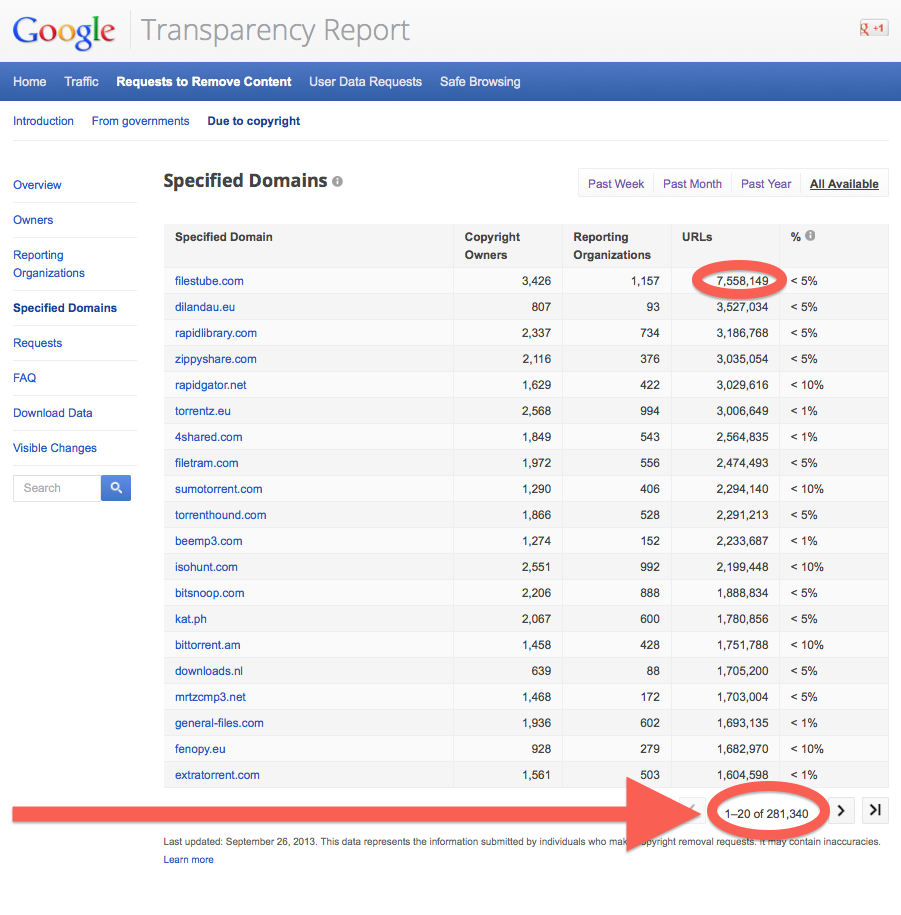
So record labels invest in the careers of artists about $4.5 Billion annually in A&R and Marketing. Meanwhile, there are 200,000 infringing sites exploiting artists work and paying them nothing that we can see from the looks of the Google transparency report.

To be precise at the time of the writing of this post there are 281,340 infringing sites on the report with the #1 offender having received over 7.5 Million DMCA takedown notices! Seriously, 7.5 Million… and Google can’t determine that this is a site “dedicated or primarily used for infringement.” Wow.

FIRST DISCLAIMER:

Now look, we don’t always like record labels, but when we do, it’s because they are actually paying artists and investing capital into developing careers (hello Trent Reznor returning to a major label). Ninety percent of new releases financed by labels don’t recoup or break even, but the bands still gain the marketing and PR benefit from the labels investment after the deal ends (hello Thom Yorke and Radiohead).

SECOND DISCLAIMER:

Any wrong doing should be unacceptable. We’ve heard far to many stories of artists being exploited by record labels, publishers, managers, booking agents, concert promoters and a wide range of those offering services from radio promotion to independent PR and marketing. If anything, the internet has added to this list a whole new group of opportunists including the ad tech industry, pirate sites, cyber lockers and more.

So yes, any wrong doing against artists and creators should be unacceptable, even if it happens online.

So here’s some quick notes from the report published by the IFPI:

* Record companies’ total investment in A&R and marketing tops US$4.5 billion annually according to IFPI’s Investing in Music report

* Labels have maintained A&R spending at US$2.7 billion, representing 16 per cent of global recorded music revenues, despite the economic recession

* US$1 million to break a new artist in major markets

* More than 70 per cent of unsigned artists would like a recording contract according to two new surveys

Record companies remain the primary investors in artists, maintaining A&R spend despite declining overall revenues in recent years. Labels spent US$2.7 billion in 2011, only marginally down on 2008 (US$2.8 billion), despite an overall decline of 16 per cent in the trade value of the industry globally over the same period. Revenues invested in A&R increased from 15 to 16 per cent of industry turnover between 2008 and 2011.

Music companies invest a greater proportion of their global revenues in A&R than most other sectors do in research and development (R&D). Comparisons show music industry investment exceeding that of industries including software and computing (9.6%) and the pharmaceutical and biotech sector (15.3%). The comparisons are based on the European Commission’s 2011 EU Industrial R&D Investment Scoreboard.

Two new surveys, conducted in the UK and Germany in 2012, show more than 70 per cent of unsigned acts want a record deal, with marketing leading the perceived benefits of record company support.

Ok, then you have this… those who pay nothing, invest nothing, and pocket everything for themselves… this is the future you want? When artists complain about tiny payments from Spotify it’s important to note the reason why they can get away with paying so little, is because of all of those who pay nothing at all.

200kinfringingsitesAnd most of this is financed by Fortune 500 Companies flowing money through online ad networks like Google and others. The situation has even gained the attention of The White House, although we’ll see what good it does.

So if you want to get paid, focus on removing the bad actors from the marketplace and restoring fairness. Our hope has always been that the internet would in fact create a new middle class of professional musicians, by the means of their own choice. Unfortunately what we’ve seen is just more exploitation.

How piracy is Hurting Indie Artists | ABS-CBN News

REDWOOD CITY, Calif. – Jackie Chavez has been trying to make it big as a singer and musician for five years now. It hasn’t been easy.

“It’s tough when you’re just doing it independently and you don’t have connections. You rely on pure talent. It’s really hard,” she mused.

Chavez released her self-titled album in the Philippines in 2011, and she’s trying to do the same in the U.S. For now, she earns her money through gigs. But she said selling her songs online through iTunes and Amazon has been especially challenging, because of piracy.

“As artists, we put our dedication and hardwork to create music. It’s so sad that they’re just going to copy it. They’re just going to pirate it,” she added.

READ THE FULL STORY HERE:
http://www.abs-cbnnews.com/global-filipino/09/23/13/special-report-how-piracy-hurting-indie-artists
