Don’t Cut Funding for the Arts and Arts Education | Americans for the Arts

With a 49% budget cut, the NEA will be forced to drastically scale back their grant-making. These disproportionate cuts of $71 million are short-sighted and will ultimately be devastating when combined with the additional loss of $639 million in potential matching funds for the arts. For every dollar the NEA invests in a nonprofit arts organization, it is matched on average 9-to-1 by additional grants. Communities rely on NEA grants to leverage additional support for the arts, generate local economic activity, and fuel innovation. Through the relatively small investments made by Congress, NEA is making possible extraordinary things all across the country, including seeding new jobs in the creative economy.

Stand with us as we protect this important educational and economic investment in our country, by telling Congress that cutting funding to the NEA is not an option. Now is the time to make sure that they hear our voice and protect the arts in America. Add your name to the online petition and make a difference in the lives of all Americans.

TAKE ACTION:
https://www.votervoice.net/mobile/ARTSUSA/Petitions/263/Respond#/?page=respond

“Google & The World Brain” Airing Now on Al Jazeera America

This may be the single most important piece of work to date that explores the rights and concerns of creators in the digital age. The film details how Google has made plans to commercially monetize and monopolize all creative works for their own corporate profit.

FIND CHANNEL AND AIRTIME:
http://america.aljazeera.com/watch/2013/8/trailer-for-googleandtheworldbrain.html

MORE ABOUT THE FILM:
http://www.worldbrainthefilm.com/

The goal of accumulating all human knowledge in one repository has been a dream since ancient times. Only recently, however, has that dream become a reality. Quietly and behind closed doors, Google has been executing a project to scan and digitize every printed word on the planet. Working with the world’s most prestigious libraries, the webmasters are reinventing the limits of copyright in the name of free access to anyone, anywhere. What can possibly be wrong with this? As “Google and the World Brain reveals,” a whole lot.

Some argue that Google’s actions represent aggressive theft on an enormous scale, others see them as an attempt to monopolize our shared cultural heritage, and still others view the project as an attempt to flatten our minds by consolidating complex ideas into searchable “extra long tweets.”

At first slowly, and then with intensifying conviction, a diverse coalition mobilizes to stop the fulfillment of this ambitious dream. Incisive and riveting as it uncovers a high-stakes multinational heist, Ben Lewis’s film voices an important alternative to the technological utopianism of our time.

“Artists Should Expect Nothing” from Spotify says George Howard

Why George Howard should stop chasing what’s best for musicians and focus on academics.

George Howard just wrote an article for Forbes, “Why Artists Should Stop Chasing Spotify’s Pennies And Focus On Top Fans“. It’s amazing how decade old talking points can keep being recycled. It’s always interesting to see an academic (and/or business consultant) telling artists what is best for them. But it’s kinda disturbing when they let loose with gems like this…

Artists must therefore recalibrate not only their expectations with respect to payments (they should expect nothing), but also their approach generally.

There you have it, artists should expect nothing. Not that George Howard doesn’t make valid points earlier about the meaninglessness of Spotify royalties to musicians. Although the irony of how bad he misses the point is astounding.

Certainly, the payments to artists from streaming services are immaterial to the artists. This does not mean that these services aren’t paying out some, prima facie, big numbers to certain artists. It’s just that even if, for instance, Pandora pays out a million dollars to Jay Z, this amount, when compared to the money Jay Z earns from other ventures, is immaterial. It works the same way for a new artist who gets a payment of $0.25 from Spotify; it’s immaterial when compared to what they got paid for playing a club gig or selling a t-shirt. Same deal for mid-level and heritage artists.

And this is where the tired, decade old, tech lobby talking points come in (Bueller, Bueller…). Focus on building a fanbase and the money will follow from other revenue sources like t-shirts and touring. OH MY GOD… did this guy actually, really say this in Forbes? That horse from 1999/2000 could not be any more dead than the original Napster that spawned such out of touch suggestions.

It’s thirteen years later. There is no magical unicorn business model that pays artists while their work is being either devalued for fractions of a penny, or they are not being compensated at all.

Here’s a brief recap of what these so called “business experts” and “internet technology consultants” see as the “new” models for artists… Ready, set, go!

* Touring… existed BEFORE the internet…
* Merchandise (T-Shirts)… existed BEFORE the internet
* Film/Sync Licensing… existed BEFORE the internet
* Sponsorships/Endorsements… existed BEFORE the internet

These are not NEW models or revenue streams.

So “touring and t-shirts” (CwF+RtB babee!) is not a business model for artists, but rather an open admission that the internet has completely and undoubtedly failed to empower artists. In light of this fact George (and others) instead suggested that musicians and songwriters revert to pre-internet ANCILLARY income streams to now be their PRIMARY revenue streams. Wow, what genius is this?

As seen as a potential catalyst to herd more casual and active fans — fans who may become Passionate Fans — into this funnel, these services take on a real value. This value far exceeds any direct financial payment (whether that number goes up or down 10%). To this end, the artists must learn to use these services and benefit them in the same way the artists are being used by and benefiting these services.

In fact, the “new music business” looks pretty much exactly like the “old music business” with revenue from recorded music sales removed.

Repeat after us, “Exploitation is NOT innovation“.

[UPDATE] : When asking investors for a new round of funding, while getting bad press from upset musicians you probably are looking for some spin control. We don’t think George Howard is that solution. More than anything else, Spotify like Pandora might only be of interest to investors if musicians are completely screwed on royalties. Maybe the ask for cash, and the call for musicians to accept nothing are not related, but that would be suspicious timing at best.

Spotify Is Now Asking Investors for More Cash, Swedish Paper Reports…

Google and YouTube want “Transparency and Openess” except when it applies to Google and YouTube!

Censorship anyone? Hmmmmm…

Because information wants to be free, as long as it’s your information. Which brings us to this: YouTube is now threatening to completely sever its relationship with digital distributor ONErpm, thanks to some ‘over-sharing’ of information in a recent guest post on Digital Music News. According to ONErpm founder Emmanuel Zunz, YouTube is unhappy that certain payout details and percentages were disclosed, with a complete blacklisting being threatened.

According to ONErpm, YouTube has demanded that the entire guest post – here – be ripped down, which would obliterate nearly 100 comments and the knowledgebase that comes with that (not to mention the detailed information in the post itself).

“Yt is threatening to cancel our agreement,” Zunz emailed. “It’s a very serious issue for us.”

READ THE FULL STORY HERE AT DIGITAL MUSIC NEWS:
YouTube Demands the Removal of a Digital Music News Guest Post…

The idea that Google is an open and transparent company is simply laughable to anyone who has actually dealt with the company and given Google’s monopoly over video search, when it makes threats about cutting someone off from YouTube, those threats are amplified with what is called a “force multiplier” in some circles (or an “A-hole multiplier” in others).  An amplification that varies directly with the effectiveness of YouTube’s monopoly over online search, a monopoly perfected for years by Google subsidizing YouTube with profits from its other monopoly businesses.

READ THE FULL STORY AT MUSIC TECH POLICY:
More Stupid New Boss Tricks: Google’s YouTube Artist Relations Debacle

RELATED:
So Much For Innovation, YouTuber’s Meet The New Boss…

21st Century Piracy: The Demise of the Music Industry | THE WIP

EDM artist Victoria Aitken speaks out.

The Internet pirates have made me, and thousands of other musicians, walk the plank. We now have to swim in shark-infested waters where the big fish gobble up our dues and the pirates laugh their way to the bank.

I believe this basic injustice must be remedied – Internet pirates are white-collar criminals. They should pay the royalties they have stolen or be answerable to the law, like looters, burglars, and fraudsters.

READ THE FULL STORY AT THE WIP:
http://thewip.net/contributors/2013/08/music_industry_killed_by_pirat.html

RELATED:
Google, Advertising, Money and Piracy. A History of Wrongdoing Exposed.

Why Copyright is a Right and Fair Use is a Privilege | Law Theories

In this post, I’ll explain why copyright opponents have it exactly backwards when they claim that copyright is a privilege and fair use is a right. At the outset, I note that these terms can have various, nontechnical meanings that possibly overlap. For example, Black’s Law Dictionary defines “right” to mean, inter alia, a “privilege,” and it defines “privilege” to mean, inter alia, a “right.”2 But copyright opponents are not using these terms interchangeably; they are using them in contradistinction to each other. In other words, they are saying that right and privilege are mutually exclusive terms. It’s this technical usage of these terms that I’ll address.

READ THE FULL STORY AT LAW THEORIES:
Why Copyright is a Right and Fair Use is a Privilege

How Will Musicians Survive In the Spotify Era? | The New Yorker

Sasha Frere-Jones, Dave Allen, Jace Clayton, and Damon Krukowski discuss how (mildly) popular musicians are going to survive.

Last month, Damon Krukowski and I discussed Spotify, the public exit of Nigel Godrich and Thom Yorke from that platform, and the various challenges facing musicians who do or don’t want to participate in similar streaming services. Toward the end of the discussion, Damon and I both hinted at the freedom of going free, the moments when giving your music away is more profitable—in the long run—than letting another company sell it inefficiently and unprofitably. Damon expanded on his position in a subsequent article for Pitchfork, but neither of us was advocating that musicians play and record for free, in all scenarios, all the time: nothing of the sort. So before I hand this discussion over to a new panel, one clarification.

My band, Ui, released a clutch of records through Southern Records. These albums are no longer available on Spotify because, according to Southern, the costs of administrating the relationship were not covered by the microscopic amount of revenue generated. I believed them then, and believe them even more now.

READ THE FULL STORY:
http://www.newyorker.com/online/blogs/sashafrerejones/2013/08/how-will-musicians-survive-in-the-spotify-era.html

Why are you still fighting for Torrents, If Piracy is Collapsing Due to Legal Alternatives?

Oh, like the drunk who insists they don’t have a drinking problem, perhaps “the lady doth protest too much.”

In the latest offer of highly selective reasoning of what may be a dubious study (er uhm, sorry, make that survey) our favorite (ok, maybe second favorite) site for tech lobby disinformation lets loose with another gem, “Piracy Collapses As Legal Alternatives Do Their Job.” Which, you know, may or may not be true, based on the methodology of the “survey” and the bias of the subjects questioned.

It seems once a year we get one of these “no really, piracy isn’t really happening” survey’s passed off as science. First it was pirates buy 10xs more music than non-pirates, despite there being no factual sales data to support that claim. This is categorically different than say the actual traffic studies that show how BitTorrent is 99% infringing.

And why is it that “illegal” is positioned as a necessary alternative to “legal” in the first place? Why the false binary? There should be no excuse for allowing illegally operating businesses making billions of dollars a year in advertising revenue from the illegal exploitation of artists work to even exist. This has nothing to do with copyright but everything to do with common sense.

Also Norway may not exactly be the best model for the rest of the world. The same people that like to tell us that when they ask college students about piracy, we’re told that “Norwegian students think piracy is OK.” So the outcome of this latest survey should not come as a surprise and it’s always the spin that is most amusing,

So what is responsible for these significant drops in piracy? First of all this effect cannot be put down to anti-piracy campaigns. Only a tiny number of Norwegian file-sharers have been prosecuted in the past five years and only since July 1st has the law been loosened to allow that position to change.

Really now? Not to put to fine a point on it but this is the same tech lobby and freehadi talking points we’ve been hearing for over a decade and not much unlike Kim Dotcom’s “End Of Piracy” hubub. Over and over for more than a decade the same tech lobby and anti-artist talking points are repeated, “piracy isn’t hurting you, it’s helping, get over it.” Not so fast…

All of this despite what the source article states here:

In a report by IFPI, an organization for the international record companies, it also appears that in countries where it is introduced legislation that will block sites like Pirate Bay, the number of users of Pirate Bay has more than halved in 2012. This includes countries such as Denmark, Finland, the Netherlands and the United Kingdom.

Perhaps it’s just common sense that a “study of studies” not surprisingly reported that “Yes, Piracy Does Cause Economic Harm.

if dozens of researchers have tried, all using different methodologies, then their conclusions in the aggregate are the best we’re going to do. Put another way, it will henceforth be very difficult to dislodge Smith and Telang’s conclusion that piracy does economic harm to content creators.

But the proof is really that despite all of these claims, there are 45% fewer professional musicians since 2002. Even the best spin to put on the numbers (by the IFPI no less) at the end of 2012 was a net gain of three tenths of one percent… Even being an optimist and giving the benefit of the doubt that sales may have actually increased by less than a third of one percent is that really any evidence that ad sponsored piracy isn’t continuing to destroy the careers of artists?

And there’s this, courtesy of the New York Times (hint, graph going wrong direction despite decade plus of dubious “survey’s”)…

So the question remains if piracy is collapsing due to legal alternatives why is there such a need to keep defending the ripping off musicians and creators without their consent, and without paying them?

If piracy is irrelevant, it makes little sense to keep fighting for something that has outlived it’s usefulness now that “legal alternatives” are providing the better user experience. Except for just one thing… that little bit about money… who makes it, how, who actually get’s paid (the illegally operating businesses) and of course, who doesn’t get paid (the creators).

Could it be this is the last stand of Free Culture’s Epic Fail? We think so.

[UPDATE] The “collapse” of piracy seems to have been short lived…

Half of surveyed Britons listened to pirated music last month says Bloom.fm

Almost half of a sample of Britons listened to illegally downloaded music last month, according to new survey by music streaming service Bloom.fm.

When asked whether they had listened to music acquired from an illegal online service, from the 976 respondents, 49 per cent admitted that they had, reports Music Ally.

Thom Yorke Vs Spotify : Why Doesn’t Spotify Speak Out Against Ad Funded Piracy?

Thom Yorke’s announcement to boycott Spotify is just the latest public acknowledgement that the pay rates and business models of streaming services need to adapt and evolve to pay sustainable rates to artists and rights holders. We’ve previously offered our own point of view on Spotify whereby we believe that current streaming based models are fundamentally flawed at the level of their pay rates and are especially devastating to developing artists.

Both Thom Yorke of Radiohead and Trent Rezenor of Nine Inch Nails were two of the first artists to explore and experiment with potentially new music business models on the internet. However, the realities of those experiments have become apparent this year as Thom Yorke spoke out about Google and Trent Reznor against music streaming services being unfair to artists.

But it’s also important to remember that despite our disagreements over the revenue distribution models of Spotify and Pandora these are legal and licensed services. The primary reason that these streaming businesses even exist is in response to a decade plus of infringing and illegally operating business who pay nothing at all, zero, zilch, nada.

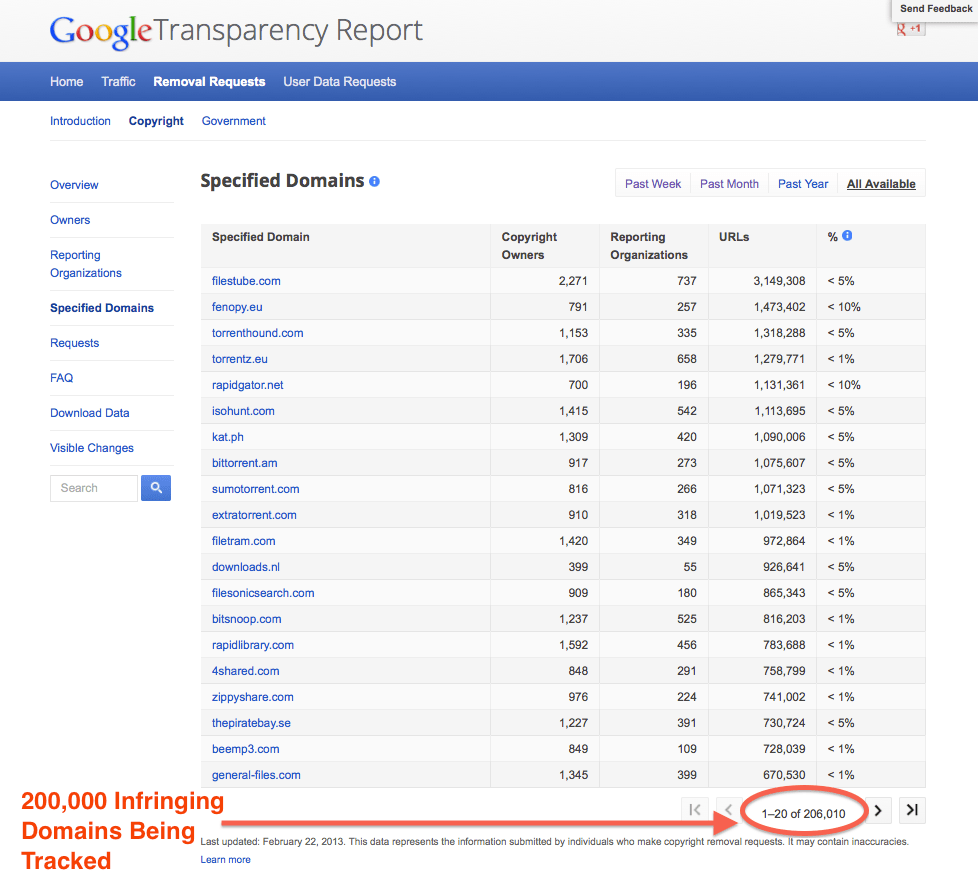
Let’s get really real for one second… One of the primary reasons Spotify pays so little is because so many more pay nothing at all. Google alone is tracking millions and millions of infringement notices to over 200,000 known illegally operating businesses.

For those who unaware, Ad Sponsored Piracy is the mechanism by which illegal and infringing online businesses get paid to display advertising on their sites. These sites do not license any of the music they distribute nor do they share any of this revenue with artists or rights holders. In other words Silicon Valley corporate interests pocket 100% of the money and pay artists nothing.

Simply put, ad supported piracy is the practice whereby ad networks like Google’s Adsense profit by placing ads on pirate sites like www mp3skull com.

Brand $$$-> Ad Agency $$$-> On Line Ad Services $$$-> Ad Exchanges $$$-> Illegal and Infringing Sites Profit from Ad Placements.

Any legally licensed, legitimate internet music business has to acknowledge that mass scale, enterprise level, commercial infringement of music only harms their business. The devaluation of advertising inventory on infringing sites harms both the legitimate businesses ability to grow, and the ability to pay sustainable rates to musicians.

So why doesn’t Spotify join with artists by insisting on better controls and regulation of online advertising? Spotify’s existence alone is not the solution as the payments to artists and rights holders simply do not scale as we have previously pointed out (also note how much less YouTube pays than Spotify – more on this later).

Music Streaming Math, Can It All Add Up?

Maybe we’re missing something. If streaming is the future how does $2.5b in revenue from a massively successful Spotify replace the loss of $8.3b in annual earnings?

Solutions for Artist Rights must include the acknowledgement that the mathematical facts of streaming services is that they are unsustainable at current rates (see chart above). Therefore, there must be regulatory enforcement to protect artists and other creators (authors, filmmakers, etc) from Ad Sponsored Piracy.

We have previous identified over 50 Major Brands Supporting Illegal and Infringing online businesses here:

Over 50 Major Brands Supporting Music Piracy, It’s Big Business!

See more Corporate Advertising Funded Exploitation of Artists:
Tom Waits * Neil Young * Aimee Mann * Neko Case * U2 * Ben Gibbard/Death Cab For Cutie * East Bay Ray / Dead Kennedy’s * Billy Corgan/Smashing Pumpkins

How Pandora Became Music’s Big Villain – The Verge

The Verge reports on the battle over internet royalties…

Pandora struggles to win hearts and minds because its leadership lacks credibility, and has also been utterly inept at pitching the company’s plan to the public, press, and Congress. Pandora failed to generate congressional support to lower royalties last year and unless the company’s leadership dramatically changes its strategy, the popular radio service doesn’t appear to have a prayer of getting help from Washington any time soon.

Michael Pachter, a research analyst with Wedbush Securities, believes Pandora will eventually thrive but that its attempt to legislate lower costs is misguided. “The bill is idiotic,” Pachter said. “It’s insulting to Congress to say you want regulation to lower your costs at the expense of artists. Did you see who was on stage with Obama helping him campaign? Jay-Z and Bruce Springsteen. That’s the Democrats, and how many Republicans are going to want to legislate against capitalism and the free market?”

RED THE FULL STORY AT THE VERGE:
http://www.theverge.com/2013/7/9/4475102/pandroas-pr-problem-why-the-company-cant-win-in-washington