“…somebody should fight for fellow artists, because this is madness. Music has become tap water, a utility, where for me it’s a sacred thing, so I’m a little offended. The Internet has emasculated rather than liberated artists…”
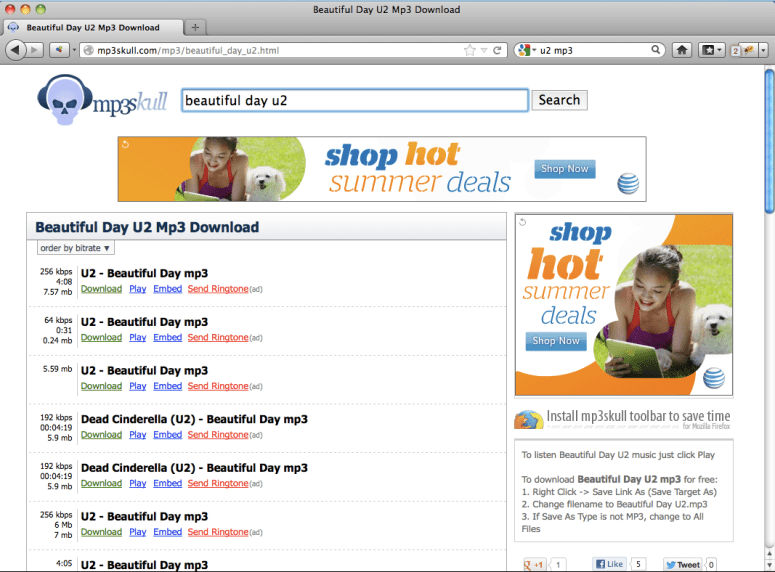
Let’s be clear about this. It’s about money. A lot of advertising money supporting the people ripping off artists to further their own wealth. Brands hire advertising agencies. Advertising agencies hire ad networks. Ad networks pay infringing and illegally operating sites, many of which are based outside of the USA.
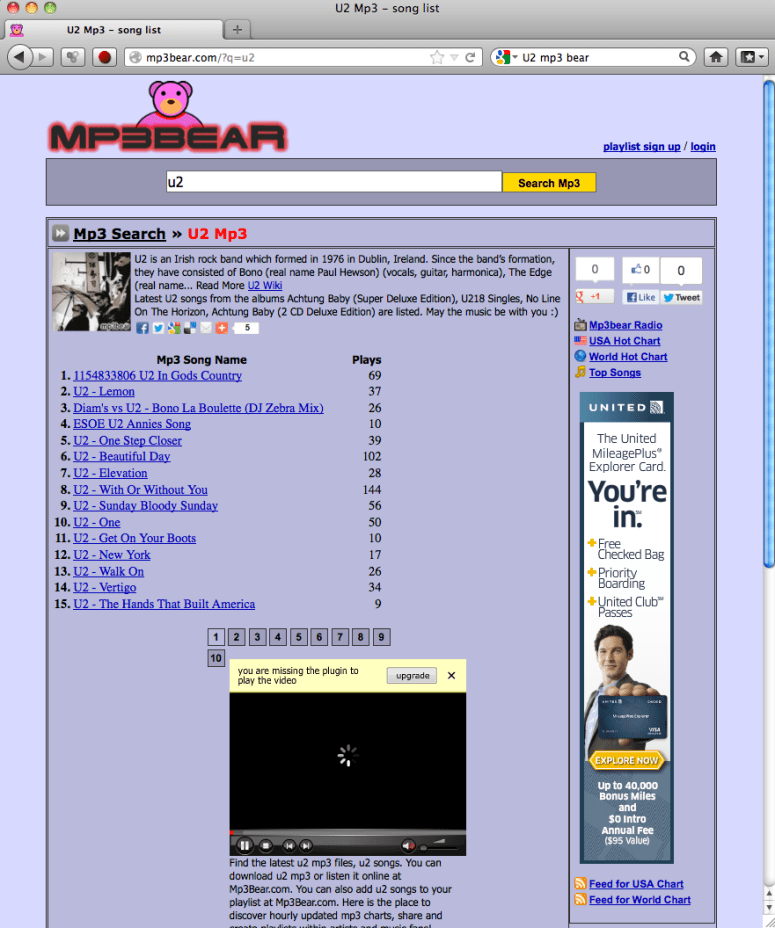
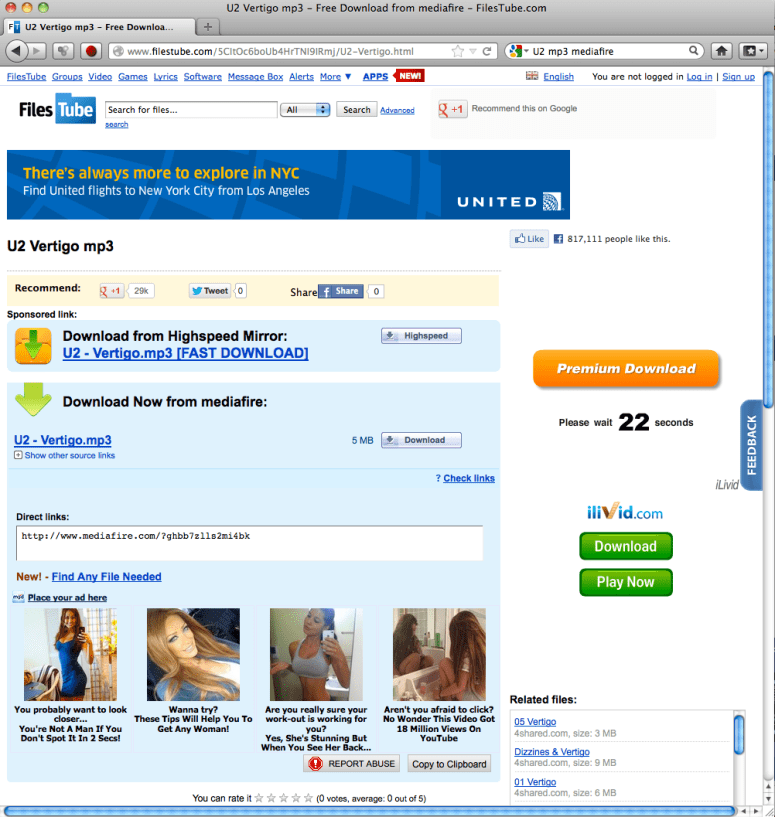
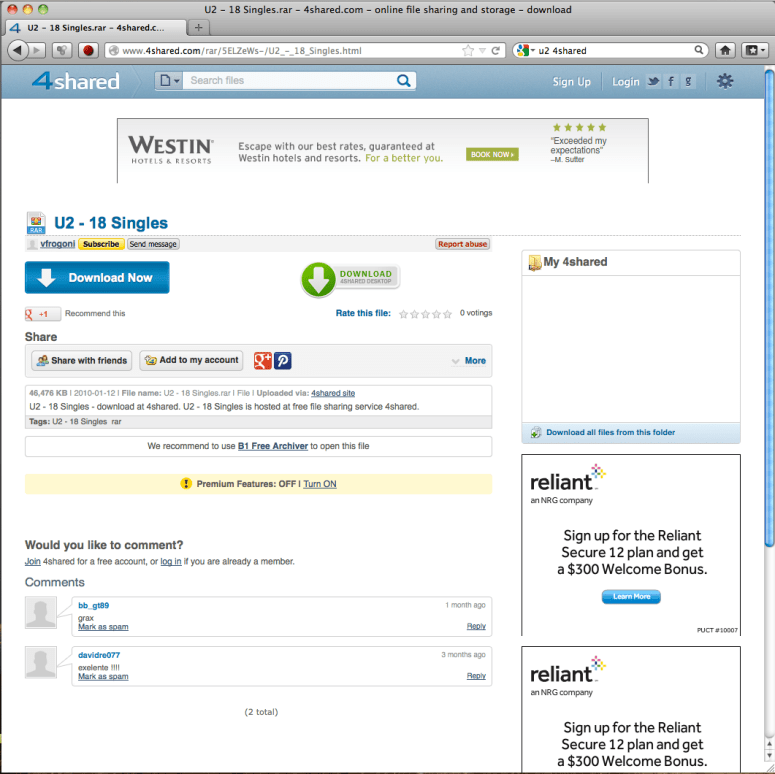
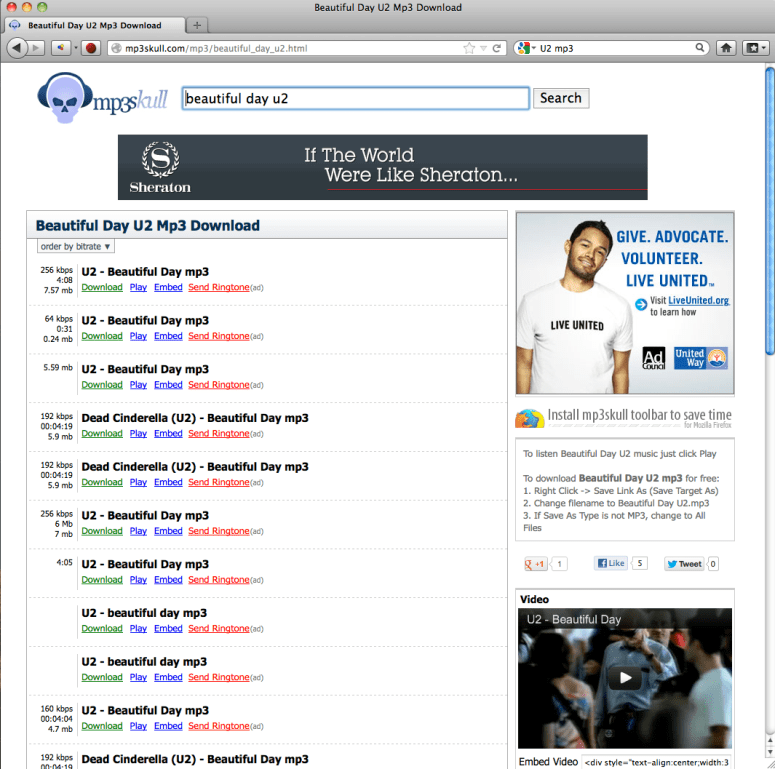
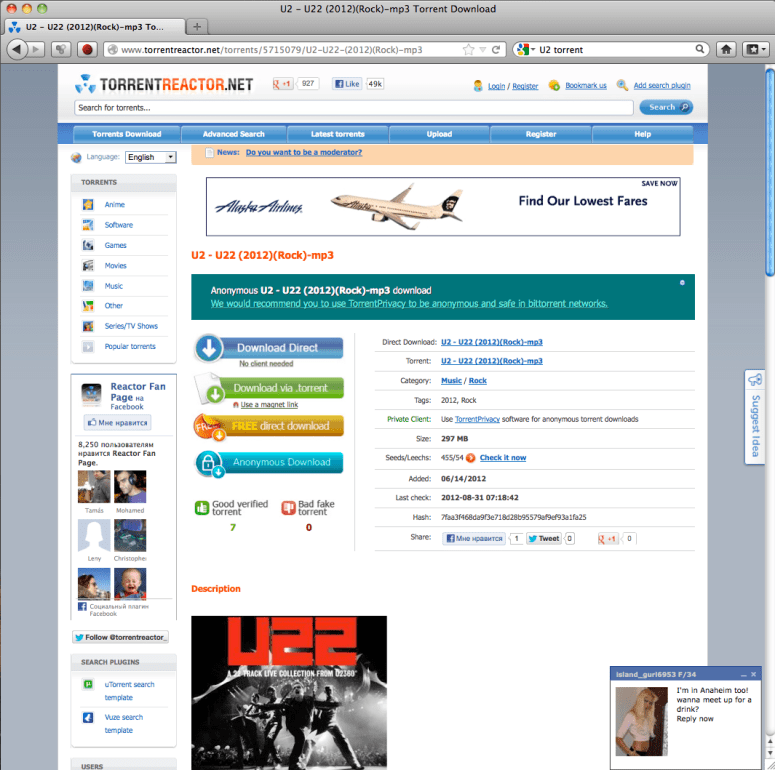
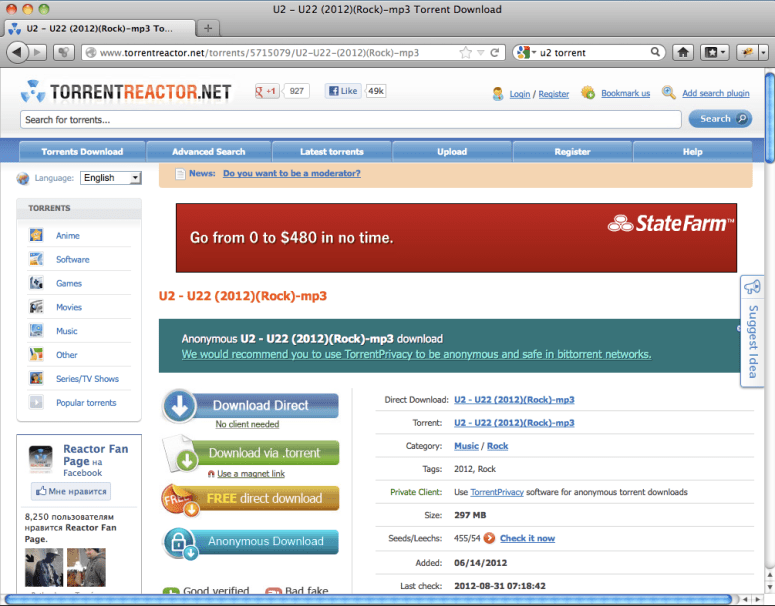
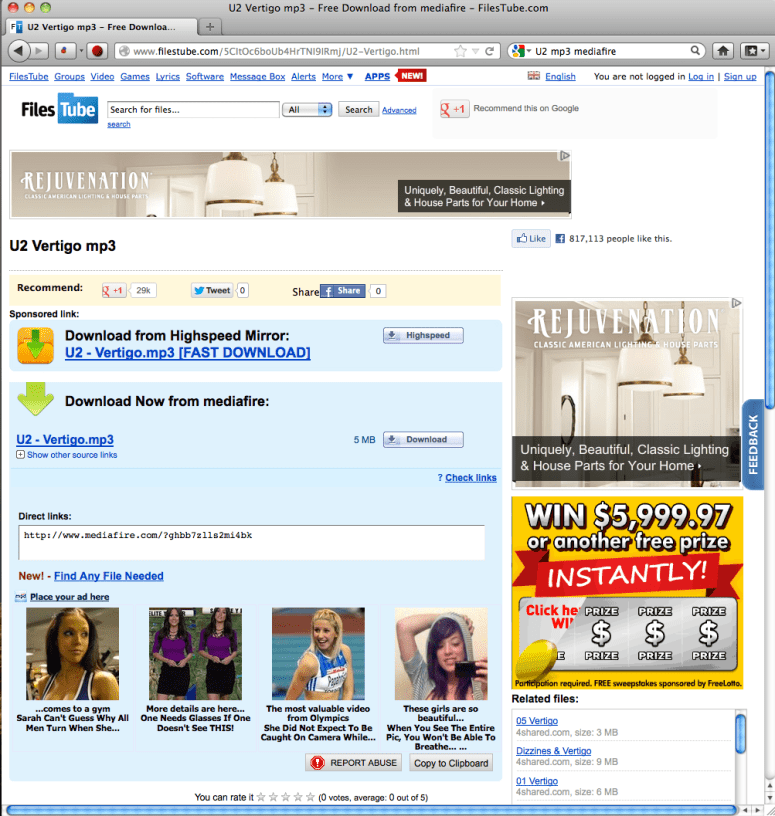
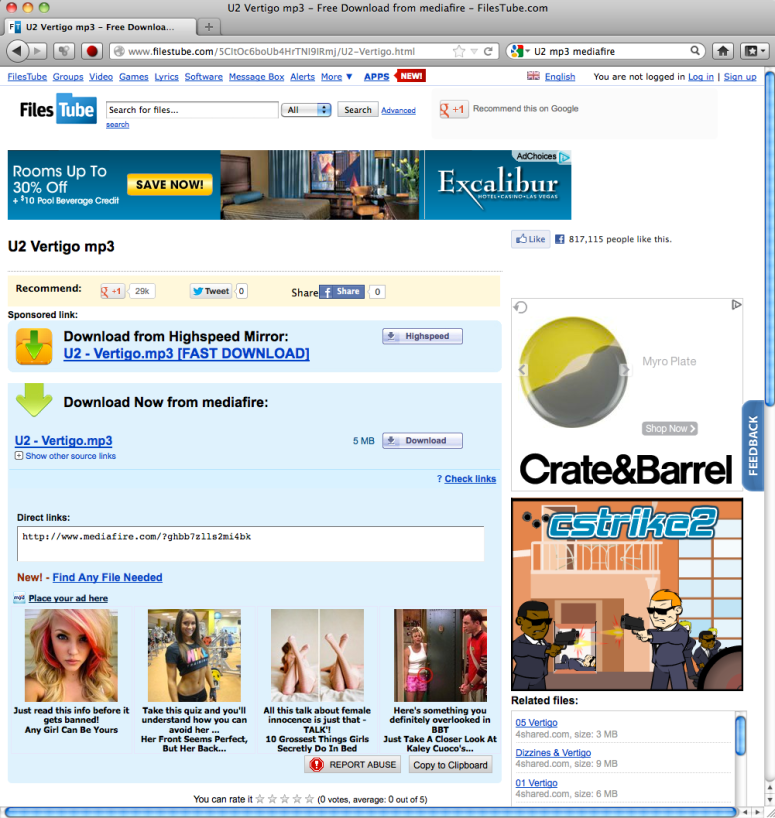
Bono, here’s your haul for one nights research… Someone should have a talking to these brands and ad networks, will you join us on Madison Avenue?
* United Airlines x2 on h33t
* United Airlines on mp3 bear
* United Airlines on FilesTube
* Jet Blue and Kayak on h33t
* Hewlett Packard and State Farm on mp3skull
* Westin Hotels on 4shared
* Westin Hotels on mp3raid
* Urban Outfitters on mp3skull
* Sheraton Hotels on mp3skull
* Century 21 on 4shared
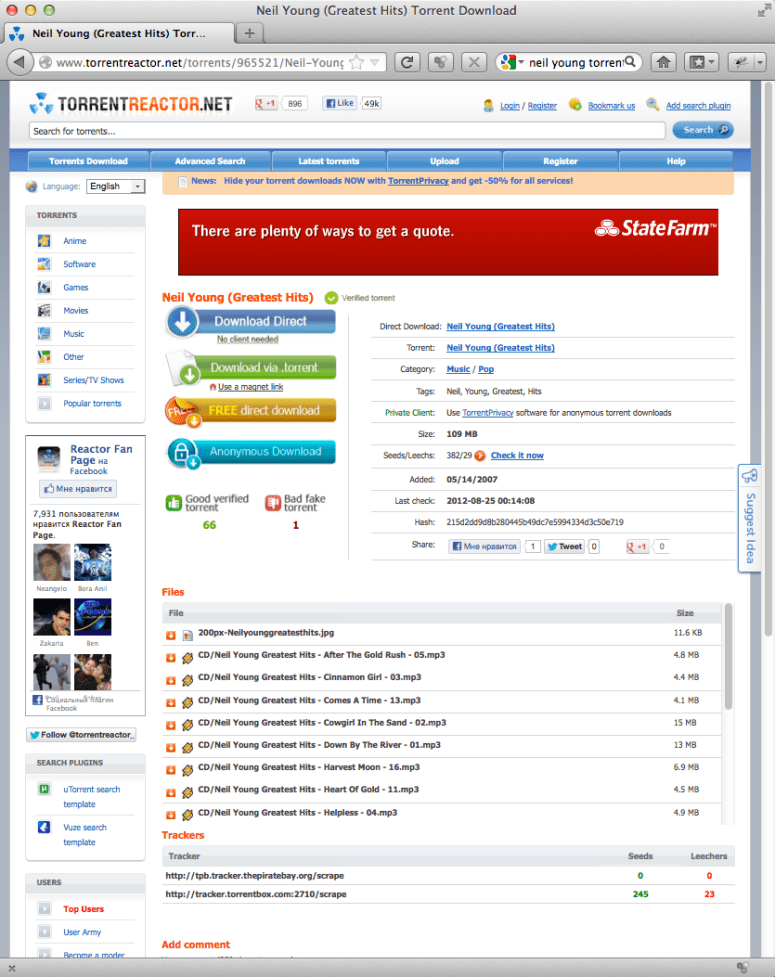
* Alaska Airlines on torrent reactor
* State Farm on torrent reactor
* Sprint on torrrent reactor
* Sheraton Hotels on 4shared
* Hewlett Packard x2 on filestube
* Hewlett Packard and State Farm on mp3skull
* Hewlett Packard on h33t
* Rejuvenation on filestube
* Disney Resorts on torrent reactor
* Crate & Barrel on Files Tube
* Charter Cable on mp3 raid
* AT&T on mp3skull
* Amazon on 4shared
U2 Exploited by @UnitedAirlines, @JetBlue, @HP, @StateFarm, @Westin, @UrbanOutfitters, @sprint, @ATT, @amazon, @Disneyland, @CrateandBarrel
On this Labor Day, we’d like to thank everyone donating their labor and love to the issues concerning artists rights. Be sure to drop by each of these excellent sites to get insight and opinion from many different perspectives about the issues important to artists and creators online. Each of the blogs below is worthy of your attention.
The Illusion of More : Dissecting the Digital Utopia
– A fantastic new blog and audio podcast launched this week which explores the good, the bad and the ugly of Internet culture, “Now that we’re just about 20 years into the digital age, and the babies born to the sound of dial-up modems are young adults who’ve never known life without the Web, it seems like a good time to explore some of the best and the worst of what we’re making of this technology.”Check out The Illusion of More [here].
Copyhype’s Friday Endnotes 08/31/12
– In addition to the weekly recap here, we strongly recommend the weekly reading of Friday’s Endnotes from Terry Hart’s fantastic blog, Copyhype. Terry often delivers thoughtful and insightful analysis of recent copyright cases, legal developments and news stories that are important to artists and creators.
Artists Exploitation is a Mass Scale, Enterprise Level, Infringing Business
– We are pleased to see several other blogs picking up on this story and asking the same questions we have been. Who is responsible for the funding of illegal artists exploitation on sites dedicated to infringement? Adland picked up the ball this week on our Neil Young post and commented from the perspective from within the Advertising Industry. Several other blogs also have been picking up on the story including Bill Rosenblatt’s Copyright and Technology, Terry Hart’s Copyhype, and Bruce Warlia at Music Think Tank.
Apple V Samsung, $1 Billion Dollar Victory for Apple leaves Anti-IP/Freedhadists with panties all bunched up…
– This is a major win for all artists and creators of Intellectual Property. Even though this case is about patents and not copyrights it clearly illustrates (again) that when presented to a jury (Tenenbaum/Thomas), people understand right from wrong and that copying without permission, is in fact stealing someone else’s hard work for profit. It’s important to note, this jury is comprised of regular folks being presented the actual facts in a court of law. All of the free culture nonsense that reverberates through the echo chamber of tech blogosphere has little impact in the bright light of reality. We are encouraged by the common sense and fairness that this jury displayed, Ars Technica reports;
The jury “wanted to send a message to the industry at large that patent infringing is not the right thing to do, not just Samsung,” Hogan told the newspaper. “We felt like we were 100 percent fair, but we wanted something more than a slap on the wrist.”
Comscore released a white paper this week on the Economics of Online Advertising.
– You can download the white paper [here]. Readers of this blog will note that we are somewhat skeptical of the economics of online advertising as they seem to be largely dependent upon “exploitation economics” to remain profitable. This could be the use of unpaid bloggers for corporate gain, or the use of unlicensed content to aggregate an audience large enough to monetize with advertising. One only need look at the post IPO performance of Facebook to see this in action. Given the above, we found this statement particularly interesting,
“Bottom line, despite all the ingenuity of market participants, the current market situation is untenable.”
Cult of Mac Writer John Bownlee on “Why I Stopped Pirating Music”
– It’s a bitter sweet essay not unlike the one written by NPR’s infamous intern Emily White. We’re encouraged by the notion that as people mature from their 20s into their 30 recognize the value (not the cost) of music in their lives. Not only do they recognize this value, but they recognize the value in actually paying the creators of that work for enriching their own lives. As Brownlee writes, “As a thirty-three year old man, I’m ashamed of the piracy of my twenties” which is encouraging. However it’s the second part of the sentence, the rationalization for a decade plus of denying artists their rightful compensation that still remains as the bitter part, “but I’d be lying if I didn’t admit that it gradually helped transform me from a person who didn’t care about music into a music lover, an individual with a true passion for sound, and a fervent believer in buying music.” The takeaway may be that one in their twenties will not pay for music if they don’t have to, but we should be grateful to them if they should grow a conscience and awareness in their thirties? We hope that people like John will stop with the rationalizations, and just admit to themselves and others that the artists that provide enrichment of their lives are deserving of compensation for the consumption of their work and for their contributions to the listeners life.
Streaming and Sustainability, Maybe it Just Doesn’t Work?
– This isn’t just about Spotify as Pandora also faces challenges with scaling it’s business. Maybe the truth is that internet advertising dependent businesses for content just don’t work once one factors in the actual fixed costs to produce and license the content itself? It’s no mystery to us why the illegally operating infringing sites monetizing content seem to be the only ones making money. They’re not actually paying for the content they are monetizing against. This is not a failure of the content industries, it is a failure of the internet community to figure out how to build models that can actually pay for the content they are using to attract the audience they need in which to sell advertising. Not surprisingly, Pandora has hired K-Street lobbyists in an attempt to deny artists of royalties and to line their own pockets. This may also be why Spotify is betting on a subscription model and not advertising, as Digital Music News reports.
Pirates meltdown as they realize that Copyright Law is not going to be abolished anytime soon.
– It is endlessly fascinating to us that the entirety of the free culture movement is defined by the same talking points as a petulant two year old, “I want it, I want it, I want it.” The constant whining and crying is really troublesome as they could be actually working on cooperative and innovative solutions for all stakeholders. Although Rick Falkvinge at Torrent Freak fears having these conversations for the next forty years, we’re a little more optimistic that only those who like walking into walls instead of walking through doorways will insist on continuing the pointless discussion about the unprincipled practice of exploiting the labor of others. We suspect in forty years people will look back at this moment in time and realize the truth that the exploitative robber baron’s of internet industry got a nearly two decade free ride as education and the law reconciled core societal values that have been present for centuries. Copyright is an individual right.
FilesTube Facebook Page Hacked
– Fascinating as it is entertaining. This week the Facebook page of FilesTube was hacked and an endless streaming of taunting and humorous pictures were posted. Not sure why, or who would be motivated to do this but it does indicate that not all hackers are aligned with the free culture movement. Wouldn’t a true “Robin Hood” movement actually transfer wealth from corporations to artists and creators as opposed to the other way around? One again, Torrent Freak reports.
Google, YouTube, Porn, Infringement, Copyright Policy and Consequences.
– We pretty much adhere to the time tested idea that eventually, the truth will out. We’ve said for a long time that managing copyright online is a question of will and not capability. This stunning story on Buzzfeed from a Google/YouTube temp worker confirmed what we’ve always believed. If there are consequences for bad behavior (such as porn and other nasty stuff getting onto YouTube) then there are ways to figure out how to manage it. This simply illustrates the obvious, consequences lead responsibility. Or in other words, necessity if the mother of innovation,
“One of the most shocking parts of my job was working on porn issues. Child porn is the biggest thing for internet companies. By law you have to take it down in 24 hours upon notice and report it to federal authorities.”
The Illegal Exploitation of Creators Work is not limited to Musicians.
– Javier Bardem, the Academy Award Winning star of “No Country For Old Men” explains how piracy removes opportunities from actors and other creative artisans.
Be sure to check out the CNBC, Crime Inc. Broadcast of Hollywood Robbery
– Airing Sunday, September 2nd, 11:00 PM EST/PST.
Remember the bad old days of the music business of yore? When sleazy cigar chomping gangsters would give an old bluesman $20 for a song? Later when that song became a hit, the old bluesman discovered that he had signed away all his rights to that song for 20 bucks. And the gangsters kept all that cash that rolled in.
Well the new guys are much worse. These cigar chomping Vladmirs don’t even bother giving the bluesman the 20 bucks. They take the old bluesman’s songs without permission, slather them in ads, and charge for faster downloads. If the artists complain about this, they are shouted down by Vladmir’s useful idiots at foundations like the EFF or glassy-eyed digital utopians from Berkeley* and Harvard. “Censorship” and “Freedom” they shout. Nevermind that many of the websites they are protecting are based in countries like Belarus and Russia. Not exactly paragons of democracy and freedom.
And what about the brands that advertise on these sites and the ad networks that put the ads there, and the payment processors who process the money for them? These guys are no different than the bankers and money launderers that enable the cartels.
This is bullshit right? Cause every single one of these companies advertising here, their advertising agencies and the ad networks have either “corporate responsibility” initiatives or grandiose statements of best and ethical practices. And here they are making a mockery of all that right here for all the world to see.
Plus it’s against the law.
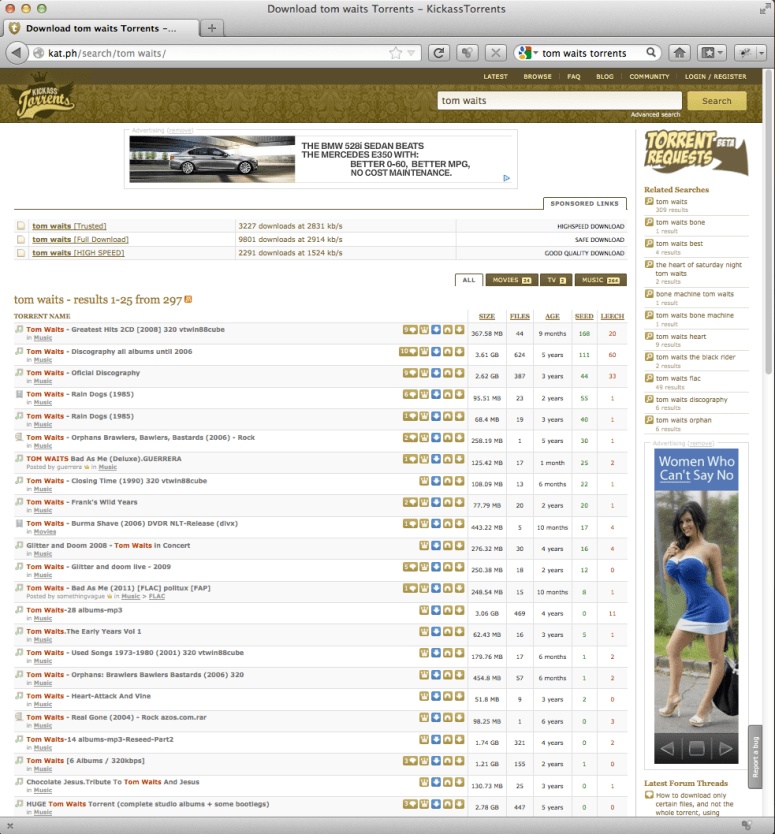
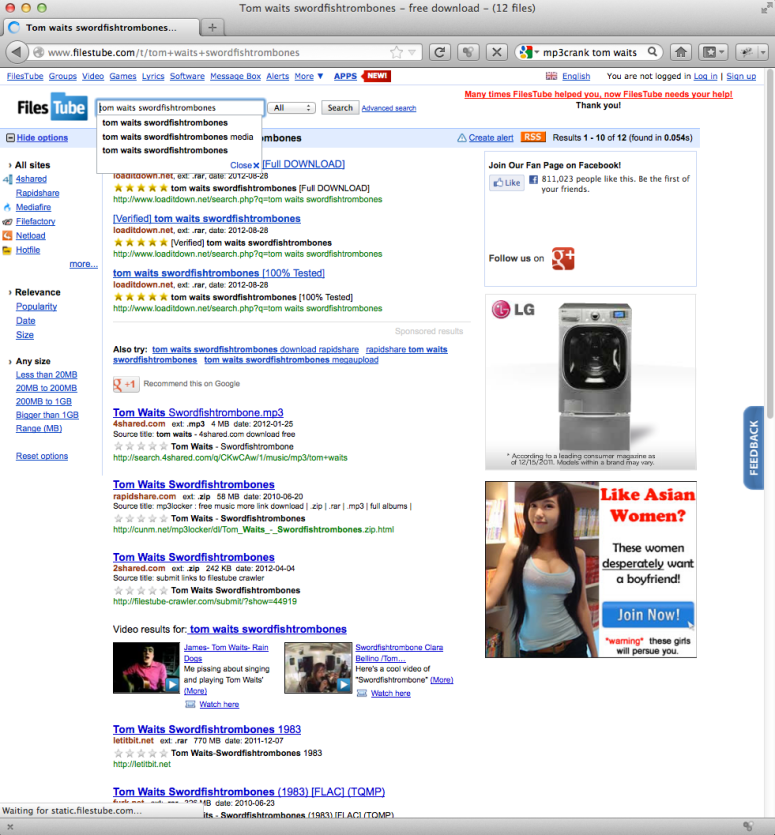
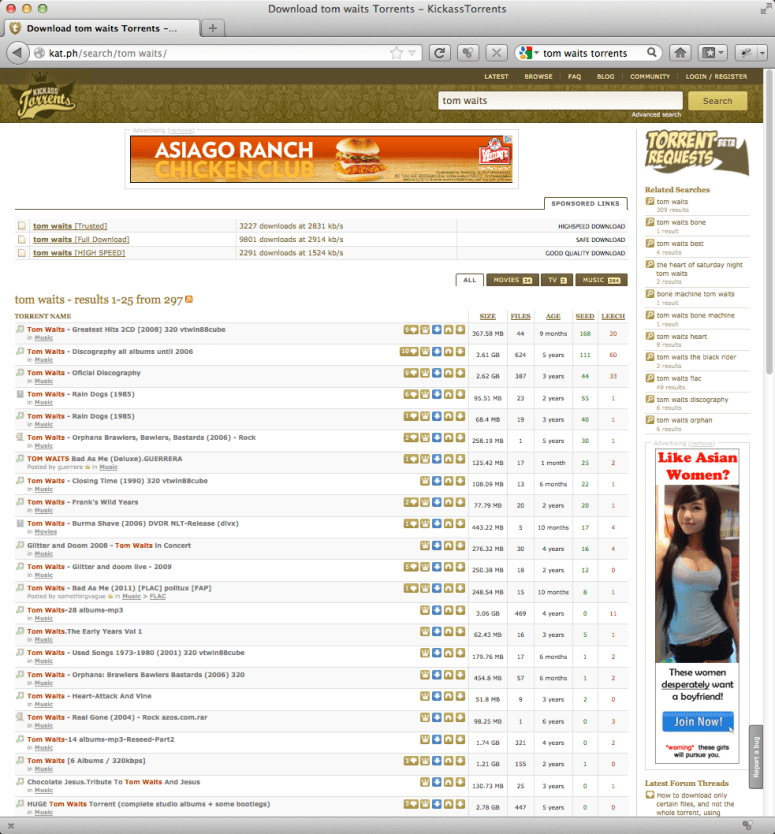
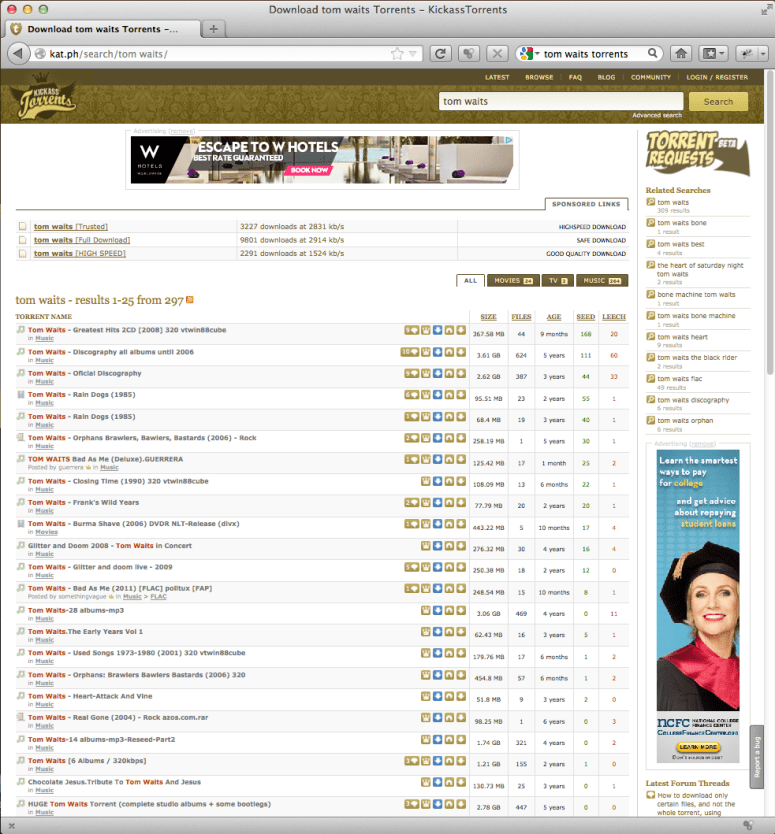
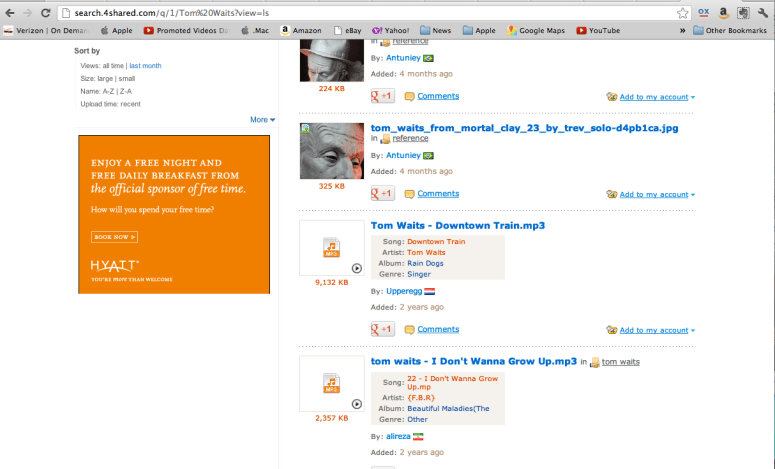
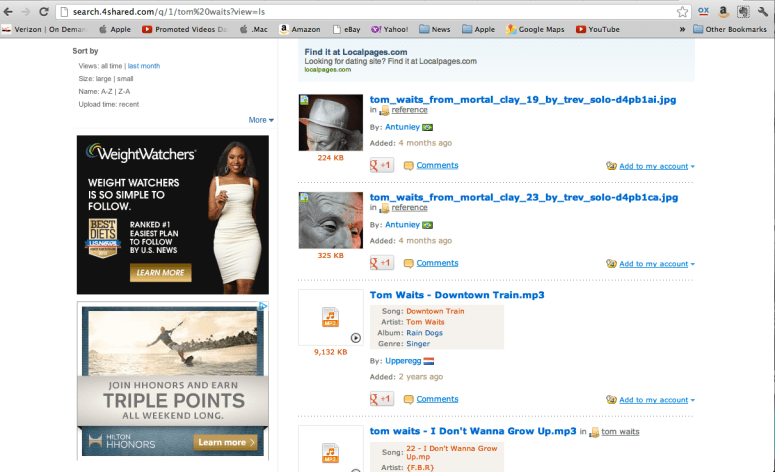
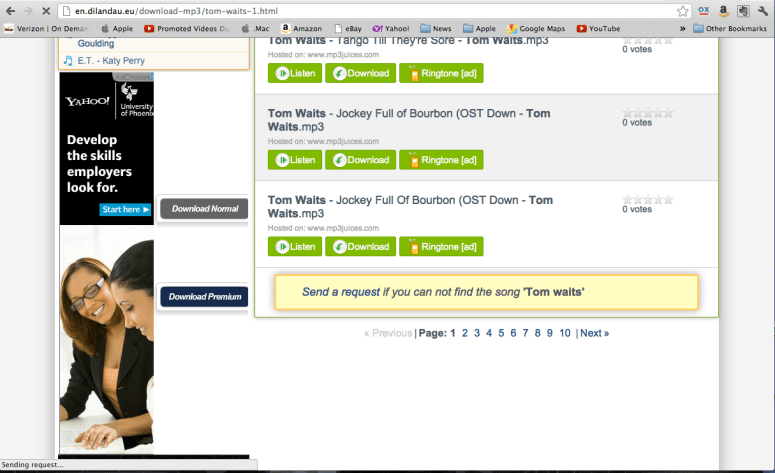
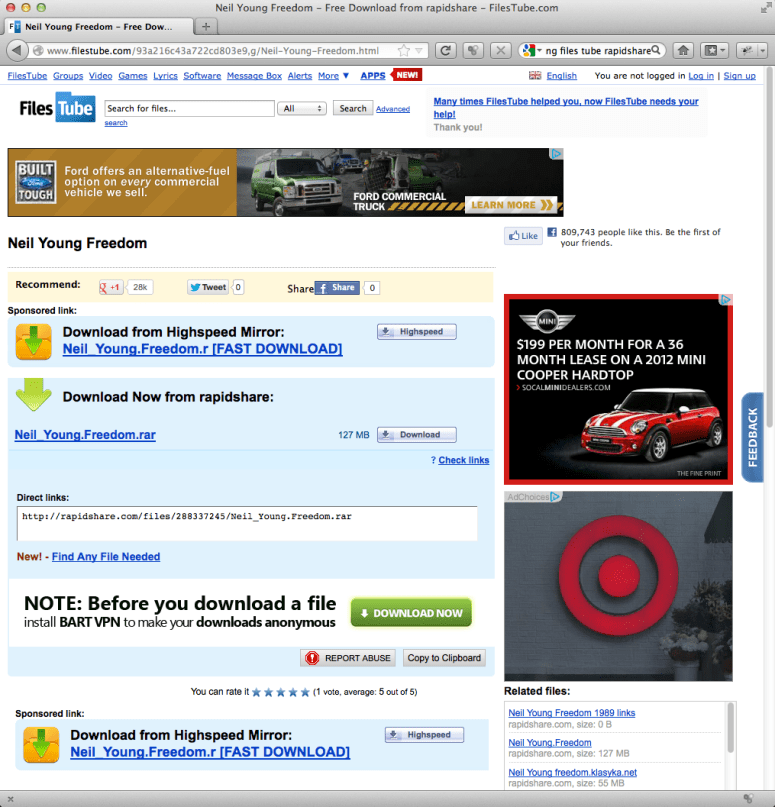
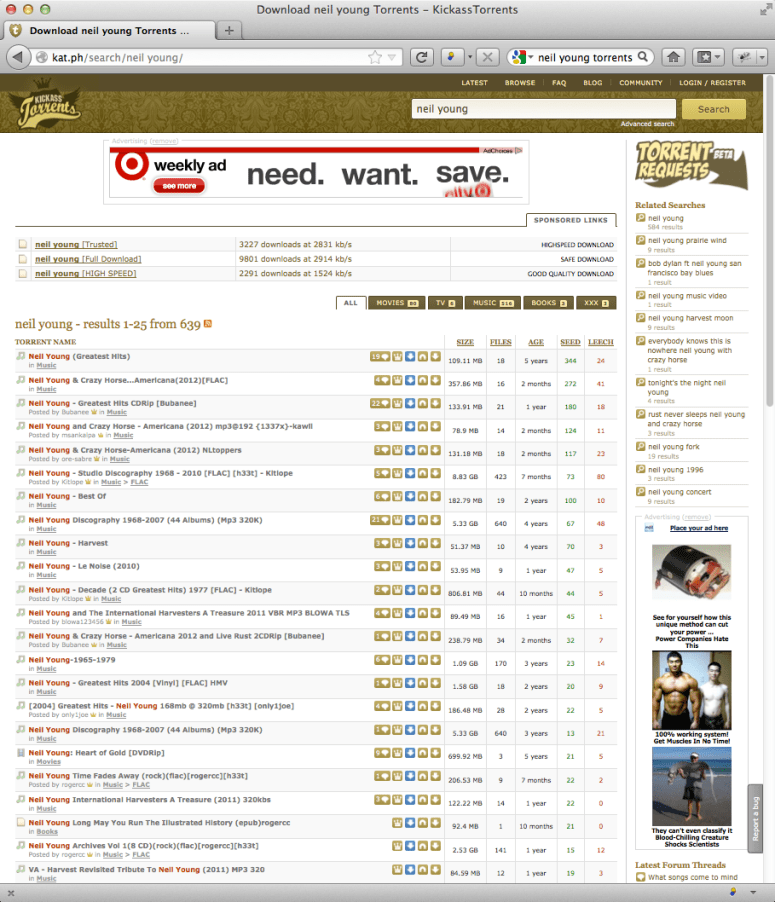
What do you have to say BMW, Mitt Romney, Adobe, Cadillac, LG, Target, Visa, Wendy’s, Westin, Priceline, Weight Watchers, Hyatt, Hilton, Yahoo, Urban Outfitters and University of Phoenix?
(According to Google, the websites in this screenshot — filestube, 4shared,Kat.ph and Dilandau — are the #1, #6, #11, and #8 top copyright infringing sites in the world.)
(*Berkeley runs the aptly named http://www.chillingeffects.org that is dedicated to posting the names of everyone that files DMCA “takedown” notices of copyright infringing links. You read that right, the birthplace of the free speech movement runs a site that basically punishes, er, publishes the name and address of the little guy that attempts to protect his/her freedom of expression. Intimidation pure and simple. You can write the Chancellor of Berkeley here: chancellor<AT>Berkeley.edu)
Here’s yer Bandido’s…
* BMW on Kick Ass Torrents * Mitt Romney, ADT Security on 4Shared * Adobe, Mini Cooper on FilesTube * Cadillac on FilesTube * LG on FilesTube * Target on Mp3Crank * VISA, State Farm on Mp3 Crank * Wendy’s on Kick Ass Torrents * Westin on Kick Ass Torrents * Priceline, Weight Watchers on 4Shared * Hyatt on 4Shared * Weight Watchers, Hilton on 4Shared * Yahoo on Dilandau * Urban Outfitters on FilesTube
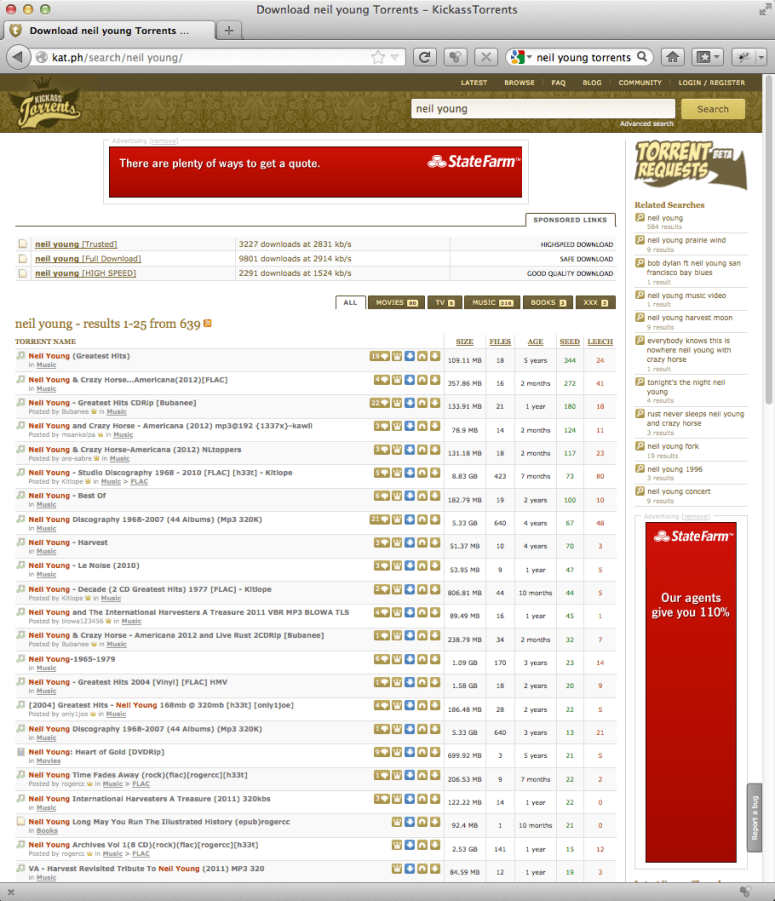
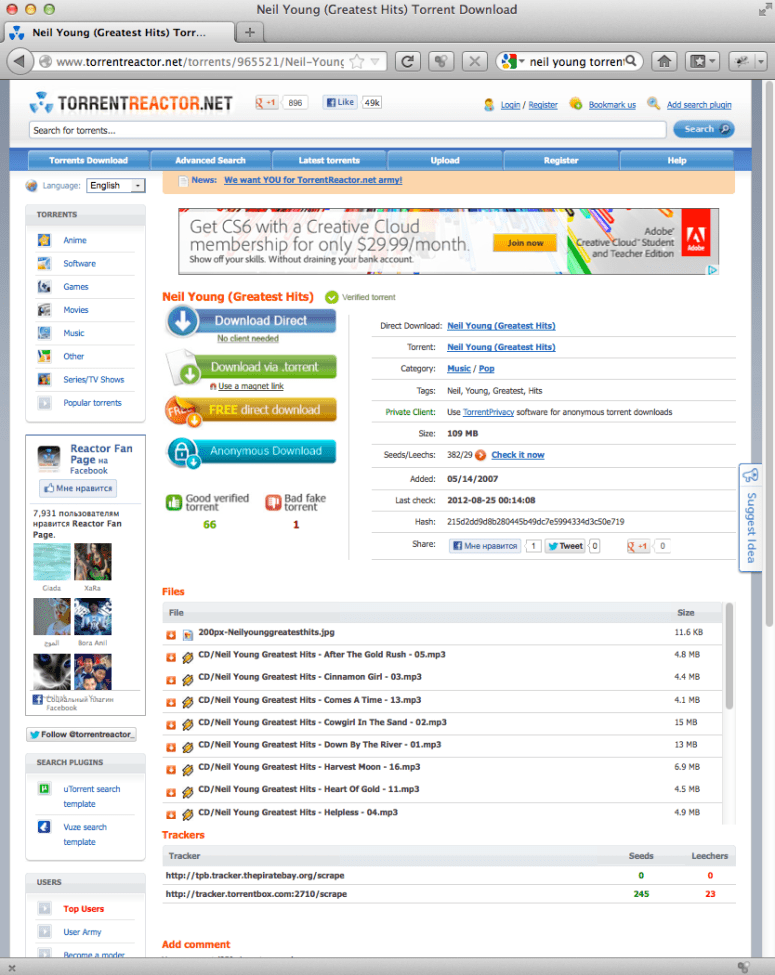
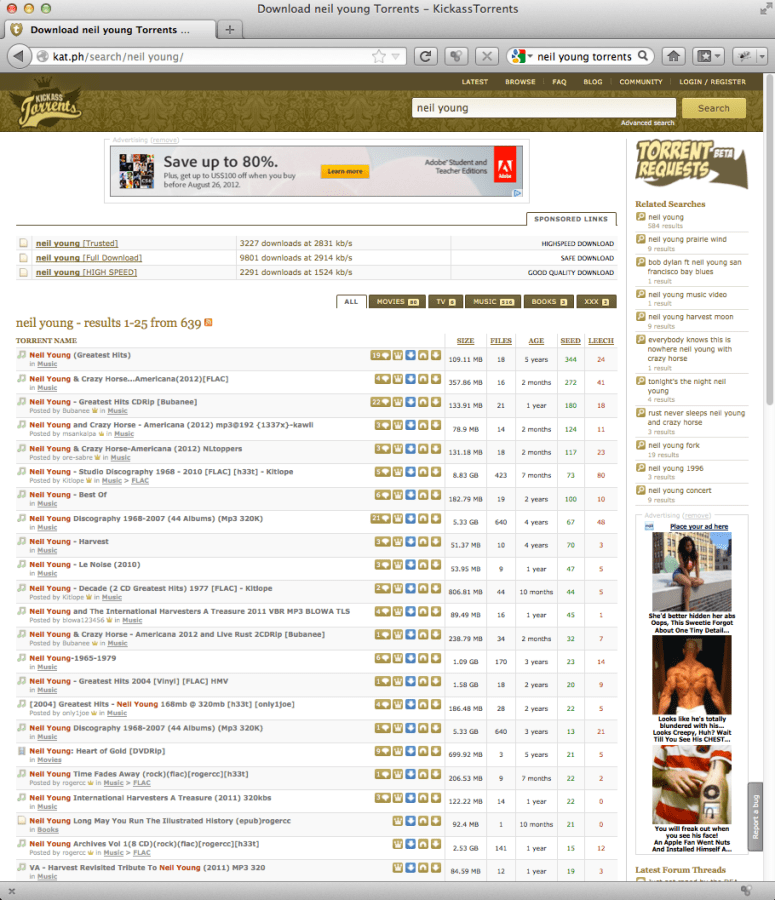
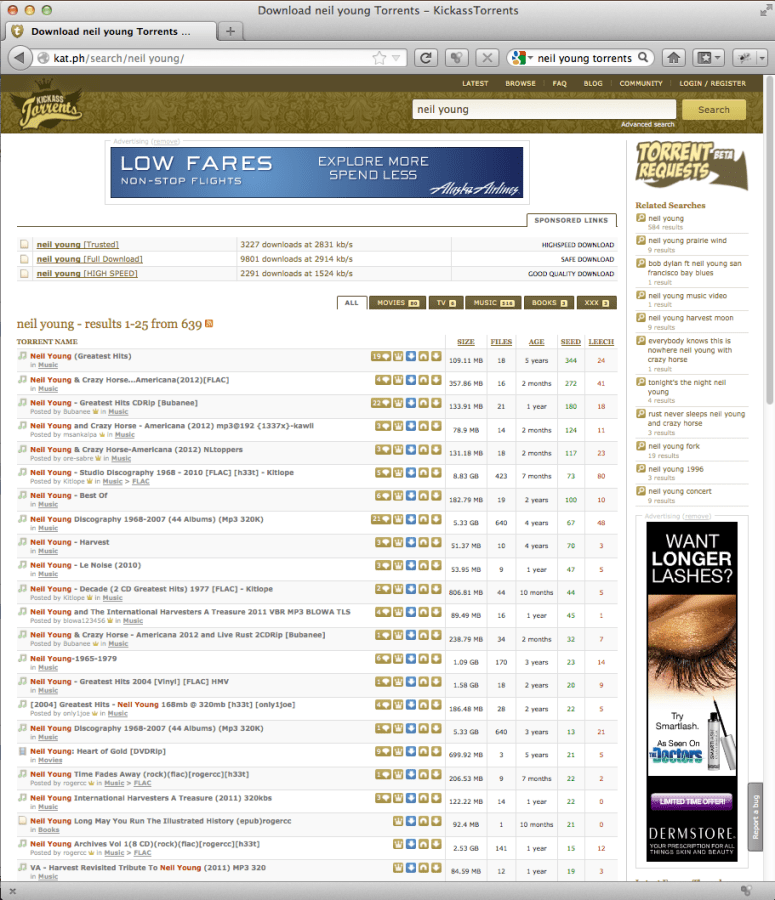
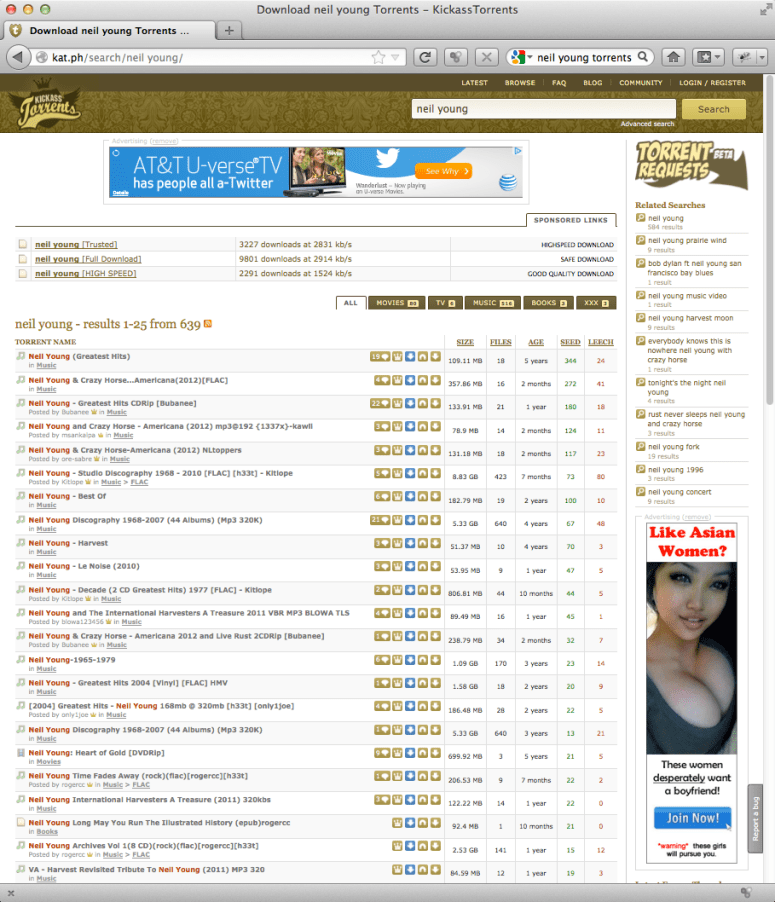
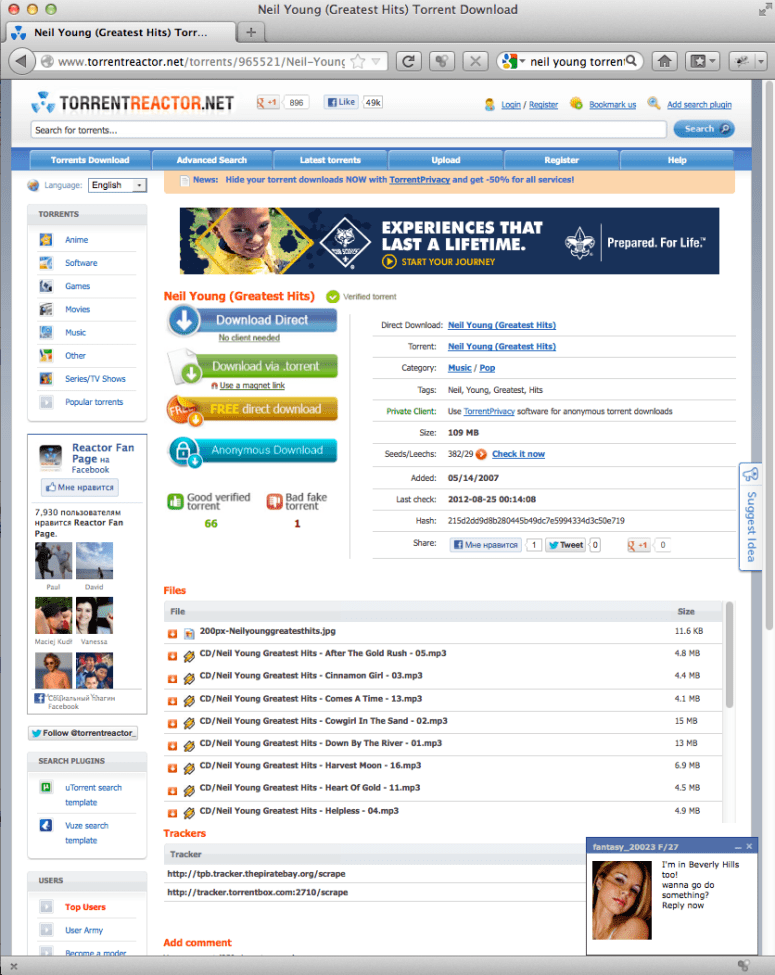
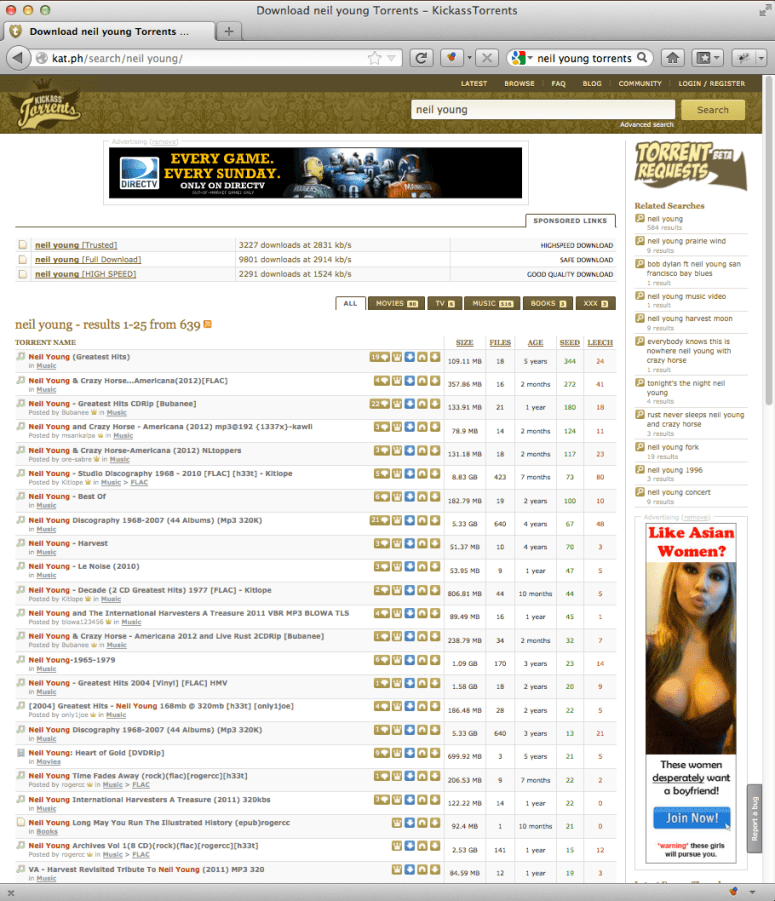
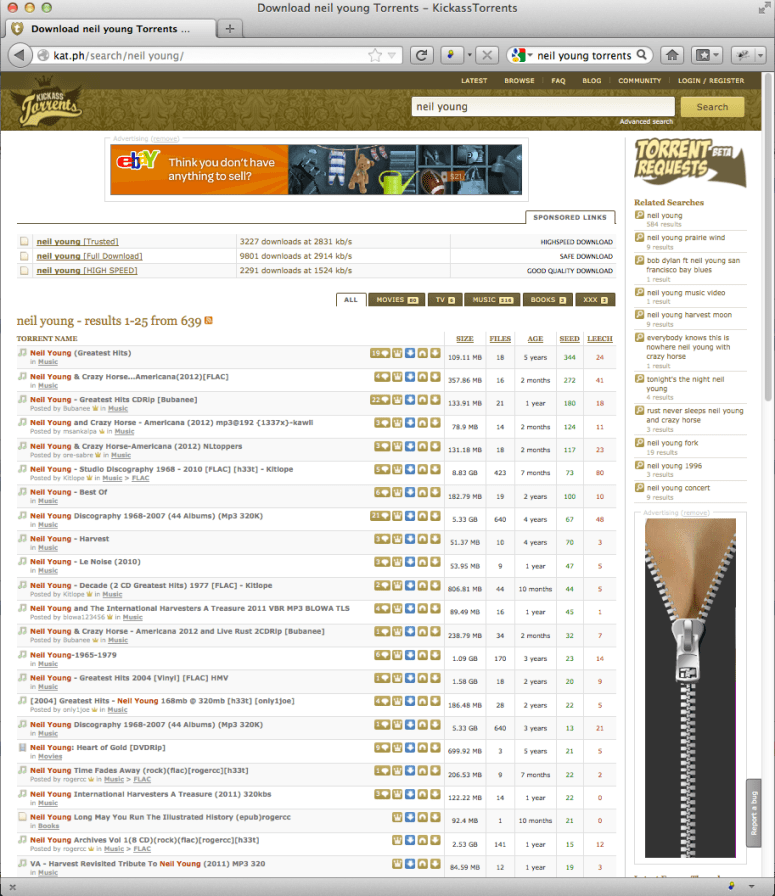
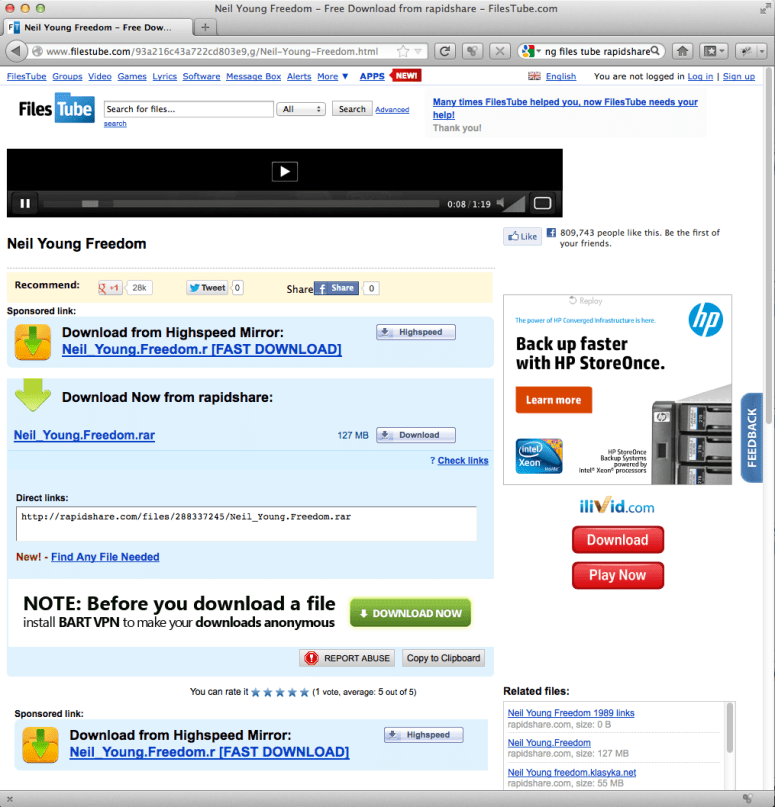
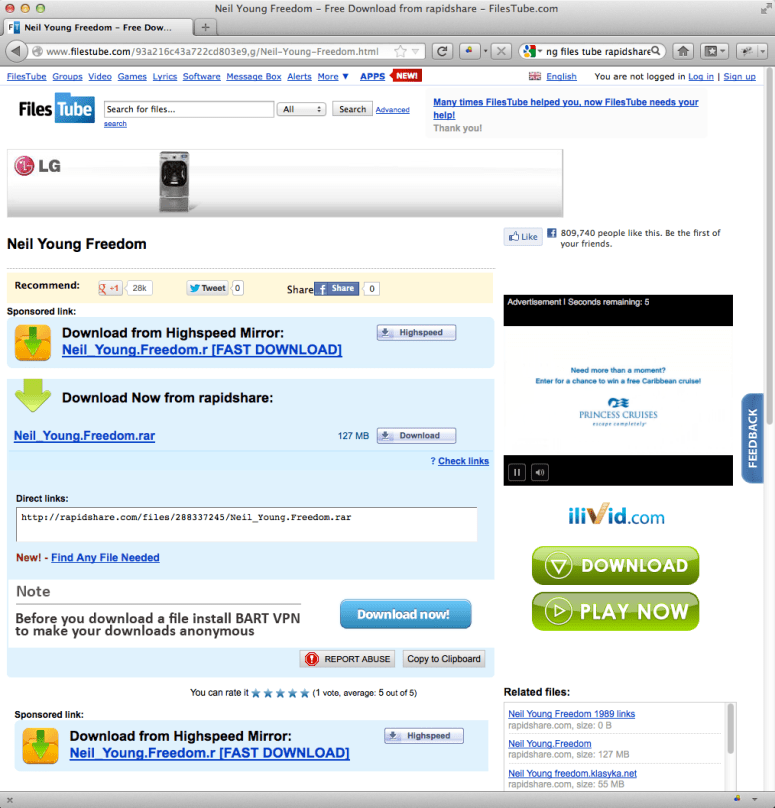
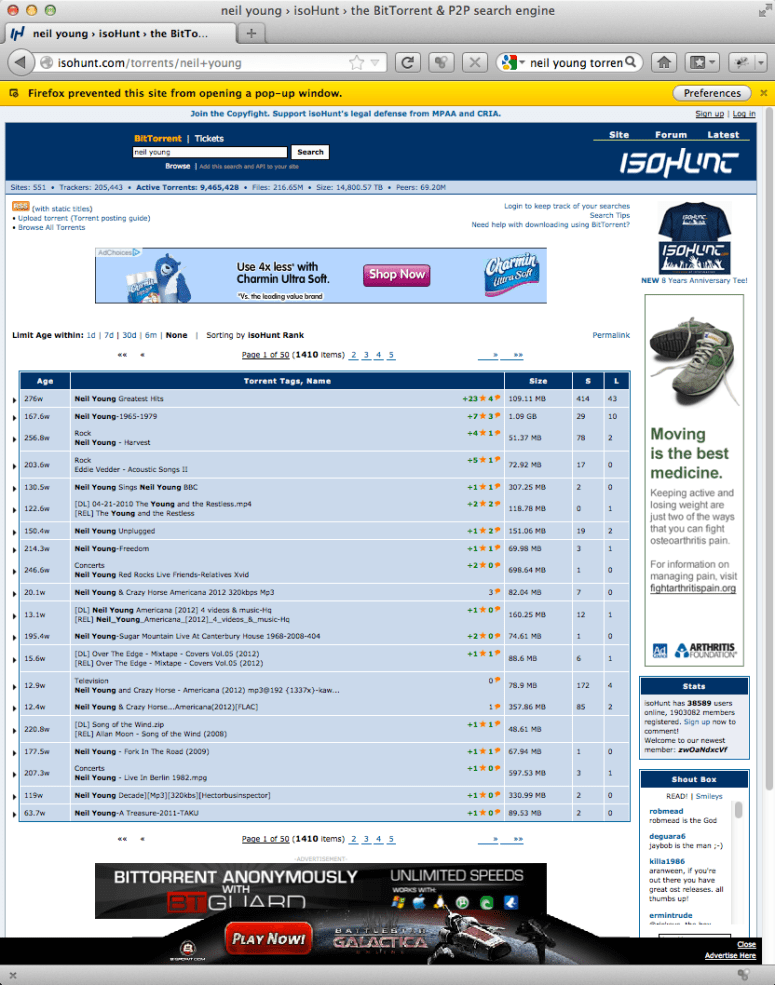
Neil Young Exploited… We’re Speechless… The impressive list below is just scratching the surface, or the tip of the iceberg. The only question to ask is…
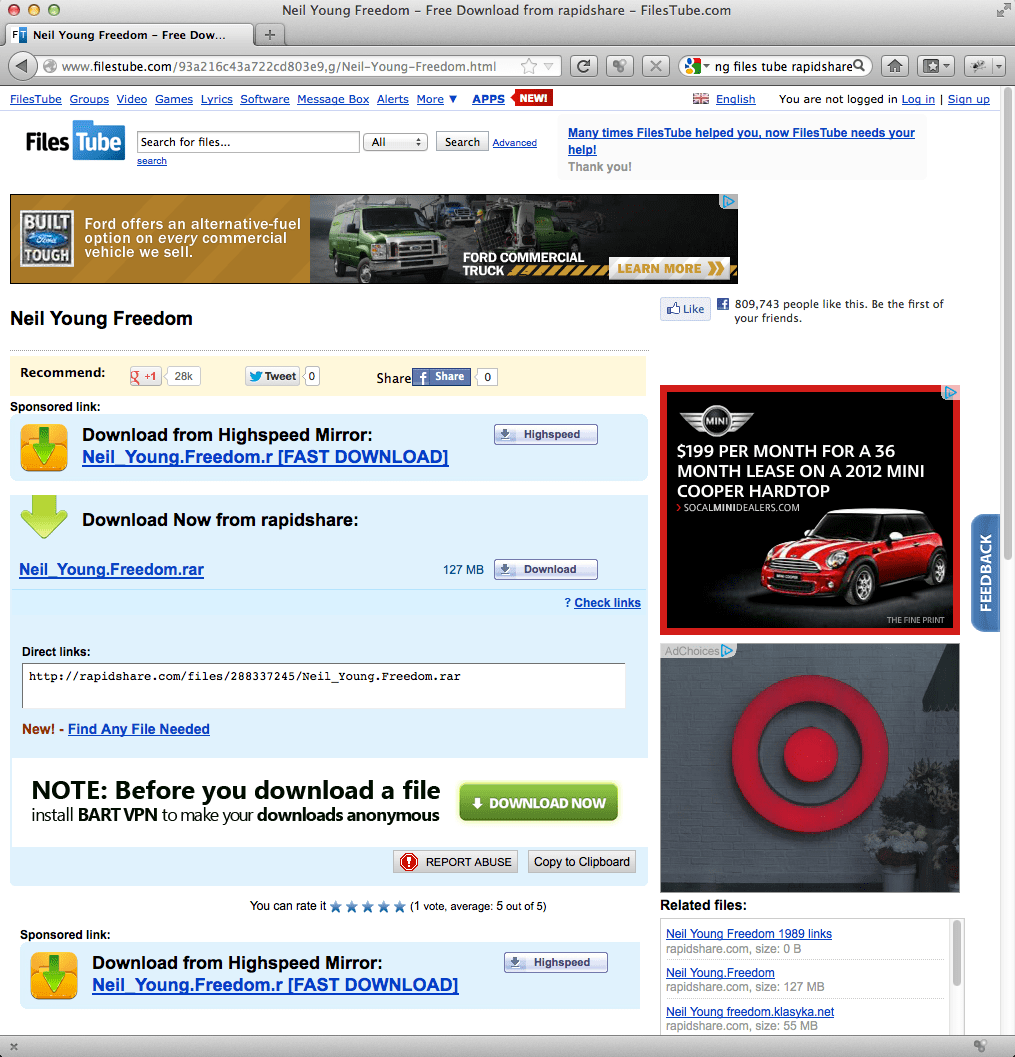
How much money have these brands paid these ad networks, which ultimately is collected by these actively infringing sites, to profit from the music and career of Neil Young?
* Ford, Cooper (BMW), Target on FilesTube
* Target on Kick Ass Torrents
* State Farm on Torrent Reactor
* State Farm on Iso Hunt
* State Farm (X2) on Kick Ass Torrents
* Adobe on Torrent Reactor
* Adobe, Legal Zoom on Iso Hunt
* Adobe on Kick Ass Torrents
* Alaska Air on Iso Hunt
* Alaska Air on Kick Ass Torrents
* AT&T on Kick Ass Torrents
* Boy Scouts on Torrent Reactor
* Direct TV on Kick Ass Torrents
* Ebay on Kick Ass Torrents
* Hewlett Packard on Files Tube
* LG, Princess Cruises on Files Tube
* Westin Hotels on Kick Ass Torrents
* Charmin Toilet Paper on Iso Hunt
And, let’s be honest… What artist doesn’t want to be associated with Charmin Toilet Paper?
Neil Young Exploited by … @Ford, @CooperMiniLtd, @Target, @StateFarm, @Adobe, @AlaskaAir, @ATT, @boyscouts, @DIRECTV, @LGUSAMobile, @PrincessCruises, @HP, @Westin, @Charmin, @RapidShare@RapidShare
If you don’t want to subscribe to our blog to get all of our posts, the weekly mailing list is a great way to get the weekly recap, news, links and the occasional call to action email for artists rights.
Technology may change but principles do not. A society that encourages the creative spirit is rare in history and worth defending. The internet and digital technology have opened up many new opportunities for artists, but it has also opened up new opportunities for those who wish to exploit those artists.
We offer for discussion a set of principles as a guide for companies and policy makers to keep in mind. It is our hope that these principles will help build a sustainable online creative ecosystem, one that benefits creators, innovators, and the general public alike.
1. FAIR AND ETHICAL LABOR PRACTICES: RESPECT WORKERS’ RIGHTS A fair and ethical internet is built on the respect and protection of the rights of individuals to determine who benefits from their labor and creations.
Since the rise of digital utopians in the 1990s, we’ve unfortunately seen many very old arguments surface as to why the economic benefits of a few big companies should be valued over the labor rights of many. This problem is what drives workers to organize to protect their labor and demand fair compensation. Not only are artist rights protected by the US Constitution, artist rights are also internationally recognized as human rights protected by many international treaties, including the Universal Declaration of Human Rights. Unfortunately, however, there are those who seek to capture the value of artist rights profit only for themselves by systematically violating these rights for commercial gain.
A free and open internet works best without overbearing regulation, but it will not work at all without protection for fundamental rights of working people.
2. CONSENT IS THE FOUNDATION OF CIVILIZATION: RESPECT ARTISTS’ INTEGRITY Your right to swing your fist stops at the end of my nose. Your rights end where mine begin.
Rights secured by the Constitution are intended to protect the individual from hostile majority forces and the tyranny of the mob, particularly the corporate mob. This is especially true regarding copyright, which is itself a vehicle of the right of free expression for individuals, and protected by the Constitution.
Everyone understands the value of individual privacy in the digital age. The essence of the artist’s control over the integrity of their work is not that different. Individual consent should be required for a corporation to profit from taking any creative work (just like individual consent is required for taking personal information) because the creative work goes to the artist’s personhood. Protecting an individual’s right to their personhood and the protection of their free expression are building blocks in the foundation of civilization.
3. PROTECT INDIVIDUAL FREEDOM OF EXPRESSION: DON’T TRIVIALIZE CENSORSHIP Freedom of speech requires freedom of expression. Copyright protects free expression. Together, they ensure a robust marketplace of ideas that advances truth, knowledge, and culture.
Let’s get this straight. Censorship is intolerable. You don’t have to look very far to see artists being censored by governments — there are many historical examples . No one understands this more than the scores of individual artists, musicians, painters, writers, poets, filmmakers and creators of all disciplines who have actually (and literally) have been persecuted, disappeared or assassinated for their views all over the world. Sadly, many confuse the actual freedom of expression with the mistaken idea that preventing the illegal exploitation of that very expression is the same thing. It’s not.
The copying and distribution of those expressions without the creators permission is simply exploitation without consent or compensation. Would you think that a car thief is being censored when they are prosecuted for stealing your car or a bank robber is being censored when they are prosecuted for stealing your money? Don’t trivialize “censorship”.
4. FAIR COMPENSATION: IF YOU DON’T LIKE IT, DON’T BUY IT In any value chain where the individual creator’s work is exploited, the creator must be compensated.
Most fair and reasonable people embrace “Fair Trade” products to support and encourage fair compensation of labor. Unions have fought long hard-won battles for the protection of labor rights. As a society we recognize the individual’s right to fair compensation of labor as a fundamental cornerstone to an ethical and healthy society. The internet is inhabited by as many different varied participants as the physical world, and the respect for human labor should not be devalued simply because technology makes it possible to be unethical.
It’s very simple–the answer if you don’t like an artist’s work is not to steal it–just don’t buy it. They’ll get the message.
5. MUTUAL RESPECT: IT’S ABOUT GETTING IT RIGHT, NOT GETTING AWAY WITH IT Mutual respect for the diversity of all online citizens is the cornerstone of a healthy and robust community.
The mutual respect granted by intellectual property rights allows individual creators the freedom to determine what permissions they wish to grant and at what price. No one has to pay that price, but the creator is entitled to set it. Denying these freedoms to creators because the mob or a public company wants to overrun a musician, author, illustrator or photographer violates the very protections against mob rule that the Constitution is intended to secure. Sadly, this is largely how individual rights are viewed today by some online corporate interests.
6. PARASITIC EXPLOITATION IS NOT INNOVATION: FREE AND OPEN SHOULD BE FAIR AND HONEST The illegal exploitation of individuals for commercial gain is not innovation, it is techno-thuggery and cyberbullying.
We see many companies on the internet illegally exploiting the work, labor, innovation and creations of others simply because they can get away with it. We’re often told that innovation requires the unauthorized exploitation of creators in some kind of technological determinism that rejects the innovation of creators because it“scales”. That is just another way of using “convenience” as an excuse for theft. Any business that requires the illegal exploitation of individuals to be profitable is not a business but rather is a parasitic engine of oppression.
7. SUSTAINABLE INNOVATION SOLVES PROBLEMS: FAIR NOT FAKE Sustainable innovation is best represented by solving problems, not creating them by adding intentional opaque layers of obfuscation.
The organized and deliberate complexity of some online ad networks, pirate site operations, and other businesses creates an impenetrable black box to protect illicit money flows and give the participants plausible deniability. Then we are told to “follow the money” through advertising networks, down a rabbit hole to a maze followed by another rabbit hole. That’s not innovation. It is old school wire fraud. This should not be a badge of honor for the online community but rather a point of embarrassment that the Internet—one of the greatest technological achievements of all time–is trivialized by making it nothing more than a safe house for many illegitimate businesses profiting at the expense of honest citizens.
8. COMMON GOALS, BEST PRACTICES AND SOLUTIONS: There are centuries of mutual ground between creators, commerce and rights holders. Let’s not throw this away.
Let’s not set a goal of building a large database for clearances of all copyrights and do nothing until it is operational. That solution almost guarantees that there won’t be many new works to put in that database. Such a database has never existed and is incredibly complex. A transparent rights clearinghouse is a possible solution, but the lack of one it is definitely not an excuse for bad behavior.
A Shill by Any Other Name…
– Google released it’s Supplemental Disclosures, you can read here at scribd.com featuring all the usual suspects and your favorite cast of characters. Listed and described in the document are Public Knowledge, The Electronic Frontier Foundation, Floor 64 CEO Mike Masnick (also of Tech Dirt, but who questions why he was included by Google under the reference to the CCIA that he consults for) and others. The judge who ordered the disclosure rightfully understands that he who pays the piper names the tune. It’s funny how many of these same players appeared to have editorialized the SOPA debate to the benefit of Google’s business interests.
It’s the other guys fault, no really… Rapidshare plays pass the buck…
– Rapidshare pulls a page from the Google playbook in it’s filing to the Intellectual Property Enforcement Coordinator (IPEC) by passing the buck of responsibility for illegal file sharing onto the the search engines, advertisers, pirate sites and ad networks. While this open and honest admission is encouraging, Rapidshare unfortunately is still not taking responsibility for the overwhelming amount of infringing material it is hosting itself. So tell me more about how sophisticated these websites are and why more sophisticated legislation is not the solution? Does this sound familiar?
“Rather than enacting legislation that could stifle innovation in the cloud, the U.S. government should crack down on this critical part of the online piracy network.
The only way that content stored with RapidShare can be accessed by a third party is when a user makes his or her access credentials available to others by posting this information on websites. These very sophisticated websites, often featuring advertising, facilitate the mass indiscriminate distribution of copyrighted content on the Internet and should be the focus of US intellectual property enforcement efforts.”
USA TODAY details the true costs of “Free” Downloads
– We were very encouraged to see a well written report on the reality of illegally artist exploitation online by infringing and pirates sites By Ken Paulson in USA Today. The brief but lucid article details the historical origins of both free speech and copyright as complimentary, not competing principles. Ken writes,
“…this nation adopted two major, interlacing principles: Americans were free to write whatever they wanted and had every right to be compensated for their work. The First Amendment encouraged creativity, and the copyright clause guaranteed compensation.”
Musicians Stand to Lose Again in Battle over Radio Royalties
– It seems no matter where you look today musicians are under fire. Now internet streaming internet services like Pandora and others are hoping to make more money from musicians work, by paying them less royalties. Even major labels let artists collect 100% of their streaming royalties whether or not they’re recouped but Pandora wants to profit more by paying less. For all the talk of how the internet is liberating and empowering musicians, it seems the in reality the truth is actually very much the opposite. This looks like a pattern–every few years Pandora will try to move the goal posts in their direction by exercising their lobbying muscle. So much for a “middle class musician.” Musicians need to be informed about these issues and be vocal in their support of legislative and union representation. We’re very disappointed by the strong position taken by Pandora to not fairly pay artists. Read more in AFM President Ray Hair’s piece at The Hill.
Gearslutz pulls Spotify advertising after forum users complain
– The web forum Gearslutz caters to musical enthusiasts and hobbyists interested in studio gear. The highly successful site is probably the top meeting place online for this particular demographic of aspiring musicians. This week the site pulled it’s Spotify advertising banners after users on the forum complained that Spotify might well be the end of their professional aspirations. As the Spotify debate rages on, there still appear to be more questions than answers about the transparency of the companies practices and what it’s long term effects will be on the professional music community.
Google concerned over online Piracy?
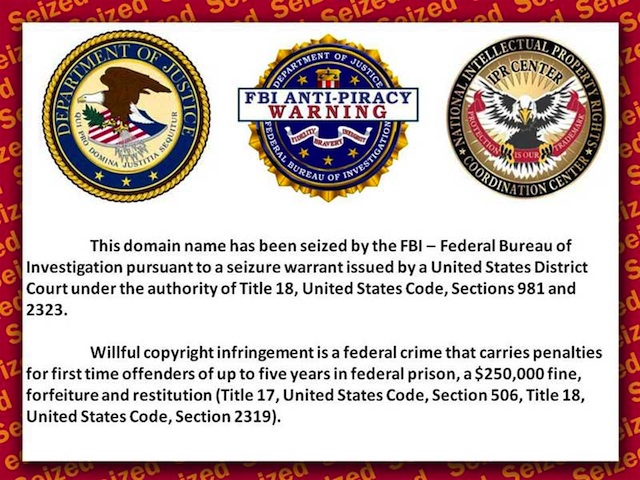
– We found this story on Ars Technica about the FBI (as opposed to U.S. Immigration and Customs Enforcement) seizing the domain names of sites that allegedly participate in Android app piracy. Sooner or later it appears Google will learn that a fair and honest internet is the best way to build a fair and honest businesses. Now if only this solution were available to remedy the sites infringing on musicians work like FilesTube, Rapidshare and others.























 The Trichordist
You must be logged in to post a comment.