Musicians POV : Are You Worthy?

By Doña Oxford
(re-post by permission, copyright in the author)

I have been a professional working musician since I was 16. I’ve been fortunate enough to have played with legends such as Keith Richards, Bob Weir, Levon Helm, Buddy Guy, Albert Lee and many more on every level: arenas, festivals, even dive bars. This is how I make my living, gig to gig, paycheck to paycheck. I’ve spent countless hours and serious money investing in my education and skill.And I’m getting really tired of giving away my art for free.

Its expected. We as artists are expected to give away free downloads, free CDs, free videos. We even pay the nightclubs to play for a crappy 40-minute time slot, all under the guise of “exposure” or “promotion.” It’s bullshit. When has an A&R rep ever showed up at your gig?

Just last week, a local blues band asked me to play on their album for free, as a marketing tool to get better-paying gigs. So I’m expected to spend my gas, my time, wear and tear on my car, my ideas and my hard-earned skill in the hopes of your band getting a few paying gigs on which you might hire me?

This is my living. I don’t work at the donut shop or as a temp at an office. I’m not a weekend warrior. I make music. I have rent and bills, overheads and employees, just like the record companies and club owners do.

In 1970, the average band made $400 a gig in a local bar. Today in 2012, it’s even less. We are one of the only sections of American society whose income has not increased with inflation. It’s appalling.

And yet top record labels, managers and agents all complain that they’re losing money and want to raise their fees. Some are charging the artist 35 to 50 percent for representation. Labels are now taking a cut of tee-shirt and non-album-related merchandise — money that isn’t theirs. And I’m so tired of hearing big companies whine because they say they are losing money. The artist is and always has been, throughout time, the lowest paid. Yet… remember… without the artist, they have no product to sell.

In 1999, everyone laughed at Metallica for going against the new Napster concept of file sharing. And look where it has got us. Why should the consumer buy music when they can get it free from YouTube? Why should the consumer buy your entire album when they can buy one track for 99 cents. Of which, if you are lucky or savvy, you may get a whopping 30 cents.

And now everyone is up in arms over the SOPA and PIPA laws. They are so afraid they will lose access to their beloved internet and their freedom of speech.

Let me tell you something: Michaelangelo, Dalton Trumbo, Eugene O’Neill, Reinaldo Arenas… none of them had websites and yet these artists found a way to get their expression out to the people. It’s all a facade.

Don’t get me wrong, I oppose the SOPA law because it is quite dangerous the way it is written. However, I am thrilled that it opens up the anti-piracy conversation. And so what if someone actually had to pay another artist for the use of their work in order to put their self-serving bullshit video up on YouTube? That artist deserves to be paid.

The “Occupy” movement is all about casting light on corporate greed. But what about the greed in all of us? It has become so commonplace that we expect to get everything for free. Especially if it’s art-related. Free music, free movies, free TV (don’t have to watch commercials now with DVR). My momma used to say, who will buy the cow if they can get the milk for free?

By expecting everything for free, we have devalued ourselves. We have bartered ourselves down to the lowest common denominator. We have increased the amount of crap we now have to wade through in order to find the gems. We have lowered our standards and the quality of our art has suffered. Lip-synching, auto tune, horrible lyrics, reality TV, bad sequels, etc. Every Joe Schmo is in the game now. So we have to compete against crap for no money and false opportunity.

Bill Cosby once said, “Mediocre people are very, very dangerous when they get together. There’s one thing they are not mediocre about and that is fighting off people who are superior. They bring standards down and make it appear that you’ve really got to be a genius to be mediocre.” Thank you, Mr. Cosby.

We are the artists. We are the free thinkers. We are the creators. We are the innovators.

Doesn’t that deserve respect? How about self respect? I know times are tough and it’s hard to say “no” to what looks like an opportunity. But how much are we really gaining in the long run?

Artists need to know their worth. We need to start demanding that we get paid for our talents. We need stronger unions, anti-piracy laws and maybe something as simple as integrity. We need to support our fellow artists instead of asking them to do us a favor. And we need to feel worthy enough to say, “No, I deserve better. I am worthy.”

###

[ THE 101 ] [NEW BOSS / OLD BOSS ] [ SPOTIFY ] [GROOVESHARK ] [ LARRY LESSIG ]
[ JOHN PERRY BARLOW ] [ HUMAN RIGHTS OF ARTISTS ] [ INFRINGEMENT IS THEFT ]
[ THE SKY IS RISING : MAGIC BEAVER EDITION ] [SF GATE BLUNDERS PIRACY FACTS ]
[ WHY ARENT MORE MUSICIANS WORKING ] [ ARTISTS FOR AN ETHICAL INTERNET ]

If the Internet is working for Musicians, Why aren’t more Musicians Working Professionally?

We keep hearing from web/tech gurus about how empowered artists are in the internet age, but yet, the numbers just don’t add up. It’s also ironic that tech bloggers like to promote the idea of  “touring and t-shirts” as a solution to the difficulties musicians are having online. But it really sounds to us, more like an admission that there is no money for artists online in the Exploitation Economy to develop new and sustainable professional creative careers.

This is why, an ethical internet for all citizens is so important. Sometimes, the facts are just so simple…

Ted Cohen: Breaking Through The Noise | | midemblogmidemblog

“The Internet was supposed to be the ultimate leveler, great music would be able to find its audience, the ‘big label’ gatekeepers would no longer control access to the masses.

It hasn’t exactly played out that way. According to my friend, Tommy Silverman/Tommy Boy Records and the co-founder of the New Music Seminar recently told me that he did the math and only 228 artists broke 10,000 units for the first time last year out of 105,000 albums.

That’s 2.17% but only 15 of those did it without the help of a real label.

That’s not very encouraging to the other ninety-eight percent. While tens of thousand of artists are self-releasing their music, their ability to get noticed in a meaningful way is stifled by the sheer volume of music that is arriving daily at iTunes, Amazon, Spotify, MySpace Music, Yahoo, Rhapsody, Pandora, iHeart and others. Ten years ago, there were roughly twenty-five thousand album releases a year.

In 2009, it is estimated that there will be over one hundred thousand albums put into digital distribution. That’s roughly a million new tracks a year, four million minutes of music, or almost three thousand days-worth of song. But, maybe, if I listen really, really fast, I could….nope!”

The numbers below are equally sobering. Not only did the volume of sales drop from 2009 to 2010, but also the number of new releases also dropped. Many promoting the exploitation of artists are also proposing that the new lower barriers for access to distribution will increase creative output, but that also appears to be false.

Business Matters: 75,000 Albums Released In U.S. In 2010 — Down 22% From 2009 | Billboard.biz

75,000 Albums Released In U.S. In 2010 — Down 22% From 2009

Not only were fewer albums released, but the weakest sellers took up a smaller share of new release sales. The 60,000 titles that sold from 1 to 100 units represented 0.7% of all sales from titles released in 2010. In 2009, 0.9% of sales came from the 80,000 titles that sold from 1 to 100 units.

So there were quite a few new albums that sold fewer than ten units.

Put another way, the 60,000 new releases that sold 100 or fewer units averaged just 13.3 units per title.

The statistics above do not support the assertion of the tech blogosphere that the internet has created more opportunities for professional creative careers, or expanded a working middle class of musicians. It’s actually very much so the opposite of their claim.

It’s clear from the numbers above (and continued below) that the democratization of production and distribution has not democratized talent. The most exploited music, is not surprisingly, the most popular. These are the artists and titles which are also developed and promoted by traditional media outlets.

Here’s another interesting stat reported by Digital Music News. Does this look like the empowerment of a new creative middle class to you?

99.9% of Tunecore Artists Make Less Than Minimum Wage…

99.875% – or nearly all – of Tunecore artists are making less than minimum wage through the platform, based on revenue figures recently shared by the company.

Despite this fact, some tech bloggers can’t even understand how the simplest mechanisms function in the recorded music business. In an attempt to discredit some of the reports above one tech blog let lose with this gem below, alleging that because Tunecore and CDBaby releases are not reported directly to Soundscan their releases are not counted in Soundscan stats creating a massive unreported pool of revenue being ignored by the industry.

TuneCore does not report results to Nielsen Soundscan and it puts out a hell of a lot of releases. Similarly, CDBaby/Disc Makers points out that Soundscan doesn’t count its releases either — which number around 50,000.

The problem with the above is not understanding that Tunecore and CDBaby can’t report to Soundscan, because Soundscan collects the data from the point of sale such as Itunes, Amazon, etc. So in fact, all Tunecore and CDBaby releases and sales are actually cataloged and reported by Soundscan afterall. So much for all that unreported sales and revenue.

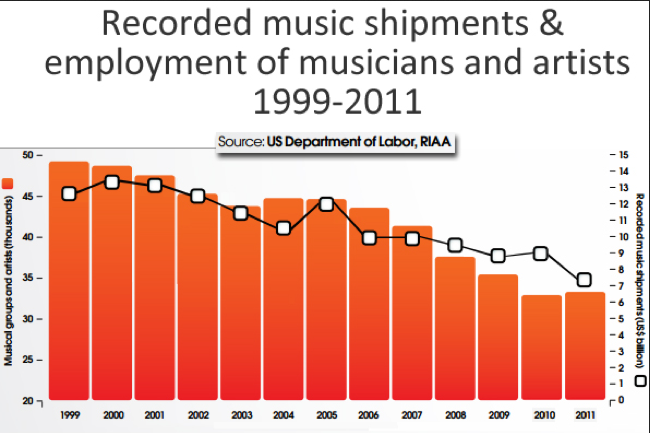
But of all the numbers, this one is the bottom line. Salon recently reported stats from the Bureau of Labor Statistics that number of working professionals in the music industry are suffering a catastrophic decline. If these numbers were reported by any other industry it would make national headlines:

No Sympathy for the Creative Class

“Musical groups and artists” plummeted by 45.3 percent between August 2002 and August of 2011.”

This is also graphically represented here at Digital Music News:

musiciansindecline


All of this gave us pause when we saw a report given by The Future Of Music Coalition (FOMC) in Digital Music News that artists earnings are benefiting from digital technologies? How? As opposed to what? I can see that some digital technologies may be helping artists, but “overall” is simply, statistically, not true given the information above. So it trouble’s us to see statements like the one below made in public by the organization’s Kristin Thomson at SF Music Tech in February of 2012.

 “Overall, digital technologies seem to be having a positive impact on musicians’ earnings capacity”

Really? Maybe it’s not surprising that FOMC is also aligned with Public Knowledge who held a joint workshop to help musicians understand that, “Copyright law is changing rapidly in the face of new technologies.” The only problem is, copyright law is not actually “changing rapidly,” but it appears that Public Knowledge would like it too! Make no mistake about it, Public Knowledge is advocating for less artists rights and protections.

So the real truth is this; if the internet is working for musicians, why aren’t more musicians working professionally?

###

Robin Gibb Remembered 1949 – 2012

It is with great sadness that we report on the passing of Robin Gibb who in his later years was a strong and vocal champion of Artists Rights serving as the President of the International Confederation of Societies of Authors and Composers (CISAC) for the past five years.

Robin served as the President of CISAC, acting as the voice of three million creators around the world as the leader of the members of CISAC’s 232 authors’ societies in 121 countries. Following a first term as president, Robin was unanimously re-elected for an additional three-year mandate in June 2010.

Below is his impassioned closing speech from the World Copyright Summit in 2009 in which he said, “I’m proud to be President of CISAC, and I will keep on fighting for creators’ rights as long as I can draw breath.”

More here:
Robin Gibb Website
CISAC.org

The Trichordist Random Reader Weekly News & Links Sun May 20

Grab the coffee!

The end of an era as Roadrunner Records is shuttered and causes one writer to ponder what the true cost of free music is to consumers in the long run, the Galleon reports:
http://www.galleonnews.com/2012/05/the-true-cost-of-free-music/

The Cynical Musician reports on “The Curious Case Of The Pirate Bay” after mandatory ISP blocking has gone into effect in several Countries…
http://thecynicalmusician.com/2012/05/the-curious-case-of-the-pirate-bay/

A great article from the Austin Chronicle looks at the realities and effects of the “Spotify Effect” on developing artists. The band “Quiet Company has garnered over 60,000 song plays since October. For those 60,000 streams, the band has earned $342.” Read more here:
http://www.austinchronicle.com/music/2012-05-18/pennies-from-heaven/

Blair Witch Project director goes on record against Piracy as it “makes it very difficult for micro-budget filmmakers to make a living.”
http://www.reddit.com/r/IAmA/comments/th9i8/i_am_eduardo_sanchez_director_of_the_blair_witch/c4mw842

A funny thought by Wayne Rosso that labels would sell to Google for $1b each… highly unlikely. Why buy the cow when you can get the milk for free? Plus is Google actually bought the labels, they would also be buying the roylaties obligations, and we just can’t see that happening…
http://www.waynerosso.com/2012/05/09/google-if-you-cant-fight-em-buy-em/

Has Silicon Valley created it’s own religious cult in “The Singularity?” The New York Times reports:
http://www.nytimes.com/2010/06/13/business/13sing.html?_r=1&pagewanted=all

Eric Clemons reviews an ongoing legacy of bad behavior by Google at the Huffington Post:
http://www.huffingtonpost.com/eric-k-clemons/google-privacy-case_b_1522874.html?ref=google

A very interesting and insightful interview with Jim Steyer regarding Children and Online Privacy at TechCrunch:
http://techcrunch.com/2012/05/15/keen-on-jim-steyer-how-to-talk-back-to-facebook-tctv/

Musicians and bands always ask, how do I rank higher on Google, well, here’s how to rank #1, by Matt Cutts:

hint, use adwords… use adsense…

The Sky Is Rising : Magic Beaver Edition

It’s unfortunate that some people are gullible enough to take a tech lobby funded Computer and Communications Industry Association (CCIA) sponsored report “The Sky Is Rising” researched by a tech blogger as fact. As we detailed in our post about the SF Gate blundering the facts (obviously without fact checking!) here are some quick responses to the grossly selective and highly biased reasoning that enables such propaganda, and should have everyone questioning the credibility of such work.

Eventually there will a complete break down of the fallacy’s presented by a real economist but until then here are five quick standouts of absurdity:

#1 :  This is not an academic study or serious scientific study. It is a tech / internet industry commissioned (CCIA) lobby report.

#2   : The report falsely claims that the value of global music business grew from 130 billion to 160 billion. They do this by including iPod and music instrument sales. We are not joking about this!!

#3:  To claim that the entertainment business grew 50%  they include revenues from computer and video games.  Video gaming has exploded over the decade. And global gaming revenues are about 5x the size of global recorded music revenues. Console Gaming also has very robust DRM booting users off console networks if pirated or cracked copies are detected (Xbox, Playstation, Wii).

#4 :  Instead of showing the fact that gross recorded music revenues which have fallen over 50%,  the report uses the number of transactions.  Of course there are more transactions since a single album is now available by tracks which can contribute 10-15 times more “transactions.” Clearly the use of this metric is intended to deceive. This chart from The New York Times represents the actual facts.

#5  : Number of tracks cataloged?  Pointless.  This is mostly hobbyists using Tunecore and CD baby to “release” their tracks.   How do we know this?  Of 75,000 albums released in 2010, 60K sold less than 100 copies. Here’s more info spelled out by Ted Cohen and Tom Silverman from a Midem Presentation.

This all really begs the question, if the internet is really working for musicians than why are there less musicians working professionally?  Salon reports a decrease of over 45% less working “Musical groups and artists” from 2002 – 2011 according to the Bureau Of Labor Statistics. The tech / internet community it seems has confused  the democratization of distribution with the democratization of talent.

Of course coming from people who insist that “the internet is different,” (different from what?) and “old economic laws do not apply to the cyber economy,” (despite Google’s Chief Economist disagreeing with them) it’s not hard to take the leap to such absurd and nonsensical beliefs that a magic beaver lives in a space ship under the googleplex, which could also lead to the distorted magical thinking that produced The Sky Is Rising.

It’s also important to understand the near religious devotion some in the tech and internet community have taken to these issues. There is a fanaticism that is blind to all logic and reason that can only be described in the cult like obsession of “The Singularity,” as Jaron Lanier comments.

###

[ THE 101 ] [NEW BOSS / OLD BOSS ] [ SPOTIFY ] [GROOVESHARK ] [ LARRY LESSIG ]
[ JOHN PERRY BARLOW ] [ HUMAN RIGHTS OF ARTISTS ] [ INFRINGEMENT IS THEFT ]
[ THE SKY IS RISING : MAGIC BEAVER EDITION ] [SF GATE BLUNDERS PIRACY FACTS ]
[ WHY ARENT MORE MUSICIANS WORKING ] [ ARTISTS FOR AN ETHICAL INTERNET ]

The Trichordist Random Reader Weekly News & Links Sun May 13

Grab the coffee!

Last week the UK ordered it’s ISPs to block access to The Pirate Bay, the Dutch are getting fed up too…
http://www.pcmag.com/article2/0,2817,2404269,00.asp

[Related]Pirate Bay angered over Faux Pirate Bay Proxies…
http://louderthanwar.com/the-pirate-bay-advising-fans-to-use-the-authentic-original-the-pirate-bay-and-not-the-rip-off-sites/

ASCAP President Paul Williams gives an impassioned speech to membership about Artists Rights…
http://www.ascap.com/Playback/2012/05/action/membership-meeting-speech.aspx

Facebook removes Grooveshark App…
http://digitalmusicnews.com/permalink/2012/120508grooveshark

MP3 tunes files for bankruptcy, owner/founder still on the hook…
http://news.cnet.com/8301-1023_3-57432278-93/emi-says-bankruptcy-wont-protect-mp3tunes-from-copyright-suit/

Music Industry discusses improved music discovery via TV Co-Viewing Apps…
http://www.billboard.biz/bbbiz/industry/record-labels/tech-types-tackle-tv-music-tie-ins-at-narm-1007018352.story

Copyhype Debunks the Copyleft Theory of Hollywood Built On Piracy…
http://www.copyhype.com/2012/05/was-hollywood-built-on-piracy/

Lamb Of God’s Randy Blythe Speaks Out for Younger Bands…
http://loudwire.com/lamb-of-god-randy-blythe-claims-record-industry-dying/

The Onion Reports on the “Bold Move” or “Charging for Content”…
http://www.theonion.com/articles/nytimescoms-plan-to-charge-people-money-for-consum,19847/

Support the people supporting Artists Rights on the Hill, the Trans Pacific Partnership progresses…
http://thehill.com/blogs/hillicon-valley/technology/226215-overnight-tech-industry-urges-obama-to-negotiate-tough-intellectual-property-protections

and… then there’s this…
http://www.nationaljournal.com/tech/white-house-pushes-voluntary-anti-piracy-efforts-senators-want-legislation-20120509

Fantastic talk by Robert Levine author of “Free Ride” on the Failure of The Internet to create better opportunities for Artists & Creators and the work to be done.

The Paradox of Pirate Logic : Music Versus Music Software – Full Post

by Chris Whitten
(Copyright in the Author, Posted with Permission)

The bottom line for many in the often heated piracy debate is this: “Give us a good product at a fair price, make it convenient and easy to obtain and we’ll buy it”.

There is a digital product that ticks most of those boxes. So by comparing two products I wonder if we can learn anything about the chances of reducing music and movie piracy by making it better quality, more affordable and easy to download?

I’m of course talking about music production software.

About 7 years ago I was involved in creating a virtual drum instrument in collaboration with a Swedish music software producer Toontrack. Our product has been critically acclaimed, is a best seller, but is also unfortunately a favourite with software pirates. The pirate’s ‘advice’ to “adapt or die” appears then to ring hollow. As a performance musician I added music software creation to my resume by adapting to new technology, but all that happened was the pirates followed me.

With a foot in each camp, music technology and music performance, I’d like to take a look at the claim that “if you build it they will come.” Let’s see if the available evidence supports that idea.

Straight away we need to acknowledge two things: firstly, no one has ever suggested music software has gone backwards in quality over the last few years. It’s also pretty easy to obtain, including plenty of free alternatives, often offered by new companies trying to build a customer base, or by hobbyist’s happy with the kudos of creating a popular plug-in. Secondly, music software is heavily pirated.

So the signs don’t look good, and the more you look at music software piracy, the more the excuses and arguments made by movie and music pirates seem questionable. Let’s look at a couple of them:

Entertainment pirates claim they are fighting corporate greed. Movies and music need to be liberated from the clutches of billionaires who remain powerful by buying political influence.

This rhetoric may sound compelling, but the reality is that most music software companies are small privately owned businesses, and/or collectives of young innovators and entrepreneurs. Most were founded no earlier than the late 1990’s and still retain the same management and design teams that started the business in the first place. In fact, many music software producers comprise one or two people working from home.

The biggest and longest established names like Spectrasonics and Native Instruments employ between 50 and 270 staff, but those are the exceptions. Even so, we are hardly talking ‘megacorps’ here. For example, one of the hottest names in computer sequencing and recording software, Cockos (producers of Reaper), has a staff of three. Cockos has an instant download demo of Reaper available. They also offer a discounted purchase price of $60 for Reaper, if you declare earnings of less than $20,000 from its commercial use each year. So you could be Donald Trump and buy Reaper for $60 as long as music is your hobby. And yet Reaper appears prominently for free download on piracy sites.

Entertainment pirates claim movies and music are overpriced.

Music software users though have many free options. Apart from the new producers and hobbyists mentioned above, many established software producers offer free products.

For example, Elysia’s Niveau Filter:
https://www.plugin-alliance.com/en/plugins/detail/elysia_niveau_filter.html

And Sonimus’ SonEQ:
http://sonimus.com/site/page/downloads/

One of my own offerings, a sample pack for Toontrack’s EZdrummer, has a retail price of $89.00, but regularly sells for $39.99 from certain online retailers.

To use these software plug-ins you need a computer audio workstation, known as a ‘DAW’. Technology giant Apple give you one free with every computer; Garageband.  Audacity is a multi-track audio recorder and editor that is also free. And as mentioned above Reaper is $60.  Even the more expensive DAW’s like Logic Studio (Apple) and Live (Ableton) come bundled with a host of free software instruments, fx plug-ins and audio loops – something not dreamed of 10 years ago.

So can we still claim music software is over priced? No, not reasonably so.

Entertainment pirates cite what they see as false barriers to access as a major factor driving them to pirate sites.

So is music software easy and convenient to obtain? The answer surely has to be yes. Most music software is available for instant download. Some music software can even be used immediately as a demo without payment.

I was working on some music a few months ago and realized late one night I needed a certain FM synth sound resembling a Yamaha DX7. Not having the keyboard to hand, I went to Native Instrument’s webshop, bought and downloaded FM8, a virtual instrument based on similar architecture to the DX7. Granted it’s quite a large program and I have a basic broadband connection, but I was using FM8 in my project about one hour later.

By the way, FM8 cost me a fraction of the original price DX7’s sold for in the early 80’s. And smaller programs like plug-in EQ’s and compressors are much quicker to download and even with anti-piracy security, you can be using them within minutes. Modern musicians are drawn to music software exactly because it is cheap and convenient.

Music pirates claim digital music has no value.                                                                                  

 MP3’s for example are just ‘1’s and 0’s’ that can be infinitely reproduced at zero cost. Well then I guess digital music software is the same, just 1’s and 0’s, something that can be copied endlessly at no cost. Music pirates say they expect free digital music because it is free to produce, but they will support music by buying concert tickets, which directly fund true performance.

If you superimpose this claim on to music software, the logic falls apart immediately. Would the people who pirate EZdrummer be likely to pay $40 to see EZdrummer live on tour? What form would that tour take? I’m imagining a ‘technerd’ onstage for 12 hours coding the software, or maybe 12 hours of me sampling drums, one drum hit at a time, both of which are akin to paying good money to watch paint dry. What about merchandising? Well I must admit there are some cool Ableton Live t-shirts, but I still feel it’s the incredible music tool I should be valuing, not a Hanes in XL.

And what about the zero cost of reproducing the product indefinitely? Well I don’t agree with that either. Music software has to be maintained, developed and supported full time by a team of workers. Like many things these days, customers demand answers within hours of contact, even if they’ve emailed their query at midnight on Easter Sunday.

Then there is the initial investment in the creation of the software. If a hobbyist doesn’t count their man hours, a basic software plug-in like a softsynth, or compressor can be produced at low or no cost – but only IF they don’t count their man hours. However, sample based music software is much more costly to produce. For example, my most recent EZdrummer sample pack was recorded over four days at a commercial studio in New Jersey. I don’t live in New Jersey, the recording engineer doesn’t live in New Jersey, the Toontrack production team don’t live in New Jersey. My drums and cymbals aren’t located in New Jersey.

So why work there? Well because it was the right studio for the product we wanted to create. But let’s be clear: the costs involved are significant. To produce the included midi content alone, I recorded my own v-drum performances over two days. Then I spent two weeks, working ten hour days editing that midi. So again, are we working for free, for the ‘fun’ of it, or is it a job, or better still a career? The answer according to the pirates is it’s up to me to decide, but don’t expect to be paid. They say if I don’t like the work conditions and lack of pay, someone else will, or at least be more flexible and accepting than me.

But there are no free equivalents to EZdrummer. Why? Because it costs a lot of money to record several drum kits over several days in a decent recording studio, and hobbyists, or the free software evangelicals, aren’t prepared to spend that kind of money, or work that hard, then give away the end product without recompense.  So I guess you can argue that digital copying is zero cost, but when people pirate music software, they aren’t just taking 1’s and 0’s without payment, they aren’t ‘paying back’ by contributing anything towards the production cost of the original product.

Put another way, our first EZdrummer customer could pay $25,000, then all subsequent customers could take it without payment. More fairly however, I’d suggest the first customer and every customer subsequently should pay the same small share towards the production costs, say $39.99?

Entertainment pirates claim Hollywood and the music industry have failed to innovate and failed to listen to their customers.

They go on to state they’ll pay for movies and music if the content industries offer “a good product at a fair price, while making it convenient and easy to obtain”.

Meanwhile, the music software industry has responded to customer demands. While continuously improving their products, they’ve priced them competitively and fairly, many producers encouraging customers to audition products freely first. Almost all music software is available for instant download, wherever you are and at whatever time of the day or night.

Those customers who buy their music software are funding new ideas from young innovators and entrepreneurs directly, not giving money to middlemen who keep most of it for themselves while passing on a pittance to the creative employees, as is claimed happens in the music industry.

And yet music software products like Live (Ableton), EZdrummer (Toontrack), FM8 (Native Instruments) and Omnisphere (Spectrasonics) all appear on unauthorized file sharing sites for people to download without paying. Are the pirates therefore sincere in their promise to buy if the product is right and the price is fair, or is the only ‘fair’ price no price?

###

you may also be interested in: You Can’t Have A Healthy Market Economy Without Property Rights
https://thetrichordist.wordpress.com/2012/05/05/full-post-you-cant-have-a-have-a-healthy-market-economy-without-property-rights-why-do-so-many-in-tech-blogosphere-want-to-abolish-cyber-property-rights-and-cripple-the-cyber-economy/

###

[ THE 101 ] [NEW BOSS / OLD BOSS ] [ SPOTIFY ] [GROOVESHARK ] [ LARRY LESSIG ]
[ JOHN PERRY BARLOW ] [ HUMAN RIGHTS OF ARTISTS ] [ INFRINGEMENT IS THEFT ]
[ THE SKY IS RISING : MAGIC BEAVER EDITION ] [SF GATE BLUNDERS PIRACY FACTS ]
[ WHY ARENT MORE MUSICIANS WORKING ] [ ARTISTS FOR AN ETHICAL INTERNET ]

The Paradox of Pirate Logic : Music Versus Music Software – Part 2

by Chris Whitten
(Copyright in the Author, Posted with Permission)

Entertainment pirates cite what they see as false barriers to access as a major factor driving them to pirate sites.

So is music software easy and convenient to obtain? The answer surely has to be yes. Most music software is available for instant download. Some music software can even be used immediately as a demo without payment.

I was working on some music a few months ago and realized late one night I needed a certain FM synth sound resembling a Yamaha DX7. Not having the keyboard to hand, I went to Native Instrument’s webshop, bought and downloaded FM8, a virtual instrument based on similar architecture to the DX7. Granted it’s quite a large program and I have a basic broadband connection, but I was using FM8 in my project about one hour later.

By the way, FM8 cost me a fraction of the original price DX7’s sold for in the early 80’s. And smaller programs like plug-in EQ’s and compressors are much quicker to download and even with anti-piracy security, you can be using them within minutes. Modern musicians are drawn to music software exactly because it is cheap and convenient.

Music pirates claim digital music has no value.                                                                                  

 MP3’s for example are just ‘1’s and 0’s’ that can be infinitely reproduced at zero cost. Well then I guess digital music software is the same, just 1’s and 0’s, something that can be copied endlessly at no cost. Music pirates say they expect free digital music because it is free to produce, but they will support music by buying concert tickets, which directly fund true performance.

If you superimpose this claim on to music software, the logic falls apart immediately. Would the people who pirate EZdrummer be likely to pay $40 to see EZdrummer live on tour? What form would that tour take? I’m imagining a ‘technerd’ onstage for 12 hours coding the software, or maybe 12 hours of me sampling drums, one drum hit at a time, both of which are akin to paying good money to watch paint dry. What about merchandising? Well I must admit there are some cool Ableton Live t-shirts, but I still feel it’s the incredible music tool I should be valuing, not a Hanes in XL.

And what about the zero cost of reproducing the product indefinitely? Well I don’t agree with that either. Music software has to be maintained, developed and supported full time by a team of workers. Like many things these days, customers demand answers within hours of contact, even if they’ve emailed their query at midnight on Easter Sunday.

Then there is the initial investment in the creation of the software. If a hobbyist doesn’t count their man hours, a basic software plug-in like a softsynth, or compressor can be produced at low or no cost – but only IF they don’t count their man hours. However, sample based music software is much more costly to produce. For example, my most recent EZdrummer sample pack was recorded over four days at a commercial studio in New Jersey. I don’t live in New Jersey, the recording engineer doesn’t live in New Jersey, the Toontrack production team don’t live in New Jersey. My drums and cymbals aren’t located in New Jersey.

So why work there? Well because it was the right studio for the product we wanted to create. But let’s be clear: the costs involved are significant. To produce the included midi content alone, I recorded my own v-drum performances over two days. Then I spent two weeks, working ten hour days editing that midi. So again, are we working for free, for the ‘fun’ of it, or is it a job, or better still a career? The answer according to the pirates is it’s up to me to decide, but don’t expect to be paid. They say if I don’t like the work conditions and lack of pay, someone else will, or at least be more flexible and accepting than me.

But there are no free equivalents to EZdrummer. Why? Because it costs a lot of money to record several drum kits over several days in a decent recording studio, and hobbyists, or the free software evangelicals, aren’t prepared to spend that kind of money, or work that hard, then give away the end product without recompense.  So I guess you can argue that digital copying is zero cost, but when people pirate music software, they aren’t just taking 1’s and 0’s without payment, they aren’t ‘paying back’ by contributing anything towards the production cost of the original product.

Put another way, our first EZdrummer customer could pay $25,000, then all subsequent customers could take it without payment. More fairly however, I’d suggest the first customer and every customer subsequently should pay the same small share towards the production costs, say $39.99?

Entertainment pirates claim Hollywood and the music industry have failed to innovate and failed to listen to their customers.

They go on to state they’ll pay for movies and music if the content industries offer “a good product at a fair price, while making it convenient and easy to obtain”.

Meanwhile, the music software industry has responded to customer demands. While continuously improving their products, they’ve priced them competitively and fairly, many producers encouraging customers to audition products freely first. Almost all music software is available for instant download, wherever you are and at whatever time of the day or night.

Those customers who buy their music software are funding new ideas from young innovators and entrepreneurs directly, not giving money to middlemen who keep most of it for themselves while passing on a pittance to the creative employees, as is claimed happens in the music industry.

And yet music software products like Live (Ableton), EZdrummer (Toontrack), FM8 (Native Instruments) and Omnisphere (Spectrasonics) all appear on unauthorized file sharing sites for people to download without paying. Are the pirates therefore sincere in their promise to buy if the product is right and the price is fair, or is the only ‘fair’ price no price?