
The USC Lecture Serialized Into Chapters for easier viewing. Chapter 2, The Pay Pal Mafia.
Read The Blog Post Here:
https://medium.com/@jonathantaplin/sleeping-through-a-revolution-8c4b147463e5
Watch the Full Lecture Here:
The USC Lecture Serialized Into Chapters for easier viewing. Chapter 2, The Pay Pal Mafia.
Read The Blog Post Here:
https://medium.com/@jonathantaplin/sleeping-through-a-revolution-8c4b147463e5
Watch the Full Lecture Here:
Must Read from Music Tech Policy…
You’ve probably heard that Apple and the major labels are being “investigated” over Apple Music by the Department of Justice, the European Commission as well as State attorneys general for New York and Connecticut. Understand that the way most of these investigations get started is that someone complained, most likely subscription service monopolist Spotify and Internet monopolist Google in this case. That would be the same Google that has a Spotify board seat. (Remember, Kara Swisher reported in Re/code that Omid Kordestani, chief business officer of Google, joined the Spotify board, and a former YouTube product head Shishir Mehrotra left Google to become a special adviser to CEO Daniel Ek and the company’s management.)
So why might Spotify and Google complain to antitrust authorities? For one reason, Google knows every single one of them and Google’s General Counsel Kent Walker has them all on speed dial (that would be the Kent Walker…
View original post 1,090 more words
This presentation by Jonathan Taplin at the Annenberg Innovation Lab breaks it all down. Required Viewing.
Also in case you missed it, please watch this video by Chris Ruen, author of the book FREELOADING.
Remapping a Broken Internet | Chris Ruen | TEDxAlbany
Bring out your shills… It’s no surprise that Spotify has once again enlisted it’s shills and PR machinery to defend it’s exploitation of artists, bad business model, and horrible royalties. The latest offensive comes as the major labels have announced that the unlimited free tier is not working for them (go figure, free doesn’t pay?).
Last year we wondered out loud, Who will be the First Fired Label Execs over Spotify Fiasco & Cannibalization? In February of this year we found out when Rob Wells exited his post at UMG. Around the same time public comments were made by Lucian Grainge for the need to get more paid subscription revenue. He also noted that the free tiers are not creating the type of performance required for a sustainable ecosystem of recorded music sales. Sony music chief Doug Morris has also come to the party stating, “In general, free is death.”
Generally speaking we’re not often fans of major labels (remember they have 18% equity in Spotify) but we’re glad they’ve gotten out the calculators. Right now, the three major labels are currently reviewing their licenses with Spotify which are up for renewal this year. This is the time for the major labels to renegotiate those licenses to be more fair for artists.
We’ve detailed the math here, Music Streaming Math Can It All Add Up? In that post we look at the numbers based only upon paying subscribers. The bottom line is that even at the current rate of $9.99 (per month, per subscriber) it’s going to take a lot more paying subscribers to even get close to the type of revenue earned from transactional sales. Free, ad supported revenue, not even close.
Here’s a couple more things to keep in mind that we’ve detailed:
* Spotify Per Stream Rates Drop as Service Adds More Users…
– and –
* USA Spotify Streaming Rates Reveal 58% of Streams Are Free, Pays Only 16% Of Revenue

But perhaps the worst part of Spotify was outlined by Sharky Laguna’s editorial, “The Real Reason Why The Spotify Model Is Broken.” The well written piece details how the artist you play, may not be the artist who get’s paid due to the fixed revenue pool and market share distribution of revenues.
Now keep in mind we’re not anti-streaming. We completely believe that streaming is the future of music distribution and delivery. None of our arguments here are anti-streaming or anti-technology.
Our arguments are anti-exploitation and anti-bad business models. Technology and economics are different issues. We detailed our thoughts for moving forward with potential solutions in our post Streaming Is The Future, Spotify Is Not, Let’s Talk Solutions. We look at five practices that can make streaming music economics viable for all stakeholders and generate the revenue required for a sustainable ecosystem.
When a Spotify rep says, “We think the model works” keep this in mind as we review the Spotify Time Machine…
* 2010 A Brief History Of Spotify, “How Much Do Artists Make?” @SXSW #SXSW
Back in 2010 during Daniel Ek’s Keynote Speech an audience member who identified themselves as an independent musician asked how much activity it would take on Spotify to earn just one US Dollar. The 27 year old wunderkind and CEO of the company was stumped for an answer… Five years later we have a pretty good idea why.
– and –
* 2012 A Brief History Of Spotify, “It Increases Itunes Sales”… @SXSW #SXSW
Ek strenuously denied that his streaming service cannibalises sales of music through services such as Apple’s iTunes.
“There’s not a shred of data to suggest that. In fact, all the information available points to streaming services helping to drive sales,” he said.
Of course, that was until this past year when Itunes sales are reported to have declined by 13-14% and that is pretty much directly attributed to the cannibalization done by Spotify. Hello…
It is said that one of the definitions of insanity is to keep doing the same thing while expecting different results. Our suggestion to the those in positions of power is simply this, if you want something different, you have to be willing to do something different.
Sure, Spotify was a grand experiment but after half a decade we now have the data to know if that experiment is working out (or not). In the end, it’s just math and free doesn’t pay…
These Internet theorists also invariably fail to distinguish between the profound moral difference between sharing something with a friend and distributing, without permission, other people’s files for profit. It’s a crucial distinction.
One of the reasons that this distinction is not brought up is because the Internet corporations don’t want you to see much discussion about the enormous riches being made on the Internet from both the consensual and nonconsensual selling of your information to advertisers, as if it didn’t matter. The advertising system has money and money is power. Ask yourself: Are you gaining real power over your destiny from the Internet, or just stuff?
Must read from Music*Tech*Policy… on #howgoogleworks
OK, now that you’ve stopped laughing, that’s not a trick question. We all know why Google has never been prosecuted by the U.S. government. One way or another, they buy their way out of it through Google’s unprecedented network of lobbyists, fake academics and shadowy nonprofits like the Electronic Frontier Foundation and Public Knowledge. (For the detail, see Public Citizen’s extensive report on Google’s three-dimensional influence network “Mission Creep-y–Google Is Quietly Becoming One of the Nation’s Most Powerful Political Forces While Expanding Its Information-Collection Empire“.)
The Wall Street Journal and a tidal wave of other publications are reporting on a previously secret internal FTC memo demonstrating conclusively that the FTC’s professional investigating staff recommended prosecuting Google. The secret memo was produced by the FTC under a Freedom of Information Act request as disclosed in the Wall Street Journal. If that wasn’t enough news, the copy of the secret…
View original post 1,303 more words
A big talking point of streaming, particularly of the Spotify variety has been that streaming is a solution to piracy, and that “access over ownership” models are the future.
Well… ok… but that assumes that piracy (of the corporately sanctioned, ad funded variety) remains a download business, while consumers migrate to the easier more accessible (free tiered, ad funded) music streaming models.
We’re told that the ad-supported free tier is the only way to attract consumers from piracy to legality. To be clear we’re not opposed to free trial periods. Free trials of 30 days, maybe even 60 days should give the consumer the ability to fully experience the value a streaming service offers. We just don’t see how the economics of ad-supported free streaming can create a sustainable revenue model for musicians and songwriters.
But here’s the bigger question. What happens when the pirates migrate to streaming over storing? Now we’re back to square one. A decade ago iTunes and later Amazon provided an legal solution to piracy that was superior in every way except one, price.
Why would anyone think that streaming would combat piracy any better than transactional downloads? Well, for the same reason piracy is, was and remains the primary source of music consumption, price. So the conversation and controversy over streaming is not one about the method of distribution, or technology. The conversation is the same as it has been for a over a decade, price.
Essentially Spotify appears to be designed to model ad-funded piracy whereby the company who can capture the largest market share would have ability to legally devalue music by delivering it to consumers for free. This math just doesn’t work. We can’t even see where the math on paid subscriptions will ever get to scale or revenue at a price point of $9.99 a month per subscriber.

So the inevitable question becomes if streaming is the solution to piracy, what happens when piracy is streaming? There are already multiple applications that are available or in development that reportedly enable users to stream music directly from BitTorrent as opposed to the need to download files to a local hard drive.
So explain to us again exactly how streaming is a solution to essentially the same service? Oh, they both need to compete on the same price point, which is free. Well, guess what, ad-supported free distribution of music is not sustainable.
YouTube is the largest free ad-supported free streaming distribution platform and it can not create the type of revenue required for the sustainability of the recorded music business. If we believe what they say, YouTube isn’t even a profitable business for Google!
So here’s the bottom line. Spotify, YouTube, Pandora and other ad-supported free streaming services are a side show to take the conversation away from the core problem, piracy. Internet piracy is big business and these side shows distract the conversation away from the fundamental truth of our economic reality… Free doesn’t pay. It’s just common sense and it’s just math…
In 2001, a journalist named Bethany McLean posed a simple question in Fortune Magazine: “How exactly does Enron make its money?”
Neither company executives nor outside analysts could give her a simple answer. Her one question is now seen as the drip that opened the floodgates that drowned Enron. By 2006, the one-time Wall Street darling was closed, companies that enabled the fraud had failed, and executives were imprisoned. All this happened because Bethany McLean got the chance to ask a question.
…
The only way we’re going to learn about what Google is doing is through legal challenges like that of AG Hood. I don’t see any Congressional hearings looking into Google’s practices (especially with Google spending almost $17 million on lobbying this past year). I don’t hear President Obama asking about Google (see previously mentioned $17 million). While there are European leaders and governments pushing Google to be more transparent, I don’t know why we’ve outsourced an investigation we ourselves should be doing. I worry that if Google can block a state’s top law enforcement officer from even asking questions, then who is there to stand up and search for the answers we clearly should be seeking?
READ THE FULL STORY AT THE HILL:
http://thehill.com/blogs/congress-blog/technology/232681-searching-for-answers-from-google-about-google
East Bay Ray is the guitarist, co-founder and one of two main songwriters for the band Dead Kennedys. He has been speaking out on issues facing independent artists—on National Public Radio, at Chico State University, and on panels for SXSW, Association of Independent Music Publishers, California Lawyers for the Arts, SF Music Tech conferences, Hastings Law School and Boalt Hall Law School. Ray has also met with members of the U.S. Congress in Washington, D.C. to advocate for artists’ rights.
Remember how we’ve been told for years that Spotify is the solution to the record industry’s problems? Remember how we’ve been told that Spotify is the solution to piracy? Remember the stories of how “sales are growing” in Sweden and Norway?
Well guess what? According to Digital Music News (reported by IFPI) overall sales in Sweden and Norway are actually down for 2014.
Overall. Down.
Hmmmm… Click the links below…
We’ve said it before, and we’re willing (and happy to be wrong) that streaming economics, specifically of the Spotify variety are unsustainable. That doesn’t mean the economics can’t be changed, or that streaming doesn’t work and can not work – it just means that the predictions about growing revenue via Spotify are wrong.
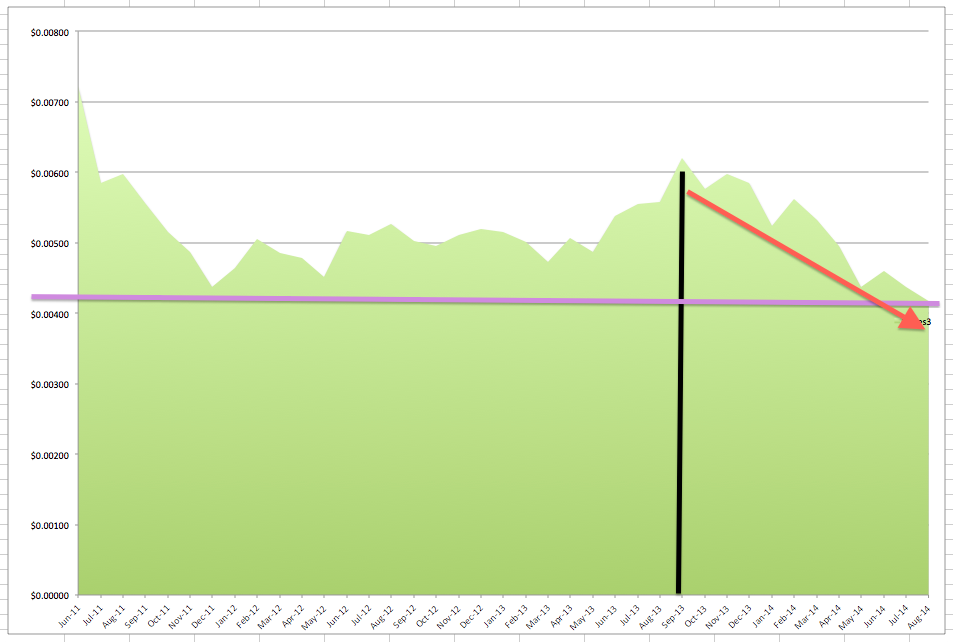
We’ve questioned the philosophy and math behind streaming for a while now and it appears some of our criticisms and concerns are coming true. For example we noted that the Spotify per stream rates are dropping as more users are added to the service.
If overall revenue continue to decline, especially in the most promoted and championed markets in the world, what does that say for the rest of the world?
We previously reported that the per stream rates are dropping as the service add more users (graph below). This new data suggests that not only is the per stream rate dropping, but in two the leading countries in the world overall revenues are also down.
It’s just math.
IMPALA Takes Action on Behalf Of Zoë Keating
Thanks to the efforts of music makers and the fans and journalists who love them–who clearly respect music more than YouTube does–the latest round of abuse on Zoë Keating from YouTube has resonated all the way to Brussels where indie label trade group IMPALA launched a new initiative against Google inspired by the reaction to YouTube’s treatment of Zoë. Paul Resnikoff of Digital Music News, Andrew Orlowski of The Register and Stuart Dredge of The Guardian deserve special recognition for doggedly sticking to the story despite Google’s Spotify-like whisper campaign to discredit Zoë.
IMPALA’s press release today in Brussels tells the story:
Independent music companies launched a unique Digital Action Plan today, calling for a new European industrial policy to drive the digital market through the cultural and creative sectors, which account for 4,2% of EU GDP and 7.1 million EU jobs.
The role of culture in Europe’s digital market will be one of…
View original post 586 more words
 The Trichordist
You must be logged in to post a comment.