Zoë Keating Publishes Google/YouTube Transcript : Clarity | Zoë Keating Blog

With friends like these…

If i wanted to just let content ID keep doing it’s thing, and it does a great job at and i’m totally happy with it and i don’t want to participate in the music service, is that an option?

That’s unfortunately not an option.

Assuming i don’t want to, then what would occur?

So what would happen is, um, so in the worst case scenario, because we do understand there are cases where our partners don’t want to participate for various reasons, what we basically have to do is because the music terms are essentially like outdated, the content that you directly upload from accounts that you own under the content owner attached to the agreement, we’ll have to block that content. but anything that comes up that we’re able to scan and match through content ID we could just apply a track policy but the commercial terms no longer apply so there’s not going to be any revenue generated.

Wow that’s pretty harsh.

Yeah, it’s harsh and trust me, it is really difficult for me to have this conversation with all of my partners but we’re really, what we’re trying to do is basically create a new revenue stream on top of what exists on the platform today.

PLEASE READ THE ENTIRE POST/TRANSCRIPT AT:
http://zoekeating.tumblr.com/post/109312851929/clarity

Involuntarily Distribution Business Subsidies | East Bay Ray

One of the talking points that various tech company commentators, academics and bloggers have used to try to justify companies exploiting an artist’s work without consent (a loophole in safe harbor) is that it would lessen the barrier for tech companies to start up. The idea is that creators should be required to give something up to facilitate this goal. Business start-ups are all well and good, but to require anyone to involuntarily subsidize a business, internet or otherwise, with something they have put time, effort, money, and skill into is extremely problematic.

Would these same people advocate that landlords and utility companies also give up income and the right of consent to help internet companies? That would also make it easier for them to start. But no one has suggested that.

It could be ruinous for creators to be required to be involuntarily involved in start-ups that may or not succeed, tying them to businesses that the artists has no way to vet to see if they even know how to distribute competently or honestly. If they are to survive, artists need to examine their licensees and distributors. I’ve seen many artist’s careers die prematurely from incompetent, greedy or dishonest businesses. (Compulsory licenses that are a last resort to negotiation, rather than the first resort to eliminate negotiation, is an alternative that has for decades shown itself to ensure artist’s sustainability.)

To put it into personal terms, I shouldn’t be forced, or any person for that matter, into being a lab rat for some click bait experiment. And then if the experiment is successful, none of the content creators share in any of the IPO rewards. A bit un-American I’d say and bad policy, it does not allocate rewards according to risk.

History has shown that exploitation of another person’s work with little compensation or without their consent to insure an enterprise’s survival is fraught with ethical and moral issues. If internet companies can not make money selling a product or service on merit and integrity, and treating the people that supply their “product” justly and with respect, something is not right. No matter how well intentioned by well meaning people, economic philosophies that ignore consent or fair compensation, rarely turn out good for society.

– – –
East Bay Ray is the guitarist, co-founder and one of two main songwriters for the band Dead Kennedys. He has been speaking out on issues facing independent artists—on National Public Radio, at Chico State University, and on panels for SXSW, Association of Independent Music Publishers, California Lawyers for the Arts, SF Music Tech conferences, Hastings Law School and Boalt Hall Law School. Ray has also met with members of the U.S. Congress in Washington, D.C. to advocate for artists’ rights.

Nashville’s Musical Middle Class Collapses | Tennessean

This says it all…

Since 2000, the number of full-time songwriters in Nashville has fallen by 80 percent, according to the Nashville Songwriters Association International. Album sales plummeted below 4 million in weekly sales in August, which marked a new low point since the industry began tracking data in 1991. Streaming services are increasing in popularity but have been unable to end the spiral.

READ THE FULL STORY AT THE TENNESSEAN:
http://www.tennessean.com/story/entertainment/music/2015/01/04/nashville-musical-middle-class-collapses-new-dylans/21236245/

Google’s Guide to RICO

well… just because… the more you know…

Music Technology Policy

PRS For Music recently released a report entitled the “Six Business Models of Copyright Infringement.”  This report was co-sponsored by Google.  The company’s European Policy Blog had a suitably Googlely statement (if you know what I mean) announcing the release of the report.  (http://googlepolicyeurope.blogspot.com/2012/07/follow-money-to-fight-online-piracy.html?utm_source=feedburner&utm_medium=feed&utm_campaign=Feed%3A+EuropeanPublicPolicyBlog+%28European+Public+Policy+Blog%29) Well, it wasn’t entirely Googley because it didn’t contain any of the usual “Joe Camel” semiotics.

No references to children’s foods, candy, or toys, and it didn’t say “goo goo ga ga”.  Maybe they take the report seriously.

The blog said in part:

How best to combat this danger [of massive copyright infringement]? Instead of imposing blocks or filters that might damage fundamental freedoms, governments should construct coalitions with reputable advertising networks, payment processors and rightsholders. Together, these coalitions can crack down and squeeze the financing behind online infringement.

Good point.  Yes, indeed, Google has made an excellent point.  And you know, here in the United States…

View original post 991 more words

MegaUpload (MegaVideo) Smoking Gun? Did the site illegally charge for Streaming Movies?

As the SONY HACK unravels, keep this in mind. It’s about the money.

The Trichordist

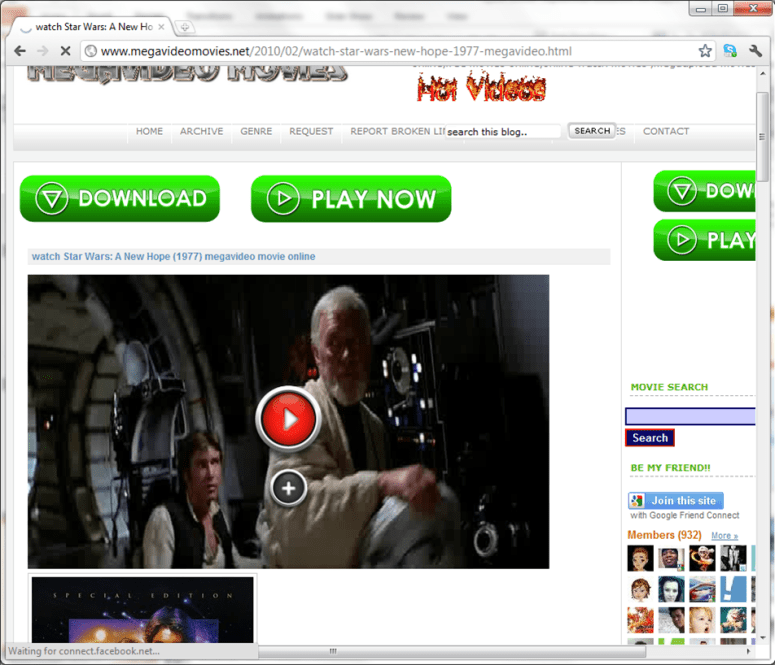
These screen shots appear to show that Kim Dotcom’s Megaupload was selling streaming movies that it did not have the rights to sell.

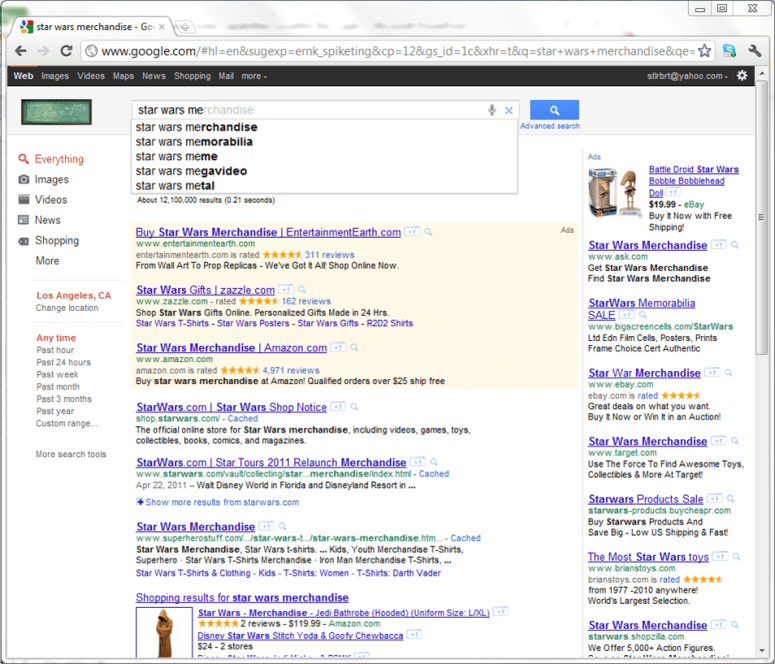
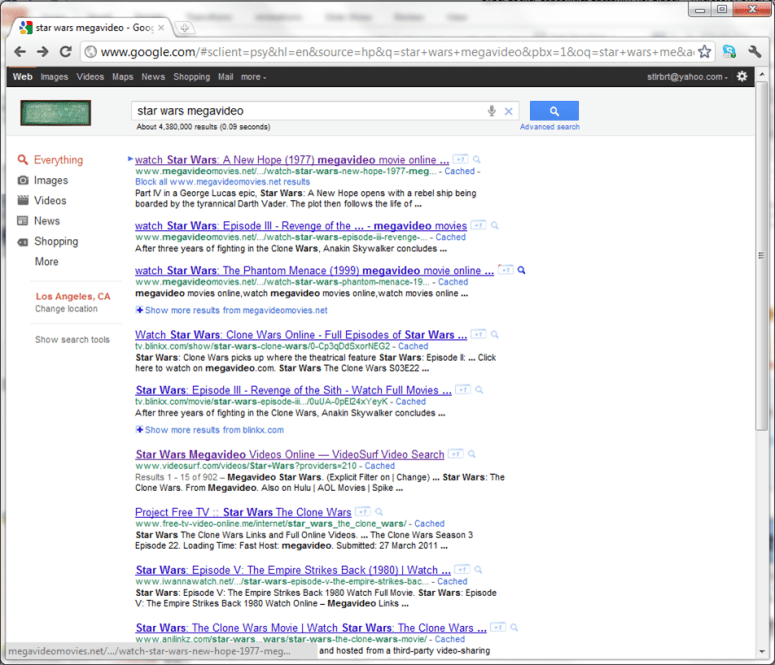
Megaupload was allegedly paid uploaders per stream from files they uploaded to Megaupload. That is why there were so many links that Google autopopulated Megavideo after you entered Star Wars in the search field.

Then Google estimated that there were 4.3 million web pages that had the words “star wars megavideo” on them.  Legitimate file locker sites like Dropbox, don’t allow any public links to copyrighted content.  In fact Dropbox just banned Boxopus, a torrent tool from using its API.

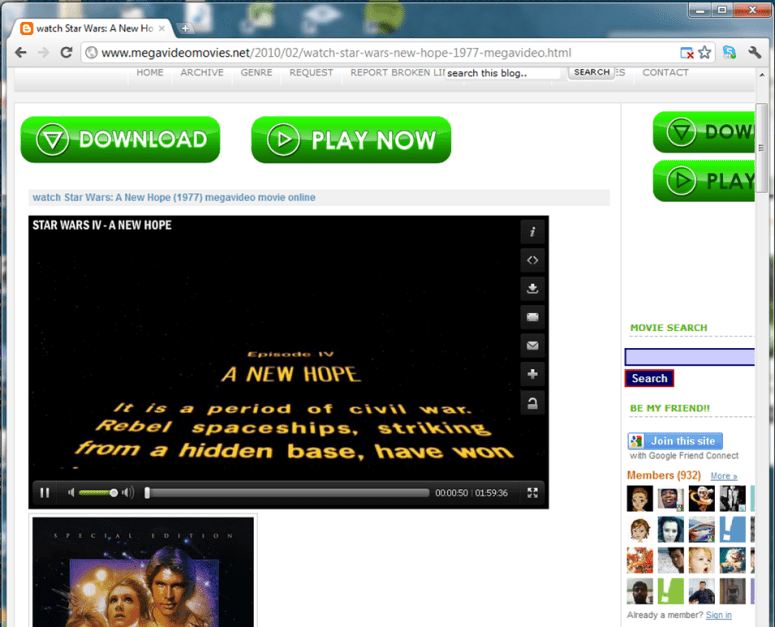
Megavideo let you play the first 45 minutes of Star Wars and thousands of other movies for free (after they had served you and profited from dozens ads) . . .

But then, to watch past 45 minutes, you had to enter your credit card and pay…

View original post 83 more words

Zero Dark Thirty, Best Picture Academy Award Nominee, Exploited by AT&T, Verizon, MetroPCS, Nissan, H&R Block, British Airways, Progresso, and more…

Zero Dark Thirty was also a SONY PICTURES release – this is how piracy is a FOR PROFIT business. The latest hack is intended to create financial harm…

The Trichordist

We spend most of our time here focused on artists rights as it applies to music and musicians. But we wanted to see if the film industry was having the same challenges as music. We believe in the rights of all creators to consent and compensation for their work (ethical internet principles numbers two and four, respectively).

With the upcoming Academy Awards we wondered if it would be possible to find pirated versions of Zero Dark Thirty. It is  the most talked about film of the year which is nominated for five Academy Awards including Best Picture. But it could easily be any of the other nominated films, in any of the categories as well. We just picked Zero Dark Thirty. It’s also been widely reported that most of the nominated films have already been pirated and are online.

We were also curious what major brands might…

View original post 695 more words

Artists, Know Thy Enemy – Who’s Ripping You Off and How…

With all the talk about Spotify and YouTube Music Key, let’s remember the source of the real problem…

The Trichordist

Musicians have been getting the short end of the stick for a long time. There are no shortage of stories about the wrong doings of managers, booking agents, etc and of course record labels.

But today we find ourselves in a battle with an enemy few of us understand. If we were to believe the writings and ramblings of the tech blogosphere, than they would have us believe that our enemy is our fans. This is simply not true.

The enemy are the for profit businesses making money from our recordings and songwriting illegally. Let’s be clear about this, our battle is with businesses ripping us off by illegally exploiting our work for profit. This is not about our fans. It is about commercial companies in the businesses of profiting from our work, paying us nothing and then telling us to blame our fans. That is the ultimate in cowardice…

View original post 959 more words

Apple Announces Itunes One Dollar Albums and Ten Cent Song Downloads | Sillycon Daily News

Satire – but not by much.

Apple Computer announced today that for it’s Itunes Music Store to remain competitive in the digital distribution marketplace for music they would be changing their retail pricing of album downloads to one dollar and song downloads to 10 cents each. The pricing change will be effective on black Friday for this holiday season. “Since we purchased Beats music and are competing directly with Spotify we recognized the need for more competitive pricing structures based on what consumers may be willing to pay”, an Apple spokesman said. He continued, “Spotify has proven that as long as we’re paying 70% of gross, the retail pricing is irrelevant, irrelevant! We are even contemplating 10 cent albums and one cent songs to further achieve parity with music streaming services!”

Record label executives rejoiced in the move as one source exclaimed,” I don’t know why we didn’t think of reducing the retail price of downloads by 90% years ago. It’s still money, right? It’s so simple that this is really the only way to grow the business to $100b annually while competing with piracy.”


calculator

Music Streaming, New Money Vs. Old and the Market Cap of All Music… | The Cynical Musican

A must read post from The Cynical Musician:

“In a hypothetical future that is nothing but streaming (a depressingly real possibility, given that everything but streaming is going down the drain), the size of the industry is capped at 70% of streaming service revenue. There’s no way to grow the industry, because there’s no new money coming in. The subscription revenue pays for all present and future consumption, it doesn’t matter how many (or few) hot new releases there are. In fact, it doesn’t even matter what music is on the service or how popular it is. The size of the pie is fixed from the start.”

READ THE FULL POST HERE:
http://thecynicalmusician.com/2014/11/new-money/