David Lowery Debates Google on Ad Sponsored Piracy in London

A full transcript of the debate is available at Music Ally. Here’s the set up…

The topic of ad-funded piracy has been increasingly prominent in recent months, with musician David Lowery, Beggars Group founder Martin Mills, music industry body the BPI and the University of Southern California’s Annenberg Innovation Lab (among others) questioning why so many big brands’ ads appear on sites that are engaged in piracy.

Google agrees with David that Music Piracy is a for profit business…

Google’s Theo Bertram gave his company’s view, suggesting that he agreed with most of what Lowery had said. “It does seem to me to be an entirely sensible way to tackle piracy… most people doing piracy are not some guy in his bedroom altruistically sharing music with his friends. It’s people making money out of piracy, and it’s big business: some of these sites have 2m visitors regularly, and they’re not doing a bad business from advertising.”

READ THE FULL TRANSCRIPT AT MUSIC ALLY:
http://musically.com/2013/05/28/live-google-david-lowery-and-the-bpi-talk-ad-funded-piracy/

BitTorrent, “Not Designed For Piracy”… Really? Seriously? 99% Infringing…

Bit Torrent creator Bram Cohen is either one of the most misinformed people on earth, or one of the most intellectually dishonest… and here’s why… Remember this one?

BitTorrent: Bram Cohen Says ‘I commit digital piracy’?

I build systems to disseminate information, commit digital piracy, synthesize drugs, maintain untrusted contacts, purchase anonymously, and secure machines and homes. I release my code and writings freely, and publish all of my ideas early to make them unpatentable.

Uhmmmm…. So why this is surprising?

Only 0.3% of files on BitTorrent confirmed to be legal | Ars Technica

This report echoes similar results out of Princeton that were published earlier this year. Though the top categories were slightly different—Princeton found that movies and TV were the most popular, while music fell behind games/software, pornography, and unclassifiable files—that study found that all of the movie, TV, and music content being shared was indeed infringing.

Overall, Princeton said that 99 percent of the content on BitTorrent was illegal.

Oh and that Princeton Study…

BitTorrent census: about 99% of files copyright infringing | Ars Technica

It has never been a secret that the majority of files being shared over BitTorrent are movies and music that are likely being shared illegally.

But wait there’s more…

Census of Files Available via BitTorrent

Overall, we classified ten of the 1021 files, or approximately 1%, as likely non-infringing, This result should be interpreted with caution, as we may have missed some non-infringing files, and our sample is of files available, not files actually downloaded.

Still, the result suggests strongly that copyright infringement is widespread among BitTorrent users.

Fast forward to 2012…

Keen On… Bram Cohen: Has BitTorrent Killed The Music Industry?

His denial was categorical. Not only did Bram deny any role in shrinking the sale of recorded music, but he actually disputed that the music industry is in decline, claiming “data” showed it to be in a quite healthy state.

Well Bram, you might want to look at this, and this

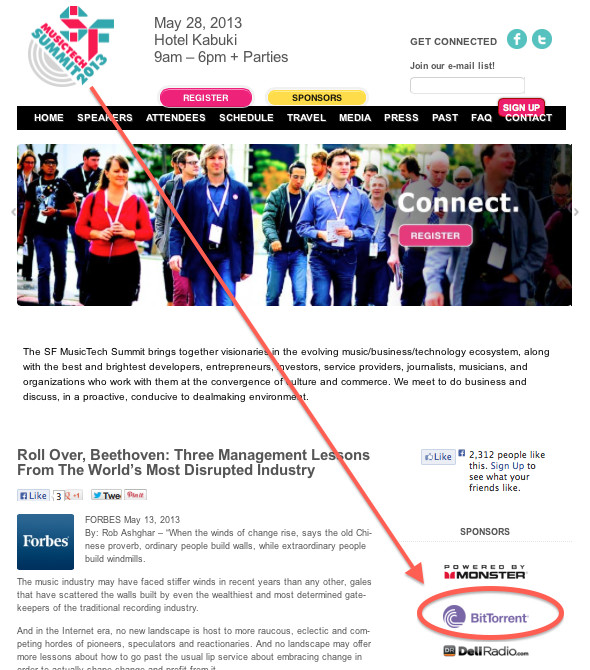
and… as another #SFMusicTech begins BitTorrent is one of the lead sponsors… To be fair, SFMusicTech get’s to run it’s event and do business with whom it chooses. Unfortunately musicians are not given the same choice of having their work “torrented.” So how about a little honesty?

This conversation is really just about consent and compensation. Two very simple fundamental principles that pretty much everyone can agree are the foundations of not just ethical business practices, but also the basis for a fair and just society.

SFmusicTechBitTorrent

Music Tech Policy explores the question, “Can 5 Billion Ads Served a Month Be Wrong”:
MTP : BitTorrent Profits from Piracy By Serving Ads To UTorrent Client

ADWEEK : “Ad Industry Takes Major Step to Fight Online Piracy”… Again…

Stop me, oh uh, stop me, if you think you’ve heard this one before…

The advertising industry took a major step Thursday in fighting rogue websites that steal copyrighted material and sell counterfeit goods. To cut off the financial support that keeps rogue sites alive, the nation’s two major ad industry associations recommended agencies and marketers take steps to keep brands’ ads off those sites.

While the debate remains contentious, there has been universal agreement that the key to shutting down rogue websites was to cut off the money that keeps them alive.

Recognizing advertising was the first line of attack, GroupM last year became the first ad shop to adopt a comprehensive anti-piracy policy, compiling last summer an updatable black list of some 2,000 websites that are cut off from ads from blue-chip clients like Ford, AT&T, Unilever and Dell.

READ THE ABOVE FULL ARTICLE HERE AT ADWEEK:
http://www.adweek.com/news/technology/ad-industry-takes-major-step-fight-online-piracy-140014

So the above is from May 3, 2013… and here’s an insightful article below from the advertising trade publication CLICKZ.COM on April 18, 2011… Yes, 2011…

What is the purpose of me bringing this up? To raise awareness and perhaps ask publicly that those involved in this industry become better corporate citizens. If you are running one of those exchanges or networks and feel that it’s only a “transparency” issue, please consider that you are funding not only these websites but organized criminal organizations that run them.

This is not a victimless crime, but instead one that is affecting musicians, programmers, artists, designers – and businesses of all sizes.

As an industry, here are some suggestions of what we can do:

1. Ensure every network that you work with has a no-warez/piracy/torrent policy. Ask around about the networks that do support this. Even if they claim that your ads aren’t going on there, be aware that many of these networks aren’t honest.

2. Put pressure on exchanges that you work with to ensure no network that has this type of inventory is on that exchange. If a few agencies call the exchanges and make it clear they won’t buy media until they are assured these sites are completely off the exchange, then maybe those in charge will consider it a serious issue.

3. Refuse to pay networks that you discover violate this policy and show your advertisements on those sites. Make it clear that you find this behavior not only illegal, but unacceptable for your agency, network, or product.

YOU CAN READ THE FULL ARTICLE HERE (FROM 2011) AT CLICKZ:
http://www.clickz.com/clickz/column/2041366/advertising-networks-supporting-piracy

Accountability?
Responsibility?
Transparency?
Anyone?
Hello?

Why I Was Banned From Speaking At San Francisco Music Tech #SFMUSICTECH

this photo says it all

“This says It all”

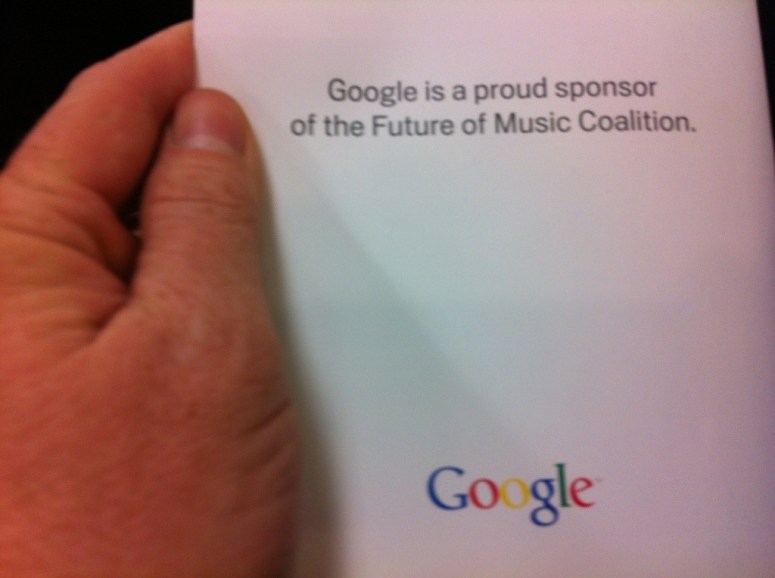
I was supposed to speak at the SF Music Tech Summit Feb 19th 2013.   A few days before my scheduled appearance I received a call from  SF Music Tech and Fututre of Music Coalition co-founder Brian Zisk explaining that I would not be allowed to speak because I tweeted/blogged the above picture with the following caption “this says it all.”   Further he noted that “certain sponsors” would not “appreciate” me speaking at this event.

I love the hypocrisy of the Silicon Valley. They are all for free speech until they aren’t.

The fundamental American right is Free Speech. SF Music Tech (and Silicon Valley in general) do not really respect this right. Especially when it begins to interfere with their bottom line.

So what do you say we just end the charade? SF Music Tech Summit is biased against creators/musicians and their rights. It’s a pro-tech industry event.  It’s held in the Kabuki Hotel in San Francisco.  Because it is a giant Kabuki.

Three times a year  you find Tech Industry “entrepreneurs” who’ve never turned a profit “debate” un-elected artists rights advocates who as it turns out work for opaque 501C  foundations and organizations  that are funded by technology companies like Google.

If it’s not clear I’m talking about you, Future of Music Coalition and Cash Music.  Sorry guys/gals you had your chance to do the right thing and  speak out publicly against me being banned and you didn’t.  That makes you at best quislings and at worst shills.

SF Music Tech and Brian Zisk have every right to do whatever they want with their #SFMUSICTECH summit but I just ask them to stop pretending it reperesents anything other than the technologists that wish to exploit artists.

Have a good SF Music Tech.  I’ll be off touring the UK.

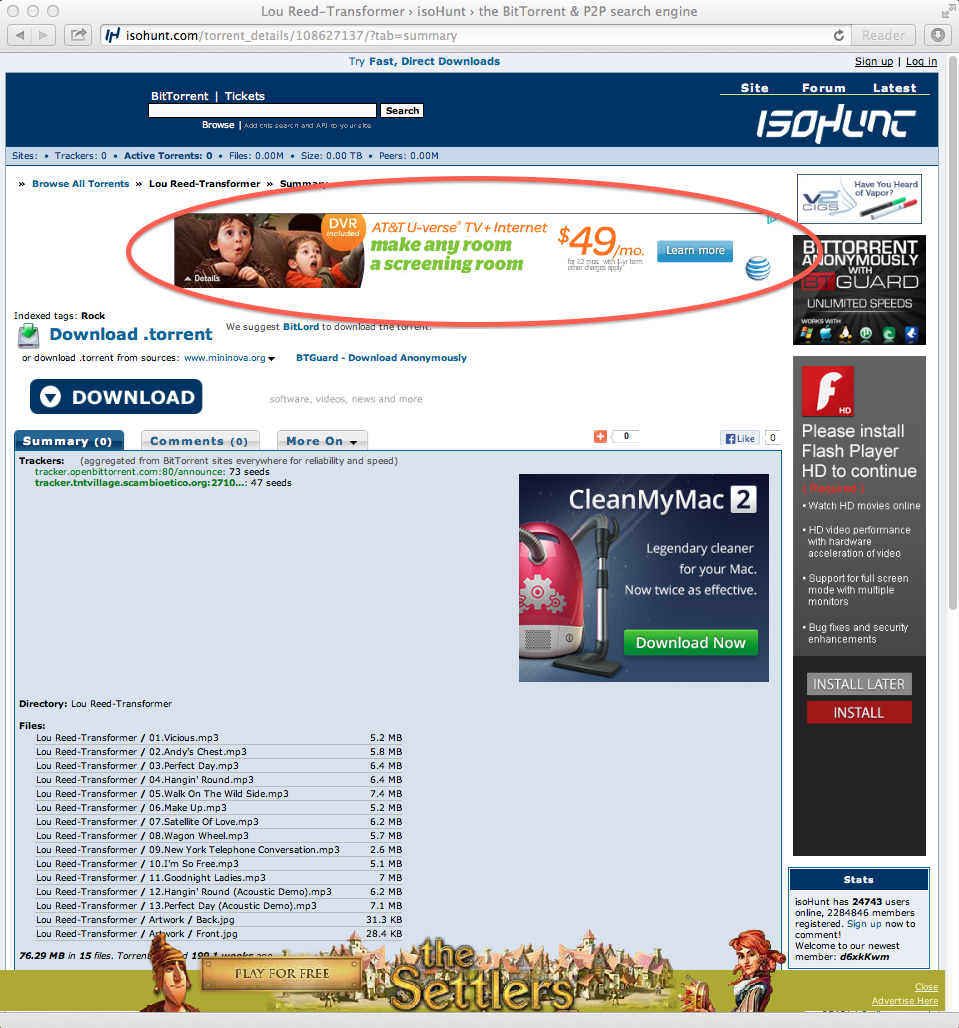
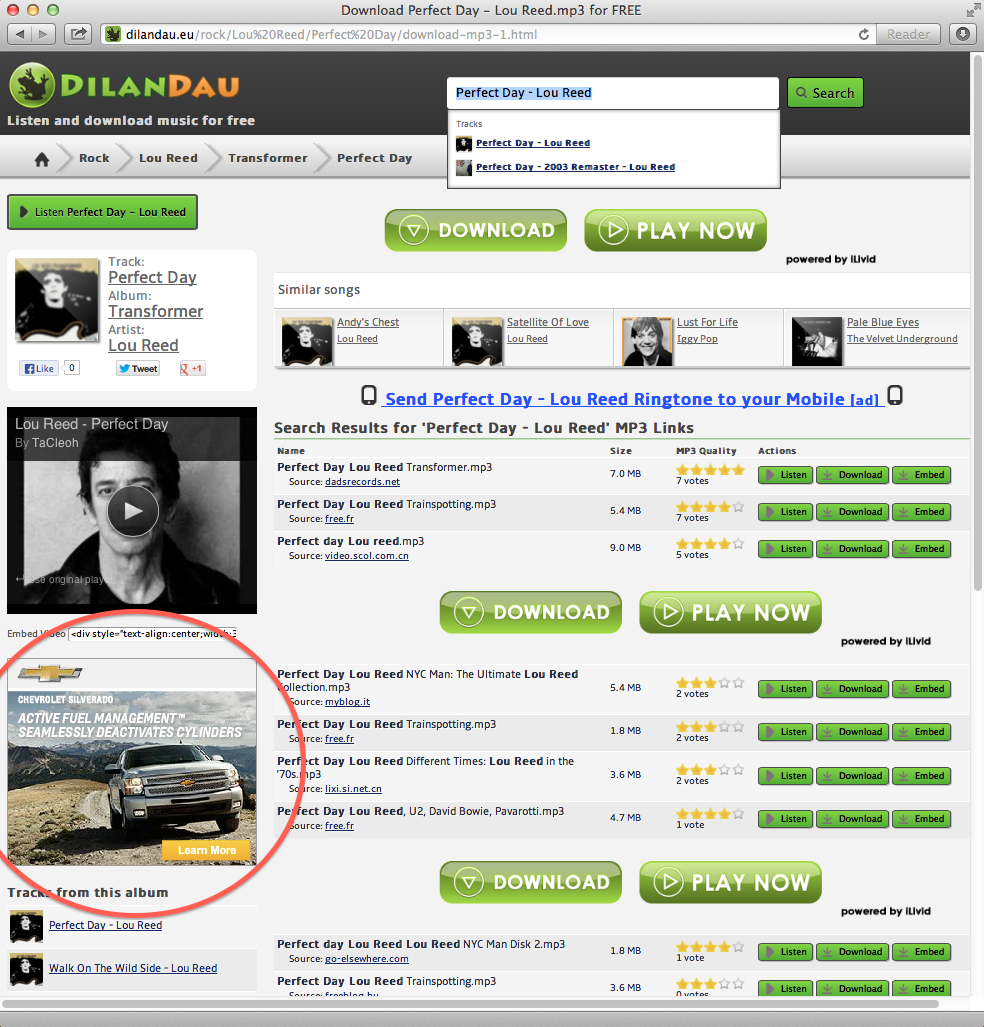
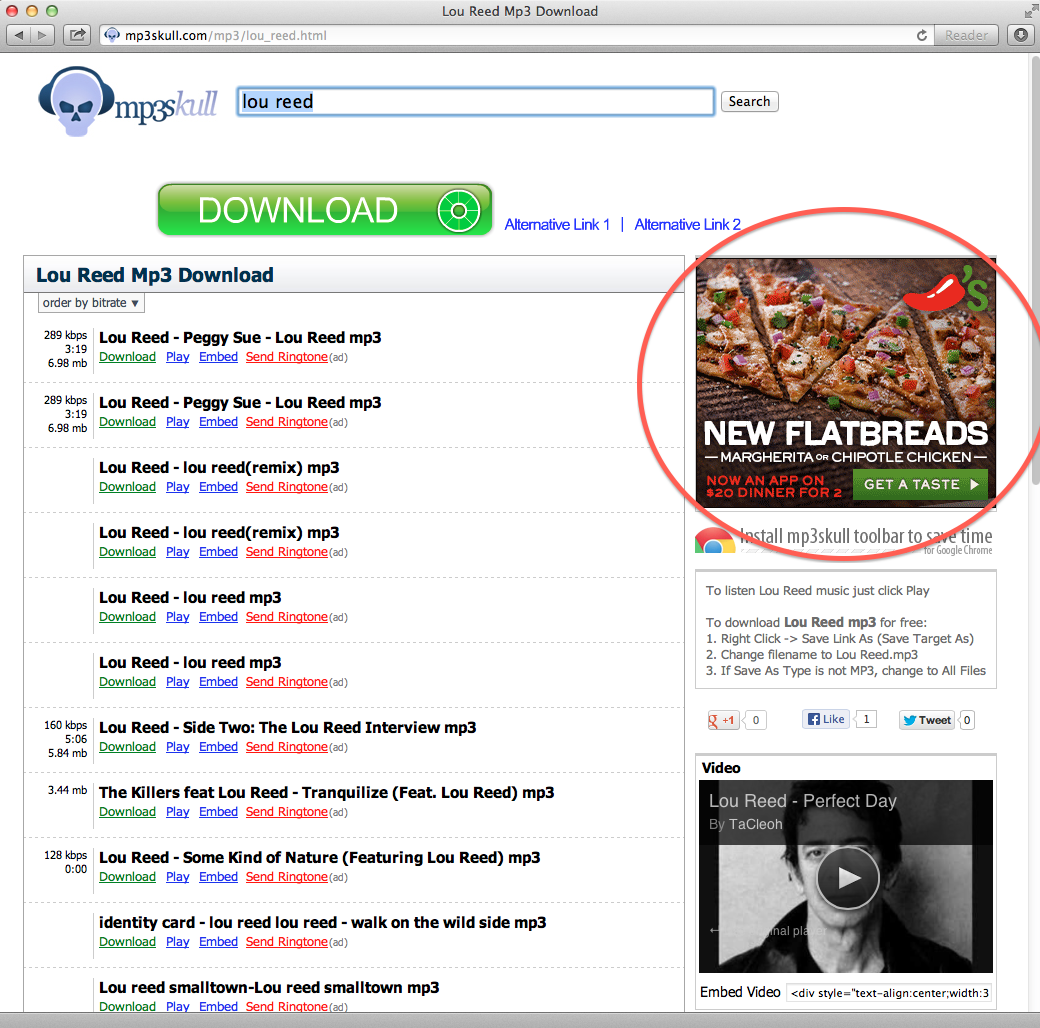
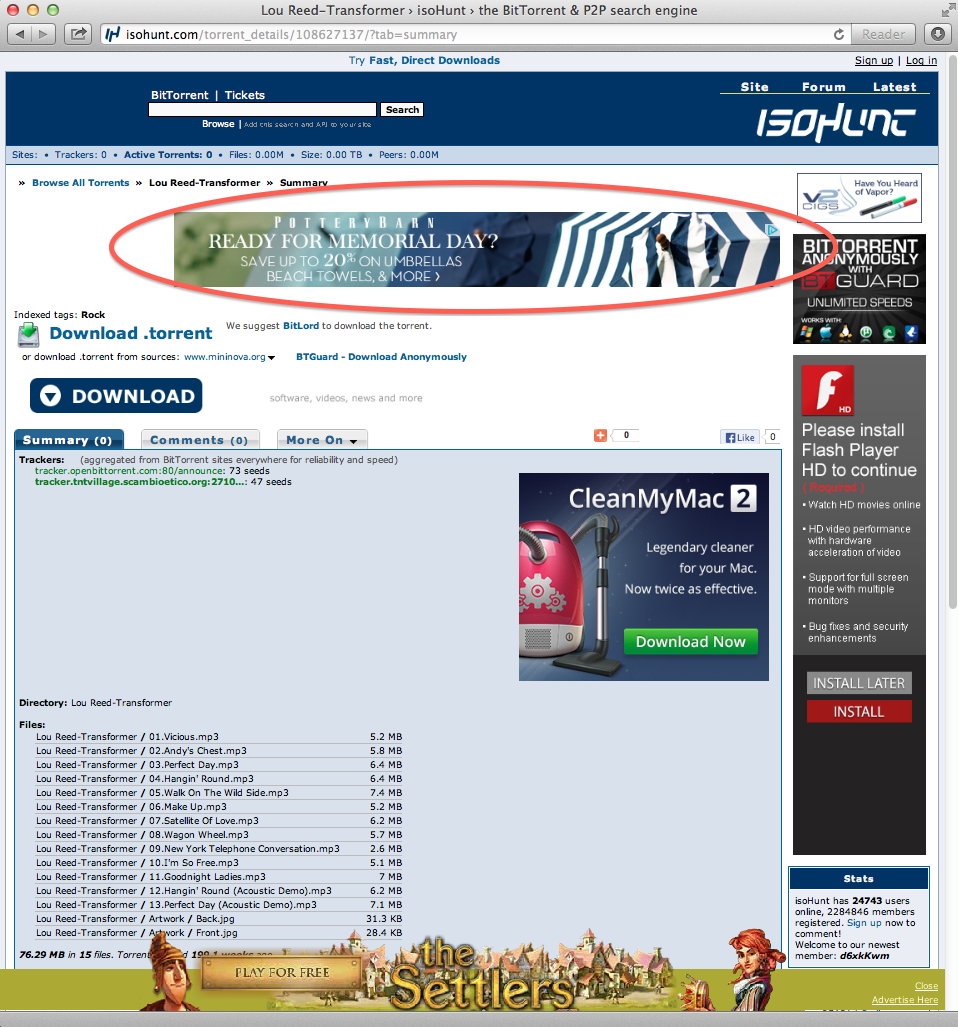
Lou Reed Exploited By American Express, AT&T, Chevrolet, Chili’s, Lysol, Pottery Barn, Vons, Domino’s Pizza, Netflix, Galaxy Nexus and Ron Jeremy!

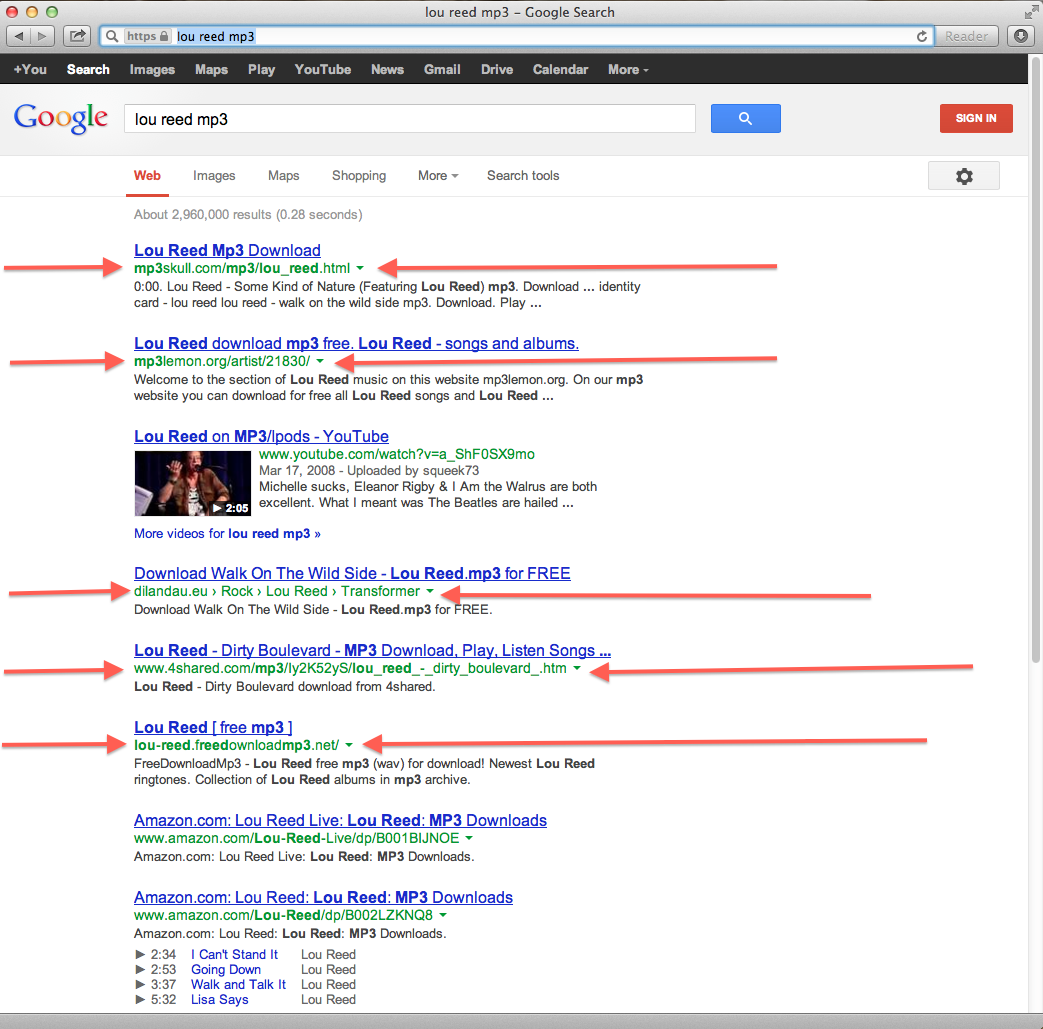
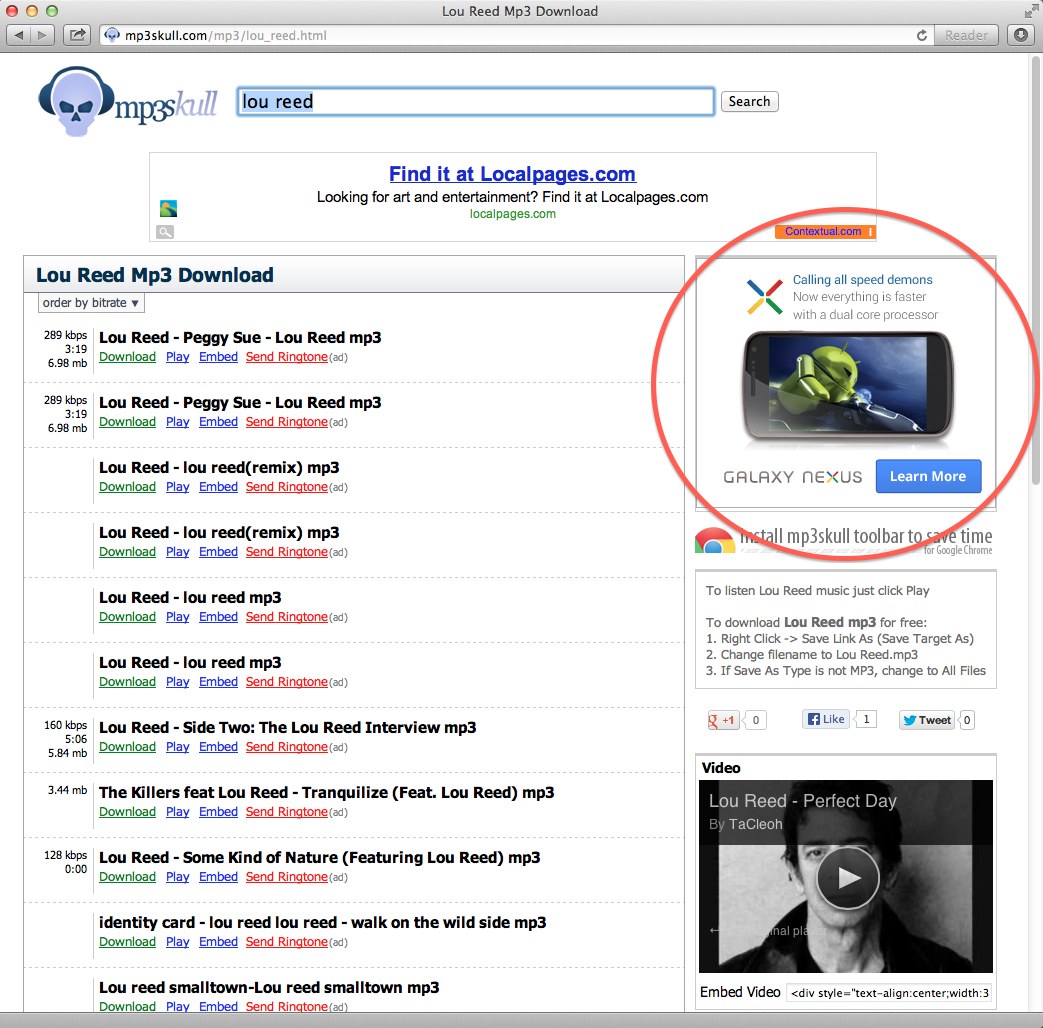
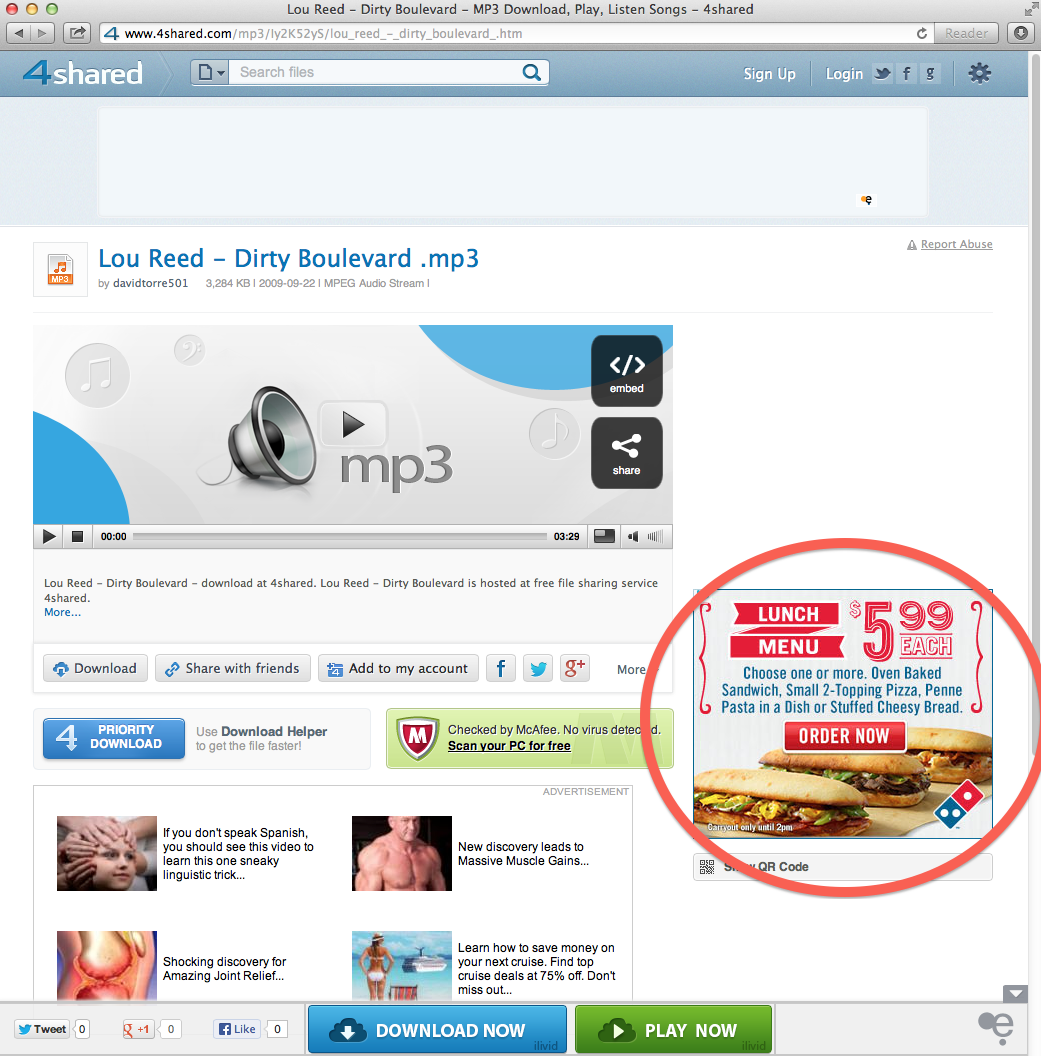
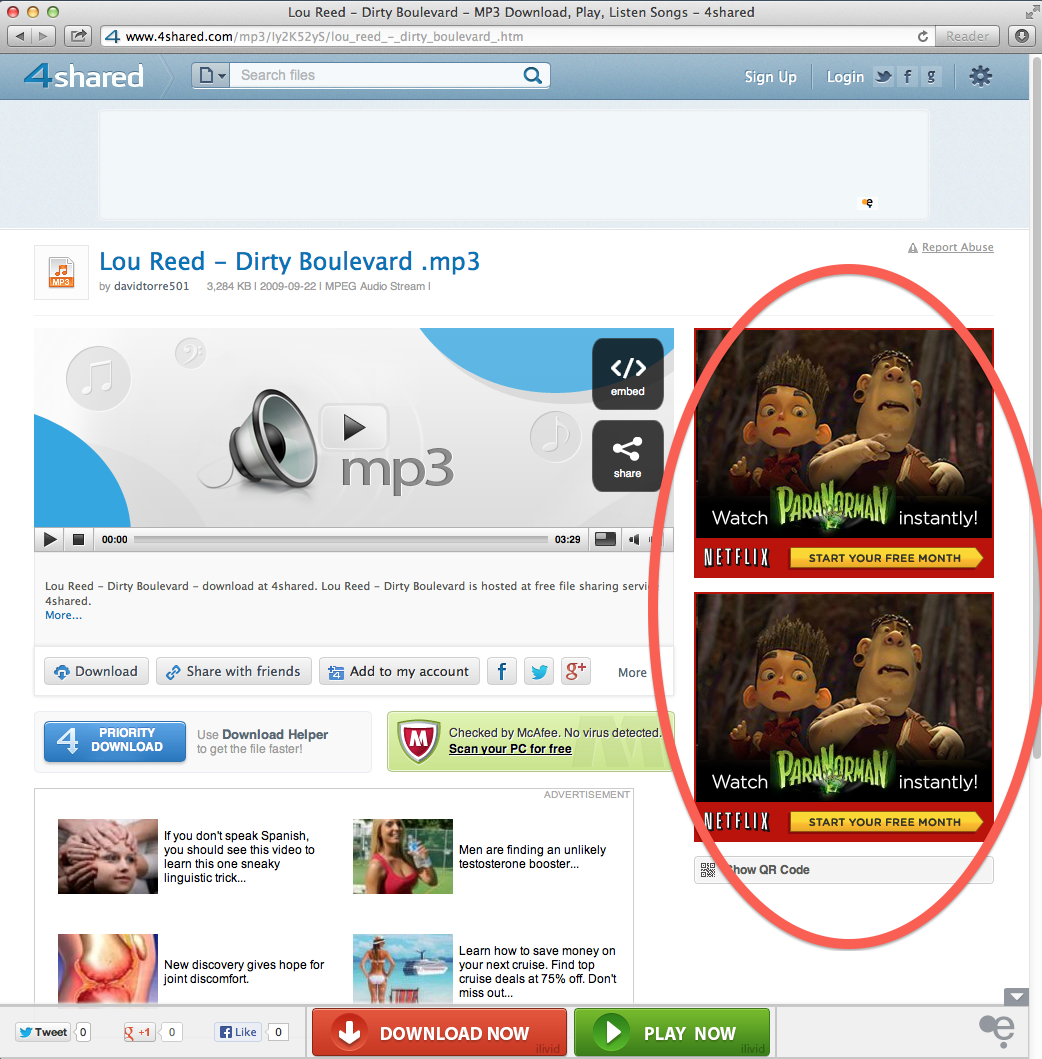
Here we go again… We can go to Google and within minutes search for an artist of stature such as Lou Reed and quickly find unlicensed and infringing internet businesses exploiting his life’s work illegally while paying the him nothing, zero, zilch, nadda, zippo.

There are many disappointing things about all of this, but the first is that when doing a simple Google search for “Lou Reed Mp3” the first five returns are for illegally operating and infringing sites.

This doesn’t count YouTube which may or may not be infringing, and may or may not actually be paying Lou from the advertising revenue (on this video, in the screen shots below for example). This is all the more troubling because we know that this can be easily filtered if there is the will to do so.

The ad networks have been highlighted in the fantastic work done by Jonathan Taplin in the USC Annenberg Innovation Lab’s Advertising Transparency Reports.

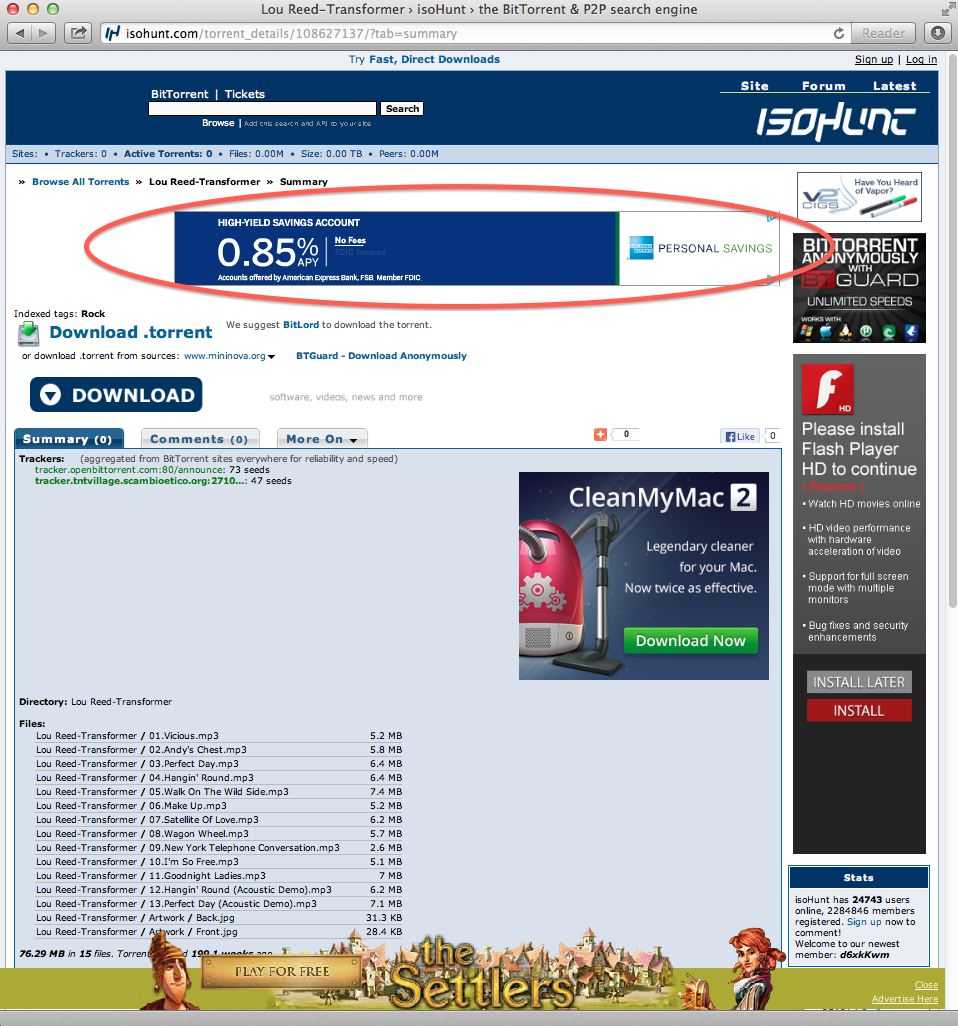
Perhaps most disappointing however is that major companies like American Express, AT&T Chevorlet, Chili’s, Lysol, Pottery Barn, Vons, Domino’s Pizza, Netflix and Galaxy Nexus are still supporting the this exploitation of artists with corporate advertising dollars. These companies not only supply the funding for these sites exploiting artists to exist, but perhaps even worse they add legitimacy to music piracy by lending their brand identity to it.

Clearly there is a lot of money being made in the distribution of music on the internet. Sadly not much of that money (or in this case NONE of it) is being distributed (or uhm, “shared”) with the artists themselves.

In any value chain where the artists work is being distributed and/or exploited for profit, the artist should be included in that value chain.

LouReedGoogleSearch

LouReedAMEX

LouReedATT

LouReedCHEVY LouReedCHILI'S LouReedLYSOL

LouReedPOTTERYBARN

LouReedGalaxyNexus

LouReedDOMINOS

LouReedNETFLIX

Not only do we see the major companies supporting these sites but there’s also the scam ads, rip offs and bogus services. And here’s where it gets even uglier…on sites like The Pirate Bay the work of Lou Reed is promoting adult (escort services?) and porn products like the one offered by Ron Jeremy below.

LouReedTPBPORN

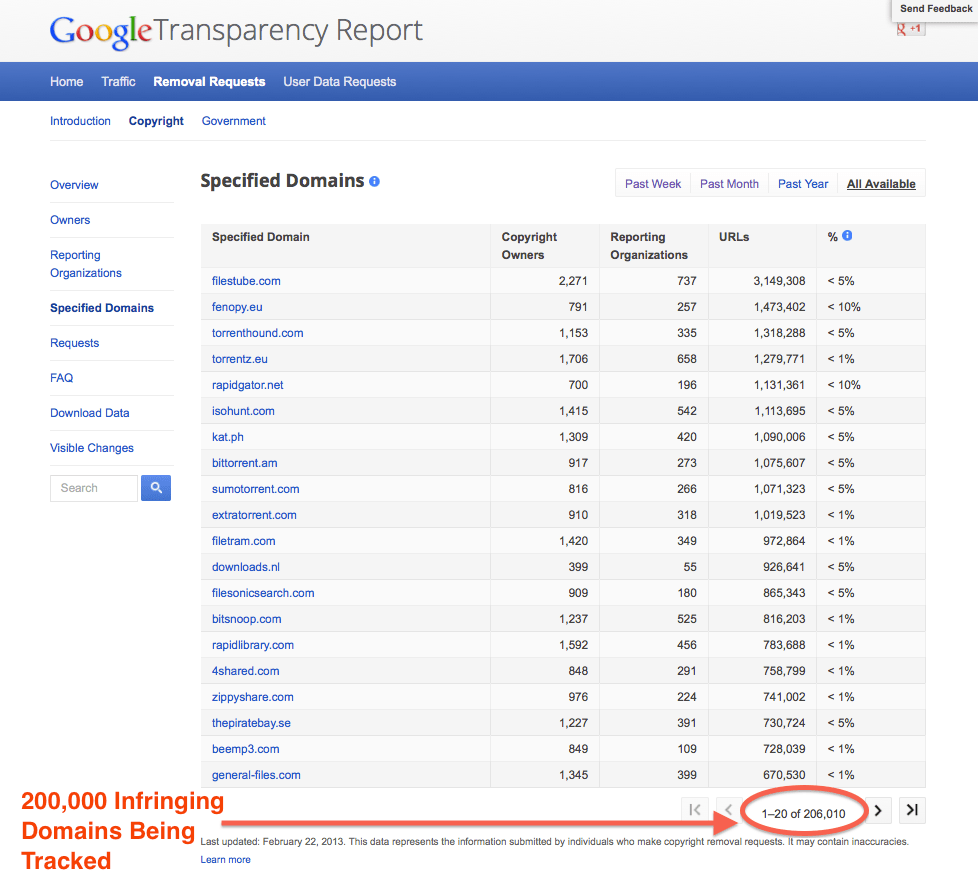
Let us not forget that the above examples represent a drop in the ocean of the over 200,000 infringing sites that Google alone is tracking.

See more Corporate Advertising Funded Exploitation of Artists:
Tom Waits * Neil Young * Aimee Mann * Neko Case * U2 * Ben Gibbard/Death Cab For Cutie * East Bay Ray / Dead Kennedy’s * Billy Corgan/Smashing Pumpkins

Look who’s Pirating now! University Of Georgia Music Business Program’s Preliminary Study Of Advertising On Copyright Infringing Sites.

Jonathan Taplin at  USC’s  Annenberg Center has spent the last few month studying which parts of the online advertising ecosystem are delivering advertising (and hence revenue) to unlicensed music sharing and streaming sites.   His study has caused quite a stir in the advertising and entertainment industry.  Jonathan recently asked me to corroborate some of his findings regarding which brands are advertising on these websites. These are  the results of my preliminary survey.

Over two weeks in April  I had a group of students at UGA note which “brands” were advertising on a small set of sites that stream and distribute my own music without permission or compensation.  I chose sites that featured my own music for a very specific reason:  I could be 100% certain that they were exploiting my material without permission and were hence illegitimate sites.  Third party sources agree with my assessment. For instance The Google Transparency Report has all but 1 of these sites  in the top 200 recipients of DMCA takedown notices.

The purpose of the preliminary study  is not to identify how these advertisements end up on these infringing sites, but simply which brands are appearing on these sites.  We realize that brands often do not realize that their ads are appearing on these sites.   We hope this information is useful to advertisers, advertising agencies and the entertainment industry.  We believe along with artists the brands are also victimized by this practice because they are not geting the quality advertising for which they’ve contracted. And often their ads  appear next to unseemly videos and ads for adult and fetish sites thus damaging the image and reputation of the brands.  We encourage the listed brands to conduct audits of those responsible for placing these ads.  If it’s not possible for those responsible  to comply with an audit demand you should be aware that it is then highly likely that your ads will continue appearing on these sites!

Below I’ve listed the brands in two orders.  The first lists the brands by frequency, adjusted by a “breadth” coefficient. I will explain this breadth coefficient in subsequent post, but because of the way advertisers “track” web users,  the sheer number of a brand’s ads on a website can be somewhat misleading.   For instance ads for the apartment complex “River One” seemed to follow a single student the entire two weeks, but none of the other students recorded an ad from this company. This does not mean that “River One” isn’t in fact funding sites that exploit artists without compensation, it’s just a number of factors could be distorting their overall rankings.  Hence the breadth adjustment to dampen some of these effects.

In the following days  I’ll publish my rather simple  methodology and links to raw data.  Items that expose students identity will be redacted.

University Of Georgia Music Business Program Top 40 Brands Advertising On File Infringing Sites- Preliminary Survey (Breadth Adjustment):

Based on sample of 1,851 pageviews.

April 10-26 2013

rank Top Advertisers instances % “breadth” frequency adj for breadth
1 Country Financial 157 8.5% 100.00% 8.48%
2 Become.com 89 4.8% 100.00% 4.81%
3 AT&T 60 3.2% 100.00% 3.24%
4 Champion roofing 51 2.8% 100.00% 2.76%
5 State Farm 47 2.5% 75.00% 1.90%
6 Target 39 2.1% 87.50% 1.84%
7 Georgia Natural Gas 31 1.7% 100.00% 1.67%
8 AAA 29 1.6% 87.50% 1.37%
9 Rooms To Go 33 1.8% 62.50% 1.11%
10 Allstate 20 1.1% 100.00% 1.08%
11 Transunion 24 24 1.3% 75.00% 0.97%
12 H&R Block 18 1.0% 75.00% 0.73%
13 Pirate storm 26 1.4% 50.00% 0.70%
14 Quibids.com 13 0.7% 100.00% 0.70%
15 Coca-Cola/American Idol 16 0.9% 75.00% 0.65%
16 The New York Times 16 0.9% 75.00% 0.65%
17 One River Place (Atlanta GA) 94 5.1% 12.50% 0.63%
18 Progressive insurance 22 1.2% 50.00% 0.59%
19 Xfinity 15 0.8% 62.50% 0.51%
20 Nationwide 15 0.8% 50.00% 0.41%
21 Suntrust 14 0.8% 50.00% 0.38%
22 The Gold Coast Casino 11 0.6% 62.50% 0.37%
23 Norton 9 0.5% 62.50% 0.30%
24 Just fab boots 14 0.8% 37.50% 0.28%
25 Wartune 10 0.5% 50.00% 0.27%
26 Bing 5 0.3% 100.00% 0.27%
27 Dominos 15 0.8% 25.00% 0.20%
28 Karaolke Pink 28 1.5% 12.50% 0.19%
29 Charter 7 0.4% 50.00% 0.19%
30 Google chrome 12 0.6% 25.00% 0.16%
31 Sea World Busch Gardens 6 0.3% 50.00% 0.16%
32 Victoria’s Secret 11 0.6% 25.00% 0.15%
33 Royal Carribean 11 0.6% 25.00% 0.15%
34 Publix 7 0.4% 37.50% 0.14%
35 Dodge dart 20 1.1% 12.50% 0.14%
36 Bodies The Exhibtion 10 0.5% 25.00% 0.14%
37 The Heist 16 0.9% 12.50% 0.11%
38 HTC 5 0.3% 37.50% 0.10%
39 Pull-ups 5 0.3% 37.50% 0.10%
40 Spirit Airlines 5 0.3% 37.50% 0.10%

Unadjusted for “breadth.”

rank Top Advertisers instances % “breadth” frequency adj for breadth
1 Country Financial 157 8.5% 100.00% 8.48%
2 One River Place (Atlanta GA) 94 5.1% 12.50% 0.63%
3 Become.com 89 4.8% 100.00% 4.81%
4 AT&T 60 3.2% 100.00% 3.24%
5 Champion roofing 51 2.8% 100.00% 2.76%
6 State Farm 47 2.5% 75.00% 1.90%
7 Target 39 2.1% 87.50% 1.84%
8 Rooms To Go 33 1.8% 62.50% 1.11%
9 Georgia Natural Gas 31 1.7% 100.00% 1.67%
10 AAA 29 1.6% 87.50% 1.37%
11 Karaolke Pink 28 1.5% 12.50% 0.19%
12 Pirate storm 26 1.4% 50.00% 0.70%
13 Transunion 24 24 1.3% 75.00% 0.97%
14 Progressive insurance 22 1.2% 50.00% 0.59%
15 Allstate 20 1.1% 100.00% 1.08%
16 Dodge dart 20 1.1% 12.50% 0.14%
17 H&R Block 18 1.0% 75.00% 0.73%
18 Coca-Cola/American Idol 16 0.9% 75.00% 0.65%
19 The New York Times 16 0.9% 75.00% 0.65%
20 The Heist 16 0.9% 12.50% 0.11%
21 Xfinity 15 0.8% 62.50% 0.51%
22 Nationwide 15 0.8% 50.00% 0.41%
23 Dominos 15 0.8% 25.00% 0.20%
24 Suntrust 14 0.8% 50.00% 0.38%
25 Just fab boots 14 0.8% 37.50% 0.28%
26 Quibids.com 13 0.7% 100.00% 0.70%
27 Google chrome 12 0.6% 25.00% 0.16%
28 lowermybills.com 12 0.6% 12.50% 0.08%
29 The Gold Coast Casino 11 0.6% 62.50% 0.37%
30 Victoria’s Secret 11 0.6% 25.00% 0.15%
31 Royal Carribean 11 0.6% 25.00% 0.15%
32 Wartune 10 0.5% 50.00% 0.27%
33 Bodies The Exhibtion 10 0.5% 25.00% 0.14%
34 Norton 9 0.5% 62.50% 0.30%
35 Colorado tech 8 0.4% 12.50% 0.05%
36 Charter 7 0.4% 50.00% 0.19%
37 Publix 7 0.4% 37.50% 0.14%
38 Bruno Mars 7 0.4% 12.50% 0.05%
39 Sea World Busch Gardens 6 0.3% 50.00% 0.16%
40 Alzhiemer association 6 0.3% 25.00% 0.08%

IsoHunt Court Ruling Notes “Ad Sponsored Piracy”: Exploitation is not Innovation

The 9th Circuit delivers a substantial win for creators in its IsoHunt ruling, as The Copyright Alliance notes in it’s summary which quotes this from the court directly,

“Fung promoted advertising by pointing to infringing activity; obtained advertising revenue that depended on the number of visitors to his sites; attracted primarily visitors who were seeking to engage in infringing activity, as that is mostly what occurred on his sites; and encouraged that infringing activity. Given this confluence of circumstances, Fung’s revenue stream was tied directly to the infringing activity involving his websites, both as to his ability to attract advertisers and as to the amount of revenue he received.”

It would appear that the motives of these for profit businesses are being seen for what they are, nothing more than than the blatant exploitation of artists and creators. It should be recognized that this practice is not unknown within the online advertising/tech business either, as reported by Jack Marshall’s post titled “Why is Ad Tech Still Funding Piracy?” in DigiDay,

Visit the top torrent search engines, and you’ll find ad calls from Yahoo, Google, Turn, Zedo, RocketFuel, AdRoll, CPX Interactive and others. These sites exist to connect people with illegal downloads of intellectual property, a practice that’s estimated to cost the U.S. economy $20 billion in the movie industry alone. No matter your feelings about U.S. copyright laws, they are laws, and there’s no doubt these sites facilitate illegal behavior, even if they don’t house the content themselves. The oxygen that sustains many of these sites is advertising, delivered by the vast archipelago of the ad tech industry.

According to AppNexus CEO Brian O’Kelley, it’s an easy problem to fix, but ad companies are attracted by the revenue torrent sites can generate for them. Kelley said his company refuses to serve ads to torrent sites and other sites facilitating the distribution of pirated content. It’s easy to do technically, he said, but others refuse to do it.

“We want everyone to technically stop their customers from advertising on these sites, but there’s a financial incentive to keep doing so,” he said. “Companies that aren’t taking a stand against this are making a lot of money.”

If you want to see more examples of Ad Sponsored Piracy in action, see our post, “Over 50 Major Brands Supporting Music Piracy, It’s Big Business!” Mainstream awareness of the subject has been growing due in part  by the work being done by the Annenberg Innovation Lab which has been reported in the Los Angeles Times and The New York Times earlier this year. And The Wall Street Journal also reported on the role of advertising in its reporting of wider ranging issues facing creators battling online piracy,

Another focus is online-ad networks, which media companies say help finance piracy by placing ads on sites that traffic in unauthorized content. A study last summer, commissioned in part by Google, found that 86% of peer-to-peer sharing sites are dependent on advertising for income.

As more awareness builds, the truth becomes plain to see and painfully obvious. Unfortunately there are still those in the tech blogosphere who like to defend businesses exploiting artists and claiming that this is a non-issue making statements like, “internet display ads pay next to nothing.” This remark seems to be a direct contradiction with the statement by the very knowledgeable AppNexus CEO Brian O’Kelley, who above stated, “Companies that aren’t taking a stand against this are making a lot of money.”

Bottom Line: Exploitation is not Innovation.

The Wall Street Journal Reports on Ad Sponsored Piracy – Mainstream News Outlets Acknowledge Major Problem Effecting Artists And Creators

Yesterday the Wall Street Journal added it’s voice to mainstream news outlets such as The New York Times and The Los Angeles Times reporting on major brand funded ad sponsored piracy.

Another focus is online-ad networks, which media companies say help finance piracy by placing ads on sites that traffic in unauthorized content. A study last summer, commissioned in part by Google, found that 86% of peer-to-peer sharing sites are dependent on advertising for income.

NBC’s special unit said it recently discovered advertisements for Blockbuster and the U.S. Forest Service on cyberlockers that had trafficked in its content without permission. The ads had been supplied through Google’s AdSense, which places ads related to keywords.

Blockbuster said it had “policies and controls” to stop improper ad placement, but called it an “ongoing challenge.” The Ad Council, which handles ads for the Forest Service, said any time its ads ran on questionable sites, it requested that they be taken down immediately.

After a request from NBC, Google removed the ads, said NBC Universal’s Mr. Cotton.

A Google spokeswoman declined to comment on the ads but said that, as a policy, AdSense ads aren’t supposed to be displayed on sites that contain or link to copyright-infringing content. She noted that the company disables “thousands of accounts proactively, as well as at the result of requests.”

Read more here : WSJ – As Pirates Run Rampant, TV Studios Dial Up Pursuit

How Musicians Are (Not) Making Money, and who is… @SFMusicTech w/ East Bay Ray

SF Music Tech is always a great place to get the temperature of the current ideology and trends relating to music and technology. Brian Zisk does a great job of creating an environment for the tech community to explore it’s relationship to music and musicians.

Respect Musicians Choices. Musicians need to get Paid.

Artists should have creative control over their work, their careers and they should be paid fairly. We couldn’t agree more. This sentiment was echoed by Emily White of Whitesmith Entertainment on one panel and was ofter heard repeated during the day. Whenever there was a “shout out” to give props to musicians it was almost always met with universal applause from the audience regardless of the panel topic.

During the day the mantra of how artists deserved respect and payment was heard over and over. Everyone loves musicians. Musicians need to be paid. But some struggled to truly accept this as a universal concept that extended to businesses operating on the internet as well.

We’ve all heard the stories of musicians being exploited by record labels, music publishers, band managers, booking agents, etc. These tales are almost universally met with disgust, as they should be. But when artist exploitation takes the form corporate profiteering on the internet the tech community often recoils into a bit of selective reasoning and double standards.

So let us say this loud and clear about people throwing stones inside of glass houses… any wrong doing of illegally exploiting musicians for corporate profiteering should be unacceptable even it is happening on the internet.

How Musicians Are (Not) Making Money

Kristin Thompson from the Future OF Music Coalition noted that even though there may be many new revenue streams available to musicians, many of them only pay “micro pennies.” The consensus was clear and perhaps best summed up by Incubus manager Steve Rennie who essentially said, “eventually this should all work it self out where musicians can earn professional careers again, but the timing might just be really bad for this generation of musicians, and that’s the luck of the draw in life.” We actually don’t find that to be encouraging.

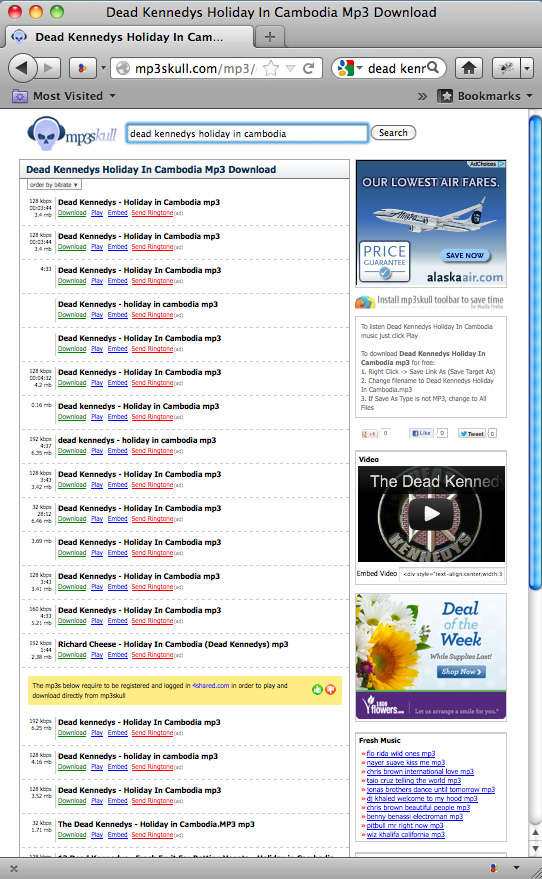
The irony and the disconnect didn’t take long to surface when East Bay Ray from the Dead Kennedy’s pointed out how exactly musicians don’t get paid from corporately funded music piracy sites when he showed a screenshot from mp3skull providing free downloads of his bands music financed by 1-800 Flowers and Alaska Airlines.
Willful Blindness

Of course those who believe in the exploitation of musicians for the profit of internet businesses had no problem rapidly resorting to name calling when it would be a lot more productive to acknowledge the problem as a detriment to the livelihood of musicians, and seek to work towards a cooperative solution to help musicians get paid.

What about Transparency, Being Open and More Human?

Ray went on to note how the negative effects of these sites create an environment that allows companies like YouTube to operate as an opaque black box. Using the best publicly available information he quickly calculated that YouTube’s 35% payment to artists (versus Itunes and Spotify’s 70%) could be a contributing factor to the 45% decline in professional musicians in the last decade. By Ray’s calculations (here at Digital Music News) the numbers may create a loss of 12,000 middle class musicians.

The Elephant In The Room

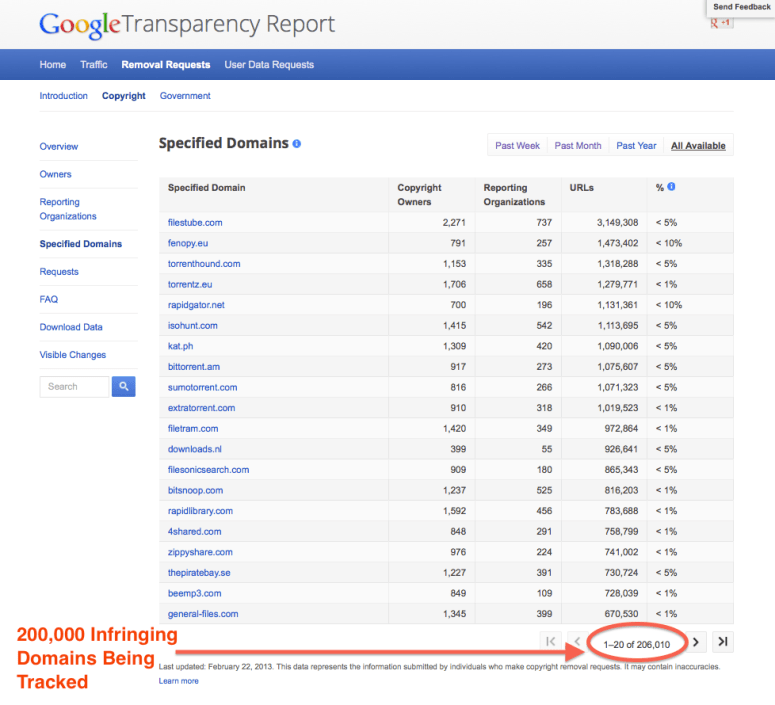
Some would like to argue that the revenue these sites are generating is inconsequential. These people seem to have difficulty understanding that if brand sponsored piracy can support 200,000 infringing domians that Google is tracking in it’s transparency report, then there is clearly enough there that musicians should be getting paid.

The real point is that there appears to be plenty of money being made online from the distribution of music, it’s just that the money is not being “shared” with musicians.
200kDomainsTracked

Any honest conversation about compensation to musicians has to address the single largest detriment to the revenue of artists at any level, which are the ad network financed music piracy sites. Ignoring these sites leaves out the most critical variable in evaluating fair and ethical compensation models when over 200,000 sites pay nothing at all to musicians with unlimited access to illegally free inventory. These sites profit from exploiting musicians and paying the musicians nothing.

Any legally licensed, legitimate music tech start up also has to acknowledge that mass scale, enterprise level, commercial infringement of music does NOT create a better environment for innovative entrepreneurs but rather a much more difficult one.

The truth is, there is no new professional middle class of musicians. The grand experiment of the digital utopia has been a massive failure for musicans and everyone at SF Music Tech now knows it. The soft back peddling by most on old hard line positions shows clearly that the reality for professional musicians has gotten worse, not better.

One of the most overheard phrases of the conference was, “we have to do better to get musicians paid.” Indeed, as we have noted here the truth is self evident, if the Internet is working for musicians, why aren’t more musicians working professionally? Not everyone aspires to work a day job, make music as a hobby and allow internet corporations to profit from their labor, illegally.

“Here we are, stuck with all these people who want music for free,” said Dave Allen, founding member of Gang of Four and interactive strategist at the branding agency North. “We have to find a way for musicians to make a living.”

If the tech and internet community are truly interested in getting musicians paid wouldn’t it make sense to start where money is already being made?


Petition to Stop Advertising on Pirate Sites

Please sign the letter in the link below to the CEOs of brands that appear on multiple occasions on infringing sites. Ask them to take a pledge to keep their ads off of illegal sites. Keep in mind that this list is not a comprehensive list of brands that appear on pirate sites.

Click Here : Please Sign The Petition to Stop Advertising on Pirate Sites

An Open Letter to the CEOs of Brands Advertising on Infringing Sites:

We, the undersigned, are just a few of the millions of artists and creators living, working, and creating across the United States. It has come to our attention that your companies are advertising on websites that illegally host or distribute creative content. We want to make you aware of the harm your companies do to independent artists and small businesses when you advertise on these sites.

Advertising on these sites encourages others to exploit our work for economic gain without a return to us. It deprives us of the opportunity to build communities with fans when they visit illegal sites to obtain our work, rather than our sites. It also gives consumers a false sense of security by lending an air of legitimacy to these sites. And, it rewards activities that are illegal.

Advertising on these sites also damages your own brands by association.

We understand that it can be difficult to know where your companies’ ads might end up because of the complexity of online advertising. However, difficult does not mean impossible. It appears that other companies make ad buys in ways that don’t result in their brands being tarnished and our work being exploited.

We ask you to encourage your companies to do the same.

You are in the best position to employ high-quality control standards and to demand the same from the ad networks you use. We encourage your companies to uphold high ethical standards for advertising placement, just as you do in other areas of business.

Please ask your online advertising purchasers to adopt practices like those detailed in the Statement of Best Practices to Address Online Piracy and Counterfeiting, released last year by the Association of National Advertisers, the American Association of Advertising Agencies (4A’s), and the Interactive Advertising Bureau. The practices outlined here, if adopted by major companies like yours, would go a long way towards ensuring a free and fair online marketplace for artists and creators to thrive. A report released by the University of Southern California’s Annenberg Innovation Lab on February 14, 2013, under the direction of Jonathan Taplin, has identified the top ten Ad Networks placing ads on infringing sites. And, according to research and documentation by artists working in tandem with this project, your companies have been identified as brands that repeatedly advertise on infringing websites.

Now that this issue has been brought to your attention, we hope that you will take affirmative steps to address this problem.