Hypebot Have No Defense of Ad Supported Piracy So They Resort To Name-Calling.

East Bay Ray of The Dead Kennedys  and I had an informal bet going.  Well maybe not a bet,  just a sort of prediction that once Ray spoke against ad supported piracy at SF Music Tech,  the music tech bloggers would start with the usual name calling. 
 
 Sure enough right on cue we see Bruce Houghton’s Hypebot giving Mike Masnick (see the “Google Shill List”) a platform to bash Ray and other  artists. “Whining” “Old” “Grumpy” and “Rant” were some of the unfair and unbalanced terms  that Ray and I predicted they would use in the de rigueur  postSF Music Tech cyber bullying. And they did.
 
This is pretty sad since ending ad supported piracy is a no-brainereven Google and Yahoo! fall over themselves to try to explain their unexplainable connection (see USC Annenberg Innovation Lab report).   Both artists and the legitimate music tech firms are negatively affected by ad supported piracy.  For instance legitimate music streaming services have to compete against these same unlicensed services for ad revenue.   Why the music tech space bloggers fail to grasp this is a mystery.
 
Bruce Houghton also owns the talent agency  Skyline Agency.   This agency tends to have a lot of “Old” and “Grumpy” artists that would probably go on a “Rant” if they were to see that their agency head is tacitly defending this practice.  So we prepared a few screenshots.  
 
Any comment Bruce?  Do you think that this practice is acceptable?  How do our “future” music models like streaming compete with the  guys that don’t pay any royalties to artists?   We’re all ears. 

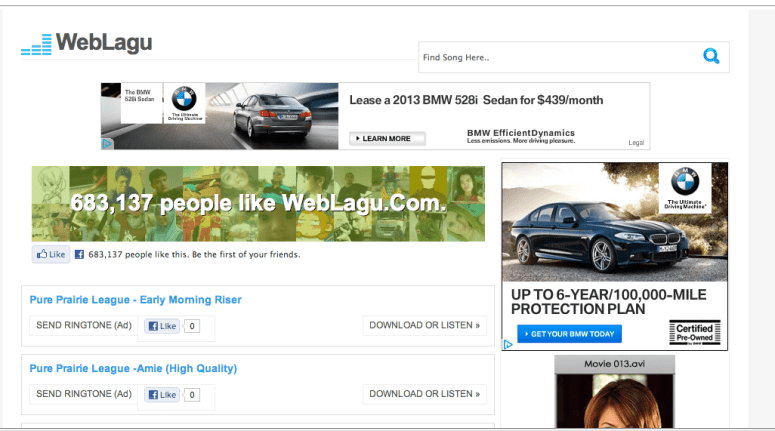
Pure Prairie League piracy brought to you by BMW.

Screen Shot 2013-02-22 at 3.57.36 PM

Al Stewart By Celestion and zZounds.

Screen Shot 2013-02-22 at 7.23.02 PM

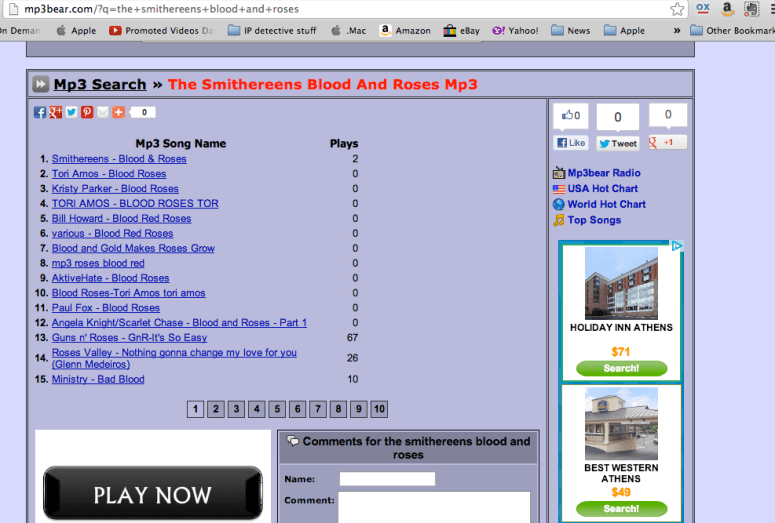
The Smithereens By Priceline

Screen Shot 2013-02-22 at 7.29.48 PM

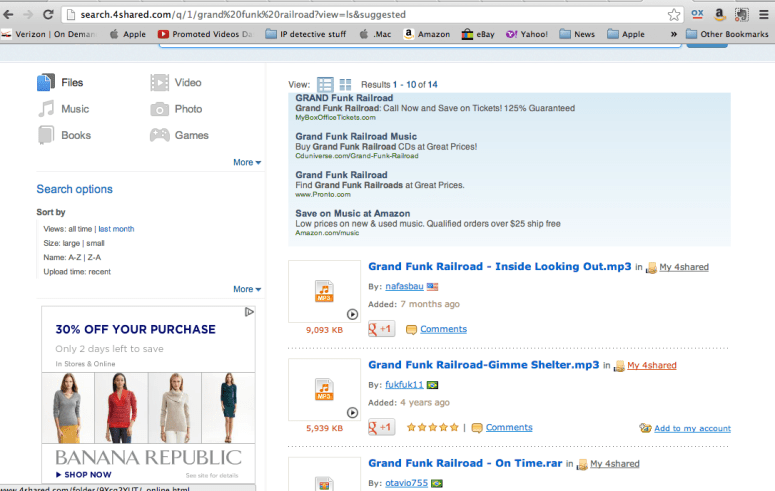
Grand Funk Railroad By Banana Republic, Amazon and others. 

Screen Shot 2013-02-22 at 7.32.59 PM

Google, Advertising, Money and Piracy. A History of Wrongdoing Exposed.

Readers of this blog will know that we’ve been gaining attention and awareness on brand sponsored piracy. We’ve noted how 50 Major Brands are Supporting Music Piracy. When that information is paired with The LA Times and The New York Times reports from the USC Annenberg Innovation Lab’s Transparency Report on Advertising Networks financing piracy we see a very clear picture emerging.

It is very clear that online piracy is a mass scale, for profit, enterprise level commercial business. There is a lot of money changing hands. Google is said to make approximately $30 Billion a year, with 97% of the money coming from advertising revenue. All of Google’s other products combined only account for less than 3% of it’s annual earnings.

So we can see that there are a lot of people making a lot money from the unauthorized, illegal infringement of artists and creators work. This is no longer about individual “sharing.” This is about businesses exploiting artists for profit, and not paying the artists a penny. We do not know of one cent being paid to artists from sites like The Pirate Bay, 4Shared and Filestube just to name a few of the major offenders.

So where does Google fit into this? Why do so many artists rights advocates focus so intently on Google? Simply because public documents have exposed Google as having knowledge of wrong doing and doing nothing about it – until they got busted, red handed, twice.

In 2011 Google paid $500,000,000 (that’s half a billion dollars) in a non-prosecution settlement agreement to avoid criminal prosecution. Yes, Google paid half a billion dollars to avoid criminal prosecution and the documents in the case revealed that knowledge of wrongdoing went all the way to the top, to none other than Larry Page himself. The story caught the attention of many mainstream media outlets including CNN.

The Wall Street Journal Reported:

“Larry Page knew what was going on,” Peter Neronha, the Rhode Island U.S. Attorney who led the probe, said in an interview. “We know it from the investigation. We simply know it from the documents we reviewed, witnesses that we interviewed, that Larry Page knew what was going on” . . .

Harvard Law Associate Professor Ben Edelman continues;

These admissions and the associated documents confirm what I had long suspected: Not only does Google often ignore its stated “policies”, but in fact Google staff affirmatively assist supposed “rule-breakers” when Google finds it profitable to do so…

In June I observed that Google’s bad ads span myriad categories beyond pharmaceuticals — charging for services that are actually free, promising free service when there’s actually a charge, promoting copyright infringement, promoting spyware/adware, bogus mortgage modification offers, work-at-home scams, investment rip-offs, identify theft, and more.

Note that Edelman reports the problem is much larger than just the illegal advertising of drugs.  It appears to even extend into such black markets as human trafficking. This issue was even met with a Change.Org petition as well as being reported on here and here.

So if Google has been caught lying about their knowledge of wrong doing in the past, and violating their actual practices versus policies, than what else do they know and what else are they doing? How many other of their own policies do they not follow, or worse, aid others in circumventing them? All reasonable questions to ask given the publicly available information.

The profiting from illegal behavior was also reported by Ars Technica ,

When the sting began in 2009, Google had in place policies designed to block illicit pharmaceutical advertising. Whitaker’s orders were initially rejected under those policies. But Whitaker says Google sales reps helped him tweak his sites to skirt the rules.

“It was very obvious to Google that my website was not a licensed pharmacy,” Whitaker told the Journal. “Understanding this, Google provided me with a very generous credit line and allowed me to set my target advertising directly to American consumers.”

All of this brings us back to where we are now regarding Google’s non-denial regarding financing commercial scale infringement sites. There is a history of this behavior with Google that dates back further. In May of 2011 The Copyright Alliance noted the following regarding the 2007 case of EasyDownloadCenter.com and TheDownloadPlace.com.

Indeed there is even publicly documented history of Google knowingly and purposefully working with pirate websites to increase traffic to such websites and profits to Google from the Sponsored Links/Adwords programs. In conjunction with the settlement of a copyright infringement lawsuit brought by the major Hollywood studios against Luke Sample, Brandon Drury and their companies for operation of subscription based websites devoted to helping consumers find and download pirated copyrighted works, Sample’s Affidavit was filed by one of the defendants testifying to the fact that Google worked directly with the illegal website to drive traffic to it and increase Google’s revenues from its participation in the sponsored links program.

This is the part below really gives us pause, reported not just by The Copyright Alliance, but also many tech publications and outlets such as DailyTech.

In fact, Google’s ad teams even made suggestions designed to optimize conversion rates by using keywords targeted to pirated content – such as suggesting downloading films still in theatrical release, that obviously were not available yet in any authorized format for home viewing.

According to PCWorld this added up to some decent money…

EasyDownloadCenter.com and TheDownloadPlace.com generated US$1.1 million in revenue between 2003 and 2005, and Google received $809,000 for advertising, the Journal reported.

So the question today is what does Google actually know about how it’s advertising practices are financing the destruction of the creative community by supporting these unauthorized, illegally operating, commercial infringers? How much has really changed?

Keep in mind that although Google pays it’s “partners” a revenue share on YouTube for claimed content, the company makes no such offer to artists and creators on the advertising that it still appears to be serving to pirate sites. This is further demonstrated by the lack of ability for the company to make a definitive statement that Google does not serve any ads, to any pirate sites (or at least the 43,000 listed in the companies own transparency report).

Also central to this conversation is that the way consumers access the unauthorized, illegal and infringing sites which usually starts with a Google search itself. In fact according to Google’s own public transparency report there are over 13 million infringing links being removed from Google’s search engine monthly by rights holders. Those 13 million infringing links represent over 43,000 infringing sites.

Wouldn’t the rational and logical solution be to create a joint review board the represents the interests of all stakeholders that can negotiate penalties or the removal of bad actors?

GoogleTransparencyReport

What You Can Do Today to Stop Brand Sponsored Piracy Through Touring Contracts or Sponsor Deals: Artists Helping Artists

by Chris Castle

If you are like most artists, you feel overwhelmed by the alliance of Big Tech and Fortune 500 companies allied against us in the intricate network of brand sponsored piracy.  (If you need more background on what “brand sponsored piracy” means, just look around on the Trichordist or on MusicTechPolicy and you’ll get the idea.)  From Google search to Chilling Effects, some artists would like to know what they can do to fight back.  Of course, if artists wanted to fight piracy full-time, they would be cops not artists.  So we need to find ways to leverage your time more effectively and try to find everyday ways that artists can help themselves and each other to fight back.

You may not be aware of it, but clubs, tours and especially festivals or event programming take ads online.  Sometimes these ads appear on pirate sites.  Here’s an extreme example from the illegal lyric site, Lyrics007.com that rips off songwriters, in this case Adele:

Beyonce, Adele and the Super Bowl Exploited by Pepsi

Do I think that Beyonce knew that her name and likeness would be plastered all over illegal music sites?  Of course not.  Did the NFL know?  Unlikely.  Did Pepsi know?

Now that is a more difficult question.  The problem that these big brands have is that someone always knows.  Someone at their ad agency also definitely knows.  They’ll give you a big song and dance about it’s a big system, millions of transactions, but it is simply not possible that no one knows, yet a brand the size of Pepsi–a company that has been a very good friend to the music business, by the way–spends millions on an advertising campaign without knowing where its ads are going?

Put Them On Notice

Thanks to David Lowery, Camper Van Beethoven and Cracker, artists have come up with an easy way to create some incentives for their touring partners to take responsibility for where the promoters advertise their shows.  And this concept could fit in every artist agreement from an one-nighter agreement, to a recording agreement, to Beyonce’s Super Bowl promotion with Pepsi or any other event-driven advertising campaign.

The artist can tell them no.

With a simple contract clause that could go in the artist’s agreement (including in the tour rider), an artist can prohibit the artist’s work from being advertised on pirate sites.  Violating this clause could put the promoter in breach–but the point isn’t to sue people.  The point is to have a dialog, raise awareness and get people to be more careful.  Offer promoters a competitive advantage to get the deals in the first place.  If you want repeat business with an artist, don’t let the artist see ads show up on pirate sites.

So what’s a pirate site?  Big Tech would like you to believe that it is only sites that have been adjudicated an infringer in a final, nonappealable judgement before the highest court in every country of the world.

That’s obviously bunk and designed to make  you feel helpless because only Big Tech can afford that kind of litigation, so naturally that’s the bright and shiny object they want you to focus on.

Remember–you are talking about a private contract.  Your private contract.  How and where your show is marketed is a function of how much you trust your promoter to market your name…your brand…so it is absolutely reasonable for you to want to control how you are presented to your fans and to the general public when you permit someone else to make decisions about that marketing, just like you would decide that the headliner’s name came first in billing.

Meaning that if you are making a private contract, you are in control of your marketing (at least generally) and you can negotiate those terms.  The list of sites you want to exclude–if any–is up to you, a subjective decision.

You could also decide that you want the promoter to be able to refer to an objective list, that is, a list determined by a third party who you both agree will reasonably set the standard.  The USC-Annenberg Innovation Lab’s Transparency Report uses the Google Transparency List.  This is a good list, but Google has some pretty large exclusions from that report.  So the language that Camper and Cracker like also includes the US Trade Representatives Notorious Markets List, which is much shorter than the Google list, but uses US Government resources in its determination.

Suggested Contract Language

If you decide you want to go this route, the Camper/Cracker antipiracy clause covers three bases, which I think are probably good enough:  The USTR List, the Google List, and whatever list the artist may come up with that isn’t on either of those lists.  (The artist doesn’t have to give a list, but reserves the right to do so–the artist may also add back sites that USTR or Google would exclude.)

Here’s the language (“BUYER” usually refers to the talent buyer or promoter):

“THE BUYER WILL NOT, AND WILL NOT AUTHORIZE THIRD PARTIES TO, ADVERTISE THE SHOW ON ANY WEBSITE THAT IS LISTED ON THE CURRENT US TRADE REPRESENTATIVE’S NOTORIOUS MARKETS LIST (currently http://www.ustr.gov/sites/default/files/121312%20Notorious%20Markets%20List.pdf), OR THAT IS LISTED IN THE CURRENT GOOGLE TRANSPARENCY REPORT (currently http://www.google.com/transparencyreport/removals/copyright/domains/?r=last-month), OR THAT THE ARTIST HAS INFORMED THE BUYER IS A SITE ON WHICH THE ARTIST DOES NOT WISH THE BUYER TO ADVERTISE THE SHOW.”

Obviously, this is not meant as legal advice and you should confirm with your own lawyers how this language might affect your rights under the particular agreement, but it should be a good starting place for any show agreement that is based on the American Federation of Musicians “One Nighter” agreement or the equivalent.This language could be included in a watermark on any pdf version of a show agreement, or placed in the artist’s rider.

Flow Down Language

In more complex situations, you may wish to consider adding it as a flow down provision in a promoter agreement that requires the promoter to include the language in any show agreements.  A flow down provision is a clause that anticipates the other side will be empowered to make many contracts with third parties that give effect to the principal two-party agreement, and one side wants to control certain aspects of those third party contracts without negotiating or signing them.

For example, a US promoter might buy a 50 city tour and have an overall deal with the band.  The US promoter then goes out and contracts with local promoters for each of the 50 shows.  The artist may want to get the US promoter to promise the each of these 50 contracts will have certain clauses to protect the artist often relating to staging, insurance, venue sales and advertising.  That’s a good place to put the antipiracy clause, but the artist is not necessarily a party to those agreements.

Artists Helping Artists

It is easy to see how this language could be adopted in sponsorship or event agreements, and i  t would go a long way to raising awareness of the situation and incentivizing all concerned in the right way.

It’s nothing personal, it’s just business.

#StopArtistExploitation – Tweet Daily for Artists Rights!

As we suggested on our post, Over 50 Major Brands Supporting Music Piracy, It’s Big Business! the best way to start to effect positive change is to simply encourage like minded people to send a daily tweet to one of the brands on the list. A tweet a day to just one of these brands will create enough awareness to bring this issue to the attention of the brands themselves. There are over 50 brands, so that’s nearly two months of tweets just by doing one simple tweet a day.

By using the hashtag #StopArtistExploitation we can also easily help others find out about this problem and build support for artists rights online.

Thanks to everyone who participates, you really can make a difference. We’re also tweeting a brand a day, so feel free to retweet us if you like – which is even easier.

Here’s a directory of the brands on Twitter. Please feel free to copy/paste this simple suggested tweet to them:

@Brand Stop Supporting Online Music Piracy #StopArtistExploitation http://wp.me/p2hvgt-1xH

@Adobe – https://twitter.com/Adobe

@ADTstaysafe – https://twitter.com/ADTstaysafe

@AlaskaAir – https://twitter.com/AlaskaAir

@amazon – https://twitter.com/amazon

@AmericanExpress – https://twitter.com/AmericanExpress

@ATT – https://twitter.com/ATT

@Audi – https://twitter.com/Audi

@BMWUSA  – https://twitter.com/BMWUSA

@bostonmarket – https://twitter.com/bostonmarket

@boyscouts – https://twitter.com/boyscouts

@British_Airways – https://twitter.com/British_Airways

@CENTURY21 – https://twitter.com/CENTURY21

@CharterCom – https://twitter.com/CharterCom

@Citibank – https://twitter.com/Citibank

@MINIUSA – https://twitter.com/MINIUSA

@CoxComm – https://twitter.com/CoxComm

@CrateandBarrel – https://twitter.com/CrateandBarrel

@DirecttTv – https://twitter.com/DirecttTv

@DishSatellite  – https://twitter.com/DishSatellite

@eBay – https://twitter.com/eBay

@EA – https://twitter.com/EA

@Air_Emirates – https://twitter.com/Air_Emirates

@FergusonShowrms – https://twitter.com/FergusonShowrms

@Ford – https://twitter.com/Ford

@GoPro – https://twitter.com/GoPro

@googlechrome – https://twitter.com/googlechrome

@HertzCWB – https://twitter.com/HertzCWB

@HP – https://twitter.com/HP

@HiltonHotels – https://twitter.com/HiltonHotels

@HyattPR – https://twitter.com/HyattPR

@Hyundai – https://twitter.com/Hyundai

@JetBlueAirlines – https://twitter.com/JetBlueAirlines

@KAYAK – https://twitter.com/KAYAK

@Kohler – https://twitter.com/Kohler

@LegalZoom – https://twitter.com/LegalZoom

@LGUS – https://twitter.com/LGUS

@MyMMscom – https://twitter.com/MyMMscom

@Macys – https://twitter.com/Macys

@_MarvelAvengers – https://twitter.com/_MarvelAvengers

@MazdaUSA – https://twitter.com/MazdaUSA

@musiciansfriend – https://twitter.com/musiciansfriend

@Nationwide – https://twitter.com/Nationwide

@neimanmarcus – https://twitter.com/neimanmarcus

@netflix – https://twitter.com/netflix

@NissanUSA – https://twitter.com/NissanUSA

@priceline – https://twitter.com/priceline

@PrincessCruises – https://twitter.com/PrincessCruises

@Register_com – https://twitter.com/Register_com

@RejuvenationInc – https://twitter.com/RejuvenationInc

@Sheraton_Hotels – https://twitter.com/Sheraton_Hotels

@Skype – https://twitter.com/Skype

@sprint – https://twitter.com/sprint

@StateFarm – https://twitter.com/StateFarm

@SweetwaterSound – https://twitter.com/SweetwaterSound

@Target – https://twitter.com/Target

@TuneCore – https://twitter.com/TuneCore

@UNITED_AlRLINES – https://twitter.com/UNITED_AlRLINES

@UrbanOutfitters – https://twitter.com/UrbanOutfitters

@VirginAtlantic – https://twitter.com/VirginAtlantic

@Visa – https://twitter.com/Visa

@VW – https://twitter.com/VW

@WHotels – https://twitter.com/WHotels

@WeightWatchers – https://twitter.com/WeightWatchers

@Wendys- https://twitter.com/Wendys

@Westin – https://twitter.com/Westin

@WilliamsSonoma – https://twitter.com/WilliamsSonoma

@Yahoo – https://twitter.com/Yahoo

Zero Dark Thirty, Best Picture Academy Award Nominee, Exploited by AT&T, Verizon, MetroPCS, Nissan, H&R Block, British Airways, Progresso, and more…

We spend most of our time here focused on artists rights as it applies to music and musicians. But we wanted to see if the film industry was having the same challenges as music. We believe in the rights of all creators to consent and compensation for their work (ethical internet principles numbers two and four, respectively).

With the upcoming Academy Awards we wondered if it would be possible to find pirated versions of Zero Dark Thirty. It is  the most talked about film of the year which is nominated for five Academy Awards including Best Picture. But it could easily be any of the other nominated films, in any of the categories as well. We just picked Zero Dark Thirty. It’s also been widely reported that most of the nominated films have already been pirated and are online.

We were also curious what major brands might be supporting that piracy, and if any of those same brands might have advertising that appears on the broadcast of  The Academy Awards show itself. We would hope the Academy Of Motion Picture Arts and Sciences would be able to educate the various brands, advertising agencies and online ad networks about the damage they are doing to the creative community.

What makes this even more frustrating in the case of Zero Dark Thirty is that the film is not even out of theaters yet. At least with music, it is usually (usually…) commercially available before it is pirated.

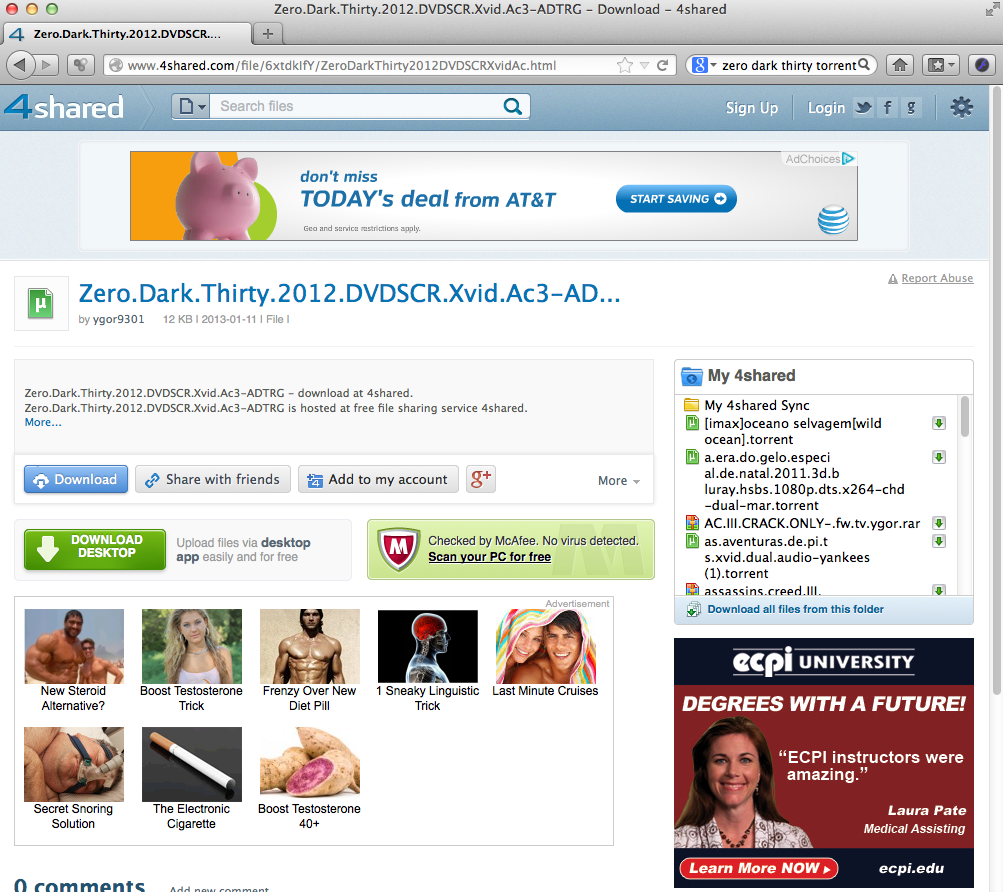
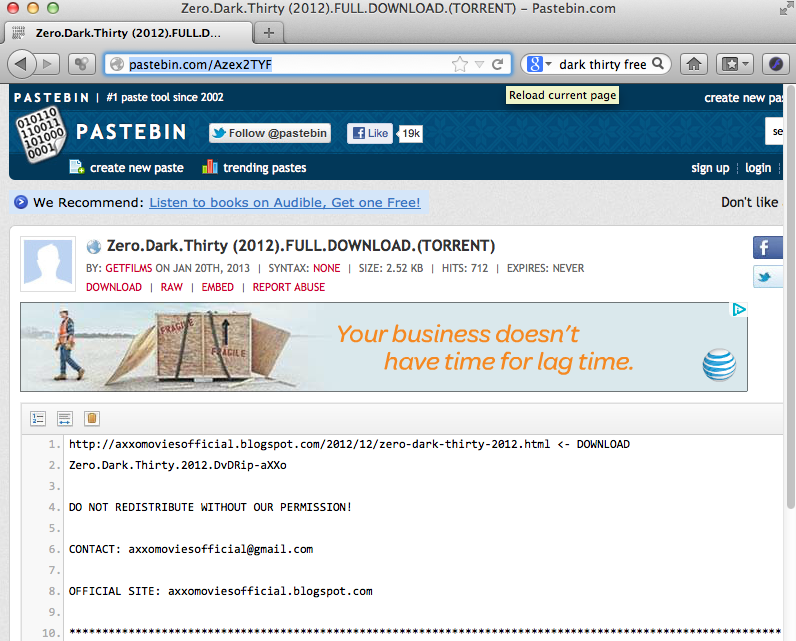
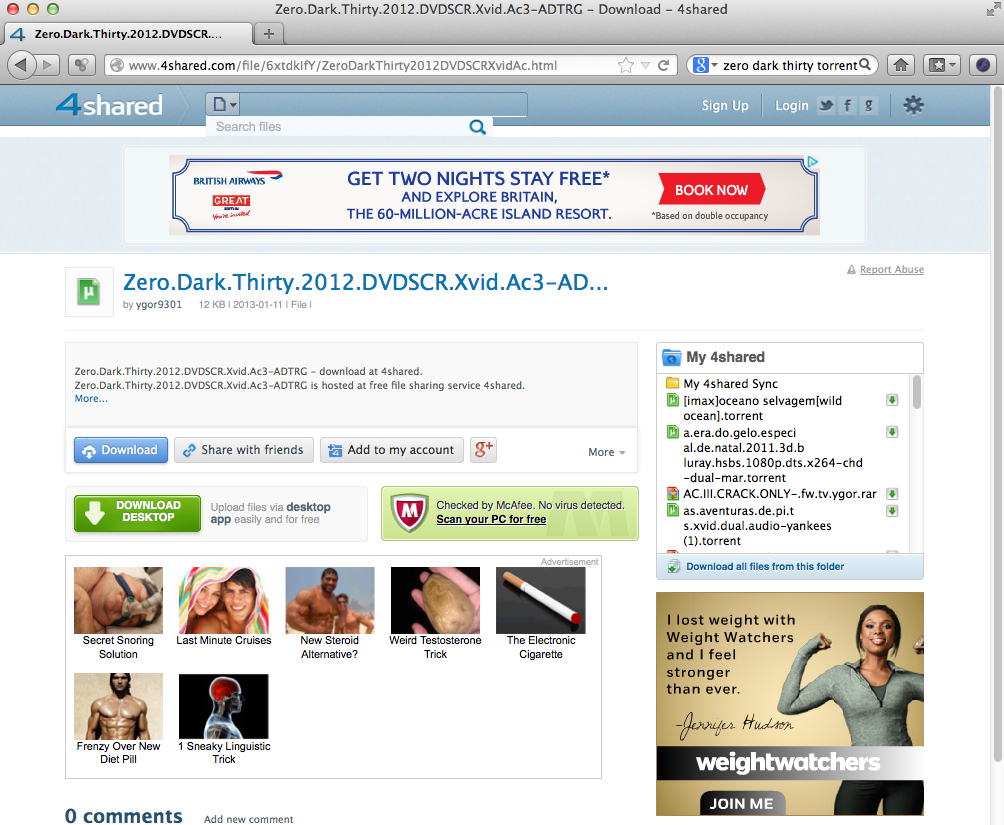
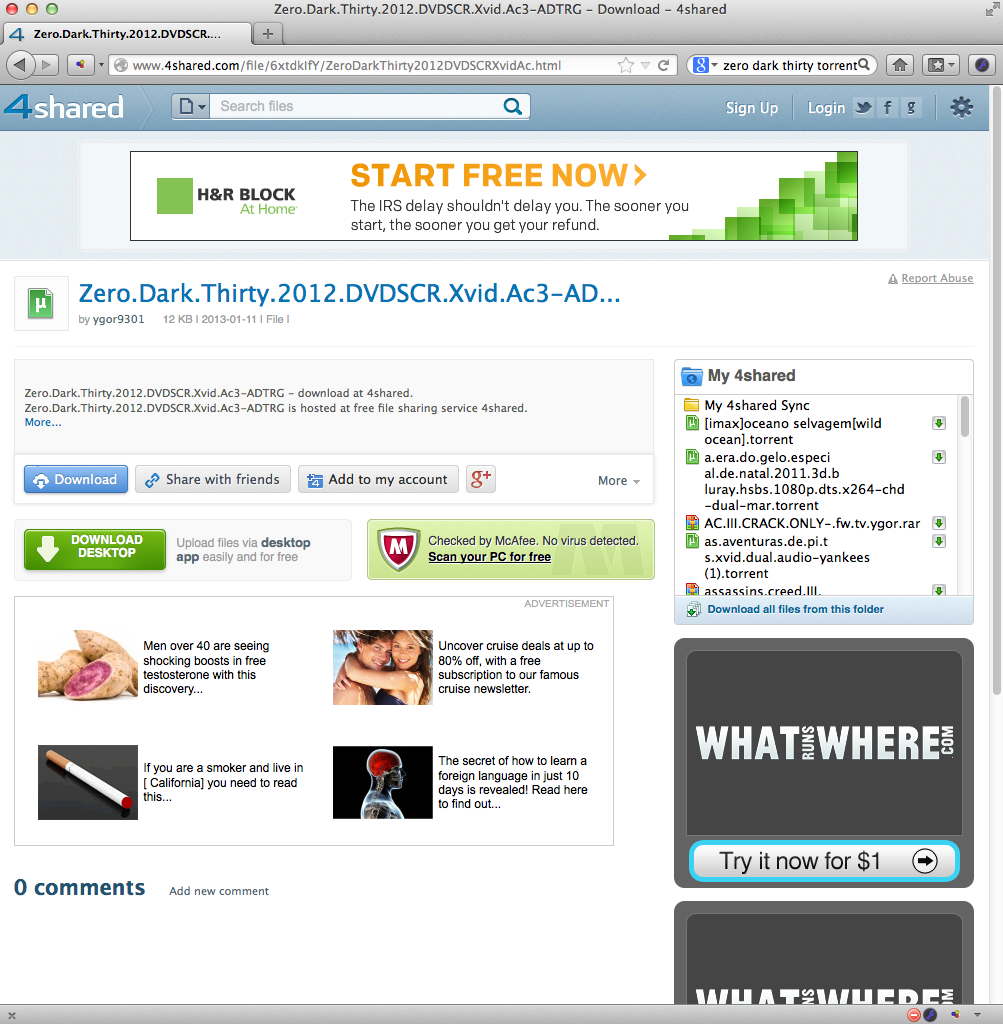
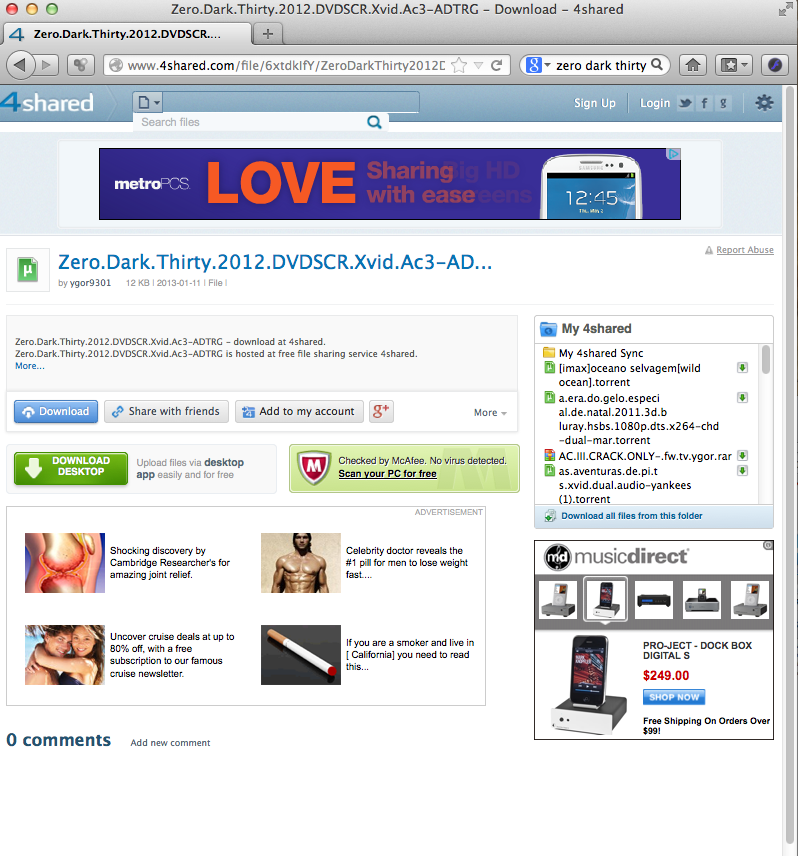
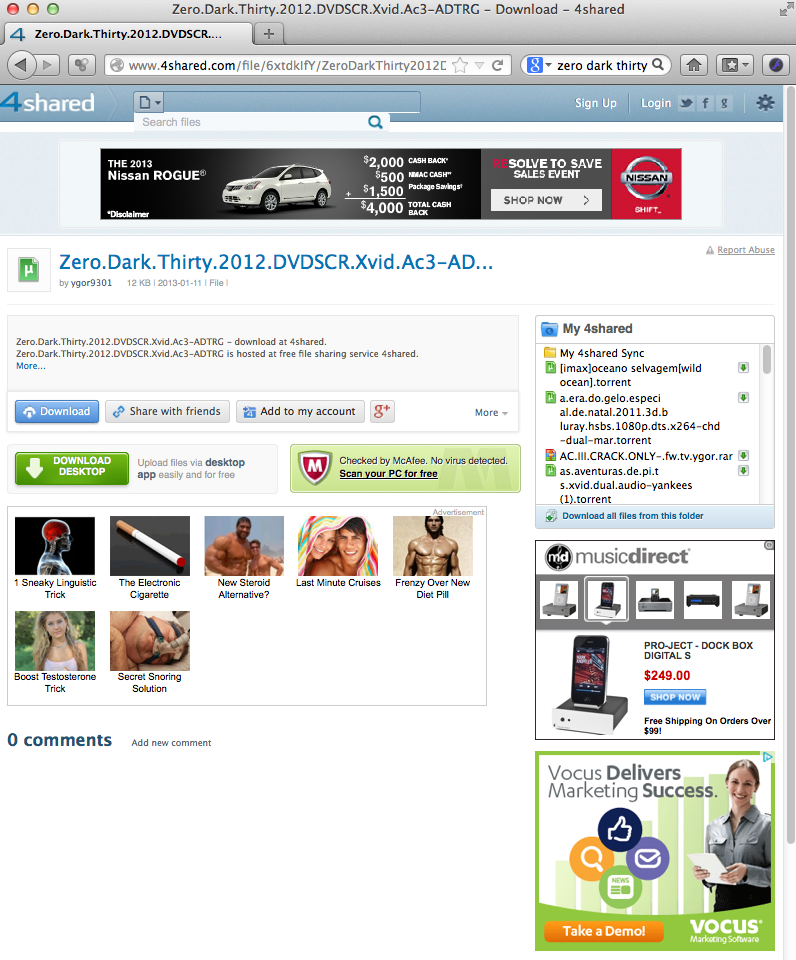
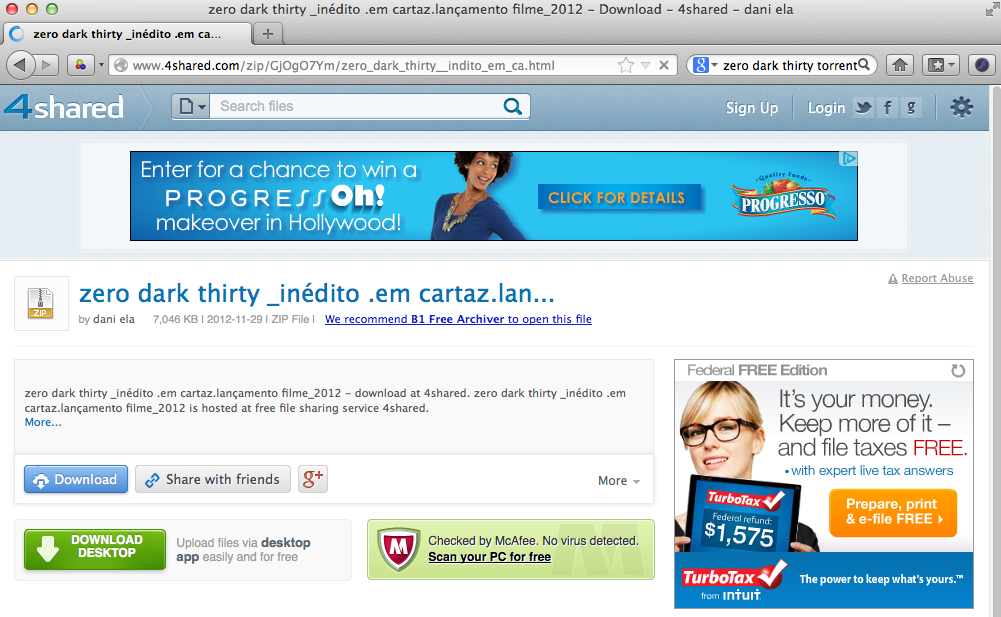
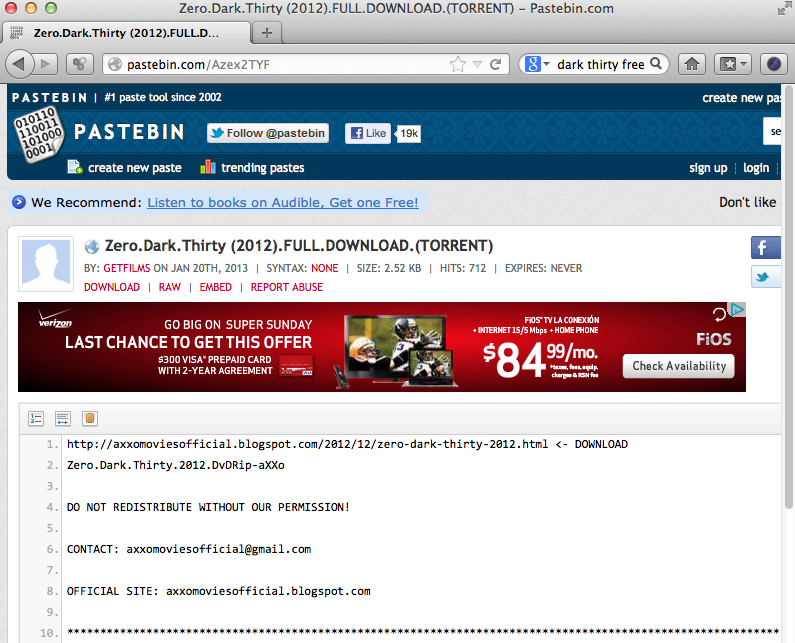
Here’s what we found within a few minutes, on just two sites…

* AT&T on 4Shared
* AT&T on Pastebin
* British Airways on 4Shared
* H&R Block on 4Shared
* MetroPCS on 4Shared
* Nissan on 4Shared
* Progresso on 4Shared
* Turbo Tax on 4Shared
* Verizon on Pastebin

ZDT_ATTT

ZDT_Pastebin

ZDT_BAZDT_H&RBlockZDT_metroPCSZDT_NIssanZDT_ProgressoTTZDT_Verizon

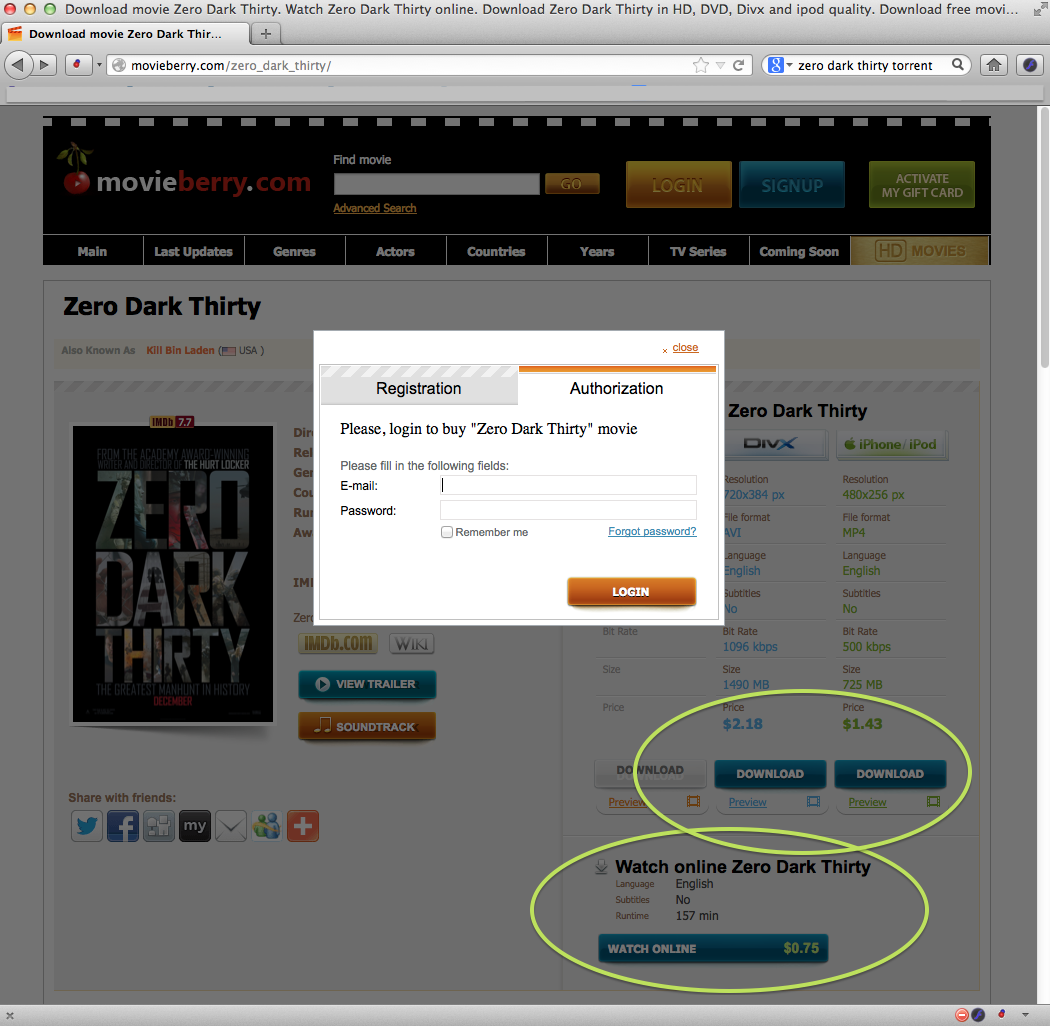
That’s just a couple sites to download the movie for free. What’s more common amongst film piracy are the faux subscription services that charge annual membership fee’s to stream all of their pirated movies (so much for information wants to be free, but movie want to be paid for…).

Here’s just one example where you can pay on a transactional basis of $.75 to stream the film or between $1.43 or $2.18 to download the film of varying quality.

ZDT_movieberry

So much for “Free Culture.” As it turns out there’s probably very little online piracy happening without money changing hands somewhere in the value chain. The money may be in advertising, or it may be in transactional or subscription fees, but one thing is for sure, people are getting paid and not paying the creators.

In the case of the above, and as we also asked did MegaVideo Charge for Streaming Movies the problem here is to address those processing payments such as American Express, Visa, Master Card and the various other banks such as Citi Bank and Wells Fargo (whom have also been seen advertising on pirate sites). At least PayPal is taking responsibility and denying service to pirate sites. That thanks largely to the good work being done by StopFileLockers.

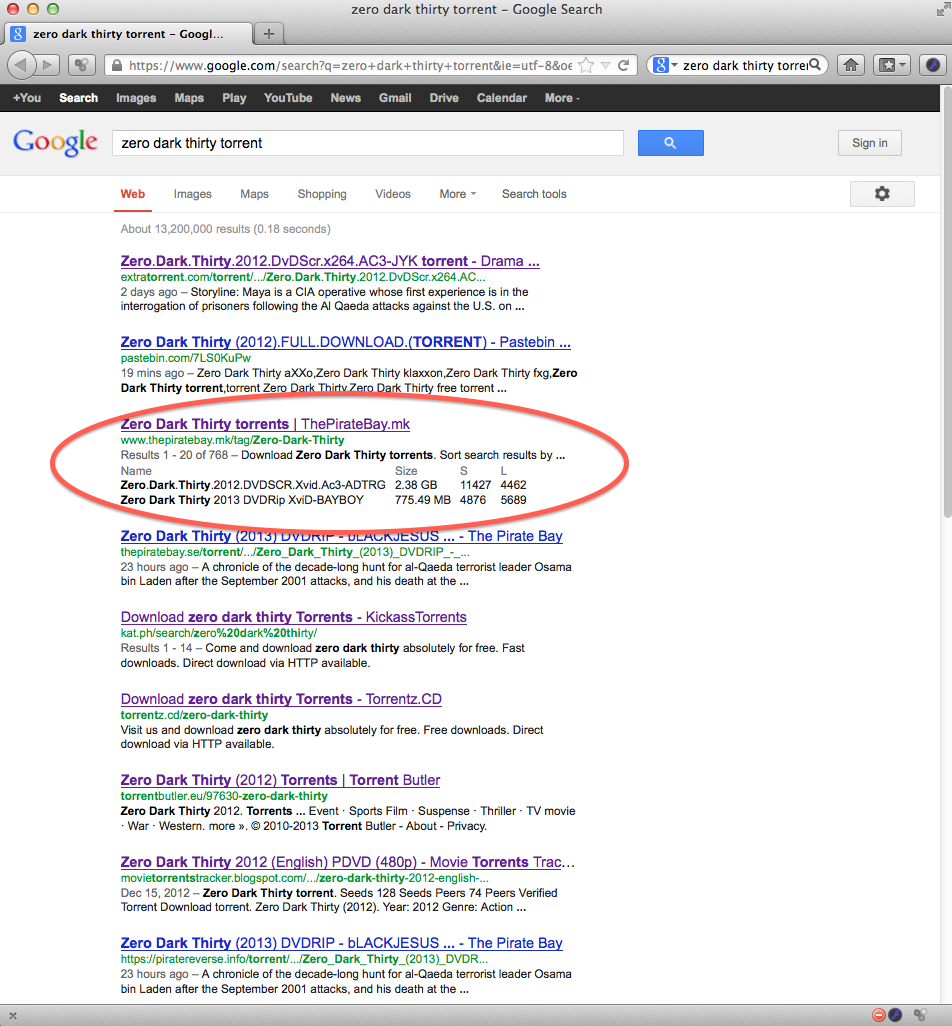
We found a couple of things of interest as well regarding Google’s search. Despite there being (we’re guessing conservatively) literally thousands of DMCA notices to remove the film from search, The Pirate Bay still ranks #3 on the first page of search results! Surely Google as well as everyone else in the world knows the site was found guilty and it’s founders sent to jail. Yet Google has not delisted the site from search in it’s entirety which would be the right thing to do, knowing that the judgement against The Pirate Bay was upheld even by the Supreme Court of Sweden.

ZDT_GoogleSearch

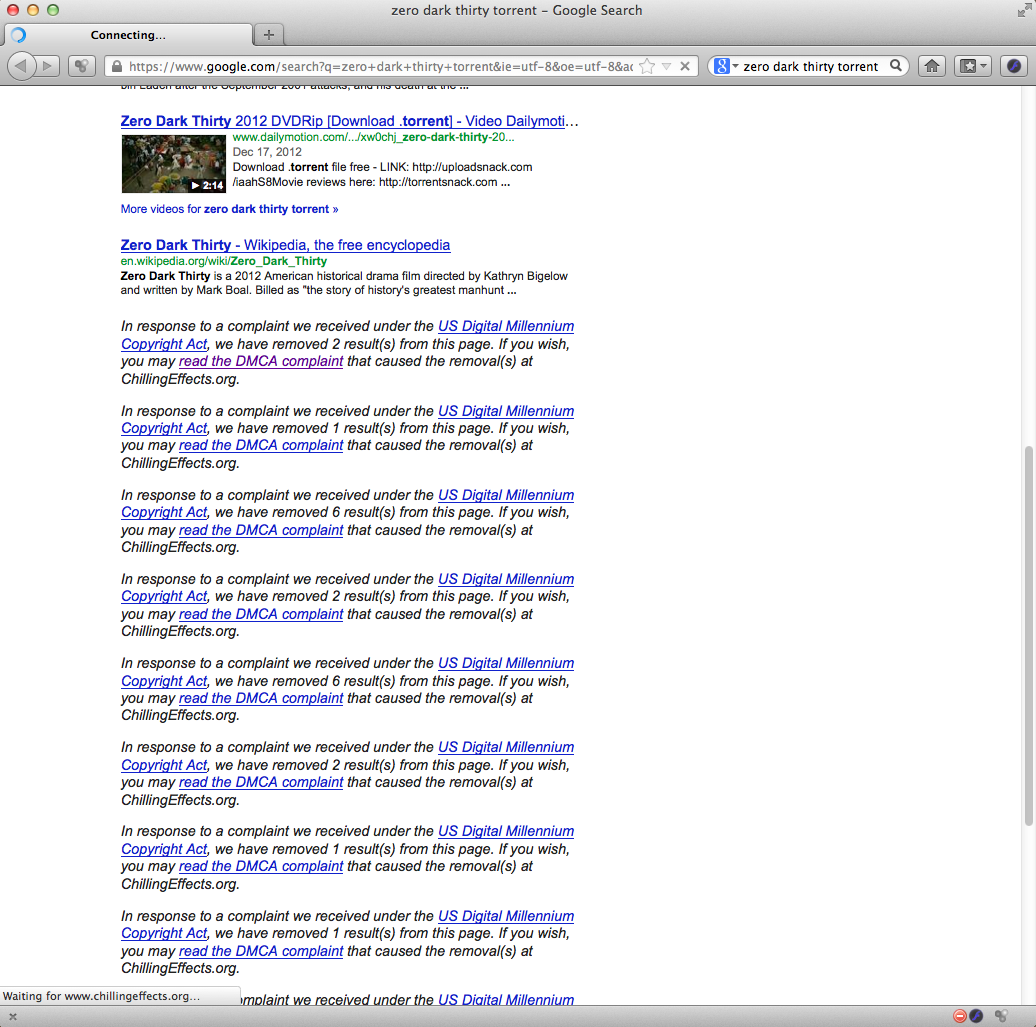
Of course a quick scroll down the page and the delisted link removal notices start to appear as follows:

In response to a complaint we received under the US Digital Millennium Copyright Act, we have removed 1 result(s) from this page. If you wish, you may read the DMCA complaint that caused the removal(s) at ChillingEffects.org.

ZDT_DMCA_GoogleCjill

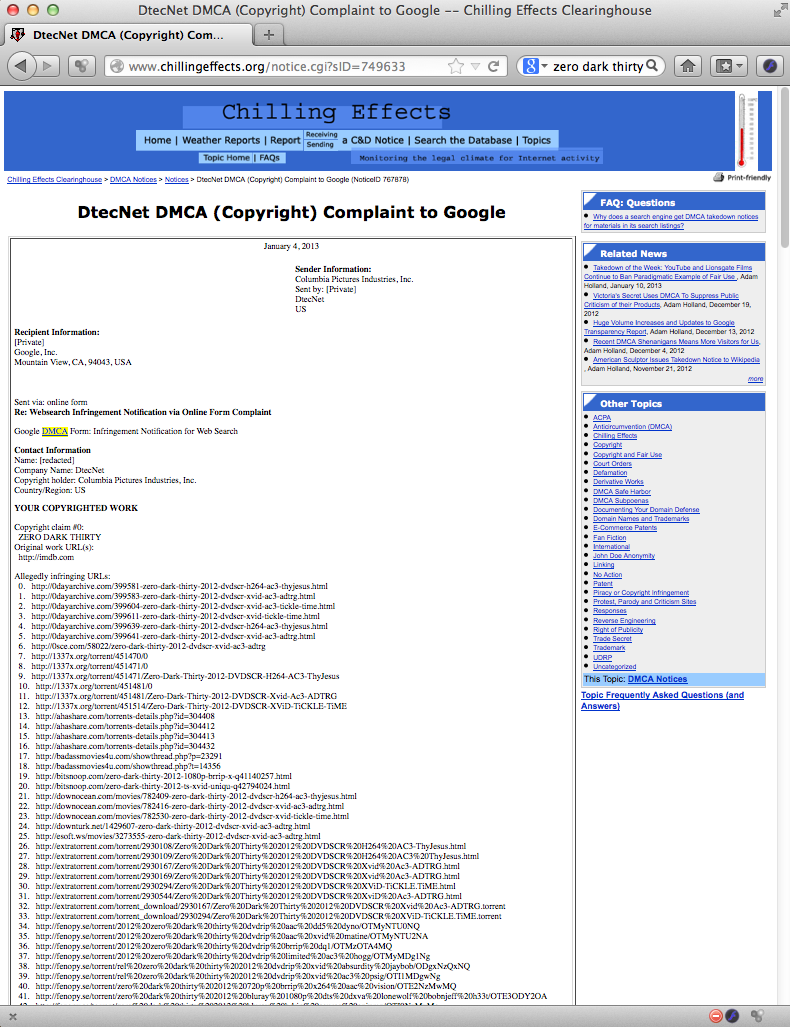
Now why exactly is there a need, once a link has been delisted to post a notice to a site that then shows that very same link that had been lawfully delisted from Google search by the DMCA? In the screen shot below are shown just the first forty delisted links, but on that one notice alone there are over three hundred delisted links to pirated copies of Zero Dark Thirty in one way or another.

ZDT_CEpg1

Make no mistake about it, every one of those previously delisted links is still active on the servers where it originated and it can simply be copied and pasted back into any web browser.

Further more, these links have been delisted due to the fact that most if not all of these infringing sites are not based in the United States and do not conform to United States law and therefore do not comply with the DMCA itself.

Is this all just a cat and mouse game for Google to profit from piracy? Draw your own conclusions.

Over 50 Major Brands Funding Music Piracy, It’s Big Business!

Below is a partial list of over 50 major brands who are advertising on pirate sites and therefore supporting not only music piracy, but also the mainstream piracy of films and every other kind of digitally distributed work. As we’ve stated before the content industries may have the ability to address mass scale, enterprise level, commercial infringement without necessarily requiring any new legislation.

What we find frustrating is that the major content companies and corporations must have existing relationships with these brands as the content and media distribution companies own the television networks (at the very least) that these brands are dependent upon for the mass scale and mainstream promotion of their products and services.

The major content companies as well as their well respected institutions such as The Academy Of Motion Picture Arts and Sciences (The Oscar’s), The National Association Of Recording Arts and Sciences (The Grammy’s) and The Hollywood Foreign Press Association (The Golden Globes) all host annual award shows where many of these brands are also advertising. Why isn’t it possible to use that opportunity to educate these brands about the damage they are doing to the creative community? In other words, where are the adults?

What is disappointing is that the same people pushing for new legislative solutions could also be leveraging their relationships with the brands and advertising agencies directly to educate them about the seriousness of this problem. The same goes for the banks and payment processors such as American Express, Master Card, Visa and others. At least one company, Paypal has been very proactive in severing it’s ties and services with illegal and infringing sites, we wish more would to the same.

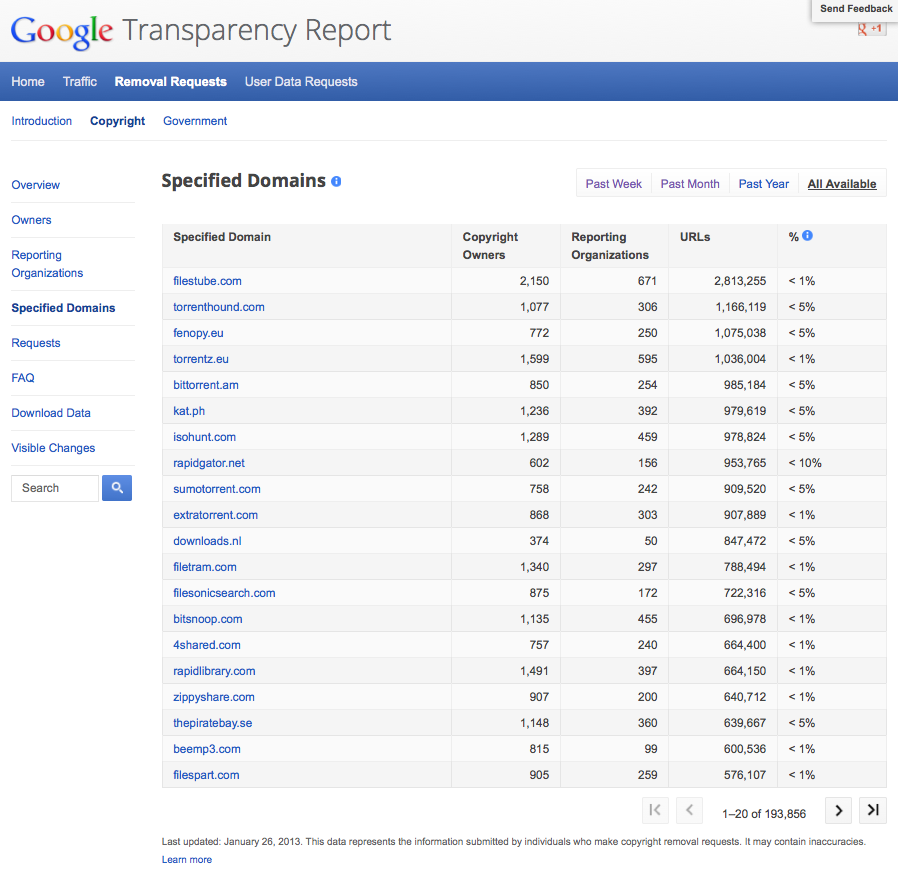
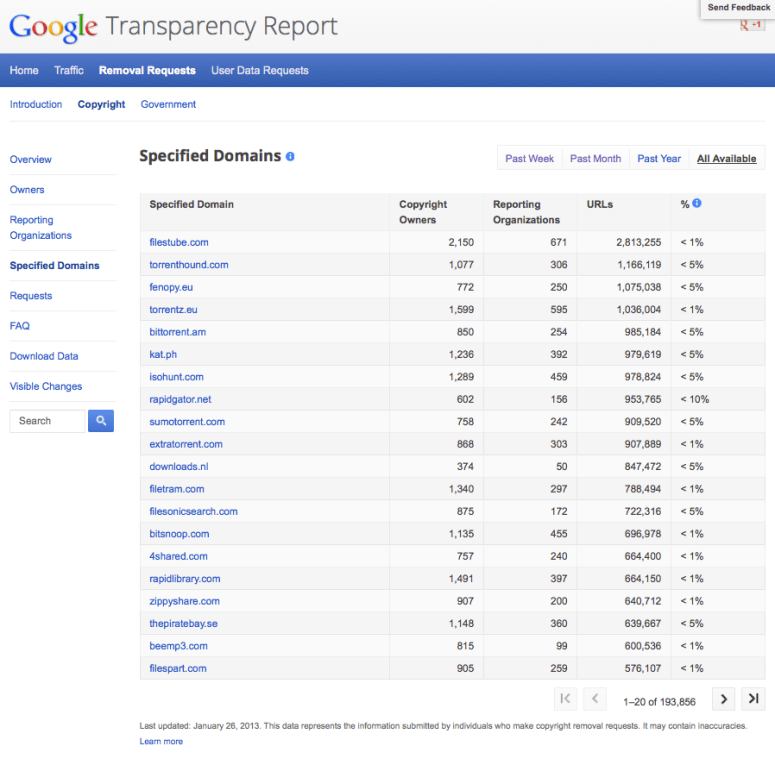
The US Trade Representative’s list of sites in the Notorious Markets List combined with Google’s transparency report for copyright infringement via legitimate DMCA notices to delist links from its search engine provides a very effective list of sites where no advertising should appear as a simple baseline of “best practices”.  (Of course, the Google list does not include YouTube or Blogger.)

http://www.google.com/transparencyreport/removals/copyright/domains/?r=all-time
GoogleTransparencyReport

Keep in mind the screen shot above only lists the Top 20 sites of the almost 200,000 in total that are receiving DMCA notices for copyright infringement.

Clicking on the name of any of the brands below will take you to a post that contains the screen shot of the ad itself. What is also important to note is what brands are NOT on this list.

Brands like Coke and Pepsi do not seem to appear on pirate sites, and that can’t be an accident anymore than it not being an accident that these other brands do appear on pirate sites. So for that, we applaud Coke and Pepsi for their respect to the creative community.

Who knows, perhaps the content industries should use their might, weight and prestige to create an award for brands who respect the creative community in a public forum that enhances value for the brand by the endorsement of artists, musicians, filmmakers and other creators. Just a thought if anyone is reading…

We might also suggest that the brands on this list think about adopting the Bill of Rights for Online Advertisers by Benjamin Edelman of The Harvard Business School.

Five rights to protect advertisers from increasingly powerful ad networks — avoiding fraudulent charges for services not rendered, guaranteeing data portability so advertisers get the best possible value, and assuring price transparency so advertisers know what they’re buying.

Brand  Pirate Site  Artist
Adobe Files Tube Tom Waits
Adobe Files Tube 30 Seconds To Mars / Jared Leto
Adobe Torrent Reactor Neil Young
Adobe Iso Hunt Neil Young
Adobe Kick Ass Torrents Neil Young
ADT Security 4Shared Tom Waits
Alaska Air Iso Hunt Neil Young
Alaska Air Kick Ass Torrents Neil Young
Alaska Airlines Torrent Reactor U2
Amazon 4Shared U2
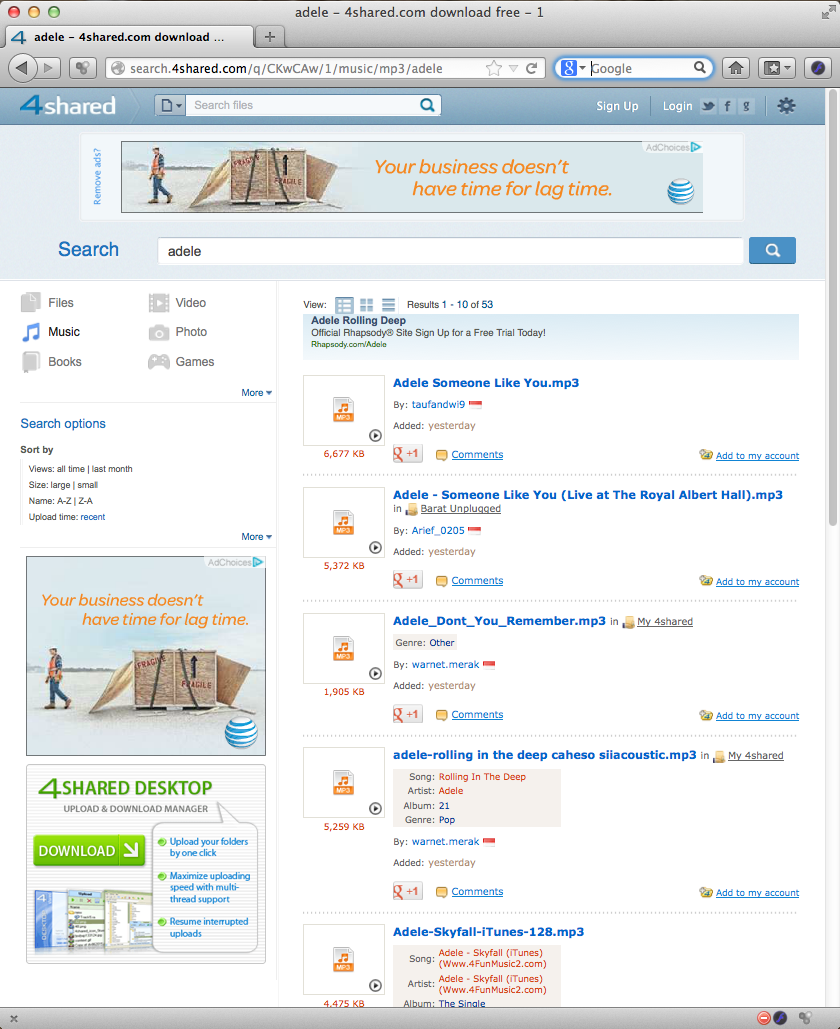
American Express 4Shared Adele
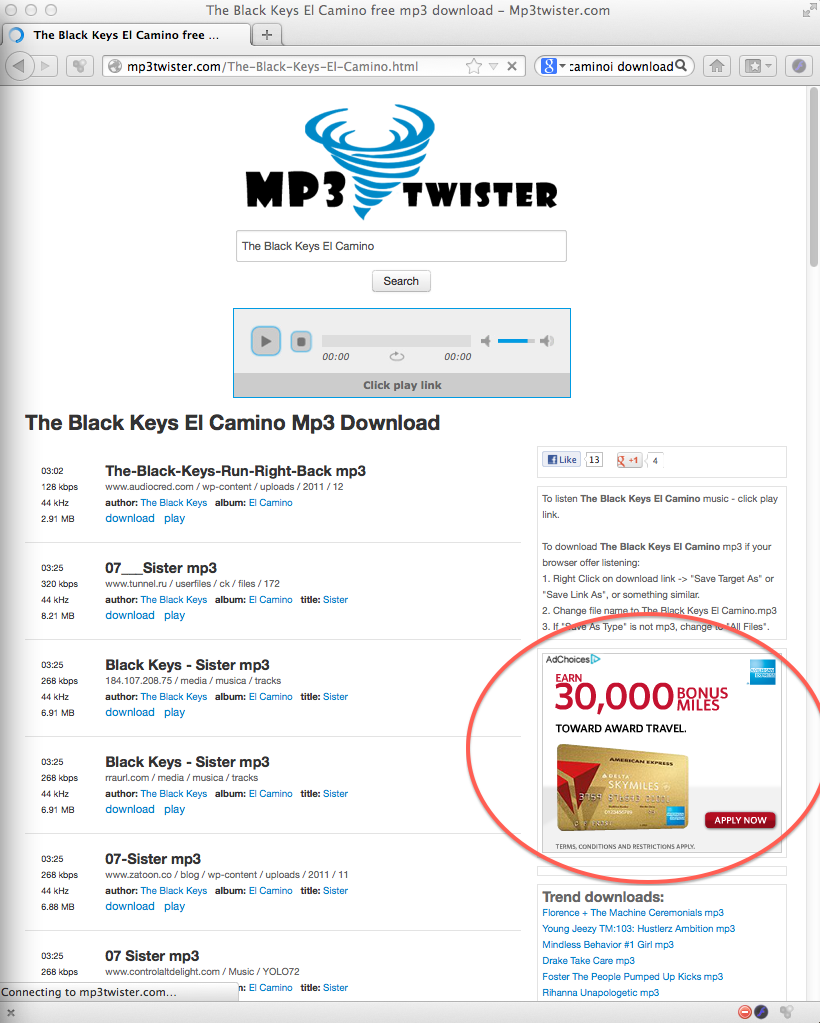
American Express Delta Airlines Card Mp3 Twister Black Keys
AT&T Mp3 Twister Black Keys
AT&T 4Shared Smashing Pumpkins / Billy Corgan
AT&T Mp3Skull Smashing Pumpkins / Billy Corgan
AT&T 4Shared Adele
AT&T mp3 Skull U2
AT&T mp3 Skull John Mellencamp
AT&T Kick Ass Torrents Neil Young
Audi Mp3Skull Smashing Pumpkins / Billy Corgan
BMW 4Shared Smashing Pumpkins / Billy Corgan
BMW Kick Ass Torrents Tom Waits
Boston Market 4Shared Smashing Pumpkins / Billy Corgan
Boy Scouts of America Torrent Reactor Neil Young
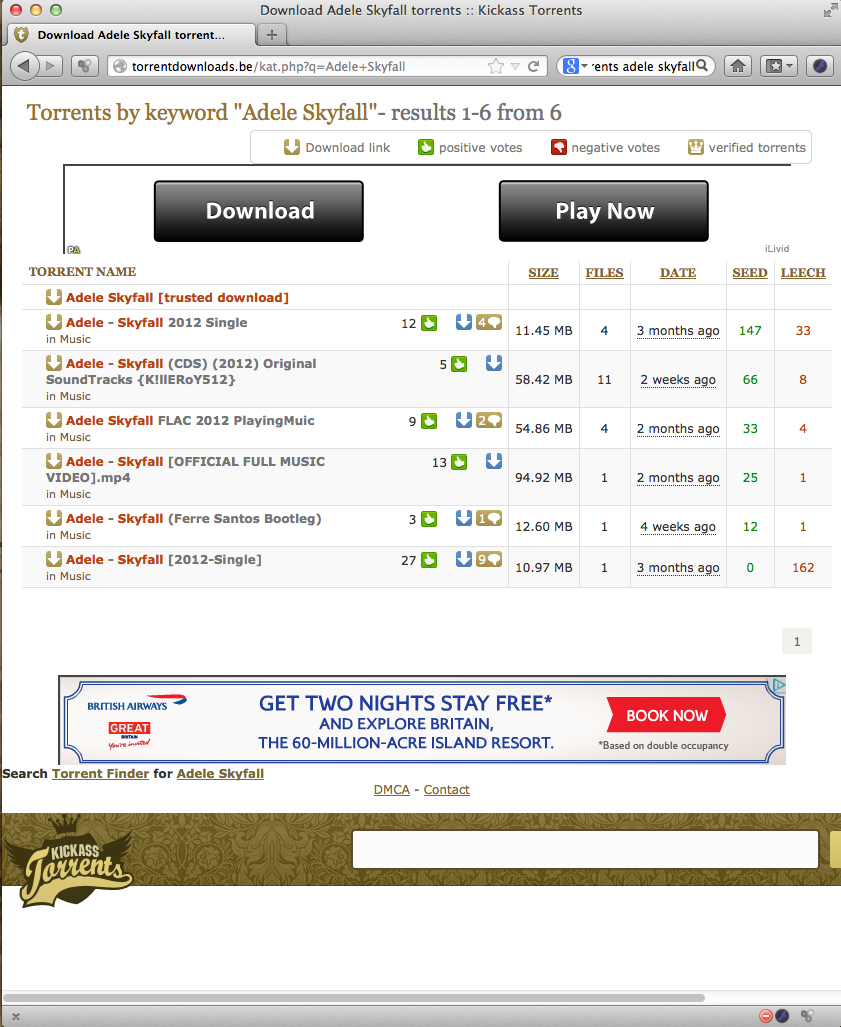
British Airways Kick Ass Torrents Adele
British Airways Mp3 Crow Adele
Century 21 4Shared U2
Charmin Toilet Paper Iso Hunt Neil Young
Charter Cable mp3 Raid U2
Citi Bank 4Shared Smashing Pumpkins / Billy Corgan
Citi Bank 4shared John Mellencamp
Cooper Mini (BMW) Files Tube Neil Young
Cox Cable 4Shared John Mellencamp
Crate & Barrel Files Tube U2
Direct TV Kick Ass Torrents Neil Young
Dish Network Mp3 Twister Black Keys
Ebay Kick Ass Torrents Neil Young
Electronic Arts Need for Speed Mp3 bear Neko Case
Emirates Airlines Files Tube 30 Seconds To Mars / Jared Leto
Ferguson Kick Ass Torrents Talib Kweli
Ford Files Tube 30 Seconds To Mars / Jared Leto
Ford Files Tube Neil Young
Go Pro Files Tube 30 Seconds To Mars / Jared Leto
Google Chrome Mp3 Juices Talib Kweli
Hertz Rent A Car 4Shared Smashing Pumpkins / Billy Corgan
Hewlett Packard Files Tube Neil Young
Hewlett Packard Mp3 Skull U2
Hewlett Packard Files Tube U2
Hewlett Packard Mp3 Skull U2
Hewlett Packard h33t U2
Hilton 4shared Tom Waits
Hyatt 4Shared Tom Waits
Hyundai Mp3Skull Smashing Pumpkins / Billy Corgan
Jet Blue h33t U2
Kayak h33t U2
Kohler Kick Ass Torrents Talib Kweli
Legal Zoom Iso Hunt Neil Young
Levi’s Mp3 Bear Neko Case
LG Files Tube 30 Seconds To Mars / Jared Leto
LG Files Tube Neil Young
LG Files Tube Tom Waits
M&M’s (Mars) Share Beast Black Keys
Macy’s Mp3 bear Neko Case
Marvel Avengers Alliance Mp3 Bear Neko Case
Mazda Mp3Raid Smashing Pumpkins / Billy Corgan
Mini Cooper (BMW) Files Tube Tom Waits
Mitt Romeny 4Shared Tom Waits
Movie 43 (Relativity Media) Mp3 Boo Black Keys
Musicians Friend 4Shared Smashing Pumpkins / Billy Corgan
Nationwide Insurance MediaFire Mp3 Aimee Mann
Neiman Marcus Mp3Skull Smashing Pumpkins / Billy Corgan
Neiman Marcus Mp3 Juices Talib Kweli
Netflix Mp3 Skull John Mellencamp
Nissan Mp3 Boo Black Keys
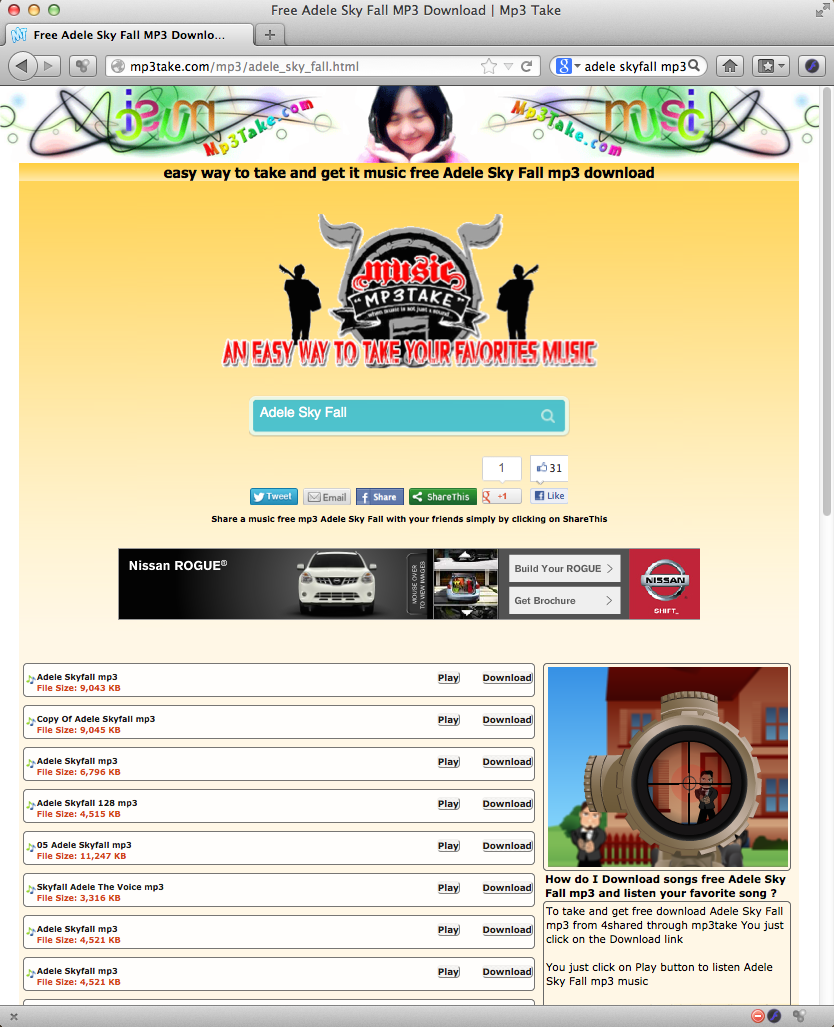
Nissan Mp3 Take Adele
Nissan MP3 Ape Adele
Priceline 4Shared Tom Waits
Princess Cruises Files Tube Neil Young
Princess Cruises Mp3 Bear Neko Case
Register.Com Kick Ass Torrents Talib Kweli
Rejuvenation Files Tube U2
Sheraton Hotels mp3 Skull U2
Sheraton Hotels 4Shared U2
Skype Mp3 bear Neko Case
Sprint Torrent Reactor U2
State Farm Insurance Mp3 Crank Tom Waits
State Farm Insurance Torrent Reactor U2
State Farm Insurance Kick Ass Torrents Talib Kweli
State Farm Insurance Torrent Reactor Neil Young
State Farm Insurance Iso Hunt Neil Young
State Farm Insurance Kick Ass Torrents Neil Young
State Farm Insurance Mp3 Skull U2
State Farm Insurance 4Shared John Mellencamp
State Farm Insurance Mp3 Skull U2
Sweetwater 4Shared John Mellencamp
Target Mp3Skull Smashing Pumpkins / Billy Corgan
Target MP3 Ape Adele
Target Kick Ass Torrents Neil Young
Target Mp3 Crank Tom Waits
Target Files Tube 30 Seconds To Mars / Jared Leto
Tunecore 4Shared John Mellencamp
United Airlines mp3 Bear U2
United Airlines Files Tube U2
United Airlines h33t U2
Urban Outfitters 4Shared Smashing Pumpkins / Billy Corgan
Urban Outfitters Files Tube Tom Waits
Urban Outfitters mp3 skull U2
Virgin Atlantic IsoHunt Smashing Pumpkins / Billy Corgan
Visa Mp3 Crank Tom Waits
Volkswagen Files Tube 30 Seconds To Mars / Jared Leto
W Hotels 4Shared John Mellencamp
Weight Watchers 4Shared Tom Waits
Wendy’s Kick Ass Torrents Tom Waits
Westen Hotels Kick Ass Torrents Neil Young
Westin Hotels Kick Ass Torrents Tom Waits
Westin Hotels 4Shared U2
Westin Hotels mp3 Raid U2
Westin Hotels 4Shared John Mellencamp
Williams Sonoma IsoHunt Smashing Pumpkins / Billy Corgan
Yahoo Mp3 Bear Neko Case
Yahoo Dilandau Tom Waits

Remember all change is local, and you vote with dollars. If we don’t take action directly ourselves we can’t really blame others. These brands are paying the pirate sites to give away your music (directly or indirectly). One tweet a day to any of these brands is all it takes to start building awareness.

You, yes you, can make a difference. Which of these brands do you support with your money? Let them know you don’t want your money, that you pay to them, being used to promote online music piracy and artist exploitation.

We’re going to be tweeting a brand a day starting tomorrow. Retweet us if you like.

Here’s a directory of the brands on Twitter. Please feel free to copy/paste this simple suggested tweet to them:

@Brand Stop Supporting Online Music Piracy #StopArtistExploitation http://wp.me/p2hvgt-1xH

@Adobe – https://twitter.com/Adobe

@ADTstaysafe – https://twitter.com/ADTstaysafe

@AlaskaAir – https://twitter.com/AlaskaAir

@amazon – https://twitter.com/amazon

@AmericanExpress – https://twitter.com/AmericanExpress

@ATT – https://twitter.com/ATT

@Audi – https://twitter.com/Audi

@BMWUSA  – https://twitter.com/BMWUSA

@bostonmarket – https://twitter.com/bostonmarket

@boyscouts – https://twitter.com/boyscouts

@British_Airways – https://twitter.com/British_Airways

@CENTURY21 – https://twitter.com/CENTURY21

@CharterCom – https://twitter.com/CharterCom

@Citibank – https://twitter.com/Citibank

@MINIUSA – https://twitter.com/MINIUSA

@CoxComm – https://twitter.com/CoxComm

@CrateandBarrel – https://twitter.com/CrateandBarrel

@DirecttTv – https://twitter.com/DirecttTv

@DishSatellite  – https://twitter.com/DishSatellite

@eBay – https://twitter.com/eBay

@EA – https://twitter.com/EA

@Air_Emirates – https://twitter.com/Air_Emirates

@FergusonShowrms – https://twitter.com/FergusonShowrms

@Ford – https://twitter.com/Ford

@GoPro – https://twitter.com/GoPro

@googlechrome – https://twitter.com/googlechrome

@HertzCWB – https://twitter.com/HertzCWB

@HP – https://twitter.com/HP

@HiltonHotels – https://twitter.com/HiltonHotels

@HyattPR – https://twitter.com/HyattPR

@Hyundai – https://twitter.com/Hyundai

@JetBlueAirlines – https://twitter.com/JetBlueAirlines

@KAYAK – https://twitter.com/KAYAK

@Kohler – https://twitter.com/Kohler

@LegalZoom – https://twitter.com/LegalZoom

@LGUS – https://twitter.com/LGUS

@MyMMscom – https://twitter.com/MyMMscom

@Macys – https://twitter.com/Macys

@_MarvelAvengers – https://twitter.com/_MarvelAvengers

@MazdaUSA – https://twitter.com/MazdaUSA

@musiciansfriend – https://twitter.com/musiciansfriend

@Nationwide – https://twitter.com/Nationwide

@neimanmarcus – https://twitter.com/neimanmarcus

@netflix – https://twitter.com/netflix

@NissanUSA – https://twitter.com/NissanUSA

@priceline – https://twitter.com/priceline

@PrincessCruises – https://twitter.com/PrincessCruises

@Register_com – https://twitter.com/Register_com

@RejuvenationInc – https://twitter.com/RejuvenationInc

@Sheraton_Hotels – https://twitter.com/Sheraton_Hotels

@Skype – https://twitter.com/Skype

@sprint – https://twitter.com/sprint

@StateFarm – https://twitter.com/StateFarm

@SweetwaterSound – https://twitter.com/SweetwaterSound

@Target – https://twitter.com/Target

@TuneCore – https://twitter.com/TuneCore

@UNITED_AlRLINES – https://twitter.com/UNITED_AlRLINES

@UrbanOutfitters – https://twitter.com/UrbanOutfitters

@VirginAtlantic – https://twitter.com/VirginAtlantic

@Visa – https://twitter.com/Visa

@VW – https://twitter.com/VW

@WHotels – https://twitter.com/WHotels

@WeightWatchers – https://twitter.com/WeightWatchers

@Wendys- https://twitter.com/Wendys

@Westin – https://twitter.com/Westin

@WilliamsSonoma – https://twitter.com/WilliamsSonoma

@Yahoo – https://twitter.com/Yahoo

Two Simple Facts about Technology and Piracy : iTunes Vs. YouTube

Fact number one.

Unlike Google’s YouTube, Apple’s Itunes Store does not have a piracy problem, nor does it have an unmanageable issue with DMCA notices. This is often explained that this is because Apple does not allow user generated content from just anyone, therefore there is a barrier to entry that prevents such issues. But this is simply just not true, anyone can upload an album of music to Itunes using any one of the third party aggregation services such as Tunecore or CDbaby. And yet, there are not (as far as we know) hundreds or thousands of DMCA notices and content take downs on Itunes per day, as there are on YouTube. So why is this? In a word, intent.

If Apple, Spotify, Amazon and virtually every other legal and licensed distributor of digital music can put into place, the checks and balances that are capable of managing these rights effectively why is it so hard for Google to do the same YouTube? Think about it.

Fact number two.

YouTube can effectively filter content if it wants to. Since day one, we have never, ever seen any live porn on YouTube. Not a single live link to porn, ever. In debates in various online forums we have often proposed the challenge to anyone to present an active live link to full fledged porn on YouTube. It has NEVER happened. No one has EVER been able to present a live link to an active porn video on YouTube in the six plus years we and our friends have presented the challenge. Talk about a crowd sourcing FAIL.

What these two facts reveal is that rights management online, the protection of copyrights and the enforcement of Intellectual Property require nothing more than the intent and will to do so. But don’t take our word for it, listen to Google’s own Chief Economist Hal A Varian from his book “Information Rules” where he describes “Bitlegging.”

“Bitlegging” can’t be ignored: there’s no doubt that it can be a significant drag on profits.

Bitleggers have the same problem that any other sellers of contraband material have: they have to pet potential customers know how to find them. But if they advertise their location to potential customers, they also advertise their location to law enforcement authorities. In the contraband business it pays to advertise… but not too much.

This puts a natural limit on the size of for-profit illegal activities: the bigger they get, the more likely they are to get caught. Digital piracy can’t be eliminated, any more than any other kind of illegal activity, but it can be kept under control. All that is required is the political will to enforce intellectual property rights.

So Apple, Amazon, Spotify (and hundreds of others) can effectively manage digital distribution without triggering millions of DMCA notices. YouTube can effectively filter porn, and yet the internet is not broken as best as we can tell.

Maybe, just maybe this isn’t so complicated after all. That is unless one has a specific intent and motive from which they perhaps profit from the mass scale aiding of commercial level infringement.

Grammy Award Nominated Black Keys Exploited by… American Express Delta Airlines Card, AT&T, Dish Network, M&M’s (Mars), Nissan and others…

The Black Keys have been very vocal about their opposition to the payment and revenue models of new streaming services like Spotify, but we wonder how the band will feel when seeing their music generating ad revenue for commercial level infringing websites like Filestube, Mp3 Twister, Share Beast and Mp3 Boo all as from a simple Google Search.

We also wonder if any of these brands will be advertising during the Grammy Awards for which the band is nominated for Best Album. These are major brands such as American Express, Delta Airlines, Dish Network, Nissan and M&Ms. All of whom we’ve seen running television advertising campaigns for their products and services.

Here’s a quick look at a random sampling of sites from searching Google. This is despite what might be hundreds or more likely thousands of delisted links from legitimate DMCA notices. Mind Boggling…

American Express Delta Airlines Card on Mp3 Twister
AT&T on Mp3 Twister
Dish Network on Mp3 Twister
M&M’s (Mars) on Share Beast
Nissan on Mp3 Boo
Movie 43 (Relativity Media) on Mp3 Boo
Exposed Webcams on FilesTube

googleblackkeystorrents

Despite the amount of delisted links, presumably to the largest infringers, the pirate bay can still top the search results listed. Also interesting is that the reach of the ad networks seems to go very deep into a long tail of very dispersed infringing sites like Mp3 twister. It appears that as brands and agencies are learning of their ads appearing on infringing and illegal sites, the ads are starting to migrate down stream to perhaps previously less visited sites.

bk_mp3twisterAMEXDELTA

bk_mp3twisterATT

bk_mp3twisterDISH

bk_sharebeastMMS

bk_mp3booNISSAN

bk_mp3booMovie43

What is disturbing about the ad above for Movie 43 on Mp3 Boo is that it is for a film by Relativity Media, a Hollywood film production and distribution company. It’s entirely possible if we looked for this film it may already be leaked and pirated, and if not, most certainly will be within hours on the day it is theatrically released.

bk_filestuneEXPOSEDWEBCAMS

Also of interest in this batch are the porn site ads on FilesTube. Isn’t this some kind of public safety issue that minors under 18 years of age who are visiting these infringing sites to get free music illegally are being exposed to pornographers showing girls who are barely legal themselves at just 18 years old?

Is this really acceptable to our representatives on Capital Hill?

Kim Dotcom’s “End Of Piracy”, that was easy…

In the anticipation of the announcement of the new Mega launch, Pat Pilcher at The New Zealand Herald wrote an article titled “Kim Dotcom on Ending Piracy” in which the journalist listed Mr.Dotcom’s five steps to ending piracy. Pilcher writes,

As ironic as that may sound, Kim Dotcom’s logic is inescapably robust. Here’s what his end to piracy manifesto says:

1. Create great stuff
2. Make it easy to buy
3. Same day worldwide release
4. Fair price
5. Works on any device

Looking at what Kim is saying, the 5 points seem pretty obvious, although each could quickly get bogged down once Hollywood gets involved.

So let’s look at these one by one.

1. Create Great Stuff
Well, that’s a no brainer. The content industries create the most prized and sought after “stuff” in the world including films such as Avatar, The Avengers, and The Dark Night Rises as well as franchises like Iron Man, Transformers, Harry Potter and others. Music artists include the likes of Adele, The Black Keys, Taylor Swift, The Beatles and countless others. Making great stuff has never been a problem.

2. Make It Easy To Buy
Another no brainer. Perhaps a decade plus ago this might have been an argument, but not today. There are over 500 legal and licensed music services alone. For the film industry there are services like Netflix, Vudu and Cinemanow as well as other direct to home video on demand providers that give consumers more access to more content across more platforms than at any time in history.

3. Same Day World Wide Release
For music this is more less the standard now and is also more and more common for feature film releases as well. This is a common practice for the largest and most anticipated releases of music and films, the “stuff” that is the most aggressively pirated. For smaller indie releases this may not always be possible but than again I’m not sure that the problem we are combating is in Nigeria on indie rock albums and movies that are more or less film festival darlings.

4. Fair price
Done. Netflix is $7.99 a month for unlimited access to it’s entire library of films and tv shows. Spotify is $9.99 for unlimited access to it’s entire library which consist of probably 95% of every known recording in print. Add to this the cost of a song download is 99 cents. Less than the cost of a candy bar. Renting a movie from a video on demand service ranges from 3.99 to 5.99. Price is no longer an issue and has not been for years.

5. Works on Any Device
Music is DRM free and has been for at least half a decade. Streaming Services such as Netflix and Spotify are also available on every major platform including not only Mac and PC computers, but also mobile devices such as smart phones and tablets by a variety of manufacturers. Additionally most new video game consoles and blu-ray players also include many of these same apps.

So there you have it, the end of piracy. Even Pat Pilcher at The New Zealand Herald agrees a referring to a similar response from the New Zealand record industry. He writes,

Well there it is, RIANZ’s response in full. I can’t argue with much that they’ve said, as they’ve pretty much complied with most of Kim’s 5 points.

So Kim Dotcom’s five suggestions have been fulfilled and yet, I don’t think we’ll see an end to piracy anytime soon. There is still one thing piracy offers that legal, licensed and legitimate services do not, and that is compensation to the artists, musicians, filmmakers and creators which requires that consumers actually do pay the fair price asked.

It’s all pretty simple and by Kim Dotcom’s own suggestions and admission it’s pretty clear where the problem is from here on out, and it’s not in his five suggestions…

And, of course, let us not forget this classic… Kim Dotcom Parody Video Appears on YouTube

Golden Globe Winner Adele Exploited by American Express, AT&T, British Airways, Target and Nissan

On Sunday January 13th, Adele won the Golden Globe for the Best Song In a Motion Picture for her song “Skyfall” in the latest James Bond film of the same name. So we thought we’d take a look and see which brands are advertising on both the Golden Globes Awards Show and also on the pirate sites giving away the song that had just won the award.

It’s interesting to note who doesn’t show up on pirate sites as well. For example we’ve seen no ads by L’Oreal (as yet) on pirate sites. L’Oreal had a very strong presence running ads during the Golden Globes, as did Target (who unfortunately also shows up frequently on pirate sites).

Here’s what we found in just a few minutes… this is like shooting fish in a barrel. Who will advertise on the Academy Awards and Grammys who is also funding piracy? We wonder…

AdeleTargetMp3Ape

AdeleAT&T4shared

adeleamex4shared

adeleBristishAirmp3crow

AdeleKATbritAir

AdeleNissonmp3take

British Airways is interesting in this batch. Adele is British. James Bond is British. Have to wonder how smart these ad networks are getting in their targeting of consumers based on interests and other relational values.