Gene Simmons is receiving Kennedy Center Honors with KISS this Sunday, and is also bringing his voice to the fair pay for radio play campaign to pass the American Music Fairness Act (AMFA).
Gene will testify on AMFA next week before the Senate Judiciary Committee. He won’t just be speaking as a member of KISS or as one of the most recognizable performers in American music. He’ll be showing up as a witness to something far more universal: the decades-long exploitation of recording artists whose work powers an entire broadcast industry and that has never paid them a dime. Watch Gene’s hearing on December 9th at 3pm ET at this link, when Gene testifies alongside SoundExchange CEO Mike Huppe.
As Gene argued in his Washington Post op-ed, the AM/FM radio loophole is not a quirky relic, it is legalized taking. Everyone else pays for music: streaming services, satellite radio, social-media platforms, retail, fitness, gaming. Everyone except big broadcast radio, which generated more than $13 billion in advertising revenue last year while paying zero to the performers whose recordings attract those audiences.
Gene is testifying not just for legacy acts, but for the “thousands of present and future American recording artists” who, like KISS in the early days, were told to work hard, build a fan base, and just be grateful for airplay. As he might put it, artists were expected to “rock and roll all night” — but never expect to be paid for it on the radio.
And when artists asked for change, they were told to wait. They “keep on shoutin’,” decade after decade, but Congress never listened.
That’s why this hearing matters. It’s the first Senate-level engagement with the issue since 2009. The ground is shifting. Gene Simmons’ presence signals something bigger: artists are done pretending that “exposure” is a form of compensation.
AMFA would finally require AM/FM broadcasters to pay for the sound recordings they exploit, the same way every other democratic nation already does. It would give session musicians, backup vocalists, and countless independent artists a revenue stream they should have had all along. It would even unlock international royalties currently withheld from American performers because the U.S. refuses reciprocity.
And let’s be honest: Gene Simmons is an ideal messenger. He built KISS from nothing, understands the grind, and knows exactly how many hands touch a recording before it reaches the airwaves. His testimony exposes the truth: radio isn’t “free promotion” — it’s a commercial business built on someone else’s work.
Simmons once paraphrased the music economy as a game where artists are expected to give endlessly while massive corporations act like the only “god of thunder,” taking everything and returning nothing. AMFA is an overdue correction to that imbalance.
When Gene sits down before the Senate Judiciary Committee, he won’t be wearing the makeup. He won’t need to. He’ll be carrying something far more powerful: the voices of artists who’ve waited 80 years for Congress to finally turn the volume up on fairness.
The moratorium would block states from enforcing their own laws on AI accountability, deepfakes, consumer protection, energy policy, discrimination, and data rights. Tennessee’s ELVIS Act is a prime example. For ten years — or five years in the “softened” version — the federal government would force states to stand down while some of the most richest and powerful monopolies in commercial history continue deploying models trained on unlicensed works, scraped data, personal information, and everything in between. Regardless of whether it is ten years or five years, either may as well be an eternity in Tech World. Particularly since they don’t plan on following the law anyway with their “move fast and skip things” mentality.
Ted Turns Texas Glowing
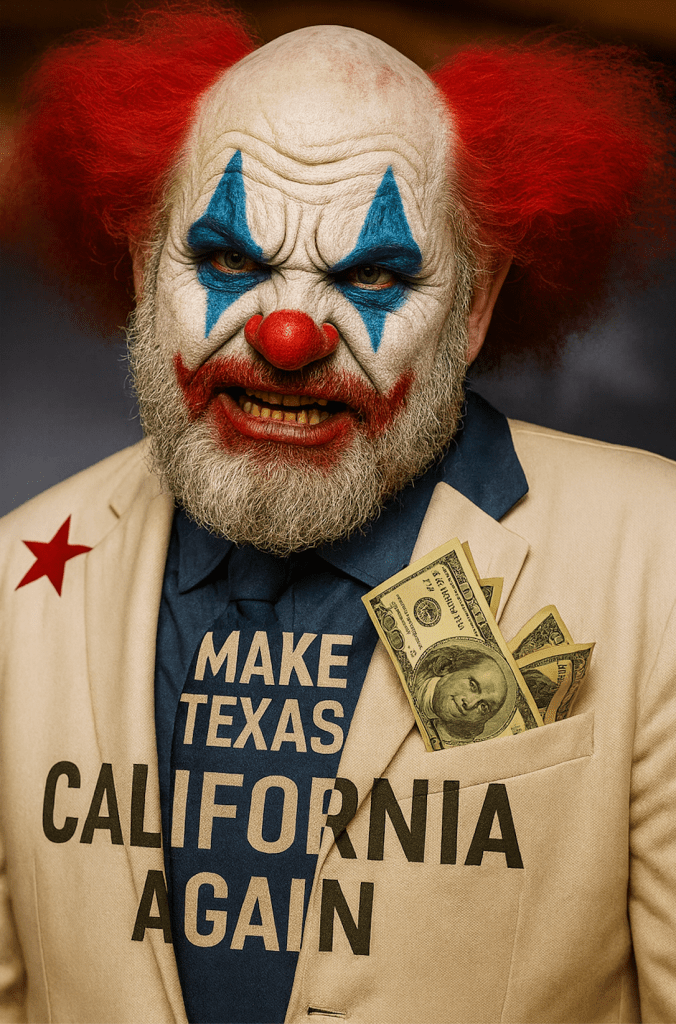
99-1/2 just won’t do—Remember the AI moratorium that was defeated 99-1 in the Senate during the heady days of the One Big Beautiful Bill Act? We said it would come back in the must-pass National Defense Authorization Act and sure enough that’s exactly where it is courtesy of Senator and 2028 Presidential hopefull Ted Cruz (fundraising off of the Moratorium no doubt for his “Make Texas California Again” campaign) and other Big Tech sycophants according to a number of sources including Politico and the Tech Policy Press:
It…remains to be seen when exactly the moratorium issue may be taken up, though a final decision could still be a few weeks away.
Congressional leaders may either look to include the moratorium language in their initial NDAA agreement, set to be struck soon between the two chambers, or take it up as a separate amendment when it hits the floor in the House and Senate next month.
Either way, they likely will need to craft a version narrow enough to overcome the significant opposition to its initial iterations. While House lawmakers are typically able to advance measures with a simple majority or party-line vote, in the Senate, most bills require 60 votes to pass, meaning lawmakers must secure bipartisan support.
The pushback from Democrats is already underway. Sen. Brian Schatz (D-HI), an influential figure in tech policy debates and a member of the Senate Commerce Committee, called the provision “a poison pill” in a social media post late Monday, adding, “we will block it.”
Still, the effort has the support of several top congressional Republicans, who have repeatedly expressed their desire to try again to tuck the bill into the next available legislative package.
In Washington, must-pass bills invite mischief. And right now, House leadership is flirting with the worst kind: slipping a sweeping federal moratorium on state AI laws into the National Defense Authorization Act (NDAA).
This idea was buried once already — the Senate voted 99–1 to strike it from Trump’s earlier “One Big Beautiful Bill.” But instead of accepting that outcome, Big Tech trying to resurrect it quietly, through a bill that is supposed to fund national defense, not rewrite America’s entire AI legal structure.
The NDAA is the wrong vehicle, the wrong process, and the wrong moment to hand Big Tech blanket immunity from state oversight. As we have discussed many times the first time around, the concept is probably unconstitutional for a host of reasons and will no doubt be immediately challenged.
AI Moratorium Lobbying Explainer for Your Electric Bill
Here are the key shilleries pushing the federal AI moratorium and their backers:
Promote ‘uniform national standards’ in Congressional meetings
Operate through and alongside trade groups
PARASITES GROW IN THE DARK: WHY THE NDAA IS THE ABSOLUTE WRONG PLACE FOR THIS
The National Defense Authorization Act is one of the few bills that must pass every year. That makes it a magnet for unrelated policy riders — but it doesn’t make those riders legitimate.
An AI policy that touches free speech, energy policy and electricity rates, civil rights, state sovereignty, copyright, election integrity, and consumer safety deserves open hearings, transparent markups, expert testimony, and a real public debate. And that’s the last thing the Big Tech shills want.
THE TIMING COULD NOT BE MORE INSULTING
Big Tech is simultaneously lobbying for massive federal subsidies for compute, federal preemption of state AI rules, and multi-billion-dollar 765-kV transmission corridors to feed their exploding data-center footprints.
And who pays for those high-voltage lines? Ratepayers do. Utilities that qualify as political subdivisions in the language of the moratorium—such as municipal utilities, public power districts, and cooperative systems—set rates through their governing boards rather than state regulators. These boards must recover the full cost of service, including new infrastructure needed to meet rising demand. Under the moratorium’s carve-outs, these entities could be required to accept massive AI-driven load increases, even when those loads trigger expensive upgrades. Because cost-of-service rules forbid charging AI labs above their allocated share, the utility may have no choice but to spread those costs across all ratepayers. Residents, not the AI companies, would absorb the rate hikes.
States must retain the power to protect their citizens. Congress has every right to legislate on AI. But it does not have the right to erase state authority in secret to save Big Tech from public accountability.
A CALL TO ACTION
Tell your Members of Congress: No AI moratorium in the NDAA. No backroom preemption. No Big Tech giveaways in the defense budget.
When Spotify and the National Music Publishers’ Association (NMPA) announced an “opt-in” audiovisual licensing portal this month, the headlines made it sound like a breakthrough for independent songwriters. In reality, what we have is a bare-bones description of a direct-license program whose key financial and legal terms remain hidden from view.
Here’s what we do know. The portal (likely an HFA extravaganza) opened on November 11, 2025 and will accept opt-ins through December 19. Participation is limited to NMPA member publishers, and the license covers U.S. audiovisual uses—that is, music videos and other visual elements Spotify is beginning to integrate into its platform. It smacks of the side deal on pending and unmatched tied to frozen mechanicals that the CRB rejected in Phonorecords IV.
Indeed, one explanation for the gun decked opt-in period is in The Desk:
Spotify is preparing to launch music videos in the United States, expanding a feature that has been in beta in nearly 100 international markets since January, the company quietly confirmed this week.
The new feature, rolling out to Spotify subscribers in the next few weeks, will allow streaming audio fans to watch official music videos directly within the Spotify app, setting the streaming platform in more direct competition with YouTube.
The company calls it a way for indies to share in “higher royalties,” but no rates, formulas, or minimum guarantees have been disclosed so it’s hard to know “higher” compared to what? Yes, it’s true that if you evan made another 1¢ that would be “higher”—and in streaming-speak, 1¢ is big progress, but remember that it’s still a positive number to the right of the decimal place preceded by a zero.
The deal sits alongside Spotify’s major-publisher audiovisual agreements, which are widely believed to include large advances and broader protections—none of which apply here. There’s also an open question of whether the majors granted public performance rights as an end run around PROs, which I fully expect. There’s no MFN clause, no public schedule, and no audit details. I would be surprised if Spotify agreed to be audited by an independent publisher and even more surprised if the announced publishers with direct deals did not have an audit right. So there’s one way we can be pretty confident this is not anything like MFN terms aside from the scrupulous avoidance of mentioning the dirty word: MONEY.
But it would be a good guess that Spotify is interested in this arrangement because it fills out some of the most likely plaintiffs to protect them when they launch their product with unlicensed songs or user generated videos and no Content ID clone (which is kind of Schrödinger’s UGC—not expressly included in the deal but not expressly excluded either, and would be competitive with TikTok or Spotify nemesis YouTube).
But here’s what else we don’t know: how much these rights are worth, how royalties will be calculated, whether they include public performances to block PRO licensing of Spotify A/V (and which could trigger MFN problems with YouTube or other UGC services) and whether the December 19 date marks the end of onboarding—or the eve of a US product launch. And perhaps most importantly, how is it that NMPA is involved, the NMPA which has trashed Spotify far and wide over finally taking advantage of the bundling rates negotiated in the CRB (indeed in some version since 2009). Shocked, shocked that there’s bundling going on.
It’s one thing to talk about audiovisual covering “official” music videos and expressly stating that the same license will not be used to cover UGC no way, no how. Given Spotify’s repeated hints that full-length music videos are coming to the U.S. and the test marketing reported by The Desk and disclosed by Spotify itself, the absolute silence of the public statements about royalty rates and UGC, as well as the rush to get publishers to opt in before year-end all suggest that rollout is imminent. Until Spotify and the NMPA release the actual deal terms, though, we’re all flying blind—sheep being herded toward an agreement cliff we can’t fully see.
[A version of this post first appeared on MusicTechPolicy]
When White House AI Czar David Sacks tweets confidently that “there will be no federal bailout for AI” because “five major frontier model companies” will simply replace each other, he is not speaking as a neutral observer. He is speaking as a venture capitalist with overlapping financial ties to the very AI companies now engaged in the most circular investment structure Silicon Valley has engineered since the dot-com bubble—but on a scale measured not in millions or even billions, but in trillions.
Sacks is a PayPal alumnus turned political-tech kingmaker who has positioned himself at the intersection of public policy and private AI investment. His recent stint as a Special Government Employee to the federal government raised eyebrows precisely because of this dual role. Yet he now frames the AI sector as a robust ecosystem that can absorb firm-level failure without systemic consequence.
The numbers say otherwise. The diagram circulating in the X-thread exposes the real structure: mutually dependent investments tied together through cross-equity stakes, GPU pre-purchases, cloud-compute lock-ins, and stock-option-backed revenue games. So Microsoft invests in OpenAI; OpenAI pays Microsoft for cloud resources; Microsoft books the revenue and inflates its stake OpenAI. Nvidia invests in OpenAI; OpenAI buys tens of billions in Nvidia chips; Nvidia’s valuation inflates; and that valuation becomes the collateral propping up the entire sector. Oracle buys Nvidia chips; OpenAI signs a $300 billion cloud deal with Oracle; Oracle books the upside. Every player’s “growth” relies on every other player’s spending.
This is not competition. It is a closed liquidity loop. And it’s a repeat of the dot-bomb “carriage” deals that contributed to the stock market crash in 2000.
And underlying all of it is the real endgame: a frantic rush to secure taxpayer-funded backstops—through federal energy deals, subsidized data-center access, CHIPS-style grants, or Department of Energy land leases—to pay for the staggering infrastructure costs required to keep this circularity spinning. The singularity may be speculative, but the push for a public subsidy to sustain it is very real.
Call it what it is: an industry searching for a government-sized safety net while insisting it doesn’t need one.
In the meantime, the circular investing game serves another purpose: it manufactures sky-high paper valuations that can be recycled into legal war chests. Those inflated asset values are now being used to bankroll litigation and lobbying campaigns aimed at rewriting copyright, fair use, and publicity law so that AI firms can keep strip-mining culture without paying for it.
The same feedback loop that props up their stock prices is funding the effort to devalue the work of every writer, musician, actor, and visual artist on the planet—and to lock that extraction in as a permanent feature of the digital economy.
As we’ve been posting about for years—alongside Blake Morgan and the #IRespectMusic movement that you guys have been so good about supporting—there’s still a glaring failure at the heart of U.S. copyright law: performing artists and session musicians receive no royalty for AM/FM radio airplay. Every other developed country (and practically every other country) compensates performers for broadcast use, yet the United States continues to exempt terrestrial radio from paying the people who record the music.
Now Congress is preparing to pass the AM Radio in Every Car Act, a massive government intervention that would literally install the instrument of unfairness into every new car at significant cost to consumers. It’s a breathtaking example of how far the National Association of Broadcasters (NAB) will go to preserve its century-old free ride—by lobbying for public subsidies while refusing to pay artists a penny. This isn’t public service; it’s policy cruelty dressed up as nostalgia.
Hundreds of artists have already spoken out in a letter to Congress demanding fairness through the American Music Fairness Act (AMFA). Their action matters—and yours does too.
👉 Here’s what you can do:
Read the open letter below.
Share it with your representatives.
Tag them on social media with #AMFA and #IRespectMusic.
Don’t let Washington hard-wire injustice into every dashboard. Demand that Congress fix the problem before it funds the next generation of unfairness.
Dear Speaker Johnson, Leader Jeffries, Leader Thune, and Leader Schumer:
Earlier this year, we wrote urging that you take action on the American Music Fairness Act (S.253/H.R.791), legislation that will require that AM/FM radio companies start paying artists for their music. We are grateful for your attention to ensuring America’s recording artists are finally paid for use of our work.
As you may know, some members of Congress are currently seeking to pass legislation that will require every new vehicle manufactured in the United States come pre-installed with AM radio. The passage of the AM Radio for Every Vehicle Act (S.315/H.R.979) would mark another major windfall for the corporate radio industry that makes $13.6 billion each year in advertising revenue while refusing to compensate the performers whose songs play 240 million times each year on AM radio stations. Every year, recording artists lose out on hundreds of millions of dollars in royalties in the U.S. and abroad because of this hundred-year-old loophole.
This is wrong. In the United States of America, every person deserves to be paid for the use of their work. But because of the power held by giant radio corporations in Washington, artists, both big and small, continue to be overlooked, even as every other music delivery platform, including streaming services and satellite radio, pays both the songwriter and performer.
We are asking today that you insist that any legislation that includes the AM Radio for Every Vehicle Act also include the American Music Fairness Act. We do not oppose terrestrial radio. In fact, we appreciate the role that radio has played in our careers and within society, but the 100-year-old argument of promotion that radio continues to hide behind does not ring true in 2025.
When you save the radio industry by mandating its technology remain in cars, we ask that you save the musician too and allow us to be paid fairly when our music is played.
Thank you again for your consideration of this much-needed legislation.
I believe Americans should have the ability to defend their human data, and their rights to that data, against the largest copyright theft in the history of the world.
Millions of Americans have spent the past two decades speaking and engaging online. Many of you here today have online profiles and writings and creative productions that you care deeply about. And rightly so. It’s your work. It’s you.
What if I told you that AI models have already been trained on enough copyrighted works to fill the Library of Congress 22 times over? For me, that makes it very simple: We need a legal mechanism that allows Americans to freely defend those creations. I say let’s empower human beings by protecting the very human data they create. Assign property rights to specific forms of data, create legal liability for the companies who use that data and, finally, fully repeal Section 230. Open the courtroom doors. Let the people sue those who take their rights, including those who do it using AI.
Third, we must add sensible guardrails to the emergent AI economy and hold concentrated economic power to account. These giant companies have made no secret of their ambitions to radically reshape our economic life. So, we ought to require transparency and reporting each time they replace a working man with a machine.
And the government should inspect all of these frontier AI systems, so we can better understand what the tech titans plan to build and deploy.
Ultimately, when it comes to guardrails, protecting our children should be our lodestar. You may have seen recently how Meta green-lit its own chatbots to have sensual conversations with children—yes, you heard me right. Meta’s own internal documents permitted lurid conversations that no parent would ever contemplate. And most tragically, ChatGPT recently encouraged a troubled teenager to commit suicide—even providing detailed instructions on how to do it.
We absolutely must require and enforce rigorous technical standards to bar inappropriate or harmful interactions with minors. And we should think seriously about age verification for chatbots and agents. We don’t let kids drive or drink or do a thousand other harmful things. The same standards should apply to AI.
Fourth and finally, while Congress gets its act together to do all of this, we can’t kneecap our state governments from moving first. Some of you may have seen that there was a major effort in Congress to ban states from regulating AI for 10 years—and a whole decade is an eternity when it comes to AI development and deployment. This terrible policy was nearly adopted in the reconciliation bill this summer, and it could have thrown out strong anti-porn and child online safety laws, to name a few. Think about that: conservatives out to destroy the very concept of federalism that they cherish … all in the name of Big Tech. Well, we killed it on the Senate floor. And we ought to make sure that bad idea stays dead.
We’ve faced technological disruption before—and we’ve acted to make technology serve us, the people. Powered flight changed travel forever, but you can’t land a plane on your driveway. Splitting the atom fundamentally changed our view of physics, but nobody expects to run a personal reactor in their basement. The internet completely recast communication and media, but YouTube will still take down your video if you violate a copyright. By the same token, we can—and we should—demand that AI empower Americans, not destroy their rights . . . or their jobs . . . or their lives.
David Lowery sits down with John Patrick Gatta at Jambands for a wide-ranging conversation that threads 40 years of Camper Van Beethoven and Cracker through the stories behind David’s 3 disc release Fathers, Sons and Brothers and how artists survive the modern music economy. Songwriter rights, road-tested bands, or why records still matter. Read it here.
David Lowery toured this year with a mix of shows celebrating the 40th anniversary of Camper Van Beethoven’s debut, Telephone Free Landslide Victory, duo and band gigs with Cracker, as well as solo dates promoting his recently-released Fathers, Sons and Brothers.
Fathers, the 28-track musical memoir of Lowery’s personal life explored childhood memories, drugs at Disneyland and broken relationships. Of course, it tackles his lengthy career as an indie and major label artist who catalog highlights include the alt-rock classic “Take the Skinheads Bowling” and commercial breakthrough of “Teen Angst” and “Low.” The album works as a selection of songs that encapsulate much of his musical history— folk, country and rock—as well as an illuminating narrative that relates the ups, downs, tenacity, reflection and resolve of more than four decades as a musician.
🎙️ Artist Rights Roundtable on AI and Copyright: Coffee with Humans and the Machines
📍 Butler Board Room, Bender Arena, American University, 4400 Massachusetts Ave NW, Washington D.C. 20016 | 🗓️ September 18, 2025 | 🕗 8:00 a.m. – 12:00 noon
Hosted by the Artist Rights Institute & American University’s Kogod School of Business, Entertainment Business Program
🔹 Overview:
Join the Artist Rights Institute (ARI) and Kogod’s Entertainment Business Program for a timely morning roundtable on AI and copyright from the artist’s perspective. We’ll explore how emerging artificial intelligence technologies challenge authorship, licensing, and the creative economy — and what courts, lawmakers, and creators are doing in response.
☕ Coffee served starting at 8:00 a.m. 🧠 Program begins at 8:50 a.m. 🕛 Concludes by 12:00 noon — you’ll be free to have lunch with your clone.
🗂️ Program:
8:00–8:50 a.m. – Registration and Coffee
8:50–9:00 a.m. – Introductory Remarks by Dean David Marchick and ARI Director Chris Castle
9:00–10:00 a.m. – Topic 1: AI Provenance Is the Cornerstone of Legitimate AI Licensing:
Speakers: Dr. Moiya McTier Human Artistry Campaign Ryan Lehnning, Assistant General Counsel, International at SoundExchange The Chatbot Moderator Chris Castle, Artist Rights Institute
10:10–10:30 a.m. – Briefing: Current AI Litigation, Kevin Madigan, Senior Vice President, Policy and Government Affairs, Copyright Alliance
10:30–11:30 a.m. – Topic 2: Ask the AI: Can Integrity and Innovation Survive Without Artist Consent?
Speakers: Erin McAnally, Executive Director, Songwriters of North America Dr. Richard James Burgess, CEO A2IM Dr. David C. Lowery, Terry College of Business, University of Georgia.
Moderator: Linda Bloss Baum, Director Business and Entertainment Program, Kogod School of Business
11:40–12:00 p.m. – Briefing: US and International AI Legislation
1. have balls 2. be accused of distributing postcards with the slogans "Glory to Ukraine!" and "зutin to the gallows" in a supermarket in St. Petersburg 3. be sentenced to 3.5 (Anastasia) and 3 years (Alexander) in a penal colony 4. do not betray… pic.twitter.com/mmXaw9X9Bz
In July 2024, a military court in Saint Petersburg convicted Russian artists Anastasia Dyudyaeva and her husband Alexander Dotsenko on charges of “public calls for terrorism” after they placed anti-war messages—some in Ukrainian, one reading “Putin to the gallows”—on napkins or postcards in a Lenta supermarket. Dyudyaeva received a 3½-year sentence; Dotsenko, three years. They denied wrongdoing, asserting their creative expression was mischaracterized. Their home, which had hosted anti-war exhibitions, was searched, and they were added to Russia’s registry of “terrorists and extremists.”
You must be logged in to post a comment.