@jemaswad: Senators Introduce American Music Fairness Act, Which Would Require Radio to Pay Royalties to Musicians [thanks to Senators @MarshaBlackburn and @AlexPadilla4CA] #IRespectMusic

[Introducing AMFA in the Senate is a huge thing and a major win by MusicFirst over the evil NAB and their $50 handshake. The bipartisan legislation has to pass both Senate and House to become law.]

Since the dawn of radio, the United States has been and remains the only major country in the world where terrestrial radio pays no royalties to performers or recorded-music copyright owners of the songs it plays — a situation that is largely due to the powerful radio lobby’s influence in Congress. While the more than 8,300 AM and FM stations across the country pay royalties to songwriters and publishers, they have never paid performers or copyright holders, although streaming services and satellite radio do.

On Thursday morning, Senators Alex Padilla (D-Calif.) and Marsha Blackburn (R-Tenn.) introduced the bipartisan American Music Fairness Act, which aims to rectify that situation by “ensur[ing] artists and music creators receive fair compensation for the use of their songs on AM/FM radio. This legislation will bring corporate radio broadcasters up-to-speed with all other music streaming platforms, which already pay artists for their music.”

Read the post on Variety

A Response to A2IM’s Objection to the New Statutory Mechanical Rates: Part 3

Continued from Part 1 and Part 2

By Chris Castle

The American Association of Independent Music, the independent label trade association, filed comments with the Copyright Royalty Board opposing increasing the mechanical royalty to songwriters from the “frozen rates” to the 12¢ (plus cost of living adjustment) settlement rate of the participating record companies with the NMPA and NSAI. I wrote a reply to the A2IM comment that was timely filed with the CRB–barely. I will repost that comment in a few parts here on MTP. As I had about 10 minutes to write the comment due to the lateness of the A2IM filing, I will add some bracketed language to make it a bit less inside baseball.

The A2IM comment starts out claiming that the organization supports songwriters making more money, but then rejects the settlement that would demonstrably pay songwriters a higher rate because they don’t like the per-unit penny rate. That argument sounds a lot like “make it up on volume” which we’ve heard before.

Unfortunately, A2IM chose not to participate in the Phonorecords IV proceeding and came in a bit late to the party complaining of the check. Nobody stopped them from participating; it appears they put it all on red and it came up black. This is important because unlike independent songwriters who cannot afford the cost of participating at the CRB hearings, A2IM could have participated but evidently chose not to.

As I told the Judges in my comment, I will focus on a few issues raised by A2IM regarding the CRB settlement process in general, the penny rate structure of the mechanical royalty system in the United States, and their proposal that mechanical licensing for physical configurations be handed over to the Mechanical Licensing Collective.

A2IM raises an interesting point that mechanical rates should be different for new releases than for catalog titles. It sounds like they are asking for songwriters on new releases to take an even greater haircut than they already do given the effect of controlled composition clauses–which are justified by the same “investment” (largely recouped from artist royalties) that would be used to justify a further reduction in rates. 

I agree that it is rather insane to expect the Judges to come up with a single rate that treats every song as the same when we all know that’s not true and never has been true.

Accordingly, the copyright law should make it easier for a hit songwriter to charge a higher rate for new releases because after all, the statutory rate is the “minimum”. Why shouldn’t a hit songwriter (or really any songwriter) be able to charge, say, double statutory for new releases, particularly if they are being courted to provide an unproven artist with a song for a single (often already produced). So while there may well be support for rejecting what A2IM describes as a one-size-fits-all approach, it may not come with the result they are looking for. 

It must also be understood that when A2IM asks the Copyright Royalty Board to change the entire century-old mechanical royalty rate from an inflation-adjusted fixed penny rate to a percentage of wholesale is a vast undertaking. That’s why I made the following general comment to the judges:

As a general comment, all of these ideas must be examined under the authority delegated to the CRB by Congress, particularly in light of the Supreme Court’s recent ruling in West Virginia et al v. Environmental Protection Agency et al.  [This case radically cut back the authority of administrative agencies like the CRB to vastly alter their Congressional mandate. Otherewise, the administrative state become effectively a fourth–and unaccountable–branch of government. At first blush, it appears to me that all of these ideas, whatever one thinks of the merits, will require Congress to act.

Mechanical Licensing Collective

The idea that the MLC will just take over the mechanical licensing process for configurations that Congress specifically held back from their portfolio [a few years ago] supports the idea that Congress would need to act in order to accomplish what A2IM wants to do.

I would respectfully point out to the Judges that the MLC has been sitting on top of at least $500,000,000 of other people’s money on the streaming side for a year or more and still can’t manage to get it matched and most importantly paid.  There is also a growing anecdotal belief in the indie publisher community who actually deal with the MLC that there is no musical works database constructed as instructed by Congress—that database appears to be entirely resident at HFA, an MLC vendor.  That seems odd and would be a good question for the Judges to ask of the MLC at the next administrative assessment. [I’ve found that people who are fans of a central planning approach to create a static database for a dynamic dataset like songs are usually people who themselves have never built one from the ground up.]

Plus, the MLC will not be able to do this additional work on physical accounting for free.  I simply cannot imagine that the DLC will welcome the opportunity to provide free accounting services for access to the compulsory license when their own members pay up front a share of the millions that have vanished into the MLC in return for what I cannot say.  

We must ask that if the A2IM members cannot afford the modest increase in mechanical royalties for their own songwriters—many of whom are their own artists—how will they afford a share of the administrative assessment plus the transaction costs of switching over to an entirely new accounting system plus what will almost certainly be frequent audits by the MLC.

Conclusion 

In short, while A2IM’s comments are well-intentioned and I understand that they feel overlooked in the process, believe me they are not alone.  There are a lot of people in the community who take their objections to heart and are willing to parlay about all these ideas in the future. Unfortunately, I don’t think there is support for derailing the process at the 11th hour which should come as no surprise to anyone.

A Response to A2IM’s Objection to the New Statutory Mechanical Rates: Part 2

By Chris Castle

This post first appeared on MusicTechPolicy, continued from Part 1

The American Association of Independent Music, the independent label trade association, filed comments with the Copyright Royalty Board opposing increasing the mechanical royalty to songwriters from the “frozen rates” to the 12¢ (plus cost of living adjustment) settlement rate of the participating record companies with the NMPA and NSAI. I wrote a reply to the A2IM comment that was timely filed with the CRB–barely. I will repost that comment in a few parts here on MTP. As I had about 10 minutes to write the comment due to the lateness of the A2IM filing, I will add some bracketed language to make it a bit less inside baseball.

Unfortunately, A2IM chose not to participate in the Phonorecords IV proceeding and came in a bit late to the party complaining of the check. Nobody stopped them from participating; it appears they put it all on red and it came up black. This is important because unlike independent songwriters who cannot afford the cost of participating at the CRB hearings, A2IM could have participated but chose not to.

As I told the Judges in my comment, I will focus on a few issues raised by A2IM regarding the CRB settlement process in general, the penny rate structure of the mechanical royalty system in the United States, and their proposal that mechanical licensing for physical configurations be handed over to the Mechanical Licensing Collective.

The Longer Table

I actually was pleased to join A2IM at their annual Indie Week conference recently in New York on a panel devoted to this very topic.  I am well aware that they believe their members will be disproportionately affected by the increase in cost although I have not seen the data.  After many years in the music business, I will take on faith for purposes of this letter that they are correct.

I completely concur that the negotiation process for CRB needs a relook if not an overhaul.  I made the point on the A2IM panel that David Lowery and I intend to host a conference devoted largely to this subject [on November 15] at the University of Georgia at Athens.  Dr. Lowery and I are both of a mind that this issue needs to be vetted by the Copyright Office in their roundtable format.

However, I do not concur that the Subpart B resolution should be derailed at the 11th hour because of these structural issues that lawmakers no doubt will need to resolve.  The time for A2IM to have made their views known in Phonorecords IV has long passed.  They had the opportunity to participate in the proceeding, which individual songwriters could not afford to do, and they did not.  They had the opportunity to comment on the first and second comment periods for what became the rejected settlement and they did not.  They had the opportunity to insert themselves in the second settlement and appear not to have done so until filing a comment on the last day at the 11thhour.

Derailing the settlement for this purpose at the 11th hour is inappropriate.  Whether the Judges can even accomplish what is asked of them, I respectfully leave to Your Honors to decide, but I do think there’s a question of authority here.  I do support including all these topics being on the table for Phonorecords V as do many other commenters.

What is the Actual Cost to Labels of the New Rates?

While I am prepared to take disproportionate impact on faith, I am less prepared to take disproportionate financial impact without more data.  There is an assumption that A2IM labels all will have a one-to-one increase in costs because of the new rates, whatever they end up being.  I’m not so sure about that and would want to know a few things including the following.

Many indie labels operate on a revenue share basis with their artists (or licensors).  In those revenue share deals, the artist or licensor is paid a percentage of revenue that includes all mechanical royalties.  In that structure, the new rates have arguably zero impact on the [independent] label.

Because of rate fixing dates in deals [with controlled compositions clauses] where the label does pay the mechanicals, the new rates would only apply to records delivered during the rate period, i.e., after January 1, 2023.  Term recording artist agreements would typically include a controlled compositions clause as the Judges have noted in the Withdrawal Notice.  In such an arrangement, the label would be paying a modest increase and could easily tell the artist that unless the artist-songwriter agreed to take still lower rates based on the previously frozen rates, the label would be unable to release their records.

A2IM does make a good point about the bull-headedness of the DSPs on permanent download rates.  Perhaps the Judges could refer this issue to the Register for subsequent referral to the Department of Justice Antitrust Division to investigate these pricing practices.  Congress seems focused on these kinds of issues at the moment.

[It is unfair for A2IM to complain of being excluded from settlement negotiations by the labels who did participate in the proceedings and who did negotiate a settlement with the NMPA publishers who also participated in the proceedings. Participating in the proceedings is a threshold condition for participating in a settlement of the proceedings. It’s hardly the case that the major labels conspired against the indies this time. If A2IM labels were concerned about being included in these negotiations there are a number of steps they could have taken, starting with participating in the bifurcated Subpart B proceeding–a much less expensive proposition than the streaming side.

There is also a threshold question–that A2IM does not really address–as to whether the CRB has the authority to unilaterally change U.S. mechanical licensing structure that Congress initiated in 1909 and has been based on a penny rate ever since, not to mention hundreds of thousands of term recording artist agreements and licenses incorporating those statutory rates. The entire US recording industry is built on statutory rates and controlled compositions clauses, not to mention the valuations of music publishing catalogs. 

That change requested by A2IM is a question of such “magnitude and consequence” that it should require Congress to act based on both the CRB’s statutory authority, the U.S. Supreme Court’s recent holding in West Virginia vs. EPA as well as common sense. Not to mention there are other reasons why getting a CRB case before the Supreme Court could backfire and disrupt a process that in other important ways is working quite well.]

Where Was the Board? AdRev and YouTube Play Essential Supporting Roles in one of the Biggest YouTube Scams According to Billboard’s Reporting by @wordsbykristin

By Chris Castle

And that’s saying a lot. Thanks to first-class investigative reporting by Kristin Robinson at Billboard, the story of what looks to be one of the biggest advertising fraud cases can be told. It involves a whole lot of people looking the other way starting with the boards of directors of Downtown Music (which owns AdRev) and YouTube (which doles out access to Content ID).

This isn’t the first time Google and YouTube have been caught up with shady dealings due to Google being the paymaster of piracy and handing out advertising money which is the mothers milk of online crime. Trichordist readers will recall Maria Schneider’s 2016 post (“YouTube, Pushers of Piracy“) that foreshadowed her 2020 lawsuit against YouTube over the effects of YouTube’s restrictive access to Content ID that is now poised to go to trial

Trichordist readers will also recall the bad old days of brand sponsored piracy led by Google and Google’s ad serving deal with Megavideo according to the Megavideo indictment in an extradition proceeding that somehow…ahem…has been stalled offshore for ten years by a bottom less pit of legal fees paid for by someone in.a scene worthy of Hieronymus Bosch. 

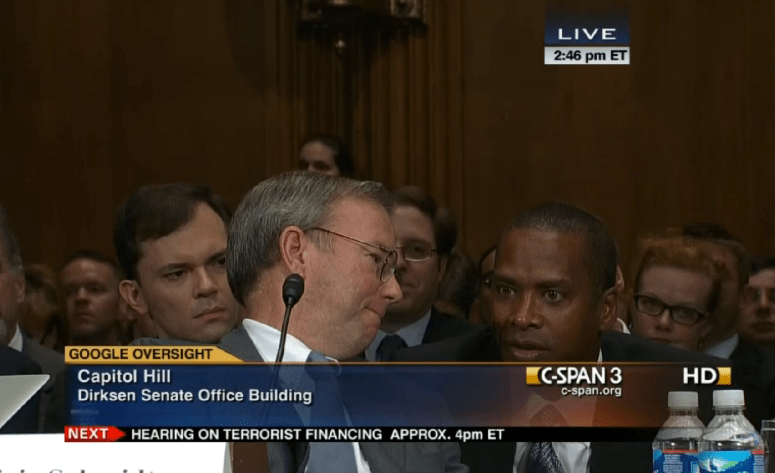
And who can forget Google’s $500,000,000 non prosecution agreement with the DOJ when the Obama Justice Department refused to actually indict Larry Page, Sergei Brin and Eric Schmidt for violating the Controlled Substances Act and even apologized to Google–despite the 4,000,000 documents and who knows how much in person testimony before a Rhode Island grand jury that directly implicated Larry Page and the massive shareholder lawsuit and settlement against Google for squandering the shareholders money keeping the C-suite’s butts out of prison. When questioned about the nonprosecution agreement by Senator John Cornyn before the Senate Antitrust Subcommittee, Eric “Uncle Sugar” Schmidt refused to answer on the advice of counsel, often referred to as “taking the Fifth.”

L-R Google Brain Trust Chief Shill Pablo Chavez, Uncle Sugar, Head Lawyer David Drummond

But it is the first time that Downtown has been involved. I have the same question of both companies: Where was the board? The reason we have boards of directors is to protect the shareholders from exactly this kind of thing. In YouTube’s case, they have another layer of fiduciary duty–protecting the advertisers–both large and small–who trust them with billions of the advertisers’ money. Not to mention the children that the platform caters to.

Take the time to read Kristin Robinson’s outstanding journalism and then see if you can answer the question–where were the boards? I think the entire story hasn’t been told.

David Brooks and @knopps Give The Other Side of Dynamic Pricing: Big Tech Scalpers

What we don’t like about dynamic pricing is that it’s necessary because of free riding scalpers and the artists get blamed.

Bruce Springsteen fans had a rough introduction to the world of dynamic ticket pricing Wednesday (July 20), as many logged into Ticketmaster’s Verified Fan platform to buy tickets for his upcoming tour with the E Street Band and experienced sticker shock at the cost of the best seats.

Those prices – which climbed into the thousands of dollars, as widely reported – represented about 1 percent of the tickets listed on the Ticketmaster Verified Fan sale, but they became a sore point for fans who felt that they no longer had a shot at great seats after years of loyalty to the Boss.

By selling high-priced platinum tickets, Ticketmaster argues, the company can prevent the best seats from being bought and resold by scalpers. That money can instead go to Springsteen. However, this only works when the tickets cost enough to prevent scalpers from making a profit.

Sources tell Billboard that early numbers show that less than 10 percent of tickets sold for the five concerts that went on sale Wednesday ended up on the secondary market – lower than average – and that despite complaints about four-figure prices, only 1 percent of tickets were above $1,000.

Read the post on Billboard

@davidclowery is back at the Supreme Court, this time with added Attorneys General

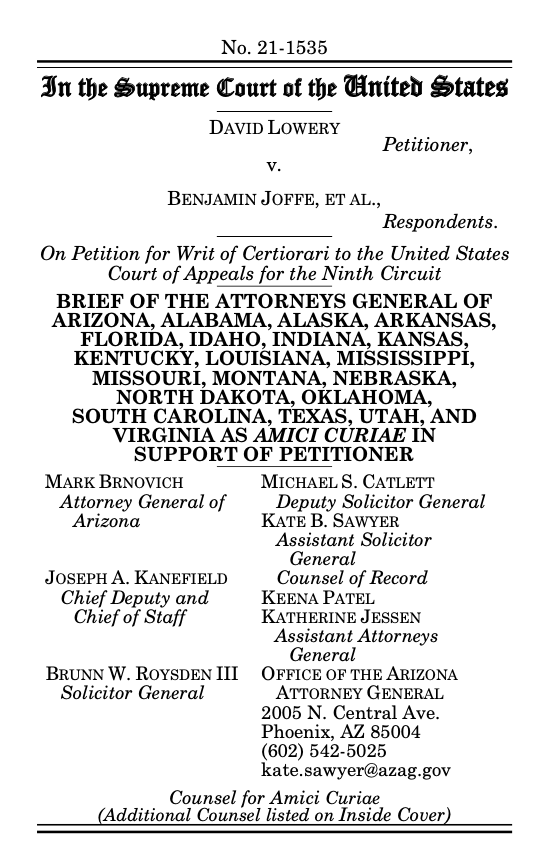
David is petitioning the Supreme Court of the United States to stop Google’s cy pres payola system of class action settlements. This is David’s third trip to the Supreme Court. This time, 21 state attorneys general agree. Read their friend of the court brief here. The Court has not granted a hearing yet, but we’ll be keeping an eye on it.

More to come on this topic.

San Antonio Musicians: Texas Public Radio Presents the Music Artist Forum TODAY

Get more info and materials here

TPR Music Artist Forum | In Partnership with SLATT Management

Musicians of all ages are invited to a networking workshop and panelist discussion dedicated to understanding the future of music technology, copyright law, entertainment law, obtaining royalties, and navigation of music streaming services.

Address:

321 W. Commerce St, San Antonio, TX 78205

Doors open at 6:30pm. 

Panelist discussion will take place at 7:00pm.

Guest Panelists:

Ondrejia Scott | 7:00pm – 7:10pm

Chris Castle | 7:10pm – 7:20pm

Krystal Jones | 7:20pm – 7:30pm

Dr. Steven Parker | 7:30pm – 7:40pm

Linda Bloss-Baum | 7:40pm – 7:50pm

Food and drinks will be provided.

Musicians are welcome to submit an original track to be featured on our TPR Music Artist Forum playlist:

Professional headshots will be offered free of charge by Oscar Moreno.

We will be ending out the night with a special live performance by J. Darius live in the Malú and Carlos Alvarez Theater.

RSVP here to reserve your spot for this free event!

@DavidCLowery: Address on Acceptance of the American Eagle Award from the National Music Council

June 2nd 2022 Anaheim California

Hello and thank you. Thanks to the board for this award. President James Weaver. Chair Charlie Sanders. Thanks to David Sanders for help with logistics.

And while I have him here, special thanks to Rick Carnes for his help a few years ago with the University of Georgia Artists Rights Symposium.

I wanted to start out today, by saying it is a great honor to receive this award.

When I look at past recipients and see names like Odetta, Dizzy Gillespie, Quincy Jones, Lena Horne, Hal David, Phil Ramon and Kris Kristofferson, I feel like the protagonist in the Talking Heads song:

“How did I get here?”

You see, my original claim to fame is the song Take The Skinheads Bowling. How did the guy that wrote that song end up amongst such musical luminaries?

By way of introduction and explanation:

The song Take the Skinheads Bowling is the first single from a band I started in 1983 in Santa Cruz California.

The band is called Camper Van Beethoven. And it’s still around after 39 years.

I would describe that band as a psychedelic folk-rock garage band but we didn’t have a garage. We actually rehearsed in an attic.

Three flights of stairs… SVT.

Go figure.

Around the same time I started an indie record label to promote and distribute the records of Camper Van Beethoven. We later signed to Virgin Records.

I then started another band called Cracker. This band went on to have platinum hits. You’ve probably heard a few.

I produced albums by groups like Counting Crows.

I ran a recording studio complex for many years.

And in 2012 I began to speak out on behalf of artists at various technology conferences.

In particular I wrote a rather long essay, quite controversial at the time, “Meet the New Boss, Worse Than the Old Boss?”

In this essay I argued that the emerging digital landscape for music was one in which the new bosses (mostly tech companies) would pay nothing up front for our work, and very little on the back-end. I predicted this would shift most of the financial burden and risk onto those who could least afford it, the working class artist.

Unfortunately, my predictions were correct.

Now, It is important to note I am not hostile to technology and technology companies per se. Indeed I graduated with a degree in mathematics from UC Santa Cruz, and before Camper Van Beethoven became my full time job I worked as a computer programmer.

In addition I have had some success as a seed investor in technology startups. Since we are at NAMM I assume you all have heard of Reverb.com?

Technology is important in my life. It’s important to how I make music. Most other artists I know feel the same way. I don’t think technology companies and artists should always be at odds.

So let’s rewind for a second…

“I started a band in my attic (not garage) and later a record label.”

The foundational myth of Silicon Valley is the garage startup that becomes a global brand.
(Think Apple).

Look at my own startup: Camper Van Beethoven. A few kids in a faded beach town start a band. With a small personal loan from a singing cowboy-true story- we made a record and went from the attic to competing on a global scale in a few short years.

In the 80’s and 90s, this story was replicated, to different degrees, by hundreds of indie rock bands all across The United States.

And this story is not unique to the US or rock music. In1990 while traveling around Morocco I met many musicians who sold their recordings on cassettes in souks all across North Africa, the Middle East and southern Europe.

In 2014 I toured China as a cultural and Intellectual property ambassador for the US State Department. I met a Mongolian folk-rock ensemble that was doing essentially the same thing across central Asia.

If Silicon Valley is widely hailed for its entrepreneurial energy and innovation shouldn’t artists and bands also be praised and seen in the same light? We are certainly as creative.

We generate jobs and substantial economic activity. Some political scientists even think it was really American Pop Music that ended the cold war.

It has always seemed like something worth protecting to me.

Turning our attention back to this room, I see a similar entrepreneurial spirit in the boutique amp, instrument, and music software makers represented here by the National Music Council.

Conversely the big manufacturers and major rights holders represented here have problems that will feel familiar to artists:

The unlicensed use of their intellectual property and designs.

We have a lot in common.

Now this award is ostensibly given to me for my work as an artists rights activist. But I want to put that in a bigger context.

Many of you may have first heard of my efforts on behalf of artists when I filed a class action lawsuit against Spotify for failing to pay self published songwriters.

This, indeed, was a milestone as it gave songwriters the first opportunity in the digital age to extract some concessions from digital services.

Also the 2018 Music Modernization Act may be understood as an unintended consequence of this lawsuit.

But in the big picture, this lawsuit was a minor skirmish in what I call “the long war” to protect the rights of the creators.

And In this long war, I submit, I am just a foot soldier.

I look at the members of the National Music Council, whether music creators, unions, manufacturers, music associations, labels, educators or performing rights organizations and I can think of many many times when I have been aided in my efforts by the good folks from these organizations.

Because ultimately, we have this in common:

We are all fighting to protect our intellectual property

our copyrights,
our neighboring rights,
our patents,
our trademarks
and our designs

We fight to protect them from freeloaders that too often convince policymakers and courts that in the name of “innovation” they should have access to our Intellectual Property without permission or payment.

Sadly this is nothing new. There have always been and there will always be unscrupulous schemers that claim their exploitative business model is somehow “the future.”

The problem is, that in their vision of “the future” they get rich while little of that money trickles down to us. Those that create the intellectual property.

To paraphrase Led Zeppelin: The scam remains the same.

But it is here that the National Music Council has always been helpful. The council and its members provide the long lasting intellectual infrastructure that allows individual artists like myself, to fight.

To fight Today.

To fight 5 years from now

and to fight into the foreseeable future.

I humbly accept this award as someone who has simply followed in the footsteps of other council members and award recipients.

Keep up the good fight my friends,

You are truly on the right side of history.

Series 3 of the @ArtistRights Watch Podcast is here! Nik Patel, @DavidCLowery, @MusicTechPolicy and @KCEsq Discuss The Future of Frozen Mechanicals — Artist Rights Watch

Series 3 of The Artist Rights Watch Podcast is here! Nik, David, and Chris are joined by attorney Kevin Casini to talk about the latest with the Copyright Royalty Board and mechanical rates in the Phonorecords IV proceeding and discuss alternatives so songwriters are better represented at the CRB compared to the status quo. 

Check out the podcast here!! Available on all platforms! 

ARW Podcast S3E1: Unfreezing Mechanicals show notes

On the this episode of the Artist Rights Watch, Nik, David, and Chris sit down to talk about the recent developments with the CRB and mechanicals with lawyer and advocate, Kevin Casini. The Copyright Royalty Board who herein will more than likely be referred to as the CRB, ‘is a US system of three copyright reality judges who determines rates and terms for copyright statutory licenses and make determinations on distribution of statutory license royalties collected by the US Copyright Office.’ The US mechanical royalties are determined by the CRB and they meet every 5 years to determine the rate. Songwriter groups argued for a higher rate, and the CRB agreed. On March 29, 2022 the CRB agreed to unfreeze the $0.091 mechanical royalty rate which would commence a fight for a new rate in the 2023-2027 period. Over the past few years, there has been numerous criticisms about the constant rule for freezing the mechanical royalty rate. The royalty rate currently is $0.091 which was set back in 2006, and frankly, songwriters are making less  money due to economic inflation.

Show Notes and Background Materials

Copyright Royalty Board’s Rejection of NMPA, NSAI, Sony, Warner, Universal settlement

Survey Results from Songwriter Survey on Frozen Mechanicals

Selected Frozen Mechanicals Comments:

Rosanne Cash

Helienne Lindvall, David Lowery, Blake Morgan

David Poe

Abby North, Erin McAnally, Chelsea Crowell

Kevin Casini

NMPA, NSAI, Sony, Warner, Universal Comment with Copy of MOU4

Below are some links about Guest Kevin Casini:

Tweets by KCEsq

https://kcesq.medium.com

Below are some links for further reading:

https://completemusicupdate.com/article/us-copyright-royalty-board-rejects-proposal-to-keep-mechanical-royalty-on-discs-and-downloads-unchanged/embed/#?secret=CDnkY1xuT7#?secret=GoUJkY3oLr

https://variety.com/2022/music/news/copyright-royalty-board-crb-rate-1235219872/

https://musictechpolicy.com

https://www.crb.gov

https://variety.com/2022/music/news/songwriters-win-copyright-royalty-board-mechanical-royalties-1235259518/ 

https://www.musicbusinessworldwide.com/record-labels-and-publishers-ink-major-settlement-moving-from-9-1-cents-to-12-cents-per-track-for-us-mechanical-royalties-on-physical-sales1/

Below are our social links and terms of use:

Chris: http://www.christiancastle.com/chris-castle

David: https://twitter.com/davidclowery?s=20

https://www.instagram.com/davidclowery/

Nik: https://www.instagram.com/nikpatelmusic/

www.nikpatelmusic.com

Website: https://artistrightswatch.com

Facebook: https://www.facebook.com/artistrightswatch

Twitter: https://twitter.com/ArtistRights?s=20

Terms of Use: https://artistrightswatchdotcom.files.wordpress.com/2021/01/arw-podcast-terms-of-use-v-1-i-1.pdf

Intro/Outro song: “All My Years” by Nik Patel

Survey Results: Physical and Download Mechanical Rates Survey–Artist Rights Watch

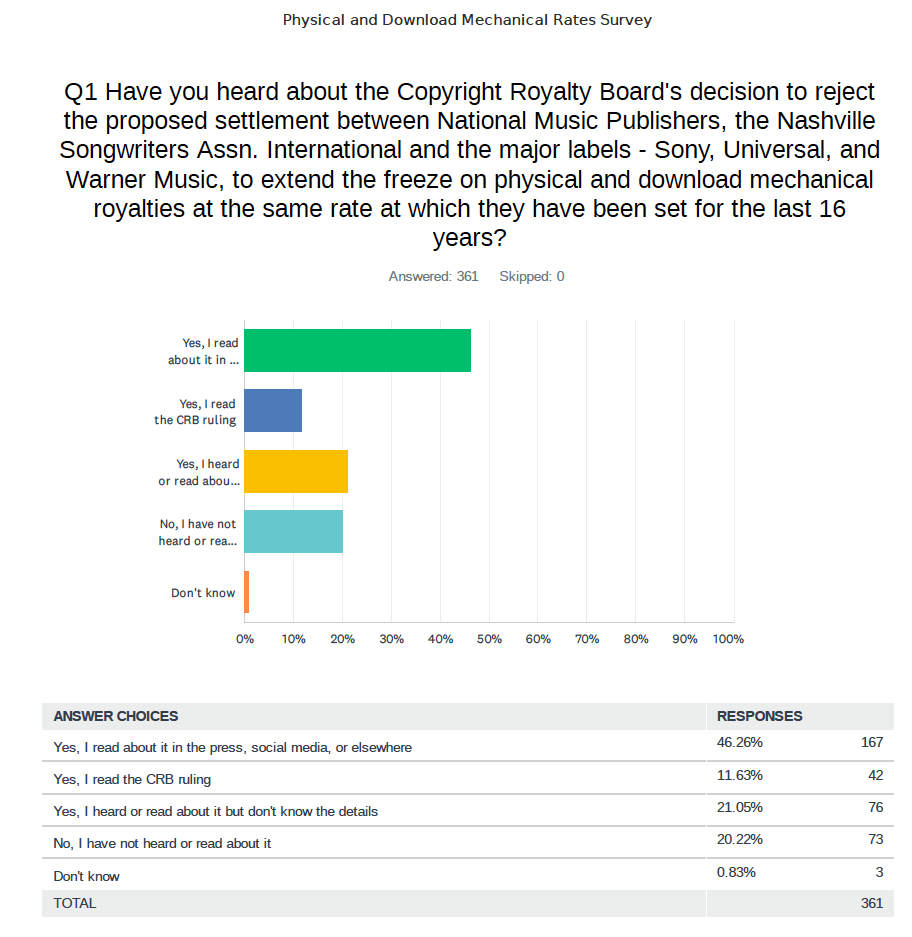
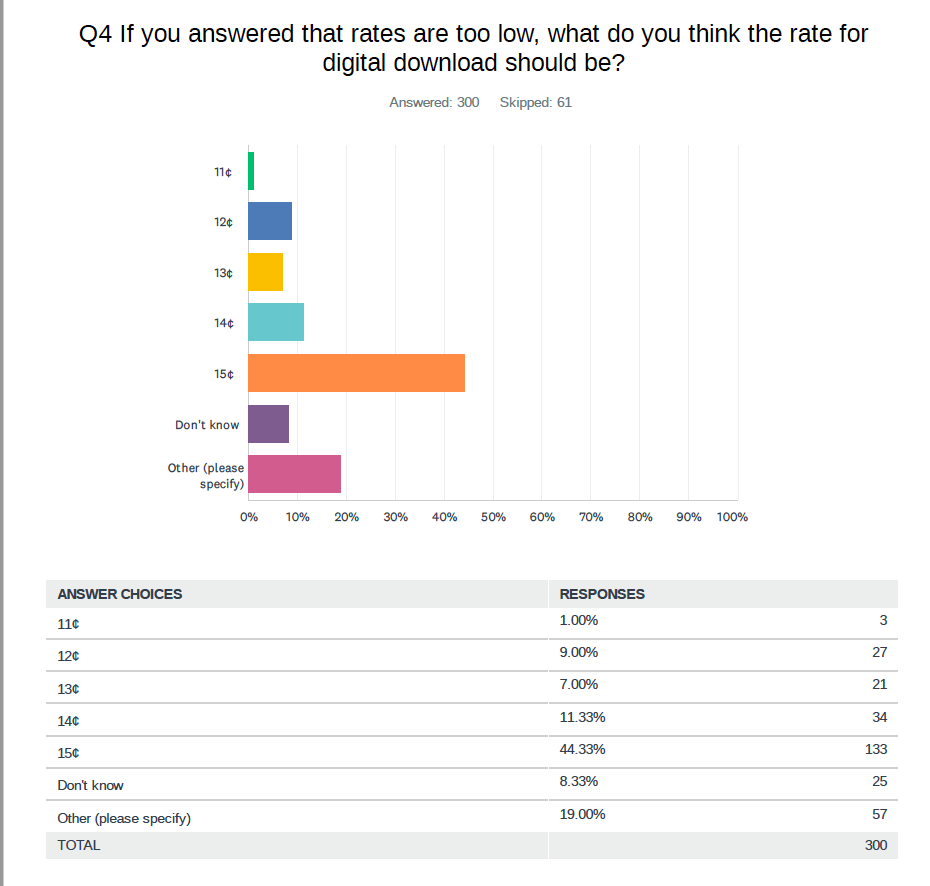
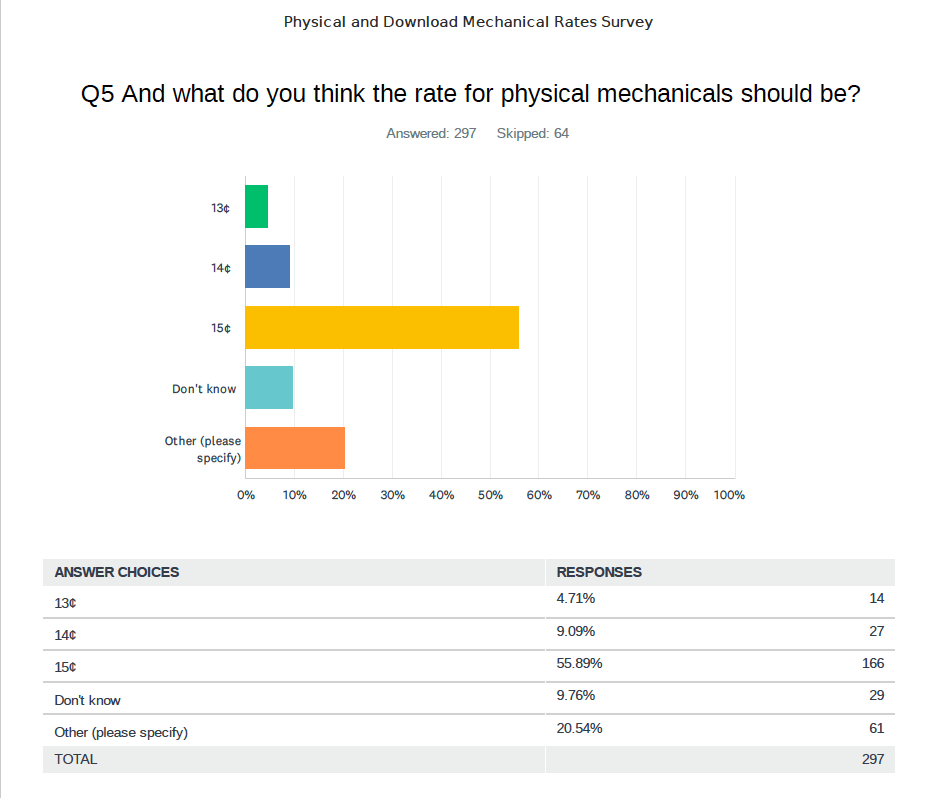
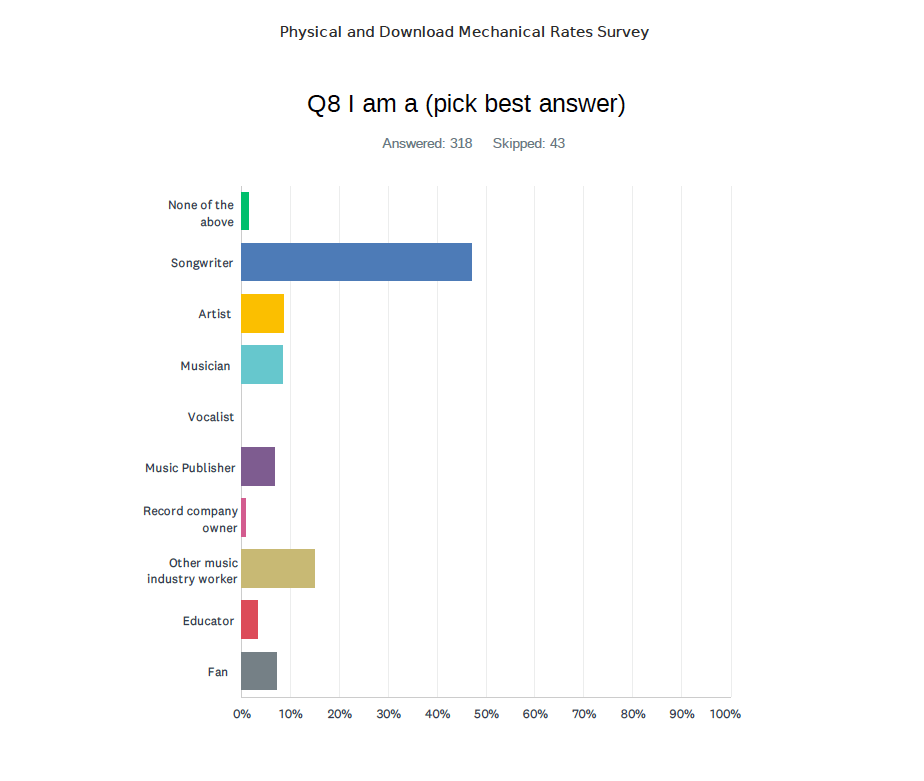
Many readers participated in the Physical and Download Mechanical Rates Survey that various organizations have sent to their members over the last few weeks. Here are the results of the main questions for which we had 361 respondents who self-selected their participation. (Other answers included comments which we chose not to publish for privacy reasons.). 

The results suggest that participants were mostly informed songwriters who had never been asked before what they thought about the issues in the Copyright Royalty Board. We would have to conclude that any of our regular readers would be a bit skewed toward knowledgeable because between the Trichordist, MusicTechPolicy, ARW, Hypebot and Celebrity Access we were probably carrying a very high percentage of the available information on the frozen mechanicals issues.

It also is striking how few respondents said they had ever been asked what they think about any mechanical rates (physical, download, streaming), an important and easily measurable issue. This is something to add to the learning from this episode. It may be that our data is skewed, but even so we didn’t expect that 68% would say they’d never even been asked their opinion. An easy way to find out what people think about something is to ask them.