Chris Castle has some excellent analysis of the ALI copyright restatement project as well as some other recent ALI restatements. Hew writes:
However, there appears to be a trend at the ALI to trade on the “Restatement” series to provide a vehicle through which those who control the pen in drafting new versions of old Restatements and new Restatements on new topics can try to change the law to what the drafter thinks it ought to be rather than a tool for practitioners to quickly learn what the “black letter law” is. This is a way to make an end run around the democratic process to deny voters and their elected representatives their proper role. What’s different is the potential for the moral hazard of astroturfing making it more important than ever to know who is behind the pen.
Who ever thought that the American Law Institute–of all places–would become the center of a corruption scandal over–of all things–its “Restatement of the Law” series. Chances are good that MTP readers outside of the legal profession have no bloody idea what a “Restatement” is and will sleep well in that knowledge deficit. But for lawyers (particularly litigators), the Restatement series has had some passing value.
However, there appears to be a trend at the ALI to trade on the “Restatement” series brand value to provide a vehicle through which those who control the pen in drafting both new versions of old Restatements and new Restatements on new topics can try to change the law to what the drafter thinks it ought to be–rather than a tool for practitioners to quickly learn what the “black letter law” is. This is a way to make an end run around the democratic…
I’d like to offer an alternate theory on the foundering attempt by the American Law Institute to “restate” copyright law. While my colleagues make good points on the lack of transparency, openness and fairness with the current ALI process; rightfully note the conflicts of interest; and excoriate Sprigman for taking money (however indirectly) from Silicon Valley while working on the project, the most obvious conclusion is that those in charge of the restatement are incompetent. Not devious.
I refer you to Hanlon’s Razor:
Hanlon’s Razor: “Never attribute to malice that which is adequately explained by incompetence.”
Now incompetence rather than malice doesn’t mean that someone shouldn’t be fired. Someone probably should be fired. Start with Sprigman. He’s in charge of the project. If that doesn’t work fire someone else. Repeat until incompetence stops.
The case for incompetence.
Exhibit One: The fact that this is now a PR issue for the ALI is the clearest example of incompetence. Sprigman or Director Revesz could have made some relatively small changes to the project in 2015 (as many suggested) and the acting Register of Copyrights would have never written the now infamous “pseudo version of the copyright act” letter. This of course was the basis of the Billboard story that enraged artists. In other words an easily avoidable mistake started the entire controversy. Incompetence.
Exhibit Two: Leader of the project Christopher J Sprigman. Good lord does the man have a shred of common sense? I assume the position as “reporter” on the ALI Copyright Restatement is a position that confers some prestige. Why screw it up by taking on Spotify as a client in the middle of the project? Or co-author papers that are directly or indirectly funded by Google at the same time? It’s not an “impartial” look. Did he need the money? I doubt it. Now, not only does his reporter position NOT impart prestige, his own reputation is in tatters. What a screw up. Clearly not a devious mastermind.
Exhibit Three: Sprigman’s letter proposing the project clearly indicates he had a result in mind. It reads like a police confession. He admits to everything he is accused of by his critics. A scholarly project like this is not supposed to start with conclusions and work backwards. Yet he pretty much admits this is his intention in the letter. If I intended to do something this dishonest I wouldn’t start by writing it down in a letter that would surely one day become public. I was too dumb for law school. But this guy must be dumber. Again not a devious mastermind.
Exhibit Four: If you choose to measure incompetence by quantity, look at some of the letters that take issue with the drafts. For instance the Author’s Guild wrote a long letter to ALI Director Revesz detailing 16 major mistakes in the draft of the first chapter. Some of these mistakes are just bizarre, (I can’t see the draft) but apparently royalties and fees paid to creators are referred to as “taxation.” This is either a dumb mistake, or an unnecessary provocation of copyright holders that only an incompetent person would make while trying to build consensus for a draft. Incompetence.
Exhibit Five: Just for fun, let’s take last exhibit and assign deviousness to Sprigman and Revesz. Suppose they were attempting to pull a variation of a machiavellian committee minority strategy. A competent strategist wouldn’t needlessly antagonize the committee minority by using the term “taxation.” The minority (pro copyright members) are not supposed to see that the game is rigged. The marks are supposed to think they were simply outvoted. That’s how the con works!! Again incompetent not devious. Maybe add arrogant.
Exhibit Six: Sprigman took to facebook to call out his critics describing them as “hacks engaging in hackery.” I was speechless when I came across this on facebook. This is not the kind of thing that a competent leader does when faced with criticism. The guy is clearly out of his league. Again not a devious mastermind.
I think you get my point.
The Invisible Stage Hand works in the live music business.
Christopher J. Sprigman a New York University Law School professor is leading the American Law Institute’s dubious “Restatement of Copyright” project, a project the Acting Register of Copyrights called an attempt to establish a “pseudo copyright act” while simultaneously representing Spotify in the Bluewater v Spotify copyright infringement case.
Pure hubris. How is it the American Law Institute doesn’t see the appearance of impropriety? The process is clearly rigged against creators. I can only conclude the leadership at American Law Institute is corrupt or incompetent. David F. Levi along with the entire board should resign.
One of three Google funded papers co-authored by Sprigman which were published after he began working as the “impartial” reporter on the American Law Institutes Copyright Restatement project.
Silicon Valley corporations and anti copyright ideologues are unhappy that there is even a shred of copyright protection left for artists. They have not been able to completely eliminate copyright through congress or the courts so a small highly ideological group have embarked on a dubious “restatement” project to create what the US Register of Copyrights calls a “pseudo copyright act.” This is an end run around the legislative and judicial branch.
The vehicle is an American Law Institute Restatement of Copyright. In the past the American Law Institute has issued restatements when there were conflicting state laws or matters of “common law.” Never before has the ALI issued a restatement when there is a federal statute that spells out the law. After all the statute is the statute. Who is the ALI to tell judges what the statute says?
The damage comes to artists because it will at best create confusion on copyright in courtrooms. At worst the project will further tilt rulings towards Google and other Silicon Valley firms that infringe upon our works with impunity. Like they really need any more money.
The whole thing is rigged. According to the Google Transparency Project the leader of the restatement Christopher J. Sprigman has been taking funding from Google to write research papers since at least 2011. And he has apparently been receiving funding while working on this project (see screenshots above).
You also may recognize the name because he is Spotify’s lawyer in the Bluewater v. Spotify case. Yes, the same joker that has argued there is no such thing as a streaming mechanical royalty. This despite the fact the federal Copyright Royalty Board just set the new royalty rate. WTF right? This is the “impartial” reporter the American Law Institute put in charge of the copyright restatement project.
The ALI should end this project now. It stinks of corruption and cronyism. It’s an embarrassment. David F. Levi the president of The American Law Institute has been made aware of the problems with this project and has done nothing about it. He should resign for allowing this academic fraud to take place on his watch.
We have obtained a copy of the letter that Acting Register of Copyrights Karyn Temple Claggett sent to David F Levi, Dean of Duke University Law and President of the American Law Institute. On Jan 16th she clearly warned Levi that the project will mislead judges. Why is Levi still pursuing this? Is misleading judges the point of the project? If one reads the original letter between project leader Christopher J Sprigman and the ALI director, it seems like that is more or less the intent from the beginning. Levi is a former federal jurist.
Claggett states
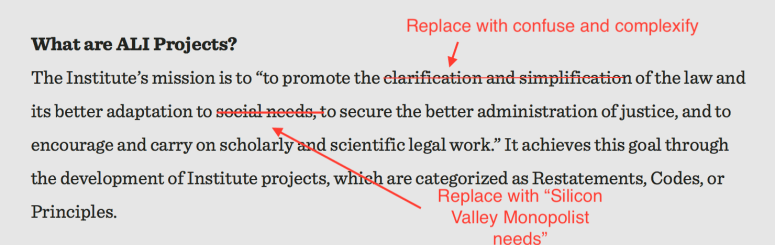
“Ultimately, as thoughtful and ambitious as it may be, the Restatement project appears to create a pseudo-version of the Copyright Act that does not mirror the law precisely as Congress enacted it and one that will quickly become outdated as Congress amends it or the courts clarify it. As a result, the attorney or judge who relies on it will often be misled. That outcome would not serve the ALI’s mission “to promote the clarification and simplification of the law.” For these reasons, we again urge the ALI to reconsider the project as a whole.”
Move over Chris Harrison, looks like The American Law Institute President David F Levi may be 2018’s Artist Enemy #1. Don’t fret Chris, it’s only January you still have 11 months to make a comeback. (Photo hosted and served from Duke University Law School website.)
Artist Enemy #1 title is only given when an individual or group is engaged in activity that will do irreparable harm to the rights of artists. In this case it is David F Levi President of the American Law Institute that has captured my attention. Under the leadership of David F Levi the American Law Institute is engaged in a dubious “restatement”project to create what the US Register of Copyrights calls a “pseudo version of the copyright act.”
In all seriousness, this is very hard for me to write. David F Levi is a widely regarded former federal jurist. He is also the highly respected dean of the Duke University School of Law. It saddens me to have to point out he bears ultimate responsibility for what appears to be a full blown academic scandal at the American Law Institute. A scandal that may forever damage the ALI (and Levi’s) reputation for impartiality.
My father was a career NCO in the US Air Force. I grew up on military bases all over the world. If there is one thing that those experiences (and my father) taught me is that real leadership demands one accept responsibility for failures that occur on one’s watch. In my experience most Americans also feel the same. For intuitively it makes sense: You don’t get the perks of leadership without accepting the responsibilities and downsides as well. I’ll admit in my own life I have often failed to live up to the demands of this credo. It is extraordinarily difficult. That’s why I hate to point a finger. But it is also because of my own experience with my own failures I feel like I have some insight here. And I’m not optimistic that the ALI’s Levi will show true leadership and accept the responsibility that comes with leadership. Why? I see all the telltale signs of the covering up a problem rather than fully addressing it. At the time of publication, the only action from ALI is a vague statement about reorganization of the project at the heart of the scandal. Further as far as I can tell, it was only posted on a page buried deep in ALI website. This is not how anyone with half a brain (or heart) does damage control. This is the kind of thing that otherwise good people do because they think no one has really noticed yet, and maybe, just maybe, they can avoid the difficult process of taking responsibility.
The Trichordist has convened a group of artists for “The Honest Restatement of American Law Institute Principles Project.” Above are some suggested amendments to current principles.
So what is the scandal?
If you really want to understand just how crazy this scandal is, you should read one or more of the following:
These documents go back almost 3 years. Many of these complaints were made directly to the ALI. It is unfathomable that Levi would not be aware of these complaints. This is why I feel Levi bears full responsibility for this dubious project. And it is a dubious project, with more than a whiff of corruption surrounding it.
If you don’t want to read these documents, I’ll do my best to explain it here. However I am not a lawyer.
The scandal concerns the ALI’s so-called Restatement of Copyright Project. This project has a multitude of problems. But basically early reports show it is an attempt to stand up a tech industry friendly extra-legal alternative to the copyright act. Pardon the use of this term, but frankly, it is an exercise in “fake lawmaking.”
Further it is a bizarre and puzzling project for the staid ALI, as it goes against their very principles. It attempts to “restate” and reinterpret statutory law something it has generally sought to avoid. Why? Well as most law students know this is something only the congress and (sometimes) the courts have power to do. It goes against ALI principles because instead of clarifying matters the ALI seems to want to muddy the waters by presenting a competing version of the copyright act.
Yes, in the past the ALI has issued “Restatements” but these genuinely clarify matters. As a result Judges routinely consult these restatements for help. (Many judges are political appointees and not really…er…uh.. well versed in the law). But there is a crucial difference between those “restatements” and this one. Until now, the restatements have concerned non-statutory “common law,” conflicting state laws, international law, treaties etc. My understanding is that past projects were well intentioned attempts to clarify “effective” existing law from a number of widely dispersed sources. Not law contained in a single statute with a couple of minor amendments. The ALI has never before offered what is essentially alternate reality legal fiction that (according to early reports) will contradict existing law and federal jurisprudence.
Okay. That’s the gist of the scandal. Well except for the next part…
The biggest (and completely avoidable) problem is that the restatement project leader is Christopher J. Sprigman. This is where Levi has really failed as a leader of the ALI. One would be hard pressed to find a less impartial choice to mediate between big tech and artists. Sprigman is Spotify’s lawyer in the Bluewater v Spotify case. Does Levi not know this? But hang on cause it gets worse. In documents filed with the court in the Bluewater case Sprigman argues that Spotify is not copying and distributing songs and thus doesn’t owe a mechanical royalty. This is far outside the mainstream of legal thought, and is at odds with the facts. Sprigman is either completely unaware of the nature of the services Spotify provides or he is going beyond advocating for his client and purposely misleading the court. Either way this is troubling.
Let’s look at the undisputed facts:
1) Until late 2014 Spotify operated using P2P technology which necessitates the copying and distributing of millions of music files. Files downloaded onto users computers were cached and subsequently “streamed” to other devices and user accounts. They admit it. They were proud of it as it saved them server costs.
2) Spotify allows users to make playlists available offline. This necessitates distributing and copying works. This sort of use is no different than the “limited download” described in federal copyright regulations and according to same regulations require a mechanical licenses. Spotify calls it a download on their own website seemingly contradicting Sprigman statements to the court suggesting Spotify doesn’t allow users to download music.
3) The federal government sets a rate for streaming mechanical royalties via the Copyright Royalty Board. A Jan 26th 2018 ruling just set a new rate for this streaming mechanical royalty. Why on earth would the Copyright Royalty Board set a royalty for something that need not be paid according to Sprigman? Clearly he’s outside the mainstream.
5) Spotify and its agents have sent songwriters (like myself) thousands if not millions of “notices of intent” to obtain a compulsory mechanical licenses for use of songs on its service. Was the intention expressed in these notices (sent through the US mail) not accurate? Is Sprigman not aware of this practice?
6) Spotify has filed millions of “address unknown” notices of intent to obtain a compulsory mechanical license to the US Copyright office. Why would it make such statements to a federal agency if it did not believe it needed a compulsory mechanical license? Again is Sprigman not aware of this practice?
Finally Sprigman started the ALI project by declaring:
“Yet, by most accounts, copyright law is in a bad state, and has been for some time now. Among the public at large, and especially among young people, the law is widely disliked”
WTF? It’s a statute. If it’s so unpopular then get Congress to change the law. No one voted for the ALI. The ALI has no power to make law. The current statute is what is. It is an limited exclusive right given to individuals. We don’t do twitter polls on individual rights. It is also quite confounding to have to remind the ALI that individual rights are always unpopular with the public and “young people.” At least until their rights are violated. Then they are enormously popular. Most of the public and especially “young people” would prefer beer be free. At least until it’s their beer that gets given away for free. Does “unpopularity” of rights of individuals in certain quarters seem like a starting point from which an honest legal scholar would start? No it doesn’t and David F Levi (if he’s paying attention) should know this. Read the letter Sprigman wrote to the ALI to launch the project. It is appalling. In it he admits to launching this project because he thinks congress is not going to make the changes he and his cronies think should be made to copyright law. He freely admits it is an end run around the legislative process and courts. I quote from the letter:
“In sum, Congress is unlikely to proceed any time soon with copyright reform. As a consequence, it falls to the federal courts to attempt to improve the fit between a mid-20th century copyright law and 21st century digital technologies. Fortunately, the current copyright law is open-texted enough that its coherence and effectiveness could be advanced significantly via common law development. Unfortunately, however, aside from a few notable exceptions, there is a relatively low level of interest or expertise in copyright law among federal judges.
In light of these facts, I think it’s plain that a Restatement of Copyright Law – at least if undertaken with the object of assisting the courts and mindful always of copyright’s constitutional mandate to promote progress – could be enormously influential, both in shaping the law that we have, and, perhaps, the reformed law that in the long term we will almost certainly need.”
This is not a guy that intends to faithfully interpret the statute and recent jurisprudence. No way.
Sprigman and Google.
Let’s go back to Sprigman’s statement about the law being unpopular with certain demographics. If you replace the phrase “public and young people” with “internet companies” I think we get much closer to the truth. IMHO Sprigman wants to make copyright law more friendly for his benefactors. Hear me out.
Sprigman appears in the Google Academics Inc database. According to this report he received money from Google to write/cowrite five papers that (lo and behold) mostly supported positions favorable to Google. It is not illegal for him (or anyone else) to take money from Google (or any other company) for academic work. It should be disclosed. But it’s not illegal. The problem is that he appears to have taken some of that funding after he started this project. As far as I can tell the ALI does not disclose this important fact anywhere. I highly doubt they disclosed this to their membership. The only reason anyone knows about this is the Above The Law article referenced above.
It’s worth noting that the dude is seriously defensive about Google funding. Like numbered-tweet-storm defensive about this fact. When I mentioned the Google connection in a tweet last week he launched a numbered-tweet-storm at me, which ended hilariously with him demanding his money back on a show I performed in 1987. Something I did in 2018 requires me to reverse a transaction in 1987 that somehow retroactively became unsatisfactory? He’s a time traveller. His DJ name should be DJ Ex Post Facto. We should jam. We’ll get that guy who rapped the middle part of the big Soup Dragons hit.
What are the odds he performs the same sort of time traveling while restating/remixing copyright?
I would assume Sprigman is particularly sensitive about the Google thing because it makes him appear less than impartial. But this is a problem of his own making. I’m not impartial on copyright. And I don’t pretend to be. I also don’t try to anoint myself as the final arbiter on copyright in the US. Sprigman seems to lack basic common sense, that little voice that says “don’t pretend to be impartial on issue when you are not.” Most lawyers have enough common sense to not try to lead an ALI “restatement” of copyright when there is even a hint of impropriety. For it tends to ruin careers. This lack of common sense alone should disqualify him to lead this project.
RIP American Law Institute 1923-2018
But what really saddens me is that I have to report to artists once again: another prestigious American institution appears to have taken the side of powerful Silicon Valley monopolists against artists. The fix is in. The current oligarchy at ALI, a clique of lawyers from a handful of elite academic institutions seem to be living in a bubble in which sycophants from those same academic institutions, sing their praises assuring the they are building a gleaming city on a hill, a beacon of hope and fairness for all. What a joke. In fact they are helping prop up a powerful and decadent group of crony capitalists, the likes of which we have not seen since the robber barons. This sounds like a joke, but it’s an open question whether our republic will even survive the predations of these powerful billionaires as many are openly hostile to the notion of democracy and the nation state.
This is the side the ALI willingly chose to take. Shameful.
The question now: Are there any decent and conscientious men or women in positions of power in business, government or academia that will ever stand up for the little guy again? Who in position of power or authority has the guts to argue for the middle class songwriter, performer, photographer, filmmaker or author against the billionaires of Silicon Valley and their legal enablers? Does anyone even have the minimal amount of backbone required to go against the grain and oppose their old law school chums. Isn’t there at least one decent lawyer out there tired of the current climate of law douchebaggery? Legal scholarship which seems to exist only to celebrate the successful exploiting of loopholes and generally helping the parasitic class get away with crap?
Where is our Joseph Welch? The Defense Department lawyer who finally stood up to the bully McCarthy? Where is that lawyer who will finally ask on behalf of artists “Have you no sense of decency sir, at long last? Have you left no sense of decency?”
Maybe David F Levi is simply unaware of the scandal that has occurred on his watch and maybe he will turn out to be our Joseph Welch. But I’m not holding my breath.
************************************************
FURTHER NOTES ON CHRISTOPHER J SPRIGMAN
*************************************************
To support my contention that Sprigman came to this study with an agenda and thus should not be leading this project, I’ve provided a further reading list:
—was lead counsel with Lessig in Kahle v. Ashcroft (later v. Gonzales) in 2006 https://en.wikisource.org/wiki/Kahle_v._Gonzales which unsuccessfully challenged the “opt out” provisions of eliminating the renewal requirement under the 1992 Copyright Renewal Act.
–Member of Pamela Samuelson’s “Copyright Principles” project and co-authored its paper that also advocated registration (see Sec. IIIA of paper, “Reinvigorating Copyright Registration”)
–Has written five academic papers funded by Google on copyright issues, including three against moral rights attribution. In addition, he filed comments in Copyright Office moral rights study that incorporated concepts in Google-funded papers and cited to one of them without disclosing Google’s funding in his Copyright Office filing. (https://www.regulations.gov/document?D=COLC-2017-0003-0019)
Hypebot is reporting an important story you might have missed: SoundExchange/SXWorks has launched a tool for songwriters to begin unraveling the mess that Digital Media Association companies created at the Copyright Office over mass NOIs.
The loophole is that they only have to look for the copyright owner in the Copyright Office records that are notoriously incomplete because the Copyright Office tells us all that we don’t have to register with them in order to own copyright and get benefits like getting paid when DiMA companies use our songs. Plus even if you do register, it takes the Copyright Office a year to approve or deny your registration.
But–but–if the DiMA company claims they can’t find you in the Copyright Office records, they can file that NOI with the Copyright Office. Then they claim they have a compulsory license except for one tiny detail–they don’t have to pay you! So even if you have taken the time to file your song with YouTube’s CMS and Content ID so they actually know who you are, if you haven’t registered with the Copyright Office it doesn’t matter.
Insult to injury, the Copyright Office has allowed Big Tech to post these notices in hundreds of gigantic and weirdly compressed Excel files with no simple way to search for your song. Plus the Copyright Office doesn’t bother checking to see if Big Tech has filed the NOI properly while they give your copyright registration the third degree. The Copyright Office then creates their own fake safe harbor to self-insulate themselves from failing to check NOIs. Are we ever in the wrong business.
The millions upon millions of NOIs started getting posted in April 2016–now there are 60 million and counting songs that the DiMA companies are not paying and no real way to search the mass NOI filings to know if your songs are implicated.
Thankfully, SoundExchange/SXWorks is on our side. They came up with a free searchable database of all of these NOI filings so you can look up your song. This is the first step toward songwriters getting justice and it’s an important one. If you don’t know you’re getting screwed how can you do anything about it?
Hypebot carried an explanation from Mike Huppe:
“Music publishers and songwriters finally have a way to gain visibility into address unknown filings made by some service providers using their songs,” said Michael Huppe, Chairman of the Board of SXWorks. “Publishers and songwriters can search the NOI submissions via a simple web-based interface. The service makes a complex process much more transparent, supporting our goal of trying to improve how the music industry operates.”
You want to do this so you can know if you should register your song for copyright or better yet if your song is already registered and the Copyright Office has made a mistake in allowing the NOI to be filed. (If you find mistakes, call the Copyright Office at Tel: (202) 707-8150 Fax: (202) 707-0905 or Email: licensing@loc.gov)
This SXWorks NOI Lookup will be a hugely important tool for songwriters trying to unravel the bureaucratic barf that DiMA created (and it’s a nice touch that it was SoundExchange that stepped up to solve a publishing problem created by DiMA after fighting DiMA for years on behalf of artists and labels).
You can access the “SXWorks NOI Lookup” database at this link. (FAQ is at this link) You’ll need to do a free registration to get access so you can use the account features, this video explains:
Huffington post CEO seems stoked about Spotify subscriber metrics. Why is that?
Digital Music News is reporting:
“Huffington Post CEO Jared Grusd was General Counsel and Global Head of Corporate Development at Spotify for 4 years. Which means there’s probably a strong connection, and even financial strings like stock options.”
The bad odor emanating from HuffPo keeps getting stronger. For background, artists rights advocate Blake Morgan posted this mildly critical piece about Spotify on his HuffPo contributor account. Just as it was beginning to go viral HuffPo took the article down. The justification was… shall we say less than convincing? And in the words of Digital Music News “the internet called bullshit.”
Digital Music News hints at another issue by noting that HuffPo CEO Jared Grusd may have “financial strings like stock options.” This is interesting for several reasons.
First Spotify appears to be in its “quiet period” for it’s IPO. Second Spotify is going public through an unusual direct listing. This means that current stock and options holders are essentially making the public offering. Rather than underwriters and banks. I am not a securities law expert, but wouldn’t this make current shareholders selling stock in the direct listing, the parties making “the offering” of stock as defined in SEC regulations? Wouldn’t these parties then be subject to the SEC rules governing what can be said by the parties making the public offering? Further the SEC guidance on public statements during quiet periods (here) has pages of rules on what “related media” can or can’t do when providing information to the public (start on page 133). The question I can’t answer is whether a shareholder “offering stock” actively suppressing information that would otherwise be public violates the letter or spirit of these rules. That’s above my pay grade. But someone out there knows the answer.
As we predicted as streaming consumption grows, the per stream rate will continue to drop, every year, year to year.
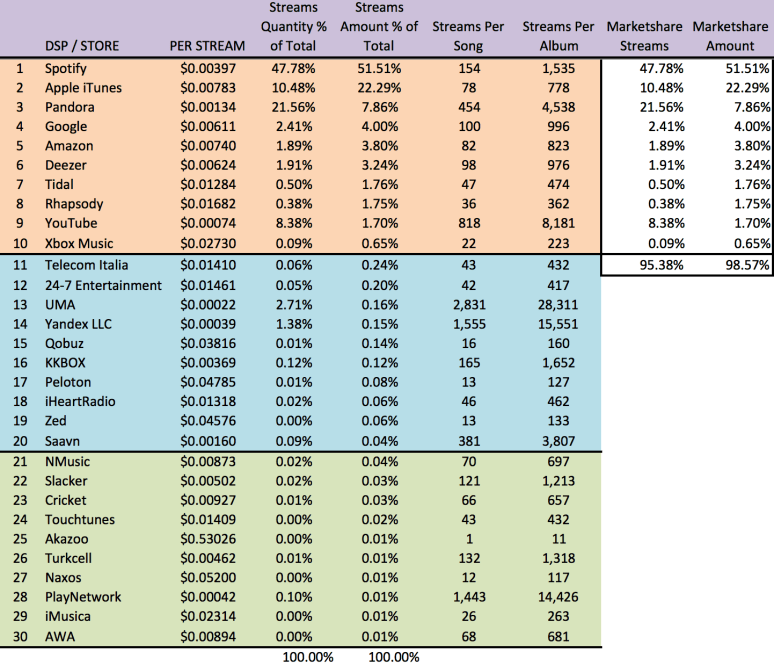
This data set is isolated to the calendar year 2017 and represents a mid-sized indie label with an approximately 200+ album catalog now generating over 200m+ streams annually. That’s a pretty good sample size. All rates are gross before distribution fees.
Spotify was paying .00521 back in 2014, two years later the aggregate net average per play rate dropped to .00437 in 2016, a reduction of 16%.
The current effective per stream rate at Spotify has now dropped to 0.00397, a reduction of 9% since last year. This a cumulative reduction of 24% since 2014, which is an average decrease of 8% a year of the per stream rate.
If the music business could set a per stream rate that allowed revenue growth, proportionate to consumption growth that would be a much better model. Looking at the stats below we can actually see that working for Apple Music!
An interesting change from last year is that Pandora replaces YouTube with the greatest value gap of streams at 21.56% volume with only 7.86% of revenue. YouTube drops to 8.38% of volume with only 1.70% of revenue. Again, this is just music delivered to YouTube via the distributor for the automated song generation and it does not include Content ID or Artist Channel revenues.
For the second year in a row Apple Music Streaming sits in the sweet spot generating the second largest amount of streaming revenue. The current per stream rate seems to have actually modestly increased from .00735 last year to .0783 this year. A nominal increase but worth noting. Apple’s current effective rate of .00783 is pretty close to double the Spotify effective rate of .00397.
There’s more good news for Apple as their market share has risen from 7.18% last year to almost 11% this year. But the bigger story is that Apple Music is now accounting for over 22%+ of music streaming revenues up nearly 11% from last year. This is good news and shows the power of both Apple’s commitment to streaming, and the value of a paid only platform. Apple Music is actively taking marketshare away from Spotify.
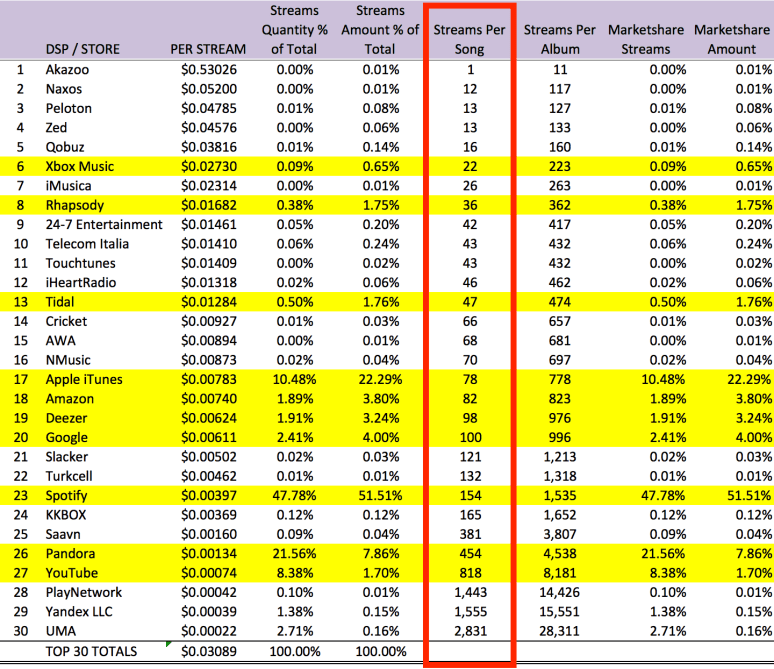
To put this list in the context of our previous reports and numbers we’re adding the chart below with the data sorted by the quantity of streaming plays required to match the revenue of a single song or album download. This is important as we work towards defining and setting a fair per stream rate and also setting an accurate economic equivalent of streams to songs and albums for the purposes of charting.
Billboard currently calculates 1,500 streams to one album for the purposes of charting, which at current streaming rates (at Spotify) actually sorta matches an economic equivalent. But that’s just backing out of an arbitrary rate set by Spotify, it doesn’t actually define what the cost of a stream should be.
Keep in mind every streaming service has a key piece of data that would allow artists and labels to set a fair per stream rate. Every on demand streaming service, Apple, Spotify, Tidal, Google Play all know how many times a song is played (per person) on average over time. This is the data that is key to setting fair streaming rates. Who will share this information? Apple, Jimmy Iovine, we’re looking at you.
These numbers are from one set of confidentially supplied data. If you have access to other data sources that you can share, we’d love to see it.
HOW WE CALCULATED THE STREAMS PER SONG / ALBUM RATE:
As streaming services only pay master royalties (to labels) and not publishing, the publishing has to be deducted from the master share to arrive at the comparable cost per song/album.
$.99 Song is $.70 wholesale after 30% fee. Deduct 1 full stat mechanical at $.091 = $.609 per song.
Multiply the above by 10x’s and you get the album equivalent of $6.09 per album
[EDITORS NOTE: All of the data above is aggregated. In all cases the total amount of revenue is divided by the total number of the streams per service (ex: $5,210 / 1,000,000 = .00521 per stream). In cases where there are multiple tiers and pricing structures (like Spotify), these are all summed together and divided to create an averaged, single rate per play.]
The music world continues to be exceedingly vulnerable, and there are looming questions that desperately need to be addressed. Most important: How can artists distribute and sell their work in a digital economy beholden to ruthlessly commercial and centralized interests? Enter Spotify, a platform that is definitely not the answer.




 The Trichordist
You must be logged in to post a comment.