Confirm Your Mechanical Rates Have Escalated

By Chris Castle

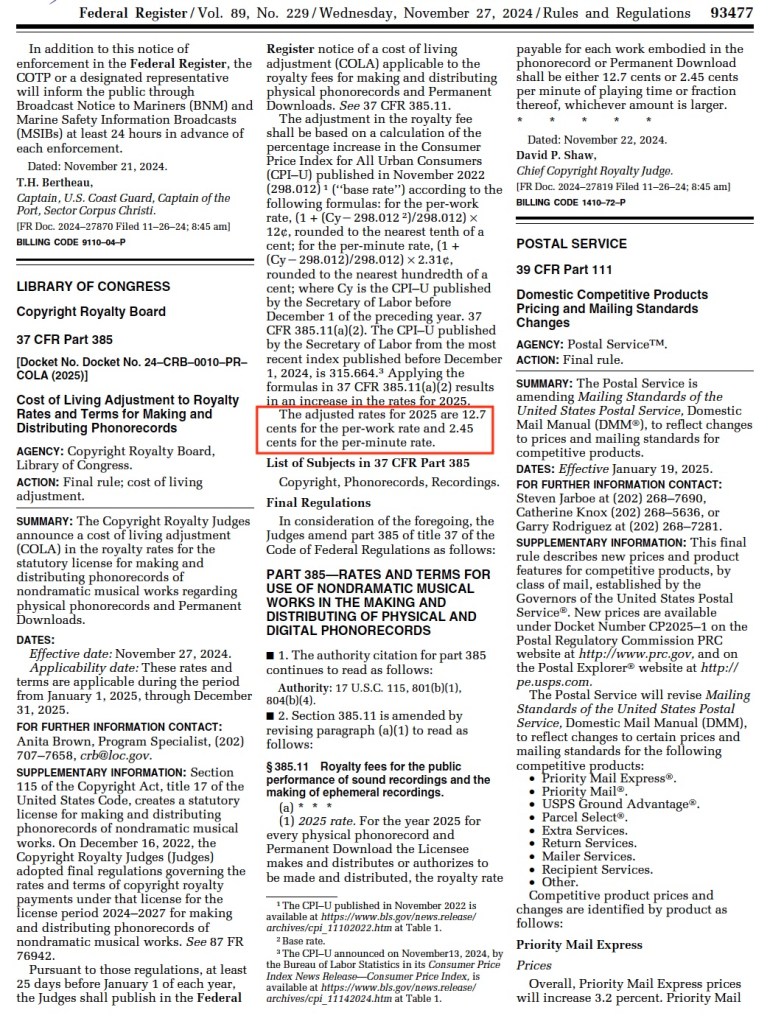
As you probably already know, the statutory mechanical royalty rate for physical or downloads (not streaming) has increased as of January 1, 2025. This means that all floating rate licenses (e.g., not subject to controlled comp rates) should have increased as of January 1, 2025 from 12.4¢ to 12.7¢ due to the Phonorecords IV cost of living adjustment. (And of course should have increased in prior PR IV years in 24.). And of course we have Trichordist readers to thank for helping to persuade the Copyright Royalty Judges to reject the Phonorecords IV frozen mechanical rate settlement that led to the labels agreeing to an increase from 9.1¢ to 12¢ plus a cost of living adjustment on physical and downloads that rose to 12.4¢ in 2024 and now to 12.7¢ in 2025. (But remember there is no cost of living adjustment for streaming mechanicals like Spotify.)

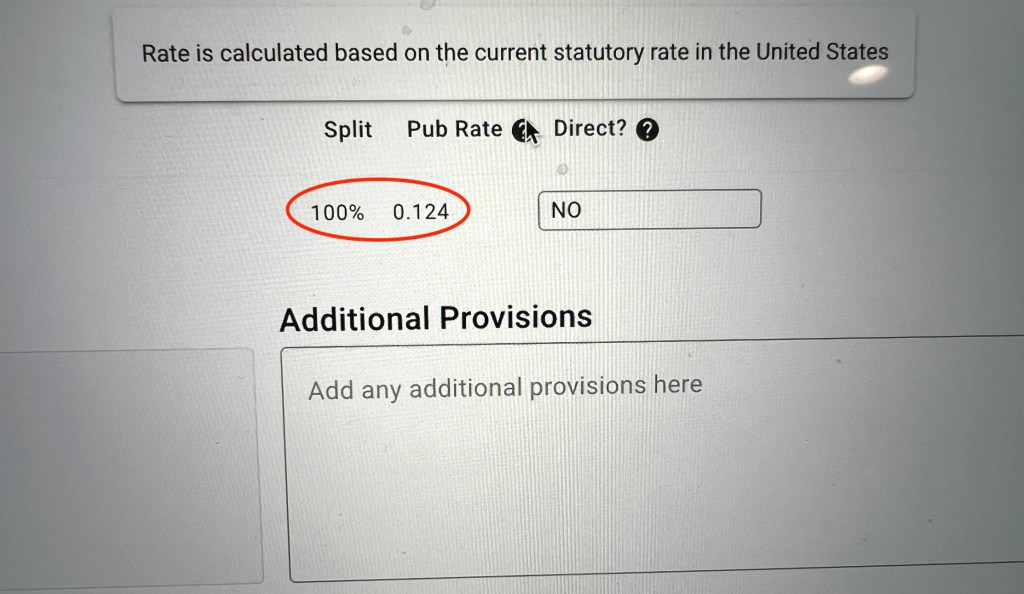
It’s probably just a glitch, but I understand that HFA hasn’t updated the 1/1/25 rates yet for “licensing out” in at least one instance (see screen capture below obtained this week). I’m inclined to believe that the issue is with the database and would not be a one-off, but I could be wrong. That suggests to me that every songwriter and publisher with either a newly issued license since 1/1/25 or a floating rate license in place during PR IV rate period (2023-2027) should probably confirm that the respective COLA escalations have been properly applied as of January 1 of 2024 and 2025. I would imagine that this isn’t an isolated incident, but maybe it is. No reason to let grass grow, however.

Here’s the Copyright Royalty Board’s timely notice of the new rate effective 1/1/25–which means that the HFA system does not appear to have been updated unless the screen capture reflects a one-off which seems doubtful to me.

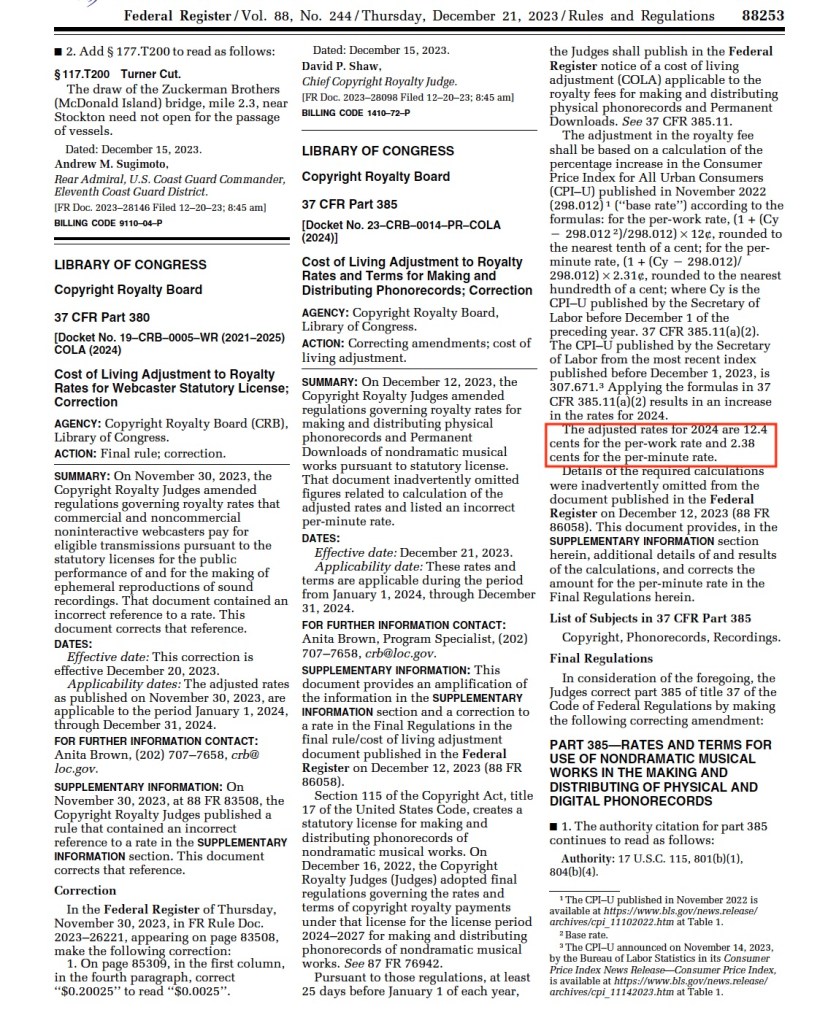
And for reference, this is the rate for 2024 with the COLA adjustment that may also have been misapplied–everyone would have to check to know if it was misapplied to them.

Step Right Up: The Chamber of Progress’s Ticketing Chamber of Horrors Fools Nobody

It’s one of those sad facts there are people you meet in life who just always seem to have the wrong side of the deal. Sometimes it’s emotionally understandable in the case of kids like the Cox character from William Boyd’s Good and Bad at Games or even Smike from Nicholas Nickleby. But when you see one of these cringy Silicon Valley policy laundries like “Chamber of Progress” keep getting the wrong side of the deal, there’s a much simpler explanation.

And now they are wrapping themselves in the flag of progressivism as they run the thimblerig on–of all things–ticketing. And cutesy names like “Chamber of Progress” notwithstanding, the group’s latest “report” if you can call it that would have state legislators believe that the StubHubs of this world are actually on the side of all that is good, just innocent puppies scampering across the stage with an IPO in their mouth. 

These high minded choir boys fancy their souls are just purer than everyone else’s in their cyberlibertarian progressivism who oppose asymmetrical commercial power except when it suits them and only when it suits them. We see it with Chamber of Progress’s “Generate and Create” obfuscation campaign to promote Silicon Valley’s interests in the “fair use” copyright exception absurdly applied to generative AI. This under the guise of “supporting” artists while destroying their craft and, yes, their humanity. OK, I went there. And we now we see it in ticketing, too. Can’t these guys get a real job?

As we will see, what the Chamber of Progress is really about when it comes to our community is locking in asymmetrical power relationships and protecting Silicon Valley’s cybergod-given right to extract money from relationships where they are not wanted and transactions where they don’t belong. Far from “forget the middleman”, StubHub’s entire business model is based on imposing themselves as the middleman with, it would appear, some pretty nefarious partners. While Chamber of Progress wants to point to the pending Department of Justice case against LiveNation as an excuse for just about anything you can think of, it is well to remember that pending cases don’t always turn out as advertised and flags can become shrouds. Since they seem to like DOJ investigations so much, let’s not forget there’s another one that may be in the offing they’ll like a lot less.

The Flawed Premise of Faux Property Rights

The report starts off from a very flawed premise and a classic projection about the plethora of state ticketing laws backed or opposed by StubHub & Co. The Chamber tells us that “legislators should adopt resale ticketing laws to foster competition, reduce ticket prices, and increase transparency.” Reduce ticket prices? Really? If anyone is acting to increase ticket prices it’s the middleman resellers whose very existence undermines the longstanding economic relationship between artists and fans. Economic relationships that thrive in an environment of classical enforceable property rights.

It begins like a lot of these propaganda campaigns do–identify your villains (those you want to unseat) and then trot out a parade of horrors you create by shading the facts. By the end, a busy legislator or staffer is ready to believe they discovered the cause of cancer and that the potholes are somebody else’s fault!

But here is the essential flaw that I think brings down the entire chamber of horrors this report tries to manufacture. They really want you to believe that once an artist sells a ticket, that ticket can then be resold or repackaged because the artist has sold the right to control the ticket to the purchaser. This tortured analysis of the artist’s property rights is simply incorrect and this one error is the beginning of a cascading effect of really bad stuff for everyone in the chain. Here’s what the report says:

The use of “license” language in ticketing legislation has created a loophole that unscrupulous venues can exploit. When a ticket is defined as a “license” rather than a property right, it gives venues and event organizers the power to revoke the license of any ticket that is resold. This means that even if a ticket was legally purchased, the venue can declare it invalid if it is resold to another party. 

Resale freedom laws provide essential benefits to consumers by ensuring their rights to buy, sell, and transfer tickets without arbitrary restrictions by primary sellers like Live Nation. These laws help to keep ticket prices affordable and enhance consumer choice and access to live events. Resale freedom laws ban anti-consumer practices and empower fans to find tickets on the platform of their choice, increasing their chances of securing seats for popular events. 

See what they did there? First, they are selling “freedom” as in “resale freedom.” This is both laughable but truly Orwellian Newspeak, as in SLAVERY IS FREEDOM. This is not supposed to be a funny joke, somebody paid a lot of money for this report. Yet what do you expect from people who think “Chamber of Progress” is a great brand?

But seriously, they skip over the fact that the artist sets the price for their ticket. They skip over it because they have to if they want to make their sponsor’s case. That doesn’t make them correct, however. The report bungles the economic relationships in ticketing because they either fail to understand or don’t want to understand the reality.

The Report Gets the Economics Backwards

Live shows are not fungible or interchangeable. The ticket starts out as the artist’s property and the artist decides the ticket’s face price based on the economic relationship the artist wants with their fan. As David Lowery has said many times, the economic relationship between artists and fans is analogous to a subscription, it’s not a one-time transaction from which the artist wants to extract the net present value of all possible transactions with the fan. The resellers have the opposite relationship with the fan because to them, fans are fungible. Resellers want to extract the maximum from each fan transaction because they don’t care about a long-term relationship with the fan. Upside down world, right?

When the artist sells a ticket, they sell a right to attend the show under certain conditions. They don’t sell a piece of property. They don’t sell a pork belly or a can of Coke. They sell an emotional connection. That’s not a “loophole.” Pretending that a ticket is a pork belly is creating a loophole out of thin air.

That is true of cover charge for bands at your local dive bar and it is true of Taylor Swift at your local soft-seat venue or stadium. It’s also true in dynamic pricing situations–I’m not a fan of dynamic pricing, but I respect the artist’s decision if they think it’s right for them. Big or small, this is the core relationship that must be respected if you want live music to survive and it’s something I think about in Austin where the city styles itself the Live Music Capitol of the World.

So Chamber of Progress objects to state laws that confirm this license relationship, and that’s an important distinction. These laws confirm the reality of the true original property right, they don’t recreate an alternate reality out of whole cloth. The fact that it is even necessary to pass these laws belies the oligopoly power of StubHub & Co. 

But Chamber of Progress goes even further because the point of the report is to identify a villain. And here is where the fudging starts. They tell you “When a ticket is defined as a “license” rather than a property right, it gives venues and event organizers the power to revoke the license of any ticket that is resold.”

Not true. The artist has that right and delegates that right to the venues as part of the ticketing function. But even StubHub is leery of attacking artists directly so they devise this bizarre rhetorical construct of licensing vs. ownership in order to blame venues, and for what? Preventing scalpers from profiting from their scams and preventing resellers from profiting from their arbitrage. 

Bots and Scammers

This fallacy alone is really enough to refute the entire report, but wait, there’s more. There are two key foundations for the ticket reselling business at scale: bots and making a market for scammers to sell what they don’t own, aka speculative ticketing. They need bots because it allows scalpers to beat fans to tickets in quantity and they need spec ticketing because it allows them to sell a ticket that doesn’t even exist yet but for which there is demand.

Remember–bots are illegal. The Better Online Ticket Sales Act of 2016 sponsored by Senators Marsha Blackburn and Richard Blumenthal banned the use of bots for ticket sales in the US. The National Independent Talent Association asked the Federal Trade Commission to investigate open and notorious bot technologies on sale at the big ticket resellers convention:

Our organization recently attended the World Ticket Conference organized by the National Association of Ticket Brokers (NATB). At this event, we observed a sold-out exhibition hall filled with vendors selling and marketing products designed to bypass security measures for ticket purchases, in direct violation of the BOTS Act.

Realize, this isn’t a question of whether or not resellers profit from the use of bots on their platforms–the question is why aren’t people being prosecuted for violating the BOTS Act. But the Chamber of Progress wants you to believe there is something wrong with passing state laws to give state Attorneys General the power to prosecute these laws shoulder-to-shoulder with the overworked and under-resourced FTC.

Bills that purportedly claim to enhance transparency through speculative ticket bans, protect consumer rights through anti-bots legislation, or improve access through customer data sharing often contain hidden provisions that restrict competition and limit consumer choices. 

In other words, the report opposes banning speculative ticket sales–selling something you don’t own is already illegal, probably since the dawn of our legal systems–and opposes state anti-bots legislation–already illegal under the federal BOTS Act. This should tell you all you need to know.

It’s Just Business: Racketeering, Silicon Valley Style

The real story that goes unreported is that StubHub is currently being sued in a New York class action for violating the civil Racketeer Influenced and Corrupt Organizations laws in selling tickets to a UK football match without rights. They have managed to punt that case based on their one-sided adhesion contract requiring arbitration in their terms of service, but interestingly the federal judge overseeing the case has retained jurisdiction. Imagine the risk factor in the StubHub IPO prospectus about how they could be subject to the RICO laws.

I recently posted about a “model” ticketing legislation that some of these characters were trying to get adopted by ALEC (the conservative state lobbying operation) which I gather has been dropped since the old link to the model bill is dead. It looks to me like the Chamber report is a new offensive rising out of the ashes of the ALEC lobbying effort. 

“Progressives” Who Fail to Address Asymmetry between Big Tech and Artists are Not Progressives

So once again, our friends in Silicon Valley are trying to elbow their way into a place they are not wanted, not needed, and are poisonous all in the aid of making them even richer all under a miasma of crap about “reseller freedom.” Fortunately, the public is getting wise to their scams no matter how much they try to sell their oppressive tactics as some kind of freedom. If they want to really be progressive, they’d help artists establish a resale royalty so that we could share in the riches from their arbitrage in return for a right to resell our tickets. Don’t hold your breath.

As we’ve seen with their logical backflips in AI and now with ticketing, the Chamber of Progress may be a lot of things, but “progressive” they ain’t. Maybe we can help them find productive work in this season of hope.

[A version of this post first appeared on MusicTechPolicy.]

DMCA Take Two: UK Government is to Propose Death Blow Opt-Out for AI Training

Americans are freedom loving people, and nothing says freedom like getting away with it.
Long Long Time, written by Guy Forsyth

Big Tech is jamming another safe harbor boondoggle through another government, this time for artificial intelligence. The defining feature of the DMCA scam is every artist in the known universe having to single-handedly monitor the entire Internet to catch each instance of theft in the act. Once caught, artists have to send a DMCA notice on a case by case basis, and then overcome what is 9 times out of 10 a BS counternotification. Then if they disagree with the BS counternotification, artists are faced with having to file a federal copyright infringement lawsuit which they don’t file because they can’t afford it.

And so it goes.

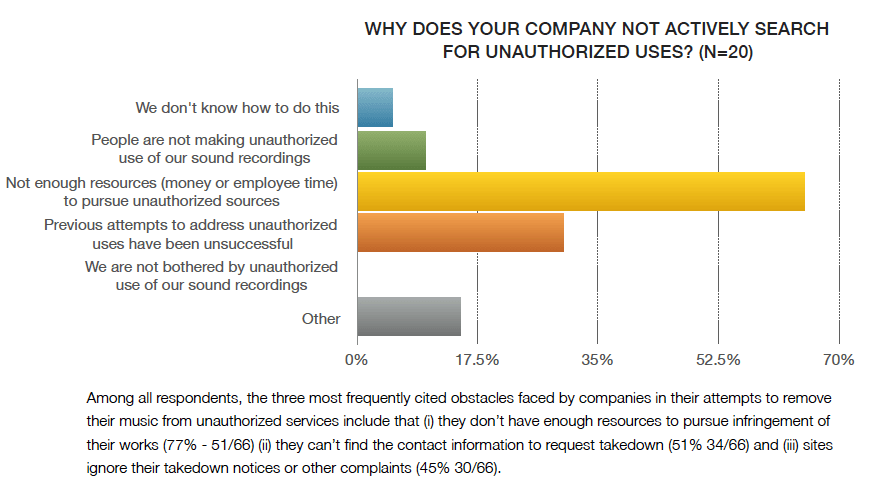
This is what an “opt-out” looks like. We have seen this movie before and we know how it ends–it’s called getting away with it. Let us be very clear with lawmakers: Notice and takedown and “opt out” is bullshit. It has never worked and has imposed a phenomenal cost on the artist community to the point that many if not most artists have just given up. The Future of Music Coalition and A2IM surveyed their members and determined that over half don’t even bother to look anymore because they can’t afford to run the search. The next largest group give up because they get no response from the notices.

Let’s understand–every time an artist gives up even looking for infringers, that’s a win for Big Tech. That’s why year after year, there are over a billion DMCA notices sent to a variety of infringers.

Ask yourself in all honesty, are you surprised? What head up the ass buffoon would ever think that an opt out would work? Unless the plan was to let Big Tech run wild and give both the biggest corporations in commercial history and the lawmakers a big fig leaf to cover up the theft?

That same approach is rearing its head again in both the US Congress and the UK. But this time it is being applied to artificial intelligence training and outputs. This is stark raving madness, drooling idiocy. At least with the DMCA an artist could look for an actual copy of their works that could be found by text-based search, audio fingerprints or just listening.

With AI, the whole point is to disguise the underlying work used to train the AI. The AI platform operator knows what works they used, which sites they scraped, or other ways to identify the infringed works. When sued, these operators have refused to disclose the training materials because they say that the sources of those materials are supposedly a trade secret and confidential.

Once a work is ingested into the AI, the output is also purposely distorted from the original. Again, impossible to conclusively identify. So what exactly are you opting out of? To whom do you send your little notice?

This entire opt-out idea is through the looking glass into the upside down world. Yet is is true.

The most current manifestation of this insanity is the UK government’s intention to pass legislation that would force artists to use an opt-out model, possibly on a work-by-work basis. And the worst part is that somehow they have been led to think that an opt-out is a protection for artists.

Orwellian.

Fortunately the UK government may seek public comment on this opt-out proposal. We will keep you posted on what the UK government actually proposes and how you can comment.

In the meantime, if you live in the UK, it’s not to early to contact your MP and ask them what the hell is going on. You may want to ask them why you can call the police when your car is being stolen but there’s nobody to call when your life’s work is being stolen. Particularly when the government protects the thieves.

Stubhub & Co. Launch Stealth state-by-state legislative offensive strategy for Astroturf “Model” State Ticketing Laws

By Chris Castle

Yes, it’s kismet in the legislature–the sketchy ticket resellers are redoubling their efforts to normalize “speculative tickets.” They have found a willing partner in gaslighting with an organization called “ALEC”.

The American Legislative Exchange Council (hence “ALEC“) is a nonprofit organization that brings together private sector representatives and relatively conservative state legislators to draft (and pass) “model legislation” that pushes a particular narrative. (That private sector representation is led by Netchoice, aka, Big Tech.) Unlike other model legislation with a social benefit like say the Uniform Partnership Act, ALEC’s “model legislation” pushes a particular agenda. Examples would be “stand your ground” gun laws, Voter ID laws, and “right to work” laws.

Netchoice Members (Netchoice leads ALEC’s Private Enterprise Advisory Council)

ALEC’s many successfully-passed “model” laws are intended to be passed by state legislatures as-written. Like Al Capone’s green beer, it ain’t meant to be good it’s meant to be drunk. A cynic–not mentioning the names of any particular cynics–might say that the ALEC strategy is an end-run around federal legislation (like the fake library legislation that was shot down in New York). If ALEC can get a critical mass of states to pass one of their “model bills” as-drafted on any particular subject, then the need for federal legislation on that topic may become more muted. In fact, if federal legislation becomes inevitable, the ALEC model bills then provide guidance for federal legislation, or new federal legislation has to draft around the states that adopt the model bill.

So much for Justice Louis Brandeis’ concept of states as laboratories of democracy (New State Ice Co. v. Liebmann, 285 U.S. 262 (1932)), unless that lab belongs to Dr. Frankenstein. ALEC’s mission claims to promote principles of limited government, free markets, and federalism; I will leave you to decide if it’s more about checkbook federalism.

Ticketing Panel, Artist Rights Symposium 11/20/24, Washington DC
L-R: Chris Castle (Artist Rights Institute), Dr. David Lowery (Univ. of Georgia, Terry College of Business), Mala Sharma (Georgia Music Partners), Stephen Parker (National Independent Venue Association), Kevin Erickson (Future of Music Coalition)

Like so many of these bills, ALEC’s Live Event Ticketing Consumer Protection & Reform Act disguises its true objective with a bunch of gaslighting bromides that they evidently believe to be persuasive and then when you’re not looking they slip in the knife. Then when the knife is protruding from your back you discover the true purpose. I think this section of the bill is the true purpose:

This is an odd construct. The model bill starts out by requiring positive behavior of a primary seller (which would be the band on fan club sales or other direct to fan sales). That positive behavior immediately turns to using the ticket purchaser into an enforcer of the values beneficial to the ticket reseller. This is done by forcing a purchaser to be able to resell their ticket without regard to any restrictions placed on reselling by the artist. 

And you know that’s the intention because the section also requires there to be no maximum or minimum price. While the model bill doesn’t require any particular restriction on the platforms, it has enough in it that it can look like a consumer protection bill, but what it is really doing and apparently was designed to accomplish is eliminate an artist’s a ability to set prices.

ALEC is serious about violations of the act, including civil penalties. Their model ticketing legislation can be enforced by both the Federal Trade Commission and state attorneys general. Penalties can include fines of up to $15,000 per day of violation and $1,000 per event ticket advertised or sold. One problem with the model bill is that it appropriates jurisdiction already available to federal agencies like the FTC which is already failing to enforce the existing BOTS Act and other property theft laws.

The main targets seem to be Stubhub’s competitors like “Primary Ticket Merchants,” These are the original sellers of event tickets, such as event organizers or venues. “Secondary Ticket Merchants” may also be prosecuted as well as individuals.

We continue to study the proposed model legislation, but I tend to agree with Stephen Parker (NIVA) and Kevin Erickson (Future of Music) on my Artist Rights Institute panel in DC yesterday. The better model bill may be their bill passed in Maryland, recently signed into law by Maryland governor Wes More.

Key differences between Maryland and the ALEC bill I could spot:

  • Scope of Penalties: The Maryland bill specifies fines for speculative ticket sales, while the ALEC bill includes broader penalties for various violations.
  • Refund Policies: The Maryland bill explicitly requires refunds for counterfeit tickets, canceled events, or mismatched tickets, whereas the ALEC bill focuses more on transparency and restrictive practices.
  • Study on Resale Impact: The Maryland bill includes a provision for studying the impact of resale price caps, which is not present in the ALEC bill.

    It appears that the Live Event Ticketing Consumer Protection & Reform Act will be introduced at the ALEC meeting on December 5, 2024. This is where ALEC members, including state legislators and private sector representatives, will discuss and vote on the model policy. 

    Watch this space.

Updates for Nov. 20 @ArtistRights Symposium at @AmericanU @KogodBiz in Washington DC

We are announcing the time schedule and speakers for the 4th annual Artist Rights Symposium on November 20. The symposium is supported by the Artist Rights Institute and was founded by Dr. David C. Lowery, Lecturer at the University of Georgia Terry College of Business.

This year the symposium is hosted in Washington, DC, by American University’s Kogod School of Business at American’s Constitution Hall, 4400 Massachusetts Avenue, NW, Washington, DC 20016.  We are also pleased to have a Kogod student presentation on speculative ticketing as part of the speaker lineup.

Admission is free, but please reserve a spot with Eventbrite, seating is limited!

The symposium starts at 8:30 am and ends with a reception at 4:30pm. The symposium will be recorded as an audiovisual presentation for distribution at a later date, but will not be live-streamed. If you attend, understand that you may be filmed in any audience shots, questions from the floor or still images. The symposium social media hashtag is #ArtistRightsKogod.

Schedule

8:30 — Doors open, networking coffee.

9:00-9:10 — Welcome remarks by David Marchick, Dean, Kogod School of Business

9:10-9:15 — Welcome remarks by Christian L. Castle, Esq., Director, Artist Rights Institute

9:15-10:15 — THE TROUBLE WITH TICKETS:  The Challenges of Ticket Resellers and Legislative Solutions:

Kevin Erickson, Director, Future of Music Coalition, Washington DC
Dr. David C. Lowery, Co-founder of Cracker and Camper Van Beethoven, University of Georgia
  Terry College of Business, Athens, Georgia
Stephen Parker, Executive Director, National Independent Venue Association, Washington DC
Mala Sharma, President, Georgia Music Partners, Atlanta, Georgia

Moderator:  Christian L. Castle, Esq., Director, Artist Rights Institute, Austin, Texas

10:15-10:30: NIVA Speculative Ticketing Project Presentation by Kogod students

10:30-10:45: Coffee break

10:45-11:00: OVERVIEW OF CURRENT ISSUES IN ARTIFICIAL INTELLIGENCE LITIGATION: Kevin Madigan, Vice President, Legal Policy and Copyright Counsel, Copyright Alliance

11:00-12 pm: SHOW ME THE CREATOR – Transparency Requirements for AI Technology:

Danielle Coffey, President & CEO, News Media Alliance, Arlington, Virginia
Dahvi Cohen, Legislative Assistant, U.S. Congressman Adam Schiff, Washington, DC
Ken Doroshow, Chief Legal Officer, Recording Industry Association of America, Washington DC 

Moderator: Linda Bloss-Baum, Director of the Kogod School of Business’s Business & Entertainment Program

12:00-12:30: Lunch break

12:30-1:30: Keynote: Graham Davies, President and CEO of the Digital Media Association, Washington DC.

1:30-1:45: Coffee break

1:45-2:45: CHICKEN AND EGG SANDWICH:  Bad Song Metadata, Unmatched Funds, KYC and What You Can Do About It

Richard James Burgess, MBE, President & CEO, American Association of Independent Music, New York
Helienne Lindvall, President, European Composer & Songwriter Alliance, London, England
Abby North, President, North Music Group, Los Angeles
Anjula Singh, Chief Financial Officer and Chief Operating Officer, SoundExchange, Washington DC

Moderator:  Christian L. Castle, Esq, Director, Artist Rights Institute, Austin, Texas

2:45-3:15: Reconvene across street to International Service Founders Room for concluding speakers and reception

3:15-3:30: OVERVIEW OF INTERNATIONAL ARTIFICIAL INTELLIGENCE LEGISLATION: George York, Senior Vice President International Policy from RIAA.

3:30-4:30: NAME, IMAGE AND LIKENESS RIGHTS IN THE AGE OF AI:  Current initiatives to protect creator rights and attribution

Jeffrey Bennett, General Counsel, SAG-AFTRA, Washington, DC
Jen Jacobsen, Executive Director, Artist Rights Alliance, Washington DC
Jalyce E. Mangum, Attorney-Advisor, U.S. Copyright Office, Washington DC

Moderator
John Simson, Program Director Emeritus, Business & Entertainment, Kogod School of Business, American University

4:30-5:30: Concluding remarks by Linda Bloss-Baum, Director of the Kogod School of Business’s Business & Entertainment Program and reception.

Kim Dot Com Emerges from the Memory Hole

By Chris Castle

“If you get down on your knees and beg to be arrested, don’t be surprised if you are.”

That was what I told a TV news anchor in an interview I did in 2012 right after Kim Dot Com was arrested on his vast estate in New Zealand.  Dot Com’s arrest started a long running extradition proceeding between the United States and New Zealand that Dot Com and his team of lawyers somehow managed to drag out until this year.  That’s right—twelve years.  That puts him right up there with Roman Polanski and Meng Wanzhou.  So now Dot Com is subject to extradition back the US to face criminal charges, and yet nobody in New Zealand seems to be in a big hurry to arrest him and send him Stateside.

The first time I connected the dots on Dot Com’s piracy site Megaupload was when film maker Ellen Seidler launched a site called Pop Up Pirates.   Megaupload figured large in her site for a simple reason:  When you tried to access a film stored on Megaupload, it launched a popup with an ad.  At that time, many of those ads included a credit saying “Ads by Google.”  Ellen gave me a short clip of her launching the Mega popup in real time with a close up of that ad.  I played the clip on a panel with one of the Google charm offensive folks who I thought was going to vomit when he realized what I had just shown the audience.  I thought I conclusively demonstrated that Google profited from piracy and paid pirates—being Kim Dot Com aka “Defendant.”

Shortly after, I started posting about this obvious connection, which is how Dot Com and his confederates were getting rich from their the-Hong Kong-based pirate site.  And of course, I would find it hard to believe that anyone was operating a lucrative pirate site from Hong Kong without taking care of people if you know what I mean.  So there’s that.

Fast forward a year and I was in front of the National Association of Attorneys General demonstrating Google’s many, many connections to crime, terrorists, and general issue bad guys.  

Right about this time I got a call from a distinguished music industry executive who asked me whether I was seriously suggesting that a public company was involved in funding crime.  I said that’s exactly what I was saying.  If that were to happen today, nobody, and I mean nobody, would question that Google is the paymaster of the dark web.

Which leads me to the Dot Com indictment.  It turns out that we are not the only ones who made the connection between Google and massive piracy. The Department of Justice did, too, and describes the connection quite clearly in the indictment.

Adbright and Google were Sequoia investments and PartyGaming was one of the big donors to Creative Commons (and the whole Lessig/Nesson poker lobbying extravaganza).

So who had an interest in keeping Kim Dot Com out of an American jail in case he might negotiate a plea deal as did his confederate Andrus Nomm back in 2018? According to the New Zealand Herald:

While [Dot Com] and his co-accused have denied all charges, Nomm testified in support of the US case. As an insider, his testimony will be key to supporting prosecution arguments the so-called “Megaconspiracy” knew what it was doing, attacking any claim the accused were acting in the belief the website was lawful.

Nomm’s testimony was included in the case for extradition in New Zealand but documents showing how will not be made public until after the judge’s decision has been made. The Herald is unable to report the details of the US case that Nomm pleaded guilty to in the United States until then.

The press release from the U.S. Department of Justice tells us:

In court papers, Nomm agreed that the harm caused to copyright holders by the Mega Conspiracy’s criminal conduct exceeded $400 million.  He further acknowledged that the group obtained at least $175 million in proceeds through their conduct.  Megaupload.com had claimed that, at one time, it accounted for four percent of total Internet traffic, having more than one billion total visits, 150 million registered users and 50 million daily visitors.

In a statement of facts filed with his plea agreement, Nomm admitted that he was a computer programmer who worked for the Mega Conspiracy from 2007 until his arrest in January 2012.  Nomm further admitted that, through his work as a computer programmer, he was aware that copyright-infringing content was stored on the websites, including copyright protected motion pictures and television programs, some of which contained the “FBI Anti-Piracy” warning.  Nomm also admitted that he personally downloaded copyright-infringing files from the Mega websites.  Despite his knowledge in this regard, Nomm continued to participate in the Mega Conspiracy. 

An extradition hearing for co-defendants Kim Dotcom, Mathias Ortmann, Bram Van der Kolk and Finn Batato is currently scheduled for June 2015 in Auckland, New Zealand.  Co-defendants Julius Bencko and Sven Echternach remain at large.

This case is being investigated by the FBI’s Headquarters and Washington Field Office.  The case is being prosecuted by Senior Counsel Ryan K. Dickey and Brian L. Levine of the Criminal Division’s Computer Crime and Intellectual Property Section and Assistant U.S. Attorney Jay V. Prabhu of the Eastern District of Virginia.  The Criminal Division’s Office of International Affairs also provided significant assistance.

So if there was a “conspiracy”, it takes more than two to tango. That racketeering and money laundering conspiracy might have included the advertising companies that played an essential role in providing illicit revenue to the “Megaconspiracy”. Recall that Google got caught in a federal sting operation, paid a $500,000,000 fine and entered a nonprosecution agreement with the same DOJ for promoting the sale of illegal drugs online, all at roughly the same time as they appear to have been the paymaster for Mr. Dot Com. Why else were Adbright, Google and Partygaming mentioned in the indictment?

Stay tuned, boys and girls.  The plot sickens.

NAME, IMAGE AND LIKENESS RIGHTS: New Speaker Update for Nov. 20 @ArtistRights Symposium at @AmericanU @KogodBiz in Washington DC

We are announcing more topics and new speakers for the 4th annual Artist Rights Symposium on November 20, this year hosted in Washington, DC, by American University’s Kogod School of Business at American’s Constitution Hall, 4400 Massachusetts Avenue, NW, Washington, DC 20016.  The symposium is also supported by the Artist Rights Institute and was founded by Dr. David Lowery, Lecturer at the University of Georgia Terry College of Business.

We’re pleased to add an overview of artificial intelligence litigation in the US by Kevin Madigan, Vice President, Legal Policy and Copyright Counsel from the Copyright Alliance and an overview of international artificial intelligence-related legislation by George York, Senior Vice President International Policy from RIAA. We’re also announcing our fourth panel and speaker line up:

NAME, IMAGE AND LIKENESS RIGHTS IN THE AGE OF AICurrent initiatives to protect creator rights and attribution

Jeffrey Bennett, General Counsel, SAG-AFTRA, Washington, DC
Jen Jacobson, Executive Director, Artist Rights Alliance, Washington DC
Jalyce E. Mangum, Attorney-Advisor, U.S. Copyright Office, Washington DC

Moderator
: John Simson, Program Director Emeritus, Business & Entertainment, Kogod School of Business, American University

Panels will begin at 8:30 am and end by 5 pm, with lunch and refreshments. More details to follow. Contact the Artist Rights Institute for any questions.

Admission is free, but please reserve a spot with Eventbrite, seating is limited! (Eventbrite works best with Firefox)

Previously confirmed panelists are:

Keynote: Graham Davies, President and CEO of the Digital Media Association, Washington DC.  Graham will speak around lunchtime.

CHICKEN AND EGG SANDWICH:  Bad Song Metadata, Unmatched Funds, KYC and What You Can Do About It

Richard James Burgess, MBE, President & CEO, American Association of Independent Music, New York
Helienne Lindvall, President, European Composer & Songwriter Alliance, London, England
Abby North, President, North Music Group, Los Angeles
Anjula Singh, Chief Financial Officer and Chief Operating Officer, SoundExchange, Washington DC

Moderator:  Christian L. Castle, Esq, Director, Artist Rights Institute, Austin, Texas

SHOW ME THE CREATOR – Transparency Requirements for AI Technology:

Danielle Coffey, President & CEO, News Media Alliance, Arlington, Virginia
Dahvi Cohen, Legislative Assistant, U.S. Congressman Adam Schiff, Washington, DC
Ken Doroshow, Chief Legal Officer, Recording Industry Association of America, Washington DC 

Moderator: Linda Bloss-Baum, Director of the Kogod School of Business’s Business & Entertainment Program

THE TROUBLE WITH TICKETS:  The Economics and Challenges of Ticket Resellers and Legislative Solutions:

Kevin Erickson, Director, Future of Music Coalition, Washington DC
Dr. David C. Lowery, Co-founder of Cracker and Camper Van Beethoven, University of Georgia
  Terry College of Business, Athens, Georgia
Stephen Parker, Executive Director, National Independent Venue Association, Washington DC
Mala Sharma, President, Georgia Music Partners, Atlanta, Georgia

Moderator:  Christian L. Castle, Esq., Director, Artist Rights Institute, Austin, Texas

Guest Post: Taylor’s Guitar

By Charles J. Sanders

Recently, a viral video originating from Waxahachie, Texas made the social media rounds featuring the winning bidder of a Taylor Swift guitar immediately, publicly destroying it with the auctioneer’s hammer.  The perpetrator claims the stunt was intended as a light-hearted act of political satire protesting celebrity endorsements of a presidential candidate he does not support.  Most folks of a similar political bent cheered gleefully, while members of the other camp generally eye-rolled and shrugged their way through what appeared to be a somewhat more mean-spirited statement than the disgruntled, new owner was willing to acknowledge.  It’s tough to tell, but hey, free speech is free speech.

I suppose that in a world in which the legendary, guitar-smashing prowess of a Pete Townshend or Jimi Hendrix has long been celebrated, and in a country where Stan Laurel and Oliver Hardy turned the dismantling of upright pianos into an art form, perhaps the nonchalant reactions over the sad end to the icon’s former axe are understandable.  We are surely a country and a music community with bigger issues on our plate.  That reality, combined with the dangers of crying wolf being what they are, would ordinarily render the engagement in a humorless, long-winded diatribe against a gavel wielding, wannabe cowboy defacing a guitar a meaningless exercise. 

But in my role as chair of the National Music Council of the United States, the Congressionally-chartered umbrella organization of American music groups advocating for the advancement of musical culture and education, I feel obliged to at least offer reflections on what some may consider to be the far less-benign overtones of this seemingly trivial event. In simplest terms, the alternative of silence is made unacceptable by the ghastly results that such a non-response has produced in the past, particularly when it comes to the long, grim, global history of political violence against music creators and musical culture.  Shining a light just seems the better course.

Last year, it was NMC’s honor to host a series of discussions with several incredibly brave members of the international music community fighting to keep creators and their works safe from political harm.  One such hero of musical culture is Dr. Ahmad Sarmast, founder of the Afghanistan National Institute of Music currently in exile under the protection of the Government of Portugal.  Dr. Sarmast, who had nearly been beaten to death in previous run-ins with the ultra-rightist Taliban movement over his audacious teaching of young, female Afghani music students how to play musical instruments, was unsurprised that one of the first targets of the resurgent Taliban in 2021 was his world-renown music program. 

The group’s initial act in its renewed crackdown on infidelity was the burning not only the school’s instruments, but also of a large percentage of musical instruments throughout the entire country.  The teacher, his students and their families fled for their lives to Qatar and then Lisbon, where they remain two years later in defiant pursuit of musical creativity and freedom.  This week, meanwhile, the Taliban announced its intention to bar the artistic depiction “of any living thing” throughout Afghanistan pursuant to Sharia law.

The experiences of another international champion of artistic freedom NMC interviewed, Cambodian Living Arts organizational founder Arn Chorn Pond, serve as an even more fraught example of violent, music-related suppression and its horrific results.  Professor Pond, whose parents’ national opera company in Phenom Penh was one of the great gems of Southeast Asian musical culture, was a ten-year old flautist when ultra-leftist Khmer Rouge terrorists seized power in Cambodia during the mid-1970s.  The party’s first acts of cultural cleansing included the summary execution of most musicians and composers (including his parents and family), the destruction of virtually every traditional and modern musical instrument in the country, and the banning of all unapproved music on threat of death. 

The details of young Arn’s enslavement and unspeakable torture, even as he was relied upon as a resource for the creation and performance of new and “acceptable” Khmer musical works, are far too graphic to repeat here.  It has taken him a half-century following the defeat of the Khmer to rekindle the light of traditional Cambodian musical culture throughout his nation, all the while carrying scars that cannot possibly be fully healed even after a lifetime of fighting for greater protections for others.    

Other historical examples are legion.  In 1973, one of the first acts of the Pinochet military junta following its coup in Chile was the arrest of progressive singer-songwriter and nationally celebrated guitarist Victor Jara.  Rather than merely destroying his confiscated guitars, the regime mutilated both his hands prior to executing him at the National Soccer Stadium as a warning to others who might be contemplating musical protest.  Days later, the great Chilean poet Pablo Neruda was dead, as well.

Soviet dictator Joseph Stalin terrorized the towering composer Dimitri Shostakovich into an emotional wreck through political manipulation and death threats starting in the 1930s. Nazi Fuhrer Adolph Hitler launched an immediate program of terror against “degenerate art and artists” upon rising to power in 1933, culminating in the forced expatriation and eventually the execution of Germany’s greatest composers, conductors and performers (many of them Jewish victims of the Holocaust).  One such target, the poet and songwriter Ilse Weber, actually composed the famous lullaby “Wiegala” while imprisoned at Prague’s Terezin concentration to comfort the children in her care.  She later volunteered to accompany her physician-husband and those children to Auschwitz, where they were murdered in 1944 just as she expected they would be.  Only her music miraculously survived, attributable to the panic of the fleeing killers at war’s end.

And finally, in our own country the great jazz singer Billie Holiday was one among many American creators and artists with more than just a passing acquaintance with the travails of brutal, sometimes fatal repression.  Intimidation of music creators knows no geographical or political boundaries. 

As desperately uncomfortable as these past and continuing events may be to contemplate, the crucial reason to educate ourselves about them is their value as examples of exactly what must be avoided at all costs in the future.  Clearly throughout history, music creators and performers have not only been frequently subject to pressure to conform, or to participate in propaganda efforts by governments and extremist groups, but also victimized by repressive actions up to and including murder to enforce their silence. 

This depraved strategy often eliminates the most persuasive voices of protest, while at the same time setting an example of what happens to those less-visible citizens who choose dissent.  The threatening or carrying out of violent repression against outspoken music creators, performers and educators is simply one of the preferred means of warning everyday people in the bluntest possible terms, “if this is what we’ll do to them, imagine what we’ll do to you.” 

Nevertheless, even armed with such knowledge one might still legitimately ask in the current instance, “what has any of this really got to do with a laughing man in a cowboy hat destroying a celebrity’s former musical instrument?”  Well, probably nothing.  But potentially everything.

Visitors today to Berlin often wander over to the enormous square fronting the library at Humboldt University, a revered institution of learning whose alumnae include some of the greatest thinkers and artists in western history, from Mendelssohn and Heine to Planck and Einstein.  The empty cobblestoned plaza, restored after repeated wartime bombings some 80 years ago, remains completely devoid of any structures whatsoever.  There is only a barely discernable, rectangular glass plate embedded into the pavement in front of the library, allowing viewers to gaze downward into a room of empty bookshelves two stories below, and an equally flat plaque sunk into the ground next to it.  That view, gazing through the glass darkly into history, is why most visitors come. 

This is the very spot on which Joseph Goebbels lit the bonfire of books written by many of Humboldt’s most illustrious graduates, and where the people laughed and cheered as those works burned in 1933.  The empty shelves are self-explanatory, and the plaque has only one simple quote, written by Heinrich Heine fully one hundred years prior to the day that the Nazis struck their match. “Where they burn books,” it reads in German with extraordinary prescience, “they will eventually burn human beings.” 

As our own Mr. Twain was fond of reminding us, while history doesn’t actually repeat, it surely does rhyme.  Is a private citizen smacking a recently acquired guitar with a hammer for political effect the same as a government or terrorist group burning a book, banning a musical work for its content, or assaulting a creator?  No, probably not.  Was the destruction of the Waxahachie guitar a symbolic, political warning issued by an individual or group seeking power through intimidation, intended to be interpreted as a threat of actual violence to any one or all of us in the music community? 

That’s a harder question to answer.  We simply do not and cannot know the intent, effect, or seriousness of the action at this time, nor do we possess Heine’s cursed gift of farsighted genius. 

As a result, on the advice of the American bard of Hannibal, Missouri, we less-gifted prognosticators are left with just one inquiry that absolutely must be asked under this circumstance –and in every other instance like it– for the safety, security and freedom of everyone in our music community and in this country:

“Does the Waxahachie event, or any subsequent one, rhyme?” 

Whether it does or not, now or in the future, will in large part depend on us– not just on the folks with the hammers and the matches.

About the author: Attorney, historian and author Charles J. Sanders is outside counsel to the Songwriters Guild of America, chair of the National Music Council of the United States, and an adjunct professor of music business and its history at New York University.  For more information, visit https://www.musiccouncil.org/. All opinions are his own.

CHICKEN AND EGG SANDWICH:  Bad Song Metadata, Unmatched Funds, KYC and What You Can Do About It: Speaker Update for Nov. 20 @ArtistRights Symposium at @AmericanU @KogodBiz in Washington DC

We’re pleased to announce additional speakers for the 4th annual Artist Rights Symposium on November 20, this year hosted in Washington, DC, by American University’s Kogod School of Business at American’s Constitution Hall, 4400 Massachusetts Avenue, NW, Washington, DC 20016.  The symposium is also supported by the Artist Rights Institute and was founded by Dr. David Lowery, Lecturer at the University of Georgia Terry College of Business.

The Symposium has four panels and a lunchtime keynote. Panels will begin at 8:30 am and end by 5 pm, with lunch and refreshments. More details to follow. Contact the Artist Rights Institute for any questions.

Admission is free, but please reserve a spot with Eventbrite, seating is limited! (Eventbrite works best with Firefox)

Keynote: Graham Davies, President and CEO of the Digital Media Association, Washington DC.  Graham will speak around lunchtime.

We have confirmed speakers for another topic! 

CHICKEN AND EGG SANDWICH:  Bad Song Metadata, Unmatched Funds, KYC and What You Can Do About It

Richard James Burgess, MBE, President & CEO, American Association of Independent Music, New York
Helienne Lindvall, President, European Composer & Songwriter Alliance, London, England
Abby North, President, North Music Group, Los Angeles
Anjula Singh, Chief Financial Officer and Chief Operating Officer, SoundExchange, Washington DC

Moderator:  Christian L. Castle, Esq, Director, Artist Rights Institute, Austin, Texas

Previously confirmed panelists are:

SHOW ME THE CREATOR – Transparency Requirements for AI Technology:

Danielle Coffey, President & CEO, News Media Alliance, Arlington, Virginia
Dahvi Cohen, Legislative Assistant, U.S. Congressman Adam Schiff, Washington, DC
Ken Doroshow, Chief Legal Officer, Recording Industry Association of America, Washington DC 

Moderator: Linda Bloss-Baum, Director of the Kogod School of Business’s Business & Entertainment Program

THE TROUBLE WITH TICKETS:  The Economics and Challenges of Ticket Resellers and Legislative Solutions:

Kevin Erickson, Director, Future of Music Coalition, Washington DC
Dr. David C. Lowery, Co-founder of Cracker and Camper Van Beethoven, University of Georgia
  Terry College of Business, Athens, Georgia
Stephen Parker, Executive Director, National Independent Venue Association, Washington DC
Mala Sharma, President, Georgia Music Partners, Atlanta, Georgia

Moderator:  Christian L. Castle, Esq., Director, Artist Rights Institute, Austin, Texas

SHOW ME THE CREATOR – Transparency Requirements for AI Technology: Speaker Update for Nov. 20 @ArtistRights Symposium at @AmericanU @KogodBiz in Washington DC

We’re pleased to announce more speakers for the 4th annual Artist Rights Symposium on November 20, this year hosted in Washington, DC, by American University’s Kogod School of Business at American’s Constitution Hall, 4400 Massachusetts Avenue, NW, Washington, DC 20016.  The symposium is also supported by the Artist Rights Institute and was founded by Dr. David Lowery, Lecturer at the University of Georgia Terry College of Business.

The four panels will begin at 8:30 am and end by 5 pm, with lunch and refreshments. More details to follow. Contact the Artist Rights Institute for any questions.

Admission is free, but please reserve a spot with Eventbrite, seating is limited! (Eventbrite works best with Firefox)

Keynote: Graham Davies, President and CEO of the Digital Media Association, Washington DC.  Graham will speak around lunchtime.

We have confirmed speakers for another topic! 

SHOW ME THE CREATOR – Transparency Requirements for AI Technology:

Danielle Coffey, President & CEO, News Media Alliance, Arlington, Virginia
Dahvi Cohen, Legislative Assistant, U.S. Congressman Adam Schiff, Washington, DC
Ken Doroshow, Chief Legal Officer, Recording Industry Association of America, Washington DC 

Moderator: Linda Bloss-Baum, Director of the Kogod School of Business’s Business & Entertainment Program

Previously announced:

THE TROUBLE WITH TICKETS:  The Economics and Challenges of Ticket Resellers and Legislative Solutions:

Kevin Erickson, Director, Future of Music Coalition, Washington DC
Dr. David C. Lowery, Co-founder of Cracker and Camper Van Beethoven, University of Georgia
  Terry College of Business, Athens, Georgia
Stephen Parker, Executive Director, National Independent Venue Association, Washington DC
Mala Sharma, President, Georgia Music Partners, Atlanta, Georgia

Moderator:  Christian L. Castle, Esq., Director, Artist Rights Institute, Austin, Texas