Can Songwriters Demand Answers from CPAs signing statutory royalty certifications?

This is important. Songwriters can only get paid fairly if the CPAs are diligently performing their work.

Music Technology Policy

As we’ve discussed several times on MTP, songwriters and publishers who are compelled to accept a compulsory license under Section 115 have no way to know whether any of their statements are correct because the government denies songwriters and publishers the right to audit any royalty statement under the compulsory license.

Instead, songwriters are put in the same position they would be in if the IRS audited their tax return and refused to let them have their own representative defend them.  The government mandates moral hazard:  The only accountant who verifies the legitimacy of the royalty statement is the digital service’s own accountant.  (See the applicable section of the Federal government’s Code of Federal Regulations 37 CFR Section 201.19.)

This Kafka-esque rule may have a solution.  It’s hard to believe that the government somehow has it in for songwriters and wants to create distrust.  While the government refused to…

View original post 1,304 more words

Target Facebook: Is the Social Network Joining the “DMCA License” Group — MUSIC • TECHNOLOGY • POLICY

Americans are freedom loving people and nothing says freedom like getting away with it. From Long, Long Time by Guy Forsyth Facebook is unlicensed. Let’s be clear about that. We all know that Facebook profits from music, and some of us know that Facebook not only profits in a general sense from having music on […]

via Target Facebook: Is the Social Network Joining the “DMCA License” Group — MUSIC • TECHNOLOGY • POLICY

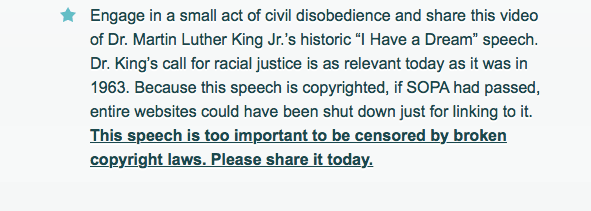
Uncivil Rights: Astroturf Organization Protesting Copyright Hearings Organized Mass Copyright Infringement Campaign Against MLK Estate

Screen Shot 2016-05-01 at 3.54.41 PMScreen Shot 2016-04-30 at 4.52.33 PM

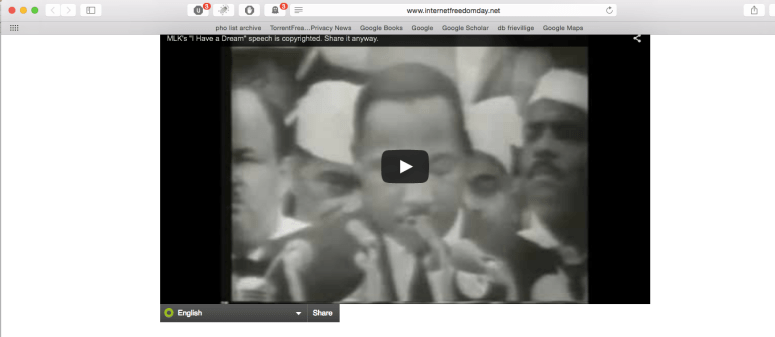
Fight For The Future a Massachusetts non-profit committed willful copyright infringement when they uploaded a copy of the “I Have a Dream Speech” and then encouraged thousands of followers to share it on for-profit social media platforms like Twitter and YouTube. Violating the rights of the King family estate while simultaneously generating page views for your Silicon Valley patrons is not “civil disobedience,” It’s positively Orwellian!

Any creators attending the Copyright Office roundtables on the “notice and takedown” provisions of the DMCA may see or hear from some “takedown abuse” protestors at this forum today in San Francisco.   These are not grassroots protestors but most likely operatives from an astroturf group called Fight For the Future.  This group has received massive funding from tech companies; venture firms (like Union Square Ventures); and a couple of mysterious “black box” foundations.

You probably have never heard of Fight For The Future, but back in 2012 they organized an “Internet Freedom Day.”   The key component of their campaign for “Internet freedom” was built around violating the rights of the MLK family.  Yes, these arrogant (and tone deaf) New Englanders organized a mass copyright infringement campaign against the MLK estate by posting  a copy of the “I have a dream” speech online and encouraging their thousands of followers to repost it on for multi-billion dollar for-profit platforms like Twitter and YouTube.

Fight For The Future blatantly misled the public into thinking the speech was not available or somehow being kept from the public by “bad copyright laws.” This was an absolute fiction, the speech was and continues to be available in many formats including a $2.99 iTunes download. (It was recently re-broadcast on the 50th anniversary by networks like CNN and MSNBC.)

So it’s tempting to choose the wrong moral outrage here:  A privileged and entitled group of Bostonians have an online temper tantrum because they want to watch the speech now and they don’t want to pay for it!

But that’s not the real moral outrage.

The real moral outrage is that this was a tech and venture capital funded anti-civil rights protest pretending to be a kind of civil disobedience.  This was a  protest designed to deprive the King estate of constitutionally protected intellectual property rights and allow multi-billion dollar social media, online video, tech and ad-tech companies to generate revenues from the I Have a Dream speech without compensating the King estate.

Disgusting isn’t it?

So who is funding this group?

According to Federal tax documents these Corporations and “black box” foundations are massively funding this organization.

Screen Shot 2016-05-11 at 2.06.11 PMScreen Shot 2016-05-11 at 2.06.45 PM


CORPORATE MONEY FUNDING FFTF

Union Square Ventures (Twitter, SoundCloud, Tumblr, and a host of other DMCA abusing services).  Their website says they welcome feedback here info@usv.com.

SV Angel  ( ex Google: Partners Topher Conway & Brian Pokorny;  Ex-Goldman Sachs: Paul LaLonde) Here’s their twitter account: https://twitter.com/svangel 

London Trust Media AKA Private Internet Access  Nearly $200K from every TorrentFreak’s favorite VPN!

NameCheap (also funds the EFF another anti-civil rights organization)

Yelp  (tweet their CEO!)

Consumer Electronics Association AKA Consumer Technology Association (Google funding).


BLACK BOX  FOUNDATIONS FUNDING FFTF

Screen Shot 2016-05-11 at 6.22.42 PM

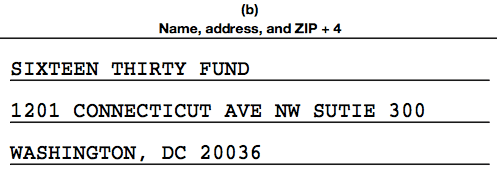
What the f— is the Sixteen Thirty Fund?  According to it’s 501 (c)(3) it “promotes Environmental Quality, Protection and Beautification.”   Is Fight For the Future building nature trails on Cape Cod? Martha’s Vineyard?

Screen Shot 2016-05-11 at 6.26.15 PM

Proteus seems mostly concerned with death penalty issues.  Good for them.   So why $100k for Fight For The Future? Wouldn’t that money be better spent on death penalty issues? Well, if you read in the fine print they brag:

Each initiative is uniquely structured and focused to achieve the goals of its funding partners, and led by experienced program staff. Our highly effective rapid response grantmaking function and ability to integrate support for lobbying activity are two key tools utilized by our collaborative grantmaking initiatives.

Translation:  We also do lobbying work for unspecified “funding partners”

I couldn’t find any way to contact them.  But I see that that one of the board members is this person:

Screen Shot 2016-05-11 at 12.43.22 PM

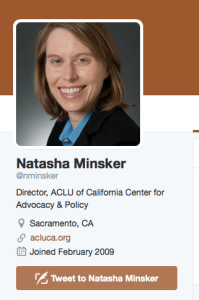
You’d think the Director,ACLU of California Center for Advocacy & Policy would feel a twinge of conscience over funding ($100K) an organization that willfully violated the rights of the King estate.  Imagine if it were 1960 and some Dixiecrat decided to encourage thousands of people to use Dr King’s copyrighted works without permission or payment?  What would the ACLU of 1960 say about that?

Screen Shot 2016-05-12 at 12.29.44 AM

Obviously Chicago Instructional Tech Foundation is based in Boulder Colorado.  And naturally it makes sense for them to give $105,000 to Fight For The Future, because of their well known “instructional tech” expertise.   It of course follows that donations to this foundation are not tax deductible.  And naturally they don’t disclose funding.  If you’re a glutton for punishment read their 990.  It’s a maze of related entities paying each other money.  If anyone has any idea what this “non-profit” is doing explain it to me.


Google Party Celebrates Revolving Door to Obama White House — Artist Rights Watch

The White House has a reputation for being remarkably cozy with Google lobbyists, but apparently this relationship also extends after-hours. The National Legal and Policy Center, a government watchdog group, has released a video showing top Obama officials flocking to Google’s White House Correspondents’ dinner party earlier this month. Party attendees included David Edelman, the […]

via Google Party Celebrates Revolving Door to Obama White House — Artist Rights Watch

Spotify’s New Release Excuse Is Wrong

The latest excuse from Spotify (which strangely is being echoed by David Israelite (NMPA CEO) in a recent interview with Dale Kawashima  in Songwriter Universe) is that “most of the new music that gets released, you don’t know yet who owns it.”

Aside from being simply incorrect, this argument is simply unbelievable on its face.  First of all, every record deal has what’s called a “controlled compositions” license that covers songs written or co-written by the band or individual artist, the producer, or any co-writers who write with the artists.

That same contract requires the artist to deliver songwriter credits, publisher information and often “splits” or ownership shares in order to meet their contract obligations to their label (and get paid their “backend” advance).

Artists sometimes pass that obligation on to their producers.  The producers then have to get those splits and songwriter information (also called “label copy”).

If the song is not written by an artist, producer or co-writer (also called “outside writers”), most of the time the splits are also known and delivered by the artist or producer.

If the song is a cover, the splits and publisher information is usually easily findable through public databases maintained by ASCAP, BMI, SESAC or the Harry Fox Agency (“HFA”).  HFA was hired by Spotify to clear the publishing on songs used by Spotify.

If there is a sample, most of the time the recording won’t be released until the samples are cleared (the infamous “legal hold” on an artist’s release).

So it is simply false to say that “most of the new music that gets released, you don’t know yet who owns it.”  In fact, the opposite is true.  Most of the music that gets released, you do know exactly who owns it.

Even if you strain to try to make some sense of this statement, the most you could say is that the writers may be known but the splits may not be known on a handful of new releases day and date with the release.

This is a tiny handful of songs, and even those are irrelevant when it comes to Spotify because they could easily send the required notice to each of the known writers.

It is also irrelevant for sending the “NOI” or “notice of intention to use” the song under the compulsory mechanical license.  Here’s the regulations which confirms in a nutshell that “ownership” or “splits” are not required.  The rules require that the notice go to “A copyright owner of the work, if known”.  “A copyright owner”–not all–“A”.  As in at least one.  If known.

(d) Content.

(1) A Notice of Intention shall be clearly and prominently designated, at the head of the notice, as a “Notice of Intention to Obtain a Compulsory License for Making and Distributing Phonorecords,” and shall include a clear statement of the following information:

(i) The full legal name of the person or entity intending to obtain the compulsory license, together with all fictitious or assumed names used by such person or entity for the purpose of conducting the business of making and distributing phonorecords;

(ii) The telephone number, the full address, including a specific number and street name or rural route of the place of business, and an e-mail address, if available, of the person or entity intending to obtain the compulsory license, and if a business organization intends to obtain the compulsory license, the name and title of the chief executive officer, managing partner, sole proprietor or other person similarly responsible for the management of such entity. A post office box or similar designation will not be sufficient for this purpose except where it is the only address that can be used in that geographic location.

(iii) The information specified in paragraphs (d)(1)(i) and (ii) of this section for the primary entity expected to be engaged in the business of making and distributing phonorecords under the license or of authorizing such making and distribution (for example: a record company or digital music service), if an entity intending to obtain the compulsory license is a holding company, trust or other entity that is not expected to be actively engaged in the business of making and distributing phonorecords under the license or of authorizing such making and distribution;

(iv) The fiscal year of the person or entity intending to obtain the compulsory license. If that fiscal year is a calendar year, the Notice shall state that this is the case;

(v) For each nondramatic musical work embodied or intended to be embodied in phonorecords made under the compulsory license:

(A) The title of the nondramatic musical work;

(B) The name of the author or authors, if known;

(C) A copyright owner of the work, if known;

(D) The types of all phonorecord configurations already made (if any) and expected to be made under the compulsory license (for example: single disk, long-playing disk, cassette, cartridge, reel-to-reel, a digital phonorecord delivery, or a combination of them);

(E) The expected date of initial distribution of phonorecords already made (if any) or expected to be made under the compulsory license;

(F) The name of the principal recording artist or group actually engaged or expected to be engaged in rendering the performances fixed on phonorecords already made (if any) or expected to be made under the compulsory license;

(G) The catalog number or numbers, and label name or names, used or expected to be used on phonorecords already made (if any) or expected to be made under the compulsory license; and

(H) In the case of phonorecords already made (if any) under the compulsory license, the date or dates of such manufacture.

Nobody who knows anything about the real music business will give any credence to Israelite’s statement.  Particularly because it’s exactly the kind of statement that infringers have been hiding behind since the Napster case that somehow we don’t know what we own.

Not true, not legally required and not helpful.

(Errata: This post first referred to the interviewer as Dean Kay instead of Dale Kawashima.)

A Single Picture Explains Why the NMPA/HFA/Spotify Settlement is Deeply Flawed


Screen Shot 2016-05-05 at 10.59.43 AM

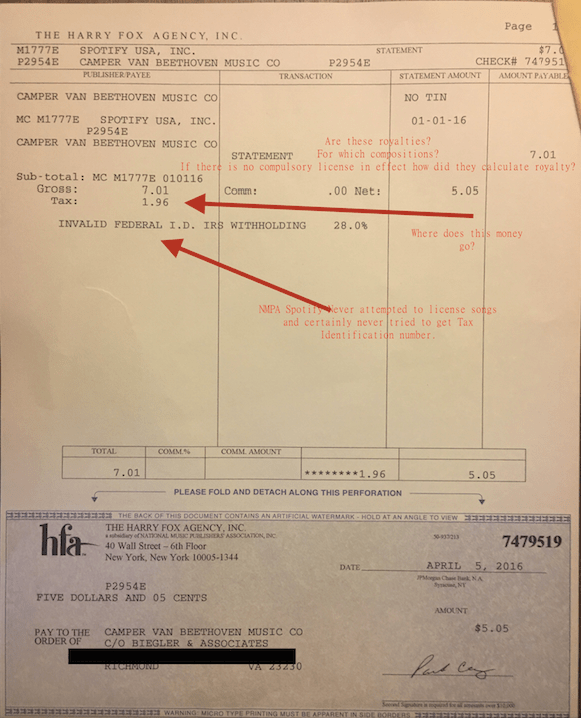
You’re kidding me right?  What is this for? No accounting? No cover letter.  Is this some sort of “bait” check?  How can NMPA/HFA/Spotify settlement possibly be “fair” with this sort of nonsense going on? 

For those not familiar with the nuances of the music licensing business  Harry Fox Agency (HFA)  is s former subsidiary of the National Music Publishers Association (NMPA).  HFA acts as a clearing house for those wishing to  obtain mechanical licenses (copy AND distribute) a songwriters work.  So for instance streaming services like Spotify can come to HFA and obtain licenses for many songs, but not all.  It is important to note that HFA can only issue licenses for songwriters/publishers that opt into their service.

So how do streaming services get the licenses from the remaining writers?  Normally they hire a third party to track down the remaining writers and send what are called “Notices of Intent” to exercise a compulsory license.

In the case of Spotify they hired Harry Fox Agency to  perform this task.  Are you following me here?  This means that Harry Fox is on one hand representing songwriters and publishers,  but on the other hand they are also representing Spotify.   Does this seem like a conflict of interest to anyone?

Now in my case (and virtually every independent songwriter/publisher I surveyed),  they never bothered to send valid “notices of intent” to obtain the licenses for Spotify to use my songs until after the fact (hence the class action against Spotify).  In the vernacular: they totally fucked up.

But Harry Fox Agency was also apparently hired to pay royalties and account to songwriters on behalf of Spotify.   Have they also fucked this up as well?   Yes.  Just look at the check above.   Here are just some of the things wrong with this check

  1. What is the check for?   Songwriter royalties?   Is it for just being a cool band?    Or is it a super sleazy legal trick  (cashing a check is sometimes viewed as an implicit license)?
  2. Are they sending out checks like this to other independent publishers? To whom and why?
  3. If it is for songwriting royalties,  which tracks? How many spins?
  4. What accounting period does it cover?
  5. How did they arrive at this amount?  If there is no license in effect, there is no royalty rate with which to calculate a royalty?
  6. As they are acting as an agent of Spotify isn’t this an improper Ex-parte communication?
  7. They don’t have a taxpayer ID from me, because there is no contract or license. How do they even know they are paying the proper party?
  8. Where does the 28% withholding tax go?  I’m not a tax expert but this doesn’t seem like the  proper procedure.

So HFA is clearly fucked up. But why does this matter?  Because the NMPA/HFA and Spotify all have an interest in stopping the songwriter class action.

  1. The NMPA owned HFA when they began working (and fucking up) on behalf of Spotify . NMPA owned HFA until July of 2015.   It is likely that NMPA had to indemnify the new owners of HFA private equity firm Rizvi Traverse.  In turn it’s highly likely that HFA had to indemnify Spotify for services (poorly) performed.   Thus it’s in NMPAs interest to make this all go away.  This is not the same as being in the interest of NMPA’s constituent publishers. Why are constituent publishers being dragged into this?
  2. NMPA/HFA/Spotify settlement leaves HFA in place.   Look at the check above!  How can any publisher or songwriter ever have any confidence that they will ever receive a proper accounting? One of the reasons we filed a class action against Spotify was to bring in an independent third party auditor and bring some much needed transparency to the process.

The choice is clear for songwriters and publishers.  A backroom deal between related parties or a transparent court supervised process?


Why Does the Center for Democracy & Technology Take Millions from Google? — MUSIC • TECHNOLOGY • POLICY

A recent story in the Daily Caller reported on some good open source analysis by a corporate ethics group that demonstrated Google’s funding of the “Center for Democracy and Technology”, a Washington, DC based lobby shop long associated with Google. The Daily Caller reports that: An influential tech industry watchdog group that has received millions […]

via Why Does the Center for Democracy & Technology Take Millions from Google? — MUSIC • TECHNOLOGY • POLICY

@TuneCore Asks Songwriters To Sign Up For Spotify Settlement Without Disclosing Terms

Screen Shot 2016-05-02 at 6.32.24 PM


Are you fucking kidding me?  A Survey Monkey form?  If you are a Tunecore songwriter you recently got an email asking you to sign up for the NMPA/Harry Fox Agency/ Spotify settlement.  Songwriters are directed to the above Survey Monkey form.  This is it.  No details. Nothing.Nada. In particular there is no mention of the possible statutory damages that songwriters are waiving by opting in to this.

So it’s your choice songwriters:

Sign up for a backroom deal cooked up between the NMPA, Harry Fox Agency and Spotify? Or wait for a FAIR and TRANSPARENT process supervised by a federal judge?

Wish all choices were this easy.

Astroturf “Fight For The Future” Received Almost 100K From Mysterious Company Based in Mini Industrial Park


Screen Shot 2016-05-02 at 10.02.30 AM

Does your typical “grassroots” group get $96,000 dollars from a company with an address in a mini-industrial park in Michigan?  I can’t imagine that a company based in such a location would have $96,000 a year to give to an anti-copyright group like Fight For The Future?   (see more on Fight For The Future here, here, here and here).

But from the Federal 990 tax return for Fight For The Future:

Screen Shot 2016-05-02 at 10.19.49 AM

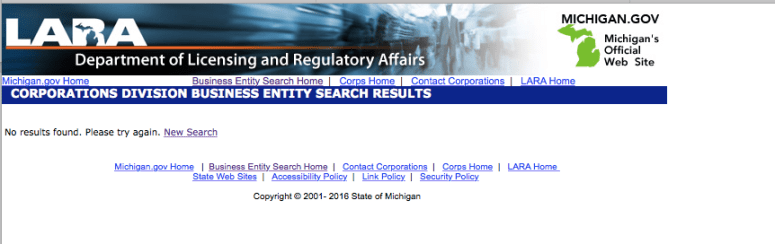
A search of Michigan State business licensing records seems to indicate that this company is not registered in Michigan.

Screen Shot 2016-05-02 at 10.08.51 AM

I’m not sure what this ultimately means, but here are some other businesses that list physical addresses as 2885 Sanford Ave SW Grandville, Michigan.  I have no idea if they are related.

World Fertility Experts

Seems an odd location for this sort of business.  Overseas fertility treatments.

Not in state business entity records

http://www.worldfertilityexperts.com/contact-us.php

Screen Shot 2016-05-02 at 11.29.43 AM

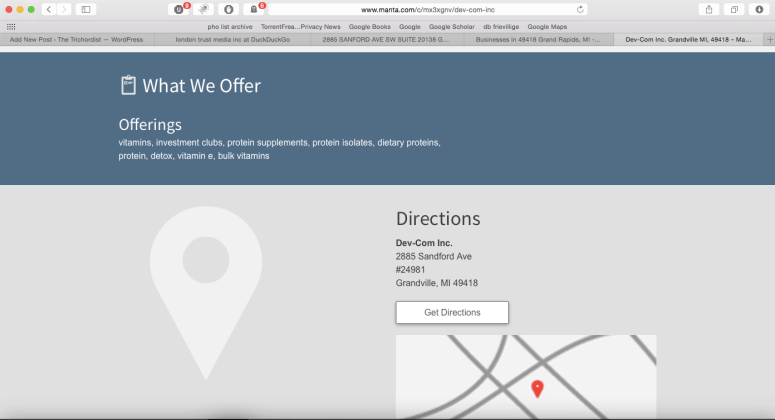
Dev-Com

Vitamins, investment clubs and protein supplements?!?  Those things really go together!

Below is the Manta listing.  No other records could be located.

Screen Shot 2016-05-02 at 11.12.55 AM

The Mesh Lawsuit Group

As far as I can tell there is no law firm or “lawsuit group” in the US.  Michigan business entity records have nothing listed.

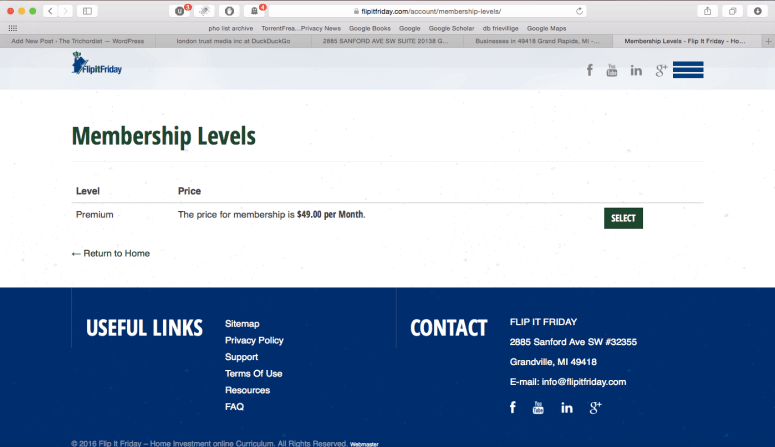
Flip it Friday

A $49.95 a month online curriculum for flipping houses.

Screen Shot 2016-05-02 at 11.27.24 AM

My Fast Diploma

Not found in Michigan State business entity database.

Screen Shot 2016-05-02 at 11.48.55 AM


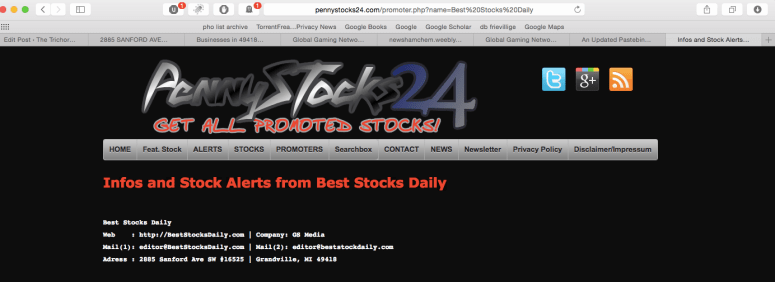
GS Media

Looks to be a penny stock promoter.   Again no business records in Michigan state database.  They come up in this interesting article here

Global Gaming Network (GBGM): First the pump, now the big dump

Screen Shot 2016-05-02 at 2.15.26 PM


Anti-Copyright “Fight For The Future” and their 1% Grassroots

Screen Shot 2016-05-01 at 4.01.36 PM

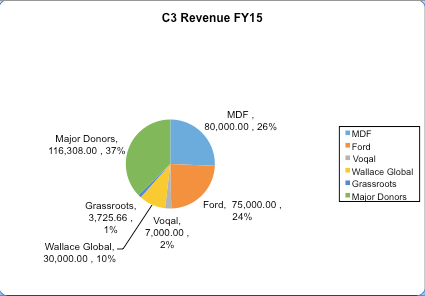
Does this look like a grassroots organization to you?  Pie chart from Fight For The Future’s 2015  financial documents. 

At every turn “grassroots” Fight For The Future has been there to undermine artists’ copyright protections in ways that benefit major technology companies.

They famously organized a scripted automated dial-in that overwhelmed the US Congress phone systems during SOPA deliberations creating the impression that thousands of Americans were spontaneously calling in opposition to copyright protections for artists and rights holders. I’ve never understood why this scripted robotic dial in campaign was never investigated.  (Read Chris Ruen’s excellent book Freeloading for more on the “spontaneous” corporate lobbyist led anti-SOPA uprising.)


Screen Shot 2016-05-01 at 4.53.40 PM

Screen Shot 2016-05-01 at 4.56.19 PM Screen Shot 2016-05-01 at 4.55.56 PM

Similarly they organized an automated dial in against the TPP apparently because it doesn’t weaken copyright enough!  That’s right, FFTF thinks TPP doesn’t do enough to undermine US  cultural exports!  So while pretending to protect american jobs the “progressive” FFTF are actually hurting workers in the largely unionized cultural industries while benefiting anti-union libertarian leaning technology company!  As Lenin might have called them they are “useful idiots.”  But that’s not all Fight For The Future targeted eight Democratic Senators,  and promised to oppose them in their next election.   “Oh and just one last question… about that ‘no’ at  Part IV item 3  on your federal 990 tax return…”

Screen Shot 2016-05-01 at 3.54.41 PMScreen Shot 2016-04-30 at 4.52.00 PM

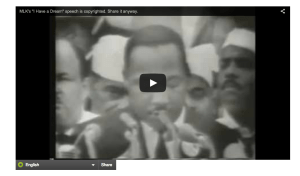
Before it was deactivated the link above allowed sharing of illegally uploaded video of King’s I Have a Dream speech across all social media. 

On “Internet Freedom Day”  they organized the worlds first anti-civil rights  “civil disobedience” campaign directed at the Martin Luther King Estate by illegally copying and distributing Kings “I Have A Dream Speech” and encouraging thousands of others to “share” the video on digital platforms.   I’m not a lawyer, but isn’t this criminal willful infringement under 17 U.S.C. § 506?  Also how is it that a non-profit keeps it’s tax exempt status when it’s committing criminal acts?

And most recently they used an automated script to “comment bomb” the regulations.gov website in response to a request for comments from the copyright office in a  review of the “Whack-a-Mole” DMCA takedown provisions.  I believe their efforts were problematic, illegal or violated federal rules for non-profits. Possibly fraudulent as EXACTLY 86,000 of the responses are identical!  A detailed explanation is provided here:

https://thetrichordist.com/2016/04/19/exactly-86000-identical-comments-the-illegal-comment-bombing-of-dmca-notice-takedown-review-by-google-proxy-fight-for-the-future/

This is not a grassroots operation.  This is a cynical astroturf lobbying organization.