Poll: Which Presidential Candidate is Most Likely to Nominate Lessig for Supreme Court

Scalia accepts book from his former law clerk Lawrence Lessig

It’s Monday.  Let’s have a little fun here and try to figure which presidential candidate would be most likely to nominate copyleft demagogue (and former Democratic presidential candidate) Lawrence Lessig to the Supreme Court.  After losing at the Supreme Court twice on copyright issues you’d know he’d jump at the opportunity to be nominated.

Hillary Clinton

The super creepy logo of  Groundwork, the secretive Eric Schmidt big data operation backing Hillary Clinton.

While Hilary Clinton’s close connections to Hollywood would on the surface make it seem unlikely that she would support a Supreme Court nominee so hostile to the interests of creators, she seems awfully close to Eric Schmidt CEO of Alphabet/Google.  And the admiration is mutual, Eric Schmidt is backing the Hilary campaign with a massive data operation.  As QZ reports:


“An under-the-radar startup funded by billionaire Eric Schmidt has become a major technology vendor for Hillary Clinton’s presidential campaign, underscoring the bonds between Silicon Valley and Democratic politics.
The Groundwork, according to Democratic campaign operatives and technologists, is part of efforts by Schmidt—the executive chairman of Google parent-company Alphabet—to ensure that Clinton has the engineering talent needed to win the election. And it is one of a series of quiet investments by Schmidt that recognize how modern political campaigns are run, with data analytics and digital outreach as vital ingredients that allow candidates to find, court, and turn out critical voter blocs.”


This is particularly clever as the shadowy organization claims to be a “vendor” of the Clinton campaign, but as the QZ article goes on to suggest the Clinton campaign is essentially being undercharged for these services because an even more shadowy and opaque group “Timshel” is really subsidizing the salaries of the data engineers doing the heavy lifting.

“Schmidt did not respond to several requests for comment. But several Democratic political operatives and technologists, who would only speak anonymously to avoid offending Schmidt and the Clinton campaign, confirmed that the Groundwork is funded at least in part by the Alphabet chairman.”

If this is true, this is an extremely crafty way for Google and Schmidt to disguise what are in effect campaign contributions to the Clinton campaign.   So what better way to pay back Schmidt for his help than to nominate the piracy defending Harvard Law Professor to the Supreme Court?   You think YouTube abuses section 512 of the DMCA now?  Lessig on the Supreme Court would make pretty much anything “Fair Use.”

Screen Shot 2016-04-11 at 10.45.34 AM

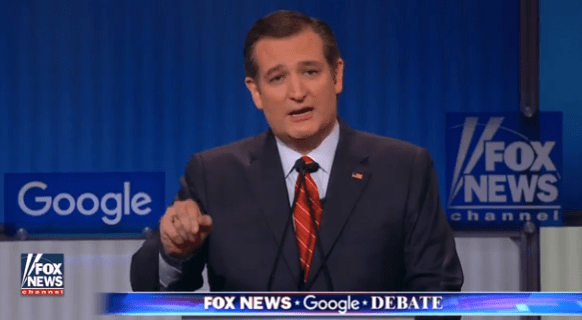
Ted Cruz at the Google sponsored Republican debate.

Ted Cruz

While it seems unlikely that the conservative candidate would nominate a progressive Democrat for Supreme Court,  remember Ted Cruz lobbied on behalf of Google in an Texas Anti-Trust investigation.  As Yahoo News reported in  March of last year:

“Facing the threat of an antitrust lawsuit from the state attorney general, Google hired Cruz to represent its interests before the agency where Cruz himself had worked just over two years earlier and where his mentor, Abbott, still called the shots. The future political star met with a top Abbott deputy on Google’s behalf in August 2010, and Cruz then accompanied a team of antitrust lawyers from Google and a Palo Alto, Calif.-based law firm to three additional meetings at the agency, according to a Cruz spokesman and visitors’ logs for the Texas attorney general’s office.”

Lessig’s copyleft stances on YouTube and in defense of piracy would be very good for Google’s core advertising businesses.  See ad supported piracy here.

Screen Shot 2016-04-11 at 10.35.08 AM

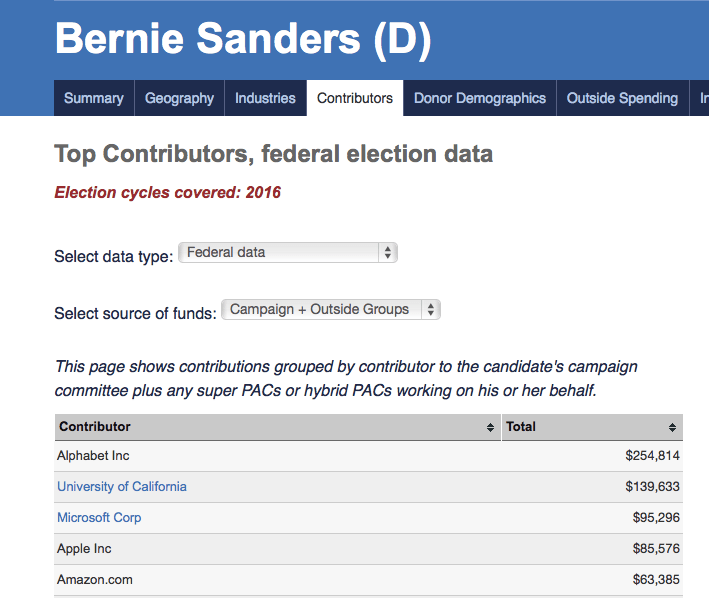
Top contributors to Bernie Sanders by company.  Alphabet is new corporate parent of Google. 


Bernie Sanders.   Democratic Socialist?  That seems like he would be good for the rights of the little gal/guy right?   I mean surely a progressive like Sanders would see copyright for what it is: an individual right that empowers individual creators and forces large corporations to pay creators for use of their works.   However if he turns out to be anything like his fellow progressives and European Democratic Socialist counterparts he will probably weaken copyright further.  Remember in April of 2015 the UK Green Party came out in favor of greater “sharing” of copyrighted material and limit copyright to 14 years.  The same length copyright was in 1710, when the average lifespan was less than 40 years.  Talk about buggy whips!

The French Socialists challenged the constitutionality of the French anti-piracy law HADOPI.  And the Socialist Party of the USA platform simply states: “We call for the repeal of all existing copyright laws.”

Progressives are fond of proclaiming that many poor Americans seem to vote against their economic interests by supporting conservative candidates.  Less often noted is that something similar happens with progressives and left wing political candidates.  They have a habit of attacking the entertainment industry and robust copyright laws that support these industries.  Funny because the entertainment industry is a largely a unionized industry that overwhelming supports left of center candidates.  Meanwhile many of these same progressive candidates suck up to the libertarians of Silicon Valley. Go figure.


Donald Trump:   A friend of mine refers to Donald Trump as the “Manchurian Candidate.”  This is a reference  to the classic political thriller by Richard Condon, in which an American Korean War hero is actually a communist “sleeper agent.” The point is that Donald Trump and Lawrence Lessig seem to share an extreme ideological flexibility.   They are thus a perfect for each other:

Lessig is a “progressive” candidate that was a law clerk to  Supreme Court Justin Antonin Scalia.

Lessig a “progressive” has repeatedly praised Scalia.

Lessig ran as a “progressive” Democrat for president while his Mayday PAC accepted campaign funds from arch libertarians like Peter Thiel. 

Lessig ran as a single issue candidate on campaign finance reform  while accepting massive donations from Silicon Valley to his MayDay PAC.

In a Vanity Fair interview the “progressive” Lessig expressed admiration for Donald Trump and disappointment with Bernie Sanders.


So who do you think is most likely to nominate Lessig for the Supreme Court?


Silicon Valley Hypocrisy: We Support Solutions To Piracy, Except When They Are Actual Solutions to Piracy…

You can’t make this up. Law 360 is reporting that the International Trade Commission (ITC) has been denied authority over digital goods.

The Federal Circuit said Thursday that it wouldn’t reconsider its decision that the International Trade Commission lacks the authority to block the import of digital files, drawing a lengthy dissent from one of its judges.

Keep in mind, the same people now opposed to the ITC having this authority are the same who argued in favor of the the ITC doing so as an alternative to SOPA called the Open Act.

Below is an except from an excellent post on this issue By Devlin Hartline & Matthew Barblan at CPIP.

When advocating for the OPEN Act as a good alternative to SOPA and the PROTECT IP Act, the bill’s sponsors touted the ITC as being a great venue for tackling the problems of foreign rogue sites. Among the claimed virtues were its vast experience, transparency, due process protection, consistency, and independence:

For well over 80 years, the independent International Trade Commission (ITC) has been the venue by which U.S. rightsholders have obtained relief from unfair imports, such as those that violate intellectual property rights. Under Section 337 of the Tariff Act of 1930 – which governs how the ITC investigates rightsholders’ request for relief – the agency already employs a transparent process that gives parties to the investigation, and third party interests, a chance to be heard. The ITC’s process and work is highly regarded as independent and free from political influence and the department already has a well recognized expertise in intellectual property and trade law that could be expanded to the import of digital goods.

The Commission already employs important safeguards to ensure that rightsholders do not abuse their right to request a Commission investigation and the Commission may self-initiate investigations. Keeping them in charge of determining whether unfair imports – like those that violate intellectual property rights – [sic] would ensure consistent enforcement of Intellectual Property rights and trade law.

Some of the groups now arguing that the ITC shouldn’t have jurisdiction over digital goods openly supported the OPEN Act. Back in late 2011, the EFF stated that it was “glad to learn that a bipartisan group of congressional representatives has come together to formulate a real alternative, called the OPEN Act.” The EFF liked the bill because the “ITC’s process . . . is transparent, quick, and effective” and “both parties would have the opportunity to participate and the record would be public.” It emphasized how the “process would include many important due process protections, such as effective notice to the site of the complaint and ensuing investigation.”

Google likewise thought that giving the ITC jurisdiction over digital goods was a great idea. In a letter posted to its blog in early 2012, Google claimed that “there are better ways to address piracy than to ask U.S. companies to censor the Internet,” and it explicitly stated that it “supports alternative approaches like the OPEN Act.” Google also signed onto a letter promoting the virtues of the ITC: “This approach targets foreign rogue sites without inflicting collateral damage on legitimate, law-abiding U.S. Internet companies by bringing well-established International trade remedies to bear on this problem.”

You can read the full post here (Strongly Recommended):

Digital Goods and the ITC: The Most Important Case That Nobody is Talking About


Hacking Democracy: Google/YouTube Proxy Group “Fight For The Future” Crashes US Copyright Office Website During Crucial Comment Period


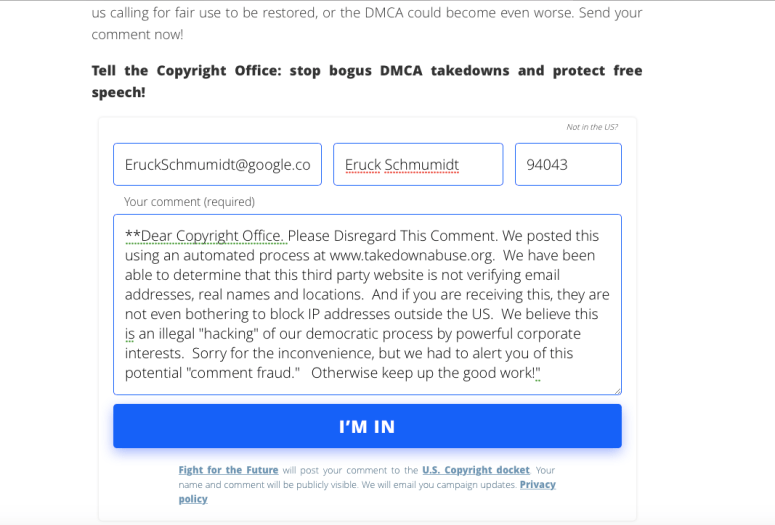
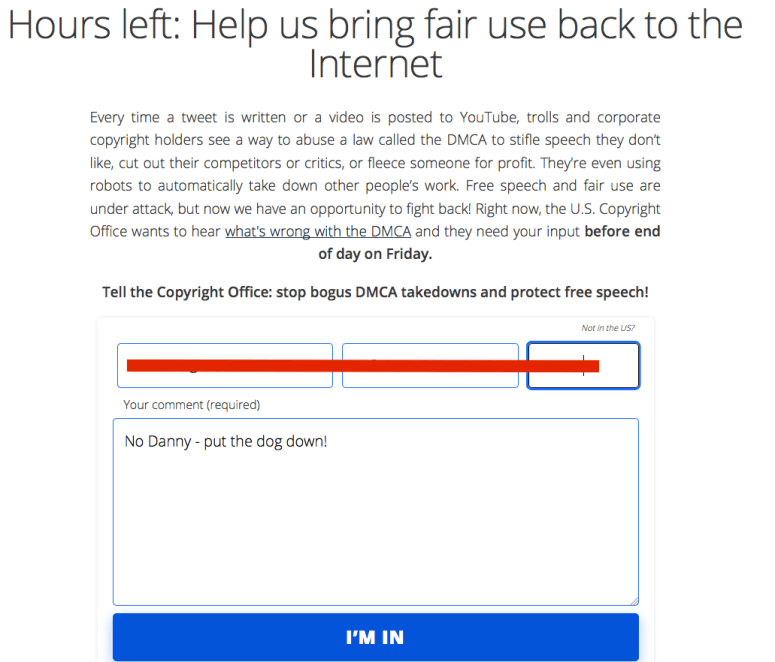
Test Comment through takedownabuse website

We replaced the canned message on the takedownabuse.org web form with a message like this, to verify that Google/YouTube proxy Fight For The Future website was indeed automating comments on an official US Government website. 

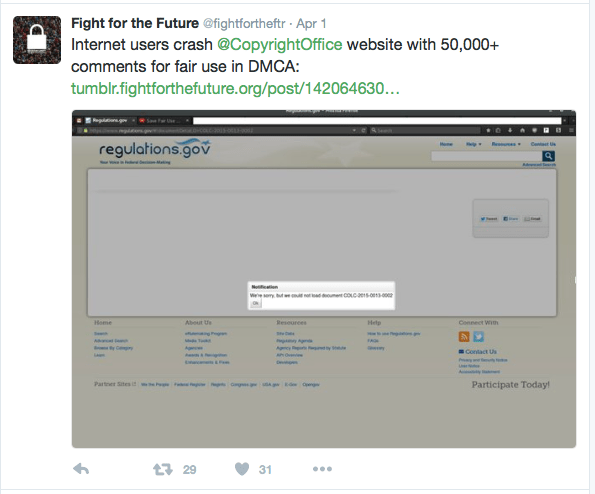
Torrent Freak is reporting that  Google/YouTube proxy  “Fight for the Future” generated a flood of automated “comments” that crashed the regulations.gov website Thursday.  This was within the crucial last 48 hours of a comment collection period for a consultation on the DMCA notify and takedown process which currently allows Google/YouTube to reap billions by monetizing “user generated content” that actually belongs to songwriters  like myself.

FFTF (Fight for the Future) publicly boasted about the website outages on Thursday to Torrent Freak:

“The flood of new submissions over the last several hours appears to have repeatedly crashed the website that the government set up to receive feedback,”

(On Friday night around 10:30 PM we received a tip and then verified that the regulations.gov website was again unresponsive.)

Screen Shot 2016-04-03 at 8.27.02 PM

Users? Actually FFTF web form bot crashed the page.

How did this happen?

FFTF employed a sophisticated campaign of technology and misinformation to electronically generate tens of thousands of identical canned comments to the CO website.    Further instead of having users visit the consultation comment page for comments as the Copyright Office requires, FFTF used a web form hosted by Fight For The Future at www.takedownabuse.org, and this is where things get ugly. Very ugly!

Visitors to this website were directed to fill in their email address, name and ZIP code which then automatically posted a canned comment to the copyright office website.  We tested the web form and discovered:

  1. FFTF (Fight For The Future) did not verify email, name and ZIP code before accepting comments.
  2. FFTF did not verify our IP address was in the US before accepting comments.
  3. FFTF web form allowed multiple comments. By refreshing the page you could simply comment again and again.
  4. FFTF put no restrictions on “bots” on their web form. Using the crudest keystroke automation we managed to post rapid fire comments (less than three seconds between comments).++
  5. FFTF violated the federal rules  that require comments be posted only using the regulations.gov interface. FFTF appears to have violated this rule and further may have used automation to simulate a visitor (rather than bot) to the official government website.
  6. The Copyright Office website was non-responsive late Friday night when a large number of the automated comments came in.
  7. FFTF was still auto-generating comments after the official deadline and demanding the copyright office accept these submissions.

We believe FFTF’s actions may have been illegal in several ways:

Using automation to post comments to a government website and as a result causing a website outage is essentially a denial of service attack on a USG agency.

Using a third party website and automated systems to post comments for the copyright office consultation is clearly against the consultation rules.

The campaign by FFTF would seem to qualify as Spam! Further the likely coordination between  FFTF, Google and other commercial entities could qualify this as a deceptive commercial communication since the associated videos contained unsubstantiated claims, and the Google funded study reference also makes unsubstantiated conspiratorial claims+++

By effectively monopolizing the regulations.gov website for the last two days did FFTF unlawfully suppress the constitutional right of creators to petition their government?

We call on the Copyright Office, Congress and FBI to look into whether any laws were broken by Fight For The Future and their patron Google.  

++ we conducted only a short burst of “automation” on the takedownabuse.org web form. Less than 7 comments were potentially posted.  The copyright office was informed we made test comments through the takedownabuse.org website.

+++  Example:  “A more pointed question is whether the notice escalation represents coordinated retaliation against Google for its role in opposing stronger enforcement obligations on OSPs, culminating in the defeat of the Stop Online Piracy Act in 2012. The timing of the escalation outlined by Seng is suggestive.  2011 saw a large 305% increase in notices over 2010.  But the banner year was 2012, with a 524% increase overall and a 227% increase in April alone, in the immediate aftermath of the withdrawal of the bill. Most of the major rightsholders only began actively targeting Google Web Search during this period, including those who currently send massive numbers of notices: the RIAA and BPI, the major movie studios, and Degban Ltd.—the lead REO for the pornography industry.”

This is of course absurd and  they presents no evidence to support their claim. Further with Occam’s Razor in mind, a theory that adds far less assumptions and doesn’t require a massive conspiracy among half a dozen multinationals is this:  After the failure of SOPA large rights holders only had only one option left, DMCA takedown and notice, so as rational actors they all used this tool to protect their copyrights.

The “Legal Literacy Test” Imposed On Artists By Lenz Decision Benefits Google, Violates Human Rights


Everyone has the right to the protection of the moral and material interests resulting from any scientific, literary or artistic production of which he is the author.

The Universal Declaration of Human Rights (1948)

Everyone.  Not just those authors, artists and musicians with a legal staff. Not just those with deep knowledge of copyright law.  And it especially does not limit copyright protections to those able to perform one of the most difficult legal analyses under copyright law: a fair use test.

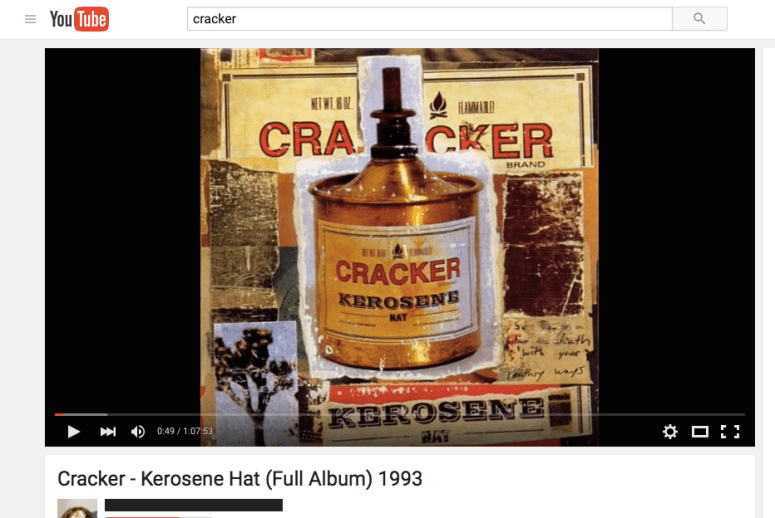
Yet that is the burden that the Lenz decision imposes on authors,artists, musicians and songwriters.  This is essentially a “legal literacy test” that creates two classes of copyright holders in violation of human rights treaties.   Those with or without legal knowledge or resources cannot fully exercise their rights.  For the Lenz Decision says an author must perform a fair use test before they can even send a notice to a blatant copyright infringer like YouTube that is pirating my work:
Screen Shot 2016-04-03 at 12.41.22 PM

I receive no revenues from plays of this video on YouTube.   Further it is the number 1 search result for Cracker.   There are licensed versions of this album (with actual full production videos).  This robs me, my band, employees and family of revenue generated by legitimate licensed versions of this track.  And Google gets to keep what ever money is generated.   This is worse than  the old blatantly exploitative music business of the 1950s! I don’t even get a Cadillac in lieu of royalties!

Yet in order for me to take action against Google, I have to perform a “fair use test.”  Quick show of hands.  How many of you can state the 4 pillars of fair use and how to properly perform the balancing test required by courts?   No one?  That’s what I thought.

Further since fair use is a creature of jurisprudence, that is, the rules that interpret fair use are contained in previous rulings.  Without a legal education how do I know where to find and interpret these decisions?   Then does the method of interpretation vary depending on which federal circuit in which I live?   Do I use those circuit court opinions for the district in which I reside?  Or do I use the circuit court opinions  that  apply to the district in which the corporation or user is based.  I almost never know in which district the YouTube user lives. Or if they are even based in the US.   Many websites obscure their geo location.  So according to the Lenz decision I’m not even able to start a proper fair use analysis.

Read the Trial by Kafka sometime.

This is simply a hurdle that the courts have thrown up to benefit YouTube while depriving millions of authors of their legal rights under US law and Human Rights under the Universal Declaration of Human Rights.

It’s no wonder so many americans have lost faith in the our government.

Here is what I filed to the US Copyright office consultation on the flawed “Notice and Takedown” system as interpreted by the US courts.   Someone really needs to challenge this in the Supreme Court.


Jacqueline C. Charlesworth
General Counsel and Associate Register of Copyrights

United States Copyright Office

Washington, D.C. 20559-6000

Re: Section 512 Study [Docket 2015-7]


Dear General Counsel Charlesworth:


My name is David Lowery. I am a founding member of the groups Cracker and Camper Van Beethoven and a lecturer at the Terry School of Business at the University of Georgia at Athens. Many of the albums my two bands have recorded over the years have been released on my own label. I also write The Trichordist blog devoted to issues of importance to independent artists and songwriters. I am filing this comment on my own behalf from the perspective of an independent recording artist.

Thank you for the opportunity to comment on Section 512, the “notice and takedown” process. I would argue that it has become patently obvious that what started with the Congress as “notice and takedown” is better described as “notice and shakedown”. As Beggars Group Chairman Martin Mills said in his Canadian Music Week keynote a couple years ago:


The original intent was to protect reasonable people acting reasonably from falling foul of the law, to enable the digital economy to grow without “ gotcha “ law suits against ISPs who had no idea that their networks were being used for infringement. They were not intended to provide fortress walls behind which companies could build billion dollar businesses on content that had not been cleared. They were never intended to become a de facto “ license “.
To draw an offline analogy, these provisions would allow someone to burgle your house and remove its contents, with their only risk being that if you caught them, they’d have to return them – and maybe apologize. And then do it again. And again. And again.


Nowhere is Mr. Mills’ point made more clearly than in the BMG Music Rights v. Cox Communications case[1] where Judge Liam O’Grady denied the safe harbor to an ISP that had blatantly failed to comply with the repeat infringer policies required by the statute.


Anyone who has a passing acquaintance with reality knows that Judge O’Grady’s ruling is both courageous and fundamental—what BMG proved was that Cox handled DMCA notices in a cavalier fashion in a prime example of what Mr. Mills called the “de facto license” or as some call it a “DMCA license” that neither complies with the Copyright Act nor is a license. But it may as well be, particularly if like most independent artists you can’t afford to file a lawsuit and use the force of law to extract the proof that everyone knows is there.


And this is what I would like to draw to the Copyright Office’s attention. The notice and takedown process was intended to be a low cost way for creators of all copyright categories large and small to enforce their rights. Instead, it has become a battleground between big tech companies and their surrogates (like the Electronic Frontier Foundation that received over $1 million from Google[2]) getting rushed by an overwhelming number of infringers with the artists the statute was intended to protect being pushed aside.


The is no better way to illuminate this story than to refer you to the bizarre ruling in Lenz v. Universal Music Corp.,[3] a case that appears to have been largely bankrolled by the Electronic Frontier Foundation in furtherance of its obsessive hostility toward Universal[4] with utter disregard for the lives of artists left in its wake.


As if it is not enough that YouTube is promoting to the general public that it will directly bankroll litigation over “fair use”, the federal courts have interpreted the DMCA to require that the artist sending a takedown notice “consider” fair use before sending their notice:

The panel held that the DCMA requires copyright holders to consider fair use before sending a takedown notification, and that failure to do so raises a triable issue as to whether the copyright holder formed a subjective good faith belief that the use was not authorized by law. Regarding good faith belief, the panel held that the plaintiff could proceed under an actual knowledge theory. The panel held that the willful blindness doctrine may be used to determine whether a copyright holder knowingly materially misrepresented that it held a good faith belief that the offending activity was not a fair use.

The Court goes on to an extremely technical discussion of the difference between an affirmative defense and a plain old defense:

Regardless of how fair use is viewed, it is clear that the burden of proving fair use is always on the putative infringer….Fair use is therefore distinct from affirmative defenses where a use infringes a copyright, but there is no liability due to a valid excuse, e.g., misuse of a copyright.

And then the Court held this:

To be clear, if a copyright holder ignores or neglects our unequivocal holding that it must consider fair use before sending a takedown notification, it is liable for damages under § 512(f). If, however, a copyright holder forms a subjective good faith belief the allegedly infringing material does not constitute fair use, we are in no position to dispute the copyright holder’s belief even if we would have reached the opposite conclusion…. In order to comply with the strictures of § 512(c)(3)(A)(v), a copyright holder’s consideration of fair use need not be searching or intensive….We are mindful of the pressing crush of voluminous infringing content that copyright holders face in a digital age. But that does not excuse a failure to comply with the procedures outlined by Congress.

I really have only a hunch as to what the Court is requiring of me, but what does seem clear is that I need to hire a lawyer before I file a DMCA notice or run the risk that even if I’m right, I’m wrong because I may have known that I didn’t know what I might have known if I’d “considered” it longer. I will either be taken down by the known unknowns or the unknown unknowns that I should have known but couldn’t afford to hire a lawyer to tell me I didn’t know them.

In reading the opinion of the Court, it is obvious to me that the Court has no idea of the import of its decision for independent artists, photographers, authors, scrapbookers and all of us who are not able to have our copyrights enforced by corporations on our behalf. The court has essentially created a legal literacy test! This stands in stark contrast to the intentions of Congress. The Congress pretty clearly intended to have the notice and takedown process be an inexpensive remedy for all kinds of copyright owners to enforce their rights.

On the one hand the Court acknowledges the burden placed on us by companies like YouTube, but on the other hand exponentially increases that burden by essentially requiring all of us to get a legal opinion on fair use (which is either an affirmative defense, a regular defense, or a right) before we send a takedown notice.

This bizarre reading of the Copyright Act further enshrines the “notice and shakedown” DMCA “license” best described by YouTube founder Steve Chen in one of the few internal YouTube emails that Viacom was able to recover in its long-running litigation against Google as reported by USA Today:

Viacom says Chen discussed in another instance how YouTube could handle a hot news clip from CNN: “[I] really don’t see what will happen. what? someone from cnn sees it? he happens to be someone with power? he happens to want to take it down right away. he gets in touch with cnn legal. 2 weeks later, we get a cease & desist [takedown] letter. we take the video down.”[5]

If the Congress really did intend for everyone sending a takedown notice to have it vetted by a lawyer to see if, in that lawyer’s opinion (and good luck getting that in writing), the infringer might be able to successfully argue fair use at some point in the theoretical future in a theoretical lawsuit at which point—if it ever comes to pass—the infringement wouldn’t be an infringement because it would have been legally proven to be fair use which means there should never have been a takedown notice in the first place–then what’s the point of having notice and takedown in the first place?

Because what that really means is that YouTube gets to keep driving traffic to its website and “monetizing” user-generated content under this tortured interpretation of the safe harbors. Respectfully, if that’s what the Congress really intended, then why don’t they just say outright that multinational tech companies and their surrogates always win and suck it up?

I don’t think that’s what the Congress intended, but I can’t afford the million dollars in legal fees to prove it. Maybe you can.

I appreciate the opportunity to express my views on the safe harbors and appreciate the Copyright Office’s dedication to trying to get this right.

Sincerely,


David C. Lowery

[1] BMG Rights Management (US) LLC V. Cox Communications, Inc., Civil No. 1:14-cv-1611 (U.S.D.C. E. Dist. Va)

[2] Roger Parloff, “Google and Facebook’s new tactic in the tech wars”, Fortune (July 30, 2012) available at http://fortune.com/2012/07/30/google-and-facebooks-new-tactic-in-the-tech-wars/

[3] Lenz v. Universal Music Corp. et al, Civil 5:07-cv-03783-JF Order and Amended Opinion (9th Cir.) (March 17, 2016).

[4] “The first topic on which Lenz waived privilege had to do with her and EFF’s motives for pursuing the case. She emailed a friend that EFF was “very, very interested in the case” and was “salivating over getting their teeth into [Universal] yet again.” She also emailed her mother to explain that she ‘couldn’t say much,” but EFF was planning a “publicity blitz and/or a lawsuit against Universal.’” “The Walls Have e-Ears”, Foley & Lardner Intelligence Blog (May 19, 2011) available at https://www.foley.com/the-walls-have-e-ears-05-19-2011/

[5] “The Juicy Details Behind the Viacom-YouTube Lawsuit”, USA Today, available at http://archive.wusa9.com/news/article/98844/189/the-juicy-details-behind-the-viacom-youtube-lawsuit

 

Fight For The Future Of Corporate Astroturf Ripping Off Creators!

Musicians, know who your friends are and are not. Here is another example of big tech money, corporate astroturf, attempting to remove your rights. In the last hours of the submissions to the Copyright Office for comments on the DMCA a webform was introduced.

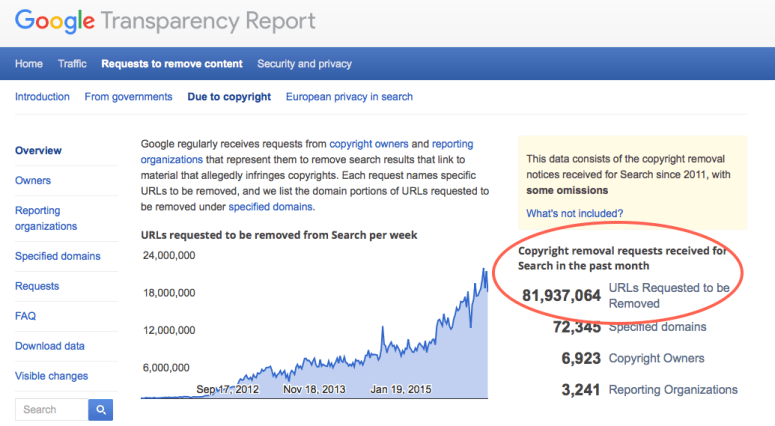
Note the fear-inducing reference to “robots”–“robots” must refer to the tools that Google itself gives to big companies to automate sending DMCA notices to Google for infringing links.  So by definition, “corporations” use Google’s own “robots” at Google’s request.  80 million infringing links this month alone!  (And remember, the Google “transparency report” does not include DMCA notices sent to YouTube, Blogger or any other Google property, it just covers Google search.)  EEP! ROBOTS!  DON’T BREAK THE INTERNET!

Google DMCA 3-31-16

This letter is exceptionally misleading because Google doesn’t allow independent artists to use these tools.  That means even the handful of artists who can monitor Google search 24/7 have to send manual notices.  So what the astroturf group is really complaining about is that EVERYONE should have to send notices manually which would increase the amount of time that Google has to profit from links to infringing content by data profiling or advertising sold on pirate sites.

This webform did not even verify if those sending the automated letter to the US Copyright Office were actually US Residents or machines…or made an intelligible comment on the questions the Copyright Office asked for public comment.  So, we had some fun with it, see bel0w.

David Newhoff at The Illusion Of More has an excellent piece looking much deeper at how these corporations and their funded organizations are working aggressively to take away the protections granted to individual creators in copyright.

Read it here, at the link below.

Astroturf Organizations Typically Hysterical on DMCA | The Illusion Of More


fightforthefuture....png

Call To Action! DMCA Notice and Takedown Comments to Copyright Office Deadline April 1st

We’ve all experienced the astonishing absurdity of how YouTube and other New Boss tech companies interpret the DMCA notice and takedown debacle.  (Or as my friend Rick Carnes would say, “notice and shakedown.”)  What was once a safety valve to offer reasonable protection to ISPs from users sending infringing files by email has turned into a “catch me if you can” business model based on misuse of the very same law by people who know exactly what they are doing.  No independent artist can afford to monitor the Internet–or even YouTube–24/7, but that’s what the New Boss wants everyone to believe the law requires.

How can Congress ever have intended that one company–Google–receive over 80 MILLION DMCA notices in ONE MONTH and FOR SEARCH ONLY (not including YouTube, Blogger or any other Google property)?

Google DMCA 3-31-16


The Copyright Office is giving us a chance to tell them what we think about the DMCA and how it’s working out for us.  Most of the time these comments only get filed by big companies, but you have the chance to be heard on this issue, too.  You can email your comments using the comment form at https://www.regulations.gov/#!submitComment;D=COLC-2015-0013-0002 or if that doesn’t work email to Karyn Temple Claggett, Director of the Office of Policy and International Affairs and Associate Register of Copyrights, by email at kacl@loc.gov.  (Don’t get confused by the “Extension of Comment Period” language you’ll see on the link, this is the correct one.)

I will be filing comments, too, and will post when I file them.

THE DEADLINE IS APRIL 1 AT 11:59 PM ET.  That’s TOMORROW NIGHT!

We all really appreciate the way Trichordist readers have stepped up on these public comments in the past, and it’s really vitally important that they hear from somebody besides the lobbyists and the New Boss.  Thank you guys so much for all you do to support artist rights!

What’s Next for Pandora?

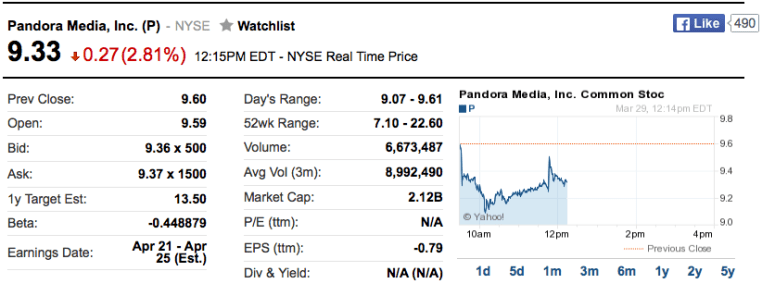
It was just announced that Pandora founder Tim Westergren has returned as CEO. The markets did not like the news, punishing Pandora’s stock, but Chris Castle asks a fair question: Should we give Westergren a chance to undo past misdeeds that Pandora made under different CEOs?

Music Tech Solutions

Tim Westergren has returned to Pandora as the company’s CEO.  He’s got a golden opportunity to change how Pandora is viewed–we all want Pandora to succeed, but there’s little support for the path the company has been on for years now.  The 42% decline in Pandora’s stock price over the last 12 months hasn’t been helped by the company’s rocky relationship with the vendors of their main product: music.

pandora stock price

With some analysts giving Pandora a fair value stock price of $7, here’s a little unsolicited advice.

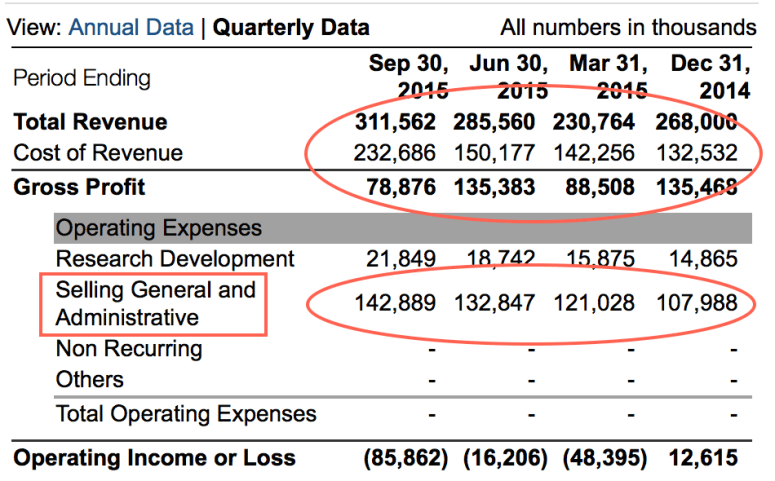
Overhead:  Pandora’s overhead is out of control.  They will blame it on royalties, but a closer look shows that the company has a problem with its operating costs that they would like you to ignore (hence the $7 fair value price target).

Pandora 2015 YOYIntegrity:  Westergren arrives at Pandora in a much different point in the zeitgeist than when he founded the company in terms…
View original post 529 more words

The DMCA Still is Not An Alibi: How is Google Search Like the Ford Pinto?

As YouTube founder Steve Chen said of infringing CNN videos on YouTube: “[I] really don’t see what will happen. what? someone from cnn sees it? he happens to be someone with power? he happens to want to take it down right away. he gets in touch with cnn legal. 2 weeks later, we get a cease & desist [takedown] letter. we take the video down.”

Music Technology Policy

The Pinto Gap

Google frequently defends what I would call the “Pinto Gap”–Google’s business practice named after the notorious Ford Pinto model with the exploding gas tank.  Why the “Pinto Gap”?  Because one would have to believe that Google has determined, just like Ford, that the cost benefit of programming their search algorithm to play whack a mole with artists profits them more than “doing the right thing.”  One day we may find out if there is a “Pinto memo” at Google.

google motto

Recall that the reason Ford was nailed so badly for products liability on the Pinto was that it turns out that Ford knew that the Pinto gas tank was dangerous and would probably explode.  Ford made a horrendously cold-blooded decision to put the Pinto into commerce anyway.  Why?  Because during the gap between the time that Ford put the car into commerce and the…

View original post 1,447 more words

The Truth About Vinyl And Streaming – And It Is Not Pretty…

More talk about vinyl and streaming, here’s more clarity…

The Trichordist

vinylcu

There’s a romanticism about vinyl, and we share that enthusiasm of the format for obvious reasons. However it should be noted that the romanticism that surrounds vinyl, is largely that- romanticism. Below we’ve assembled a number of recent editorials and reports about the state of vinyl production to shed some light and much needed perspective on this subject.

There several important take-a-ways from our friends who are on the front lines of vinyl production that are also noted in the reports below.

1) Vinyl revenues are grossing more than free streaming receivables. This sounds impressive at first but said another way it means that free streaming is just not generating a lot of revenue in the aggregate of the total business (not a surprise, free streaming is a big problem).

Second, and more sadly is the fact that vinyl production is very expensive and miscalculations on selecting a title or…

View original post 904 more words

Register of Copyrights: Please Support Take Down-Stay Down | Nova.Edu

“Why can’t everyone see that section 512 is an abysmal failure? If take down worked, the number of notices should go down. Instead the number of takedown notices sent increases exponentially every year. This is an enormous waste of time and resources for everyone involved. “

READ THE FULL POST AT NOVA.EDU:
http://copyright.nova.edu/take-down-stay-down/


Safe Harbor Not Loophole: Five Things We Could Do Right Now to Make the DMCA Notice and Takedown Work Better


DMCA “Take Down and Stay Down” Is The Logical Solution to a Flawed Loophole [VIDEO]