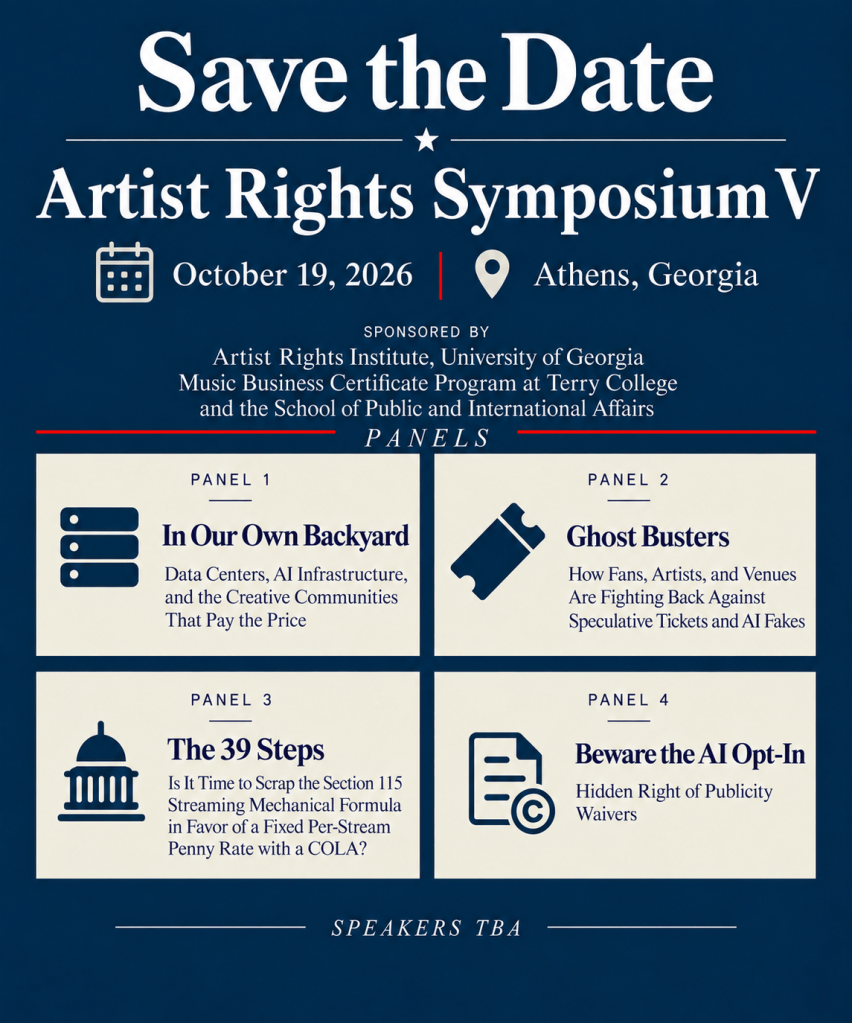
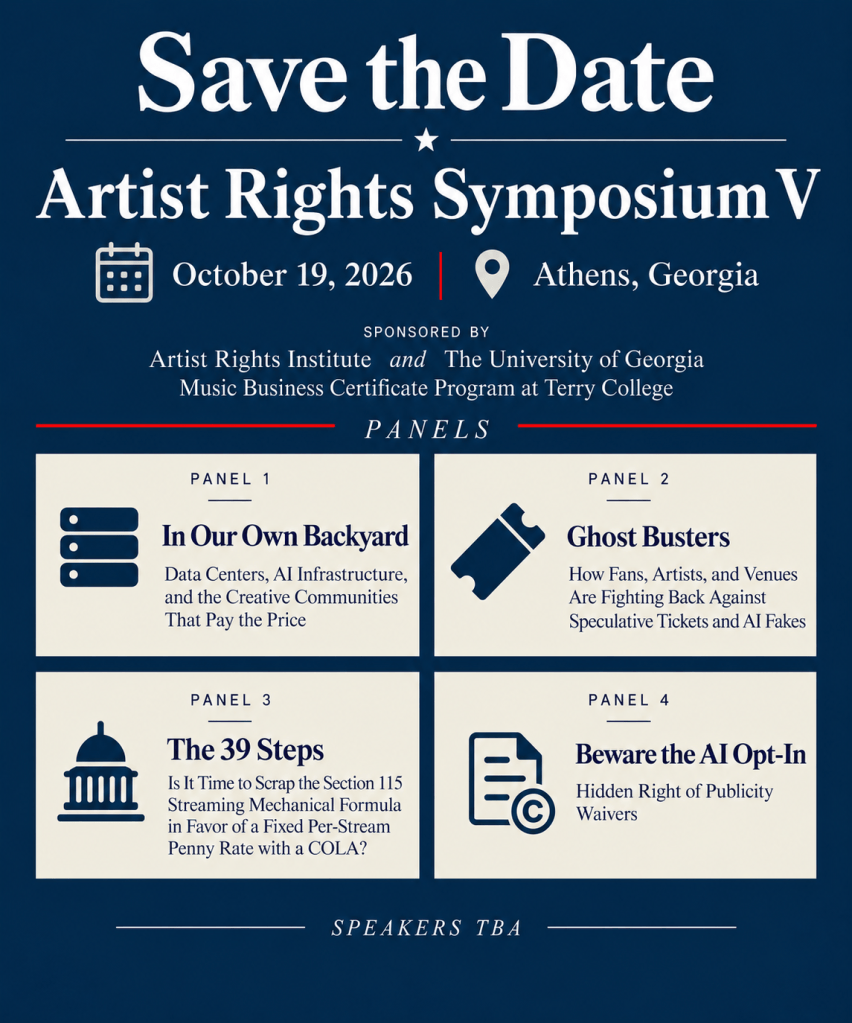
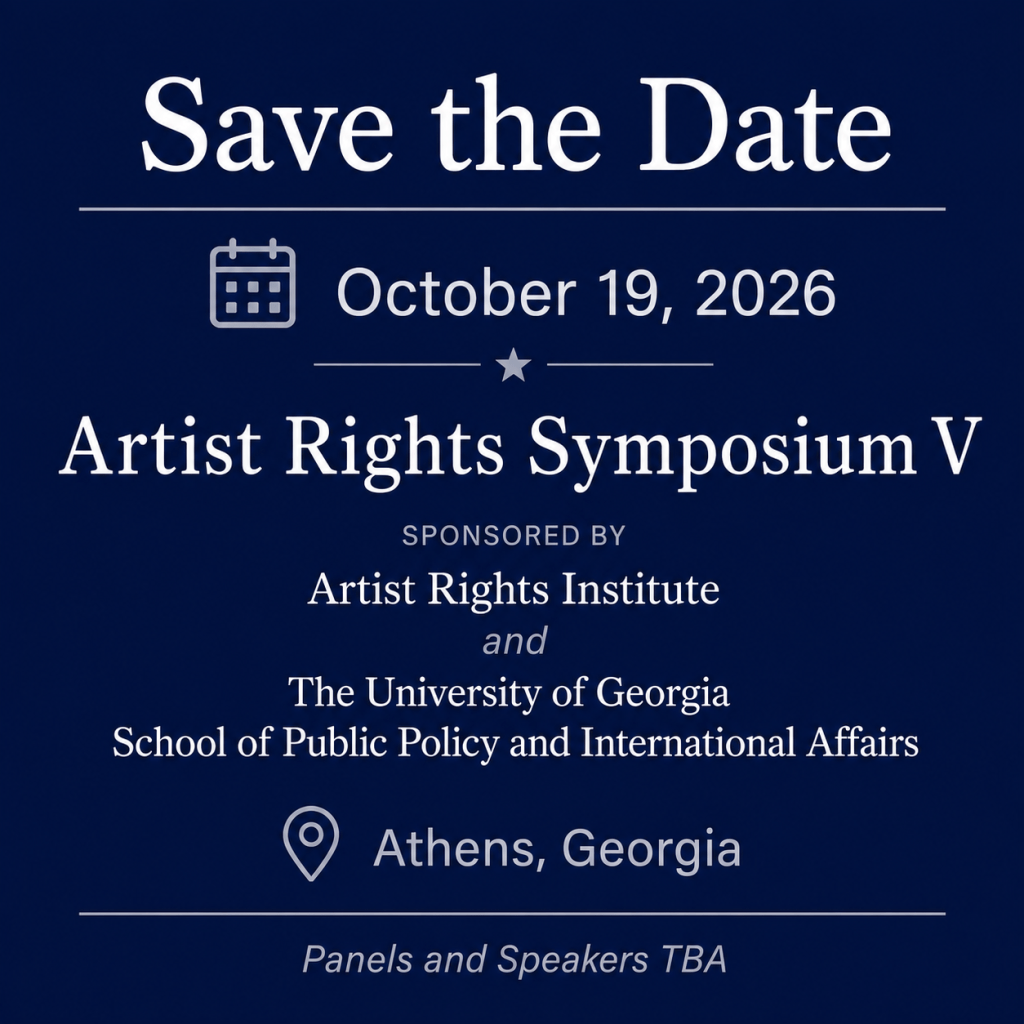
We’re pleased to announce that the University of Georgia’s School of Public and International Affairs has joined the Artist Rights Institute and UGA’s Music Business Certificate Program at Terry College as a sponsor of the fifth annual Artist Rights Symposium, October 19, 2026, in Athens, Georgia.
The addition of SPIA is especially timely. This year’s Symposium reaches beyond traditional music-industry issues to examine the broader public-policy consequences of artificial intelligence—from the massive data centers, energy infrastructure, and local communities supporting AI development to the legal and policy questions surrounding artist consent, identity, compensation, and the use of creative work.
Bringing together music business, law, public policy, artists, advocates, and policymakers is exactly what this moment requires.
Artist Rights Symposium V October 19, 2026 — Athens, Georgia Speakers and additional program details coming soon.
The Artist Rights Institute and the University of Georgia School of Public Policy and International Affairs are pleased to announce Artist Rights Symposium V, to be held October 19, 2026, in Athens, Georgia at the School of Public Policy.
The fifth annual symposium will bring together artists, songwriters, musicians, academics, lawyers, policymakers, and other voices for a day of candid discussion about the rapidly changing legal, technological, and economic issues affecting creators.
The symposium will be moderated by David Lowery, Principal Lecturer in the Music Business Program at the University of Georgia’s Terry College of Business and co-founder of the Artist Rights Institute. As in previous years, the emphasis will be on hearing directly from the people whose livelihoods and creative work are affected by these changes.
Panels and speakers will be announced soon.
For now, save the date: October 19, 2026 — Athens, Georgia.
Save the Date! September 18 Artist Rights Roundtable in Washington produced by Artist Rights Institute/American University Kogod Business & Entertainment Program. Details at this link!
The Artist Rights Watch podcast returns for another season! First episode is Tim Kappel discussing the Vetter v. Resnik landmark copyright termination case. Follow us wherever you get your podcasts.
New Survey for Songwriters: We are surveying songwriters about whether they want to form a certified union. Please fill out our short Survey Monkey confidential survey here! Thanks!
Big Tech’s “Text and Data Mining” Lobbying Head Fake
George York of Digital Creators Coalition and RIAA gives an excellent overview of international AI Text and Data Mining (TDM) loopholes and how to plug them. Nov. 20, 2024 Artist Rights Symposium, Washington, DC. Watch the Symposium playlist here.
The Artist Rights Institute filed a comment in the UK Intellectual Property Office’s consultation on Copyright and AI that we drafted. The Trichordist will be posting excerpts from that comment from time to time.
Confounding culture with data to confuse both the public and lawmakers requires a vulpine lust that we haven’t seen since the breathless Dot Bomb assault on both copyright and the public financial markets.
We strongly disagree that all the world’s culture can be squeezed through the keyhole of “data” to be “mined” as a matter of legal definitions. In fact, a recent study by leading European scholars have found that data mining exceptions were never intended to excuse copyright infringement:
Generative AI is transforming creative fields by rapidly producing texts, images, music, and videos. These AI creations often seem as impressive as human-made works but require extensive training on vast amounts of data, much of which are copyright protected. This dependency on copyrighted material has sparked legal debates, as AI training involves “copying” and “reproducing” these works, actions that could potentially infringe on copyrights. In defense, AI proponents in the United States invoke “fair use” under Section 107 of the [US] Copyright Act [a losing argument in the one reported case on point[1]], while in Europe, they cite Article 4(1) of the 2019 DSM Directive, which allows certain uses of copyrighted works for “text and data mining.”
This study challenges the prevailing European legal stance, presenting several arguments:
1. The exception for text and data mining should not apply to generative AI training because the technologies differ fundamentally – one processes semantic information only, while the other also extracts syntactic information.
2. There is no suitable copyright exception or limitation to justify the massive infringements occurring during the training of generative AI. This concerns the copying of protected works during data collection, the full or partial replication inside the AI model, and the reproduction of works from the training data initiated by the end-users of AI systems like ChatGPT….[2]
Moreover, the existing text and data mining exception in European law was never intended to address AI scraping and training:
Axel Voss, a German centre-right member of the European parliament, who played a key role in writing the EU’s 2019 copyright directive, said that law was not conceived to deal with generative AI models: systems that can generate text, images or music with a simple text prompt.[3]
Confounding culture with data to confuse both the public and lawmakers requires a vulpine lust that we haven’t seen since the breathless Dot Bomb assault on both copyright and the public financial markets. This lust for data, control and money will drive lobbyists and Big Tech’s amen corner to seek copyright exceptions under the banner of “innovation.” Any country that appeases AI platforms in the hope of cashing in on tech at the expense of culture will be appeasing their way towards an inevitable race to the bottom. More countries can be predictably expected to offer ever more accommodating terms in the face of Silicon Valley’s army of lobbyists who mean to engage in a lightning strike across the world. The fight for the survival of culture is on. The fight for survival of humanity may literally be the next one up.
We are far beyond any reasonable definition of “text and data mining.” What we can expect is for Big Tech to seek to distract both creators and lawmakers with inapt legal diversions such as trying to pretend that snarfing down all with world’s creations is mere “text and data mining”. The ensuing delay will allow AI platforms to enlarge their training databases, raise more money, and further the AI narrative as they profit from the delay and capital formation.
[1]Thomson-Reuters Enterprise Centre GMBH v. Ross Intelligence, Inc., (Case No. 1:20-cv-00613 U.S.D.C. Del. Feb. 11, 2025) (Memorandum Opinion, Doc. 770 rejecting fair use asserted by defendant AI platform) available at https://storage.courtlistener.com/recap/gov.uscourts.ded.72109/gov.uscourts.ded.72109.770.0.pdf (“[The AI platform]’s use is not transformative because it does not have a ‘further purpose or different character’ from [the copyright owner]’s [citations omitted]…I consider the “likely effect [of the AI platform’s copying]”….The original market is obvious: legal-research platforms. And at least one potential derivative market is also obvious: data to train legal AIs…..Copyrights encourage people to develop things that help society, like [the copyright owner’s] good legal-research tools. Their builders earn the right to be paid accordingly.” Id. at 19-23). See also Kevin Madigan, First of Its Kind Decision Finds AI Training Is Not Fair Use, Copyright Alliance (Feb. 12, 2025) available at https://copyrightalliance.org/ai-training-not-fair-use/ (discussion of AI platform’s landmark loss on fair use defense).
[2] Professor Tim W. Dornis and Professor Sebastian Stober, Copyright Law and Generative AI Training – Technological and Legal Foundations, Recht und Digitalisierung/Digitization and the Law (Dec. 20, 2024)(Abstract) available at https://papers.ssrn.com/sol3/papers.cfm?abstract_id=4946214.
More than 1,000 musicians have come together to release Is This What You Want?, an album protesting the UK government’s proposed changes to copyright law.
In late 2024, the UK government proposed changing copyright law to allow artificial intelligence companies to build their products using other people’s copyrighted work – music, artworks, text, and more – without a licence.
The musicians on this album came together to protest this. The album consists of recordings of empty studios and performance spaces, representing the impact we expect the government’s proposals would have on musicians’ livelihoods.
All profits from the album are being donated to the charity Help Musicians.
Yes, it’s kismet in the legislature–the sketchy ticket resellers are redoubling their efforts to normalize “speculative tickets.” They have found a willing partner in gaslighting with an organization called “ALEC”.
The American Legislative Exchange Council (hence “ALEC“) is a nonprofit organization that brings together private sector representatives and relatively conservative state legislators to draft (and pass) “model legislation” that pushes a particular narrative. (That private sector representation is led by Netchoice, aka, Big Tech.) Unlike other model legislation with a social benefit like say the Uniform Partnership Act, ALEC’s “model legislation” pushes a particular agenda. Examples would be “stand your ground” gun laws, Voter ID laws, and “right to work” laws.
Netchoice Members (Netchoice leads ALEC’s Private Enterprise Advisory Council)
ALEC’s many successfully-passed “model” laws are intended to be passed by state legislatures as-written. Like Al Capone’s green beer, it ain’t meant to be good it’s meant to be drunk. A cynic–not mentioning the names of any particular cynics–might say that the ALEC strategy is an end-run around federal legislation (like the fake library legislation that was shot down in New York). If ALEC can get a critical mass of states to pass one of their “model bills” as-drafted on any particular subject, then the need for federal legislation on that topic may become more muted. In fact, if federal legislation becomes inevitable, the ALEC model bills then provide guidance for federal legislation, or new federal legislation has to draft around the states that adopt the model bill.
So much for Justice Louis Brandeis’ concept of states as laboratories of democracy (New State Ice Co. v. Liebmann, 285 U.S. 262 (1932)), unless that lab belongs to Dr. Frankenstein. ALEC’s mission claims to promote principles of limited government, free markets, and federalism; I will leave you to decide if it’s more about checkbook federalism.
Ticketing Panel, Artist Rights Symposium 11/20/24, Washington DC L-R: Chris Castle (Artist Rights Institute), Dr. David Lowery (Univ. of Georgia, Terry College of Business), Mala Sharma (Georgia Music Partners), Stephen Parker (National Independent Venue Association), Kevin Erickson (Future of Music Coalition)
Like so many of these bills, ALEC’s Live Event Ticketing Consumer Protection & Reform Act disguises its true objective with a bunch of gaslighting bromides that they evidently believe to be persuasive and then when you’re not looking they slip in the knife. Then when the knife is protruding from your back you discover the true purpose. I think this section of the bill is the true purpose:
This is an odd construct. The model bill starts out by requiring positive behavior of a primary seller (which would be the band on fan club sales or other direct to fan sales). That positive behavior immediately turns to using the ticket purchaser into an enforcer of the values beneficial to the ticket reseller. This is done by forcing a purchaser to be able to resell their ticket without regard to any restrictions placed on reselling by the artist.
And you know that’s the intention because the section also requires there to be no maximum or minimum price. While the model bill doesn’t require any particular restriction on the platforms, it has enough in it that it can look like a consumer protection bill, but what it is really doing and apparently was designed to accomplish is eliminate an artist’s a ability to set prices.
ALEC is serious about violations of the act, including civil penalties. Their model ticketing legislation can be enforced by both the Federal Trade Commission and state attorneys general. Penalties can include fines of up to $15,000 per day of violation and $1,000 per event ticket advertised or sold. One problem with the model bill is that it appropriates jurisdiction already available to federal agencies like the FTC which is already failing to enforce the existing BOTS Act and other property theft laws.
The main targets seem to be Stubhub’s competitors like “Primary Ticket Merchants,” These are the original sellers of event tickets, such as event organizers or venues. “Secondary Ticket Merchants” may also be prosecuted as well as individuals.
We continue to study the proposed model legislation, but I tend to agree with Stephen Parker (NIVA) and Kevin Erickson (Future of Music) on my Artist Rights Institute panel in DC yesterday. The better model bill may be their bill passed in Maryland, recently signed into law by Maryland governor Wes More.
Key differences between Maryland and the ALEC bill I could spot:
Scope of Penalties: The Maryland bill specifies fines for speculative ticket sales, while the ALEC bill includes broader penalties for various violations.
Refund Policies: The Maryland bill explicitly requires refunds for counterfeit tickets, canceled events, or mismatched tickets, whereas the ALEC bill focuses more on transparency and restrictive practices.
Study on Resale Impact: The Maryland bill includes a provision for studying the impact of resale price caps, which is not present in the ALEC bill.
It appears that the Live Event Ticketing Consumer Protection & Reform Act will be introduced at the ALEC meeting on December 5, 2024. This is where ALEC members, including state legislators and private sector representatives, will discuss and vote on the model policy.
“The issue – and challenge – of incomplete metadata is one close to my heart, as I worked for many years dealing with finding solutions to reduce the significant cost that collecting societies incur, trying to find this missing data. This is why I started the Credits Due initiative when I was at Ivors [Academy], to raise awareness of the problem and support industry wide solutions that enable accurate metadata to be attached to recordings at the earliest point in the creation process.
This was how I first encountered [Digital Media Association], who have supported the initiative from the beginning. The supply of recordings with accurate metadata is in the interests of creators, rightsholders and streaming services alike.”
“The previous pre-[Music Modernization Act] approach to licensing musical compositions was not particularly effective before and became entirely unfit when it was overtaken by the speed of adoption of streaming. And to understand why this was the case, let’s step through how the licensing process worked – or didn’t – pre-MMA.”
“To date, DIMA’s members and other streaming services have paid more than $160 million dollars for the operation of the [Mechanical Licensing Collective], including meeting all of the requirements for its setup. And the MLC has now distributed more than $2 billion dollars in revenues collected from the streaming services.
This is a great success. The MMA has given certainty to licensees and rightsholders alike, whether major publishers, independent publishers and songwriters.”
“It is our collective role to ensure the MLC embraces its responsibility – actually, it’s statutory obligation – to serve its three key stakeholders – songwriters, publishers, and streaming services.”
Let me be clear – any efforts to unravel the MMA will not improve licensing or improve the growth and success of the music industry. Rather, such moves will lead to an upheaval of the whole system and likely return to the problems of the past.”
You must be logged in to post a comment.