It’s been exactly two years since I caused a furor by posting “Meet The New Boss, Worse Than The Old Boss?” I think it’s worth reading if you have never read it. If you have read it you might want to re-read it and ask: “what has changed and what has stayed the same?”
My opinon.
What has changed? Hundreds of artists have spoken up demanding that the digital “New Boss” pay us fair royalties. Artists were able to defeat the misleadingly named “Internet Radio Fairness Act.” Artists are no long afraid of speaking out. There is no stigma. Further there is a new grassroots movement demanding the “Old Boss” terrestrial radio pay performer royalties. That’s a first. See here http://irespectmusic.org/
What hasn’t changed? Well torrenting and cyberlockers keep piracy going strong. Major brands and ad exchanges run by the likes of Yahoo and Google still profit by serving ads onto illegal sites. Digital royalties are not getting better. Judges instead of markets set prices for songwriters. Pandora dropped IRFA but now they are reportedly not paying artist royalties on pre-1972 master recordings!
The most disturbing development is that the old line record labels seem to have drank the koolaid and joined forces with the streaming services. I don’t know if they really believe the magic-unicorn based math or if “golden parachutes” are somehow involved. But I fear we are about to make the entire business smaller. A lot smaller. I hope I’m wrong. I fear that we are returning to an era like the 1950s where artists are paid a pittance if at all. If the business gets even smaller there is no hope for artists.
I was like all of you. I believed in the promise of the Internet to liberate, empower and even enrich artists. I still do but I’m less sure of it than I once was. I come here because I want to start a dialogue. I feel that what we artists were promised has not really panned out. Yes in many ways we have more freedom. Artistically this is certainly true. But the music business never transformed into the vibrant marketplace where small stakeholders could compete with multinational conglomerates on an even playing field.
In the last few years it’s become apparent the music business, which was once dominated by six large and powerful music conglomerates, MTV, Clear Channel and a handful of other companies, is now dominated by a smaller set of larger even more powerful tech conglomerates. And their hold on the business seems to be getting stronger.
On one hand it doesn’t bother me because the “new boss” doesn’t really tell me what kind of songs to write or who should mix my record. But on the other hand I’m a little disturbed at how dependent I am on these tech behemoths to pursue my craft. In fact it is nigh impossible for me to pursue my craft without enriching Apple, Amazon, Facebook and Google. Further the new boss through it’s surrogates like Electronic Frontier Foundation seems to be waging a cynical PR campaign that equates the unauthorized use of other people’s property (artist’s songs) with freedom. A sort of Cyber –Bolshevik campaign of mass collectivization for the good of the state…er .. I mean Internet. I say cynical because when it comes to their intellectual property, software patents for instance, these same companies fight tooth and nail.
The other problem? I’ve been expecting for years now to see aggregate revenue flowing to artist increase. Disintermediation promised us this. It hasn’t happened. Everywhere I look artists seem to be working more for less money. And every time I come across aggregate data that is positive it turns out to have a black cloud inside. Example: Touring revenues up since 1999. Because more bands are touring, staying on the road longer and playing for fewer people. Surely you all can see Malthusian trajectory?
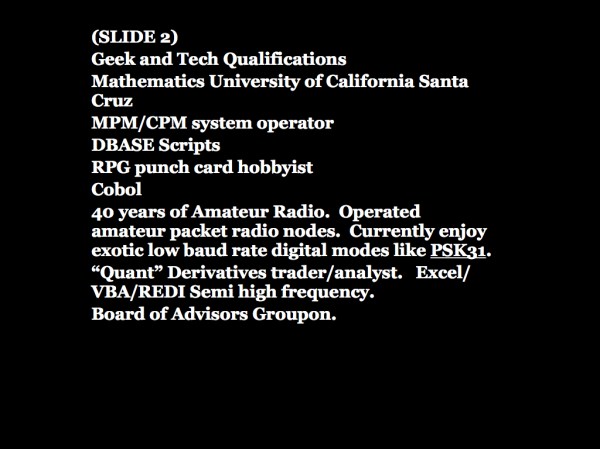
I realize that some of you may not know much about me or even who I am. I like to think that I am uniquely qualified as an artist, entrepreneur and geek. I was trained as a mathematician. My first job after I graduated involved being the systems operator for an MPM OS system and I wrote a lot of DBASE IV scripts. I had a fascination with the old RPG punch card programming language. I am deeply involved in the digital amateur radio world. You can sometimes find me operating PSK31 on 20 meters. I spent some time in Chicago near the CME. I worked as a “Quant” doing some semi high frequency trading. While there I became involved with a company called www.thepoint.com which evolved into www.groupon.com.
I can out geek most of you.
Musicians are constantly derided by the Digerati. It’s usually after someone like myself suggest that if other people are profiting from distributing an artist’s work (Kim Dotcom, Mediafire, Megavideo, Mp3tunes,) they should share some of their proceeds with the artists. At this point the Digerati then proceed to call us “dinosaurs”, “know nothings” or worse. Suddenly your Facebook page is filled with angry comments from their followers that seem to all be unsuccessful Canadian hip hop artists who proclaim:
“We are gonna turn you into Lars Ulrich and bitch your band sucks anyway”.
(At the risk of getting the Canadian non-lethal equivalent of a “cap in my ass” I have to say: I am so scared!)
The most virulent of these folks are almost always unsuccessful musicians. It fascinates me. I can only surmise that part of their anger seems tied to the hatred of the record companies that rejected them. Successful even marginally successful musicians are often viewed as some kind of traitors. A special kind of hatred is reserved for these apostates. The file sharing/ cyber locker industry has figured this out and purposely stokes stokes them with a faux populism. I would say it’s juvenile but it’s really more medieval. That’s why I call them Freehadists. People like me are actually looking out for these young musician’s rights. I am trying to keep the new boss from screwing them. They dont’ realize they are doing the work of The Man. But I digress.
Despite the tech lobby’s portrayal of musician as luddites or doddering old hippie, musicians, especially independent musicians are often the early adopters of technology. We are always a couple years ahead of the “straight” business world when it comes to technology. As an example we perfected “social marketing” before it even had a name. We were outsourcing and insourcing services for our highly flexible virtual companies when Windows 3.0 was state of the art.
When it comes to the web, we not only understand the consumer side of the Internet we understand the producer/supplier side as well. And like any producer or supplier we want to be compensated. The reason the Digerati are so fixated on “what the consumer wants” is simply because most of them have only experienced the web as consumers.
“The consumer wants music to be free” they shout as they pound their tiny fists on their Skovby tables.
The consumer also wants cars to be free. And beer. Especially beer. But any market involves a buyer and a seller. A consumer and a producer. If GM can’t afford to give away their product for free it ain’t gonna happen. No matter what the consumer wants. (See my note on “digeridiots”)
Often overlooked by Digerati, is the glaringly obvious fact that musicians and bands have long been a part of the new economy. We’ve been a web-enabled business since 1992. We’ve been a web-based business since Napster. Virtually every interaction that an artist and a fan have is web based. Even live concerts are web-enabled. The artist and the fan communicate about the upcoming concert through Twitter, Facebook events or traditional email. Recording has long been web enabled. We might all get together in the same spot to record basic tracks, but oftentimes overdubs and even mixing happens remotely, exchanging files and notes via the web.
So please forgive us if we roll our eyes at the Digerati who tell us we need to “embrace the web”, “work the new digital ecosystem” or come up with a “new model”. It’s a little like your great aunt seeing you at thanksgiving dinner and telling you something like:
“You should make some T-shirts for your band and sell them on tour”.
You politely smile and try not to roll your eyes.
Actually that’s the number one “new model” that the Digerati suggest. Sell T-shirts at your shows to make money! This despite the fact it’s not new. Bands have been selling t-shirts at live shows since the early 1970s. Recording albums to sell a few t-shirts is a terrible way to make money. Thanks for the advice but no thanks. Plus t-shirts are just as bootlegable as music.
Everyone knows there a second half to his quote? Right? Cause I usually only see the first sentence bandied about in technology circles.
Sound recordings are information. Sound recordings are not cheap to make. The technology is not the expensive part of making songs and sound recordings. It hasn’t been since the late 1980s. Many in the tech community blindly assume that recording budgets have gone down because the technology is less expensive and provides greater productivity. With absolutely no facts to back up their argument I often hear:
“Well artists are making less money but recording costs are lower, so the artists are doing okay”.
In other words technology has lowered your revenues in the form of unlicensed file-sharing on an industrial scale but that’s okay because Digidesign (the makers of Pro-Tools™) has given back some cost savings. As if Kim Dotcom and Digidesign share the same bank account. These people believe in technology like it is a religion. The lord Technology Industry taketh, and The Lord Technology Industry giveth back.
The data I have from recording studios says something different. Recording budgets are lower because artists spend dramatically less time recording. They just don’t have the money.
Recording budgets didn’t start shrinking until after the advent of file-sharing. 2002 ish. While most of the improvements in technology and gains in productivity occurred in the early 1990s. By 1996 the home studio/pro studio production chain was firmly in place. Pro studios used for “tracking” and “mixing.” Home or project studios used for overdubs and editing. If lower recording budgets were caused by improvements in technology they should have started shrinking 10 years earlier.
Sound recordings are very labor intensive. If you want to make good ones you are relying on highly skilled labor. The cost of sound recordings is largely dependent on labor costs. Technological advances have little effect on recording cost.
This is the main problem with the technologists contention recordings should be free. They seem to think that the only people who work on recordings are the touring performers themselves. Artists still have to pay for that highly skilled labor.
Is the mix engineer gonna follow us around on tour hawking HIS T-shirts to the audience?
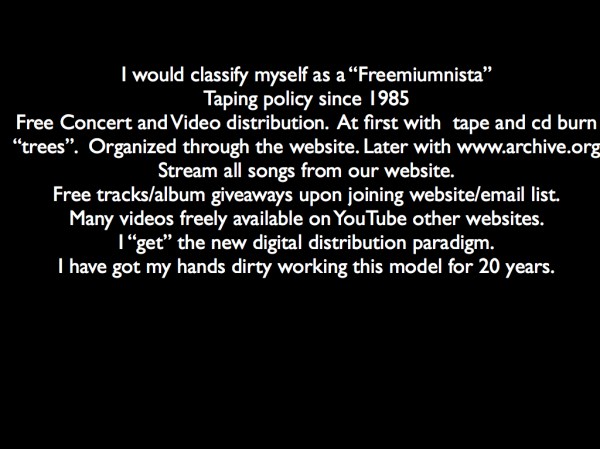
Nevertheless, I’m what you might call a “Freemiumnista”. I was a Freemiumnista before there was an Internet. I get that not all interactions between fans and artists should be monetized. I get that you can give away something and make more money in the long run. Virtually every live show we’ve ever played is available free on archive.org. Even before the internet we’ve encouraged and organized tape trees and later CD burn trees for distributing our live shows And we spend a lot of time trying to get people to buy our studio albums as well.
Unlike a lot of the Digerati I have walked the walk. I still do.
I’ve embraced many of the things that those on the tech side of the music business want musicians to embrace. But what many of you forget is that IT IS MY CHOICE whether I choose to give away my songs or sell them. IT IS MY CHOICE how and where to distribute my songs. IT IS MY CHOICE to decide which websites get to exploit my songs. Like it or not, the right to control one’s intellectual property (like songs) is a constitutional right. It is also part of every international human rights agreement. Technology company funded blogs that think there should be no song copyrights are actually advocating violating my constitutional and human rights!
Many in the digital music industry rightfully condemn the past exploitation of artists by record labels. But at the same time they seem to be doing the same thing. Trying to bully artists into giving up their rights so that companies like MegaUpload or YouTube can make money is the same thing.
With exploitative record contracts The Old Boss tried to take your songs a dozen at a time and pay you pennies. The New Boss wants to take ALL of your songs, past present and future and pay you nothing.
I’ll make technologists a deal, I’ll give up my song copyrights if you give up your software patents. Software patents are even less unique than your typical song. So this should be easy right?
Talk the Talk. Walk the Walk.
slide 4
Bullshit Hippy Capitalism.
When Napster and P2P came along honestly I wasn’t pleased. At best I was ambivalent. I thought that we’d lose sales to large scale sharing but through more efficient distribution systems and disintermediation we artists would net more. So like many other artists I embraced the new paradigm and waited for the flow of revenue to the artists to increase. It never did. In fact everywhere I look the trend seemed to be negative. Less money for touring. Less money for recording. Less money for promotion and publicity. The old days of the evil record labels started to seem less bad. It started to seem downright rosy.
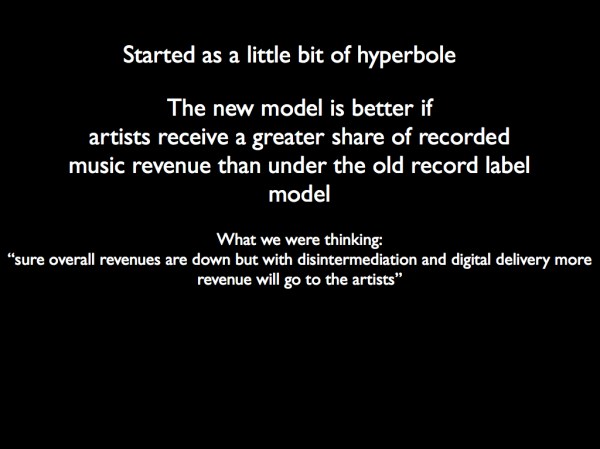
So this talk I’m giving grew out of this bit of hyperbole:
Was the old record label system better?
I mean it didn’t seem like the artists were literally starving and living in their vans like now? I mean even the independent bands seemed able to stay in a hotel every once in a while and being a “Freegan” was a lifestyle choice, not a necessity.
Sadly I think the answer turns out to be yes. Things are worse. This was not really what I was expecting. I’d be very happy to be proved wrong. I mean it’s hard for me to sing the praises of the major labels. I’ve been in legal disputes with two of the three remaining major labels. But sadly I think I’m right. And the reason is quite unexpected. It’s seems the Bad Old Major Record Labels “accidentally” shared too much revenue and capital through their system of advances. Also the labels “accidentally” assumed most of the risk. This is contrasted with the new digital distribution system where some of the biggest players assume almost no risk and share zero capital.
I can see Russia from my house. No really I can.
To be clear, when I’m talking about how things are now, I’m not talking about my band and my friend’s bands. I’ve owned a studio complex for 18 years. We’ve recorded everything from hobbyists to Lamb of God. High school punk rockers to octogenarian blues singers. My wife is a concert promoter of some note. She probably books over 300 artists a year. We share an office and from where I write this, I feel like I have a comprehensive view of the music scene in the Southeastern US, if not the entire United States. We live in a city that has one of the highest concentrations of musicians outside of Nashville and Austin.
I generally know what artists are grossing I also have a pretty good idea of what they are netting. If a 4 piece band shows up at the 40 watt club with 2 crew members, beat up old van and they sell 200 tickets? They are probably making about 150 bucks a day each. If a band shows up at my wife’s Atlanta theatre with 2 buses, a truck 10 crew members and an 8 piece band? Well I can tell you they need to sell it out or they (or the promoter) are losing money. Likewise having detailed knowledge of different artists recording budgets and schedules through my studios tells me a lot about how much these artists are expecting to make from sales and touring.
Artists have seen their most important assets collectivized by file-sharing. They no long control the distribution and exploitation of these assets. If this were happening to practically any other group of Americans there would be mass outrage and civil unrest. Other than Ted Nugent and John Popper most musicians are not heavily armed. Hence the lack of armed standoffs.
Without the ability to effectively and fairly exploit their sound recordings the vast middle and lower class, the 99% of the music business has been impoverished.
* There have been a couple serious arguments that if artists received 0.3 – 0.9 cents a song each stream this would be a “sustainable” amount. “All you can eat streaming” services would be able to charge a reasonable rate to the consumer and it would stabilize recorded music revenues or even lift them a little. Also the Spotify question deserves it’s own post cause I’m not sure if artists getting too little money is necessarily Spotify’s fault.
Spock.
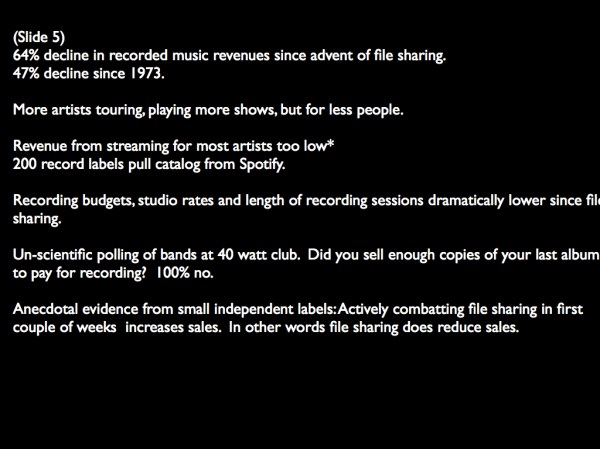
So this is the data I am looking at. It’s all aggregate and most of it is hard data. Those who argue things are better for the artist now usually cite anecdotal cases as evidence, cook the books by excluding data or simply argue that there is no conclusive evidence file sharing has had any effect on recorded music revenues. In other words it’s an unproven theory like global warming, evolution and the roundness of the earth. It’s just a coincidence recorded music revenues dropped 64% since the advent of file sharing.
I think the recording studio data is really important. This is an expense that is common to the independent artist and the label artist (label artists pay for recording out of “their” advance money). Further they can roll in revenue from live performance and other sources into the recording budgets. So you get an expression of the artists entire revenue outlook when you look at the recording process. The fact that artists are spending much less TIME recording can only mean they have less money or expect to make less money. When hundreds of artists of all kinds do this simultaneously it’s hard to argue that artists are making more money.
Improved technology is not the explanation. Technology may have produced some productivity gains, but not in the time consuming tasks of getting sounds, composition and arrangement. Many people who haven’t worked in a studio don’t realize how long it takes just to position microphones and instruments in a room to capture the sounds right. And every drumset, studio, microphone piano, guitar amp and player is a little different. There are no shortcuts.
No matter how good the recording engineer, he/she can’t make the drummer figure out the right beat for the song, what words the singer should sing or the melody of the guitar solo. No, the only explanation for why artists are spending much less time recording is the obvious one. Occam’s razor. Every other explanation adds assumptions.
I’m With Stupid.
“But wait a minute, I keep reading stuff on the internet that says artists are doing much better now? Why do so many people think artists are doing better?”
Let me give you an amusing answer and a serious answer.
The internet is making us stupider. You can make a strong mathematical argument to this effect. The internet is an entertainment medium. It propagates what is entertaining. The internet does a much better job of propagating the wacko-tin-foil-hat way-out-in- the-long-tail untruths than it does propagating the sober accepted scientific facts that live in the head of the curve.
Wacko-tin-foil-hat is way more entertaining especially if it claims to be true. I’m not knocking it cause the entire Camper Van Beethoven oeuvre is based on these kinds of untruths. It’s much more exciting to believe that global warming is a hoax, Obama is a secret Muslim born in Kenya or the RIAA is throwing old ladies in jail for singing happy birthday to their grandchildren in YouTube videos.
Here is a chart that a well intention but hopelessly un-informed friend shared on my facebook page.
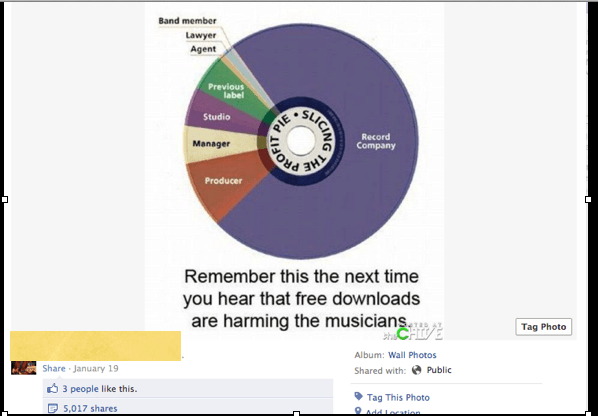
If you look at the chart. It is wildly non factual. Yet it’s been shared over 5 thousand times. How many hundreds of thousands of people have absorbed this as fact!
It includes percentages of revenue from record sales going to the agent. Agents only charge fees on live performance.
Former record label (?!)
The studio. Usually paid a flat fee not a percentage of sales.
The manager slice is too large. 15%-20% of net on recorded music not gross as represented here.
But all you really need to know is that it appears this chart was created by a bass player. There is only one bass player joke:
“What do bass players use for birth control?”
“Their personalities.”
The general consensus in the music business is that The Bass Player is the most aggrieved and dissatisfied member of any ensemble. I have many good friends that are bass players and even they will admit there is some truth to this stereotype.
In actuality a much higher share of revenue goes to most artists under a typical record deal. In the 1990‘s typical deals were 15-25% of wholesale. I’m told some superstars got as much as 50%. Add another 70-95 cents for mandatory and statutory “mechanical royalties”. And your “typical’ artist was getting more than 25% of wholesale on physical CDs.
Further mechanical royalties are paid regardless of whether a record is recouped or not. So “downloading a free album” almost always takes 70-95 cents out of the artists pocket, EVEN IF THE ARTIST IS UNRECOUPED!
This negative view of record deals is the result of what I call “the whiner bias.” You only hear about the “bad” record deals. And believe me there were bad deals out there! but most weren’t. But what artist is gonna go out and say “Man my record label is paying me so much money it’s amazingly fair!!”
Also people often confuse artistic conflicts with monetary conflicts. Record labels definitely sought to control artists creatively. But as Morrissey notes
“you could have said no, if you wanted to, you could have said no”
I remember being told to dress in powdered wigs and 18th century clothing for a video. I said no.
Then there is the matter that most record deals end badly. Record deals end when the artist is no longer selling enough albums to justify the deal. The artist is then dropped which leads to a very public falling out. In fact see my song about Virgin Records “It Ain’t Gonna Suck Itself”.
The more serious reason that people think artists are doing much better post napster? There has been a concerted effort by a certain part of the tech blogosphere to paint a rosy picture of the music industry. They have two techniques:
Totally misleading fake studies. Like the Computer and Communications Industry Association’s “The Sky is Rising” Report. First off this was passed around as independent research when it was actually industry lobby generated propaganda. Among the most outrageous obfuscations and bizarre metrics: Including gaming revenue to help disguise recorded music revenue decline, Not mentioning the drop in live music revenues in North America, and creating the bizarre metric of “number of recorded music transactions” instead of using recorded music revenues. Recorded music transactions are up because people buy individual tracks now instead of 1 album of 10 songs. Get it?
There are 14 academic peer reviewed studies that paint quite a different picture. Yet you rarely see these quoted by the digerati.
Anecdotal Examples. Things like Ok Go. Yep that’s a success story. Louis CK Yep success story. But here’s the thing: the music business is like the casino business. You can’t look at one or two players winnings and tell how the casino or ALL the other players are doing. And like a casino the house lets a few people win but overall the game is rigged.
The Future of Music Coalition or as I like to call them the Fooling our Musicians Coalition seems to be the new innovator in this field. Their recent “case studies” seem to be taking it to the next level. They appear to have combined misleadingly titled studies with meaningless anecdotal information.
Example 1.
Are Musicians benefiting from Music Tech?
http://money.futureofmusic.org/are-musicians-benefiting-from-music-tech-sf-musictech-presentation/
Their conclusion is a resounding yes!
But dig into the paper and you find that by “benefiting” they mean things like “being able to keep in touch with fans through Twitter” and being able to use .Zip files. While the .Zip file was a real game changer for musicians, especially banjo players, most people reading the headline and not reading the article would think they were addressing a much more important question:
“Despite the loss of revenue to file sharing has technology allowed the artists to make up the loss of revenue in other ways?.”
We all know that Twitter allows us to talk to our fans already. This has been established. Why did FOMC need to do a study on this? Anytime I read something put out by the FOMC I find myself asking “what exactly was the point of that?”
Example 2.
http://money.futureofmusic.org/case-study-a/
Their “case study” of the veteran 13 year indie rock musician composer showed this particular artist had increasing revenues 2008-2011 (why not 1999-2011 since the artist’s professional career began in 1999?) However the artists identity was not revealed and FOMC refused to release raw data. Further they refused to publish actual total dollars. Instead they only published relative percentages of revenues and expenses. When pressed on these matters on Digital Music News blog, The FOMC study director refused citing “privacy concerns”. Who’s privacy concerns?
And right here is where my tech industry friends will start to hate me.
I call bullshit. I don’t think the FOMC wanted to release the raw data because as clever bloggers deduced it appears this 13 year veteran artist netted less than 34 thousand dollars in his/her best year! (they interpolated this from the percentage assigned to AF of M dues).
“Famous indie rocker only makes 34k a year !” was not a headline they wanted to see in relation to the study.
Why would self proclaimed artist advocates publish such a study?
I don’t really know. But the FOMC is relentlessly praising technology and the technology industry. Fawning might be more accurate. In fact they spend way more time talking about technology issues than they do issues of interest to musicians. Just look at their blog. It’s as if there were an organization called “Friends of Mary Todd Lincoln” but all they did was talk about the theatre.
“Creators must be able to maximize value from their copyrights in a legitimate digital marketplace. We understand the very real problem of intellectual property infringement and its impact on the music ecosystem. We also share the convictions of those who depend on the internet in practically every aspect of their lives and careers that free expression and entrepreneurship are too important to be undermined by overly-broad policy.
“We look forward to working with our many friends in the music and arts communities, as well as those in the innovation sector to find ways to achieve stronger protections for artists while preserving the dynamics of innovation and expression that are the engines of the internet.”–Casey Rae Hunter Dept Director Future of Music Coalition. Statement on Intellectual Property Bills “Reset”.
“Free expression” and “Innovation” are tech speak for being able to use artists songs, sound recordings, films, photos and books without having to license or share any revenue.
And step back for a second. Look at the absurdity of this statement. How the fuck are indie artists making 34k a year, how the fuck are these artists slowing down and preventing Google and other billion dollar companies from innovating?
And why am I pointing this out instead of an organization that claims to represent artists in the digital world?
Maybe if the “Innovation Sector” spent a little less time “innovating” novel legal arbitrages, trying to intimidate struggling indie film makers by posting her DMCA takedown notices on the appropriately named www.chillingeffects.org or wasting shareholder dollars building driverless cars they wouldn’t need the subsidy that the unlicensed use of our music is providing them. But I digress.
And referring to the tech industry as “The Innovation Sector”? I mean is it possible to be more of a bootlicker? This is why I’ve started calling FOMC The Fooling our Musicians Coaliton. Helping musicians does not seem to be at the top of their agenda.
<Note april 17 2014. If there’s one thing in this that makes me cringe it’s the preveious paragraph. Over the last two years I’ve gotten to know Casey Rae who wrote that statement for FOMC. Although I disagree with many of his stances I believe that he is sincere about trying to find a “third way.” I didn’t need to call him a bootlicker. He’s not. That comment was “over the line.”>
>>>>>>>>>>>>>>>>>>>>>>>>>>>>>>>
Slides 6 and 7
White Riot.
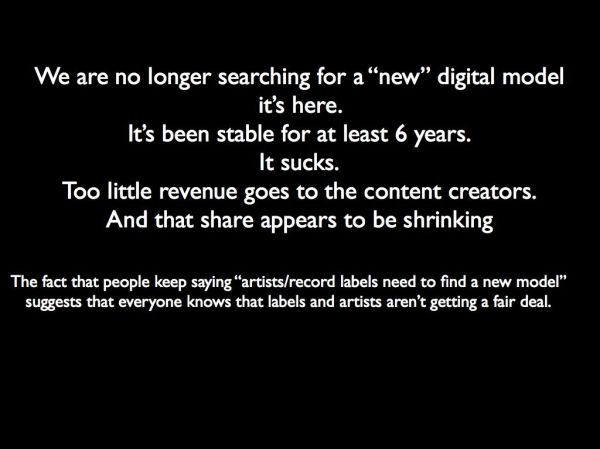
If we’re gonna have a dialogue we need to be honest. Right? So Let’s be honest. The fact that many in the tech community keep saying “artists and record labels need to find a new model” is an admission that the current digital status quo doesn’t work. Right? Not for the artist anyway. As I’ll explain it actually makes a lot of money for a lot of companies.
I ran into Bob Weir at the SF Music Tech Summit. He asked what I’d spoke about. I briefly explained that I had a critique of the new digital model cause my data shows that little revenue is flowing to the artists. He replied “I know we got to make it so artists can make a living”. Now this is significant because I assume Bob was there with his longtime songwriting partner Electronic Frontier Foundation Co-Founder John Perry Barlow. Barlow was probably busy pounding the table downstairs shouting “Intellectual Property is not Property” as he is wont to do. Now I must point out that this is quite a radical position for any American to take. The very success of our nation has been built on IP. Silicon Valley is built on IP. Does Barlow give away his royalties from all those Grateful Dead songs he wrote? But I digress.
++++++++++++++++++++
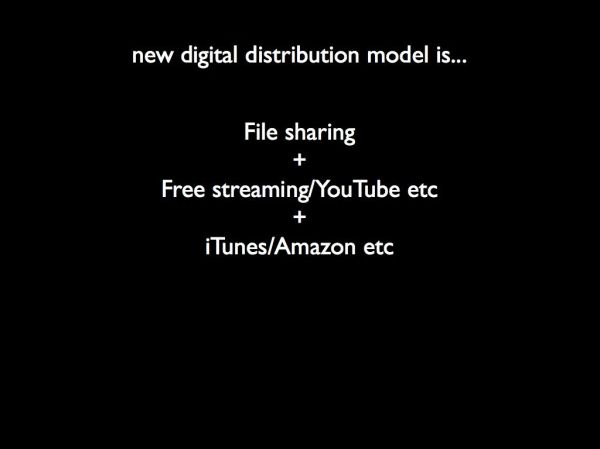
First I need to point out that THERE IS a stable digital music distribution model. We are not still trying to invent it. It’s been here for at least 10 years and has been relatively stable for the last six. It has three legs:
File sharing/Cyber Lockers. MegaUpload, FirstLoad, Pirate Bay, Bittorrent etc etc
Streaming type services. Pandora, Spotify, YouTube, Grooveshark, etc.
Digital Music Stores. iTunes, Amazon Mp3, Rhapsody, Google Play etc
This digital distribution model is firmly entrenched with all of the “distributors” revenue models firmly in place and with the exception of streaming, solidly profitable.
File Sharing.
(Thanks to Ellen Seidler for enlightening me on much of this)
Unlicensed File-sharing sites make money off advertising and upgrades that allow faster downloads of unlicensed materials. As demonstrated in the video “Pop up Pirates” Google and other web advertising companies make money placing ads on these sites as well as making money from people searching for things like “download we are young fun.” Let me quickly demonstrate.
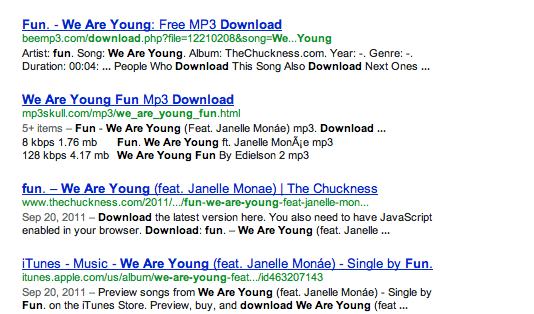
Now note the first two sites are unlicensed. The artist’s own site is #3. iTunes is #4. There is lot’s of data on how important it is to be the the first or second link in search results. This is when the the Digerati suddenly become ignorant of consumer behavior on the web.
“Nah….you really think unlicensed file sharing has any effect on legal sales?”
Let’s click on the Mp3skull link.
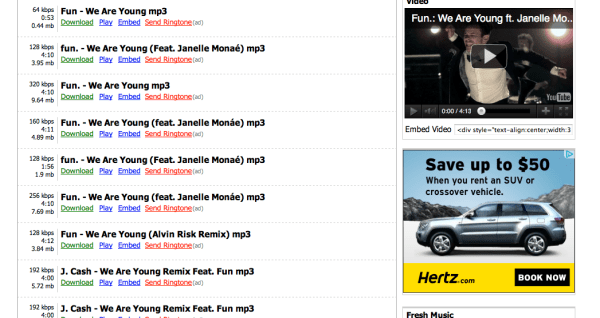
As you can see Mp3skull.com is making money from that Hertz ad. I’m sure it’s not much per view but considering this is the #1 song in the country I’m sure it adds up. And the web advertising company that placed it there is also making money (google?). These are not small companies. And some of these file sharing companies are making big money. Kim Dotcom and MegaUpload anyone?
Now an artist or record label can request that google take these links down. You file a DMCA takedown notice. I sometimes do this. Usually only if an advance copy has leaked and my album is not commercially available yet. But look what happens when you file a DMCA takedown notice with google.
First redo search this time for a 50 Cent track.

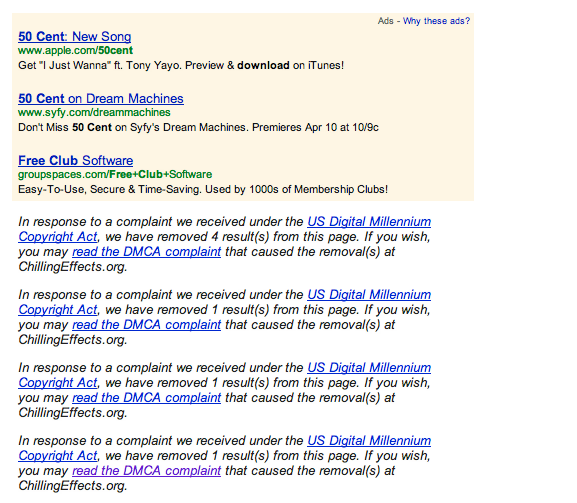
Scroll down a bit and you will find that google has included these strange notices.
In response to a complaint we received under the US Digital Millennium Copyright Act, we have removed 1 result(s) from this page. If you wish you may read the DMCA complaint that caused the removal(s) at ChillingEffects.org
Google removes the links. It’s required to do this by law. But the next part is not required by law.
Google has chosen to proclaim it has removed this link, and it provides you with a link to the complaint on the (ironically named) Chillingeffects.org. But if you click on “read the DMCA complaint” you are taken to www.chillingeffects.org where you get to see the actual complaint. But more importantly you get to see the offending links. The unlicensed download link you wanted is just one extra click away.
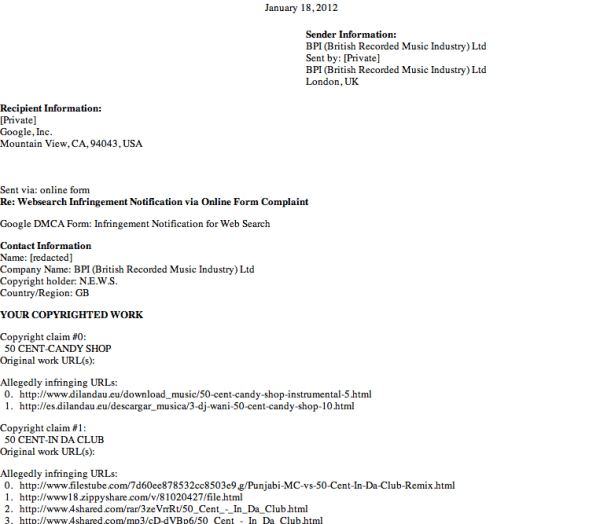
Copy and paste the link into your browser and you can download the file. So really nothing has been accomplished. I can’t imagine I’m the first one to discover this.
(I can’t find a DMCA agent for Chillingeffects.org. If they happen to not have one aren’t they liable for posting these links under DMCA? anybody?)
This is why Google is the giant of the “Innovation Industry” here is one of the most beautifully executed legal kludges I’ve ever seen. Google date rapes the spirit of the law while keeping to the letter.
The new boss thinks we’re stupid.
Apparently they are partially right because Stanford, UC Berkeley, Harvard, University of San Francisco, George Washington School of Law, Santa Clara University of Law and (inexplicably) The University of Maine are all listed as sponsors of this website.
This is from the home page of www.chillingeffects.org
Monitoring the legal climate for internet activity.
A joint project of the Electronic Frontier Foundation and Harvard, Stanford, Berkeley, University of San Francisco, University of Maine, George Washington School of Law, and Santa Clara University School of Law clinics.
There is a bunch of mumbo jumbo on this site about how it’s supposed to help individuals navigate through the DMCA legal thicket. They claim the idea is to combat the Chilling Effects of DMCA on free speech. This is all fine and dandy if the typical individual needing help was some poor innocent teenager who didn’t know it was not legal to share long clips of Hugo on her movie review blog.
But dig into the site. Almost all the activity is Twitter or Google publishing the DMCA takedown notices they receive. Because you must list your legal name and address on these DMCA notices I believe these are published to specifically intimidate those who ask for links to be removed. I mean I certainly think twice before I file one of these notices with Google specifically because there is a good chance Google will put me this on this site.
Good job university eggheads! Congrats on making it easier for the rich, powerful and unaccountable to intimidate the little guy!
If anyone reading this is an alumni of one of these fine institutions I suggest you do as I did and write the President or Dean and ask if they are aware that Google is using them as a fig leaf for a dubious legal workaround? Further the site is actually working to chill free speech.
File-sharing: So how much does this part of the digital ecosystem share with artists?
ZERO. NADA. ZILCH.
Old Boss: pays the artist too little.
New Boss: pays the artist nothing.
So this part of the new digital ecosystem is clearly worse than the old system. Plus at least one player profiting from this system seems to be trying to intimidate the artists into not exercising their rights.
Streaming
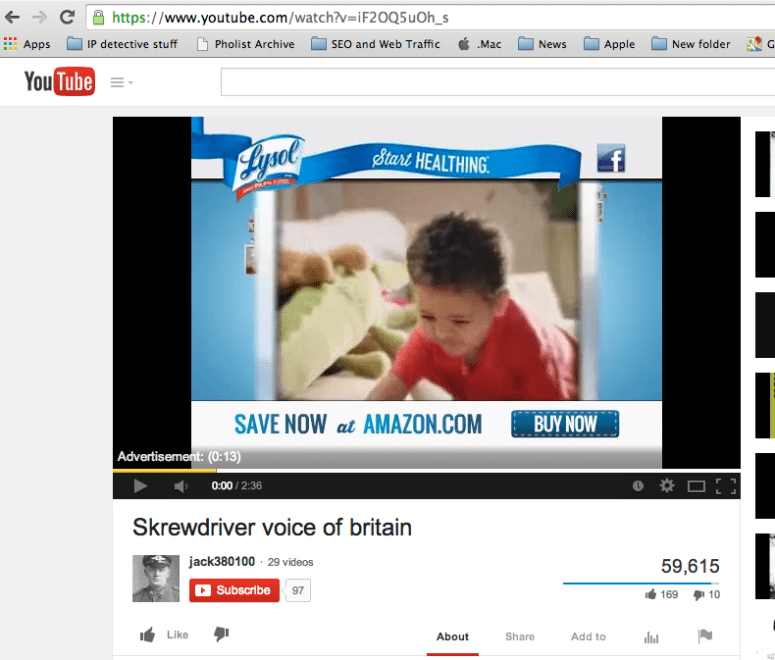
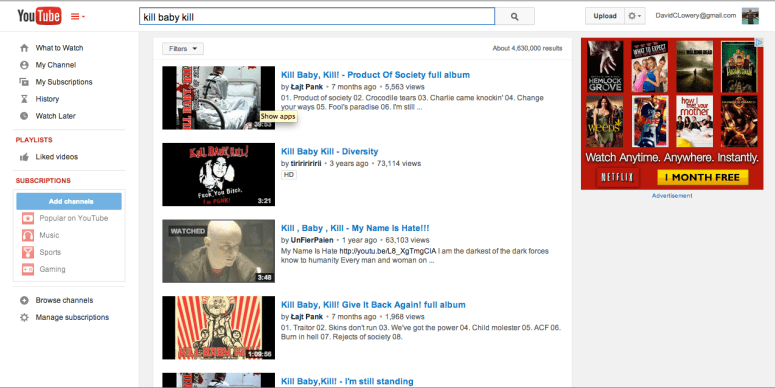
When I refer to streaming I include not only Spotify, Pandora and other similar services. I also include YouTube. Virtually every song i’ve ever written is streamable on YouTube. Even if it’s just a static shot of the cover and the audio uploaded by some well meaning fan.
Pandora pays the artists according to statutory rates. Personally I’m happy that Spotify is attempting to pay artists, even if it’s not really enough yet. YouTube wouldn’t pay anything if it didn’t have to. So they don’t get my thanks. And Grooveshark pays nothing to artist.
First thing you need to know about streaming? Aside from Pandora there is a huge dispute about how much any of these services pay. And unfortunately I won’t be able to clear it up much.
I have friends, artists and record label execs who swear they or their artists are receiving about .3 to .6 cents a spin from Spotify (a rate some regard as “sustainable”and equitable). Others swear that’s not true, more like hundredths or thousandths of a penny.
I’ve looked at royalty statements from various artists. Both groups appear to be right!
I’ll just add my voice to the call for transparency in Spotify and all streaming licensing. It’s never good when there is no transparency. It inevitably part of some scheme to take advantage of someone somewhere. Usually the artist. Or to quote P.J. O’Rourke “Complexity IS fraud”.
Regardless in the last few months a lot of artists have come out with their personal stories on how their revenues from streaming are quite small. Here is a typical story from Benji Rogers who also runs Pledge Music.
http://www.pledgemusic.com/blog/52-so-wheres-it-all-going-digital-sales-for-the-independent-musician
The Black Keys really don’t like spotify.
http://www.billboard.biz/bbbiz/industry/digital-and-mobile/black-keys-drummer-patrick-carney-calls-1006579552.story
So clearly a lot of artists feel they aren’t being adequately compensated.
When pressed on this Spotify seem’s to point the finger at the record labels. And the record labels point back at Spotify. And curiously UMG seems to defend Spotify more than the other labels. No one knows what deal UMG cut with Spotify but clearly they have some sort of stake in Spotify. How this effects revenue flowing to artists is unknown. UMG needs to clarify.
So for now let’s just say artists share of revenue from spotify and other streaming services is:
Unknown and subject to possibly shady deals.
Sounds just like the old boss right?
The White Hats.
Finally what about the ‘white hats in the digital music ecosystem? By this I mean the legitimate digital music stores like iTunes, Amazon’s MP3 store, Rhapsody, eMusic and Google’s Play. I call them white hats because this seems to be the only part of the digital music ecosystem which has consistently paid artists. Still if you dig into how the money gets split you start to encounter problems when you compare it to the old record label system.All the big stores take about 30% of gross on a 99 cent song. But here is the catch. If you are an independent artist you have to go through an “aggregator” to get your songs into iTunes/Amazon. This will cost you a minimum of 9%. Except Google. Google should be commended for not requiring the aggregator for their store. However iTunes represents about 70% of the digital music market. Amazon is a distant second (13%?). I could find no data on Google’s store now called Play.
So for now lets just focus on iTunes. The genius of Steve Jobs was that he was not afraid to be greedy. Like most Apple products, Steve Jobs built the thing he wanted and picked the price and margin he wanted. This is commendable in a CEO. That’s why I own Apple stock. I doubt there were any consumer studies. He didn’t really negotiate with the suppliers and consumers on price. A kind of take it or leave it proposition. Fortunately it paid off for Apple.Now when you are building a brand new digital music store, a concept no one else has ever really done on a large scale there is considerable risk. So in 2003 (when iTunes store launched) a 30% margin is totally justified. Nearly a decade later after the concept is proven, after the store has brought millions of new consumers into the apple ecosystem and after billions of dollars of hardware have been sold is 30% a reasonable margin? It’s no longer a risky proposition. I say no. My techie friends immediately point out that all those servers, all those engineers and all that software is really really expensive.
Ok… then this is another example of the failure of theory of
Disruptive Innovation? So John Dvorak is right when he calls Disruptive Innovation the biggest crock of the millenium? Disruptive innovations are supposed to be much much cheaper than what they “disrupted”. So if the mom and pop record stores could sell physical product profitably on a 40% margin with all that shipping, returns, breakage shrinkage, real estate and stoned employees AND big chains like best buy and walmart with their deep discounts could sell music on a 20% margin, then the only conclusion is that the iTunes store is incredibly wasteful and inefficient way to do business. I don’t think that is the case. I think that selling music as mp3 downloads from Apple/Amazon servers has to be more efficient than shipping thousands of breakable CDs all over the world. So I think what has happened is that over the years that 30% margin has become
parasitic. Parasitic in an economic sense meaning it’s not really justified by the value it’s adding. The 30% is simply the result of iTunes/Amazon being more of a bottleneck or gatekeeper. The fact that sites like
http://www.bandcamp.com and
http://www.cdbaby.com can do the same job on a lower margin suggests that the 30% is artificially high. I know the Apple-can-do-no-wrong crowd is sharping their knives right now. But hear me out. If the market lets Apple take 30% they should take 30%. The part of me that is an Apple shareholder applauds this action. And Apple should continue to charge this margin until it is forced to lower it by it’s suppliers or competitors.Until apple really has some reasonable competition, until the music conglomerates figure out it’s in their interest to license new online stores, create other competitors cheaply and efficiently, iTunes is not gonna have any competition. And as iTunes sales grow and physical sales shrink, Apple’s market share is only gonna get bigger. Apple will become more powerful and behave more like a monopoly. If iTunes recorded music store were it’s own separate company it’s gross revenues would represent over 30% of the market. It would be the biggest recorded music company by revenue except UMG. Apple is the most valuable company in the world. In a way you can argue that Apple IS The Man 2.0.But unlike UMG , WMG or Sony, Apple (or any of the digital music stores) does not recycle any of their revenues back into the creation and development of artists and songs. And this is part of the problem.
++++++++++++++++++++++++++++++++++++++++++++++++++++++++
What percentage of revenue from digital sales goes to an artist on a record label?
This is a long and fairly complicated calculation and I’ll save the details for my book . But the percentage of revenue that goes to artists on a label is about the same as under the old record label model. It may be slightly better because there have been some improvements from the artists perspective. For instance the old record company scam known as
“free goods” is impossible to justify with digital downloads.Under the new digital model I calculate that most label artists get between 15%- 35% of wholesale. For example the most recent of my recording contracts says I should get a total of 20.5 cents on a 99 cent song (including mechanical royalties). This works out to 29.7% of wholesale. So this part of the new digital paradigm is about the same as the old record label system.
So when you compare share of revenue for artists on record labels under the new digital system to the old system it looks pretty good. At least until you consider the fact that the price of music has dropped. For instance, an artists royalty on an album is now calculated at 6.90 not at a $10.00 wholesale price as it was in the 1980s. . This drop in the price of music was inevitable. But the record label’s expenses fell considerably in the switch from physical to digital products whereas the artist’s expenses (the recording budgets) did not. So this had the effect of reducing artists net revenues and shifting revenue towards the record labels. For the new digital distribution model to be as “fair” to the artist, the artist share of download revenue should have increased. It stayed the same or increased only marginally.
But let’s look at this in real dollars. Let’s take my artist royalty rate of 16% and compare who gets what under the old pre digital system and the new system. (don’t forget i’m also including the mechanical royalty).

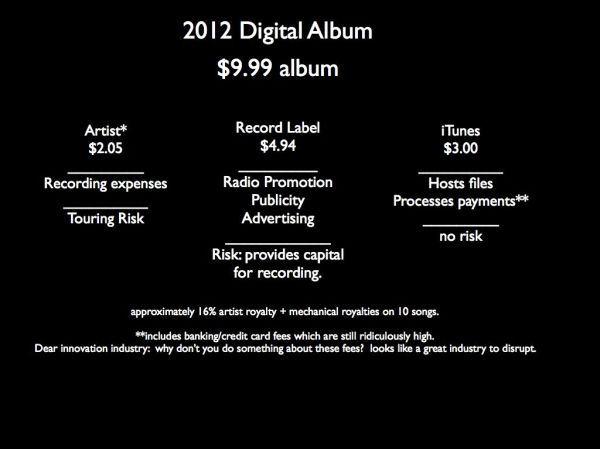
Looked at this way I think you can see the problem. Artists revenue falls but the artist still needs to pay for recording. Record label revenue falls but the new digital distribution system provides them enormous savings. They have eliminated manufacturing warehousing and shipping costs.
And then there is that iTunes store 30%. Seems kind of high to me. What is their risk? Today in 2012? Do they really deserve more per album than the artist? At least the record labels put up capital to record albums. At least the record labels provide the artist with valuable promotion and publicity. Historically in the music business when someone was taking more than 20% of gross revenues that had some “skin in the game”. They risked losing a lot of money.
Between the record labels and the digital retailers like iTunes, once again the artist gets squeezed. If you add to this the cannibalization of sales from streaming sources that pay too little and illegal file-sharing that pays nothing at all you can see why the artists have much less money now. This also helps explain why artists are spending dramatically less time and money recording.
The New Boss, in this case Apple, takes 30 percent, takes no risk and provides the artist with almost nothing in return.
Always look for that Union Label.
In the late 80’s through the late 90’s the Music Business experienced a boom. Not as big as some have reported. When adjusted for inflation and population only 13% higher than the previous peak in the 1970s. Nevertheless it was a boom. It’s instructive to look at what the record labels did with their profits when it was flush with cash. They created what I like to call “The Grunge Bubble”. Record labels bid up the advances for new artists to unheard of levels. Unknown rock bands were getting signing bonuses of $750,000 dollars!
The record labels flush with cash not only dumped a lot of money into signing artists directly, they also gave money to other people, veteran artists for instance, myself included, to start our own sub-labels. Then the sub labels went out and gave that money to other artists as well. This was a really good time to be an artist.
But here is the important point. Record labels value content and content creators. Sure they kept a lot of money for their executives (although even mid 90’s music executive pay is dwarfed by tech executive pay.) But record labels unlike tech companies, know they built their businesses on those who create content. Therefore when they were flush with cash they set out to buy the services of as many artists as they could. This had the effect of sharing the wealth with musicians. It may have been uneven it may have been wasteful, it may have not touched every artists and the labels may have pocketed most of the revenue but at least they felt they needed to give something back to the content creators. They knew artists created something of value.
For a very long period of time record labels provided a decent living to thousands of lucky artists. They may not have guaranteed an artist riches but It was like having one of those good union manufacturing jobs. In fact you could have your royalties paid to you in such a way that you qualified as an AFTRA/SAG member and then you had union health Insurance and a Pension! Unlike the tech industry the music conglomerates are PRO UNION.
Now look at the “Innovation industry”. They do not value content. In fact they argue they are doing the content creators a huge favor by “distributing” content. (the distribution myth is a canard that needs it’s own post, Chris?). They think their services and networks are the only thing of value in the digital ecosystem. This is like the owner of Shoreline Amphitheater thinking people are paying for the privilege of sitting on the chairs. Further they seem collectively obsessed with their own self proclaimed genius. And we lowly content creators are some sort of ungrateful wretches. Just look at how their blogosphere surrogates talk about musicians. If Wall Street titans hadn’t claimed the mantle “Masters of the Universe” in the 1980’s the zeppelinesque egos of the tech industry would claim it.
A friend of mine who works in Silicon Valley likes to point out that Silicon Valley IS the new Wall Street. It attracts the same “I wanna get rich at whatever cost” sleazebags that used to go to Wall Street and bilk old ladies out of their pensions.
And just like the Wall Street the tech industry has funded an army of professional Washington lobbyists to weaken, undo and even eliminate laws it finds inconvenient. In this case copyright protection for artists on the internet. The desired result is that internet/tech companies will never have to pay for using artists songs, movies, books and photos.
The New Boss doesn’t value what you create. And the New Boss would like to change the laws so that your songs are no longer yours.
++++++++++++++++++++++++++++++++
Freebird.
So at last we get to the part of the new digital paradigm where things should work as promised. The independent artist on their own label who directly releases their recorded music through iTunes, Amazon Mp3 store etc. This is where we would expect to find the artists benefiting from the process of “disintermediation”. This is where we should find the artists that are capturing the lions share of revenue. This is where we should find that vibrant marketplace of small stakeholders competing with multi-national conglomerates. This is where the playing field should be even. This is what the tech visionaries promised us anyway.
What percentage of revenue from digital sales goes to an independent artist?
iTunes/Amazon 61%*
Google Play 70%
Bandcamp 85% -fees**
CDbaby 75%
Directly off the artists Website. 100%-fees
* requires using an aggregator like CDbaby. generally 9% fee.
** looks like Bandcamp pays after the credit card paypal frees.
So clearly the best thing for an artist is to sell fans digital downloads of their music directly off their own website. And indeed that is what most artists try to do. And the most engaged fans will go to your website and buy your music that way. Failing that you could also sell your music through Bandcamp or CDbaby and net a little more than you would on iTunes.
Here’s the problem with that:
Facebook, YouTube and Twitter ate our web traffic.
It started with Myspace and got worse when Facebook added band pages. Somewhere around 2008 every artist I know experienced a dramatic collapse in traffic to their websites. The Internet seems to have a tendency towards monopoly. All those social interactions that were happening on artists websites aggregated on facebook. Facebook pages made many band’s community pages irrelevant. It is so much more convenient for your fans. Think about it. Your fans are probably already on Facebook all day anyway. It’s so much easier for them to interact with other fans and artists on Facebook.
Most artists I know now mostly use their websites to manage their facebook and twitter presence. There are band oriented CMS services that automatically integrate with Facebook and Twitter. They turn your website news, tour dates and blog posts into facebook events, facebook posts and Tweets. Most websites function more as a backend control panel for your web presence. Yes some of us sell swag and downloads on our websites but unless you are a really really popular band, or you have a major record label that can help you promote your website , it’s generally a few hundred of the most ardent fans that ever spend anytime on a bands website.
In the mid nineties bands had complex websites and fulltime web masters. This is really rare now cause Facebook, YouTube etc has absorbed all our web traffic. Managing a unique website is not really worth the time you put into it unless you are a very popular artist. And the only reason fans would go to your website often is if you have unique content for your visitors.
Think of websites as TV networks or TV stations. A very popular channel has enough viewers and revenue to justify creating it’s own content. A little public station in a tertiary market does not. Admittedly not having unique content because you are too small is a self reinforcing dynamic. But it’s one that I have found is virtually impossible to conquer.
I spent 40 hours shooting and editing a video for the song “Raise ‘Em Up On Honey” and put it on my website. It received several hundred views on my website then slowed to a trickle. But the version on YouTube got tens of thousands of views. But I HAD to also put it on YouTube. It would have been stupid to have not. My fans are all on YouTube watching cute cat videos. They can see when I add a new video to my channel. Why bother going to http://www.davidlowerymusic.com?
A similar situation occurs with the process of selling music online. Our fans already have an iTunes account. They already have a credit card on file with Amazon. That small hassle of getting your credit car out of your wallet to buy music directly from the artist website is a giant hurdle that most people will not jump over. The internet has a tendency to monopoly because we are fucking lazy fat slobs.
65%
So iTunes and Amazon which account for approximately 83% of the digital music market, so this duopoly share about 61% of revenue with the independent artist. But let’s assume that the artist manages to sell some music directly off their website and a few other slightly more generous stores like http://www.bandcamp.com or CD Baby. So let’s round up the artists share of digital download revenues. Let’s round it up to 65%.
This is pretty damn good. It dwarfs the revenue that record labels shared with artists. And indeed there are some spectacular success stories of artists selling their music directly to fans and making a lot of money. Imagine how much Radiohead made off the album they sold directly to their fans.
These are the stories that you hear when the tech true believers, the eVangelicals ecstatically shout “Things have never been better for musicians!”
While that is true for these musicians is it true overall? Is it better for musicians as a group? I mean cause I can say the same thing about lottery winners. I can find three or four Jackpot winners and say “Things have never been better for Lottery players”. And this would not be true because we are not accounting for all the losers. The house or the lottery always wins. But their are just enough winners that people keep playing the game. And this is exactly how the new digital paradigm works. It’s a lottery. A few musicians win every year. But overall money steadily flows to file-sharing companies, YouTube, AdSense, Google, Apple, Amazon, Spotify and the record labels. Artists haven’t been liberated. We’ve been enslaved in a new and fancier way. It’s been sold to us as freedom. Michael Robertson of Mp3tunes has been on a crusade to “liberate” artists like Pink Floyd from their record companies. Liberate them how? Take their songs and share them on Mp3tunes then share NONE of the revenue with Pink Floyd? Why would they do they that? At least EMI pays them something.
Meet the new boss, worse than the old boss!
+++++++++++++++++++++++++++++++++++++++++
When I Win The Lottery.
But the music business has always been a lottery. This is nothing new. It has always been ruled by unpredictability and luck. That’s why you often hear something like this attributed to Ahmet Ertegum:
“The secret to the music business? Throw ten records against the wall and see what sticks.”
Never mind that I can find no evidence that he ever said this. This is clearly how the music business has worked for a long time. It’s built into the very structure of the business. In the 1960s when a music scene would pop up someplace like San Francisco (Haight Ashbury) or Boston (The Bosstown Sound), record companies would come in and sign anyone with long hair and a guitar. They did the same all through the 70s, 80s and 90s. That’s what they did during Seattle’s Grunge Bubble. Historically the companies that tried to be selective, pick the stars were no more successful than the companies that were not selective. From this record companies learned to spread their bets around. In this way record companies have long resembled hedge funds, VC funds or “black box” trading firms that buy 100’s of longshot bets, losing on most of them with the few winners paying spectacular returns.
The crucial difference between the old boss and the new boss is that the old boss the record labels saw that it was in their interest to invest in the creation of music. Further they knew success in the music business was highly unpredictable. Therefore they spread their investment around. They didn’t do this out of the kindness of their own hearts, they did this cause it was a in their long term interest. And it was the surest way to make money. So up until the early 2000’s record companies essentially overpaid the 9 “losing” artists and underpaid the one “winning” or hit artist through their system of advances for each album. It was a semi-socialist system. A system in which the superstars revenue subsidized all those new and developing artists. The destruction of this revenue and risk sharing system is another important reason why artists are poorer now.
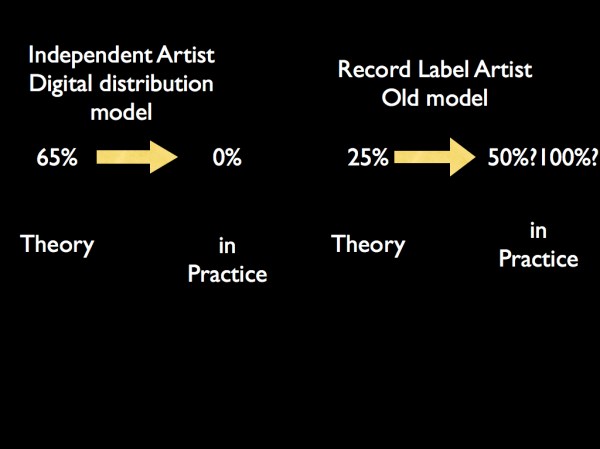
Slide 25. How risk sharing/revenue sharing made record label artist royalty rates a “floor”.
This is what people do not understand. When they look at the royalties that the record labels paid artists it doesn’t seem like a lot. It seems unfair. Until you consider the guaranteed advances. Let’s say the artist was to be paid a lowly 12% royalty by contract. That compares unfavorably to the 61% of revenue that the independent artist gets from iTunes. But the artist is always given an advance and usually the advance assumes moderate success. But 9 of those 10 bands did not achieve great success even moderate success. It was never expected that all 10 would be successful. So the result was that the record label artist actually received a lot more than that contractual 12%. The unsuccessful artist may have received an advance that was equal to 90% of the gross revenue generated by that recording. And most artists were unsuccessful. So your average record label artist was actually receiving way more than 12%. The artist royalty rate is actually the floor. It’s the minimum share of revenue the artist will receive.
(I know this is probably really confusing to you civilians. Am I really saying it’s better to be un-recouped as an artist? Yes it is. Quantitative finance geeks will see this as selling a series of juicy “covered calls”. Being un-recouped means you took in more money than you were due by contract. You took in more money than your sales warranted. And there was a sweet spot, being un-recouped but not too un-recouped. For instance I estimate that over my 15 year career at Virgin/EMi we took in advances and royalties equivalent to about 40% of our gross sales. In other words we had an effective royalty rate of 40%, despite the fact that by contract our rate was much lower).
+++++++++++++++++++++++++++++++++++++++++++++++++++++++++++++++++
Sympathy For The Record Labels.
So under the old school record label system MOST artists had a much higher effective royalty rate than the contracts would lead you to believe. This was directly a result of this socialistic risk sharing/revenue sharing scheme that record companies devised. It was directly the result of the record companies financing the recording of albums through it’s system of advances.
But wait these “effective” royalty rates were still mostly lower than that 65% that the independent artist receives under the new digital distribution model. Right?
Well yes. but under the new digital distribution model the independent artist is now shouldering all the risk and expenses.

With the exception of a few lottery winners, the independent artists that seem most successful under this new digital model seem to fall into two categories:
1.Established recording artists recently freed from major label contracts.
2.Artists playing to a specific non-commercial niche. For example Black Metal.
Both types of artists don’t have to spend a lot of money on marketing, advertising, radio promotion or publicity. These expenses can be huge!
The ex-major label artists are able to sell significant albums as independents because they are able to rely on their brand that was built with years of record company money. Niche artists only have to promote and publicize themselves to a very limited tightly grouped audience. But if you are not in one of these categories the independent artist route is tough.
In 2010 there were 75,000 albums released. Of those about 60,000 sold less than 100 copies. Only approximately 2,000 sold more than 5,000 copies. Slightly less than 1,000 sold more than 10,000 copies. And you got to figure most of those artists were on record label artists.
An album that sells 10,000 copies for the independent artist would gross around $65,000. From that $65,000 dollars the independent artist must pay for recording, a publicist, radio promotion, advertising, photos artwork and on and on. You quickly realize that the independent artist is unlikely to be better off under the new system. In practice the independent artist is unlikely to net anywhere near the 65% we estimated.
Rock and Roll Animal Spirits.
Then there is the matter that the independent artist must raise the capital to record and promote the record. The record label artist has the advantage of receiving a loan of sorts from the record company. The independent artist must either scrounge together the money or borrow the money. But imagine being an independent artist and trying to borrow money from someone to make a record. In this day and age no one is ever gonna loan an artist money specifically BECAUSE of widespread illegal file-sharing. Digeridiots pounding tables and shouting “intellectual property is not property” makes the investment environment even worse. I mean would you loan anyone money to make an album these days? I wouldn’t. I don’t even know if I would loan myself money to make an album in this day and age. This air of uncertainty, this “animal spirit” as Keynes would term it discourages investment.
There is also a strange quirk of human nature studied by behavioral economists called Prospect Theory. Among other things it predicts an individual artist will risk much less of their own money on an uncertain venture ( like recording an album) than a company would risk. Actually Prospect Theory and what derivatives traders call Volatility Theory can explain the entire structure of the music business. But I digress.
Basically these two things combine to starve the independent artist of capital.
This lack of capital available to the independent artist makes it highly unlikely that the independent artist will sell many records.
++++++++++++++++++++++++++++++++++++++++++++++++++++++++
Freakin’ at the Freaker’s Ball.
I think I’ve demonstrated how important it was to the old system that record labels shared risk and invested capital in the creation of music. And that by doing this the record labels “accidentally” shared more revenue with the artists. But I’ve yet to explain why it is that The New Boss refuses to share risk and invest in content creation. I mean the old record labels eventually saw that it was in their long term interest to do so.
My only explanation is that there is just something fundamentally wrong with how many in the tech industry look at the world. They are deluded somehow. Freaks.
Taking no risk and paying nothing to the content creators is built into the collective psyche of the Tech industry. They do not value content. They only see THEIR services as valuable. They are the Masters of the Universe. They bring all that is good. Content magically appears on their blessed networks.
I’m using this language for good reason. There is a quasi religious tone to many tech convention speeches and press releases. What other industry constantly professes utopian visions for all humanity? What other industry would dare proclaim they were liberating artists? Students? Workers? What other industry thinks they are mystical shaman “Let’s send our magic objects, our laptops to poor children in third world countries”. What other industry genuinely believes they (and only they) possess the lapis philosophorum? They have even created their own God. A Superhuman intelligence that they (naturally) have created. The singularity. Their egos know no bounds.
Not only is the New Boss worse than the Old Boss. The New Boss creeps me out.
###





You must be logged in to post a comment.