Aiding and Infringing : iPad Music Apps – A New Low

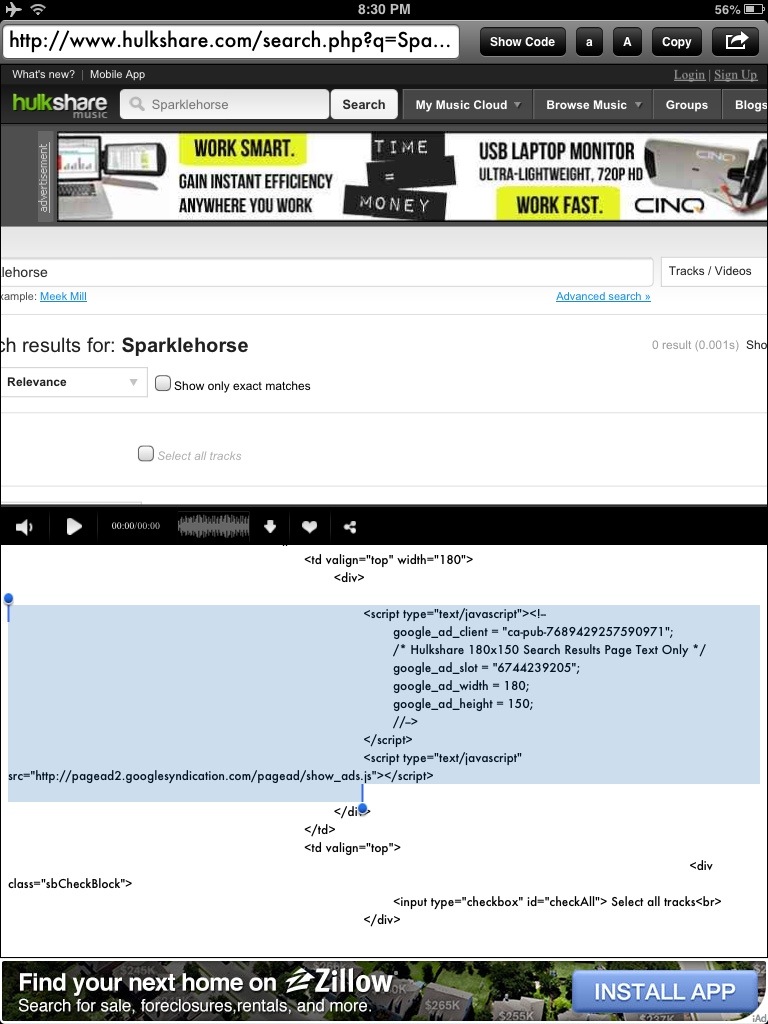
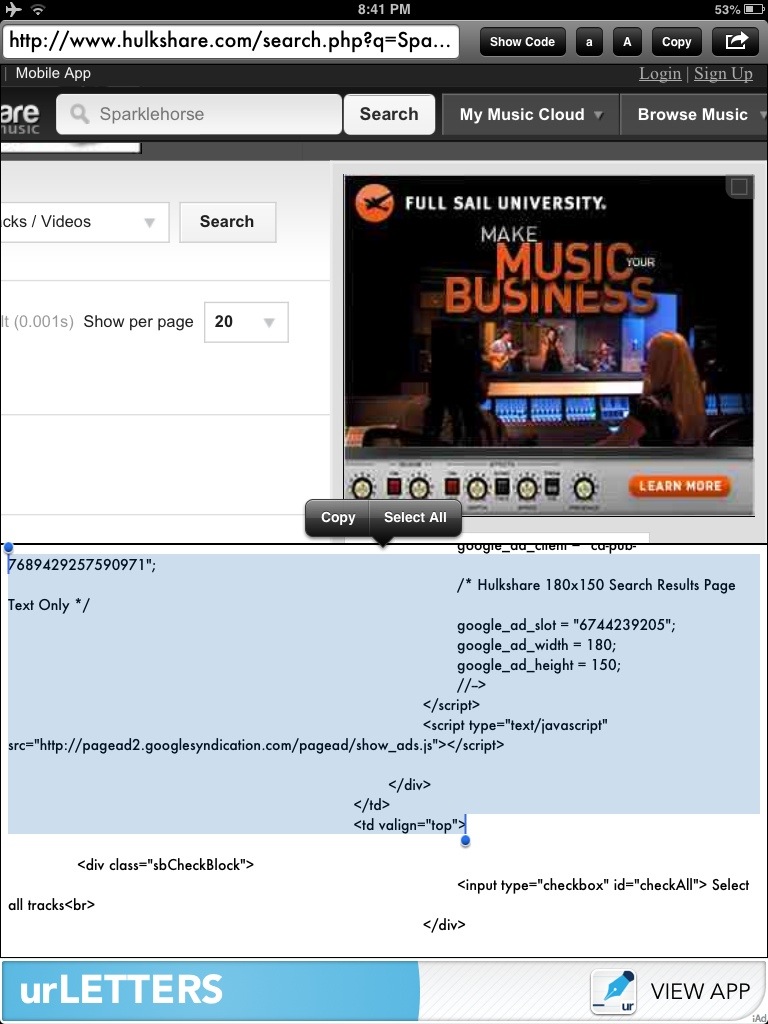
Advertisers need to capture the mobile market. The problem is the functionality of the some of the most frequented websites by the coveted youth demographic is disabled on iDevices (the inability to download content to the idevice). In other words, there is no draw to pirate websites (and to the advertising they serve) if the infringing music is no longer accessible. Worry no more, there’s an APP for that… note the top grossing and most popular music apps for the ipad…

IMG_0001

IMG_0002

IMG_0003

IMG_0004

adsforGAMES

lovebuddy

And uhm… let’s not worry that ads for Adult Services are being targeted to minors…

The Digital Royalty Fight: A Primer for Business Journalists. Part 1.

The Digital Royalty Fight: A Primer for  Business Journalists. 

We realize that to those outside of the music business the digital music royalty system seems incredibly complex.  Those of us on the music side often forget we’ve often had decades of experience dealing with the intricacies and machinations of the system and our explanations are not always as clear as they should be, partly because we assume certain awareness that may be asking too much.

There are also many journalists who honestly try but confuse the distinctions between a performer royalty and a songwriter royalty; or the simulcast stream of a radio station on IHeartRadio.com and Spotify’s on demand music service; or the fact that the government essentially dictates both the license for most songs through its consent decrees with ASCAP and BMI and the rate courts that set the prices for those songs and the compulsory mechanical license.  The government also dictates both the license for sound recordings and the government’s Copyright Royalty Judges essentially dictate the prices for recordings online and the mechanical royalty for songs.  If you are a songwriter you have the government setting your prices for almost everything except sync in film/tv/commercials.  (Weird right?  Is this World War II? Are we rationing sugar?  Nylon?  Gasoline? We need to set prices for songs?)

On the other hand there are technology companies (and bloggers)- that should know better-who purposely confuse the public on these matters by mixing the different kinds of royalties and make false equivalencies between songs and recordings, not to mention types of services, to help bolster their public relations campaign for lower royalties.

So it’s no wonder people are confused.

So let me try to give everyone a quick primer on digital royalties by highlighting some of the most common misunderstandings that have been fueling the debate over webcasting royalties this last month.  One caveat: When I speak of “artists” or “performers” I include session musicians and vocalists with “featured” artists.

Let’s start with the simplest misconception.

Misconception #1.  There is no difference between an Artist and a Songwriter.

The songwriter and the artist are often two different people.   Sometimes –like in my case- I am both songwriter and artist.   But the majority of songs populating The Billboard top 20 at this moment are written or co-written by professional songwriters that are not the performing artists!! And because music sales exhibit what is mathematically termed a “wild distribution” often the Top 20 songs represent the majority of all recorded music revenue for that week!

These professional songwriters are economically very important to the entire music business (including all forms of radio). They create the fundamental element on which the entire music industry is based–it all starts with the song. The consumer clearly values the work of these professional songwriters. Yet these important professionals don’t tour, sell T-shirts or have clothing lines.  Their songwriting royalties are their only income.  Songwriters are not paid a share of the artist royalties for Pandora.  Songwriters are paid from a completely different source.

Occasionally more obscure performer/songwriters have their songs covered by pop superstars.  They also do not benefit from the touring activities, t-shirt sales or clothing lines of the pop superstar, even though the superstar’s fame may be based entirely on covering some obscure songwriter’s songs!

To make things more equitable most countries in the world pay separate royalties to songwriters and performers.  Even “old boss” record companies are required to pay songwriters “mechanical royalties” for  “cover” songs they release.

This brings me to #2.

Misconception #2. Webcasters and other digital services pay only one kind of royalty.

There are two broad kinds of royalties paid by digital services, Satellite radio, AM/FM Radio (ex-US), Cable TV, Broadcast TV and others to “Artists”. The Songwriter gets one royalty and the performer gets another royalty.  It’s very important when discussing royalties to know which one is being discussed and most importantly NOT lump them together.

Example.  I am both the co-writer and co-performer (with Cracker) of the song “Low”.  As a songwriter I received $16.89 for 1,159,000 spins of “Low” on Pandora (paid to me by BMI).  In contrast, my  band Cracker (the artist and performer) was paid a little over $600 in performance royalties for those spins (paid to Cracker by SoundExchange).

Like most bands, Cracker takes these moderately sized checks and deposits them into the band’s general operating funds.  (You don’t have to do it that way, but that’s how we do it.)  Airplay after all is often the result of touring and other promotional activity of the band and is part of the band’s gross revenues, not net profit.

But let’s ignore that and pretend there are no costs associated with achieving airplay.  Then eventually as 1 of 4 members of the band Cracker about $150 dollars works its way into my paycheck.

Now switch to the songwriters on “Low”.  Compare my $150 share of as an artist to my co-writer Davey Faragher. He is not a member of the band Cracker.   He received no royalties as an artist.   As a 30% co-writer of “Low” he received $12.67.   Total.   No more.

Most people don’t understand the difference between an artist royalty and a songwriter royalty. They add them together when they should not. If Justin Beiber covers one of my songs I don’t get any of his artist royalty.

This misunderstanding was skillfully (and purposely?) exploited by Tim Westergren of Pandora when he made his rebuttal to my 100% unimpeachably factual statement that the songwriters of “Low” had received $42.23 in royalties for 1,159,000 spins on Pandora.  He subtly and carefully mixed the bands performer royalties with songwriter royalties.  Many other journalists who didn’t understand the difference also unintentionally made the same mistake.

Misconception #3.  Terrestrial Radio (AM/FM) doesn’t pay royalties. Why should Internet radio?

Not true.  They pay songwriters quite significant royalties.  The confusion arises because in the United States we don’t pay performance royalties to  artists on terrestrial (“over the air”) radio.   A handful of other countries in the world also don’t pay performer royalties: North Korea, Iran, Rwanda and Syria.   Quite a nice club to belong to right?  The axis of weasel.

Webcasters should be arguing that terrestrial radio pay its share.  They are noticeably quiet on this matter.  Instead their surrogates often falsely claim that terrestrial radio doesn’t pay any royalties at all so webcasters shouldn’t either. And hence the confusion.

An important underreported consequence of the US not paying sound recording performance royalties is other nations do not have to reciprocate and pay our artists performance royalties in their countries.  Since we are a net exporter of music we are leaving hundreds of millions of dollars on the table every year.  SoundExchange has been working hard for years to solve this informally on a country-by-country basis with some success, but it’s still not a legal requirement.

Misconception #4.  All radio and streaming services are “promotion” never consumption.

There is a big difference between promotion and consumption.  Fundamentally this is the distinction between who is bringing the value when a song is spun. The service or the performer and songwriter.  Many writers and commentators fail to see the distinction, yet this distinction has always influenced royalty negotiations and court deliberations that set royalty rates.

AM/FM radio and Sirius play music to a (largely) passive audience that does not get to select which song it hears.    Obviously there is actual promotional value to a new artist that suddenly gets added to the playlist at KROQ in Los Angeles. The average listener generally knew little or nothing about this new artist before they heard it on KROQ.  The listener didn’t tune into KROQ to hear an artist they never heard before–that’s the artificial scarcity that the “format” or “Top 40” concept is all about. There is clearly some benefit and value transferred from the radio station to the artist.  This is promotion.

At the other extreme is the song-on-demand or “interactive” version of Spotify (Spotify also has a non-interactive web radio service to which this analysis does not apply).   When I go to Spotify and I want to hear  music I generally already know the name of the artist or the song.  “New boss” Spotify doesn’t do much of anything until I tell it what to play.  Someone or something other than Spotify–often touring by the artist or the artist’s “old boss” record company–helped me discover that artist.   Someone or something else promoted that song to me. In this scenario it’s largely the fame of the artist bringing value to Spotify.   This is the opposite. This is consumption.

Now I realize that these are both oversimplifications. I’m simply trying to illustrate the difference between consumption and promotion which are too often blurred.  Spotify does promote artists on their home page (for high fives and hugs or for a fee?).  And they do have a webcasting service that does help to promote artists.

It’s also an oversimplification  in the case of AM/FM and other forms of broadcast radio. Oftentimes the artist brings value to the radio station–there’s a tipping point.   Can you imagine a  Top 40 radio station that didn’t play Macklemore and Lewis in the months of April, May and June 2013?   Quite a few listeners would switch to  competing stations playing these popular songs. Same with Daft Punk and Pharrell this week.

Pandora and other interactive webcasters (including Spotify’s radio like service)  lie somewhere in the middle.  Pandora is sometimes promotion and sometimes consumption.  If someone builds a custom “radio station” around the band Cracker they will immediately be played a Cracker song.   Not the exact song they might want to hear but they get the right band.  This is the artist bringing value to Pandora.  This is consumption.

If however someone builds a radio station around Weezer and they get exposed to an obscure Cracker track like “Guarded By Monkeys” this is promotion.  This is Pandora radio service bringing value to Cracker. (But judging by my royalty statements, 99% of my spins on Pandora  are coming from my songs that were already hits long before Pandora exisisted, so I doubt I’m getting much “promotion” from Pandora).

This is one reason that per spin per listener Pandora should (and often does) pays more than pure broadcast radio but less than on demand Spotify and YouTube.  It has to do with who is bringing value to whom.

(If you look at the actual rates, if anyone is getting a free ride it’s YouTube.  They are essentially an on demand music service just like Spotify but they pay songwriters 1/8th of what Spotify pays songwriters–if you assume you are getting a straight count from YouTube which I do not.  But I digress.)

Misconception #5.   Fairness requires all services to pay the same rates and percentages of revenues  to performers and songwriters.

Not true for two reason.

1) Because of the distinction between promotion and consumption (above) and the level of interactivity offered,  different services should pay different rates.   Spotify on demand is like virtually owning a song.  you can play it at anytime as long as you have a broadband connection.  They should pay more per spin than a simulcast stream of a terrestrial station on Iheartradio.com in which the user has no control over which song is played.  Again it’s all based on who is bringing the value in the transaction.  The service? or the performer and songwriter? Promotion or consumption.  You would expect to see the market struggle to differentiate between services, which is what happens even under the government mandated pricing regime–SoundExchange has separately negotiated royalty rates for Pureplay, small webcasters, NAB stations, college radio, etc.  Those markets just want to be free.

2) Pandora in particular disingenuously compares the royalties it pays to royalties Sirius/XM pays in percentages of gross revenue.   So Pandora says it pays more than 50% of its (largely ad-supported) revenue to performers while Sirius XM pays 12.5% of revenue from music subscription plans and then cries foul!

This is a mathematical trick.  Pandora has relatively low revenues per user because 90% of their users pay nothing for the ad supported service. Further Pandora has decided to play  only one minute of commercial an hour further hobbling their business model.   In contrast Sirius/XM is 100% subscription supported service (sometimes with advertising).  Users pay a minimum of $9.95 a month and are subjected to 13 minutes of advertising on many of the nonmusic channels.

With that said, I want to be very clear about something.   There are distortions in the relative rates paid by different services.  When rates are negotiated under threat of government mandate or set directly by government mandate  there are gonna be distortions.   You can see this most clearly in the rates the politically connected YouTube  (Google) pays songwriters vs the rates that Spotify pays songwriters.  Judging by my statements YouTube pays about an eighth of the rate Spotify pays songwriters–and there are no representatives of the creative community on YouTube’s board, either, and certainly not Google’s.

Artists Speak Out on Pandora’s Proposed Royalty Rate Cuts

We know that David Lowery’s post here at the Trichordist has re-ignited the debate over Pandora’s latest attempt to reduce royalty rates to songwriters, but David is not alone. During the last attempt by Pandora to screw songwriters and musicians we saw a number of artists speak out, amongst them was respected songwriter, musician and producer Jimmy Jam who testified on Capital Hill.

Here’s a look at some of the other songwriters and artists speaking out from different perspectives.

Songwriter Ellen Shipley in Digitial Music News, “My Song Was Played 3.1 Million Times on Pandora. My Check Was $39…

It is interesting and very disturbing that no one is addressing the SONGWRITER’s situation in this Pandora debacle.

Pandora wishes to REDUCE the amount of royalties that songwriters have already seen CUT in 2005. Let me give you an example of what Pandora is paying in royalties to SONGWRITERS–not the performers, but the people who write the songs–the foundation of the music world—

PANDORA —-“Heaven Is A Place On Earth” (co-written)

accounting period for 3 months—–3,112,300 streams

My Pandora royalty ……………..$39.61

Songwriter, Musician and Indie Label owner Blake Morgan in The Huffington Post, “Tim Westergren Emails Underscore Tension Between Pandora, Artists.

The AFL-CIO, NAACP, Americans for Tax Reform, the American Conservative Union, SoundExchange, and others all oppose this bill, and the supposition that Pandora should pay less to artists and songwriters in order to accomplish higher profitability.

The Songwriters and Musicians of the band Pink Floyd in USA TODAY, “Pink Floyd: Pandora’s Internet radio royalty ripoff.

Of course, this letter doesn’t say anything about an 85% artist pay cut. That would probably turn off most musicians who might consider signing on. All it says about royalties is “We are all fervent advocates for the fair treatment of artists.” And the only hint of Pandora’s real agenda is the innocent sounding line “We are also fervent supporters of internet radio and want more than anything for it to grow.” The petition doesn’t mention that Pandora is pushing the growth of its business directly at the expense of artists’ paychecks.

Even former Pandora employee (and  Camper Van Beethoven band member) Jonathan Segel has written about the situation on his blog, “Pandora Groupthink. (look it up).”

Several of my former workmates at Pandora seem to be drinking the Kool Aid. I’m seeing posts claiming that David Lowery and Pink Floyd are talking ‘trash’. Yes, I worked at Pandora. You can read all about that here. I also play in a band with David Lowery, it’s called Camper Van Beethoven (not the band with the song in question here.) He and I don’t necessarily agree on everything, but I’m totally backing him up on this one.

Let us also not forget that over 125 artists signed a letter to Congress opposing these rate cuts. Here they are again.

Pandora hires Qorvis consultant (as in Lobbying firm for Kingdom of Saudi Arabia) for “Grassroots” campaign.

Pandora has apparently hired Nancy Tarr , a self-described consultant for Qorvis Communications, to manage their grassroots artists outreach campaign.  (See her Linkedin profile here http://www.linkedin.com/in/tarrwager.)

If you are not aware, both Source Watch  and Wikipedia identify Qorvis Communications as a big Washington DC PR and Lobbying firm that has  such respectable clients such as The Kingdom of Saudi Arabia.  (BTW how  do you ” PR manage” an adultery stoning?)  

We’re not sure if she’s behind the “sock puppet” comments we are getting in reply to the Pandora post but we are clearly getting an organized astroturf response.   Many of the comments we are getting contain the exact same language. D’oh!

Now just in case this is a Qorvis orchestrated campaign let us give you some basic advice on how to organize a corporate funded fake grassroots campaign:

Don’t have your folks cut and paste the exact same language into comments. Have them put the talking points in their own words.

By the way we are headed towards 1 million page views on this one post today alone.

My Song Got Played On Pandora 1 Million Times and All I Got Was $16.89, Less Than What I Make From a Single T-Shirt Sale!

Pandora less than t-shirt sale

As a songwriter Pandora paid me $16.89* for 1,159,000 play of “Low” last quarter.  Less than I make from a single T-shirt sale.  Okay that’s a slight  exaggeration.  That’s only the premium multi-color long sleeve shirts and that’s only at venues that don’t take commission.  But still.

Soon you will be hearing from Pandora how they need Congress to change the way royalties are calculated so that they can pay much much less to songwriters and performers. For you civilians webcasting rates are “compulsory” rates. They are set by the government (crazy, right?). Further since they are compulsory royalties, artists can not “opt out” of a service like Pandora even if they think Pandora doesn’t pay them enough. The majority of songwriters have their rates set by the government, too, in the form of the ASCAP and BMI rate courts–a single judge gets to decide the fate of songwriters (technically not a “compulsory” but may as well be).  This is already a government mandated subsidy from songwriters and artists to Silicon Valley.  Pandora wants to make it even worse.  (Yet another reason the government needs to get out of the business of setting webcasting rates and let the market sort it out.)

Here’s an idea. Why doesn’t Pandora get off the couch and get an actual business model instead of asking for a handout from congress and artists? For instance: Right now Pandora plays one minute of commercials an hour on their free service. Here’s an idea!  Play two minutes of commercials and double your revenue! (Sirius XM often plays 13 minutes and charges a subscription).

I urge all songwriters to post their royalty statements and show the world  just how terrible webcasting rates are for songwriters.

The revolution will not be webcast.

* I only own 40% of the song, the rest of the band owns the other 60% so actually amount paid to songwriters multiply by 2.5 or $42.25)

**  I am also paid a seperate royalty for being the performer of the song.   It’s higher but also what I would regard as unsustainable.   I’ll post that later this week.

For frame of reference  compare Sirius XM paid me $181.00

sirius royalties

Terrestrial (FM/AM) radio US paid me $1,522.00

Terrestrial Radio royalties Low

Rick Carnes, Eddie Schwartz and Fair Trade Music Project Speaks Out for Silenced Songwriters–Please sign the petition!

Music Technology Policy

The Music Creators North America (spearheading the Fair Trade Music Project) took another step toward defending the rights of creators.

In comments this week Eddie Schwartz of the Songwriters Association of Canada (SAC) and Rick Carnes of the Songwriters Guild of America (SGA) discussed the alarming trend of the recent imprisonment of songwriters throughout the world.

“Freedom of expression is the life blood of all creators. There is a disturbing trend in many parts of the world to snuff out political opposition by denying songwriters the ability
to express themselves through their songs. This is why the Fair Trade Music Project adopted protection of free speech as one of its five principles. Without basic freedom of
expression it’s not just music that suffers… people suffer as well,” said Carnes.

The group’s fifth guiding principle reads, “Music creators must be free to speak, write and communicate without fear of censorship, retaliation…

View original post 221 more words

Ethical Fan Reports : EFF Agenda Theories

A fascinating look at the Electronic Frontier Foundation.

Rather than fighting for the rights of people who work to create content, EFF appears to fight for the rights of organized for-profit enterprises who appear to us to be breaking the law and appear to be profiting from illegally distributing digital goods with no intention of ever paying the owners or creators.

READ THE FULL POST AT ETHICAL FAN . COM:
http://ethicalfan.com/2012/04/eff-agenda/

RELATED:
EFF’s John Perry Barlow is Wrong, says Google’s Chief Economist

Facebook Communities For Artists Rights

The Trichordist links through to FarePlay on Facebook  from the blog and there are also these other communities. Please support all of these pages and let us know if there are more.

CONNECT!

FARE PLAY
https://www.facebook.com/FarePlay

COPY LIKE
https://www.facebook.com/copylike

RE-VALUE MUSIC
https://www.facebook.com/ReValueMusic

FIGHT FOR MUSIC
https://www.facebook.com/freefallfaithfirestor

MUSIC FIRST
https://www.facebook.com/musicFIRSTcoalition