Radio Fairness? Sirius/XM Paid My Band $2,213 Pandora Paid $91

By the sound of it you’d think that Pandora pays a lot of money to artists compared to something like Sirius XM radio.   Pandora keeps comparing the percentage paid to artists (50%) to satellite radio (10%).  And they keep crying out for “fairness”.

This is really manipulative.  Pandora is largely an ad supported model.   Sirius/XM is subscription supported.  As a result Sirius has much better revenues.  It doesn’t make sense to compare percentages.

Let’s look at what the two services really pay!

So for the 3rd quarter of 2012

Sirius paid Camper Van Beethoven  $2,213.70

Pandora Paid Camper Van Beethoven $91.07

And terrestrial radio?  Or what civilians call normal local FM/AM?

well… let’s just say they  paid me A LOT more than either of these services.

Now wait a minute!!  Pandora supporters say  that terrestrial radio doesn’t pay any royalties to performers.  That’s true, but only technically true.   Because of a quirk in the laws  terrestrial radio pays THE SONGWRITERS not the performers.  Often times they are the same.  sometimes not. But terrestrial radio is paying royalties.  Pandora is purposely distorting the facts.

Shareholders:  what other facts might they be distorting?

Screw You Too Pandora! Pt IV. Why Conservatives and Libertarians Should Be Appalled By The IRFA Bill.

As you may or may not know Pandora is trying to push a bill through congress  (Internet Radio Fairness Act) that would slash payments to artists by as much as 85%.   By “pushing through congress” we  actually mean paying-oops er we mean being a “top contributor” to Rep. Chaffetz according to Open Secrets, and then Chaffetz magically sponsors the IRFA bill which will pretty much just benefit Pandora.    Pandora pays hundreds of thousands of dollars to lobbyists including a former legislative director of a leading member of the House Judiciary Committee.  It will let Pandora get around agreements it made with artists and copyright holders. This is like Delta Airlines going to congress and asking them to pass a law to force  their pilots and fuel suppliers into accepting an 85%  cut.  We don’t do this in this country.  Screw these guys.

So every day this week we are gonna highlight something that we particularly offensive about Pandora and this bill.

Tell Congress: Don’t Slash Music Creators’ Pay

http://musicfirst-coalition.rallycongress.com/7986/tell-congress-dont-slash-music-creators-pay/

#4  The Free Market Argument Against the Pandora Sponsored Bill.

Very simply this is the ultimate in Crony Capitalism.

This is Pandora asking the U.S government to bail out a public corporation.  Never mind that the bail out money is coming from artists.  This is still a government mandated transfer of wealth from artists to a publicly traded  silicon valley company.

And why?  Cause Pandora’s  business model is apparently not profitable.  So what?  Cut expenses, trim salaries, negotiate with your suppliers, raise prices, add more commercials.  Do what your average small business owners do everyday  all across America.    Why does Pandora think they are so special that they get to run to congress for a handout?

If Pandora can’t make it let em fail.

Consumers and musicians have plenty of other options for streaming music. Pandora isn’t the only internet radio service you know.  Let a smaller more nimble company take their place.    Shit, artists could  stream their own music off their own websites if they wanted.  It is technically quite easy. What is the emergency here?

But perhaps the most outrageous thing about this bill from a libertarian perspective is that this is a Statutory License they are messing with.  This means that artists would not be able to opt out of this.  We couldn’t pull our music from Pandora even if we didn’t like the new lower royalty rates.   Can you imagine if the government told you at what price and to whom you were to sell your services?    Why does Pandora get to do this to performers?

Yeah so we musicians and performers are not the most sympathetic characters.  We do stupid stuff and wear sunglasses inside. Some people say we get what we deserve. But still I ask you to pay attention to this for a very good reason:

If they can do this to us, they can do this to you too.

Screw you too, Pandora™ PT III. Kangaroo Court: Pandora Bill Requires Firing of Copyright Judges and Replacement with Fake Judges.

As you may or may not know Pandora is trying to push a bill through congress that would slash payments to artists by as much as 85%.   By “pushing through congress” we  actually mean paying-oops er we mean being a “top contributor” to Rep. Chaffetz according to Open Secrets, and then Chaffetz magically sponsors the IRFA bill which will pretty much just benefit Pandora.    Pandora pays hundreds of thousands of dollars to lobbyists including a former legislative director of a leading member of the House Judiciary Committee.  It will let Pandora get around agreements it made with artists unions and copyright holders. This is like Delta Airlines going to congress and asking them to pass a law to force  their pilots union and fuel vendors into accepting an 85% cut.  We don’t do this in this country.  Screw these guys.

So every day this week we are gonna highlight something that we particularly offensive about Pandora and this bill.

Tell Congress: Don’t Slash Music Creators’ Pay

http://musicfirst-coalition.rallycongress.com/7986/tell-congress-dont-slash-music-creators-pay/

#3.  Pandora’s  Kangaroo Court and Fake Judges.

Hyperbole?  Not really.  What else would you call it when a bill designed to benefit a private corporation demands the dissolution of one court and replacement with another court but the judges aren’t allowed to consider “facts” that the bills backers find inconvenient?

No you didn’t wake up in some 1970s third world kleptocracy.  Nope this is really happening.  The  Tim “I’m- a-friend-of-musicians-but-their-unions-should-be-prosecuted-under-the-sherman-act” Westergren backed Internet Radio Fairness Act would do exactly that.

By cleverly switching who appoints these judges from the (non-partisan) Librarian of Congress to the President with Senate approval,  the current un-Pandora™-approved judges will be let go.

(a) Appointment.— The Librarian of Congress President of the United States, by and with the advice and consent of the Senate shall appoint 3 full-time Copyright Royalty Judges, and shall appoint 1 of the 3 as the Chief Copyright Royalty Judge. The Librarian shall make appointments to such positions after consultation with the Register of Copyrights.

Next the Pandora sponsored bill would makes sure the new judges couldn’t rule unfavorably for Pandora by restricting what facts they are allowed to consider.   For instance the judges are REQUIRED to consider the rates that non interactive radio stations pay (read broadcaster Sirius/XM), but the section that requires the judges consider the rates other interactive broadcasters pay is removed from the Law.  What’s more it expressly  FORBIDS the judges from considering the previous interactive rates set in other agreements and the  rulings and decisions of the previous judges!!  He who controls the past controls the future?!!!  This is fucking Orwellian.

You don’t understand?  Pandora and Spotify are more like jukeboxes then radio.   Spotify plays artists on demand and Pandora plays artists near on demand.  The performers provide a large share of the “value”  in this transaction.  In traditional broadcast the radio station can be seen to be “promoting” the performer. Further unless you get on a request line they don’t play exactly the artist you want.  Thus royalties for webcasters  like Pandora  have always been higher than for traditional broadcast radio because of the higher value provided by the artists.  But this rewriting of the law  forces the judges to ignore the differences between a normal broadcaster like Sirius/XM and near on demand Pandora when setting rates. It doesn’t allow the judges to consider the other interactive services so their only choice is to set rates the same as XM/Sirius.

It’s really quite shitty.  Yes there are judges in the process but the outcome is predetermined.  That’s why I say “fake judges”.  They aren’t really allowed to judge anything.

added language:

(B) …….under this paragraph, the Copyright Royalty Judges shall apply the objectives set forth in section 801(b)(1) and may also consider the rates and terms for noninteractive digital audio transmission services under voluntary license agreements described in subparagraph (A). that were entered into under competitive market circumstances. In any proceeding under this subsection, the burden of proof shall be on the copyright owners of sound recordings to establish that the fees and terms that they seek satisfy the requirements of this subsection, and do not exceed the fees to which most copyright owners and users would agree under competitive market circumstances.

added language

(v) shall not take into account either the rates and terms provided in licenses for interactive services or the determinations rendered by the Copyright Royalty Judges prior to the enactment of the Internet Radio Fairness Act of 2012.

Screw you too Pandora.

IRFA Analysis: Section 2

Here at The Trichordist, we’re taking a look at the Internet Radio “Fairness” Act all week. As a service to readers, we’re firing up the LegalTron 3000 to take a closer look at the bill, analyzing it section by section.

Both the House version, H.R. 6480, introduced by Rep. Jason Chaffetz (R-UT), and the Senate version, S.3609, introduced by Sen. Ron Wyden (D-OR), are identical, so the following applies to both. The bills contain eight sections, though the first merely sets forth the title of the Act and the last specifies the effective date and transitional rules, so we’ll focus only on sections two through seven.

The bill mainly amends the current Copyright Act, so we’ve done our best to show how these amendments look in context. The text of the affected statutes follows; strikethrough text indicates current language that has been removed or altered by the bill, underlined text indicates new or changed language added by the bill.

SEC. 2. APPOINTMENT OF COPYRIGHT ROYALTY JUDGES AND QUALIFICATIONS.

17 USC § 801 – Copyright Royalty Judges; appointment and functions

(a) Appointment.— The Librarian of Congress President of the United States, by and with the advice and consent of the Senate shall appoint 3 full-time Copyright Royalty Judges, and shall appoint 1 of the 3 as the Chief Copyright Royalty Judge. The Librarian shall make appointments to such positions after consultation with the Register of Copyrights.

17 USC § 802 – Copyright Royalty Judgeships; staff

(a) Qualifications of Copyright Royalty Judges.—

(1) In general.— Each Copyright Royalty Judge shall be an attorney who has at least 7 not fewer than 10 years of legal experience and has significant experience in adjudicating arbitrations or court trials. The Chief Copyright Royalty Judge shall have at least 5 years of experience in adjudications, arbitrations, or court trials. not fewer than 7 years of experience in adjudicating court trials in civil cases. Of the other 2 Copyright Royalty Judges, 1 shall have significant knowledge of copyright law, and the other shall have significant knowledge of economics. An individual may serve as a Copyright Royalty Judge only if the individual is free of any financial conflict of interest under subsection (h).

(d) Vacancies or Incapacity.—

(1) Vacancies.— If a vacancy should occur in the position of Copyright Royalty Judge, the Librarian of Congress shall act expeditiously to fill the vacancy, and may appoint an interim Copyright Royalty Judge to serve until another Copyright Royalty Judge is appointed under this section. President of the United States shall act expeditiously to fill the vacancy. An individual appointed to fill the vacancy occurring before the expiration of the term for which the predecessor of that individual was appointed shall be appointed for the remainder of that term.

(2) Incapacity.— In the case in which a Copyright Royalty Judge is temporarily unable to perform his or her duties, the Librarian of Congress President of the United States, by and with the advise and consent of the Senate, may appoint an interim Copyright Royalty Judge to perform such duties during the period of such incapacity.

The primary effect of this section is to shift appointment of Copyright Royalty Judges from the Librarian of Congress (who is the head of the department under which both the Copyright Royalty Board and Copyright Office reside) to the President.

This past summer, the DC Circuit Court held that as then drafted, the then-current method of appointing Copyright Royalty Judges was unconstitutional under the Appointments Clause. However, rather than striking down the law altogether, the court remedied the matter by the simple fix of removing limitations on the Librarian’s ability to remove Judges. So while this section of IRFA might appear to be in response to that decision, it isn’t at all necessary from a constitutional standpoint after the DC Circuit’s ruling.

What’s interesting is that, until 1993, Judges were appointed by the President, and it was generally considered a failure — in the words of one Senator, the Board “was a dumping ground for unqualified people to whom the President owed a small favor.” So why do we want to go back to that? One theory is that the bill’s writers simply don’t like the decisions the current Copyright Royalty Judges have made; by removing appointment from an expert agency to the Executive branch, with the advice and consent of the Senate, the bill opens the door to political games and partisanship.  Not to mention delays.

The section also adjusts the requirements for Judges, bumping up the minimum experience required, but also, oddly, removing the requirement that any of the Judges have experience in economics or even copyright law. Why you’d want a Copyright Royalty Judge without requiring a background in copyright is beyond us. But more to the point, is there any evidence that current Judges aren’t qualified to hold their positions, or that an extra three years experience is necessary? Or are these provisions just more cover for a collateral attack on the Board’s prior decisions?

The last section of the bill provides that the new Judges will be appointed immediately. Current Judges will continue to preside over proceedings where a hearing on the merits has concluded, or where it has commenced, except that proceedings under Sections 112 and 114 (proceedings that affect Pandora) will only continue with “consent of all participants.” So Pandora gets a fresh slate to have its own judges decide how little it should pay musicians under its own rules.

Screw You Too, Pandora. Part II: Did Pandora Lie During Their IPO? Or are they just plain old greedy.

As you may or may not know Pandora is trying to push a bill through congress that would slash payments to artists by as much as 85%.   By “pushing through congress” we  actually mean paying-oops er we mean being a “top contributor” to Rep. Chaffetz according to Open Secrets, and then Chaffetz magically sponsors the IRFA bill which will pretty much just benefit Pandora.    Pandora pays hundreds of thousands of dollars to lobbyists including a former legislative director of a leading member of the House Judiciary Committee.  It will let Pandora get around agreements it made with artists unions and copyright holders. This is like Delta Airlines going to congress and asking them to pass a law to force  their pilots and flight attendants into accepting an 85% pay cut.  We don’t do this in this country.  Screw these guys.

So every day this week we are gonna highlight something that we particularly offensive about Pandora and this bill.

Tell Congress: Don’t Slash Music Creators’ Pay

http://musicfirst-coalition.rallycongress.com/7986/tell-congress-dont-slash-music-creators-pay/

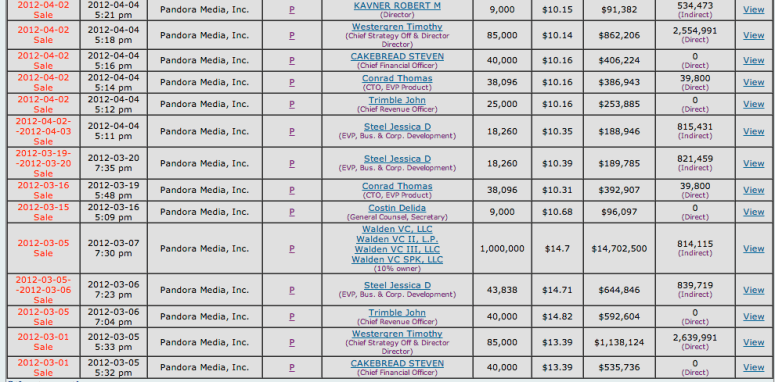
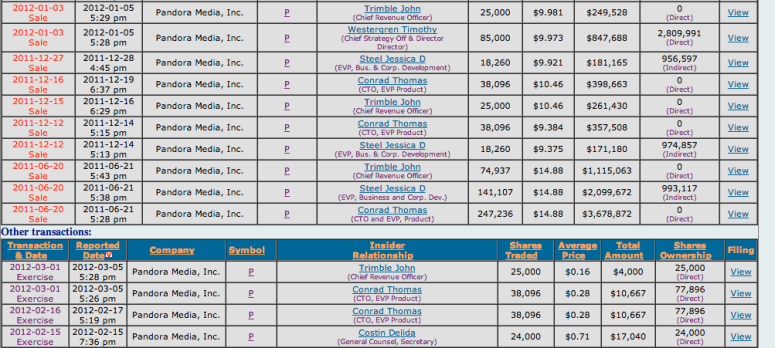
#2 The IPO Problem.

First consider this.  Did Pandora mislead investors in the months leading up to its successful IPO in June 2011?   I mean they convinced investors that they had a sound business model, that they would be profitable, and this must have included paying the rates to artists that they had agreed upon in 2009 that would be in effect until 2015.

Did Pandora tell prospective nvestors that Pandora would need to renegotiate the rates they agreed to pay to artists in order to become sufficiently profitable to justify their IPO share price?   Did they tell investors that after their IPO they wanted to go to Congress and lobby to pass a law to make their business sufficiently profitable to justify their share price?

No.

And I can’t imagine that they only just discovered that they wanted to change this rate.  I bet they’ve been planning this for a long time. I mean you don’t just cook up a bill for Congress overnight.   So  all we need is ONE former employee or associate of Pandora that knows of any talk before the IPO of planning to change this rate after the IPO  and Pandora is Toast. (email us!)

Look at their chart:

With mostly institutional investors,  I bet there is someone out there with resources  that feels like they got burned on their Pandora stock.   Shareholder problems?

OR perhaps Pandora didn’t mislead investors leading up to the IPO.  Which is most likely how they will respond.  If that is the case consider the following:

Pandora is perfectly capable of becoming profitable with the current artists royalty rates.

This means Pandora is just plain old greedy.  Greedy and just like every other corporation in the 1% because they are using their lobbying power to ask Congress to change the law to lower the agreed-upon royalty rates simply benefit their bottom line.   And all of this at the expense of musicians over whom they have absolute power.  And you know what they say about absolute power.

Screw you too, Pandora.

Four Simple Reasons Why the Pandora Radio Act Screws Musicians (EZ Reader)

The intentionally misnamed “Internet Radio Fairness Act” (IFRA) should actually be called the “Pandora Greed Screwing Musicians Bail Out Act” and here’s four simple reasons that everyone can understand why the rate setting in this bill, is in fact UnFair.

1) Pandora negotiated their royalty rate based on functionality.  Other formats of digital radio have different functionality, so they pay different rates.  If Pandora wants to pay a rate like another format of digital radio, then Pandora should function like that format.  They don’t. That’s why Pandora’s rates were fairly negotiated after carefully determining how Pandora actually functions.  As Westergren said in 2009–“The royalty crisis is over!”  Until it’s not, apparently.

2) Other online content services that are dependent upon music for their primary source of revenue such as Spotify and Itunes distribute 70% of their gross keeping a 30% margin for all operating costs. Pandora is complaining about paying only 50% of gross revenues and Tim Westergren wants to pay even less so that he can show Wall Street analysts that Pandora can make more profit.   Not to mention propping up the price of his own Pandora stock for a little bit longer (that he’s selling for about $1 million a month.)

3) It seems strange that Pandora could sell investors on the profitability of its business model during it’s IPO but now seems to think that model doesn’t work. Is this incompetence, or a deliberately dishonest and greedy transfer of wealth in a Wall Street Style bail out by asking Congress to change the law and move the goal posts? A two year old could figure out this is UnFair. Did Pandora think they could make a go of their business at the current rates during the IPO when they cashed out, or have they abandoned that idea now?

4) Pandora uses recordings on a government-mandated compulsory license which means artists have no ability to remove their music from Pandora even if they feel the rates are unfair. (This is like the compulsory license and statutory rate for songs–aka, “prison”.)  Again, both Spotify and Itunes allow artists to remove their music from those services if they so chose. Pandora will force artists into a deal they can not opt out of, this is UnFair.
You May Also Like More Info about PANDORA:

Screw You Too, Pandora. Part I. Pandora The Union Buster! Jail time for Collective Bargaining?

Tim Westergren’s Sophomore Slump. New Bill Sucks, Old Radio Fairness Bill Was Way Better.

Screw You Too, Pandora. Part I. Pandora The Union Buster! Jail time for Collective Bargaining?

As you may or may not know Pandora is trying to push a bill through Congress that would slash payments to artists by as much as 85%.   By “pushing through Congress” we  actually mean paying-oops er we mean being a “top contributor” to Rep. Chaffetz according to Open Secrets, and then Chaffetz magically sponsors the IRFA bill which will pretty much just benefit Pandora.    Pandora pays hundreds of thousands of dollars to lobbyists including a former legislative director of a leading member of the House Judiciary Committee (a lobbyist who also was a board member of the union busting Net Coalition as well as the Digital Media Association according to the lobbyist’s “revolving door” profile on Open Secrets).  It will let Pandora get around agreements it made with artists unions and copyright holders. This is like Delta Airlines going to Congress and asking them to pass a law to force  their pilots and flight attendants into accepting an 85% pay cut.  We don’t do this in this country.  Screw these guys.

So every day this week we are gonna highlight something that we particularly offensive about Pandora and this bill.

Tell Congress: Don’t Slash Music Creators’ Pay

http://musicfirst-coalition.rallycongress.com/7986/tell-congress-dont-slash-music-creators-pay/

#1.  Egad Smithers! Release the Pinkertons!

Liberals and progressives are constantly derided by conservative commentators as being out of touch with common people and constantly siding with the elites.  This is best exemplified by the “latte sipping liberals” slur.  Normally I find this to be an unfair characterization.  Normally, but not always. When it comes to anything involving copyright, technology and the web.  Then it’s totally accurate.

For instance  on  Social Media I keep seeing naive “progressive” friends passing around the Pandora sponsored “Internet Radio Fairness Act” hashtag.  Clearly they haven’t read the bill.  Cause it’s anything but “progressive”.

Forget for a moment that  it’s the ultimate in crony capitalism: A Congressional bill  basically designed to  increase the profit of one company!

Forget for a moment that  founder  Tim “I’m also a Musician” Westergren  is gonna “help” artists by paying artists 85% less than he’s paying them now.

Forget the fact that Pandora was fine with these rates when it was selling its IPO on its roadshow!

Forget all that.  For now just focus on one thing.  This bill is an anti-collective bargaining bill! A union busting bill for artists.   Now why exactly are you folks–who were the ones who were recently sending money to Wisconsin to recall Scott Walker–now against the workers and for bosses?  Why exactly are you folks for the Congress passing a bill that would strip musicians right of those same collective bargaining rights and for the bosses being authorized to threaten criminal prosecutions for speaking out (for “impeding” direct licensing)!  Talk about a “chilling effect”!

I quote directly from the “Internet Fairness Radio Act”

(B) by adding at the end the following: `Nothing in this paragraph shall be construed to permit any copyright owners of sound recordings acting jointly, or any common agent or collective representing such copyright owners, to take any action that would prohibit, interfere with, or impede direct licensing by copyright owners of sound recordings [including artists who own their own sound recordings] in competition with licensing by any common agent or collective, and any such action that affects interstate commerce shall be deemed a contract, combination or conspiracy in restraint of trade in violation of section 1 of the Sherman Act (15 U.S.C. 1).’.  [For which there are both civil and criminal penalties.]

The Sherman Act?  I mean my draw dropped when I saw this.   I’m no lawyer but are we really talking prosecution here for collective bargaining? Is it 1894?*

I was gonna say this is a play out of the Google Anti-Union playbook (see google books lawsuit, the Net Coalition’s “union thugs” memo) but it’s more like a play out of the 19th century robber barron playbook.  What’s next is Pandora gonna send in the Pinkertons?

++++++++++++++++++++++++++++++++++++++++++++++++++

*Ironically the Sherman act was intended to be used against corporate monopolies but its first use was in 1894 when it was misused in an attempt  try to break up the American Railway Union.

Also we applaud Tim Westergren and Pandora for their amazing historical re-enactment of the 1890’s.  What amazing attention to detail!!  We just hope that when they show up for the Congressional hearing they dress the part.   Top hat and Monocle?

Tim Westergren’s Sophomore Slump. New Bill Sucks, Old Radio Fairness Bill Was Way Better.

As you may or may not know Pandora is trying to push a bill through congress that would slash payments to artists by as much as 85%.   By “pushing through congress” we  actually mean paying-oops er we mean being a “top contributor” to Rep. Chaffetz according to Open Secrets, and then Chaffetz magically sponsors the IRFA bill which will pretty much just benefit Pandora.    Pandora pays hundreds of thousands of dollars to lobbyists including a former legislative director of a leading member of the House Judiciary Committee.  It will let Pandora get around agreements it made with artists unions and copyright holders. This is like Delta Airlines going to congress and asking them to pass a law to force  their pilots and flight attendants into accepting an 85% pay cut.  We don’t do this in this country.  Screw these guys.

So every day this week we are gonna highlight something that we find particularly offensive about Pandora and this bill.

Tim’s Sophomore Slump.  New Bill Sucks Old Bill Was Better.

We just found this old blog post from Tim Westergren founder of Pandora.

http://blog.pandora.com/pandora/archives/2009/07/important-updat-1.html

July 7, 2009

Important update on royalties

For more than two years now I have been eagerly anticipating the day when I could finally write these words: the royalty crisis is over!

Webcasters, artists, and record labels have reached a resolution to the calamitous Internet radio royalty ruling of 2007. Pandora is finally on safe ground with a long-term agreement for survivable royalty rates. This ensures that Pandora will continue streaming music for many years to come!

Not only that in this post Tim reveals that he is supporting HR848 the Radio Fairness Act, which would have closed the loophole that exempts terrestrial radio from performance royalties.  See it would make all forms of radio pay royalties to performers.

The system as it stands today remains fundamentally unfair both to Internet radio services like Pandora, which pay higher royalties than other forms of radio, and to musical artists, who receive no compensation at all when their music is played on AM/FM radio. We, along with the artists whose music we play, strongly support the establishment of a level playing field, a truly fair system, as articulated in a new bill called the Performance Rights Act (H.R. 848).

But now Tim has sold out. Now he’s saying the opposite.  He’s going for the cash and mainstream radio airplay.  Or something like that.  Now his new bill the Internet Radio Fairness Act would fire the Copyright Royalty Judges and replace them with a Kangaroo Court.   Now Sophomore Slump Tim wants to slash artist’s royalties.   As Tim is a musician there is really only one reasonable response:  Sell Out!

If Pandora wants Terrestial Radio Royalty Rates, Act Like It – Problem Solved!

We have no problem with Pandora getting parity with terrestrial radio royalty rates, just disable all of the user interactivity and function exactly like Terrestrial Radio to get exactly the same rates. Isn’t this just obvious?

Simple. Done.

Fair.

In truth, Terrestrial Radio in just about every country outside the USA pays performance royalties to artists and rights holders. So yes, there also should be parity, and Terrestrial Radio in the USA should be paying artists performance royalties as well. The selective reasoning of those who seek to exploit artists seems to know no bounds in it’s lack of consistency or logic.

Stay tuned for more…

Tell Congress: Don’t Slash Music Creators’ Pay

http://musicfirst-coalition.rallycongress.com/7986/tell-congress-dont-slash-music-creators-pay/

Remembering Steve Jobs

This week marked the one year anniversary of the passing of Steve Jobs. He was by most accounts a complex man of many contradictions. One thing was clear about him however, he loved music and respected artists. It was this genuine appreciation for the arts that is said to have driven his sense of design, look, feel and performance of Apple products. With the iPod and iTunes Steve and Apple made the most significant change to the record business probably since the introduction of the 12″ long play album.

It’s easy to slip into revisionist history about the iPod, but the truth is that the product launch was delayed pending the verdict in the Digital River Mp3 player trial. Only after it was clear that the iPod was not violating any rights did the product launch. Apple very well could have also achieved market dominance of the iPod without introducing a legally paid music store, but Steve recognized an opportunity that would be mutually beneficial to both Apple and artists alike.

Although controversial when it launched in 2003 (for ala carte song downloads), the Itunes Store is still the most successful online music start-up ever. Most important in recognition of that fact is acknowledging Itunes is a model that takes into account and benefits all stakeholders fairly. The prevailing wisdom of the internet and tech community was then (and sadly remains largely so today) to be one of greed and exploitation of both artists and rights holders.

It is precisely this intention and respect that makes the iTunes store great. When Steve rolled out iTunes for indie labels he said, “Things for you are going to get worse, they are not going to get better. Payment is optional, this will help you compete against illegally free by providing a better user experience, at a reasonable price.” He was right on all counts.

Thanks Steve, if only more people in the internet and technology community had as much respect for the arts and artists as you did we’d all probably be a lot better off. We miss you, sail on.